The tension that had filled the Iron Summit Dojo moments earlier now hung like a living thing, thick and electric, beneath the bright overhead lights. Snow-capped peaks of the Rocky Mountains loomed visible through the tall windows, their ancient silence contrasting sharply with the charged atmosphere inside. Marcus Brooks, still breathing heavily from his unexpected fall, rose slowly to his full six-foot-four height. Sweat glistened on his powerful shoulders, but the fire in his eyes had shifted from arrogance to a raw, unsettled curiosity.
Thomas Hale stood unmoved, his faded brown jacket now back on his shoulders, the fabric worn soft from countless mornings like this. At sixty-two, his silver-gray hair was neatly combed, and the deep crow’s feet around his piercing blue eyes spoke of long summers working as a master carpenter on timber-frame homes in the foothills, and quiet winters tracking elk in the high country. His loose gray training pants and plain white T-shirt carried the faint scent of pine resin and coffee.
“Again,” Marcus said, his voice lower now, stripped of theatrical flair. “Please.”
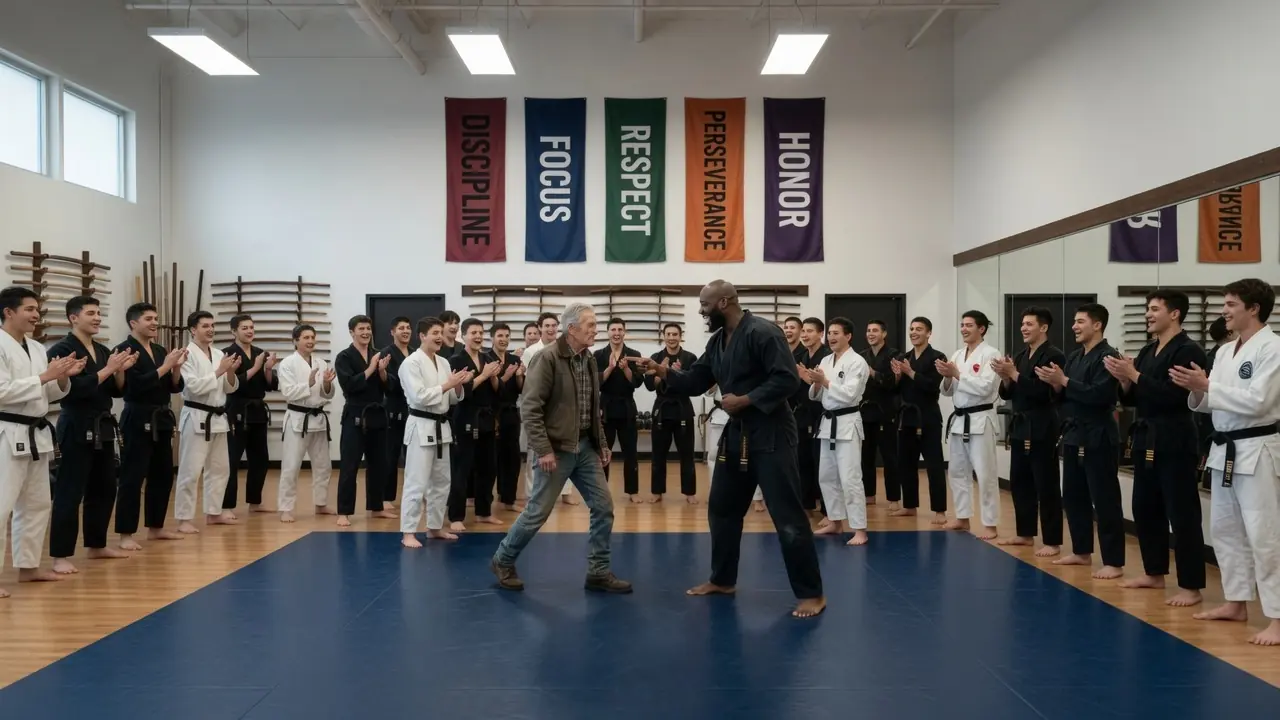
Thomas studied him for a long moment, then nodded once. What followed was not another quick demonstration but a masterclass that stretched well into the late afternoon. The other students, parents, and even Master Robert Kim formed a wide circle around the central mat. Thomas began slowly, explaining concepts with the patience of a man who had raised two daughters and buried a wife after a long battle with illness.
“Power is easy to generate when you’re young and strong,” Thomas said, his voice carrying clearly without effort. “But power without direction is like a mountain river in flood—destructive and wasteful. True skill is the riverbed that guides it.”
He had Marcus attack again, this time at three-quarter speed. As the younger man launched a powerful roundhouse kick, Thomas stepped not away but slightly inside the arc, his lead hand guiding Marcus’s leg with the gentlest touch on the knee. The momentum carried Marcus spinning past him. Before the champion could reset, Thomas was already behind him, one palm resting lightly on his back—not pushing, simply present. Marcus stumbled forward again, catching himself on the edge of the mat.
The room remained silent except for the soft pad of bare feet.
Over the next two hours, Thomas unpacked layers of knowledge. He demonstrated how breath control could change reaction time, how peripheral vision allowed one to read an opponent’s entire body rather than just the striking limb. He shared a new detail from his past: in his forties, after recovering from a near-fatal construction accident where a falling beam crushed his left shoulder, he had spent three years studying with an elderly Japanese immigrant named Mr. Sato in a tiny basement dojo in Los Angeles. Sato had survived the internment camps during World War II and taught Thomas the concept of *mushin*—no-mind—through hours of silent sitting meditation followed by fluid partner drills.
“Mr. Sato never raised his voice,” Thomas recalled. “He simply moved, and you learned or you didn’t.”
Marcus absorbed every word. The cocky undefeated champion, who had dominated regional tournaments for four years with his explosive boxing-karate hybrid style, now asked questions like a beginner. “How do you see the intention before it forms?”
Thomas smiled gently. “By emptying yourself of your own intentions first. When you stop planning your counter, you can truly listen to your opponent’s body.”
Word of the session spread rapidly through Denver’s martial arts community. By the following weekend, visitors from other dojos appeared—some curious, some skeptical. Among them was a tall, stern instructor named Elena Vargas from a rival kickboxing gym across town. She had heard rumors and came to test the old man herself. Elena, a former professional fighter in her mid-forties with a reputation for brutal leg kicks, approached Thomas after the main class.
“You don’t look like much,” she said bluntly, arms crossed.
Thomas chuckled. “I’ve heard that before.”
Their exchange became another highlight. Elena attacked with crisp, professional technique. Thomas flowed around her kicks like mist around boulders, occasionally tapping her shoulder or hip to show openings she had never noticed in her decade-long career. After ten minutes, Elena stepped back, breathing hard, and bowed deeply. “I’ve been training wrong for years,” she admitted publicly. The moment marked the beginning of a respectful alliance between the two schools.
As winter deepened and snow piled against the dojo walls, Thomas’s presence became a weekly anchor. He began sharing more personal stories during informal talks by the wooden weapons rack. He spoke of losing his wife, Maria, to cancer six years earlier—how caring for her in their small cabin outside Golden had taught him the deepest form of strength: showing up every day even when hope seemed gone. He described building their home by hand, using techniques that mirrored his martial philosophy: joinery that flexed with the seasons rather than rigid nails that eventually failed.
Marcus’s transformation accelerated. He lost his next local tournament deliberately—not through poor performance, but by choosing not to compete in the finals after noticing his opponent had injured his ankle in an earlier match. “It didn’t feel right to take advantage,” he explained to Thomas afterward. The decision cost him ranking points but earned him something far more valuable: the respect of the entire Colorado martial arts scene.
Spring arrived with melting snow and longer days. Thomas introduced new elements to the training—outdoor sessions in the foothills where students practiced forms on uneven ground, learning to adapt to real-world conditions. During one such session near a rushing creek, he revealed another layer of his background: as a young man in the late 1970s, he had traveled through Southeast Asia, training briefly in Thailand and the Philippines, blending what he learned with his American roots. “I never sought belts or titles,” he said while demonstrating a flowing stick defense using a fallen branch. “I sought understanding.”
One particularly poignant afternoon, Marcus brought his younger brother, Jamal, a talented but hot-headed fourteen-year-old who was struggling with anger issues after their parents’ divorce. Thomas spent hours working privately with the boy, using metaphors of mountain storms and patient pines. By summer, Jamal had become one of the most improved students in the children’s program.
The dojo itself evolved. Master Kim expanded the schedule to include a monthly “Wisdom Circle” led by Thomas. These gatherings mixed light training with deep discussions on topics ranging from resilience to ethical combat. Parents reported better behavior at home. Students carried the lessons into school and work. Even the advanced black belts, who once smirked at the “old guy,” now sought Thomas’s corrections with genuine humility.
By the time the leaves turned gold again, a full year had passed since that fateful Saturday. Marcus, now a more complete fighter and a respected instructor in his own right, organized a special celebration. The dojo was decorated with simple mountain wildflowers and photographs of past training sessions. Thomas arrived as always—unassuming, carrying his thermos—but this time the entire community rose to greet him with a unified bow.
That evening, as the Rocky Mountains stood sentinel under a star-filled sky, Thomas offered his deepest lesson yet. “I am not special,” he told the gathered crowd. “I am simply old enough to have failed enough times that I stopped pretending. Every one of you has that same potential. The mountains don’t rush to reach the sky. They rise steadily, layer by layer, through countless seasons. Be like the mountains.”
The legend of Thomas Hale continued to grow quietly, not through self-promotion but through the transformed lives of those he touched. New students arrived each season, drawn by whispers of the unassuming master who taught that real power often wore faded jackets and spoke in soft voices. In the bustling heart of Denver, where dreams met discipline on polished hardwood floors, the Iron Summit Dojo had become more than a training hall. It had become a living testament to the timeless truth that wisdom, patience, and quiet mastery could humble even the mightiest champions—and in doing so, elevate everyone around them.
The mountains watched, eternal and approving, as another generation learned to move not with noise, but with harmony. And somewhere in the back, near the old weapons rack, an empty chair waited for the next unassuming soul ready to begin their own quiet journey.