Fletcher Owens had spent his entire life learning how to stay calm when other people expected him to break. He had stayed calm in boardrooms where men twice his age tried to talk over him. He had stayed calm during hostile acquisitions, shareholder fights, and interviews where reporters asked him questions they would never ask anyone else. Calm had become more than a habit. It had become a shield.
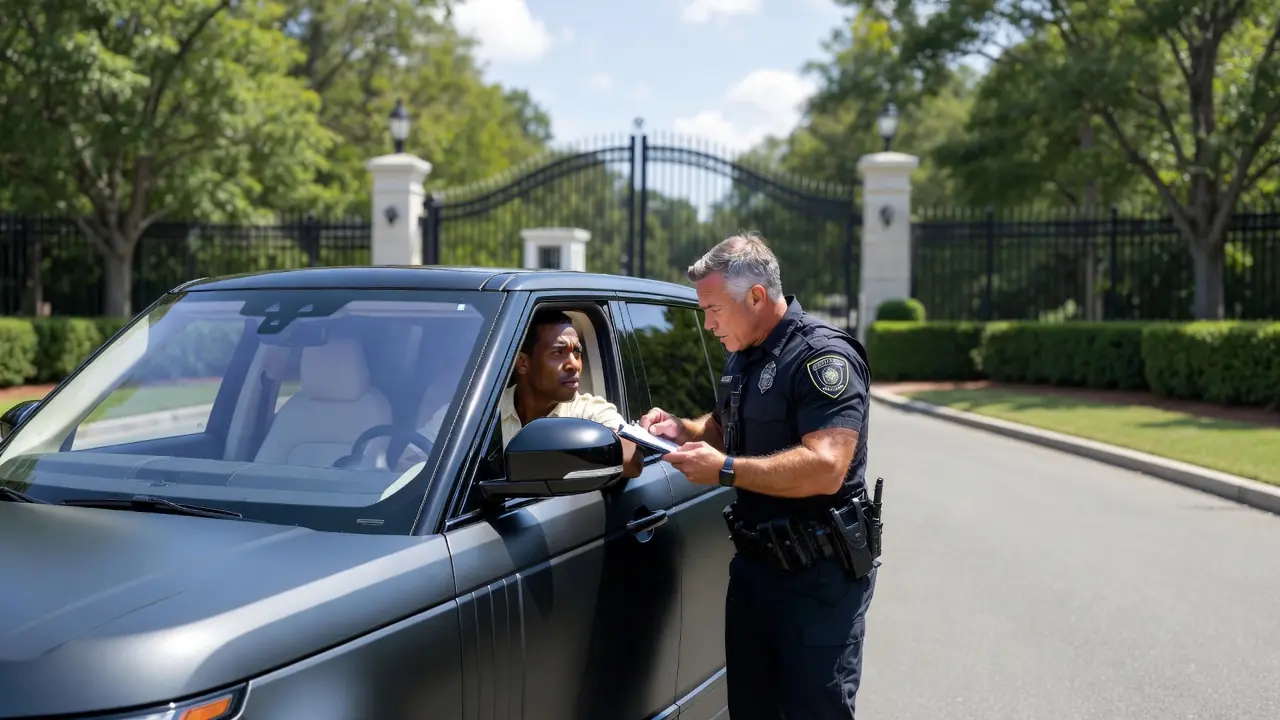
But on that bright Saturday morning in late September, sitting behind the wheel of his matte black Range Rover at the front gate of Greystone Estates, Fletcher felt something colder than anger move through him. The black iron gate stood shut in front of him, tall and polished, with limestone pillars on both sides and a brass sign that read Greystone Estates. Beyond the bars, his own mansion sat at the end of a private cul-de-sac, large enough to be seen through the trees. It was his house, bought in cash eighteen months earlier, yet the guard in front of him was looking at him like he had crawled out of a place he had no right to leave.
Craig Sutton stood beside Fletcher’s driver’s window with a clipboard tucked under one thick arm. He was fifty-two, white, broad through the shoulders, with a hard square jaw, a gray crew cut, sun-reddened skin, and pale eyes that did not bother hiding suspicion. His dark Sentinel Shield uniform was pressed sharp, his black boots were planted wide, and one hand rested on the top edge of Fletcher’s car door. It was not enough pressure to damage anything, but it was enough to say stay where you are. Fletcher noticed that kind of thing.
“Good morning,” Fletcher had said when he first arrived. “Fletcher Owens. I live at 1 Greystone Lane.” Craig had not answered right away. He had looked through the open window, past Fletcher’s face, past his hands, past the clean interior of the Range Rover, as if searching for proof of a lie. Then he asked for identification in a voice that sounded less like a question and more like a warning. Fletcher handed over his license without complaint.
Craig held the license between two fingers like it was something unpleasant. He studied it in the sunlight, then studied Fletcher, then tilted the card as if expecting the name to rearrange itself into something more convenient. He walked back to the guard booth and left Fletcher sitting there with the engine idling. The gate remained closed. The morning air smelled of cut grass, magnolia blossoms, and warm asphalt.
Fletcher kept both hands visible near the steering wheel. He had learned early what visibility meant. His mother had taught him that lesson before he was old enough to fully understand it. Keep your hands where people can see them. Speak clearly. Do not give anyone an excuse. He had spent decades building a company worth billions, and still, at his own front gate, the old rules applied.
Craig returned slowly, taking his time. Behind him, a second guard watched from near the booth, half hidden by the angle of the wall. Craig did not hand the license back immediately. He held it low and loose, smirking as if Fletcher had already been caught in some foolish performance. “This address doesn’t match anything in our system,” Craig said.
“It should,” Fletcher replied. “I’ve lived here for eighteen months.” Craig tapped the clipboard with two fingers, slowly and deliberately, like a teacher scolding a child. “I know every resident in this community,” he said. “Every car, every face, every family. And I can tell you right now, you’re not on my list.” Fletcher looked at the gate, then back at Craig. “Then your list is wrong.”
Craig’s mouth twisted slightly. It was not quite a smile. It was the kind of expression a man makes when he thinks he is being patient with someone beneath him. “People don’t just roll up here looking like you and claim the biggest house behind these gates,” he said. Fletcher’s eyes did not move. The insult was careful enough to avoid saying the quiet part plainly, but the meaning stood there between them like a third person.
“That house behind your gate is mine,” Fletcher said. His voice remained calm. Craig leaned closer, his hand still on the door frame. “You’ll stay right there until someone decides where you actually belong.” Fletcher looked at the hand on his car. “Take your hand off my car.”
Craig did not move it. Instead, he laughed under his breath and turned the clipboard away when Fletcher glanced at it. The gesture was small, petty, and deliberate. Fletcher knew then that this was not confusion. This was performance. Craig wanted him to feel watched, blocked, and corrected.
Three weeks earlier, Greystone Estates had hired Sentinel Shield Services to replace the old security company. The residents had been told the new team would provide stronger control at the entrance. Fletcher had been overseas in London closing an acquisition, so the guards had not seen him in person. But the HOA had his file, his photograph, his vehicle information, and his plate number. His assistant had even emailed ahead to confirm his return.
None of that mattered to Craig. Or perhaps it mattered less than the picture he had already formed in his own mind. Fletcher Owens, founder and CEO of Pinnacle Dynamics, had built a fourteen-billion-dollar technology empire from nothing. He had appeared on magazine covers, negotiated with world leaders, and bought the largest property in Greystone Estates without financing. Yet Craig Sutton looked at his cream linen shirt, gray joggers, white sneakers, and deep brown skin, and decided he did not belong.
A silver BMW rolled up behind Fletcher’s Range Rover. Craig turned and saw the white couple inside. Instantly, his body changed. The stiff shoulders relaxed, the hard mouth softened, and the suspicious eyes warmed into recognition. He stepped away from Fletcher’s window and smiled broadly. “Morning, folks,” he called. “Beautiful day, isn’t it?”
He did not ask for identification. He did not check a list. He did not study their faces or hold their license up to the sun. He simply walked into the booth and pressed the button. The gate slid open with a smooth electric hum, and the BMW rolled through without stopping. Then the gate closed again in front of Fletcher.
Fletcher watched every second in the mirror. The wave, the smile, the open gate, the effortless welcome. When Craig returned, Fletcher said quietly, “You just let them through.” Craig shrugged. “They’re residents. I recognize them.” Fletcher sat with that sentence for a moment. Recognition had become the only passport that mattered, and Craig had decided Fletcher would never receive it.
Craig leaned down again, closer than before. His forearm hovered near the window frame, crowding the space without fully entering it. “Listen,” he said, lowering his voice. “These people pay a lot of money to live somewhere safe. My job is to make sure the wrong kind of situation doesn’t get through that gate.” Fletcher looked at him steadily. Craig continued, “So help yourself and don’t make this harder than it has to be.”
Fletcher reached for his phone. Craig smirked. “Go ahead. Call whoever you want.” Fletcher did not answer him. He dialed his wife, Brenda. She picked up on the first ring, and he told her, calmly, that the new guards would not let him in. For two seconds, Brenda said nothing.
Then her voice came through low and sharp. “What do you mean they won’t let you in?” Fletcher explained. License rejected. Deed ignored. Gate closed. Craig blocking the car. Brenda did not ask for more. “I’m coming down there now,” she said, and hung up.
Before Brenda arrived, a white Mercedes turned the corner and stopped behind Fletcher’s Range Rover. Craig’s face changed again. He straightened, stepped away from Fletcher, and moved toward the Mercedes with open respect. Behind the wheel sat Victoria Ashford, the HOA president of Greystone Estates. She was sixty, white, polished, and exact, with silver hair pinned neatly, pearl earrings, a cream blazer, and the kind of smile that looked expensive and empty.
Craig explained the situation as if Fletcher were not there. “Mrs. Ashford, this gentleman claims he lives at 1 Greystone Lane, but he isn’t showing up in the system.” Victoria lowered her window and looked directly at Fletcher. Their eyes met. Fletcher knew she recognized him. She had signed the welcome letter when he and Brenda moved in. She had stood on his porch, admired Brenda’s hydrangeas, and personally approved the resident list sent to Sentinel Shield.
Victoria held his gaze for one long second. Then she turned back to Craig. “Well, if he’s not in the system, then you’re doing the right thing.” Fletcher felt the moment settle into place. It was not ignorance. It was choice.
Victoria looked back at him with a porcelain smile. “If there has been some kind of mix-up, the service entrance is around the south wall.” Fletcher’s face did not change, but his eyes hardened. “Mrs. Ashford,” he said, “you know exactly who I am.” Her smile twitched. Only for a fraction of a second. Then it returned.
“I’m sorry,” she said. “I don’t believe we’ve met.” She rolled up her window before he could answer. Craig opened the side lane for her Mercedes. She drove through. The gate closed behind her, leaving Fletcher outside again.
Brenda arrived three minutes later on foot from inside the estate. She walked fast, wearing simple clothes, sneakers hitting the pavement hard, her expression sharp enough to cut through the morning. Fletcher watched her through the windshield and felt both gratitude and dread. Brenda Owens had once been a civil rights attorney, and she had not lost one ounce of that fire. She stopped in front of Craig and looked him directly in the eye.
“My name is Brenda Owens,” she said. “I live at 1 Greystone Lane. That man in the car is my husband. Open the gate.” Craig looked from her to Fletcher, then back again. For the first time, uncertainty crossed his face. But Victoria had parked just inside the gate and now stood nearby watching, arms folded, offering him silent permission. Craig recovered quickly.
“Ma’am, we have procedures,” he said. “We can’t open the gate just because someone says they live here.” Brenda pulled out her resident ID badge and held it up. Craig took it, flipped it over, and held it to the light. “This could be expired,” he said. Brenda pointed at the printed date. “It isn’t.”
Victoria stepped forward, her voice smooth and controlled. “Let’s not make a scene.” Brenda turned on her. “You know my husband,” she said. “You sent us a welcome basket. You stood on our porch. You know exactly who he is.” Victoria’s fingers tightened on her handbag strap. “I send many baskets,” she said. “I can’t be expected to remember every face.”
Every face. Brenda heard it. Fletcher heard it. Craig heard it and took strength from it. He stepped back toward Fletcher’s car. “All right,” he said. “I have reasonable concern about this vehicle. I’m going to need you to step out so I can conduct a quick inspection.” Fletcher’s hands stayed near the steering wheel. “You have no authority to search my vehicle.”
Craig leaned close and gripped the window frame. “On this property, I have all the authority I need.” Brenda pulled out her phone and hit record. The red dot appeared. Craig noticed instantly. His jaw tightened. “Put that phone away,” he said. Brenda did not move it an inch.
Twelve minutes later, a Charlotte-Mecklenburg police cruiser arrived. The officer stepped out calmly, listened to Craig, listened to Victoria, and then approached Fletcher’s window. Fletcher handed over his license and registration without a word. The officer ran them. Everything came back clean. No warrants, no flags, no issue. Still, the officer asked Fletcher to wait while they sorted it out.
Wait. At his own gate. In front of his own house. While strangers debated whether he had the right to go home. Fletcher had already been sitting there for more than thirty minutes. The humiliation had become precise now, layered and documented. Craig’s smirks. Victoria’s silence. Brenda’s recording. The officer’s hesitation.
Forty-five minutes after arriving, Fletcher picked up his phone again. This time, he did not call Brenda, the HOA, or the police. He called Terrence Baldwin, his personal attorney and one of the most feared civil litigators in Charlotte. Terrence answered on the second ring. Fletcher spoke calmly. “I’m sitting at my own gate. Security won’t let me in. They rejected my license, refused my deed, called the police, and Victoria Ashford is standing here pretending she doesn’t know me.”
There was silence on the line. “Say that last part again,” Terrence said. Fletcher repeated it. This time, Terrence’s voice changed. It became operational. “Do not say another word to anyone. Do not leave. I’m making three calls right now.”
The line went dead. Fletcher placed the phone in his lap and returned both hands to the steering wheel. Craig stood near the guard booth, talking to the second guard and pretending to laugh. Victoria scrolled on her phone with forced composure. None of them noticed the air change.
Eight minutes later, Craig’s radio crackled. He lifted it casually. The voice that came through belonged to the CEO of Sentinel Shield Services. It was loud enough for Brenda’s phone to catch. “Open that gate immediately,” the voice ordered. Craig’s face drained. He tried to explain that he had followed protocol, but the voice cut him off. “You are suspended effective immediately. Do not speak to Mr. Owens. Wait at the booth until your replacement arrives.”
Craig’s mouth opened, closed, then opened again. No words came out. The second guard hurried to the gate mechanism and pressed the release. The iron bars began sliding open. At the same moment, Victoria’s phone buzzed. She looked at the screen, and for the first time that morning, fear broke through the polish.
Fletcher put the Range Rover in drive. He rolled through the gate slowly, without looking at Craig, without looking at Victoria, without looking at anyone. The officer stepped toward the window and apologized. Fletcher nodded once. “You responded to a call that should never have been made,” he said. “Your body camera recorded everything. That is all I’ll say.”
He drove to his mansion, parked in the circular driveway, and stepped out. The limestone columns rose behind him in the sunlight. The house was visible from the gate, undeniable and enormous. Fletcher walked inside and did not look back. Brenda followed a few minutes later, still holding the phone that had captured everything.
The consequences began before sunset. Sentinel Shield terminated Craig Sutton and the second guard that same day. A formal apology arrived by courier, signed personally by the company’s CEO. Fletcher read it at the kitchen table and set it aside. Brenda folded it carefully and placed it in a file. She knew evidence when she saw it.
The HOA board met the next evening at the Greystone Estates clubhouse. They watched the gate security footage first: Fletcher’s arrival, Craig’s posture, the BMW waved through, the blocked Range Rover, Victoria arriving and choosing silence. Then they watched Brenda’s recording with sound. Victoria’s voice filled the room. “I can’t be expected to remember every face.” No one spoke after that for several seconds.
The board chair placed documents on the table. Victoria’s signed welcome letter. Victoria’s approved resident list. Fletcher’s photo on page two. His vehicle information included. Her signature on the cover page. Victoria tried to say the situation had been confusing, but the words had nowhere to stand. She was removed as HOA president by vote that night.
Then the story reached the news. Brenda contacted an investigative reporter she knew from her nonprofit work, and the video aired under the headline of a Black CEO denied entry to his own multimillion-dollar home. The six-second clip that spread everywhere was simple. Fletcher saying, “Mrs. Ashford, you know exactly who I am.” Victoria answering, “I’m sorry. I don’t believe we’ve met.” Six seconds became enough.
The lawsuit followed. It named Sentinel Shield Services, Craig Sutton, Victoria Ashford, and the Greystone Estates HOA. The claims included racial discrimination, unlawful detention, and violation of housing rights. Discovery revealed what the gate had already shown. Craig had received the resident list but never opened the attachment. Worse, he had texted about the mansion days earlier, suggesting the owner must be some performer or athlete and warning another guard to watch for him.
Victoria’s emails were even more damaging. In one, she had written that the neighborhood was changing. In another, she wrote that she had not moved there for “this.” When asked on the stand whether she recognized Fletcher at the gate, Victoria tried to avoid the answer. The courtroom went silent. Finally, barely above a whisper, she said, “Yes.”
The jury did not need long. Sentinel Shield was ordered to pay millions in damages. Craig Sutton was ordered to pay personally and was barred from private security work in North Carolina. Victoria Ashford was held personally liable for her role. The HOA was ordered to implement independent oversight and mandatory anti-discrimination training.
Fletcher did not keep the settlement money. Every dollar went to Brenda’s nonprofit, the organization she had built to fight wrongful convictions. He said the money was never the point. Dignity was the point. Accountability was the point. Making sure the next gate did not stay closed was the point.
Fletcher remained at 1 Greystone Lane. He continued running Pinnacle Dynamics, and the company’s reputation only grew stronger. Investors praised his composure. Civic leaders invited him to speak about discrimination in private residential communities. Months later, his testimony helped advance new state protections for homeowners in gated neighborhoods. People began calling it the Owens Housing Equity Act.
In Fletcher’s home office, behind his desk, he kept one framed photograph from Brenda’s video. It showed the iron gate closed in the sunlight, its bars bright and polished, its message clear. Beneath the photo, Fletcher wrote one sentence by hand. “They built the gate to keep people out. I bought the house to prove they can’t.”
And whenever someone asked how he stayed so calm that day, Fletcher gave the same answer. He said anger would have given them the story they wanted. Silence gave him the evidence he needed. Then he would look toward the photograph, toward the gate, toward the place where they tried to make him small. And he would say, “I was already home.”