Rain hammered the glass walls of the Aetherius Executive Lounge at Teterboro Airport like the sky had taken offense at New Jersey itself. The evening outside was gray, restless, and loud, with sheets of water cutting across the runway and runway lights glowing through the storm like distant warning signs. Inside the private terminal, the wealthy waited in leather armchairs with crystal glasses, expensive watches, quiet impatience, and the certainty that weather was something that happened to other people. For them, a delay was not danger. It was inconvenience served with champagne.
Damian Sterling sat in the far corner beneath the broad leaves of a potted fiddle-leaf fig, trying to disappear for ten minutes. He was thirty-four, Black, tall, athletic, and exhausted in a way money could not soften. His charcoal hoodie was faded at the cuffs, his sweatpants were plain, and his running shoes were muddy from a morning hike he had taken before the final meeting. He looked less like a billionaire CEO than a man who had missed sleep, skipped food, and stopped caring how rich people expected him to dress.
That was exactly true. Damian had not slept properly in nearly forty-eight hours. He had just finished a secret negotiation in a Newark warehouse to avoid cameras and financial press, and by the time the deal closed, his bones felt hollow. Sterling Dynamics, the back-end infrastructure company he had built from nothing, had acquired Redline Logistics in a merger that would reshape the tech and shipping world. In other words, while the people in the lounge were waiting out the weather, Damian had just completed a deal worth billions.
He did not feel triumphant. He felt empty, wired, and tired. He wanted black coffee, silence, and a flight home on the Gulfstream G700 waiting to pick him up as soon as Captain Omali received clearance. He leaned his head back and closed his eyes, hearing the rain hit the glass and the low murmur of private aviation guests talking as if everyone in the room mattered. Damian knew most of them did not matter nearly as much as they believed. That was usually how money behaved in public.
A waitress named Sarah approached with a small tray, keeping her voice gentle. “Can I get you some water, sir?”
Damian opened one eye. “Please,” he said, his voice rough. “And black coffee if you have it. Strong.”
Sarah smiled, nervous but kind. “You look like you have had a long week.”
“You have no idea,” Damian said, managing a tired smile. “Thanks, Sarah.”
She hurried away, but Damian noticed she glanced toward the concierge desk before moving. That glance mattered. He had spent years reading rooms, not because he enjoyed it, but because rooms often decided what they thought of him before he said a word. He saw hesitation in her shoulders and tension in the way she carried the tray. Somewhere nearby, someone with authority had already decided he was a problem.
Across the lounge, Preston Carmichael stood behind the polished marble concierge desk like a man guarding the gates of a kingdom he did not own. He was forty-five, white, narrow, sharp-featured, and dressed in a fitted dark suit that he seemed to believe made him part of the elite rather than an employee serving them. His tie was silk, his cufflinks were expensive, and his expression held the sour confidence of a man who had mistaken proximity to wealth for wealth itself. Preston did not think of himself as a terminal manager. He thought of himself as a curator of status.
His eyes fixed on Damian in the corner.
“Disgraceful,” Preston muttered.
The receptionist, Greg, looked up from his computer. “Sir?”
“That man in the corner,” Preston said, nodding toward Damian with visible disgust. “How did he get in here?”
Greg squinted. “I think he came through the side VIP door. The sensors let him in. I assumed he was with one of the diverted flights.”
“Assume nothing, Gregory,” Preston snapped softly. “That is how standards collapse. Look at him. Mud on his shoes. A hoodie that looks like it came from a gas station. Sleeping in the corner like this is some public waiting room.”
Greg looked uncomfortable. “Should I call security?”
Preston straightened his cuffs and smiled. “No. I will handle it. The patrons expect me to keep standards high.”
Damian had just begun to drift when a shadow fell over him. It was not Sarah’s careful approach with coffee. It was stiff, blocking, and performative. He opened his eyes and saw Preston Carmichael standing over him with his polished shoes planted too close to Damian’s worn sneakers.
“Wake up,” Preston said loudly.
Damian blinked once. “Excuse me?”
“I said wake up. This is not a motel.”
Several heads turned.
Damian sat up slowly, rubbing his face with one hand. “I am waiting for my flight. Is there a problem?”
“The problem,” Preston said, gesturing at Damian’s clothes with open contempt, “is that you are in a restricted lounge. This area is for private aviation clients and their invited guests only. Not drivers. Not baggage handlers. Not people wandering in from the weather.”
Damian looked at him for a second, deciding how much energy this deserved. He had handled hostile regulators, merger lawyers, aggressive board members, and investors who thought shouting made them intelligent. A lounge manager with a polished tie did not frighten him. But he was tired enough that the insult landed harder than usual.
“I am a client,” Damian said. “My aircraft is on approach. Check the manifest under Sterling Dynamics.”
Preston laughed. It was a dry, ugly sound designed for the audience now watching them. “Sterling Dynamics? In that hoodie?”
Damian’s face stayed calm. “Yes.”
Preston turned slightly toward the guests as if inviting them to enjoy the absurdity with him. “I know the manifest, sir. We have important clients coming through tonight. None of them would be caught dead looking like they slept behind a warehouse.”
A banker near the window chuckled into his drink.
Damian looked toward him and recognized Arthur Finch, a mid-level hedge fund executive whose firm Damian had once considered acquiring just to dismantle it for parts. Arthur smirked as if he had just been invited into a private joke. Damian saved the name. He was excellent at saving names.
“I have had a rough day,” Damian said. “I am asking for ten minutes and a cup of coffee.”
Preston snapped his fingers sharply. “Sarah.”
The waitress froze halfway across the lounge, coffee cup trembling slightly on her tray. “Yes, Mr. Carmichael?”
“Did you serve this man?”
“I was about to.”
“Take it back to the kitchen. We do not serve trespassers.”
Sarah’s face changed, but she obeyed because people with rent to pay often have to obey before they can afford courage. Preston pointed toward the exit, his manicured finger steady and accusing. “And you are leaving. Now.”
Damian did not move. The lounge seemed to hold its breath.
“I am not leaving,” he said. “I pay this terminal a membership fee every year for landing rights and lounge access. If you check your system under Sterling Dynamics, you will see my profile.”
Preston stepped closer. “Do you hear yourself? You think saying rich words makes you rich?”
Damian stood slowly.
At six foot two, he was taller than Preston by several inches. The manager flinched before he could hide it, then recovered by lifting his chin and making his voice louder. “Do not try to intimidate me. I am going to count to three. If you are not walking toward the exit, I will call airport security and have you removed.”
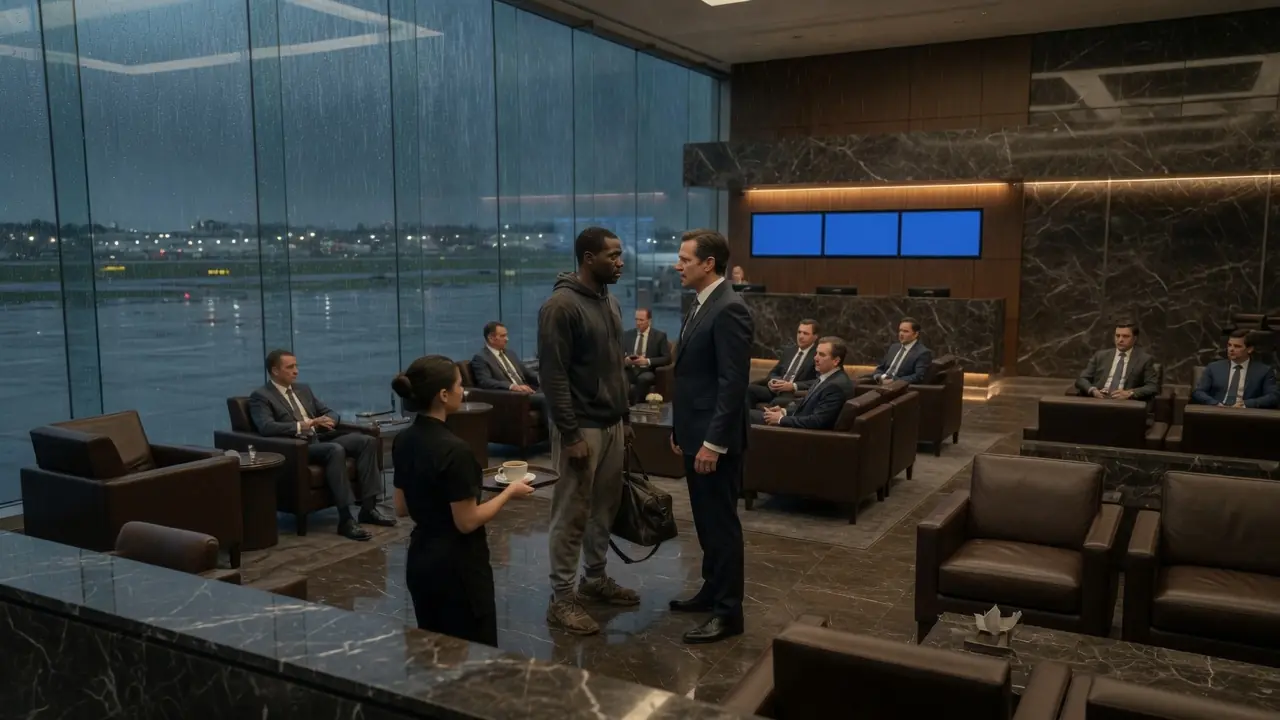
“You are making a mistake,” Damian said.
Preston pointed toward the service corridor. “The only mistake was letting you sit here long enough to stink up the atmosphere. Use the service side. I do not want you walking past the first-class guests.”
That line moved through the room like a stain. Sarah looked down. Greg stared at his keyboard. Arthur Finch laughed again, low and satisfied. Damian looked around the lounge and saw amusement, embarrassment, curiosity, and avoidance. He did not see one person stand.
He picked up his duffel bag.
“Fine,” Damian said quietly. “I will wait outside.”
“Outside the perimeter,” Preston corrected. “The public sidewalk is more appropriate.”
Damian walked past him without lowering his head. As he passed Arthur Finch, the banker leaned slightly toward him and said, “Nice shoes, pal. Charity sale?”
Laughter rippled through the lounge.
Damian did not answer. He stepped through the glass doors, and the rain hit him sideways. The overhang gave some shelter, but not enough. Water soaked through his hoodie and darkened his sweatpants almost instantly. Behind the glass, Preston adjusted his tie and pointed toward Damian outside as if showing the guests a mess he had successfully removed.
Then Damian pulled out his phone.
The screen was wet, but it lit under his thumb. He called Captain Omali.
“Mr. Sterling,” the pilot answered. “We are on final approach. ETA six minutes. Are you in the lounge?”
“No,” Damian said, watching Preston accept a drink from the bar as though he had won something. “I was evicted.”
There was a pause. “Evicted, sir?”
“The terminal manager thinks I am a vagrant.”
Captain Omali’s silence changed temperature. He had flown for Damian for six years, and loyalty in the sky is not decorative. “Would you like me to contact the airport authority?”
“No,” Damian said. A cold smile touched his mouth for the first time that evening. “I want you to make an entrance.”
“Runway one-nine brings us past the main terminal windows.”
“Good. Do not simply land. Let them know we are here. Taxi directly to the lounge glass.”
“Sir, that is irregular.”
“I will pay the fine.”
“Understood.”
“And Omali?”
“Yes, sir?”
“Use the priority code.”
Inside, the lounge returned to its low murmur of exclusivity. Preston felt better now that the blemish had been removed. He walked back toward the concierge desk, shoulders back, soaking in the approval of people whose approval he valued far too much.
Arthur Finch lifted his glass. “Handled beautifully, Carmichael. You never know with people like that.”
“Standards matter,” Preston said. “Let one in, and soon the whole place becomes a public bus terminal.”
Sarah passed with a tray of empty glasses, her face tight.
“What is your problem?” Preston snapped.
“He was not bothering anyone,” she said quietly. “He just looked tired.”
“You are paid to serve drinks, Sarah, not rescue strays. If your heart aches that much, find work at a shelter.”
Before Sarah could answer, the ground radio at the reception desk crackled loudly. “Attention all ground units. Clear taxiway Alpha and Bravo. Priority one heavy arrival. Repeat, clear the tarmac immediately.”
Preston frowned. “Priority one?”
Greg bent over his keyboard. “I do not see a diplomatic arrival.”
The radio crackled again. “Incoming traffic, Gulfstream G700, call sign Kingpin One, requesting direct taxi to Aetherius Terminal, gate one.”
“Gate one?” Preston said. “That is directly in front of the main window.”
Then they heard it.
At first it was a low vibration under the floor, something felt before it was heard. The glasses on the tables trembled. The sound grew into a roar, deep and commanding, cutting through the rain and lounge chatter alike. Guests turned toward the window. Landing lights pierced the storm, bright and cold.
The Gulfstream G700 came out of the rain like a machine from another world. Midnight blue, sleek, massive, and unmistakably private. It did not glide politely into the distance where ground crews could hide it. It turned toward the terminal, nose aimed straight at the floor-to-ceiling glass.
Someone gasped. Arthur Finch stepped back from the window.
Preston froze.
The aircraft rolled closer, engines humming with controlled force, rain sheeting off its body. At the last moment, with perfect precision, it stopped so close to the lounge windows that heat and mist fogged the glass. The entire room fell silent except for the winding engines and the rain.
“My God,” Arthur whispered. “That is a G700.”
Preston found his voice through panic. “Who does this clown think he is?”
He grabbed his walkie-talkie and stormed toward the doors. “Security to gate one. We have a rogue pilot.”
The aircraft door opened, and the automatic stairs unfolded with a smooth hydraulic hiss. A flight attendant in a pristine navy uniform stepped down holding a large black umbrella. She did not walk toward the terminal guests. She stood at the bottom of the stairs and looked toward the curb.
Toward Damian.
Preston followed her gaze and saw the man in the soaked hoodie still standing outside. “You!” he shouted, marching through the rain. “I told you to leave. You are trespassing.”
Damian did not look at him. He began walking toward the jet.
Preston stepped into his path. “Where do you think you are going? You do not walk near an aircraft like that.”
Damian stopped. Rain ran down his face, but his eyes were steady and cold. “Get out of my way, Preston.”
“Or what?” Preston sneered, still clinging to arrogance because panic had not yet given him another tool. “You will beg me for change?”
The flight attendant’s voice cut through the rain. “Mr. Carmichael, step aside.”
Preston turned. “What?”
“You are blocking Mr. Sterling’s path to his aircraft.”
Preston blinked. “His what?”
“His aircraft,” she repeated. “Mr. Sterling owns this jet.”
The rain seemed to grow louder around him. Preston looked at the jet. Then at Damian. Then at the stylized silver S on the tail, the same mark he had seen on terminal server contracts, maintenance invoices, and monthly technology service documents he had never bothered to read closely. The world rearranged itself in front of him, and he found himself standing at the bottom of it.
Damian stepped around him.
The flight attendant raised the umbrella over Damian instantly. “Welcome back, Mr. Sterling. Dry clothes are ready in the master suite.”
“Thank you, Chloe.”
Damian paused on the first step and turned back. Preston stood in the rain with his expensive suit darkening, his hair plastered flat, and his mouth slightly open.
“Oh, and Preston,” Damian said.
“Yes?” Preston managed.
“You said you like to keep the riffraff out.” Damian glanced toward the lounge. “Start packing your office. I do not like riffraff managing my assets.”
Then he climbed into the jet, and the door closed behind him.
The cabin swallowed the noise of the storm. Inside, the air smelled faintly of bergamot and polished wood. Damian stood in the entryway dripping water onto handwoven carpet while Chloe handed him a warmed towel without a trace of surprise. She had seen him board in tuxedos, hiking clothes, mud, exhaustion, anger, and silence. To her, he was not a costume. He was the principal.
“Are you injured, sir?” she asked.
“Only my patience.”
“Captain Omali is holding position.”
“Tell him to keep the engines idling,” Damian said. “I want the lounge to feel the vibration.”
Chloe nodded. “And for you?”
“Five minutes. Then bring me the secure laptop and connect me to the board of Aetherius Aviation.”
“The terminal management company?”
Damian’s eyes darkened. “Yes. It is time I made an investment.”
In the master suite, Damian removed the soaked hoodie and muddy shoes, then dressed in a navy three-piece suit from the jet wardrobe. The transformation was not vanity. It was armor. By the time he returned to the conference area, his exhaustion had been replaced by something colder and more focused.
The secure laptop was waiting beside black coffee. Damian accessed corporate filings, market data, debt positions, asset structures, and lease documents. Aetherius Aviation Holdings was vulnerable. A poorly timed expansion had stretched its balance sheet thin. Their Teterboro terminal lease was valuable but not untouchable.
He called Jonathan Vane, chairman of the board, on a private line.
Vane appeared irritated when he answered. “Who is this?”
“Damian Sterling.”
Vane blinked. “Sterling? How did you get this number?”
“You have a situation at your Teterboro terminal,” Damian said. “I am sitting on the tarmac in my G700 after being thrown out of your lounge by a manager named Preston Carmichael because he did not approve of my hoodie.”
The irritation drained from Vane’s face. “He evicted you?”
“Yes.”
“That is unacceptable. I will have him reprimanded.”
“I do not want a reprimand.”
“What do you want?”
“The terminal.”
Vane stared at him.
Damian leaned back. “I am looking at your financials. You need cash. I will buy the Teterboro lease tonight at twenty percent above market value. Cash. Immediate escrow. The deal closes in ten minutes.”
“Damian, that asset is—”
“Or I make this public before Monday, your clients ask why Aetherius discriminates against passengers, and your stock price learns gravity.”
Vane went silent.
He was not foolish. He knew the difference between a complaint and a threat from someone with the money to carry it out.
“Send the contract,” Vane said finally.
“I have one condition,” Damian said. “Full operational control immediately. And patch me into the lounge PA system.”
Back inside the lounge, Preston had returned from the rain soaked and furious. He no longer looked like a guardian of elite society. He looked like a man who had been dropped into a storm and handed back to himself. Sarah approached with a towel.
“Here, Mr. Carmichael.”
Preston knocked it out of her hand. “Get away from me.”
Arthur Finch, who had been making calls near the door, no longer looked amused. “You should calm down.”
“Calm down?” Preston snapped. “That lunatic nearly crashed his plane into my terminal.”
Finch looked at him with open contempt now. “You still do not know who he is.”
“I do not care who he is.”
“That is Damian Sterling,” Finch said. “Founder of Sterling Dynamics. He built cloud infrastructure for markets you are not important enough to understand. His company handles IT security for this airport. Probably for your parent company too.”
Preston gripped the back of a chair.
“But he was wearing a hoodie.”
“He is a tech billionaire,” Finch said. “They wear whatever they want because they own the building.”
Then the screens went black.
Flight information disappeared. Bar menus shut off. Music stopped. Guests complained that their Wi-Fi had vanished. Preston rushed to the desk and ordered Greg to reboot the system, but Greg’s screen was locked.
The main screen in the center of the lounge flickered to life.
It showed the inside of a private jet. Cream leather. Dark wood. A conference table. Damian Sterling sat at the head of it in a tailored navy suit, calm and dry now, looking directly into the camera.
“Good evening,” Damian said, his voice filling the lounge through the speakers.
No one moved.
“My name is Damian Sterling. Some of you may remember me as the man your terminal manager asked to wait outside in the rain.”
Guests shifted uncomfortably.
“I had a very useful conversation with Mr. Carmichael,” Damian continued. “He explained that this lounge has standards. He explained that ownership matters. I agree.”
Preston’s face turned gray.
“So I became an owner,” Damian said, holding up a signed digital contract. “As of three minutes ago, I have purchased controlling rights to this terminal lease. That makes me the landlord of the building you are standing in. It also makes me Mr. Carmichael’s employer.”
The silence became total.
“Mr. Carmichael,” Damian said. “I can see you on the security feed. You look wet. It is unpleasant being left in the rain, is it not?”
Preston stepped toward the screen. “Mr. Sterling, sir, please. I did not know. It was a misunderstanding. I was trying to protect the lounge.”
“You were protecting your vanity,” Damian said. “You mistook exhaustion for weakness. You mistook modest clothes for poverty. You mistook arrogance for standards. In my business, that kind of judgment is a liability.”
Preston swallowed hard.
“I have also reviewed your employment file,” Damian continued. “Complaints from junior staff. Disrespect toward service employees. Misplaced tips. Hidden charges. A pattern of arrogance disguised as discipline.”
“That is a lie,” Preston said weakly.
“My servers do not lie, Preston.”
Damian looked directly into the camera.
“Preston Carmichael, your employment is terminated effective immediately for cause.”
A soft gasp moved through the lounge.
“Security,” Damian said. “Escort Mr. Carmichael off the premises.”
Two security guards stepped forward.
“Wait,” Damian added. “Mr. Carmichael was very clear about standards. He is not to use the main exit. He may leave through the service side and wait outside the perimeter fence.”
Preston shook his head. “It is pouring rain. My keys are in my office.”
“You can walk,” Damian said. “It builds character. And Preston, if you return to this property without written permission, you will be treated as a trespasser.”
The guards led Preston away while he protested, but the room did not move to help him. The people who had laughed with him now watched him like a warning. When the service door opened, rain hissed into the corridor. Preston disappeared into it.
Damian’s expression softened slightly. “To the remaining guests, I apologize for the disturbance. Fuel and landing fees for tonight will be covered by Sterling Holdings as a courtesy. But before I go, I have one more personnel change.”
Sarah froze near the bar.
“Is Sarah still there?”
She stepped forward slowly. “I am here, sir.”
“I saw you try to help me,” Damian said. “I saw you offer coffee when others offered judgment. This terminal needs leadership that understands respect before status.”
Sarah’s eyes filled. “Sir, I am just a waitress.”
“You know how to treat people,” Damian said. “We can teach logistics. Effective immediately, you are the new terminal manager. Your salary is tripled. My team will train you Monday.”
The tray slipped from Sarah’s hands and clattered to the floor.
Damian smiled faintly. “And next time I land, I would still like that coffee.”
The screen went black. The lights returned. The Wi-Fi came back. The flight boards blinked alive. But the room was no longer the same room.
Three weeks later, the Aetherius Executive Lounge became the Sterling Lounge. The hidden fees Preston had added to fuel bills were refunded. Staff training changed. Pilots received free coffee. Catering staff received full tips. Employees no longer looked like they were waiting to be insulted. Sarah sat in Preston’s former office, now filled with monitors, training manuals, and whiteboards instead of vanity décor.
Arthur Finch returned once, quieter than before, and stood in her doorway.
“Sarah,” he said awkwardly. “I wanted to apologize for laughing that night.”
Sarah looked at him until his eyes dropped. “Mr. Sterling believes in second chances,” she said. “That is why you still have landing rights. But understand the new culture. Everyone gets respect here, from billionaires to janitors. If I hear otherwise, your access will be revoked.”
Finch nodded. “Understood.”
Months later, Damian returned by helicopter on a crisp autumn evening. He wore a simple black T-shirt and jeans, carrying a backpack. Greg greeted him at the front desk, smiling. Sarah walked over with confidence now, the kind she had earned by learning fast and treating people well.
“Place looks good,” Damian said.
“Revenue is up eighteen percent,” Sarah replied.
“Eighteen?”
“Turns out people come back when they are treated like human beings.”
Damian smiled. “That is the secret. The asset is never the building. It is the people.”
Sarah handed him a small envelope. “This arrived for you.”
Inside was a cashier’s check for four dollars and fifty cents and a note written on cheap lined paper.
Mr. Sterling, I owe you for a coffee. I was arrogant. I lost everything. I am working my way back up from the bottom. It is a long climb, but the view is different from down here. Preston Carmichael.
Damian folded the note carefully.
“Everything okay?” Sarah asked.
“He is learning,” Damian said. “Keep an eye on him. If he keeps learning, maybe one day he gets an interview.”
“Here?”
“Everyone deserves a path back,” Damian said. “Even the riffraff.”
Then he walked toward the tarmac, where his G700 waited under the evening sky. He paused before boarding and looked back at the lounge. He saw Sarah directing staff with calm authority. He saw Greg studying a coding book behind the desk. He saw a place transformed from a fortress of exclusion into a working machine of opportunity.
Damian Sterling had not only bought a terminal.
He had bought a lesson and made sure everyone in the room paid attention.
The man Preston looked down on had become the man signing the checks. But the victory was never just about money, jet engines, or public humiliation. It was about the truth Preston learned too late. Power is not the suit you wear, the desk you stand behind, or the people you can push outside in the rain.
Power is ownership.
Power is competence.
And real class is how you treat the person you think cannot do anything for you.