Harold Sullivan believed a company revealed its soul at the front door. Not in board meetings, not in polished annual reports, not in advertisements full of smiling faces and perfect lighting. The truth lived in the first five seconds after a customer walked in. It lived in the look from an employee, the tone of a greeting, the small decision to help or judge before a single word was spoken.
That belief had built Apex Collective into one of the most respected luxury menswear brands in America. Harold started the company at twenty-six with twelve thousand dollars, a rented storefront in Durham, North Carolina, and a stubborn belief that high fashion did not have to belong only to people born into money. He blended streetwear culture with fine tailoring, handcrafted leather goods, sharp jackets, and clean modern design. Within five years, one store became ten. Then ten became twenty. Then forty-two locations stretched across the country.
By the time Harold was forty-four, his face had been on the cover of Forbes twice. He was worth more than six hundred million dollars, but he still remembered duct-taped sneakers, cereal for dinner, and his mother’s hands smelling like bleach when she tucked him in at night. Lorraine Sullivan had cleaned office buildings six nights a week and sold sweet potato pies on weekends to keep the lights on. She taught Harold to watch people carefully. Not the way they acted around power, but the way they acted around someone they believed had none.
That was why Harold did floor walks every quarter. No warning, no entourage, no luxury car parked in front, no expensive watch flashing under the lights. He would pick a store at random, dress like an ordinary customer, and walk in through the same door as everyone else. His regional operations director, Tom Archer, usually came with him, dressed down and pretending to be a friend. Together, they watched what reports could never show.
Sometimes Harold found excellence. He had promoted associates who greeted every customer with dignity, even when they thought no one important was watching. Sometimes he found carelessness, bad inventory habits, weak training, and managers who hid behind excuses. Once, in Dallas, he shut down an entire store for retraining after watching a disabled customer be ignored for fifteen minutes. Harold did not play when it came to how people were treated inside his stores.
This time, the target was the Charlotte flagship. It was Apex Collective’s largest location, its highest-revenue store, and the crown jewel of the brand. Harold had approved the floor plan himself, from the placement of the jacket wall to the cedar-and-sandalwood scent near the entrance. The store was meant to feel wealthy but not cold, curated but not arrogant. At least, that was what he had intended.
On a busy Saturday afternoon, Harold walked into the Charlotte flagship wearing a plain gray hoodie, faded jeans, and old sneakers. No logo, no jewelry, no watch, no visible sign that he could buy every item on the floor without checking the price. Tom walked beside him in simple clothes, hands in his pockets, playing the part of a casual friend. To anyone watching, they were just two men browsing on a weekend. That was exactly the point.
He picked up a shopping basket and moved toward the cashmere knitwear. He touched the fabric lightly, checked the stitching, and ran his thumb along a seam. He was not pretending to know clothes. He knew them deeply. Every weave, every cut, every little compromise made in production could tell him whether a product deserved the Apex name.
That was when he noticed Craig Donovan behind the concierge counter. Craig was forty-five, white, tall and narrow, with slicked-back brown hair, sharp blue eyes, a thin face, and a store lanyard swinging from his neck like a badge of power. His khaki pants were tight, his tucked-in white shirt was too crisp, and his polished brown shoes clicked when he shifted his weight. He stood with one hip against the counter, scrolling through his phone as if the floor were beneath his attention. Then a young white couple passed by.
Craig’s head lifted immediately. His smile appeared bright and practiced. “Welcome in, folks,” he said. “Let me know if I can help you find anything.” The couple nodded and moved on. Craig returned to his phone. A few seconds later, he looked up again and saw Harold.
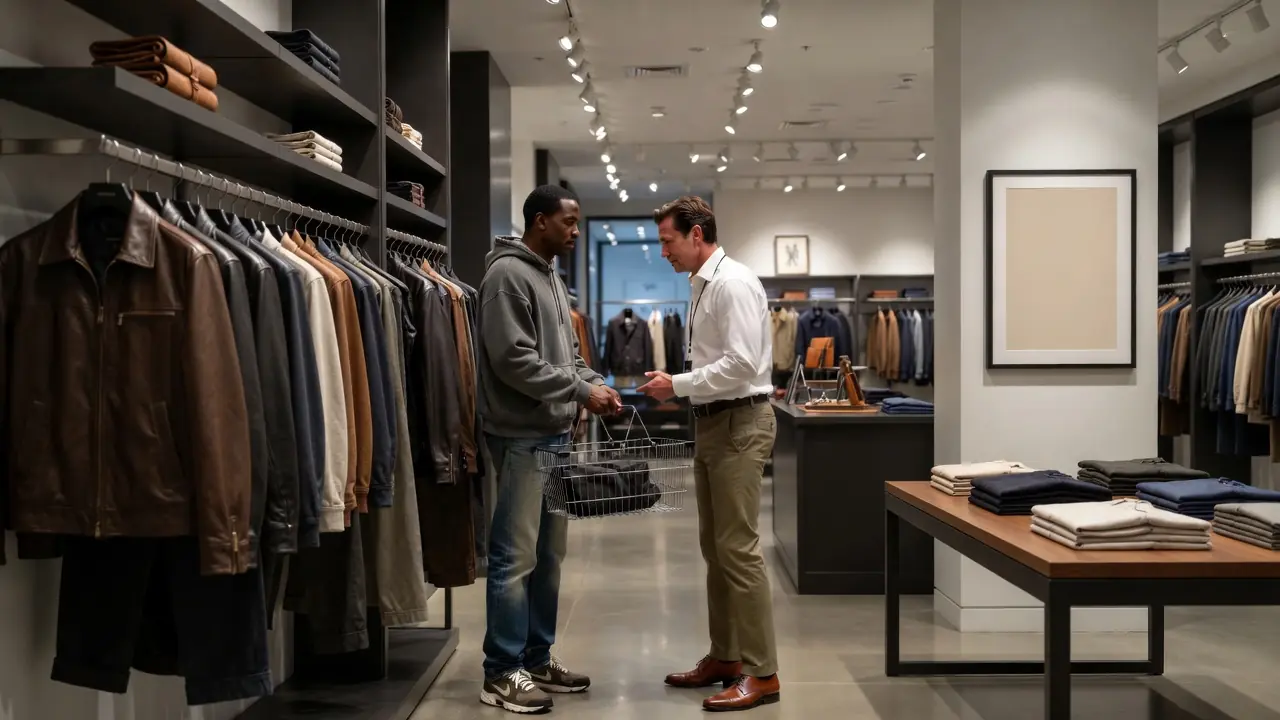
The smile vanished. Craig’s eyes moved down Harold’s hoodie, jeans, and sneakers, then slowly back up to his face. Something cold entered his expression. Harold had seen that look too many times to mistake it for anything else. It was the look of someone deciding who you were before asking your name. Harold kept browsing and waited.
He did not have to wait long. Craig pushed away from the counter and crossed the floor quickly. He stopped near the jacket display, directly in Harold’s path, close enough that Harold could smell the cologne on his collar. The frame between them felt narrow now, locked only on the two of them as Craig stepped into Harold’s personal space. “No way,” Craig said sharply. “Get out.”
Harold looked at him calmly. “Excuse me?” Craig pointed toward the entrance without looking away. “Are you deaf? I said get out.” His voice was loud enough to cut through the music and pull attention from nearby customers. “This store doesn’t serve people who wander in looking like they got lost on the way to a bus stop.”
Harold’s grip tightened once around the basket handle. His face did not change. “I just wanted to look at a jacket,” he said. Craig clicked his tongue and glanced toward the rack as if the jacket itself had been insulted. “A jacket?” he repeated. “You can’t even afford the hanger it came on.”
The words hung in the air, ugly and deliberate. Harold lowered his eyes for half a second, not from weakness, but from control. He had promised himself that on these floor walks, he would not reveal himself too soon. He wanted the truth, not a performance. And the truth was standing right in front of him, wearing an Apex lanyard.
Craig stepped even closer. He snapped his fingers near Harold’s chest, then blocked the jacket rack with his body. “Don’t touch the merchandise,” he said. “You don’t look ready to buy. You look ready to cause a problem.” Harold inhaled slowly through his nose. “I’m a customer,” he said. “That’s all.”
“A customer?” Craig laughed, loud and theatrical, as if trying to pull the room onto his side. No one laughed back, but that did not stop him. He reached toward Harold’s basket, took it from his hand, and shoved it onto the display table hard enough to make the hangers rattle. It was not violent enough to injure anyone, but it was humiliating, controlling, and meant to make a point. Harold watched the basket slide and settle near the jackets he had designed.
Tom had been standing a few racks away, pretending to examine polo shirts. Now he stepped closer. “We’re together,” he said. “Can you help us both?” Craig’s eyes moved to Tom. White, casually dressed, but cleaner in Craig’s mind. His posture softened by a degree. Not enough to become polite, but enough to expose the difference.
“Your friend isn’t really our demographic,” Craig said, leaning slightly toward Tom with a conspiratorial smirk. “You know what I mean.” Tom kept his expression neutral. “What demographic is that exactly?” Craig shrugged. “Look, I’m not the bad guy here. I’m using judgment. We get profiles like this all the time.” There was no profile. No alert. No reason except the one Craig thought he could hide under professional language.
Harold gave Tom the smallest shake of his head. Not yet. Tom understood and lowered his voice. “We’d like to speak to a manager.” Craig laughed again, sharper this time. “A manager? I’ve been running this floor for ten years. I am the manager.” He turned back to Harold. “And I’m telling you to leave.”
From the back of the store, Denise Caldwell had heard every word. She was thirty-six, Black, composed, and exhausted in the way people become exhausted when they have been right for years and ignored for just as long. She had worked at this location for four years, knew the product better than most managers, and had filed complaints about Craig before. Each one had disappeared into the system. Each one had come back as nothing.
Denise approached with her shoulders straight and her lanyard resting neatly against her blouse. “Sir, I’d be happy to help you,” she said to Harold. Her voice was warm and professional. Then she turned to Craig. “I’ll take over from here.” Craig stepped sideways, blocking her path the same way he had blocked Harold’s.
“Stay in your lane, Denise,” Craig said. “I already told him we can’t help him.” Denise did not step back. “You can’t refuse service to someone based on how they look. That is not our policy.” Craig leaned toward her, lowering his voice but not enough to hide it. “You want to ring him up? Fine. When the jacket comes back with tags ripped off and a fake receipt, that’s on your numbers.”
Denise’s face tightened. “That’s a disgusting thing to say.” Craig’s expression flattened. “Keep pushing this and I’ll write you up for insubordination again.” That final word changed everything. Again. Harold heard the history inside it. He saw Denise’s chin tremble, saw the quick fight in her eyes, saw the decision she had been forced to make too many times.
She stepped back, not because she agreed, but because retaliation had taught her what resistance cost. Harold’s chest tightened, not for himself, but for her. This was not one bad interaction. This was a system. A manager had been allowed to build a little kingdom of fear, and everyone around him had learned how to survive inside it.
Craig turned back to Harold with a satisfied grin. “Now, where were we?” he said. “Right. You were leaving.” Harold did not move. Craig’s smile faded. “You really want to make this hard?” Harold looked him in the eye. “I asked for a jacket, not your opinion.”
Craig’s face flushed. He lifted his radio and called for Bradley Moore, the off-duty officer who worked weekend security at the store. Moore appeared from the back hallway, tall, broad, with a buzz cut and a utility belt that creaked when he walked. His hand rested near his belt, not quite on anything, but close enough to send a message. He looked at Craig first, then at Harold. That order mattered.
“Sir, is there a problem here?” Moore asked Harold. Harold’s voice stayed calm. “No problem. I’m shopping.” Craig cut in. “He’s been handling high-value merchandise and refusing to leave after being asked multiple times. I need him removed.” Every word was a lie, and Harold watched Moore decide how much of the lie he wanted to believe.
Moore faced Harold. “I’m going to need to see some ID.” Harold held his ground. “Am I being accused of a crime?” Moore hesitated. His jaw moved slightly, but he did not answer. Craig pushed from behind him. “Come on, Brad. Just walk him out.” Moore looked uncomfortable, but discomfort was not courage.
“Sir,” Moore said, “I’m going to ask you to step outside.” Harold did not blink. “I haven’t stolen anything. I haven’t threatened anyone. I’m standing in a store open to the public. Am I being accused of a crime?” Moore’s silence answered for him. The store had gone quiet around them. The music still played, but it felt distant now, like it belonged to another room.
Tom raised his phone and began recording. “For the record,” he said, “this man has committed no crime. He asked to shop, was refused service, and is now being threatened with removal.” Craig snapped his head toward the phone. “Turn that off. You can’t film in here.” Tom did not lower it. “There’s no such policy.”
Craig lunged toward the phone, but Tom stepped back. Moore moved between them, though he faced Harold and Tom instead of Craig. The positioning told its own story. Craig was being protected. Harold was being managed. The truth was being recorded.
Craig recovered his composure and turned toward the floor as if addressing an audience. “Folks, I apologize for the disruption,” he said loudly. “This is what we deal with every weekend. People come in dressed like that, touch everything, buy nothing, and then merchandise goes missing.” He scanned the room, waiting for agreement. None came. A woman near the candle display shook her head and walked out.
Craig’s frustration sharpened. He turned back to Harold. “You want to prove me wrong? Buy something right now. Pull out a card. Show me you belong here.” Harold’s voice stayed low. “I don’t need to prove anything to you.” Craig smirked. “That’s what I thought.”
Then Craig grabbed the shopping basket off the display table and shoved it sideways toward a return rack. The basket clipped Harold’s hand as it swung, leaving a red mark across his knuckles. The sound of plastic hitting metal echoed across the store. Tom stepped forward. “You just made physical contact.” Craig rolled his eyes. “I moved a basket. Relax.”
Harold looked down at his hand, then back at Craig. His expression did not change, but something behind his eyes became final. Craig, still convinced he had won, leaned closer and said the sentence that would end his career. “Some people build things,” he said. “Some people take things. I can tell which one you are just by looking at you.”
The store went still. Even Moore looked down. Denise stood near the back display with tears in her eyes, one hand pressed to the edge of the table. Harold reached into his hoodie pocket. Moore tensed for half a second, then saw the phone. Harold unlocked it, tapped one number, and spoke five quiet words. “Send the team in now.”
Craig laughed nervously. “What team?” Harold set the phone on the counter and folded his hands in front of him. He did not look angry. He looked finished. Ninety seconds later, the front doors opened and three people in tailored business suits walked in with purpose. Their lanyards read Apex Collective Corporate Headquarters.
Craig straightened instantly. His voice changed. “Can I help you folks?” Tom dropped the casual act and stood taller. “Rachel, Vince, Sheila,” he said. “Thanks for coming. We have a situation.” Craig’s eyes snapped toward Tom. “Wait. You work here?” Tom pulled out his ID badge and held it up. Regional Operations Director.
Craig’s face drained of color. Slowly, unwillingly, his eyes moved to Harold. Harold reached into the front pocket of his hoodie and removed his own badge. He held it at eye level with a steady hand. Harold Sullivan. Founder and CEO. The silence that followed was absolute.
Craig looked at the badge, then at the framed founder photo blurred on the wall behind the counter. The face had been there for years, but he had never truly seen it. Harold spoke with a voice that was not louder, only final. “Craig Donovan. Hired in 2016. Three customer complaints for discriminatory conduct, all flagged in the system. Not one acted on. That ends today.”
Craig’s knees weakened. He grabbed the counter. “Mr. Sullivan, sir, I didn’t know. This is a misunderstanding. I was following protocol.” Harold looked at him. “There is no protocol at Apex Collective that tells you to refuse service based on the color of someone’s skin. I know that because I wrote every protocol this company has.”
He turned to Moore. “And you were about to remove me from my own store based on zero evidence and one man’s prejudice.” Moore said nothing. His shoulders caved in. Harold continued. “The footage from every camera in this store will be sent to your precinct commander and the civilian oversight board.” Moore stared at the floor. His private security contract with Apex was terminated on the spot.
Then Harold turned back to Craig. “You are terminated effective immediately.” Craig’s mouth opened, but nothing useful came out. “Ten years,” he said weakly. “I gave this store ten years.” Harold’s eyes stayed steady. “And in those ten years, how many customers who looked like me did you turn away when nobody was watching?” Craig had no answer.
Vince from corporate collected Craig’s badge and keys. Craig looked around the store, searching for one sympathetic face. He found none. The lanyard he had worn like armor now hung from his trembling fingers before Vince took it away. Craig was walked out through the same front doors he had tried to force Harold through. The glass closed behind him.
The store remained quiet for several seconds after he left. Harold turned toward Denise. “Denise Caldwell,” he said softly. She straightened, wiping at her face. “You tried to help me when it could have cost you everything.” Denise pressed her lips together. Harold continued. “I found your complaints in the system. Every one of them. They were buried, but not anymore.”
Starting Monday, Denise would become floor manager of the Charlotte flagship. Full promotion, full raise, and direct reporting line to regional operations. Denise covered her mouth with one hand as tears slid down her cheeks. Harold extended his hand, and she took it with both of hers. “You showed me the kind of person I want representing this company,” he said. “Thank you.”
The video went public that evening. A teenage customer had recorded enough of the confrontation to show exactly what happened. By midnight, millions had watched it. By morning, the story was national news. Apex Collective released a statement that did not deflect, deny, or hide behind vague language. Harold called the incident discrimination and promised a full review.
That review was worse than expected. Across forty-two stores, thirty-eight discrimination complaints had been filed in three years. Fewer than half had been investigated. None had resulted in real discipline. Harold fired two regional HR managers, created an independent oversight system, and required every complaint to trigger corporate review within forty-eight hours. Store managers could no longer bury what made them uncomfortable.
Craig faced legal consequences as well. Surveillance footage showed him targeting Harold while ignoring white customers who handled merchandise the same way. His text messages revealed ugly jokes and assumptions about Black customers. The court ruled against him, calling his behavior a sustained pattern of racial hostility disguised as customer service. He was barred from all Apex Collective locations and ordered to complete community service with a civil rights organization.
Officer Moore resigned after an internal affairs review uncovered prior complaints about his off-duty security work. The store changed, not only because one man was fired, but because the system that protected him had finally been exposed. Three months later, Harold returned to the Charlotte flagship in a tailored navy suit. Denise met him at the door wearing her new floor manager badge. The store looked the same from the outside, but inside, the air felt lighter.
Harold walked to the same jacket rack where Craig had blocked him. He pulled down the leather jacket, checked the size, and carried it to the register. He bought it, put it on, and wore it out the front door. No announcement. No speech. Just a quiet correction of a moment that should never have happened.
As he stepped into the afternoon sunlight, Harold thought of his mother’s bleach-scented hands and the shoes he once held together with duct tape. He thought about every customer who had been judged before being helped. He thought about Denise, finally believed. Then he looked back once at the store he had built from nothing.
The truth was simple. The way people treat someone they think has nothing is the clearest picture of who they are. Craig Donovan had shown that truth in full view of the cameras. Harold Sullivan had done something with it. And from that day forward, inside Apex Collective, no one could pretend they had not seen.