Celeste Wexford laughed the day Declan Shaw, a single father who patched boat hulls for a living, paid $20 for the abandoned Grey Haven Shipworks. She called it the most foolish purchase she had ever witnessed. But three nights later, a navy convoy sealed off the harbor and a uniformed officer asked Declan to hand over a rusted key he had pulled from the floor of Dry Dock number four. When the steel door deep beneath the earth swung open, a rear admiral placed a folder in front of him.
A formal acquisition offer for $350 million. The town of Marrow Bay, Maine had been letting Grey Haven rot for 40 years and the city finally decided to make the rot someone else's problem. The municipal transfer program listed the old shipyards as available for acquisition. Minimum opening bid of $1, no reserve.
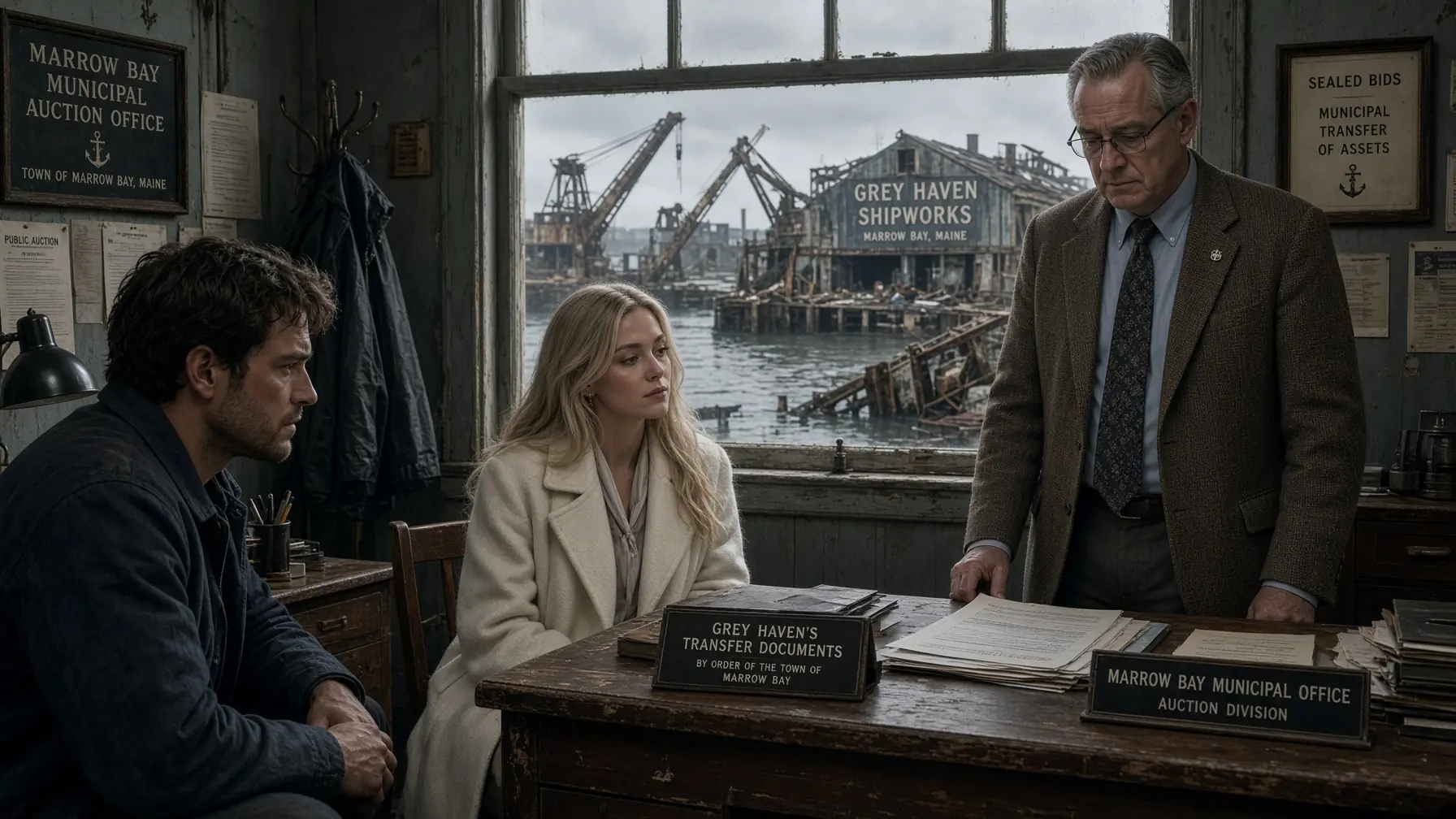
But the terms buried in the back of the listing were what kept every serious investor from raising a hand. Whoever took the deed would inherit full liability for environmental remediation, structural restoration of the collapsing berths, coastal rehabilitation obligations stretching 300 yards in both directions, and a frozen tax debt that the city had declined to forgive. Internal assessments circulated among the waterfront development community put the cleanup cost alone at somewhere between 15 and 18 million dollars, not counting the years of permits and the engineering headaches nobody wanted to buy into. The lot had sat on the transfer list for two consecutive cycles without a single registered bidder, which suited certain people in Marrow Bay just fine.
Declan Shaw arrived at the auction office on a Tuesday morning carrying a manila envelope that had once belonged to his father. He was 44 years old, built lean from 30 years of crawling through bilge compartments and welding in confined spaces, and he drove a truck that had well over 200,000 miles on it. He had spent his 20s as a naval vessel systems technician and his 30s as an underwater welding specialist. And then he had walked away from the steadiest paycheck of his life to sit beside his wife in a hospital that smelled of antiseptic and recycled air.
After she was gone, it was just him and Avery, his daughter, who was now 19 and studying marine engineering three states away. Declan lived simply, worked steadily, and had long since stopped caring what the people with expensive shoes thought about his choices. His father had been a night shift technician at Greyhaven for 11 years before the works closed, and Declan had grown up hearing stories about the place the way other children heard bedtime fables. The creak of the overhead cranes, the smell of hot steel on cold morning air, the way the whole bay seemed to breathe when a finished hull slid into the water.