The rain had followed Victor Ashford all the way from the mansion.
By the time he pushed open the door of the little bakery on Hawthorne Street, water ran from the shoulders of his dark wool coat and gathered beneath his polished shoes.
The bell above the door rang sharply.
Every conversation in the room stopped.
Victor stood just inside the entrance, breathing harder than a sixty-year-old man in good health should have been breathing. His silver hair, usually arranged with careful precision, had fallen across his forehead. His tie hung loose. One hand still gripped the phone he had used to track his daughter’s location.
Across the bakery, Claire Ashford sat in her wheelchair at a round table near the window.
She was soaked from the rain.
A man’s brown work jacket rested around her shoulders.
Beside her stood a tall carpenter with sawdust still caught in the seams of his boots. One hand rested lightly on the back of Claire’s chair, not as though he owned it or controlled it, but as though he was ready to help if she asked.
In front of them stood a six-year-old girl wearing a yellow raincoat.
The child had both arms wrapped protectively around Claire.
Victor looked at his daughter.
“Enough,” he said. “You’re coming home.”
Claire did not move.
The little girl released her and stepped forward.
She placed herself between Victor and the wheelchair.
Victor stared down at her.
She could not have weighed more than forty pounds.
“Move aside,” he said.
The child shook her head.
“No.”
Her voice was quiet, but the bakery was so silent that everyone heard it.
Victor’s expression hardened.
“This is a family matter.”
The girl looked behind her at Claire, then back at Victor.
“You’re her family?”
“I’m her father.”
The child frowned.
“Then why does she cry when she talks about you?”
Victor’s face changed.
Only slightly.
But Claire saw it.
The carpenter stepped closer.
“Molly,” he said gently.
The girl looked up at him.
“It’s true, Daddy.”
“I know.”
Victor’s eyes moved toward the man.
“You must be Ethan Hale.”
The carpenter did not seem surprised that Victor knew his name.
“I am.”
“I told my daughter to end all contact with you.”
Ethan’s posture remained calm.
“I know.”
“And yet you encouraged her to leave the house in a storm.”
“No,” Claire said.
Her voice trembled, but not from fear.
“I left because you threatened to destroy him.”
Victor turned toward her.
“I was protecting you.”
“No.”
Claire tightened her hands around the wheels of her chair.
“You were protecting yourself from admitting that someone else could give me what you refused to.”
The words struck harder than the rain against the windows.
Victor took one step toward her.
“You do not understand this man’s intentions.”
“I understand them better than I understand yours.”
“He is a carpenter with a failing business and a child to support. You are the only heir to Ashford Systems. Do you honestly believe money has nothing to do with this?”
Ethan’s jaw tightened.
Claire raised one hand before he could answer.
“Do you know what he asked me the first day we met?”
Victor said nothing.
“He asked whether he and Molly could sit with me.”
Her voice softened.
“He didn’t know my last name. He didn’t know who you were. He didn’t even know I had money.”
Molly looked up at Victor.
“She had a cake,” the child said. “But nobody was singing.”
Victor stared at her.
Molly continued.
“No one should have a birthday cake if nobody sings.”
Something inside the room shifted.
The bakery owner lowered her eyes.
A woman near the counter covered her mouth.
Victor looked at the table where Claire sat.
It was the same one beside which twenty-two white candles had burned six weeks earlier.
The same table where the life Victor believed he had carefully arranged for his daughter had begun to fall apart.
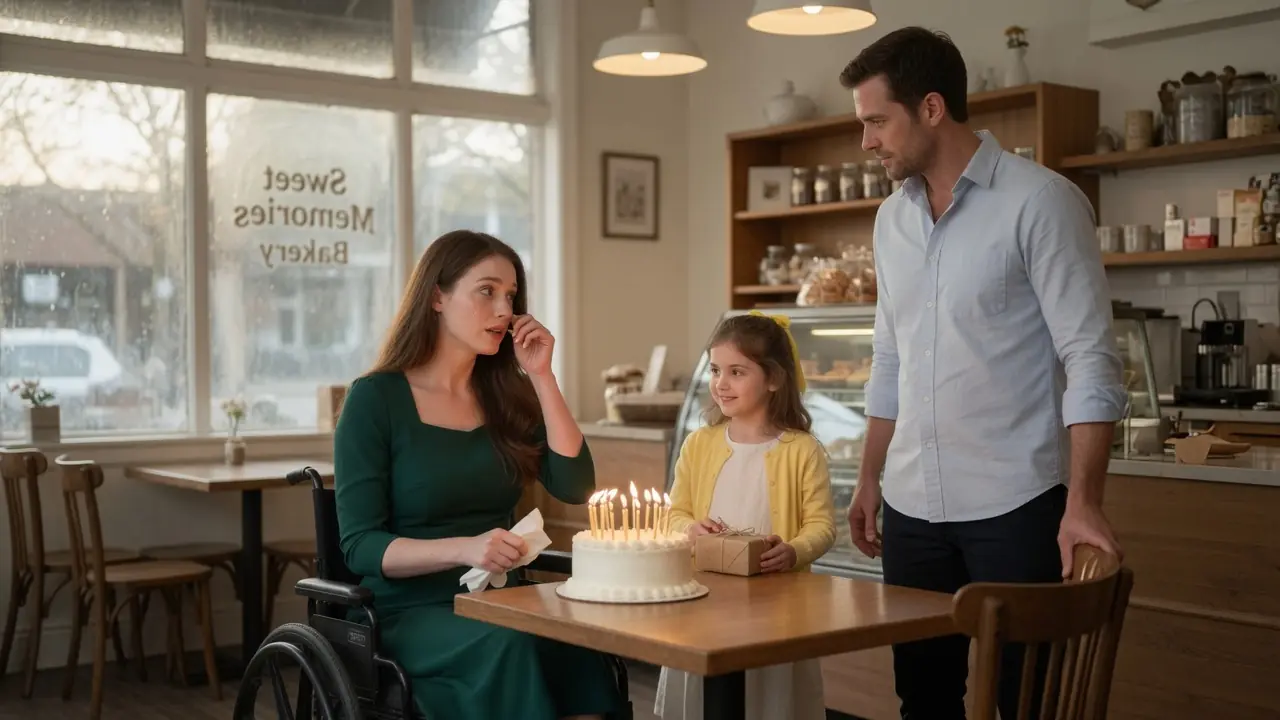
Or perhaps, Claire thought, it was where her life had finally begun again.
Six weeks earlier, the afternoon sun had entered Sweet Haven Bakery through lace curtains and painted warm squares across the floor.
Claire sat alone before a small white cake.
Twenty-two candles flickered in front of her.
Her father had promised to come.
At eleven that morning, his assistant sent a message saying an emergency board session had been added to his schedule.
At one, a driver delivered a velvet box containing diamond earrings.
At two, Claire received a bank notification showing a substantial transfer into her personal account.
At three, Victor sent a text.
Happy birthday. I’m sorry. We’ll celebrate soon.
Claire did not open the jewelry box.
She had told the household nurse she wanted an hour alone and asked the driver to leave her at the bakery where her mother once bought birthday cakes.
Her mother, Helena, had died when Claire was eleven.
Afterward, Victor worked more.
He said the company needed him.
Claire believed him.
Then, four years earlier, a drunk driver ran a red light and struck the passenger side of the car carrying her home from college.
She remembered glass moving through the air like ice.
She remembered the car turning.
She remembered waking in a hospital and asking why she could not feel her legs.
The doctors explained the spinal injury carefully.
Victor stood near the foot of the bed speaking with specialists.
He asked about surgical options, clinical trials, rehabilitation equipment, and recovery percentages.
He did not take her hand.
Not then.
Not later.
Within six months, the Ashford mansion had ramps, lifts, widened doorways, automated cabinets, adjustable counters, and one of the finest private rehabilitation rooms in the country.
Claire had nurses, therapists, nutritionists, and drivers.
She had everything except her father.
Victor handled her life as he handled a company crisis.
He gathered experts.
Approved budgets.
Measured progress.
When doctors finally said she would not walk again, he retreated almost completely into work.
Claire stopped asking him to attend therapy.
Then she stopped asking him to dinner.
Eventually, she learned to measure his love through transactions.
New equipment.
Expensive gifts.
Messages written by assistants.
The bakery cake was not elaborate.
Claire had chosen it because it looked like the cakes her mother once made.
White icing.
Small sugar flowers.
Nothing gold.
Nothing custom-designed.
Nothing delivered by a personal chef.
She lit the candles herself.
The bakery owner offered to sing, but Claire declined.
She had almost blown them out when the doorbell rang.
A man entered with a little girl.
He was around thirty-one, tall but not imposing, with dark hair that needed cutting and hands marked by small scars. His flannel shirt was clean but worn at the elbows.
The girl beside him carried a cupcake inside a clear box.
She had brown curls, bright green eyes, and the restless energy of a child who believed every room contained something worth discovering.
The pair stopped after seeing Claire.
The girl tugged the man’s sleeve and whispered urgently.
He listened.
Then they approached.
“Excuse me,” he said. “My daughter was wondering whether we might join you.”
Claire looked from him to the child.
“Why?”
The girl answered.
“Because it’s your birthday.”
Claire glanced at the candles.
“I suppose that’s obvious.”
“My name is Molly.”
The child held up the cupcake.
“This was for my mommy, but you can share it.”
The man placed one hand gently on Molly’s shoulder.
“You don’t have to give it away.”
“I want to.”
Claire looked at him.
He smiled apologetically.
“I’m Ethan Hale. We come here every year on this date.”
Molly set the cupcake beside Claire’s cake.
“It’s my mommy’s birthday too.”
Claire’s eyes moved between them.
“Where is she?”
Molly pointed upward.
“In heaven.”
Ethan’s expression softened.
“My wife died when Molly was born.”
There was no attempt to create sympathy in his voice.
Only truth.
Molly leaned toward Claire.
“Daddy says birthdays can still belong to people even when they’re gone.”
Claire looked at the candles.
“My mother is gone too.”
“Then maybe they know each other.”
Ethan pulled out a chair.
“If you would prefer to be alone, we understand.”
Claire should have said yes.
She had spent four years learning how to keep people at a safe distance. Strangers often looked at her chair before looking at her face. Some spoke too loudly. Others lowered their voices as though paralysis had also damaged her hearing.
Ethan did neither.
Molly had already climbed into the chair beside her.
Claire looked at the candles.
“You can stay.”
Molly began singing immediately.
Her voice was high, enthusiastic, and almost entirely off-key.
Ethan joined her.
Claire closed her eyes.
For the first time in years, she made a birthday wish.
She did not wish to walk.
She did not wish to undo the accident.
She wished not to feel invisible.
When she opened her eyes, Molly was holding out the cupcake.
“You have to blow out both.”
“That is a lot of responsibility.”
“I’ll help.”
Together, they extinguished the candles.
Afterward, they stayed for more than an hour.
Molly told Claire about school, her favorite books, and the wooden birdhouse Ethan was helping her build.
Ethan explained that he owned a small carpentry shop called Hale Woodworks. He repaired old furniture and built custom pieces when clients could afford them.
Claire did not mention Ashford Systems.
She introduced herself only as Claire.
For that hour, she was not an heiress, a patient, or a tragedy.
She was a woman eating cake with a widowed carpenter and his daughter.
Before leaving, Molly asked whether Claire liked ducks.
“I have no strong opinion.”
“There are ducks at Fairmont Park.”
“I’ve heard rumors.”
“We feed them on Saturdays.”
Ethan looked embarrassed.
“Molly.”
“What?”
“You cannot schedule strangers.”
“She isn’t a stranger now.”
Claire smiled before she could stop herself.
Ethan noticed.
So did Molly.
The following Saturday, Claire went to the park.
She told herself it was coincidence.
Ethan did not pretend to believe her.
Their friendship developed without announcement.
First, there were Saturday visits to the duck pond.
Then coffee after Molly’s school.
Then afternoons in Ethan’s workshop, where Claire watched him transform damaged wood into tables, chairs, and cabinets.
The shop smelled of cedar, dust, varnish, and coffee.
Molly kept a small desk in one corner where she drew while Ethan worked.
Claire loved the workshop because nothing inside it was ashamed of being repaired.
Cracked wood was reinforced.
Scratched surfaces were sanded.
Missing sections were replaced without pretending the original damage had never happened.
One afternoon, Ethan found Claire studying an old rocking chair.
“My mother had one like that,” she said.
“This belonged to a woman’s grandmother.”
“Can it be saved?”
He ran one hand along the broken arm.
“Most things can be made useful again.”
“Useful isn’t the same as whole.”
“No.”
Ethan looked toward her.
“But whole doesn’t always mean untouched.”
Claire did not answer.
That evening, she thought about the sentence long after returning to the mansion.
Molly became attached to her quickly.
The child never treated the wheelchair as something uncomfortable.
She decorated the wheel rims with removable ribbons.
She asked whether Claire could race.
Claire said yes.
They nearly struck a park bench.
Molly considered the accident a victory.
Ethan was different.
He moved more carefully.
Not because of the wheelchair.
Because he understood grief.
He spoke of his wife, Sarah, without turning her memory into a shrine or pretending he no longer missed her.
“She was a kindergarten teacher,” he told Claire one afternoon. “She painted trees and animals across our apartment walls.”
“Did you keep them?”
“For as long as we could.”
“What happened?”
“The landlord sold the building. We moved.”
“That must have been difficult.”
“It was.”
“Did Molly remember the paintings?”
“She was too young.”
“So you tell her.”
“I tell her everything I can.”
Claire looked toward Molly chasing pigeons near the fountain.
“My father stopped talking about my mother.”
“Why?”
“I think remembering her hurts him.”
Ethan remained quiet.
Claire continued.
“When I was injured, he became even more distant. I think my body reminded him that he couldn’t control everything.”
“What did you need from him?”
The question was simple.
No therapist had ever asked it that directly.
“My father.”
Ethan nodded.
Not advice.
Not analysis.
Only acknowledgment.
Claire began telling him things she had never said aloud.
How the mansion felt like a hospital disguised as a palace.
How staff members entered her room according to schedules.
How every decision about her life passed through someone paid by Victor.
How she sometimes refused help simply to prove there were still choices she could make.
Ethan did not tell her she should be grateful.
He did not tell her Victor probably loved her in his own way.
He listened.
In return, Ethan spoke of raising Molly alone.
He described the first night after leaving the hospital without Sarah.
A newborn in his arms.
A car seat he could not fasten properly.
A home filled with baby supplies his wife had chosen.
“I sat on the kitchen floor until morning,” he said.
“What made you stand up?”
“Molly cried.”
Claire looked toward him.
“She needed me to keep moving.”
“Did you ever resent that?”
He considered the question.
“I resented life. Never her.”
The friendship became love so gradually that neither could identify the exact moment it changed.
Perhaps it began when Ethan built a small tray for Claire’s chair because she struggled to balance books.
Perhaps when Claire attended Molly’s school performance and sat in the front row.
Perhaps when Molly fell asleep against Claire during a movie and Ethan looked at the two of them as though he had found something he was afraid to name.
One evening, they sat inside a coffee shop while Molly colored nearby.
Claire laughed at a drawing in which Molly had given every family member wings.
Ethan watched her.
“What?” Claire asked.
“Nothing.”
“You’re staring.”
“I was thinking.”
“That sounds dangerous.”
He reached across the table and touched her hand.
His fingers were rough and warm.
“Claire, Molly and I are not spending time with you because we feel sorry for you.”
Her smile disappeared.
“I know.”
“Do you?”
She looked down.
Ethan continued.
“You make our lives better.”
Claire’s eyes filled.
“I don’t know how to do this.”
“Neither do I.”
“You had a marriage.”
“I had Sarah.”
He glanced toward Molly.
“What I have with you would not replace her. It would be something new.”
Claire turned her hand beneath his and held on.
“We would need to go slowly.”
Ethan smiled.
“I work with wood. Slowly is usually safer.”
They did not know Victor had begun investigating him.
The first report appeared on his desk after a household driver mentioned Claire had been visiting a workshop in a working-class neighborhood.
Victor hired a private security firm.
Within days, he had Ethan’s employment history, financial records, mortgage balance, business revenue, and family details.
The report described him as financially unstable.
Victor read the phrase twice.
He looked at photographs of Ethan pushing Claire through the park.
Molly sat on Claire’s lap.
All three were laughing.
Victor saw a trap.
He did not see a family.
He summoned Claire to his study.
She entered to find Ethan’s photograph on the desk.
Victor did not ask whether she loved him.
He ordered her to stop seeing him.
“He is using you,” he said.
“You’ve never met him.”
“I know enough.”
“You know his income.”
“I know he has motive.”
“What motive?”
Victor gestured toward the room.
“This. Your trust. Your inheritance. Your vulnerability.”
Claire felt as though the air had left her body.
“My vulnerability?”
“You have lived a protected life.”
“Protected?”
“You don’t understand what people want from you.”
She laughed once.
The sound was bitter.
“I understand exactly what you want.”
Victor stood.
“I want you safe.”
“No. You want me controlled.”
“That man cannot provide the life you require.”
“What life?”
Claire spread her arms toward the mansion.
“This one? Where my father schedules ten minutes with me through an assistant?”
Victor’s jaw tightened.
“You are being emotional.”
“I am being honest.”
“He sees a wealthy, disabled woman with limited experience.”
“He sees Claire.”
“You are not thinking clearly.”
“For the first time in four years, I am.”
Victor moved around the desk.
“If you continue this relationship, I will take action.”
“What action?”
“I will have his business investigated. I will notify licensing agencies. If necessary, I will seek a protective order based on exploitation of a vulnerable adult.”
Claire stared at him.
“You would destroy him.”
“I would remove a threat.”
“And Molly?”
Victor’s expression did not change quickly enough.
That was the answer.
Claire returned to her room and sent Ethan a message.
I can’t see you anymore. Please don’t contact me. I’m sorry.
He read it in his workshop.
Then again at home.
Molly found him sitting in the dark.
“Is Claire coming Saturday?”
“No.”
“Why?”
“She said she cannot see us.”
Molly climbed beside him.
“She loves us.”
Ethan closed his eyes.
“I know.”
“Then why?”
He did not know how to explain fear shaped like protection or power disguised as concern.
For three days, he honored Claire’s request.
On the fourth, Molly asked whether Claire had left because they were poor.
Ethan decided silence was teaching his daughter the wrong lesson.
They drove to the Ashford estate.
Security refused entry.
Molly pressed her face between the iron bars.
“Claire!”
Her voice carried across the wet lawn.
“We miss you!”
Inside her bedroom, Claire heard her.
She wheeled to the window.
Ethan stood beyond the gate with one hand on Molly’s shoulder.
They looked small against the enormous property.
Claire realized that obeying Victor had not protected them.
It had only allowed him to decide what everyone else was permitted to feel.
She took the service elevator.
Maria, the cook who had known her since childhood, opened the kitchen door.
“Go,” Maria whispered. “Before you change your mind.”
Rain fell harder as Claire crossed the property.
Her arms burned from pushing the wheels over wet pavement.
At the gate, Ethan saw her.
“Claire.”
She did not stop.
“Meet me at Sweet Haven,” she said.
Then she continued toward the waiting accessible taxi Maria had called.
The bakery was nearly empty when she arrived.
Ethan and Molly entered minutes later.
Molly ran to her.
“You came back.”
Claire held the child tightly.
“I’m sorry.”
“I knew you loved us.”
Ethan removed his jacket and wrapped it around Claire.
“What happened?”
“My father threatened you.”
“That explains the message.”
“I thought staying away would protect you.”
“From what?”
“His lawyers. His company. Everything he can use.”
Ethan crouched beside her.
“Claire, he could make our lives difficult.”
“I know.”
“Are you prepared for that?”
She touched his face.
“I lost the use of my legs four years ago.”
Her voice steadied.
“I will not let fear take everything else.”
That was when Victor entered the bakery.
Now, standing in the rain-soaked room, he faced the daughter he had treated like a responsibility and the family she had chosen without him.
Molly’s question remained between them.
Then why does she cry when she talks about you?
Victor looked at Claire.
For the first time in years, he did not see the chair first.
He saw her eyes.
Alive.
Angry.
Terrified.
Determined.
He saw Ethan’s jacket around her shoulders.
Molly’s hand gripping hers.
He saw that Claire looked more present in this modest bakery than she had inside the mansion he built to protect her.
“You said I never looked at you,” Victor said.
Claire’s expression softened slightly.
“You looked at everything around me.”
Her voice broke.
“The chair. The doctors. The equipment. The risks. But never me.”
Victor pulled out a chair and sat.
He suddenly looked older than sixty.
“When you woke in the hospital,” Claire said, “I was afraid I would never feel whole again.”
Victor lowered his eyes.
“I needed you to hold my hand.”
“I couldn’t.”
“I know.”
The answer surprised him.
Claire continued.
“You couldn’t bear that you couldn’t fix it.”
Victor’s voice became quiet.
“Your mother died while I was trying to build something large enough to prove her life mattered.”
Claire listened.
“When you were injured, every doctor told me there was nothing I could buy that would restore what you lost.”
He rubbed both hands together.
“I did not know how to stand beside pain I could not solve.”
Ethan spoke.
“You don’t solve grief.”
Victor looked toward him.
“You stay near it.”
Molly nodded seriously.
“My daddy stays.”
Victor looked at the child.
She was still standing between him and Claire.
“Is that what you believe I failed to do?”
“Yes.”
The honesty of children had no polished edge.
Victor accepted the blow.
“I lost four years.”
Claire wheeled closer.
“You did.”
His face tightened.
“How do I make that right?”
“You don’t.”
He looked at her.
“You begin from today.”
Claire held out her hand.
Victor stared at it.
Then he took it.
The bakery remained silent.
There was no sudden forgiveness.
No promise that all wounds had closed.
Only a father holding his daughter’s hand because, after four years, she had asked him to.
Victor withdrew every threat against Ethan.
He ended the private investigation and apologized in person.
Ethan did not trust him immediately.
Neither did Claire.
Victor did not demand that they do so.
He began attending Claire’s therapy sessions.
At first, he asked too many questions.
The therapist eventually told him to sit quietly.
He did.
He visited Ethan’s workshop.
His first attempt to sand a tabletop ruined one corner.
Ethan showed him how to repair it.
Victor discovered that working with wood required patience no amount of money could purchase.
He and Claire ate dinner once a week without assistants, phones, or business discussions.
Sometimes they spoke.
Sometimes they did not.
The important thing was that he arrived.
One year after Claire’s lonely birthday, Sweet Haven Bakery closed for a private celebration.
White ribbons hung from the windows.
Sunflowers filled small glass jars.
The aisle between the tables had been widened for Claire’s chair.
It was her twenty-third birthday.
It was also her wedding day.
Molly had decorated the wheelchair with flowers until Claire said it looked like a garden had learned to move.
Victor walked beside her.
His hand rested lightly on her shoulder.
“You look like your mother,” he whispered.
Claire looked up.
“She would be proud that you came.”
His eyes filled.
“I will keep coming.”
At the front of the bakery, Ethan waited.
Molly stood beside him holding a basket of petals and trying very hard not to scatter them before the ceremony began.
Ethan’s vows were simple.
“You never needed me to make you whole,” he said. “You were whole when I met you. You were lonely, hurt, and afraid, but you were never less. I promise to remember that on every difficult day.”
Claire held his hands.
“You and Molly did not rescue me from my chair,” she said. “You rescued me from believing my life had already ended. I promise to choose this family not only when love feels easy, but when fear tells us to hide.”
Molly cried before anyone else.
Then denied it.
At the reception, Victor raised a glass.
For most of his life, he had spoken in public about growth, markets, innovation, and leadership.
That afternoon, he spoke without notes.
“I once believed love meant removing every danger from someone’s life,” he said. “When I discovered I could not do that, I withdrew and called it protection.”
He looked toward Claire.
“My daughter taught me that love is not solving every problem. It is refusing to let someone face those problems alone.”
Then he looked at Ethan.
“You saw her while I was measuring her limitations.”
His voice tightened.
“Thank you.”
Ethan nodded.
After the guests left, Claire sat outside beneath the evening sky.
Ethan brought two pieces of cake.
“No one should eat birthday cake alone,” he said.
Claire laughed.
“That line worked very well for you.”
“It was Molly’s idea.”
“Most of your best ideas are.”
He sat beside her.
Inside, Molly was teaching Victor how to fold a paper crane.
The billionaire was failing badly.
Neither seemed concerned.
Claire looked through the bakery window at her father, her daughter by choice, and the ordinary chaos of people learning how to become a family.
On her twenty-second birthday, she had wished not to be alone.
She once thought the wish had been answered by Ethan and Molly.
Now she understood it had also brought Victor back from the distance where he had hidden.
Not healed.
Not transformed in a single afternoon.
Present.
That was enough to begin.
Years later, Claire would still remember the original cake.
The twenty-two candles.
The empty chair across from her.
The shame of waiting for a father who never arrived.
But the memory no longer ended there.
It continued with a bell above the bakery door.
A little girl carrying a cupcake.
A carpenter who asked permission before sitting down.
And a song sung badly enough to make Claire laugh through her tears.
Her life did not change because strangers pitied her.
It changed because they treated her loneliness as something worth interrupting.
Molly saw a woman sitting alone and did not look away.
Ethan followed his daughter’s kindness without worrying whether the moment would become complicated.
Claire allowed them to sit.
Three small decisions.
That was how the family began.
Not with wealth.
Not with blood.
Not with a perfect past.
With a shared table and a place for someone who had believed there was nowhere left to belong.