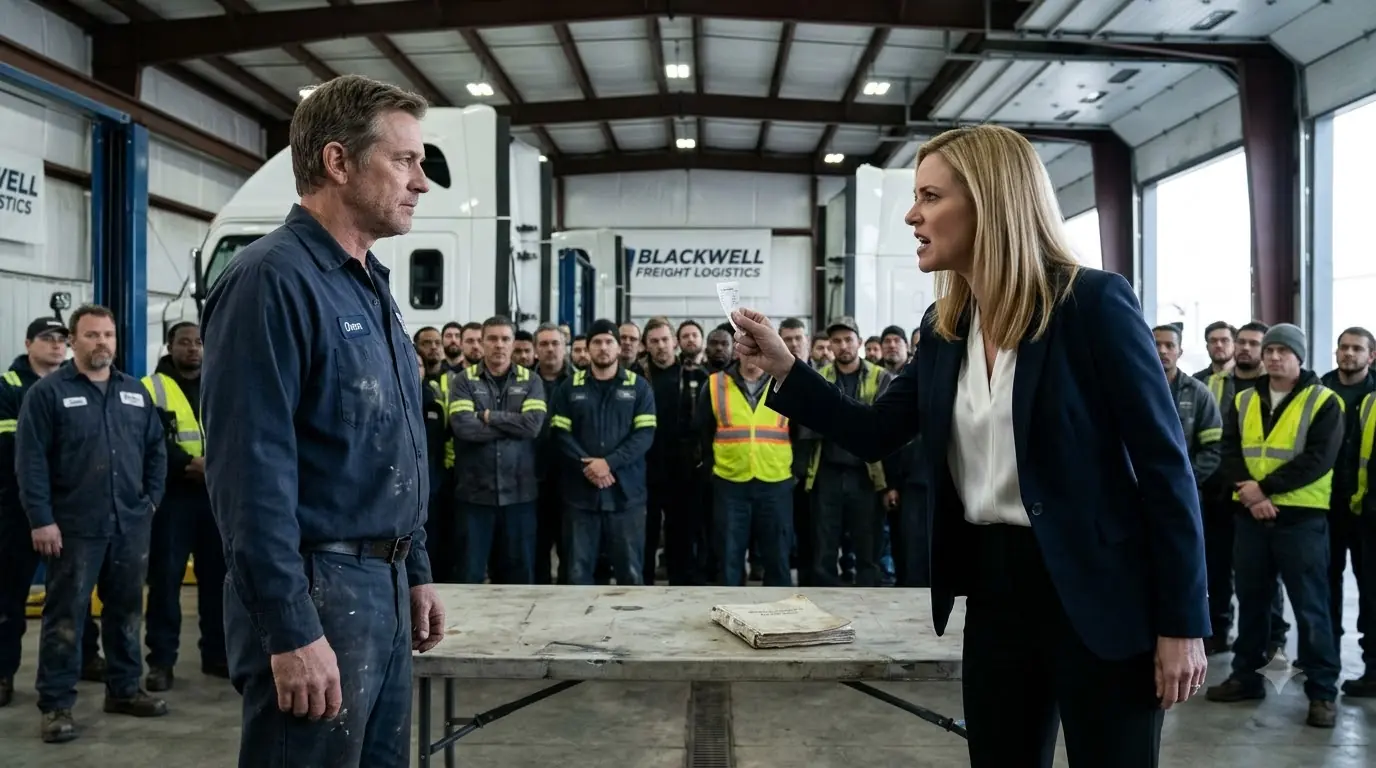
$12. "That's what you're worth to this company," CEO Lauren Whitfield said, holding up a greasy receipt before 40 silent employees. Across from her stood Daniel Mercer, a mechanic who had spent 23 years keeping her trucks on the road. She fired him, confiscated his badge, and ordered security to escort him out. Daniel didn't argue.
Daniel Mercer did not learn his trade from a manual, although there was nothing wrong with manuals. His father had kept two of them in a battered steel cabinet behind a repair shop in rural Ohio, and Daniel had read both until the pages came loose. What he remembered more clearly was a winter morning when a school bus arrived on a tow truck and the driver refused to go home until someone explained what had happened.
Daniel's father, Frank, worked on the bus until after midnight and then walked the driver through every finding with a flashlight held under the chassis. He could have repaired the obvious part and collected the bill, but he wanted the man who carried thirty children every morning to understand why that part had failed. The lesson was not that a mechanic ought to know everything. The lesson was that a mechanic ought to admit what he did not know before somebody paid for his confidence.
For many years Daniel believed that was an ordinary attitude, shared by anyone who put a name on a work order. At nineteen he discovered how often haste could make a man appear competent, especially to supervisors who only counted completed jobs. The older mechanics told him to listen for changes before they became failures and to put a hand on the wheel hub after a run to feel whether it was heating. They passed down small practices because written procedures sometimes lagged behind actual machines. Daniel absorbed the habits along with the warnings, and for a while he mistook experience for immunity from error. The accident in 1998 cured him of that mistake more permanently than any disciplinary note could have done.
He had a son now, Matthew, who was studying electrical systems at a community college and thought his father's work was simultaneously admirable and hopelessly old-fashioned. At dinner Matthew could explain a software fault in an engine control unit with the confidence of someone who had grown up around computers. Daniel would ask where the sensor drew its ground and what happened when the wiring got wet, and the conversation would become a cheerful argument about what counted as a real problem. Susan, Daniel's wife, usually listened without taking sides. She had learned that the men in her house were most affectionate when they were disagreeing over machinery. But lately Daniel had been too tired to argue, and Matthew had begun taking his plate upstairs after supper.
The change did not escape Susan. She had worked as a respiratory therapist before a complicated surgery forced her into a position with fewer hours, and she knew the look of a person carrying responsibility beyond what sleep could repair. Daniel would sit at the kitchen table with his glasses