Jerome Wilson did not arrive at the Wilson Grand Hotel in a limousine, and that was the point. He stepped out of a rideshare at the curb on a busy Friday evening in downtown Chicago wearing a bright yellow bomber jacket, a black T-shirt, dark jeans, and clean white sneakers. In one hand, he carried a simple black overnight bag that looked like it could belong to any traveler. In the other, he held a phone with a confirmed reservation he had made under his own name.
The Wilson Grand rose above Michigan Avenue like a monument to expensive taste. Marble pillars framed the entrance, brass doors gleamed beneath soft lamps, and through the glass, Jerome could see polished floors, leather chairs, fresh flowers, and guests pulling designer suitcases toward the elevators. It was one of the crown properties in his hospitality group, a five-star hotel that charged enough per night to make most people pause before clicking confirm. It was also the hotel that had brought him the most troubling complaints in the last six months.
Some complaints had been ordinary, the kind any large hotel received. Slow room service, noisy guests, a missing robe, a billing mistake. But others had a different pattern. Certain guests reported being ignored at check-in, questioned too long, told rooms were unavailable despite confirmations, or treated like they did not belong in the lobby.
Jerome could have sent corporate auditors, and normally he would have. He could have warned the general manager, scheduled staff interviews, asked for camera footage, and created another report for another meeting. But reports often showed what people wanted leadership to see. Jerome wanted the truth before anyone had time to clean it up.
So he booked a room in his own hotel.
No announcement. No assistant. No entourage. No tailored suit. Just a middle-aged Black man in a bright jacket carrying one overnight bag into a lobby where every employee should have treated him like a guest, because that was what he was pretending to be.
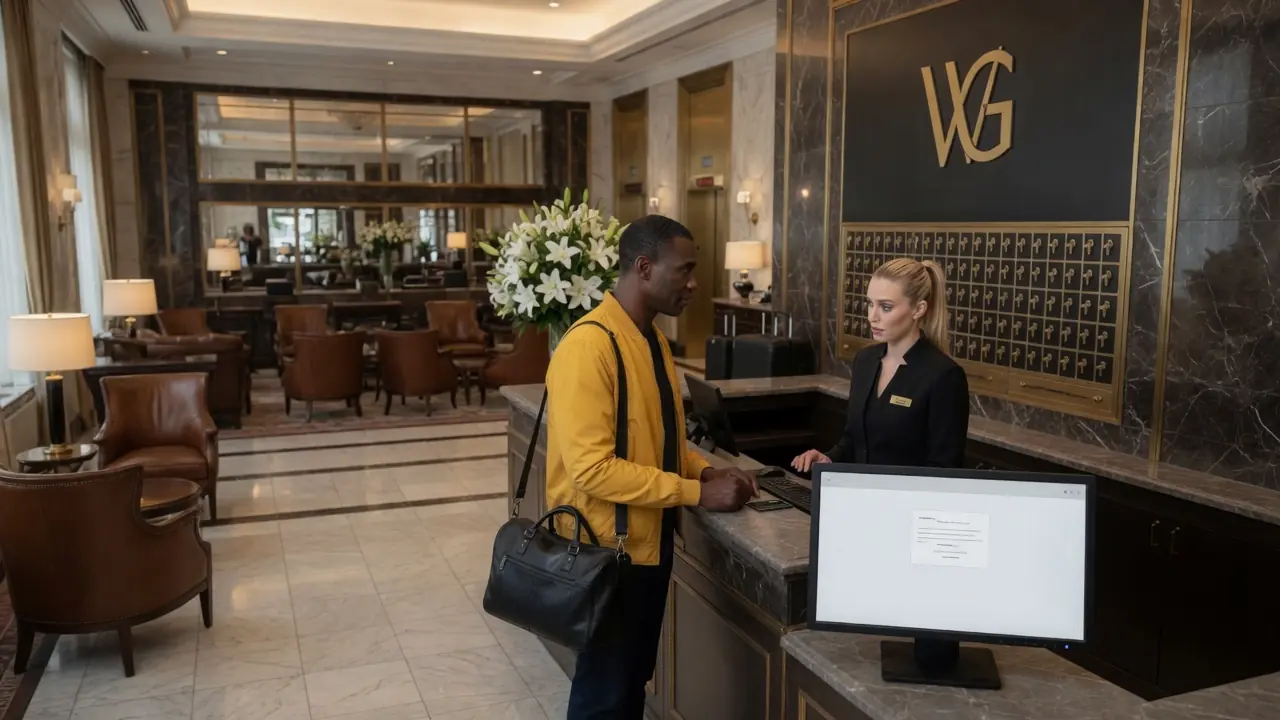
The lobby smelled faintly of lilies, leather polish, and expensive coffee. A pianist played soft music near the lounge, guests moved in small polished clusters, and the glass elevators rose silently along the back wall. Jerome walked to the marble front desk with calm steps, already observing everything. He noticed the bellman greeting a couple in matching cashmere coats, the concierge smiling at a businessman with a platinum card in hand, and the young receptionist behind the counter looking down at her phone.
Her name tag read Kim Parker.
She was blonde, twenty-six or so, slim and polished in a fitted black uniform. Her ponytail was neat, her makeup careful, and her posture carried the lazy confidence of someone who believed the counter gave her power over anyone standing on the other side. She saw Jerome approach. He knew she saw him because her eyes flicked up for half a second before returning to the phone.
Jerome stopped at the desk and waited.
Kim kept scrolling.
He waited a few more seconds. The hotel logo behind her glowed in tasteful gold letters, Wilson Grand, a name his mother had cried over when he first put it on a building. Jerome had started with one roadside motel outside Cleveland and turned it into a national hospitality brand. Yet in that moment, standing in a hotel bearing his family name, he was invisible.
He cleared his throat. “Excuse me.”
Kim sighed before looking up. It was not a tired sigh or a busy sigh. It was an annoyed sigh, the kind people use when someone interrupts something far more important than their job. She lifted her eyes slowly and gave him a look that moved from his yellow jacket to his sneakers to his overnight bag.
“Yeah?”
Jerome almost smiled. One word. Not welcome to the Wilson Grand. Not good evening. Not how may I help you? Just yeah, as if he had asked for spare change instead of service at a hotel he owned.
“I have a reservation,” he said calmly. “Jerome Wilson.”
Kim blinked once, then turned toward the computer with theatrical boredom. Her fingers tapped a few keys. She did not ask for identification, did not confirm the spelling, did not look through alternate booking fields. She typed as if she had already decided what the answer would be.
“Nope,” she said.
Jerome tilted his head slightly. “No reservation?”
“No reservation.”
“Would you check again?”
Kim’s eyes narrowed with a small smile. “I just did.”
Jerome kept his voice even. “I booked it this morning.”
“Maybe you booked the wrong location.”
“I don’t think so.”
“That happens all the time,” she said, leaning back slightly. “People see a nice lobby and get excited, then realize they meant the hotel across the street.”
The insult was clean, sharp, and wrapped in fake helpfulness.
Jerome reached into his jacket pocket and pulled out his phone. He did not turn the screen toward himself like proof to wave around. Instead, he held the phone across the marble counter so she could take it and check the confirmation for herself. “Here,” he said. “You can verify it.”
Kim glanced at the phone as if it might stain her hand. She did not pick it up. She bent just enough to see the name and reservation number, then straightened with a smirk. “A confirmation email doesn’t mean the room exists in our system.”
“It means the booking exists.”
“It means maybe someone made a mistake.”
Jerome looked directly at her. “Are you saying I made the mistake?”
Kim’s smile hardened. “I’m saying this is a luxury property. People get confused.”
A couple checking out at the next station turned their heads slightly, then looked away. The bellman near the luggage cart suddenly busied himself with a strap that did not need adjusting. The pianist kept playing, but to Jerome the music seemed farther away now, softened by the rising pressure at the desk.
“Kim,” Jerome said, reading her name tag as if confirming a detail, “please check the system again.”
Her expression changed when he used her name. Not fear, not respect, just irritation at being asked to do work she thought was beneath her. She typed again with two fingers, slowly, lazily, almost mockingly. Then she looked up.
“Still nothing.”
Jerome watched her face. “Would you call your manager?”
“No need.”
“Why not?”
“Because there’s nothing for him to fix.”
Kim slid his phone back across the counter with two fingers, as if returning something unpleasant. “Maybe try the budget hotel across the street. They usually have rooms available.”
The words landed. Not loudly. Not dramatically. But every person near the front desk felt the temperature shift.
Jerome did not raise his voice. He did not curse. He did not ask for respect, because he had learned long ago that people who needed to be asked for basic decency had already failed the first test. Instead, he looked at Kim with a calmness that began to make her uncomfortable.
“Let me ask you something,” he said.
Kim folded her arms. “Sir, I have other guests.”
“No, you don’t.” He glanced left and right. “I’m the only person at your station.”
Her cheeks colored slightly.
Jerome continued, “What happens when a reservation is manually removed from the system?”
Kim’s face changed by a fraction. Small, but Jerome saw it. His entire career had been built on noticing what people tried to hide. A blink held too long. A hand moving too quickly. A smile arriving a second late.
“I don’t know what you mean,” she said.
“Who has access to delete a reservation at the front desk?”
Kim looked back at the monitor. “Front desk staff can make adjustments when needed.”
“Like yourself?”
She hesitated. “Yes.”
Jerome nodded slowly. “Good.”
He took back his phone, but this time he did not open the guest confirmation. He opened the internal administrative system linked to his executive access. Kim could not see the screen at first, and that was intentional. Jerome logged in, searched the reservation record, and let the activity log load.
There it was.
Reservation created at 9:14 a.m. Confirmed with corporate guest account. Modified at 6:42 p.m. Status changed from confirmed to canceled. Canceled manually by K. Parker, front desk.
Jerome looked up at her.
Kim had returned her attention to her keyboard, pretending she was finished with him. Her fingers hovered without typing. She knew. She absolutely knew.
Jerome turned the phone around and placed it on the marble counter between them. “Is that your employee ID?”
Kim looked down.
For the first time that evening, her face lost color.
The lobby noise seemed to fade again. Jerome watched her eyes move over the activity log, over the time stamp, over her own name attached to the deletion. She swallowed hard. The smirk disappeared completely.
“I...” she began.
Jerome leaned in slightly, still keeping his voice low. “Why did you delete my reservation?”
Kim opened her mouth, closed it, then looked around as if searching for an answer somewhere in the flowers, the lamps, or the brass trim. “I didn’t delete it.”
“The system says you did.”
“There must be an error.”
Jerome almost laughed, but not because anything was funny. “The system does not lie, Kim. People do.”
Her eyes snapped back to his. “You can’t talk to me like that.”
“I am talking to you more politely than you talked to me.”
A man near the lounge lowered his newspaper. A woman by the elevators looked over her shoulder. Kim realized the moment was gaining witnesses, and with witnesses came danger.
She grabbed the keyboard and typed quickly. “I found a room.”
Jerome stood still. “Of course you did.”
Kim printed a key packet, grabbed a card, and pushed it toward him. “Room 1427.”
Jerome did not touch it. “Interesting choice.”
“It’s available.”
“It’s next to the elevator and the service closet, with a view of the loading dock.”
Kim froze.
Jerome let the silence work.
He knew room 1427 because he knew every weak point in the property. He knew the rooms guests complained about, the ones management used when they wanted to punish discounted bookings or late arrivals without officially admitting it. He had walked the floor plan when the hotel was still under renovation. He had chosen the marble, argued over the elevator placement, and personally approved the room classification chart.
Kim did not know any of that.
She only knew the man in the yellow jacket had somehow caught her twice.
“Do I look stupid to you?” Jerome asked.
Kim’s voice tightened. “No.”
“Then why are you trying so hard to treat me like I am?”
The question struck harder than anger. Kim’s face shifted from panic to defensiveness. People like her often preferred arrogance to accountability because arrogance felt safer than shame.
“Sir, if you don’t want the room, I can cancel the reservation.”
“You already tried that.”
A guest near the elevator murmured something to his wife. The bellman stopped pretending not to listen. Kim’s hand trembled slightly as she pulled the key packet back.
Jerome straightened. “Call your manager.”
Kim’s expression sharpened. “He’s busy.”
“Call him.”
“He doesn’t handle every front desk issue.”
Jerome reached into his overnight bag and removed a black executive access card. It was matte, simple, and engraved with the Wilson Grand Hospitality seal. He placed it flat on the marble counter between them.
Kim stared at it without understanding at first.
Then she read the name.
Jerome Wilson.
Founder and Chief Executive Officer.
Her face went blank.
For three full seconds, she did not move. Then her eyes lifted slowly to his face, and every trace of superiority collapsed into shock. She looked at the card, then at his yellow jacket, then back at the card as if one of them had to be fake.
“No,” she whispered.
Jerome’s voice remained calm. “Yes.”
“I didn’t know.”
“That is the problem,” Jerome said. “You only show respect when you think someone matters.”
Kim’s lips parted. “Mr. Wilson, I am so sorry. I had no idea it was you.”
“I know.”
“I mean, if I had known—”
He held up one hand. “Stop.”
She stopped.
The lobby had gone almost completely still now. People were watching openly. A second front desk clerk stood at the far end of the counter with wide eyes. The bellman looked like he wanted to disappear behind the luggage cart.
Jerome picked up the access card and slid it back into his pocket. “The apology you are trying to give me is not an apology. It is a confession.”
Kim looked confused and terrified. “A confession?”
“Yes,” Jerome said. “You are telling me you would have treated me better if you had known I could affect your job. That means the way you treated me before was the way you treat people you believe have no power.”
Tears gathered in Kim’s eyes, though Jerome could not tell whether they came from remorse or fear. He suspected fear. Remorse usually looked outward. Fear looked for escape.
“Please,” she said. “I made a mistake.”
“No,” Jerome replied. “You made several choices.”
The manager’s office door opened behind the reception area. Steven Lane stepped out, adjusting his tie, his face irritated at first. He was a middle-aged white man with thinning hair, soft hands, and the nervous energy of someone who had spent too long avoiding conflict. When he saw Jerome standing at the counter, irritation turned to horror.
“Mr. Wilson,” Steven said.
Kim turned sharply toward him. “You know him?”
Steven did not answer her. He walked quickly to the desk, face pale. “Sir, I didn’t know you were coming.”
“That was the point.”
Steven swallowed. “Of course.”
Jerome nodded toward Kim. “Your front desk clerk deleted my reservation, lied about it, suggested I go to a budget hotel, attempted to place me in one of the worst rooms in the building, and only apologized after learning I own the property.”
Steven’s mouth opened, but no useful words came out.
Kim began crying in earnest now. “That’s not fair. I was overwhelmed. The system was confusing. I thought—”
Jerome turned to her. “You thought I did not belong.”
She said nothing.
Steven looked at Kim, then at Jerome. “Mr. Wilson, I can handle this privately.”
“No,” Jerome said.
Steven blinked. “No?”
“This happened publicly. The correction will happen publicly.”
Kim shook her head. “Please don’t do this.”
Jerome did not enjoy what came next. That mattered to him. He never trusted leaders who enjoyed punishment, because punishment was not leadership. But consequences were necessary when someone’s position allowed them to humiliate paying guests.
“Kim Parker,” Steven said weakly, glancing at Jerome as if hoping for rescue from his own duty, “you are relieved of your position effective immediately.”
Kim stared at him. “You’re firing me?”
Steven shifted uncomfortably. “Yes.”
“But I’ve worked here two years.”
“And complaints about you go back nearly that long,” Jerome said.
Kim turned to him, angry now beneath the panic. “You set me up.”
“No,” Jerome replied. “I made a reservation. You chose what to do with it.”
Her anger faltered because the truth was too simple to fight. She looked around the lobby and realized there would be no sympathetic rescue. The guests had seen enough. The staff had heard enough. The marble desk that had made her feel powerful now looked like the place where her behavior had been exposed.
Kim removed her name tag with trembling fingers and placed it on the counter. She grabbed her purse from beneath the desk and walked away fast, her face red, her pride dragging behind her like luggage with a broken wheel. At the revolving doors, she looked back once. Jerome met her stare without expression.
Then she left.
The lobby remained quiet after the doors closed.
Jerome turned to Steven. “How many complaints were filed against her?”
Steven’s throat moved. “I would need to check.”
“I already checked.”
Steven’s eyes dropped.
Jerome continued, “Dismissed guest complaint. Reservation unavailable without explanation. Unlogged service dispute. Accusation of discriminatory treatment at check-in. Multiple system errors connected to her station. How many of those crossed your desk?”
Steven looked miserable. “Several.”
“And what did you do?”
“I gave coaching.”
“Coaching is what you give an employee who lacks training,” Jerome said. “Not one who lacks character.”
Steven said nothing.
Jerome looked around the lobby at the employees pretending not to listen. He raised his voice just enough for the desk staff to hear, but not enough to make a spectacle for guests. “Every person who walks through those doors is a guest until proven otherwise. Not a wallet. Not a category. Not a judgment based on clothing, race, luggage, accent, or attitude. A guest.”
The young clerk at the far station nodded quickly.
Jerome pointed gently toward the entrance. “If someone comes in wearing a thousand-dollar suit, you greet them. If someone comes in wearing work boots, you greet them. If someone comes in tired, confused, nervous, or carrying a backpack, you greet them. Hospitality is not a reward for people who look rich enough to deserve it.”
Steven’s face burned with shame. Jerome saw it and hoped it was useful. Shame without action was worthless, but shame connected to reform could save an organization.
Jerome turned back to him. “This property will undergo a full audit starting tonight.”
Steven went pale again. “Tonight?”
“Tonight.”
“But we’re at high occupancy.”
“Then you should have been running a better hotel before I arrived.”
Jerome pulled out his phone and called corporate operations. His voice was steady, efficient, and final. “This is Wilson. Begin immediate audit protocol at the Chicago property. Guest complaint review, reservation activity review, front desk conduct, management response, compensation list, and staff retraining assessment. I want every complaint from the last eighteen months pulled by morning.”
He listened for a moment, then added, “Yes. I am on-site.”
The person on the other end must have reacted strongly because Jerome’s expression did not change, but Steven looked like he might faint.
Jerome ended the call and looked at Steven. “You are suspended pending review.”
Steven’s mouth fell open. “Mr. Wilson, please. I can fix this.”
“You had months to fix it.”
“I didn’t know it was this bad.”
“That is not a defense for a manager,” Jerome said. “That is the charge.”
Steven nodded slowly, defeated.
A young clerk named Elena stepped forward from the far station. “Mr. Wilson?”
Jerome looked at her. “Yes?”
“I’m sorry. I saw some things before. I should have said more.”
Jerome studied her. She looked frightened, but sincere. “Did you report them?”
“Once,” she said. “It didn’t go anywhere.”
Jerome glanced at Steven, who looked down.
“Elena,” Jerome said, “after tonight, reports will go somewhere.”
She nodded, eyes damp with relief.
Jerome finally took the key packet that had been corrected by another clerk. Not room 1427. The presidential suite. He almost refused it because he did not need the symbolism, but then decided to accept. Sometimes people in a broken organization needed to see visible proof that the person they dismissed was not powerless.
He lifted his overnight bag and walked toward the elevators.
As he passed the lobby lounge, the older woman who had watched the whole exchange from a leather chair caught his eye. She raised her glass slightly in silent approval. Jerome nodded once. It was not a victory celebration. It was acknowledgment.
Upstairs, the presidential suite was quiet, elegant, and spotless. The city lights stretched beyond the windows, shimmering along the Chicago skyline. Jerome placed his bag on the bench at the foot of the bed but did not unpack. He opened his laptop and began reviewing every file connected to the hotel.
The pattern was worse than he had expected.
Kim was not the whole problem. She was the symptom employees could see. The deeper failure was a management culture that tolerated small cruelties because they were inconvenient to confront. A guest complaint had been marked resolved without contact. A late-night denial of service had been written off as misunderstanding. A family had been moved to a lower room category after questioning a rate, and no one had investigated.
Jerome read until midnight.
By one in the morning, he had approved refunds for twenty-three guests, complimentary future stays for nine, and personal apology letters for seven whose complaints showed clear neglect. By two, he had reassigned an outside operations director to take temporary control of the property. By three, he had drafted a memo to every Wilson Grand manager in the country.
The subject line was simple.
Hospitality Without Exceptions.
The next morning, the lobby felt different. Not fixed, not yet, but awake. Corporate staff had arrived with laptops and badges. Employees moved carefully, aware that the old habits had been dragged into the light. Steven’s office was locked, Kim’s station was empty, and Elena stood at the center desk greeting guests with a nervous but genuine smile.
Jerome came downstairs in the same yellow jacket.
This time, everyone saw him.
That was not what he wanted permanently. A good hotel should not need the CEO in a bright jacket for people to behave decently. But for one morning, visibility served a purpose.
Elena looked up as he approached. “Good morning, Mr. Wilson.”
“Good morning, Elena.”
“Your car is ready whenever you are.”
“Thank you.”
She hesitated. “Sir?”
“Yes?”
“I know last night was terrible, but I’m glad you came.”
Jerome looked around the lobby, at the marble floors, the flowers, the elevators, the guests checking in, and the staff learning in one hard weekend what the company should have protected from the beginning. “So am I,” he said.
Outside, Chicago moved under a pale morning sky. Jerome stepped through the brass doors and paused near the curb. His car waited, but he looked back once at the hotel name above the entrance.
Wilson Grand.
His mother’s name. His company’s promise. His responsibility.
Kim Parker had made a huge mistake, but Jerome knew the larger mistake would have been pretending she was the only one. Bad service did not appear out of nowhere. It grew in places where managers ignored warnings, where staff learned that certain guests could be dismissed, and where leadership trusted reports more than reality.
Jerome had come to test one employee.
Instead, he had exposed an entire culture that needed repair.
As he climbed into the car, his phone buzzed with the first message from the operations director.
Audit underway. Staff interviews beginning. Guest compensation in progress.
Jerome read it, then looked once more at the hotel through the window.
A hotel was not marble, gold trim, flowers, or expensive rooms.
A hotel was the moment a tired traveler walked to the desk and found out whether the person behind it saw them as human.
Last night, Kim had failed that test.
Today, Jerome would make sure the Wilson Grand never forgot it.