On a cold, rainy night, an old carpenter worked alone in his shop when suddenly a desperate knock echoed. Outside, a drenched teenage boy stood begging for work to save his ailing grandmother. Touched by the boy's devotion, the carpenter opened the door and chose to teach him his craft. Little did he know that years later, that same boy would become successful and return, determined to repay the kindness that once carved his future. Before we go back, let us know where you're watching from and subscribe because tomorrow I've got something extra special for you.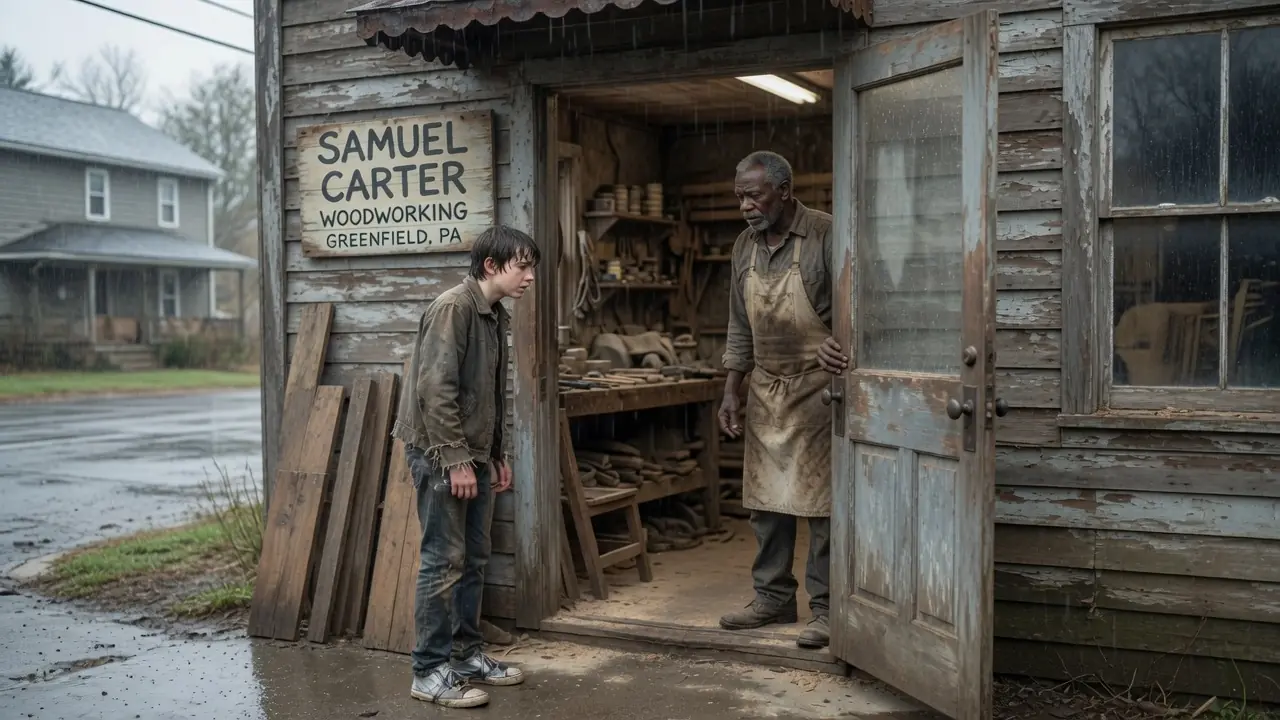
Tyler Bennett had been standing outside Samuel Carter's workshop for 20 minutes before he finally admitted to himself that he wasn't waiting for the rain to stop. He was stalling. Water ran down the back of his neck in cold rivlets that made him shiver despite the warmth of late October. His sneakers, the only pair he owned, already held together with duct tape, and desperation were soaked through. He could feel dampness creeping up his jeans, turning the cheap denim heavy and uncomfortable.
Through the tall windows, he watched the old man work. Samuel Carter moved like someone who'd been doing the same motions for 40 years, each gesture economical and certain. Sawdust floated in the light from the overhead fixtures, golden and slow, like snow in some warmer, kinder world. Tyler had walked past this building twice a day for three months, morning and evening, heading to and from the bus stop that carried him to his shifts at Morrison's warehouse. Each time he'd slowed down just enough to peer through those windows to watch Samuel Carter shape wood into impossible things.
Each time he told himself, "Tomorrow, tomorrow I'll knock. Tomorrow I'll find the words. " But his grandmother had fallen last night. Tyler had found her at 2 in the morning, crumpled on the bathroom floor, crying and asking for someone named Robert, Tyler's grandfather, dead since 1972. The visiting nurse had left a pamphlet on the kitchen table this morning, glossy and professional, with smiling old people on the cover and monthly costs that made Tyler's vision blur. $7,000 for the decent facilities, the ones that treated residents like people instead of problems. Tyler made 950 an hour at the warehouse when there was work.
Last week they'd sent him home after 4 hours. Said things were slow. Come back Monday. His hand was shaking when he finally raised it to knock three times hard enough that his knuckles stung. No response.
Maybe the old man hadn't heard over the sound of his machinery. Maybe he had heard and was choosing to ignore the dripping, desperate teenager lurking outside his shop. Maybe the door swung open. Samuel Carter was bigger than Tyler had expected. Not fat, but solid, the kind of solid that came from decades of physical work from moving lumber and wrestling furniture and standing 8 hours a day on concrete floors.
His face was deeply lined, the kind of weathering that spoke of years and hard decisions and losses Tyler couldn't imagine. Silver threaded through his close-cropped hair, but it was his eyes that Tyler noticed most. dark and assessing, taking in everything. The duct taped shoes, the trembling hands, the desperation Tyler was trying and failing to hide behind a mask of polite respect. "We're closed," Samuel said. His voice was deep textured with decades of sawdust.
"I know, sir. I'm sorry to bother you. I just Tyler's carefully rehearsed speech evaporated like steam. I need work. Unemployment office is downtown.
I've been three times. They have forms and programs and a six-month waiting list. The words were coming faster now, stumbling over each other in their hurry to get out. I'll do anything, sir. Sweep floors, move lumber, whatever you need.
I'm strong. I learn fast. And I swear I won't let you down. Samuel's expression didn't change. You know anything about woodworking?
No, sir. You got any experience with tools, construction, anything? I fixed our porch steps last summer. built them from materials I found at the Tyler stopped himself saying junkyard sounded too desperate but he was desperate his grandmother was falling apart piece by piece and Tyler was powerless to stop it you think that qualifies you to work in a professional shop it wasn't a question Tyler felt heat rise in his face despite the cold rain still dripping off his hair down his collar pooling in his shoes no sir I know it doesn't but I'm willing to learn I He swallowed hard. I just need a chance. Everybody needs a chance.
Samuel started to close the door. Tyler put his hand against the wood, not pushing, just touching, keeping it from shutting completely. The oak was warm and solid under his palm. Please. Something in that word made Samuel pause.
Please, what? And Tyler found the truth spilling out. My grandmother raised me after my parents died. She was 54. could have been retired by now if she hadn't taken in an 8-year-old. She never complained, never made me feel like a burden.
Now she's got dementia, and I can't even afford to keep her comfortable while she he couldn't finish. Samuel's face remained impassive. How old are you? 18. Just 18.
2 months. Finished high school last June. What happened to the parents? Car accident when I was 8. Drunk driver.
Tyler said it flat. Emotionless. Samuel studied him in silence that stretched so long Tyler started to believe this was rejection just delivered slowly. "You're soaking wet," Samuel said finally. "Yes, sir.
Come inside before you catch pneumonia. " The workshop interior made Tyler's breath catch. It was warm heat from baseboards and the friction of work. The air smelled like wood and oil and something else he couldn't name. Clean purpose, maybe. Tools lined every wall in precise arrangements.
In biz purpose, maybe. Tools lined every wall in precise arrangements. Workbenches ran the length of the space, but it was the furniture that stopped Tyler cold. A dining table with joints so seamless they looked impossible. A bookshelf that curved in ways that defied geometry.
A rocking chair near the window, its runners worn smooth by use. You made all this? Tyler asked. That's what I do. Samuel grabbed a shop towel and tossed it to him.
Dry off. Tyler rubbed the towel over his face and hair. His clothes were hopeless, plastered to his skin, dripping onto the concrete. Tell me about your grandmother. Samuel said, "So Tyler told him about Dorothy Bennett, 76 now, who'd worked at the library for 3two years, who was sharp as ever some days, other days convinced Tyler was her husband or her father or a stranger.
You taking care of her by yourself? Samuel asked. Yes, sir. No other family. Nobody.
What about a nursing home? Tyler's jaw tightened. The good ones cost $7,000 a month. I make 950 an hour when there's work. You do that math.
What about the bad ones? I won't put her in a place like that. Tyler's voice came out sharper than intended. Sorry, I just know. Samuel walked to a workbench and picked up a piece of wood, pale and smooth. maybe a foot long.
He held it up to the light. You see this maple? Good wood, but it's got damage. See this dark streak? Fungal infection.
Most woodworkers would throw it away. He set it down and picked up another piece. Darker and irregular. Walnut. Beautiful color.
But look at these defects. Knots, inclusions, grain reversals. Samuel placed both pieces side by side. Here's what 40 years has taught me. Sometimes the flaws make it beautiful.
Sometimes you work with the damage instead of against it and you end up with something stronger than perfect wood ever could be. Tyler waited. Not sure where this was going. You're standing here telling me you've got no experience. You're barely keeping it together.
Any sensible businessman would see you as a bad investment. Something in Tyler's chest went cold. But I'm not interested in being sensible, Samuel continued. I'm interested in what people can become when someone gives them tools and refuses to give up on them. Tyler's breath caught.
Show up tomorrow morning at 6. We'll do a two-week trial. No pay. This is me seeing if you can handle it and you seeing if you want it. You're late.
Tyler wanted to say something eloquent. Instead, his voice came out rough. Thank you. Don't thank me yet. You don't know what you're signing up for.
Samuel walked to the door and opened it. Now get out of here before you flood my floor. "And Bennett," Tyler turned back. Get some sleep tonight. You're going to need it.
Outside. The rain had stopped. Stars were visible for the first time in weeks. Tyler walked home on legs that felt disconnected. His soaked shoes squelching.
And for the first time in 6 months, he felt hope. His grandmother was asleep when he got home. Tyler stood in her doorway watching her breathe. "I got a chance, Gran. " he whispered. "A real one with Samuel Carter. " Dorothy didn't stir.
But Tyler needed to say it anyway. What he didn't know, what he wouldn't discover for years was that Samuel stood at his workshop window long after Tyler disappeared, wrestling with the decision he just made. Taking on an apprentice wasn't simple. It meant responsibility, risk, the possibility of investing time and energy in someone who might quit after a week or steal tools or simply not have what it took. Samuel had seen it happen before, but he'd also seen something in Tyler's eyes.
The same desperate hunger he'd seen in a mirror 40 years ago, standing outside James Wilson's furniture shop in Birmingham, with nothing to offer but need and determination. James had taken a chance on him. a white furniture maker hiring a young man in 1983 Birmingham when such things still raised eyebrows and cost customers. James had given Samuel not just skills but a way to see himself as someone capable of creating beauty. And James had made Samuel promise something. When you're established, when you've built something solid, pass it forward.
Find someone who needs what you needed. Give them what I gave you. Samuel had kept that promise over the years. Seven apprentices before Tyler, each one someone others had overlooked or dismissed. A single mother who became one of the best Finnish carpenters in Pennsylvania.
A kid with a juvenile record who now taught vocational arts. A veteran with PTSD who found peace in the patient repetition of hand tools. Not all of them had worked out. Two had quit within months. One had stolen equipment and disappeared.
But the ones who'd stayed, who'd learned not just craft, but character, they'd made every disappointment worth it. Samuel didn't know yet if Tyler would be one of the successes or failures. But he knew he had to try because that's what James had taught him. You don't help people because you're certain they'll succeed. You help them because everyone deserves a chance to discover what they're capable of becoming.
He turned off the lights and locked up, already planning tomorrow's first lesson. The boy would show up. Samuel was certain of that much. Whether he'd last was another question entirely. The alarm went off at 4:30 in the morning, and Tyler's body screamed in protest, but he'd said he'd be there at 6:00.
And Tyler Bennett didn't break promises. His grandmother was already awake when he came downstairs, sitting at the kitchen table in her bathrobe, staring at a cup of coffee like she couldn't quite remember what it was for. "Morning, Gran. " Tyler kissed the top of her head, breathing in the familiar scent of her ivory soap and the lavender sachets she kept in her dresser drawers. She looked up and for a terrible moment there was nothing in her eyes. No recognition, no awareness, just confusion and something that might have been fear.
Then something clicked. Tyler, you're up early. Relief flooded through him. A good morning. Thank God.
Got work. Remember I told you last night about Mr. Carter's workshop? Yes, she smiled. But Tyler could see she didn't really remember. She was just agreeing the way she'd learned to do when her memory failed her.
That's wonderful, dear. Work is good. Tyler made breakfast, scrambled eggs and toast, cut into small pieces because sometimes she forgot how to use a knife. He watched her eat slowly, carefully, and felt his heart break a little more. "I'm proud of you," Dorothy said suddenly, her voice stronger, clearer.
"Your mother would be proud, too. Thanks, Gran. I'm sorry. I'm such a burden. You're not.
Don't lie to me, baby. I know what I am. I know what's happening to me. Her hand trembled as she reached for her coffee. I just want you to know, while I still can, that you're a good boy.
The best thing that ever happened to me. Tyler's throat closed. Gran, let me finish. When you came to live with me, I was lonely. Your grandfather was gone.
Your mother was my only child. And then she was gone, too. I thought my life was over, but you gave me purpose again. You gave me someone to love. Tears tracked down her weathered cheeks.
So don't you dare think you're a burden. You're my greatest joy. Tyler knelt beside her chair and wrapped his arms around her fragile frame. I love you. I love you, too.
Now go to work. Don't be late on your second day. The sky was just starting to lighten when Tyler reached Maple Street. He was 15 minutes early, standing outside the locked workshop, hands shoved in his pockets against the morning chill. At 5:50, Samuel's truck pulled into the alley.
The old man climbed out slowly, moving like someone whose body had been complaining for years, but who'd learned to ignore it. "You're early," Samuel said, his tone giving away nothing. "No approval, no surprise. Didn't want to be late. " Samuel unlocked the door without responding. Tyler followed him inside, waiting for instructions, trying not to show how nervous he was.
The old man pulled two coffee mugs from a cabinet and poured from a thermos he brought. He handed one to Tyler. You drink coffee? Not really. You do now.
Samuel took a long drink from his own mug. Going to need it. He led Tyler to a workbench near the windows where several pieces of wood lay arranged in a precise line. Different colors, different textures, some smooth and some still rough. First lesson, Samuel said, "Know your materials.
Can't work with wood until you understand it. " He picked up one of the boards. This is oak, heavy, strong, doesn't forgive mistakes. What do you notice about it? Tyler studied the board, aware that this was a test. It's darker than some of the others.
What else? The grain. It has these lines, these patterns. Good. Those are growth rings, one for each year the tree lived.
You can read a tree's history in its grain. Dry years, wet years, disease, all of it leaves marks. Samuel set down the oak and picked up another piece. This is pine, softer, easier to work. What's different?
Tyler compared them. The pine is lighter. The patterns aren't as strong. Right. And because it's softer, it dents easier.
Requires different tools. You use a plane set for oak on pine, you'll tear it to hell. They worked through the samples. Walnut, cherry, maple, each with its own character. Tyler's head was spinning by the time they moved to tools.
These are hand planes, Samuel said, gesturing to a row of metal tools that looked like irons with handles. Existed for thousands of years in one form or another. Romans used them. Egyptians used them. Every culture that worked wood figured out some version of this tool.
You know why? Tyler shook his head. Because no matter how careful you cut, the surface is never smooth enough. The plane takes off thin layers until it's perfect. Watch.
Samuel clamped aboard in a vise and ran the plane down its length. Translucent curls of wood peeled away, drifting to the floor like snow. The sound was soft, almost musical, a whisper of blade against grain. Your turn. The plane was heavier than Tyler expected.
Awkward in his untrained hands, he positioned it the way Samuel had and pushed. Nothing happened. Too timid. Blades not even touching. You've got to commit.
Tyler pressed harder and pushed again. The plane caught, jerked violently, and gouged a chunk out of the board instead of shaving it smooth. Not like that. Samuel's hands covered Tyler's, adjusting his grip, his angle, his pressure. His skin was warm and rough with calluses.
Feel it. The wood tells you when you're right. Resists when you're wrong. Flows when you're aligned. They worked like that for an hour.
Samuel's hands over Tyler's guiding correcting until gradually Tyler began to feel what the old man meant. The way the plane wanted to move when everything aligned. The satisfaction of watching a rough surface become glass smooth. Better, Samuel said, stepping back. Keep going.
I want that whole board done by lunch. It took Tyler three hours. His arms screamed, his lower back cramped. But when he finished, the board was smooth. Not perfect, Samuel pointed out half a dozen flaws, but unmistakably improved.
"Good enough for a first try," Samuel said, which might have been the finest compliment Tyler had ever received. "They broke for lunch at noon. " Samuel pulled out two wrapped sandwiches from a cooler and handed one to Tyler. I didn't bring lunch, Tyler admitted. I'll just eat the sandwich. But you think I packed two sandwiches for myself?
Eat. Tyler unwrapped it. Turkey and cheese on wheat bread. Simple and perfect. He was so hungry he almost inhaled it, forcing himself to slow down, to chew, to maintain some dignity.
Thank you, he said when he finished. Samuel just nodded, already explaining the next task. how to use a chisel, how to cut joints that lock together through geometry instead of glue. The afternoon blurred into focused intensity. Tyler cut himself twice. Small nicks that Samuel treated with antiseptic and bandages pulled from a well-stocked first aid kit.
He learned to sharpen blades on wet stones to test for sharpness by slicing paper to understand that dull tools were more dangerous than sharp ones. At 3:00, his phone buzzed. Mrs. Patterson, your grandmother is asking for you. Nothing urgent, but she seems confused about where you are. Tyler's chest tightened.
Mr. Carter, I need to go. Samuel didn't look up from the piece he was working on. Family comes first, but it's only 3. I'm supposed to work until 5. You worked past 5 yesterday, making up for starting late.
We're even. Go take care of your grandmother. Tyler ran home through afternoon heat that made his shirt stick to his back. He found Dorothy in the living room, agitated and confused, convinced that Tyler had abandoned her, that no one was coming back, that she was alone forever. I'm here, Gran.
I'm right here. It took an hour to calm her down, to convince her she wasn't abandoned, to get her settled in front of her favorite TV show with a cup of tea. Mrs. Patterson looked exhausted. "She's been like this all afternoon," the older woman said quietly. "I'm sorry, Tyler.
I tried everything. It's not your fault. Tyler walked Mrs. Patterson to the door, thanking her, knowing she was paid nearly nothing for the patience it took to care for someone slipping away by degrees. After she left, Tyler sat beside his grandmother, holding her hand while she dozed. What he didn't know, what he wouldn't discover for years, was that Samuel had called the nursing agency that evening, arranging for additional hours of care, paid anonymously from his own account. just two extra hours per week, enough to give Mrs. Patterson backup when Dorothy had her difficult days.
The next morning, Tyler arrived at 5:50 again. Every muscle ached from yesterday's work. 8 hours of moving lumber, lifting, carrying, stacking, following Samuel's tur instructions, while the old man watched with those assessing eyes. Tyler's hands were covered in tiny cuts and splinters he'd been too focused to notice. His shoulders burned, even his feet hurt.
And the morning after that, and the one after that. Each day, Samuel taught him something new. How to read wood grain to avoid tear out. How to fit joints so tight they didn't need glue. How to sand without creating waves in the surface.
The lessons weren't gentle. Samuel corrected mistakes without softening them. Pointed out flaws without apology. But every day at noon, there were two sandwiches. Every time Tyler needed to leave early for his grandmother, Samuel just nodded and said go.
And twice Tyler came in to find his time card showed more hours than he'd actually worked. Clerical errors probably, but errors that happened to fall in his favor exactly when he needed them most. Tyler never asked about the discrepancies. Samuel never acknowledged them, but Tyler understood. in the way you understand things that can't be spoken aloud. He wasn't just learning woodworking.
He was learning what it meant to be cared for, supported, given space to struggle, and grow without judgment. 3 months into his apprenticeship, Tyler arrived at work to find a note on his workbench in Samuel's precise handwriting. Tool chest beneath bench. Use as needed. Return in same condition.
Inside the chest, clearly built by Samuel, with dovetailed corners, perfect and smooth, was a set of basic hand tools, not new, but beautifully maintained. Chisels sharp enough to shave hair, hand planes adjusted and ready, saws with teeth that cut clean and true. Tyler ran his fingers over them, throat tight, understanding what he was really holding. Trust. Samuel trusted him enough to loan him tools that cost more than Tyler made in 2 months.
He used them with reverent care, cleaning them after each use, returning them to their precise positions in the chest. And he worked harder, stayed later when he could, pushed himself to be worthy of that trust. That night, he came home to find a bag of groceries on the doorstep, milk, bread, eggs, fresh vegetables, no note, no explanation. But Tyler had seen Samuel's truck pulling away from his street that morning, driving slowly like someone who didn't want to be noticed. Tyler carried the groceries inside and told his grandmother, who was having a rare good evening, about the tool chest.
That's a good man, Dorothy said, her mind clear enough to understand what the gesture meant. He sees something in you, baby. Don't let him down. I won't. I promise.
Tyler meant it with everything in him. He just didn't know yet how hard it would be to keep that promise. Tyler was 20 years old when Samuel changed his life for the second time. He'd been working at the shop for two years, and his skills had progressed from clumsy to competent to occasionally impressive. His body had adapted to the work.
His hands were permanently calloused now. His shoulders broader from lifting lumber. His posture showing the straight back certainty that came from knowing you were good at something difficult. But his grandmother was getting worse. The dementia was advancing faster than the doctors had predicted.
The visiting nurse came twice a day now instead of once, though Tyler didn't know that Samuel had quietly arranged and paid for those additional hours through the same anonymous system. And the medications had multiplied until Tyler needed a spreadsheet to track them all. Money was tight. It was always tight. Even with his raises, Samuel had increased his pay four times in two years, always without announcement, just appearing as higher numbers on his paychecks.
Tyler was barely keeping up with the medical bills. They were closing up shop on a Thursday evening in March when Samuel said, "You ever think about college? " Tyler paused mid sweep. Can't afford it. That's not what I asked. No point thinking about impossible things.
Samuel leaned against his workbench, arms crossed. He'd aged in the two years Tyler had known him, moved a little slower, needed reading glasses more often, took longer to warm up in the mornings, but his gaze was still sharp, still seeing past Tyler's defenses to the truth underneath. Community college, 40 minutes from here, has a good engineering program, mechanical engineering, materials science, industrial design. You'd be studying the theory behind what we do here. Understanding why joints hold, how stress distributes, what makes a design strong versus what just looks strong.
Samuel, I appreciate. I'll cover tuition. Tyler froze. You can't do that, he said, shaking his head. You've already done enough.
It's not charity, Samuel said, still calm. It's an investment. Feels like charity to me. Samuel set the plane aside. You think pride pays tuition.
You think I want to owe you for the rest of my life. Tyler's voice rose before he could stop it. I don't need another person telling me what I should do. And I don't need another stubborn kid throwing away a future because he's scared to accept help. The words hung there, sharp, heavier than either intended.
Samuel sighed, rubbing a hand over his face. I'm sorry. That was unfair. Tyler. No, you're right.
I just I don't want to feel like a project. Then don't be Samuel said quietly. Take the chance and make it mean something. That's the only payback I'll ever ask for. Tyler didn't answer.
But the next morning, his college application sat on Samuel's workbench, signed and ready. The words hung in the air like sawdust after a hard cut, suspended and surreal. You'll what? Cover your tuition. You work here three days a week, go to school 2 days.
We'll adjust your pay to match the reduced hours and I'll handle the educational costs. Not alone. An investment in someone who's shown me 300 times over that he's worth investing in. After his wife passed, Samuel had lived quietly and frugally, saving every spare dollar and most of the insurance payout he never found a reason to spend until now. Tyler sat down the broom because his hands had started shaking.
Why would you do that? Samuel was quiet for a long moment, staring out the window at Greenfield's darkening streets. When he spoke, his voice carried a weight Tyler had never heard before. 38 years ago, I was working at a furniture factory in Birmingham, Alabama. Hated every minute of it.
Assembly line work, same motion 10,000 times a day. Going home with nothing to show for it but a paycheck and an aching back. I wanted to open my own shop, do real craft work, but I had no money, no connections, and in 1982 Birmingham. Not many people were eager to invest in a young craftsman. He turned to face Tyler, man named James Wilson gave me my first real chance.
White furniture maker who hired me as an apprentice when nobody else would. Taught me the trade properly. Even helped me scrape together the money to start this shop when I was ready. He said something I've never forgotten. Success isn't about what you accumulate for yourself.
It's about what you pass forward to people who need it. That's the only kind of wealth that actually matters. I don't know what to say. Say you'll think about it. You've got talent, Tyler.
Raw talent that two years of training has started to refine, but you're 20 years old with 50 years of work ahead of you. Don't limit yourself because you can't see past next month's rent. Don't stay small because it feels safe. That night, Tyler sat with his grandmother during one of her increasingly rare lucid periods. She was propped up in bed looking smaller somehow, like the disease was physically shrinking her.
"Gran, Samuel offered to pay for college engineering school. Dorothy's eyes focused on him with unusual clarity. And you're going to say no because of me. I didn't say that. You were going to?
She reached for his hand, her grip weak but intentional. Tyler, listen to me while I still have the words. I'm dying. Not tomorrow. Maybe not for two years, but it's coming.
The doctors have been honest about that. And when I'm gone, you're going to be 22, 23 years old with nothing but a high school diploma and an apprenticeship in a dying town. That's enough. It's not not for you. You're smart, baby.
So much smarter than you give yourself credit for. If you don't take this chance because you're afraid of leaving me, you'll regret it every day for the rest of your life. And I'll know even after I'm gone, I'll know and it'll break my heart. But the care you need will get more expensive whether you're in school or not. Samuel's offering you a gift.
The kind of gift people almost never get. Accept it. Get educated. Build something bigger than you could build otherwise. Her eyes were already losing focus, drifting back toward the fog that lived behind them now.
Promise me, Gran. Promise me you won't waste your life trying to hold on to someone who's already slipping away. You're not gone yet. Not yet, but I will be. Promise me anyway.
Tyler's voice broke. I promise. He enrolled two weeks later. Two classes to start. Introduction to mechanical engineering and materials science.
The coursework was brutal. Tyler hadn't studied academic subjects in two years, and even when he had been in school, he'd never been more than a mediocre student. But he'd learned patience from Samuel. He'd learned that mastery came from repetition and failure, and trying again until your hands knew what to do before your brain consciously thought about it. He applied those lessons to calculus and physics, staying up late working problems until they clicked, asking professors for help without shame, studying like his life depended on passing because maybe it did.
Samuel never mentioned the tuition again. Never asked how classes were going or whether Tyler thought it was worth it. But every few weeks, Tyler would come home to find groceries on his doorstep. No note, no explanation, just the basics that kept him from having to choose between food and textbooks. And Tyler knew he'd seen Samuel's truck too many times to believe in coincidence.
He wanted to say something to acknowledge the help, to express gratitude for kindnesses that extended far beyond tuition payments. But he understood instinctively that Samuel needed him not to know, needed to preserve the fiction that Tyler was managing on his own. So Tyler worked harder, stayed later when he could. Took on extra projects without being asked, not because he owed Samuel, though he did more than he could ever repay, but because he wanted to be worthy of the investment. Tyler was 21 and two weeks away from completing his sophomore year when his grandmother died.
He'd known it was coming. The hospice nurse had been frank about Dorothy's decline, about the way her body was shutting down system by system, about the timeline they were looking at. But knowing didn't make it hurt less. She went peacefully in her sleep, the nurse told him over the phone at 2:00 in the morning. No pain, no distress, just a gentle stopping, like a clock winding down to its final quiet halt.
Tyler sat on the floor of her empty bedroom and cried until he had nothing left. The funeral was three days later. small and quiet, attended by neighbors who remembered Dorothy from her library days. Mrs. Patterson, Samuel, and his daughter Michelle, a few of Dorothy's former co-workers. Tyler stood at the graveside and tried to feel something beyond the numbness that had settled over him like frost. Afterward, Samuel found him sitting alone in his truck in the cemetery parking lot, staring at nothing.
"Take time," the old man said. "As much as you need. I don't want time. Time just means sitting in that empty house thinking about how quiet it is. Then come to work tomorrow.
Work is steady when nothing else is. It's there when you're ready. Tyler came back three days later. He worked with mechanical precision. His hands performing tasks.
His brain barely registered. Cut, sand, fit, glue. The rhythm was almost meditative, keeping him from thinking too much about the silence in his grandmother's house. The absence that filled every room. Samuel never pushed him to talk, never asked if he was okay, or offered empty platitudes about time healing all wounds.
He just worked alongside Tyler in companionable silence, occasionally correcting a technique or suggesting a different approach, maintaining the steady presence that Tyler had come to depend on more than he'd realized. A month later, as Tyler was cleaning up after his final exams, an email arrived from Precision Dynamics Corporation in Charlotte, North Carolina. They'd seen his portfolio, designs he'd submitted for class projects, pieces that combined traditional joinery with modern materials, science and engineering principles. They wanted to interview him for a position as a junior mechanical engineer. Starting salary, $$65,000 per year.
The number made Tyler's stomach drop. It was more than Samuel probably made in a good year. More than Tyler had imagined earning for another decade at least. He stared at the email for three days, reading it over and over, trying to find the catch, the mistake, the reason this couldn't be real. Finally, he showed it to Samuel.
The old man read it carefully, his face giving nothing away. Then he set Tyler's phone down on the workbench between them. That's quite an offer. I can't take it. Why not?
Because Tyler's voice caught. Because this is where I belong. because you've invested in me, paid for my education, given me opportunities I never could have had otherwise. Walking away now would be I can't do that to you. Samuel picked up a chisel and tested its edge against his thumb. What you're describing sounds like obligation, not choice.
It's not obligation. It's gratitude. Gratitude that keeps you in a place you don't want to be. Is just guilt with a nicer name. Samuel set down the chisel.
Tyler, why do you think I paid for your education? To help me get a better job here? To make me a better craftsman? No, I paid for your education to give you choices, to make sure you had options beyond this workshop in this dying town. The whole point was to prepare you for opportunities exactly like this one.
Tyler shook his head. But the shop, you need help. You can't run this place alone. I've been alone before. I managed 30 years before you walked through that door.
I'll manage again. Samuel's expression softened almost imperceptibly. Tyler, if you stay here out of guilt or misplaced loyalty, you'll resent me eventually. You'll look around this small shop in this small town and wonder what you could have become if you'd had the courage to find out. And that resentment will poison everything, including the friendship that matters more to me than the labor you provide.
I don't want to leave you. I know. But you need to. Samuel walked to the window looking out at the street. When I was your age, I stayed in Birmingham longer than I should have because I felt I owed James Wilson.
He finally sat me down and said, "Samuel, the worst thing you can do is make my investment worthless by being too afraid to use it. Took me another 3 years to understand what he meant. " What did he mean? That the point of teaching someone isn't to keep them close. It's to give them wings and watch them fly. Even if they fly away from you, especially if they fly away from you, that's how you know the teaching worked.
Tyler felt something break open in his chest. This feels like abandoning you. It's not abandonment. It's graduation. Samuel turned back to face him.
Take the job, Tyler. Go to Charlotte. See what you can build with the foundation we've laid here. And if it doesn't work out, if you find you don't like corporate life or big cities or whatever it is they're offering, well, the shop will still be here. You promise?
I promise. This place has survived 40 years. It'll survive your absence. Over the next month, Tyler accepted the position contingent on completing his associate degree, which he could finish online while working. He found a small house to rent in Charlotte with help from the company's relocation package.
He packed his few possessions, clothes, books, his grandmother's photo albums, the wooden box he'd made in his first year of apprenticeship. The morning he left, he arrived at the shop at 5:30, even though his flight wasn't until noon. Samuel was already there, of course, standing at his workbench with a cup of coffee, looking out at the street like he'd been waiting. "Came to say goodbye," Tyler said, the words catching in his throat. Samuel turned and Tyler saw something in his face that was gone so quickly he might have imagined it.
Grief or loss or the look of someone watching something precious walk away. Brought you something. Samuel lifted a wooden box from behind the workbench larger than the one Tyler had made. Walnut with maple inlay dovetailed corners that looked like they'd grown together rather than been cut. Inside, lined with felt, was a complete set of hand tools.
Chisels, planes, saws, marking gauges. Each one clearly expensive, clearly chosen with care. Samuel, I can't. This is too much. You can, and you will.
These are the tools of our trade. Keep them with you. Use them. And remember where you learn to use them. Samuel's voice was steady, but there was something underneath it, something raw.
Remember that the best work comes from caring about what you're making and why. Remember that quality matters more than speed. That integrity matters more than profit. That the work is its own reward. Tyler took the box, feeling the weight of it.
Not just physical weight, but everything it represented. I don't know how to thank you. Don't thank me. Just Samuel paused. And when he spoke again, his voice was rougher.
Just don't forget who you are. Charlotte's a big place. Easy to get lost in all that ambition and money and pressure to prove yourself. Don't lose yourself chasing things that don't matter. I won't.
You say that now. Samuel's smile was sad. But the world has a way of changing people. The money, the success, the constant comparison to others. It makes you forget what's real.
I've seen it happen before. I'm not like that. Nobody thinks they are until they are. Samuel extended his hand. But I believe in you.
I believe you'll find your way back if you get lost. Just don't take too long about it. Tyler shook his hand, then pulled the old man into a fierce embrace. Samuel stiffened for just a moment before returning it, his arm strong despite his age, his grip certain. "Thank you," Tyler whispered. for everything.
For taking a chance on me, for the tuition, for the groceries you pretended you didn't leave, for teaching me that work can mean something. For all of it," Samuel pulled back and his eyes were bright in a way that might have been tears or might have been the morning light. "You earned every bit of it. Now go build something good. " And Tyler, "Yeah, when you make your first big salary, and you will. You're that talented.
I know you'll want to pay me back. Don't take that money and pass it forward to someone who needs it the way you needed it. That's how this works. That's how the cycle continues. Tyler's throat closed.
He could only nod. He drove away watching Samuel in his rear view mirror. The old man standing on the sidewalk outside his shop, one hand raised in farewell, getting smaller and smaller until the turn onto Main Street took him out of sight. Tyler told himself he'd call every week, visit every few months, stay connected, maintain the relationship that had become the most important one in his life. He meant it with everything in him.
What he didn't know, what he couldn't know, was how easy it would be to let those promises slip away, one missed call at a time, until the distance between intention and action became too wide to cross. Samuel watched the car disappear, then turned and walked back into his workshop. The space felt larger without Tyler there, emptier in a way that had nothing to do with physical dimensions. He'd known this was coming. Had known from the day he agreed to pay Tyler's tuition that he was preparing the boy to leave to build something beyond what Greenfield could offer.
That was the point. That was what good teaching meant. But knowing didn't make it hurt less. Samuel sat down at his workbench and picked up the piece he'd been working on, a rocking chair, commissioned by a couple expecting their first grandchild. The wood was cherry, warm and responsive under his hands, grain running true.
He worked in silence, letting the familiar motions steady him. This was what he had left, the work, the craft, the quiet satisfaction of creating something that would outlast him. It would have to be enough. The shop felt haunted by Tyler's absence. In the weeks that followed, Samuel found himself turning to ask the boy a question, to correct his technique, to share some observation about grain or joinery, and finding only empty space where Tyler used to stand.
He threw himself into work with renewed intensity, taking on more commissions than he had in years, staying at the shop until late evening, going home only to sleep, and returning before dawn. Michelle noticed, called to express concern, suggested maybe it was time to slow down, to think about retirement. I'm fine, Samuel told her. Dad, you're 66 years old, working 12-hour days by yourself. That's not fine.
The work needs doing. The work will always need doing. You're allowed to rest. But Samuel couldn't rest. Resting meant thinking about how quiet the shop was now, how empty it felt without Tyler's questions and enthusiasm and steady growth.
Resting meant acknowledging that he'd invested 3 years in teaching someone who'd left, just like Samuel himself had left, James Wilson, all those years ago. It meant admitting he was lonely in ways he hadn't let himself feel since his wife died. So he worked and told himself it was enough and tried not to count the days between Tyler's phone calls which were growing further and further apart. Charlotte swallowed Tyler whole in ways Greenfield never could have. The city was vast and anonymous and relentless, a place where you could disappear into crowds and no one would notice or care.
Precision Dynamics occupied a sprawling campus of glass and steel and ambition filled with young people who spoke in acronyms. Tyler didn't understand and wore confidence like tailored suits. His first day was overwhelming. New systems, new software, new faces that blurred together into a mass of professional courtesy and names he forgot immediately. But the work itself was fascinating.
Tyler's job was designing components for modular furniture systems, finding elegant solutions to complex problems of assembly and strength and cost. He was good at it, better than good. His combination of theoretical knowledge from school and hands-on experience from Samuel's workshop gave him insights his colleagues didn't have. He could feel material properties in ways they couldn't anticipate how designs would perform under stress, spot potential problems before prototypes were even built. Within 6 months, his supervisor was praising him in team meetings.
Within a year, he'd received his first promotion. Within 18 months, he was leading his own product development team. The money was staggering. Tyler went from carefully calculating whether he could afford ground beef to buying steaks without checking the price. He upgraded from his cramped rental to a nicer apartment in a trendy neighborhood.
He bought furniture, clothes, the kind of equipment he'd lusted after but never imagined owning. He told himself this was what success looked like. This was what Samuel had prepared him for. This was proof that the investment had paid off. And at first, Tyler did try to share that success.
Two months after starting at Precision Dynamics, he wrote a check for $5,000, his entire first bonus, and mailed it to Samuel with a note, "First installment on what I owe you. More to come. " The check came back a week later with a brief message in Samuel's handwriting. Keep your money. Invest it in your future or pass it forward to someone who needs it. That's the only payment I want.
Tyler tried again 3 months later with a smaller amount. It came back again with the same message. After that, Tyler stopped trying. He told himself Samuel had made his wishes clear. But in truth, it was easier not to push, easier to let the old man's stubbornness absolve him of the guilt that came with making more in a month than Samuel probably made in six.
The phone calls were regular at first, weekly conversations where Tyler shared stories about work and city life and how strange it felt to be somewhere so big. Samuel would ask careful questions about whether Tyler was finding time to actually build anything with his hands, whether he was remembering what mattered, whether he felt fulfilled or just busy. It's different from the shop, Tyler would admit, feeling defensive even though Samuel's tone was neutral. Everything's about efficiency and profit margins, but the work is interesting, and I'm learning a lot. That's good, Samuel would say.
And Tyler could never quite read what was underneath those words. The calls became less frequent as Tyler's responsibilities multiplied. Weekly became biweekly, then monthly. Tyler would feel guilty about the growing gaps between conversations, would promise himself he'd call this weekend for sure, and then something would come up. A project deadline, a team dinner, a conference he needed to prepare for.
Always something more urgent than checking in with an old man in a dying town. Tyler was 24 when he got his second major promotion, not to a higher engineering position, but into management product development manager, overseeing a team of eight designers responsible for entire product lines from concept to manufacturing. It meant longer hours, more meetings, endless emails, and presentations and negotiations with manufacturing partners in countries Tyler had never visited. It meant thinking in terms of profit margins and market positioning and competitive advantage rather than craft and quality and whether something was built to last. It meant becoming exactly the kind of person he'd once sworn he'd never be and not noticing the transformation because it happened by degrees, small compromises accumulating like sawdust on a workshop floor until the pile was too large to ignore. a suggestion from his director to use slightly cheaper fasteners that would save 3 cents per unit.
A request to simplify a joint that was overengineered for consumer furniture. An instruction to find ways to reduce material costs without technically violating quality standards. Tyler resisted at first, remembering Samuel's lessons about craftsmanship and integrity. But his resistance was met with patient explanations about market realities, about competition from overseas manufacturers, about shareholders who expected certain returns on their investments. Look, Tyler, his director, said during one particularly tense meeting, I respect your commitment to quality.
I do, but perfect is the enemy of profitable. These pieces don't need to last forever. They need to last long enough for customers to feel satisfied with their purchase and for us to turn a profit. That's the business we're in. So Tyler approved cheaper materials.
He simplified construction methods. He signed off on designs that met minimum acceptable standards rather than pushing for excellence. And he told himself this was just being realistic, understanding how modern business worked, growing up, and leaving behind naive idealism about craft and quality. The wooden tool box Samuel had given him sat unopened in Tyler's closet. He hadn't touched those tools in over 3 years, hadn't built anything with his own hands since leaving Greenfield.
There was no time, he told himself. And besides, he'd moved beyond that kind of work. He was a manager now, a decision maker, someone whose value came from his strategic thinking rather than his ability to cut dovetails or planing a board smooth. Tyler was 27 when he made the last phone call he'd make to Samuel for years. It was a Tuesday afternoon and Tyler was sitting in his office between meetings when guilt suddenly ambushed him.
When had he last called? Months ago, at least, maybe longer. He pulled out his phone and dialed before he could talk himself out of it. A woman answered, "Not Samuel, but a voice Tyler vaguely recognized. " "Hello. Hi, I'm looking for Samuel Carter.
This is Tyler Bennett. " "Tyler? " The voice warmed with recognition. "This is Michelle, Dad's daughter. " "Oh my goodness, Dad will be so happy to hear from you. Hold on, let me get him. " There was a long pause, some muffled conversation, and then Samuel's voice came on the line. It sounded older, more tired than Tyler remembered. Tyler: Hi, Samuel.
I'm sorry it's been so long. Work's been crazy, and it's good to hear your voice. Samuel's words were slightly slurred, his speech slower than normal. How are you doing? Tyler felt a spike of concern.
I'm fine, but are you okay? You sound had to close the shop 8 months ago. Samuel's voice carried resignation. Tyler had never heard before. Arthritis got too bad.
Hands don't work like they used to. Tried hiring someone to help, but couldn't find anyone who understood the work the way it needs to be done. Seemed better to close with dignity than compromise. Tyler's stomach dropped. Samuel, I'm so sorry.
I should have. I could have. You're building your life. That's what you're supposed to be doing. A pause.
I'm proud of you, Tyler. Michelle shows me the articles about Precision Dynamics. Your product launches. You're doing well. I should have called more.
Should have visited. I keep meaning to. I know. Life gets busy. I understand.
Another pause. Longer this time. But Tyler, don't let it get so busy you forget what matters. Don't let the success change who you are at your core. That's the only advice I've got left to give you.
I won't. I promise. Good. You're a good man, Tyler Bennett. Don't let the world convince you otherwise.
They talked for a few more minutes, surface conversation, catching up on nothing important, and then Tyler had to go because he had a meeting starting. He promised to call again soon to visit maybe over the holidays to stay in better touch. He meant it in that moment. But the next week brought a crisis at work. And the week after that, Tyler traveled to a manufacturing facility in China.
And then there was a product launch that consumed his every waking hour for a month. And somehow soon became 6 months became a year became two years became so long that Tyler wasn't sure how to call anymore. Wasn't sure what he'd say after such a long silence. Wasn't sure he wanted to face the disappointment he'd hear in Samuel's voice. So he didn't call and the silence stretched from months into years.
And Tyler convinced himself that Samuel probably understood, probably didn't blame him, probably knew how demanding corporate life could be. It was easier than admitting the truth that he was ashamed. Ashamed of how far he drifted from everything Samuel had taught him. Ashamed of the furniture he designed that fell apart after 3 years. ashamed of the values he'd compromised for bonuses and promotions. Ashamed of becoming exactly the kind of person who forgot where he came from.
Tyler was 29 years old and hollow in ways he didn't have names for when his phone rang at 11:00 on a Wednesday night. He almost didn't answer. It was late and he had an early meeting tomorrow. But something made him pick up. Is this Tyler Bennett?
A woman's voice professional and careful. Yes, this is Cedar Grove Memorial Hospital in Pennsylvania. I'm calling about Samuel Carter. You're listed as his emergency contact. Tyler's blood turned to ice.
What happened? Mr. Carter suffered a massive stroke this evening. He's alive, but the damage is extensive. His daughter is with him now, but she said to call you. She said you'd want to know.
I'm coming. Tell them I'm coming. I'll be there as soon as I can. Tyler hung up and stood frozen in his expensive apartment, surrounded by furniture he'd designed and success he'd accumulated, and felt the full weight of what he'd done crash down on him like a collapsing building. Samuel had been there for him when he was 18 and desperate. had taught him, supported him, paid for his education, sent him off to build something better, had tried to pay him back and been refused, had called one last time 3 years ago, and Tyler had promised to stay in touch.
And then Tyler had disappeared. Had been too busy, too embarrassed, too caught up in his own life to maintain the relationship that had saved him. Had let 8 years pass. eight years without a single visit, without more than a handful of phone calls, without any acknowledgement of the man who'd given him everything. He'd lost his grandmother while taking care of her, while doing everything he could to ease her suffering. That had been tragedy, heartbreaking, but unavoidable.
But Samuel, Tyler, had lost Samuel through pure selfishness, through choosing convenience over loyalty, ambition over gratitude, profit over people. And now Samuel was dying and Tyler was 6 hours away. Having wasted 8 years he could never get back. He grabbed his keys and ran. The drive to Greenfield blurred into a nightmare of guilt and memory.
Tyler pushed his car past the speed limit, hands white knuckled on the steering wheel, mind cycling through every conversation he'd meant to have, every phone call he'd promised to make, every visit he'd planned and cancelled. Eight years of good intentions that had never materialized into action. The hospital parking lot was nearly empty at 4 in the morning. Tyler found Michelle in the ICU waiting room looking exhausted and older than he remembered. She stood when she saw him.
Tyler, how is he alive? Barely. The stroke was massive. Affected his speech, his motor control on the left side, large portions of his memory processing. The doctors say her voice broke.
They say even if he survives, he'll never be the same. May never speak clearly again. May never walk without assistance. Can I see him? Michelle studied his face for a long moment, and Tyler saw the judgment there.
Not harsh, but present. The unspoken question. Where have you been? Room 312. But Tyler, prepare yourself.
He doesn't look like you remember. Nothing could have prepared Tyler for what he saw. Samuel lay in a hospital bed that made him look impossibly small, diminished in ways that went beyond physical size. His left side was slack, his arm curled uselessly on the blanket. His face drooping on one side like wax that had started to melt.
Machines beeped and hissed, tracking vitals that were holding steady but barely. His eyes were closed, his breathing shallow and labored. Tyler pulled a chair close to the bed and took Samuel's good hand in both of his own. The skin was thinner than he remembered, spotted with age and marked by IV lines, but the calluses were still there. Decades of work embedded in tissue and bone.
Samuel Tyler whispered, "I'm here. I'm so sorry I didn't come sooner. I should have called. Should have visited. Should have been better.
I got lost. You warned me it would happen and I got lost. Anyway, Samuel's eyes opened slowly, unfocused at first, then finding Tyler's face. Something flickered there. Recognition maybe, or confusion, or disappointment.
Tyler deserved. His mouth moved, struggling to form words that wouldn't come. Finally, a single sound emerged, slurred and difficult. Here. Yes, I'm here.
Finally. Too late, but I'm here. Samuel's grip tightened slightly on Tyler's hand. Not much, but enough to communicate something Tyler couldn't quite interpret. Forgiveness, acknowledgement, or just the automatic response of muscles that still remembered how to hold on.
Tyler stayed with Samuel through that first day and the next, sleeping in plastic chairs in the waiting room, eating vending machine food that tasted like cardboard, watching the man who'd saved his life fight for every breath. Michelle brought coffee and showed Tyler journals Samuel had been keeping entries about closing the shop, about missing the work, about wondering how Tyler was doing but not wanting to burden him with calls. The last entry was dated 3 weeks before the stroke. Tyler hasn't called in over 2 years now. I tell myself he's busy, that corporate life is demanding, that I shouldn't take it personally, but it hurts more than I want to admit. makes me wonder if I failed him somehow.
If I didn't teach him what really matters, if the success I helped him achieve cost him something more important. But then I remember I did the same thing to James. Got busy with my own life and forgot the man who made it possible. James never gave up on me though. Eventually I found my way back, remembered what mattered.
Maybe Tyler will too. I have to believe that if he does come back, I hope I'm still here to see it. I hope I get the chance to tell him I'm proud anyway, even if he forgot me for a while. Everyone gets lost sometimes. The question is whether they find their way home.
Tyler read it three times, then had to step outside because he couldn't breathe through the weight of his shame. He found Samuel alone that evening, machine still monitoring vitals that were gradually stabilizing. The old man was awake staring at the ceiling with his functioning eye. "I quit my job," Tyler said without preamble. Samuel's gaze shifted to him.
Called my director this morning. Gave notice. Effective immediately. He said, "I was throwing away a brilliant career. Maybe I am, but I can't do it anymore.
Can't spend my life designing furniture that falls apart. Managing people to hit profit targets that require compromising everything you taught me about quality and integrity. Can't be that person anymore. " Tyler sat down in the chair beside the bed. I don't know what I'm going to do instead. Don't have a plan.
Just know that if I stay in Charlotte, if I keep climbing that ladder, I'll lose whatever's left of myself that's worth saving. And I can't. His voice broke. I can't let that happen. Not after wasting 8 years becoming someone you wouldn't recognize.
Samuel's mouth moved, struggling to form words. Finally recognize you. You shouldn't. I forgot everything. Forgot what matters.
Forgot who I was. Forgot the people who made me. spent eight years chasing money and status while you were here alone and I can't I can't forgive myself for that not eight Samuel managed each word clearly and effort was three Tyler looked up sharply what called 3 years ago I remember Samuel's good hand moved slightly gesturing before that you called not often but called Tyler's mind reeled counting backward Samuel was right the last call had been 3 years ago though. But before that, Tyler had maintained at least occasional contact for the first 5 years. Sporadic, inadequate, but not complete silence. 8 years in Charlotte total, but only 3 years of true abandonment.
It should have made Tyler feel better. Instead, it made him realize that Samuel had been marking time, counting the years of silence, hurting in ways he'd never expressed. "3 years is still 3 years too long," Tyler said. and I'm sorry for all of it. For leaving, for forgetting, for letting work become more important than the person who taught me how to work with integrity. Samuel's eyes closed briefly, then opened again.
When he spoke, his voice was barely above a whisper, but surprisingly clear. Everyone gets lost. Question is whether you find your way back. I'm back if you'll have me. If there's anything left to come back to shops closed, buildings still there.
Lease expired. Tyler leaned forward. You're saying the building is available? Samuel nodded slightly. You think I should try to reopen it?
Your choice. Samuel's voice was fading, exhaustion, claiming him. But you could build something new, something better. I don't know if I remember how. It's been 8 years since I built anything real with my own hands.
You remember Samuel's good hand patted Tyler's weekly. Just forgot for a while. Happens to everyone. Tyler stayed in Greenfield for three weeks while Samuel's condition stabilized. The stroke had done permanent damage.
Samuel would never work with Wood again, would need assistance with basic tasks for the rest of his life, would struggle to speak clearly even with months of therapy. But he'd survived, and slowly with painful effort, he was learning to communicate through gestures, through the simplified words he could manage, through the private language he and Tyler had always shared. Michelle had moved him into her home, converted her living room into a bedroom with all the medical equipment he needed. She was patient with him, gentle, treating her father's diminishment with the same respect Samuel had once shown Tyler's grandmother. "He talks about you all the time," Michelle told Tyler one afternoon while Samuel was napping.
"Even before the stroke, you were never far from his thoughts. When you stopped calling, stopped visiting. It hurt him deeply. He'd never admit it, but I could tell. I know.
I'm sorry. Don't apologize to me, make it right with him, and then do better going forward. Tyler found the old workshop building three days before he was planning to return to Charlotte to handle the logistics of quitting his job. The For Lease sign was weathered and faded, but still visible. Through dirty windows, he could see the ghost of what had been pegboard walls where tools once hung, workbenches bolted to the floor, concrete marked with years of sawdust and oil stains.
The building looked abandoned and sad, like something left behind by people who'd moved on to better things. Tyler called Samuel's nephew from the sidewalk. I'm interested in leasing the workshop space. Your uncle Samuel's apprentice, Tyler, right? That's right.
I'll be honest. I've been trying to rent that space for 4 years with zero interest. Retail's dead in small towns and the building's too old and specialized for most businesses. I was actually thinking about tearing it down, using the lot for something else. Tyler's chest tightened with unexpected panic.
Don't, please. I want to lease it. I want to reopen the shop, continue what Samuel started. You know how to run a business. You've got capital, insurance, all that. no to the business experience.
As for capital, Tyler thought about his savings, 8 years of a good salary, most of which he'd managed not to spend despite the temptations of Charlotte. Not a fortune, but enough to get started. I have some money saved, enough to renovate and buy basic equipment. Tell you what, Uncle Samuel believed in you enough to invest years in training you. I'll extend the same faith.
First year is just utilities and insurance. Give you time to get established. After that, we'll talk about fair market rent or a purchase option. Sound good? Tyler's throat closed.
That sounds more than fair. Thank you. Don't thank me. Just make it work. This town could use something like what my uncle built.
Tyler drove back to Charlotte that weekend, gave proper notice at Precision Dynamics despite his director's attempts to change his mind, sold his expensive furniture at a loss, and packed his life back into the same sedan that had carried him away from Greenfield 8 years earlier. The wooden toolbox Samuel had given him, unopened for years, gathering dust in his closet, went into the passenger seat, where it should have been all along. Before leaving Charlotte for good, Tyler made one more stop. He withdrew $20,000 from his savings and bought a cashier's check, then drove to a nonprofit that provided scholarships for first generation college students. I'd like to make a donation, he told the director, in honor of someone who invested in me when I had nothing.
His name was Samuel Carter, and he believed that education was how you gave people choices. That's very generous. Would you like the scholarship established in his name? No, just use it to help someone who needs a chance. Someone like I was.
That's what Samuel would have wanted. The director smiled. He sounds like a remarkable man he is. And I'm going to spend the rest of my life trying to be worthy of what he gave me. Tyler stopped at the hospital one final time before leaving Greenfield.
Samuel was in his wheelchair by the window, looking frailer but more alert than he had in weeks. I'm going back to Charlotte to tie up loose ends, Tyler said. But then I'm coming home to Greenfield. I'm going to reopen the shop. Try to rebuild what you started.
Not exactly like it was. I don't have your experience or skill yet, but something that honors what you taught me. Samuel's face, the half that still moved, split into something that might have been a smile. His good hand reached out and Tyler took it. Proud, Samuel managed.
The words slurred, but clear enough. I don't deserve that. Not after proud, Samuel repeated, squeezing Tyler's hand with surprising strength. Everyone gets lost. You found your way home.
That's what matters. Tyler knelt beside the wheelchair so he could look Samuel in the eye. I won't disappear again. I promise. I'm done running, done chasing things that don't matter.
I'm coming home to rebuild what I abandoned. And I'm going to make you proud. Really proud this time. Not just with words, but with actions. Samuel nodded, satisfied.
Then he gestured to Michelle, who brought over a worn leather journal, one of many he'd kept over his decades of working. For you, Samuel managed. Read it. Learn from my mistakes. Tyler took the journal with trembling hands.
The leather was soft with age. The pages filled with Samuel's precise handwriting, observations about craft and teaching, about students who'd succeeded and ones who'd failed, about the philosophy that had guided four decades of work. Thank you for everything, for not giving up on me, even when I gave up on myself. Samuel's eyes were bright with tears or emotion, or both. He pulled Tyler close with his good arm, a one-sided embrace that somehow communicated everything words couldn't.
Forgiveness, pride, hope that the work would continue, and underneath it all, love. The kind of love that survives absence and disappointment, and comes back stronger for having been tested. Tyler drove away from Greenfield with tears streaming down his face and Samuel's journal on the seat beside him. He'd wasted eight years, no, three years of complete silence, five of inadequate contact. All of it adding up to abandoning someone who'd never abandoned him.
But Samuel was right. It wasn't too late to choose differently. Wasn't too late to come home, to rebuild, to become the person he'd been meant to be before success had reshaped him into someone unrecognizable. The cycle could continue. The circle could close.
The legacy could live on. He just had to be brave enough and humble enough to start over. The workshop looked worse than Tyler remembered. Standing in the doorway on a gray November morning 3 weeks later, surveying years of abandonment and decay, Tyler felt doubt creep in like cold through cracked windows. The roof leaked in multiple places.
He could see water stains on the concrete floor. The heating system was completely dead. Mice had colonized the walls, their droppings scattered across every surface. The windows were so filthy they barely admitted light. It would take months of work just to make the space functional.
Then he'd need to buy equipment, build inventory, somehow convince people to trust a 29-year-old who'd spent the last 8 years designing cheap furniture for a corporation rather than practicing the craft Samuel had taught him. Tyler's savings, substantial after eight years of good salary, wouldn't last forever. He was burning through money faster than he'd anticipated between renovation costs, equipment purchases, and basic living expenses. His apartment was a studio above a laundromat on the poor side of town, the best he could afford while preserving capital for the business. But he'd made a promise to Samuel, and Tyler Bennett didn't break promises.
Not anymore. He started with the basics, working 12-hour days in boots and workc clothes. His hands slowly recovering the calluses they'd lost during his years behind a desk. The roof took 3 weeks to patch properly. Tyler did most of the work himself, climbing up in the cold November air, his muscles remembering what his mind had tried to forget about physical labor.
The heating system required a professional HVAC technician who charged more than Tyler had budgeted, but did honest work. Tyler scraped together the money, telling himself it was an investment, that a workshop where you couldn't feel your fingers was useless. He tackled the windows himself, spending days scraping away years of grime, until light flooded the space again. The transformation was startling. What had looked dead and abandoned suddenly showed potential bones of something that could live again.
Word began to spread through Greenfield that Samuel Carter's apprentice had come home. A few of Samuel's old clients reached out, sending small repair jobs and custom orders out of loyalty to the man whose craftsmanship they still admired. Their support didn't make Tyler's work easier, but it made it possible. Samuel visited twice during those first brutal months of renovation. Michelle driving him in her van equipped with a wheelchair lift.
The old man couldn't speak more than a few words at a time, couldn't work the tools his hands had mastered for four decades, couldn't do anything except observe and gesture and communicate through the private language he and Tyler had developed. But when he saw the cleaned windows, saw the patched roof, saw Tyler restoring the pegboard walls to their original configuration with tools outlined exactly where Samuel had once kept them. Something in his expression broke open. "Good," he managed. the word thick but clear. Real good.
Those two words carried Tyler through another month of brutal renovation work. The shop officially reopened on a Saturday in March, 8 months after Tyler had returned to Greenfield. The sign above the door read, "Carter Bennett woodworking in handcarved letters. " Tyler had spent 3 weeks perfecting, a tribute to the man who'd started it all and the partnership that had shaped his life. The opening was modest by design. A few old customers of Samuel's came by bringing small repair jobs.
And words of encouragement, Michelle brought her family. A handful of neighbors stopped in out of curiosity. The local newspaper sent a reporter who wrote a brief piece about traditional craftsmanship in the digital age. And Samuel came, wheelchair bound, but present, his damaged face showing pride that transcended his physical limitations. Tyler had prepared a speech about honoring Samuel's legacy, about carrying forward values of craftsmanship and integrity.
But when he tried to deliver it, his voice failed him. Instead, he just said, "This is for you, all of it. Thank you for not giving up on me, for teaching me what matters, for forgiving me when I forgot. " Samuel's good hand reached out, and Tyler took it, feeling the calluses that had shaped so much, the strength that remained despite everything the stroke had stolen. Not for me. Samuel managed each word and effort for next one, always for next one.
Tyler understood this wasn't about repayment or gratitude or making amends. It was about continuing something larger, a tradition that stretched back through Samuel to James Wilson and beyond, connecting generations of crafts people who understood that the best work was helping others discover their potential. Business grew slowly at first. Tyler took on custom furniture commissions, repair work, restoration projects, whatever kept cash flowing, and his skills sharp. His hands remembered more than he'd expected.
Muscle memory surfacing after years of dormancy, but he was rusty, slower than he'd been, and the gap between his memory of competence and his current reality was humbling. He worked late into the nights building pieces for customers who'd known Samuel, who were willing to give the old man's former apprentice a chance. Each completed project was both validation and reminder. Validation that he still had the skills, reminder of how much he'd lost during those years away. The real transformation began 5 months after the opening on a Tuesday afternoon in August when a teenage boy knocked hesitantly on the workshop door.
The kid was maybe 17, black with dark hair and nervous energy that reminded Tyler powerfully of himself at that age. He stood in the doorway looking uncertain, hands shoved in his pockets. You the guy who reopened Mr. Carter's shop? The boy asked. That's me, Tyler Bennett.
I'm Marcus. Marcus Johnson. He shifted his weight. My dad used to do construction before he left. I watched him build things when I was little.
Only good memories I have of him. My shop teacher at school said I got talent with my hands. Suggested I look for apprenticeships. Said this might be a good place. Tyler saw himself in Marcus.
Not just the desperation but the hunger underneath it. The need for something real and meaningful in a world that offered mostly digital distractions and minimum wage service jobs. You in school? Senior year graduate next June. Grades.
Marcus looked at his shoes. Not great. Sees mostly. I'm not real books smart, but I can do things with my hands. Build stuff, fix stuff.
Being good in school and being intelligent are different things. Tell me about your family. The story came out in pieces. Father gone when Marcus was 12. Mother working double shifts at the hospital.
Marcus raising his two younger siblings while trying to finish high school. The weight of adult responsibilities pressing down on shoulders too young to carry them. Potential being crushed by circumstances. no teenager should face. Tyler listened, recognizing the burden Marcus carried, understanding what it meant when someone was barely holding it together, and still had the courage to ask for a chance. Come by after school tomorrow, Tyler said. three days a week, 2 hours each session, I'll teach you woodworking, how to use tools, how to read wood, how to build things that last.
No pay at first. This is education, not employment. But if you stick with it, show me you're serious. We'll talk about making it official. Marcus's face transformed.
Hope breaking through carefully maintained indifference. Really? You'd do that? Someone did it for me once. Time to pass it forward.
That conversation started something Tyler hadn't fully anticipated. Within a month, word had spread through Greenfield's tight-knit community about the workshop that was teaching kids traditional craft. Within three months, he had four teenagers coming in after school. Within six months, he had eight. Tyler discovered he loved teaching in ways he'd never loved corporate management.
There was something profound about watching a young person's face light up when they successfully cut their first dovetail joint. When they planned a board smooth, when they held something they built with their own hands and realized they created something permanent and real. He taught them technique, how to sharpen tools, how to understand grain direction, how to fit joints tight and true. But he also taught Samuel's philosophy that the quality of your work reflected the quality of your character, that shortcuts had long-term costs, that taking pride in craftsmanship was its own reward. Some of the kids grasped it immediately, natural talent combining with desperate need to create rapid progress.
Others struggled, more interested in quick results than patient repetition. Tyler learned to be patient with their learning curves, remembering his own mistakes and false starts. Understanding that transformation took time. And slowly, almost without realizing it, Tyler began to feel something he hadn't experienced since leaving Greenfield 8 years earlier. Purpose.
Not the hollow satisfaction of a good performance review or a quarterly bonus, but the deep bone certain knowledge that his work mattered in ways that transcended profit or recognition. Samuel visited when he could. Michelle bringing him twice a month. The old man couldn't participate, couldn't demonstrate techniques or correct errors with his hands. But he could observe, could nod approval or shake his head at mistakes, could communicate through gesture and expression what words couldn't capture anymore.
One evening after the students had left, Samuel sat in his wheelchair near the window, watching Tyler clean up. The late afternoon light caught the sawdust floating in the air, turning it golden. Samuel gestured Tyler closer, struggling to form words. You understand now? Understand what?
Why I chose this? Samuel's good hand gestured around the workshop, encompassing not just the physical space, but everything it represented over money, over everything else. This matters, Tyler knelt beside the wheelchair. I'm sorry it took me so long to figure it out. Sorry I wasted 8 years chasing things that didn't matter.
Not wasted. Samuel's voice was getting stronger with therapy, though still slurred and effortful. Had to see it yourself. Couldn't tell you. You had to feel it.
I feel it now. Every time one of these kids gets something right, every time I see them start to understand that they can create something meaningful. I get it. This is what you were trying to teach me all along. Samuel's fingers grip Tyler's shoulder with surprising strength.
Proud of you. So proud. I'm trying to be worthy of what you gave me. You are. Samuel's eyes were bright.
You're passing it forward. That's all anyone can do. That's everything. Samuel died on a quiet Sunday morning in February, 2 years after Tyler had returned to Greenfield. He went peacefully in his sleep, Michelle beside him.
Tyler just a phone call away instead of 6 hours and 8 years of regret. He was 74 years old and had lived long enough to see the workshop reborn. The tradition continuing, the values he'd embodied taking root in a new generation through Tyler's teaching. The funeral filled Greenfield's largest church. Former apprentices came from three states away.
Nine people Samuel had trained over his lifetime, each one now passing those skills forward in their own way. Customers came, neighbors came, people whose furniture Samuel had built decades earlier came to honor a man who touched more lives than he probably realized. Tyler delivered the eulogy, his voice rough with emotion, but steady. Samuel Carter taught me that success isn't about what you accumulate, it's about what you give away, what you pass forward, what you help others become. He taught me that the quality of your work reflects the quality of your character. that cutting corners has costs you can't always see until it's too late.
That doing things right matters even when no one is watching. He paused, looking out at the assembled faces, former students, customers, community members, young people from his current workshop program. I lost my way for a while, forgot those lessons, and chased success that felt hollow. But Samuel was patient with me. He welcomed me back when I'd failed him.
He forgave me before I'd earned forgiveness. That's who he was. A man who saw potential in broken things and patiently helped them become whole. Tyler's voice broke. I can't repay what he gave me, but I can pass it forward.
I can teach the next generation what he taught me. I can build on the foundation he laid. That's how we honor people who shaped us. Not by mourning what's lost, but by carrying forward what they gave us. After the service, Tyler stood alone at Samuel's grave.
The headstone was simple granite with an inscription. Tyler and Michelle had chosen together. Samuel Carter. He taught with his hands and his heart. I'll take care of it.
Tyler said to the stone, to the memory, to whatever part of Samuel might still be listening. The shop, the teaching, the values you lived by. I'll make sure it continues. I promise. And this time I'll keep that promise.
The wind picked up, rustling through bare February trees, and Tyler could almost hear Samuel's voice. Not for me, for the next one. Always for the next one. Tyler understood now. This was never about Samuel or Tyler or any individual crafts person.
It was about the tradition itself, the unbroken line of teachers and students stretching back through centuries forward into futures they couldn't imagine. As long as someone was willing to teach, to invest time in another person's potential, to believe that craft and character mattered, the cycle would continue. The circle would remain unbroken. 7 years after Samuel's death, Tyler stood in the workshop on a Friday evening watching Marcus Johnson teach a class of new apprentices. Marcus was 25 now, confident and skilled, moving between workbenches with the easy authority of someone who'd mastered his craft and knew how to share it.
He graduated from technical college with a degree in furniture design. Worked for two years at a prestigious shop in Pittsburgh building custom pieces for wealthy clients. Then returned to Greenfield specifically to become Tyler's partner in what was now officially Carter Bennett woodworking. Remember Marcus was telling a nervous 15-year-old girl named Sophie, "The wood tells you what it wants to be. Your job is to listen, feel the grain, understand how it moves, work with it, not against it. " Tyler felt warmth spread through his chest.
Those were Samuel's words passed through him to Marcus, now being passed to Sophie. The cycle continued, unbroken. Each generation teaching the next not just techniques, but philosophy, not just skills, but values. Carter Bennett had grown beyond what Tyler had imagined that first desperate year. What had started as him alone with a handful of volunteers had evolved into a sustainable enterprise with three full-time staff, 14 part-time apprentices, and enough commission work to support modest but stable salaries.
The program's impact rippled outward in ways Tyler struggled to quantify. Two former students had opened their own woodworking shops in nearby towns, explicitly modeling their businesses on Carter Bennett's combination of commercial work and youth education. Another was teaching industrial arts at a vocational school. Several were working in construction trades, bringing values of craftsmanship and integrity to job sites that desperately needed both. But Tyler measured success in smaller, more personal moments.
A young man with anger management issues, discovering that patience with wood taught patience with life. A girl with crippling anxiety finding that focused work quieted her racing thoughts. a recent immigrant learning that craft was a language that transcended barriers of culture and speech. These stories told Tyler the work mattered, that Samuel's vision had taken root in soil neither of them could have predicted. On this particular Friday evening, Tyler was meeting with the mayor and school superintendent about a proposal that could expand the program significantly. With state vocational training grants, private donations, and support from a community foundation that had taken interest in their model, they could triple capacity, add a summer intensive program, potentially create something other struggling towns could replicate.
What you've built here is remarkable, Superintendent Davis said, reviewing outcome data Tyler had compiled. Graduation rates for students in your program are 22% higher than district average. College acceptance rates are higher. Importantly, these kids are engaged in ways we're not seeing in traditional classrooms. They show up.
They put in effort. They take pride in their work. The work matters to them. Tyler explained, "When you're building something real, something that will be used by actual people, you can't afford to be careless. Quality matters in a way that grades on a test never quite capture, and that lesson transfers to everything else they do. " Mayor Richardson leaned forward.
The question is, sustainability. Can this model work beyond your personal involvement? What happens if you burn out or if something happens to you? How do we ensure this continues? It was a question Tyler had wrestled with since Samuel's death.
The program was built around relationships, his relationship with students, Marcus' relationship with students, the personal connections that couldn't be reduced to curriculum standards or learning objectives. Samuel Carter taught me that legacy isn't about preservation, it's about transformation. Tyler said, "Each generation has to adapt values to their own context while staying true to what matters. So, the answer isn't creating a rigid system that replicates exactly what I'm doing. It's training teachers who understand the philosophy and can embody it in their own way. " He pulled out a proposal he and Marcus had developed over months of late night conversations and careful planning.
We want to create a teacher training program, a one-year intensive for experienced crafts people who want to learn how to teach not just technique but philosophy, how to see potential in struggling students, how to maintain standards while offering patience, how to build programs that serve communities. The meeting stretched another hour. Enthusiasm building as they worked through details, funding streams, accreditation requirements, recruitment strategies, outcome metrics. Tyler felt momentum gathering around something that had started as his desperate attempt to rebuild his own life and was becoming a model others wanted to learn from. After they left, Tyler walked through the quiet shop, straightening tools, sweeping sawdust, performing the small rituals that connected him to Samuel and James Wilson and every crafts person who'd ever cared for their workspace with reverence.
His phone buzzed. Michelle found more of Dad's journals. Come by when you can. There's one specifically I want you to see. Tyler drove to Michelle's house where she handed him a leather journal opened to a marked page.
The entry was dated 38 years earlier. Written when Samuel was just starting out. Turned down an opportunity today that seemed like it should have been easy to accept. Furniture manufacturer in Charlotte. Nice title, good salary, resources I could never have working alone.
Real chance to build something significant. But I kept thinking about James Wilson and what he built. Not a famous company or recognizable brand, but a tradition of teaching that influenced dozens of crafts people who spread across the country carrying his values forward. That seemed more important than money or recognition. Told them, "No, I'm going to stay here in Greenfield.
Keep training apprentices one at a time. Build something that matters rather than something that's merely successful. It's probably crazy, but I'd rather be crazy and authentic than successful and hollow. Maybe one day I'll regret this choice, but I don't think so. Some things are worth more than money.
Some legacies matter more than profit. Tyler read it twice, feeling recognition like electricity through his body. Samuel had faced the exact choice Tyler had faced, had chosen the same path for the same reasons. The temptation of corporate success, the pull of recognition and resources. These weren't unique to Tyler's generation.
They were the eternal tension between meaning and money, between building something that lasted and building something that merely impressed. He never told me this, Tyler said. I don't think he talked about it much, but reading it now after watching your journey, it's the same choice, isn't it? The same fundamental question about what kind of success actually matters. And we both chose the harder path.
Maybe. Or maybe you both chose the only path that let you look yourselves in the mirror and feel proud of who you saw. Michelle smiled. Dad used to say that the definition of success should be simple. Can you look at your work and feel it matters?
Everything else is just noise. Tyler returned home that night and read through more of Samuel's journals, tracing the threat of a life lived with intention. struggles with money, doubts about whether he was making the right choices, pride in students who exceeded his abilities, grief when they moved away and stopped staying in touch. But through it all, a consistent theme, the work mattered, not because it made Samuel famous or wealthy, but because it connected him to something larger than himself, a tradition stretching back centuries, a commitment to passing forward knowledge and values, a belief that teaching one person well could influence dozens they would teach in turn. Tyler opened his own journal, leather-bound, a gift from Marcus last Christmas and wrote nine years since I returned to Greenfield. Seven years since Samuel died.
Today I read his journals and understood fully what he was doing all along. Not just teaching woodworking, but teaching life itself. Not just passing on techniques, but passing on a way of being in the world. Marcus is getting married next month. Planning to stay in Greenfield, raise kids here, be part of building something that lasts.
The program is expanding beyond what I imagined. We're training teachers who will start their own programs. Spread these values to other communities. Samuel used to say, "Legacy isn't what you build for yourself. It's what you help others build for themselves. " I'm beginning to understand that not just intellectually, but in my bones.
Every time I see Marcus teaching Sophie the way I taught him, the way Samuel taught me, I feel it. The circle closing, the cycle continuing, the tradition living on. I wasted 8 years in Charlotte, lost myself chasing success that felt hollow. But Samuel was patient. He forgave me.
He welcomed me back. And now I get to pass that same patience and forgiveness forward to the next generation. That's the real gift he gave me. Not just skills or knowledge, but the understanding that everyone gets lost sometimes.
The question is whether we find our way home and whether we help others do the same. Join us to share meaningful stories by hitting the like and subscribe buttons. Don't forget to turn on the notification bell to start your day with profound lessons and heartfelt empathy.