The sound reached East Madison Street before anyone saw the motorcycles.
At first, eighteen-year-old Jordan Carter thought thunder was moving across the city.
He stood beneath a raised Honda Civic inside Bellman Auto Repair, one hand wrapped around an oil filter and the other holding a grease-darkened rag.
The vibration deepened.
Tools trembled faintly against the metal workbench.
A coffee cup beside the register began making small circles across its saucer.
Jordan lowered the filter.
“That isn’t thunder.”
His boss, Calvin Bellman, rolled out from beneath a pickup truck.
Calvin was fifty-eight, broad through the chest, and permanently marked by thirty-five years of oil, brake dust, and disappointment in other people’s repair work.
He listened.
Five engines.
Then ten.
Then so many that counting became useless.
The roar moved closer, filling the narrow streets of the East Side until people stepped from laundromats, grocery stores, and front porches to see what was coming.
Jordan and Calvin walked toward the open garage door.
The first motorcycles appeared at the end of the block.
They turned onto Madison two at a time.
Old Panheads.
Shovelheads.
Modern touring bikes.
Hand-built machines with painted tanks and polished chrome.
Forty-three motorcycles filled the street from curb to curb, moving in a formation so precise that traffic stopped without anyone needing to give an order.
Every rider wore the same patch.
A silver compass surrounded by black wings.
Beneath it were the words:
RED COMPASS BROTHERHOOD
The motorcycles pulled along the curb outside Bellman Auto.
Their engines continued idling together.
Windows rattled.
A woman across the street stepped onto her porch holding a dish towel.
Two boys emerged from behind the laundromat.
Mrs. Evelyn Davis, who lived three houses away and walked with a cane, came slowly down her front steps.
Then the engines shut off.
All forty-three.
The sudden silence felt heavier than the noise.
One motorcycle remained in the center of the street.
A cherry-red 1959 Harley-Davidson Panhead.
The paint reflected the afternoon sun. Fine cream pinstripes curved across the fuel tank, hand-laid with the kind of control Jordan had studied for years in library books.
The rider removed his helmet.
Three days earlier, Jordan had seen that same man bleeding on the pavement behind a gas station.
Now the old biker looked nothing like someone who needed help.
Henry “Iron Hank” Callahan swung one leg over the motorcycle and stood.
Behind him, forty-two riders dismounted in silence.
They removed their helmets and held them against their sides.
It looked less like a motorcycle club arriving at an auto shop than an honor guard taking position at a funeral.
Calvin made a small sound in his throat.
“Jordan.”
Jordan did not answer.
“That’s Iron Hank Callahan.”
Jordan knew.
He had recognized the motorcycle before the rider removed his helmet.
Hank Callahan had founded Callahan Custom Cycles in 1995. His shops operated in five states. His hand-built motorcycles appeared in museums, magazines, and international competitions.
The cherry-red Panhead had been photographed in Jordan’s favorite library book.
He had stared at it so many times that he knew every curve around the gas cap.
Hank walked toward the garage.
A local news van stopped near the end of the block.
Reporter Laura Brennan stepped out with a camera operator.
She did not rush.
She moved with the careful confidence of someone who understood she was arriving at a story already larger than any introduction she could give it.
Hank stopped six feet from Jordan.
His left cheek was bruised.
A small cut remained near his lower lip.
He moved carefully, hiding pain in his ribs beneath a black leather vest.
“You feeling all right, son?”
Jordan looked at the old man.
“Yes, sir.”
“Your arm?”
Jordan glanced at the purple bruising beneath his rolled sleeve.
“Healing.”
Hank nodded.
Then he looked toward Calvin.
“Calvin Bellman?”
“Yes, sir.”
“I hear you have a good mechanic working here.”
Calvin looked at Jordan.
“I do.”
Hank turned toward the gathering crowd.
He did not shout, but his voice carried across the silent street.
“My name is Henry Callahan. Most people call me Hank.”
Several people raised phones.
“I started Callahan Custom Cycles thirty-one years ago. I have also served as president of the Red Compass Brotherhood for twenty-four of those years.”
Jordan remained still.
Hank continued.
“Our brotherhood has one rule above every other rule.”
He raised his right hand.
A steel ring surrounded his finger. A small compass face had been carved into its center.
“We do not forget.”
The words moved across the street.
“We do not forget the people who stood beside us. We do not forget the people who turned away. And we never forget the person who ran toward trouble when everyone else decided it was safer to watch.”
Hank faced Jordan.
“Three days ago, six men surrounded me behind a gas station.”
The crowd became quieter.
“One carried a pipe wrench. Another broke a chair across my back. A store clerk locked his door. Drivers passed. People looked away.”
Hank’s eyes remained on Jordan.
“Then this young man turned the corner.”
Jordan could feel the entire street looking at him.
“He did not know my name. He did not know what I owned. He did not ask whether anyone would reward him.”
Hank took one step closer.
“He saw a stranger asking for help.”
For the first time, Jordan looked away.
Hank’s voice softened.
“And he helped.”
Three days earlier, Jordan Carter had begun the morning with thirty-four dollars in his pocket and a medical bill sitting beside the sugar bowl.
The kitchen light was already on at five.
His grandmother, Ruth Carter, sat at the table testing her blood sugar.
The small meter beeped.
Ruth studied the number, wrote it in a spiral notebook, and closed the cover before Jordan could see it.
He had already seen her expression.
“High again?”
“I didn’t say that.”
“You didn’t have to.”
Jordan opened the oven and pushed the door upward.
The lower hinge had loosened again.
He removed a screwdriver from his back pocket, tightened two screws, and tested the door.
“It’ll hold until payday.”
Ruth watched him.
“You don’t have to repair everything in this house before breakfast.”
“Somebody does.”
Jordan placed bread inside the oven.
He carried a small adjustable wrench beside the screwdriver wherever he went. The wrench had belonged to his mother before she died, though she had used it mostly to tighten the loose handle on their kitchen sink.
Jordan had been nine when cancer took her.
Ruth had raised him afterward.
She fed him, corrected him, attended every school meeting, and taught him that poverty might limit their choices but never excuse dishonesty.
Before leaving for work, Jordan counted the cash in his wallet.
Thirty-four dollars.
He looked toward the glass rent jar on the counter.
Several folded bills rested inside.
Ruth faced away from him.
Jordan removed a twenty and slipped it into the jar.
“Jordan.”
He froze.
Ruth stood in the doorway with her arms crossed.
“Take it back.”
“Grandma—”
“That bill belongs to your bus money and lunch.”
“We need rent.”
“We always need rent.”
“The clinic called again.”
“That is my bill.”
“It affects both of us.”
Ruth approached him.
At sixty-seven, diabetes had weakened her eyesight and made long walks difficult. But she still carried herself with the calm authority of someone who had survived problems larger than the room containing them.
She removed the twenty from the jar and placed it in Jordan’s hand.
“Our family does not take what we did not earn.”
“I earned it.”
“And you need it.”
“You need the medication.”
Ruth placed one hand against his cheek.
“I do not need you to rescue me from my own life.”
Jordan looked down.
“I need you to become a man I will be proud of when I am no longer here.”
“Don’t say that.”
“It will be true someday whether I say it or not.”
Her thumb moved across his cheek.
“That is how you repay me. Not by starving yourself or walking all over town because you put your bus money in a jar.”
Jordan placed the twenty in his wallet.
“Yes, ma’am.”
His bicycle chain had snapped two weeks earlier.
He kept repairing customer vehicles but never found enough time to fix his own.
The morning bus failed to arrive.
Jordan walked twenty-two blocks to Bellman Auto.
At a gas station, he purchased a bottle of water.
The woman behind the counter watched him longer than necessary.
“You work here?”
“No, ma’am.”
“Then why are you standing around?”
“I’m paying.”
She offered no apology.
Three blocks later, a patrol car slowed beside him.
The officer looked at Jordan’s backpack, coveralls, and dark skin.
The cruiser remained beside him for several seconds.
Then drove away.
Jordan kept walking.
He had been learning how to appear harmless since he was twelve.
At the auto shop, Calvin stood beneath the hood of a Honda Civic arguing with an alternator.
“You’re early.”
“The bus didn’t come.”
“The bus arrives at six fifteen.”
“I know.”
Calvin looked at the sweat already darkening Jordan’s shirt.
Then returned to the engine.
“Put your coveralls on.”
That was the closest thing to sympathy Calvin usually offered.
Jordan worked on a 1986 BMW motorcycle through most of the morning.
It had arrived two weeks earlier with an intermittent electrical failure three other shops had failed to identify.
Jordan approached machines the way some people approached prayer.
Quietly.
Patiently.
Without pretending certainty before evidence.
Around ten, a man in a golf shirt entered with keys to a Lexus.
He looked past Jordan.
“Is the mechanic here?”
Calvin pointed toward him.
“He is the mechanic.”
The customer blinked.
“That young man?”
Jordan kept working.
“He’s eighteen,” Calvin said. “Not invisible.”
The customer tried to laugh.
“I didn’t mean anything.”
Jordan looked up.
“What is the Lexus doing?”
The man explained the vibration.
Jordan listened, asked three questions, and diagnosed a damaged engine mount before touching the car.
He had been learning to prove he belonged since he was twelve too.
During lunch, Jordan sat behind the shop with a library book.
Modern American Custom Builders: A Visual History
He had borrowed it four times.
The page corners had become soft where he repeatedly opened the same section.
A cherry-red Panhead filled the photograph.
Beneath it was the caption:
Henry “Iron Hank” Callahan, founder of Callahan Custom Cycles. Hand-built 1959 Panhead, completed 1997.
Jordan traced the pinstriping without touching the ink.
Calvin walked past holding coffee.
“You going to build something like that someday?”
“One day.”
Calvin stopped.
“You will.”
Jordan looked up.
His boss continued walking before kindness required further explanation.
That afternoon, Jordan’s shift ran late.
He left the shop carrying his backpack, library book, small wrench, and the ache of ten hours spent leaning over machines.
The West Coast Custom Motorcycle Show advertised entry fees on a billboard near Fifth Street.
Three hundred fifty dollars.
Jordan slowed to look.
He had no motorcycle to enter.
No workshop.
No tools beyond what Calvin allowed him to borrow.
Still, he studied the poster until a horn behind him forced him to move.
At Pine Street, Mrs. Davis struggled with grocery bags while balancing on her cane.
Jordan crossed the road.
“Let me carry those.”
“You have been working all day.”
“It’s nothing.”
He brought the bags into her kitchen, placed cold items near the refrigerator, and left before she could offer money.
Mrs. Davis watched him walk away.
“That boy,” she whispered.
Jordan almost remained on Main Street.
The longer route was better lit and carried more traffic.
But his shoulder hurt, and Ruth would be waiting.
He took the shortcut behind the Sunoco station.
Two blocks earlier, Henry Callahan had been filling the Panhead’s fuel tank.
Hank was sixty-two.
He had ridden alone because solitude remained one of the few things success had not taken from him.
The Red Compass Brotherhood knew he was out.
They did not know his route.
Hank preferred it that way.
He noticed the six young men when they climbed from an old Chevrolet.
He noticed how they looked at the motorcycle before they looked at him.
The first was Trent Vaughn.
Twenty-two years old, unemployed, and proud of being feared by people who could not fight back.
He walked around the Panhead slowly.
“Look at this antique.”
Hank returned the fuel nozzle to the pump.
Trent’s friend Cody kicked the rear tire.
Hank’s shoulders tightened.
Then relaxed.
“You do not want to touch that again.”
Trent smiled.
“You hear that? Grandpa gave us an order.”
The others spread across the parking lot.
Six against one.
A pickup slowed near the entrance.
The driver looked at the group, then continued.
Inside the station, the clerk watched through the window.
He recognized Hank.
Years earlier, the clerk’s older brother had ridden with Red Compass.
But fear outweighed loyalty.
When he saw Trent retrieve a rusted pipe wrench from an abandoned toolbox, he locked the front door.
He did not call the police.
Trent tapped the tool against his palm.
“Keys, wallet, and watch.”
Hank faced him.
“You can still walk away.”
Trent laughed.
“He thinks he is giving us advice.”
A young mother pushing a stroller saw the confrontation.
She turned around.
Cody smashed an empty bottle on the pavement near Hank’s boot.
Glass scattered.
Hank did not move.
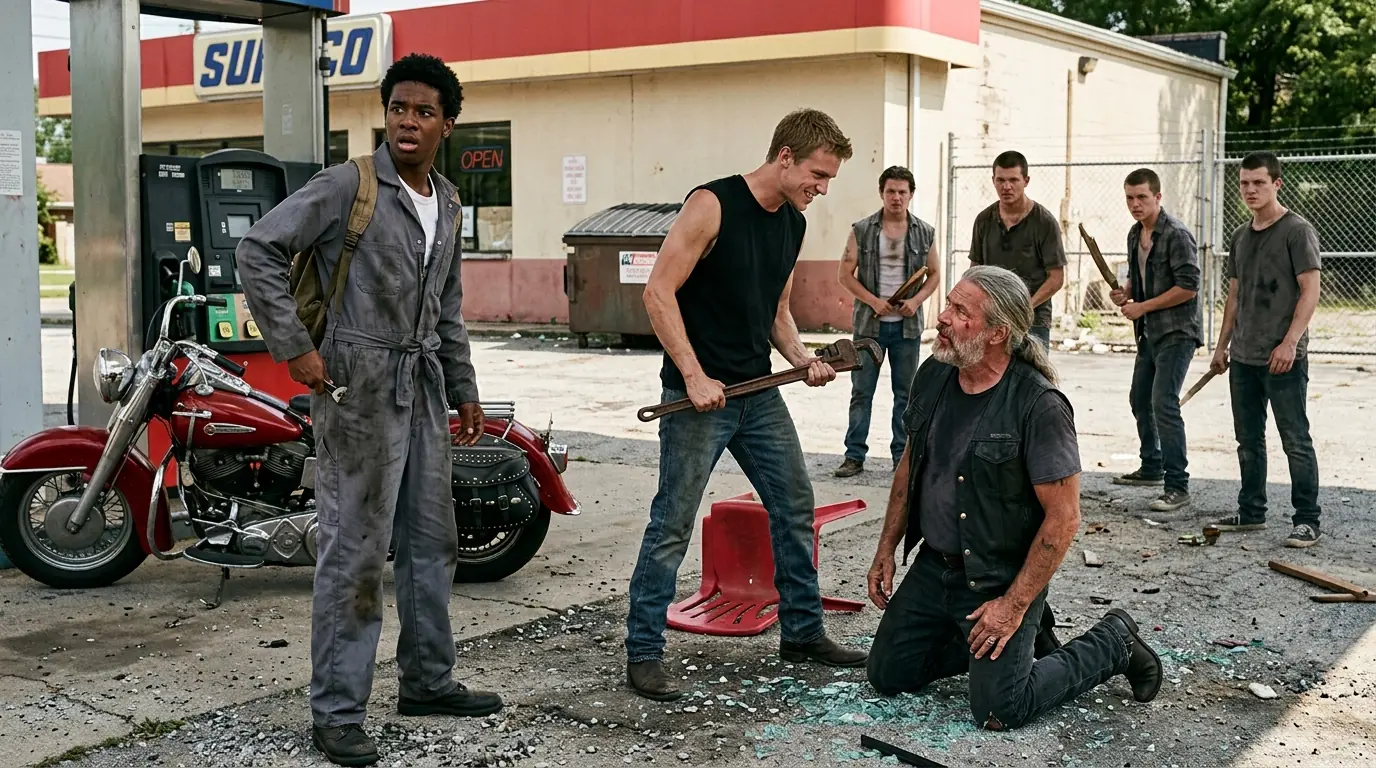
Then Brett grabbed a plastic chair from beside the station wall and swung it into Hank’s back.
The chair cracked.
Hank dropped onto one knee.
Pain moved through his ribs.
His lower lip split against his teeth.
Thirty years earlier, Hank would have broken the first man’s jaw before the second understood a fight had begun.
But age had changed the mathematics.
Six young men.
A damaged back.
No weapon.
No immediate help.
Trent stood above him.
“Now you ready to cooperate?”
Jordan turned the corner.
His shoe scraped gravel.
One of the boys looked back.
“Keep walking.”
Jordan stopped.
He saw Hank on his knees.
Broken glass.
The cracked chair.
The wrench.
Six men.
His mind counted distances automatically.
Dumpster to his left.
Chain near the curb.
Water bottle attached to his backpack.
Adjustable wrench in his pocket.
No safe way to win.
Only ways to interrupt.
Brett stepped between Jordan and Hank.
“This does not concern you.”
Jordan looked past him.
Hank met his eyes and shook his head.
“Go home, son.”
Jordan remained still.
Trent tapped the pipe wrench against the Panhead’s tank.
“Listen to the old man.”
Hank’s voice cracked.
“Please.”
That sound changed everything.
Jordan reached for the bicycle chain beside the dumpster.
Trent noticed.
“Mind your business, or we put you on the ground beside him.”
“He asked for help.”
Jordan wrapped the chain around his left hand.
“I’m helping.”
Trent laughed.
The five men spread wider.
Jordan threw his water bottle.
It struck the back of Trent’s head.
Before anyone processed the movement, Jordan drove his shoulder into Cody’s chest.
Cody fell backward.
Brett swung the broken chair.
Jordan raised his left forearm.
Plastic split against bone.
Pain shot into his shoulder.
His hand went numb.
Jordan continued moving.
He snapped the bicycle chain against Jesse’s shins.
Jesse screamed and fell.
Behind them, Hank rose.
The old man moved with a speed his age had hidden.
He swept one attacker’s legs and sent him flat onto the pavement.
Trent charged Jordan with the pipe wrench.
Jordan twisted.
The metal scraped his shoulder.
He ducked beneath the second swing, looped the chain around Trent’s wrist, and pulled.
The wrench fell.
Hank stepped beside Jordan.
One hand settled on the young man’s good shoulder.
The attackers who remained standing stopped.
Hank’s face had changed.
He was no longer an elderly victim kneeling in glass.
He looked like the man who had spent decades leading riders through disputes few outsiders ever heard about.
“Walk away,” Hank said.
No anger.
No shouting.
Something colder.
Trent looked into his eyes.
Then ran.
The others followed.
The Chevrolet left the parking lot with one door still open.
Jordan remained standing for two breaths.
Then his knees weakened.
He sat on the curb and began shaking.
The adrenaline had protected him from pain.
Now the bill arrived.
His forearm darkened.
His shoulder burned.
One knee bled through his jeans.
Hank crouched.
He studied Jordan’s hands.
Grease beneath the fingernails.
A small wrench in the back pocket.
A library card beside the wallet that had fallen during the struggle.
Hank removed a folded blue bandanna from his vest and wrapped Jordan’s forearm.
His hands moved with practiced care.
Jordan noticed the compass ring.
“What is your name?”
“Jordan Carter.”
“Why did you do that?”
Jordan looked toward the locked gas-station door.
“Nobody else was going to.”
Hank finished the knot.
Then removed a thick roll of cash from his vest.
“Take it.”
Jordan stared at the money.
“There is probably four thousand dollars here. It covers the injury and whatever trouble follows.”
“No, sir.”
“You took a wrench to the shoulder for me.”
“I did not do it for money.”
“Then use it for your family.”
Jordan heard Ruth’s voice.
We do not take what we did not earn.
He shook his head.
“I can’t.”
Hank studied him.
Most people refused money once because pride expected a second offer.
Jordan refused it a third time.
Hank returned the roll to his vest.
“All right.”
Jordan stood carefully.
He walked past the Panhead.
Then stopped.
The pinstripes.
The brass badge beneath the seat.
The shape of the tank.
He had seen it hundreds of times in the library book.
Jordan looked at Hank.
Then at the motorcycle.
Hank saw recognition arrive.
He gave no explanation.
One corner of his mouth lifted.
Jordan began walking again.
“Son.”
He turned.
Hank pulled on his helmet.
“We don’t forget.”
The Panhead started with a deep mechanical thunder.
Hank left the station.
Jordan watched until the cherry-red tank disappeared.
Inside the station, the clerk waited until both men were gone.
Then he unlocked the door and called a number he had not used in eleven years.
“It was Hank,” he said.
A pause followed.
“Six boys jumped him. Some kid helped.”
The voice on the other end asked for a name.
“Jordan. Works at Bellman Auto.”
The call ended.
Jordan returned home at six forty.
Ruth saw the bandanna, dirt, and stiffness in his shoulder.
“What happened?”
“Caught my arm on a fence.”
Ruth looked at him for a long time.
She did not believe him.
But his face told her the truth would arrive when he could carry it.
She unwrapped Hank’s bandanna, cleaned the bruising, and applied fresh gauze.
Then she folded the blue cloth and placed it beside her medical notebook.
That night, Jordan stared at the ceiling.
Three words moved through his mind.
We don’t forget.
By morning, three separate groups were searching for him.
At the Red Compass clubhouse, Hank sat at the head of a long oak table.
Ten senior members waited.
“There is an eighteen-year-old mechanic on the East Side,” Hank said. “Jordan Carter.”
A rider called Preacher opened a notebook.
“Family?”
“Lives with his grandmother.”
“Trouble?”
“None that we know.”
“Money?”
“Not enough.”
Hank tapped the compass ring against the table.
“I want facts. Not gossip. Nobody approaches him until I understand what help would actually mean.”
One member asked, “What are you planning?”
Hank looked toward the photographs covering the clubhouse wall.
“For twenty-four years, we have spent most of our energy remembering the dead.”
He returned his attention to the table.
“It may be time to invest in someone living.”
At the local television station, reporter Laura Brennan received an anonymous voicemail.
She opened an old file labeled:
CALLAHAN, HENRY — CUSTOM MOTORCYCLES
A younger Hank stood beside the red Panhead.
Laura called her producer.
“I may have a story.”
At Bellman Auto, Jordan returned to work with his arm wrapped.
Calvin examined the bruise.
“Fence?”
“Yes.”
“What kind of fence swings a chair?”
Jordan looked at him.
Calvin sighed.
“Tell me when you are ready.”
Three days later, the forty-three motorcycles arrived.
On Madison Street, Ruth appeared after Mrs. Davis called her.
She stepped from a neighbor’s car and saw her grandson standing before a motorcycle club, a television camera, and one of the most famous custom builders in America.
Jordan took her hand.
Hank removed his helmet and held it against his chest.
“Mrs. Carter.”
She nodded.
“Mr. Callahan.”
“Your grandson saved my life.”
Ruth looked at Jordan.
The lie about the fence collapsed without argument.
Hank continued.
“I asked both of you to visit my shop tomorrow morning. Ten o’clock.”
“For what?” Ruth asked.
“Business.”
“I do not accept charity.”
Hank’s expression softened.
“I have already heard that about you.”
The following morning, Jordan and Ruth entered Callahan Custom Cycles.
The flagship shop occupied a converted warehouse.
Motorcycles Jordan had only seen in magazines stood across polished concrete beneath clear lights.
He kept his hands at his sides.
Hank noticed.
He led them into a private room containing a long table.
Calvin was already there.
Hank placed a folder before Ruth.
“I will make two offers. Then you can reject, negotiate, or accept them.”
Ruth folded her hands.
“Go ahead.”
“The Brotherhood has a medical assistance fund. We are prepared to cover your outstanding diabetes treatment and future supplies.”
Ruth’s expression tightened.
Hank raised one hand.
“In exchange, when we open a community garage on the East Side, you will manage the front office. Full salary. You keep the books, greet customers, and prevent the mechanics from pretending paperwork is optional.”
Ruth looked toward Jordan.
“That is real work?”
“Very real.”
“Then continue.”
Hank placed a second folder before Jordan.
“This is a paid apprenticeship.”
Jordan stared.
“Five days a week. You begin cleaning bays, organizing tools, and preparing parts. You earn access to advanced work.”
“Why?”
“Because I watched how you moved around my motorcycle.”
Hank leaned back.
“You recognized the build without touching it. You carried a library card. Calvin says you understand machines and arrive before he does.”
Calvin cleared his throat.
“Sometimes.”
Hank continued.
“I am not giving you a career because you helped me.”
“Then what are you giving me?”
“An opportunity to prove you deserve one.”
Jordan opened the contract.
The pay exceeded what he earned at Bellman Auto.
Trade-school assistance appeared under the education section.
He read every line.
Ruth watched silently.
Jordan signed.
Calvin received a separate offer.
Senior mechanic and minority partner in the future community garage.
He accepted before Hank finished explaining.
Jordan’s apprenticeship began Monday.
He arrived before sunrise.
For three weeks, nobody allowed him near a custom motorcycle.
He swept floors.
Cleaned tools.
Sorted bolts.
Learned inventory systems.
Some employees assumed he had received the position because of publicity.
Jordan never argued.
He worked until the assumption became embarrassing for anyone still holding it.
By the tenth week, lead builders asked for him by name.
Hank enrolled him in trade school.
Ruth’s medical care stabilized.
For the first time in years, her blood-sugar readings remained within the range her doctor wanted.
Members of Red Compass repaired the Carter home on weekends.
Ruth supervised every nail from a folding chair.
She accepted the work because Hank added the material costs to the community garage’s operating agreement.
She would repay part of it through wages.
Neither side called the arrangement charity.
Nine months after the gas-station fight, Hank gave Jordan another assignment.
“Write a business plan.”
“For what?”
“The East Side garage.”
“You already have one.”
“I have an empty building and money.”
Hank handed him a blank notebook.
“You have lived there. Tell me what the neighborhood needs.”
Jordan worked for eight weeks.
Low-cost repairs for elderly residents.
Apprenticeships for teenagers.
Weekend classes.
Tool lending.
Payment plans that did not trap customers.
He asked Ruth to correct the grammar.
She rewrote entire paragraphs without mercy.
The plan was accepted.
CARTER-CALLAHAN COMMUNITY GARAGE opened the following February.
Snow covered the sidewalk.
Mrs. Davis became the first customer.
Her alternator had failed.
Jordan repaired it without charging labor.
Her grandson watched from beside the lift.
Ruth sat behind the front counter wearing a clean apron.
Within a week, she knew every customer’s name.
Behind her hung a framed blue bandanna.
Beneath it, three words had been carved into walnut.
WE DON’T FORGET.
Hank stood before it on opening day.
He touched the glass once.
Then nodded.
Eighteen months after the fight, Trent Vaughn entered the community garage.
He had lost forty pounds.
His hair was shorter.
His hands shook.
Jordan sat across from him.
Trent did not ask for forgiveness.
“I need work.”
Jordan studied him.
“Why here?”
“No one else will hire me.”
“That is not an answer.”
Trent looked down.
“Because I know you will remember what I did.”
Jordan stood and returned carrying a broom.
“Start with the front bay.”
Trent accepted it.
Jordan added, “You speak respectfully to every customer. You do not touch a motorcycle without permission. You threaten anyone, you leave.”
Trent nodded.
He stayed.
A year later, he remained at the garage and had learned enough humility to ask questions before pretending knowledge.
Hank and Jordan began building a Panhead together.
It was not a gift.
It was a teaching project.
Jordan completed each stage only after demonstrating the skill.
Two years after the rescue, the Carter-Callahan program had funded three apprenticeships and two scholarships.
One went to a young woman pursuing nursing.
Another supported a boy studying diesel technology.
Jordan still carried the small adjustable wrench.
One afternoon, he heard shouting behind a building near the garage.
Three older boys had pinned a twelve-year-old against a wall.
His backpack lay open.
Library books covered the gravel.
Jordan stepped between them.
He did not raise his voice.
The boys read the garage name across his shirt.
They had heard the story.
They left.
Jordan crouched and gathered the books.
One covered automotive engines.
“Yours?”
The boy nodded.
“Why did you help me?”
Jordan handed him the book.
He remembered Hank bleeding near the gas pump.
Ruth placing twenty dollars back in his hand.
Forty-three motorcycles filling Madison Street.
“We don’t forget.”
The boy did not understand.
Not yet.
Jordan gave him a business card.
“Come Saturday morning. Eight o’clock.”
“What for?”
“You like engines?”
“Yes.”
“Then I’ll show you how one works.”
The boy held the card carefully.
“Thank you, sir.”
“Jordan.”
“Yes, Jordan.”
He walked away.
After ten steps, he looked back.
Jordan remained there.
They exchanged one small nod.
Then the boy ran home.
Jordan took the long route back to the garage.
He passed the old Sunoco station.
New owners had painted the wall blue.
But beneath the paint, the faint outline of a winged wheel remained visible when the light struck at the correct angle.
Jordan continued walking.
Through the garage window, Ruth sat behind the counter writing in her ledger.
She looked up and waved.
He raised one hand.
The framed bandanna hung behind her.
Hank had told Jordan that the Brotherhood remembered people who stood up.
Over time, Jordan understood the code more deeply.
Remembering was not only about repaying a debt.
It was about passing forward the moment someone had once offered you.
A hand when you were cornered.
A job when every door was closed.
A lesson when anger would have been easier.
One stranger had asked Jordan for help.
Jordan ran toward him.
Years later, a frightened boy asked the same question with his eyes.
Jordan stepped forward again.
Because kindness that ends with the person who receives it is only a favor.
Kindness carried forward becomes a code.
And on the East Side, beneath a blue bandanna and three carved words, that code had finally found a home.