Daniel Hayes knew the interview was no longer ordinary when the executive elevator carried him past the twenty-ninth floor.
He stood alone beneath soft white lights, wearing the only suit he owned.
The navy fabric had been soaked through in the Seattle rain one day earlier. He had spent most of the night drying it with towels, pressing the trousers beneath a stack of books, and sewing a loose seam near the inside pocket.
A pale water stain remained along the left sleeve.
His tie was slightly crooked.
His shoes, borrowed from the elderly man across the hall, were half a size too small.
The illuminated numbers climbed.
Thirty.
Thirty-one.
Thirty-two.
Daniel looked at his reflection in the mirrored wall.
He had been invited to interview for Director of Regional Operations at Meridian Systems. The original meeting was supposed to take place yesterday on the eighteenth floor with three department heads.
He had missed it.
The rejection email arrived before he reached his daughter’s school.
Yet someone from Meridian’s executive office had called that afternoon and ordered him to return.
Not requested.
Ordered.
The elevator doors opened.
A woman carrying a tablet waited in a reception area overlooking downtown Seattle.
“Mr. Hayes?”
“Yes.”
“I’m Lauren Webb, executive coordinator. They’re ready for you.”
“They?”
Lauren gave him a careful smile.
“The leadership committee.”
Daniel looked toward the glass doors at the far end of the room.
“I thought this was another interview.”
“It is.”
“That answer did not make me less concerned.”
Her smile became more genuine.
“Please follow me.”
The conference room was larger than Daniel’s apartment.
A long walnut table occupied the center. Twelve people sat around it, dressed in dark suits and expressions shaped by expensive education, private offices, and the expectation of being listened to.
Daniel recognized several faces from Meridian’s website.
Gerald Whitmore, executive vice president of operations.
Melissa Tran, chief financial officer.
The head of human resources.
Two regional directors.
Three board members.
At the head of the table stood an empty chair.
Gerald rose.
He was in his late fifties, silver-haired, carefully groomed, and visibly displeased by Daniel’s presence.
“Mr. Hayes.”
“Mr. Whitmore.”
“I understand there was an issue with your scheduled interview yesterday.”
Daniel remained standing.
“There was no issue. I failed to arrive.”
Gerald appeared surprised by the answer.
“You acknowledge that?”
“My absence is not difficult to verify.”
A board member near the window looked amused.
Gerald did not.
“Please sit.”
Daniel chose the chair nearest the door.
No one opened a résumé.
No one introduced themselves.
The room held the quiet pressure of a hearing rather than an interview.
At exactly nine o’clock, the doors opened again.
The injured woman from the storm entered on crutches.
Daniel stood before he realized he was moving.
She wore a tailored forest-green suit instead of the bright red dress she had worn in the rain. A medical boot enclosed her left ankle. Her dark hair fell loosely to her shoulders, and the scrape on one palm had been covered with a small white bandage.
The room changed when she entered.
People straightened.
Gerald closed his notebook.
The woman stopped at the head of the table and looked at Daniel.
“You found another suit.”
“It is the same suit.”
She examined the sleeve.
“You performed emergency surgery.”
“A needle and thread were involved.”
“Impressive.”
Gerald cleared his throat.
“Mr. Hayes, this is Amelia Sterling, chief executive officer of Meridian Systems.”
Daniel stared at her.
The confidential documents scattered across the street.
The red Mercedes.
The vague answer about working in management.
The employees who supposedly existed to answer phones.
He sat slowly.
“You could have mentioned that.”
Amelia lowered herself into the chair with visible discomfort.
“You could have asked more specific questions.”
“I asked what you did for work.”
“I said management.”
“That is like a surgeon saying she works around hospitals.”
One of the board members laughed.
Gerald remained expressionless.
Amelia placed a folder on the table.
“Yesterday morning, Mr. Hayes missed his interview because he stopped to assist me after I fell and injured my ankle.”
Gerald folded his hands.
“We are familiar with the circumstances.”
“Are you familiar with the fact that his application was withdrawn without anyone allowing him to explain?”
“Our candidates are informed that punctuality is essential.”
“He called at nine three.”
“The interview began at nine.”
“He was driving an injured stranger to Harborview Medical Center.”
“We had no way to verify that.”
Amelia looked directly at him.
“You spoke to the injured stranger.”
“You did not identify yourself.”
“Would my identity have made the emergency more legitimate?”
Silence moved around the table.
Daniel understood that he had entered an argument already in progress.
Amelia looked toward the leadership team.
“Meridian’s values statement uses the words judgment, integrity, and responsibility twenty-six times.”
She opened Daniel’s file.
“Yesterday, a candidate demonstrated all three at personal cost. Our process rejected him because the demonstration occurred three minutes after an appointment rather than inside a conference room.”
Gerald’s jaw tightened.
“We cannot abandon procedure whenever a candidate offers an emotional explanation.”
“No,” Amelia said. “But we should question a procedure that punishes precisely the qualities we claim to recruit.”
She turned toward Daniel.
“Your interview begins now.”
Daniel looked around the table.
Several executives appeared curious.
Gerald appeared hostile.
Amelia’s expression was unreadable.
“I want one thing clarified first.”
Amelia leaned back.
“Go ahead.”
“If I receive this position because I helped you, then I am not being hired. I am being rewarded.”
Gerald looked toward Amelia as if waiting for the statement to offend her.
It did not.
“What if yesterday revealed something relevant to the position?” she asked.
“It revealed that I make inconvenient decisions.”
“Operations leaders make inconvenient decisions every day.”
“Yesterday was personal.”
“Every operational decision becomes personal to the people who live with it.”
Daniel considered her words.
Gerald opened his copy of the résumé.
“Then perhaps we should determine whether Mr. Hayes possesses any qualifications beyond roadside kindness.”
The rain had begun before sunrise the previous morning.
By eight thirty, downtown Seattle looked as though it were dissolving.
Water poured from rooftops, rushed through gutters, and collected in deep gray pools along the streets. Buses moved through the storm with headlights glowing like pale eyes.
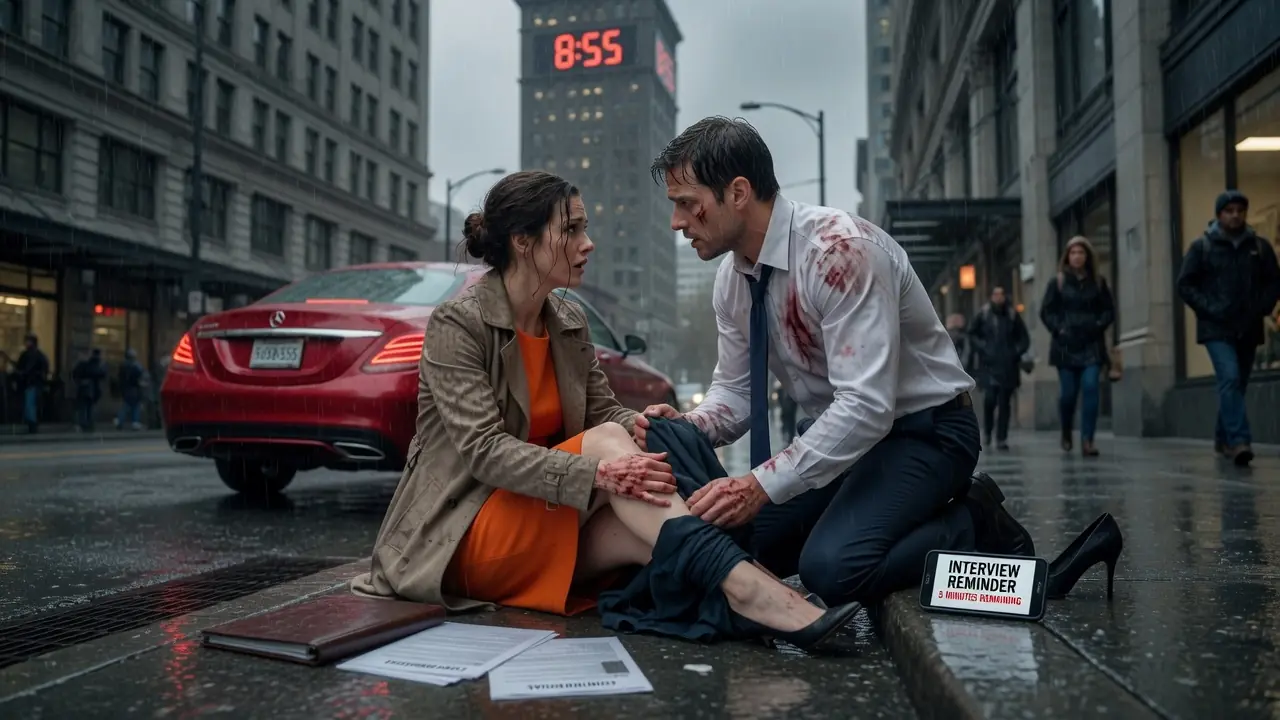
Daniel ran through it.
His jacket clung to his shoulders. Water filled his shoes and made a sucking sound with every step.
He was thirty-eight years old, recently unemployed, and three months behind on nearly everything except rent.
Rent could not wait.
Neither could his daughter’s asthma medication.
Neither could the grocery bill folded beneath a magnet on the refrigerator.
His interview at Meridian began at nine.
His watch read 8:31.
Three months earlier, Daniel had been laid off when Cascade Freight Services closed two regional distribution centers.
He had worked there fourteen years.
He began loading trucks on the night shift, became a team leader, then warehouse supervisor, and eventually director of regional logistics.
The company had praised his loyalty until an acquisition made twelve hundred workers inconvenient.
Daniel’s wife, Rebecca, had died from ovarian cancer two years earlier.
Medical bills continued arriving long after she was gone.
He shared a small apartment with their seven-year-old daughter, Sophie.
That morning, Sophie had eaten cereal at the kitchen table while Daniel adjusted the only tie he owned.
“You look worried,” she said.
“I look professional.”
“You look like you swallowed a battery.”
Daniel had smiled.
His daughter possessed Rebecca’s directness.
“This interview matters.”
“Are you going to get the job?”
“I’m going to do my best.”
“You always say people shouldn’t promise things they can’t control.”
“Doing my best is something I can control.”
Sophie held out her little finger.
“Promise?”
Daniel linked his finger with hers.
“Promise.”
The morning began badly.
Mrs. Alvarez, the neighbor who watched Sophie before school, arrived twenty minutes late because her grandson had a fever.
Then Daniel’s train stopped between stations because of an electrical failure.
Passengers waited inside the darkened carriage while the minutes disappeared.
When transportation workers finally opened the doors, Meridian Tower stood almost two miles away.
Daniel began running.
At 8:34, he reached the corner of Fifth Avenue and Madison Street.
A red Mercedes sat crooked beside the curb with its hazard lights flashing.
The driver’s door was open.
A woman in a bright red dress stepped onto the sidewalk.
She carried a beige coat over one arm and a leather folder beneath the other.
Her narrow heel entered a storm drain.
Her ankle twisted.
She struck the side of the car and fell onto both hands.
The folder opened.
Papers scattered into the street.
People moved around her.
A cyclist swerved past.
A man beneath a large umbrella looked down, then hurried across the intersection.
Two office workers stepped over her coat without interrupting their conversation.
Daniel stopped.
His watch showed 8:35.
Meridian Tower stood three blocks away.
The woman tried to rise.
Her injured ankle folded.
She cried out and dropped back to the pavement.
Daniel looked once toward the tower.
Then ran to her.
“Don’t stand.”
She looked up sharply.
Rain had loosened dark strands of hair across her face.
“I’m fine.”
“You fell twice in ten seconds.”
“I only fell once.”
“The second attempt counts.”
She reached for the car door.
“I have a meeting.”
“So do I.”
Her eyes moved over his soaked suit.
“I can see that.”
“My meeting is becoming theoretical.”
“My documents.”
The papers were moving toward the gutter.
“I’ll get them.”
Daniel stepped into the street.
He collected pages from beneath parked cars, against the curb, and beside a delivery van. One sheet floated toward a drain.
He entered ankle-deep water and caught it before it disappeared.
Across the top were the words:
MERIDIAN SYSTEMS
CONFIDENTIAL RESTRUCTURING PROPOSAL
His stomach tightened.
The woman worked for the company.
Perhaps she was an executive assistant.
Perhaps she would be in his interview.
Perhaps she was another candidate carrying material she should not possess.
Daniel placed the thought aside and collected the remaining pages.
When he returned, the woman was trying to pull her heel from the drain.
“Stop.”
“It was a gift.”
“From someone important?”
“My sister.”
“Then we save the shoe.”
He crouched and loosened the strap.
Her ankle had already begun swelling.
Daniel carefully slid her foot free.
Then he twisted the heel between the metal bars.
It did not move.
He pulled harder.
The shoe came free suddenly, sending him backward into the rain.
The woman laughed despite herself.
Daniel held it up.
“Rescued.”
“The leather is ruined.”
“Rescued and restored are different services.”
He removed his jacket.
“What are you doing?”
“Keeping your ankle still.”
“You’ll destroy your suit.”
“The weather has already started.”
Daniel folded the jacket around her ankle and secured the sleeves loosely.
He took out his phone.
“I’m calling an ambulance.”
“No.”
“You cannot stand.”
“I have a driver.”
She looked toward the Mercedes.
The driver’s seat was empty.
“Where?”
“He stopped at a pharmacy. We were late, so I told him I would drive the remaining distance.”
Daniel glanced at the shoe.
“Your morning demonstrates excellent judgment.”
She almost smiled.
Her phone screen had cracked in the fall.
Daniel handed her his.
She called the driver.
No answer.
Then an assistant.
Voicemail.
She muttered something under her breath.
“What?”
“I employ people specifically to answer phones.”
“Perhaps they’re helping strangers.”
Her look suggested the possibility was unlikely.
Daniel called emergency services.
The dispatcher warned that heavy rain had caused several accidents. An ambulance might take thirty minutes or longer.
Daniel checked his watch.
8:43.
Seventeen minutes remained.
If he left immediately, he could still reach Meridian Tower.
The woman noticed.
“You should go.”
Daniel did not answer.
“You said you have an interview.”
“Yes.”
“What time?”
“Nine.”
Her expression shifted slightly.
“Where?”
“Meridian Systems.”
Something passed across her face.
Recognition.
Concern.
Perhaps guilt.
“You will miss it.”
“I know.”
“Then leave.”
“I cannot leave you sitting beside a storm drain.”
“You have already done more than anyone else.”
“That does not mean the job is complete.”
She studied him.
“Do you always argue with injured women?”
“Only when they are obviously wrong.”
She handed him the Mercedes key.
“You drive.”
Daniel stared at it.
“I do not drive cars worth more than my building.”
“You have permission.”
“Harborview?”
“Yes.”
Traffic moved slowly through standing water.
The hospital was in the opposite direction from Meridian Tower.
Daniel thought of Sophie’s inhaler.
The rent increase.
His remaining savings.
The rejection emails.
The promise to return with good news.
Then he looked at the woman’s swollen ankle.
He opened the passenger door.
“I’ll take you.”
She blinked.
“You’re serious?”
“I have already made the bad decision. We might as well perform it efficiently.”
Helping her into the car required patience.
She insisted she could manage.
She could not.
“You’re hopping with one shoe in a storm,” Daniel said.
“I am adapting.”
“You are falling with confidence.”
Once she was seated, Daniel ran around the car.
The interior smelled of expensive leather and jasmine.
He pressed the start button.
Nothing happened.
“You need to press the brake,” she said.
“I knew that.”
“You clearly did not.”
“I was checking whether the car could detect leadership potential.”
The engine started.
Rain struck the windshield faster than the wipers could clear it.
For several blocks, neither spoke.
The woman held Daniel’s jacket around her ankle.
“What is your name?”
“Daniel Hayes.”
“I’m Amelia.”
“Nice to meet you.”
“Is it?”
“The day is still developing.”
She smiled.
Pain quickly replaced it.
Daniel noticed a bottle of ibuprofen inside the glove compartment and handed it to her with water.
“You travel with medication?”
“I travel frequently.”
“For management?”
She looked at him.
“Yes.”
“What type?”
“Corporate.”
“That is impressively vague.”
“I have worked hard at it.”
“What position are you applying for?” she asked.
“Director of Regional Operations.”
“Experience?”
“Fourteen years at Cascade Freight.”
“I know Cascade.”
“Then you know it no longer exists.”
“It was acquired by Brighton Holdings.”
“It was dismantled by Brighton Holdings.”
Amelia looked toward him.
“That sounds personal.”
“Twelve hundred people losing their jobs became personal.”
“What was your role?”
“Regional logistics director.”
“You began in management?”
“Loading trucks.”
She turned more fully toward him.
“You moved from the loading floor to regional leadership?”
“Over thirteen years.”
“Why stay so long?”
“My wife became ill.”
Daniel kept his eyes on the road.
“She had cancer.”
“I’m sorry.”
“Thank you.”
“You stayed because of insurance?”
“Insurance. Treatment schedules. Our daughter.”
“What is her name?”
“Sophie.”
“How old?”
“Seven.”
Amelia looked down at the jacket wrapped around her ankle.
“Your family needs this job.”
“Yes.”
The honesty surprised her.
Daniel had no reason to pretend otherwise.
The dashboard clock changed to 9:01.
His interview began without him.
Amelia watched his hands tighten on the steering wheel.
“You should call.”
Daniel gave her his phone.
The receptionist answered.
Amelia identified herself only by first name.
She explained that Daniel was transporting an injured woman to Harborview.
The receptionist responded with a rehearsed policy.
Candidates arriving more than five minutes late were removed from consideration.
“He called before the grace period ended,” Amelia said.
Daniel heard another response.
“You are speaking to the call.”
The receptionist apparently repeated the policy.
Amelia ended the conversation.
Daniel glanced at her.
“That went well.”
“She marked your application as withdrawn.”
“Efficient.”
“I can call again.”
“No.”
“They should understand.”
“They understood enough to make a decision.”
Amelia frowned.
“You missed the interview because of me.”
“I missed it because I chose to stop.”
“You could have left.”
“Yes.”
“Do you regret it?”
Daniel thought about the question.
“At this exact moment?”
“Yes.”
“A little.”
Amelia looked surprised.
Daniel continued.
“Doing the right thing does not require enjoying the consequences.”
Her expression softened.
At Harborview, a nurse brought a wheelchair.
Daniel helped Amelia transfer into it.
“You do not have to stay,” she said.
“I know.”
“Your daughter is waiting for news.”
“She is waiting for me to do my best.”
“And did you?”
Daniel looked at her.
“Yes.”
Amelia handed back the jacket.
“Then go.”
He accepted it.
She extended one hand.
“Thank you, Daniel Hayes.”
He shook it.
“Next time, wear shoes designed by engineers.”
“My sister will be devastated.”
“She can visit you in rehabilitation.”
Daniel stepped outside at 9:27.
The rejection email waited on his phone.
He read it beneath the hospital awning.
Due to your failure to attend your scheduled interview, your application has been withdrawn.
He placed the phone in his pocket and began walking toward the nearest station.
That afternoon, Sophie ran from school and jumped into his arms.
“Did you get it?”
Daniel set her down.
“I missed the interview.”
Her smile disappeared.
“Why?”
“A woman fell and hurt her ankle.”
“Was she okay?”
“I took her to the hospital.”
“Did she cry?”
“Not much.”
“Did you?”
“Only when I saw the parking rate.”
Sophie did not laugh.
“You needed the job.”
“I did.”
“Are we going to lose our apartment?”
The question struck harder than Daniel expected.
He crouched.
“Where did you hear that?”
“You told Mrs. Alvarez.”
“I thought you were asleep.”
Sophie held the straps of her backpack.
“Is helping someone still right if it makes us lose our home?”
Daniel wanted to give her a simple answer.
Simple answers were often lies adults told children because uncertainty frightened them.
“We are not losing our home today.”
“What about next month?”
“I will keep applying.”
“That is not what I asked.”
She had Rebecca’s persistence too.
Daniel took both her hands.
“Helping her was right.”
“Even if it cost the job?”
“Yes.”
“Why?”
“Because something does not become wrong just because doing it is expensive.”
Sophie considered this.
Then held out her little finger.
“You did your best?”
Daniel linked his with hers.
“I did.”
“That counts.”
The next morning, Amelia sat in a private room at Harborview while a doctor fitted the medical boot.
Her assistant, Lauren Webb, stood beside the bed holding two phones and looking ashamed.
“I’m sorry I missed your calls.”
“You missed eleven.”
“I was in the basement archive room. There was no signal.”
“And Marcus?”
“He had been told you were already at Meridian.”
Amelia closed her eyes briefly.
The confidential restructuring documents lay dry inside a replacement folder.
One page had been destroyed.
The rest survived because a stranger had stepped into a flooded gutter while people with umbrellas continued walking.
“Who was scheduled for operations interviews yesterday?”
Lauren checked the tablet.
“Four candidates.”
“Daniel Hayes?”
Lauren’s fingers paused.
“Withdrawn for nonattendance.”
“Who authorized that?”
“Recruiting policy. Gerald’s office approved the process.”
“Restore the application.”
Lauren looked up.
“The panel has completed the interviews.”
“Then schedule another.”
“Gerald will object.”
“Yes.”
“He may accuse you of favoritism.”
“He often confuses accountability with an accusation.”
Amelia looked toward the rain outside the hospital window.
“Schedule him for nine tomorrow.”
The boardroom interview lasted nearly two hours.
Gerald questioned Daniel’s employment gap.
Daniel explained caring for Sophie after Rebecca’s death.
Melissa challenged his lack of technology-sector experience.
Daniel replied that trucks, warehouses, and software all failed for the same reason when executives refused to listen to the people operating them.
Amelia asked why Cascade’s employee-retention rate had been higher in Daniel’s region.
“We stopped pretending turnover was a worker attitude problem.”
“What did you change?”
“Shift scheduling.”
Daniel explained how warehouse employees missed shifts because public transportation schedules did not align with management’s rotating hours.
He created fixed shift windows and an internal exchange system.
Absenteeism fell.
Overtime expenses decreased.
Accidents declined because exhausted employees were no longer pressured into double shifts.
Gerald leaned forward.
“What would your first ninety days at Meridian look like?”
“Thirty days listening.”
“That seems slow.”
“Changing a system before understanding it is slower.”
“You were hired to make decisions.”
“I would be hired to make correct decisions.”
A board member smiled.
Daniel continued.
“I would visit every regional center without giving management time to prepare a performance.”
Gerald frowned.
“You would surprise local directors?”
“I would observe normal operations.”
“There is a difference between scrutiny and distrust.”
“Yes. Scrutiny checks facts. Distrust assumes failure.”
Amelia watched Daniel carefully.
He did not use polished corporate phrases.
He spoke about loading delays, staffing incentives, maintenance budgets, and supervisors who manipulated reports because admitting failure threatened bonuses.
Then he asked his own questions.
“Why did the previous operations director leave?”
Gerald answered first.
“He pursued another opportunity.”
Amelia corrected him.
“He was terminated.”
Gerald’s face tightened.
Daniel looked toward her.
“Why?”
“Three regional centers concealed losses. He altered reporting classifications and blamed local managers.”
“Was he acting alone?”
“We are investigating.”
Daniel looked around the table.
“Then do you want an operations leader or someone to inherit responsibility for decisions already made?”
Gerald closed his notebook.
“That is inappropriate.”
“You asked whether I had questions.”
Amelia raised one hand.
“What makes you think the position lacks authority?”
“The job description uses accountability six times and decision authority once.”
Daniel met her eyes.
“That usually means the person is responsible for outcomes controlled by someone else.”
The room became quiet.
“What authority would you require?” Amelia asked.
“Direct access to regional data.”
She nodded.
“Ability to pause initiatives creating safety or staffing problems.”
“Reasonable.”
“And permission to tell the chief executive when her plan is wrong without losing my job before lunch.”
Amelia glanced at the clock.
“I rarely fire anyone before lunch.”
Daniel looked toward Gerald.
“That has not been confirmed by independent sources.”
This time even Melissa laughed.
The interview ended at 10:52.
Daniel returned home without knowing whether he had rescued or destroyed his candidacy.
Two days passed.
Then three.
He accepted temporary night work unloading grocery trucks.
At 6:40 on Monday evening, someone knocked on his apartment door.
Amelia stood outside wearing jeans, a black sweater, and the medical boot.
She carried a pizza box.
Daniel stared.
“How did you find my address?”
“I run a technology company.”
“That answer is disturbing.”
From the kitchen, Sophie called, “Is that pizza?”
Amelia raised the box.
“Yes.”
Sophie appeared beside her father.
She looked immediately at the boot.
“Are you the woman from the rain?”
“I am.”
“My dad said you were stubborn.”
Daniel closed his eyes.
“I did not use that exact word.”
“You said she argued while sitting in a puddle.”
Amelia smiled.
“He was correct.”
Daniel allowed her inside.
Their apartment was small but warm. Sophie’s drawings covered the refrigerator. A photograph of Rebecca stood on a shelf beside Daniel’s military service medal from the National Guard.
Amelia paused near it.
“Your wife?”
“Rebecca.”
“She looks kind.”
“She was.”
Sophie placed the pizza on the table.
“Why are you here?”
“Sophie,” Daniel warned.
“You say direct questions save time.”
Amelia lowered herself into a chair.
“I came to offer your father a job.”
Sophie turned.
“You got it?”
Daniel looked at Amelia.
“Did I?”
She placed a folder on the table.
“Director of Regional Operations. Full advertised salary. Medical insurance beginning immediately. Thirty days of severance protection if the board removes the role during restructuring.”
Daniel did not open it.
“What happened to the other candidates?”
“Two were qualified. One was excellent.”
“Then why me?”
“You were ranked first.”
“By whom?”
“The panel.”
“Did you influence them?”
“Yes.”
Daniel leaned back.
“How much?”
“I restored your application, joined the interview, and argued that judgment under pressure was relevant.”
“Then everyone will believe I received the job because I helped you.”
“Some people already do.”
“And you?”
“I believe helping me returned you to an interview you should never have lost.”
She slid the folder closer.
“You earned the job in the boardroom.”
Daniel looked at the papers.
“The distinction may not matter to people inside the company.”
“It will matter to you.”
“That does not solve the problem.”
“No.”
Amelia’s honesty prevented an easy argument.
“But you cannot organize your life around the suspicions of people who benefit from doubting you.”
Sophie climbed into the chair beside him.
“Does it have health insurance?”
Daniel looked at her.
“You are seven.”
“My inhaler is expensive.”
Amelia became very still.
Daniel opened the folder.
The salary was higher than he had earned at Cascade.
Enough to pay the rent.
Enough to eliminate the fear behind every grocery trip.
Enough to stop calculating whether Sophie’s medication could wait two days.
He read every page.
Amelia waited.
“When do I start?”
“Monday.”
Sophie threw her arms around him.
“You got it!”
Daniel held his daughter and looked over her shoulder.
“Thank you.”
Amelia shook her head.
“Save your gratitude until you meet the regional directors.”
The position was more difficult than Daniel expected.
Meridian had expanded too quickly.
Its software managed medical inventories, retail shipments, and distribution networks across several states. Yet its own regional operations were divided among systems that barely communicated.
Local managers competed for equipment.
Executive bonuses rewarded quarterly speed, encouraging leaders to postpone maintenance and hide staffing shortages.
During his first month, Daniel visited four facilities.
At Tacoma, management blamed workers for missed shipping targets. Daniel spent a night on the loading floor and discovered that the scheduling software displayed delivery trucks in the wrong sequence.
In Portland, workplace injuries increased after a consultant reduced break periods by six minutes.
In Spokane, an inventory algorithm classified damaged equipment as employee theft.
Daniel documented each problem.
Then he presented the findings to Meridian’s executive committee.
Gerald interrupted repeatedly.
“These are local failures.”
“They are responses to incentives created here.”
“You have been with Meridian for six weeks.”
“Long enough to read the reports you approved.”
The room became tense.
Amelia did not rescue him.
Daniel defended every number.
Afterward, she found him near the elevators.
“You were angry.”
“I was accurate.”
“You were both.”
“Was I wrong?”
“No.”
“Then what is the problem?”
“You stopped listening when Gerald challenged the injury data.”
“He was trying to discredit it.”
“Yes.”
“So?”
“So Gerald was not the person you needed to convince.”
Daniel frowned.
Amelia continued.
“Eight undecided people watched you respond to resistance. You gave Gerald your attention and allowed him to choose the emotional temperature.”
“You could have supported me.”
“I did.”
“When?”
“When I made you stand without me.”
Daniel stared at her.
Then laughed.
“You enjoy this.”
“Frequently.”
Professional conflict became respect.
Respect became friendship slowly enough that neither could identify when it changed.
Amelia told Daniel how she became Meridian’s chief executive after her father suffered a stroke.
She had been thirty-two.
The board expected her to stabilize the company until an older man with more experience could replace her.
Instead, she doubled revenue in five years.
The success required armor.
She worked longer than everyone else.
Remembered every detail.
Allowed no one to see doubt.
“I assumed being indispensable would feel like belonging,” she told Daniel one evening.
They stood before conference-room windows overlooking the city.
“Did it?”
“No. It felt like being indispensable.”
Daniel understood.
After Rebecca died, everyone praised his strength.
Few asked whether strength was simply what remained when a child still needed breakfast.
Amelia met Sophie at a company family event.
Sophie immediately asked about the red dress.
“It survived,” Amelia said.
“The shoes?”
“One survived.”
Daniel frowned.
“I recovered both.”
Amelia looked toward him.
“You left one in the car.”
“That means it survived.”
“You forgot it for six months.”
“I was busy correcting your company.”
Sophie gasped.
“You abandoned her shoe.”
“It was not abandonment.”
From that day forward, Sophie called the incident “the shoe betrayal.”
Amelia began joining them for Saturday breakfast.
At first, she arrived in expensive coats and answered emails beneath the table.
Sophie confiscated her phone.
“No working during pancakes.”
“I manage fourteen thousand employees.”
“Daddy manages warehouses.”
“I direct regional operations,” Daniel said.
Sophie pointed at him.
“And you don’t work during pancakes either.”
Amelia surrendered the phone.
Their relationship changed through ordinary moments.
Amelia remembering Sophie’s science-fair presentation.
Daniel bringing her coffee before difficult board meetings.
Amelia sitting beside him on the anniversary of Rebecca’s death without attempting to replace silence with comforting phrases.
Daniel teaching Amelia to make grilled cheese after discovering that her refrigerator contained sparkling water, olives, and no recognizable meals.
A year after Daniel missed the interview, Meridian reported its strongest retention numbers in company history.
Workplace injuries fell twenty-four percent.
Shipping delays decreased.
Regional managers were evaluated partly on employee development rather than quarterly speed alone.
An internal investigation revealed that Gerald Whitmore had altered forecasts to protect executive bonuses.
He resigned before the board could remove him.
Daniel was offered Gerald’s position.
He declined.
Amelia called him into her office.
“You are refusing a forty-percent salary increase.”
“Yes.”
“Why?”
“I’m not finished in operations.”
“That is not the complete answer.”
Daniel sat opposite her desk.
“The vice president role would move me farther from the people affected by my decisions.”
“You could visit facilities.”
“I could also remain in a role where visiting them is the job.”
“Most people ask how quickly they can move upward.”
“Upward is not always closer to the work that matters.”
Amelia smiled faintly.
“That sounds annoyingly wise.”
“I practice.”
That evening, Daniel collected Sophie from school.
She dropped her backpack onto the car floor.
“Amelia says you refused a promotion.”
Daniel looked at her in the mirror.
“Amelia discusses confidential company matters with you?”
“She says I’m an independent adviser.”
“You are eight.”
“Almost nine.”
“That has not improved your qualifications.”
“Would the promotion pay more?”
“Yes.”
“Then refusing it was not financially responsible.”
“Thank you.”
She leaned between the seats.
“Are you going to marry Amelia?”
Daniel nearly missed the traffic light.
“What?”
“She eats dinner at our apartment.”
“Twice a week.”
“She has shoes in the closet.”
“One pair.”
“She buys my cereal.”
“What does cereal prove?”
“Amelia does not eat cereal.”
Daniel pulled into the apartment lot.
“Your evidence is circumstantial.”
“That means I’m right.”
Amelia waited near the entrance.
She wore the same red dress from the storm.
Daniel parked and stared.
Sophie gasped.
“The rain dress.”
Amelia opened the rear door.
“I heard that.”
“You look beautiful,” Sophie said.
“Thank you.”
“Are you marrying Dad?”
Daniel closed his eyes.
Amelia looked at him over the roof of the car.
“Is that tonight’s agenda?”
“There is no agenda.”
Sophie pointed toward Daniel’s jacket.
A small square shape was visible through the pocket.
“Yes, there is.”
Daniel looked down.
Amelia stopped smiling.
Sophie covered her mouth.
“I was not supposed to say that.”
“No,” Daniel said. “You were not.”
She ran toward the building.
“I’m going to Mrs. Alvarez’s!”
The door closed behind her.
Daniel and Amelia stood beside the car.
Rain began falling lightly.
Amelia looked toward the sky.
“Of course.”
Daniel laughed and reached into his pocket.
Amelia raised one hand.
“Before you do anything, answer one question.”
“That does not sound encouraging.”
“Do you still have my shoe?”
“The one from the drain?”
“Yes.”
“You accused me of abandoning it.”
“I wanted to know whether you kept it.”
Daniel opened the trunk.
Beneath an emergency blanket and jumper cables rested a black high heel wrapped in tissue paper.
Amelia stared.
“You did.”
“I found it beneath the passenger seat when I returned the Mercedes.”
“Why keep it for a year?”
“I intended to return it.”
“When?”
“Timing became complicated.”
“Operations?”
“Extremely demanding.”
She laughed.
The nervousness between them broke.
Daniel removed the ring box.
“A year ago, I believed stopping for you had cost me the last opportunity capable of changing my daughter’s life.”
Amelia’s eyes filled.
“I was wrong.”
He lowered himself onto one knee.
Rain soaked through his trousers immediately.
Amelia laughed through her tears.
“You learn nothing.”
“Amelia Sterling, will you marry me?”
She looked at the ring, Daniel’s wet suit, and the ridiculous shoe in his other hand.
“Yes.”
He stood.
She kissed him beneath the rain.
From the apartment window, Sophie shouted:
“I knew it!”
Daniel looked up.
Mrs. Alvarez pulled the child away from the glass.
Amelia rested her forehead against his.
“Your daughter is terrible at confidentiality.”
“She takes after senior management.”
They married the following spring beside Lake Washington.
Sophie wore a red ribbon in her hair.
Amelia’s sister gave her a new pair of black heels.
Daniel personally inspected both before the ceremony.
At the reception, Amelia displayed the rescued shoe beside their photographs.
Guests asked why she had kept it.
She told them the story.
Not the simplified version newspapers later printed about a poor single father helping a mysterious chief executive and receiving a job in return.
That version made kindness sound like a lottery ticket.
Daniel had not helped Amelia because she could transform his life.
He helped when he believed she was only an injured stranger who might cost him the future he desperately needed.
Amelia did not hand him a career because she owed him.
She reopened a door that an inflexible system had closed, then required him to prove he belonged inside.
Years later, Sophie asked her father whether he would make the same decision again.
Daniel remembered the soaked suit.
The rejection email.
The eighty-seven dollars remaining in his savings account.
The fear that they might lose their apartment.
He remembered how close he came to continuing toward Meridian Tower while Amelia sat helpless in the rain.
“Yes,” he said.
“Even if she wasn’t a CEO?”
Daniel smiled.
“Especially then.”
Because character was not revealed by what someone did after discovering a reward was waiting.
It was revealed in the moment before any reward existed.
On that stormy Seattle morning, a woman fell beside a red Mercedes.
Dozens of people moved around her.
Daniel Hayes stopped.
For several hours, he believed that choice had cost him everything.
In reality, the choice showed exactly who he had been all along.
And that was the one qualification no résumé could prove.