Jake Mitchell’s breath formed white clouds in the frozen air as he dragged the metal garage door down with numb fingers.
The hinges screamed in protest, the steel contracting in the December cold.
9:15 p.m.
The streetlamps cast pale circles through the falling snow, illuminating the empty parking lot of Mitchell’s Auto Repair. He should have closed two hours ago.
His hands shook as he secured the padlock.
Not from the cold, though the temperature had dropped to fourteen degrees.
The tremor came from somewhere deeper, somewhere that made his chest feel hollowed out.
Inside the garage, taped to the office window, was a letter from First Prairie Bank.
FINAL NOTICE.
Jake had read it so many times that he no longer needed to unfold it.
Twenty-seven days.
That was how long he had to repay the overdue business loan before the bank began foreclosure proceedings.
The garage had belonged to his father.
Before that, it had belonged to his grandfather.
Three generations of Mitchells had repaired engines beneath the faded blue sign above the building. Jake had grown up sweeping oil-stained floors, holding flashlights, and listening to his father explain that a good mechanic did more than replace parts.
He listened.
A broken machine usually told you exactly what was wrong.
People were harder.
Jake turned toward his truck.
The heater had stopped working that morning, but fixing his own vehicle seemed almost insulting when he could barely keep the garage open. He pulled his wool cap lower and stepped off the curb.
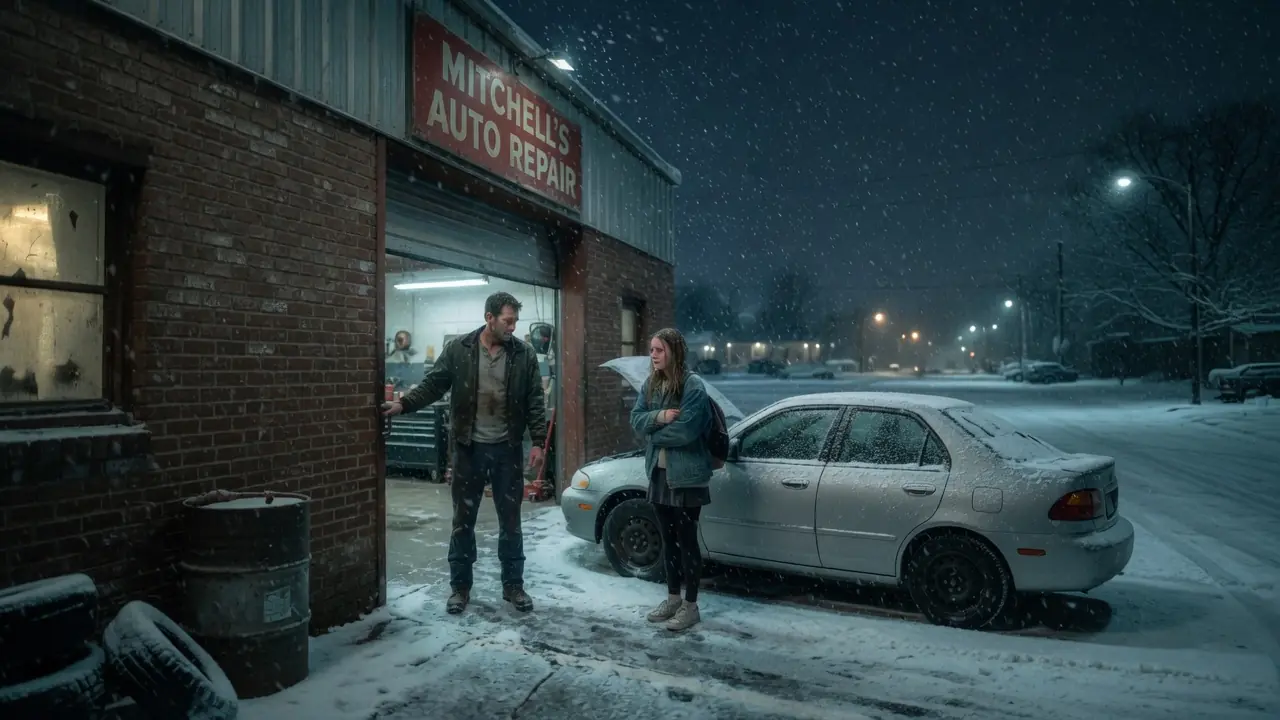
That was when he heard the crying.
At first, he assumed the sound came from the wind moving between the buildings.
Then it came again.
A small, broken sob.
Jake looked toward the road.
A silver sedan stood beneath a dead streetlight near the edge of the parking lot, its hazard lights blinking weakly through the snow.
The driver’s door was open.
A teenage girl stood beside the vehicle with one arm wrapped around herself and a phone pressed against her ear. She wore a navy school blazer over a white blouse, a plaid skirt, and thin black tights completely unsuitable for the weather.
Her long brown hair had begun to freeze at the ends.
“No, Mom, I’m not moving,” she said into the phone. “I know. I know, but the car keeps sliding.”
She listened.
Then her face crumpled.
“I’m sorry.”
Jake watched for a moment.
He could drive away.
Someone was already on the phone with her.
The rational part of him said he had done enough for one day. He had repaired an elderly man’s alternator for half price, allowed a delivery driver another week to pay, and spent three hours trying to revive an engine whose owner had already decided Jake was responsible for its age.
He needed to get home.
His eight-year-old daughter, Lucy, was staying with Jake’s mother. Lucy had a spelling test in the morning and had asked him to help her practice.
He looked toward the sedan again.
The girl slipped.
Her hand struck the hood as she caught herself.
Jake sighed.
Then he walked toward her.
“Hey.”
The girl spun around.
Fear flashed across her face.
Jake immediately stopped several feet away and raised both hands.
“I own the garage.”
He pointed toward the sign.
“Mitchell’s Auto Repair.”
She looked at the building, then back at him.
“My tire blew out.”
“I can see that.”
The front passenger tire was completely flat. The sidewall had been torn open, most likely by a piece of metal hidden beneath the snow.
“You have a spare?” Jake asked.
“I don’t know.”
“That’s all right.”
The voice on the phone became louder.
The girl held it toward him.
“My mom wants to talk to you.”
Jake accepted the phone.
“Hello?”
A woman answered immediately.
“Who is this?”
Her voice was controlled, but fear lived beneath every word.
“Jake Mitchell. I own the repair shop beside your daughter.”
“Are you alone with her?”
Jake glanced at the girl.
“Yes, ma’am. But she can stay in the locked car while I look at the tire.”
“Is your shop open?”
“I just closed.”
“Then don’t open it.”
Jake frowned slightly.
“I wasn’t planning to.”
The woman exhaled.
“I’m sorry. That sounded rude.”
“It sounded like a mother.”
A brief silence followed.
“What condition is the car in?” she asked.
“Flat front passenger tire. I haven’t checked the wheel yet.”
“Can it be driven?”
“Not without damaging the rim.”
“I’m approximately forty-five minutes away. Maybe longer in this weather.”
Jake looked toward the road.
Snow was thickening, and the wind was beginning to push it sideways.
“She shouldn’t wait in the car that long without heat.”
“The heater works.”
“Not safely if snow blocks the exhaust.”
The woman went quiet.
Jake continued.
“I have an office inside the garage. It has heat, a camera, and a door that locks from the inside. She can wait there while I change the tire.”
“You said the garage was closed.”
“I own the keys.”
Another pause.
“What is your full name?”
“Jacob Daniel Mitchell.”
“What is the address?”
He told her.
“What color is your truck?”
Jake looked toward the battered Ford.
The girl almost smiled.
The woman did not.
“Give the phone back to my daughter.”
Jake handed it over.
The girl listened, nodding several times.
Then she ended the call.
“She said I can go inside, but I need to keep my location on.”
“Smart.”
The girl hugged her arms tighter.
“I’m Ava.”
“Jake.”
“I know.”
She looked toward the frozen garage door.
“Can we go inside now?”
Jake unlocked the padlock.
The door rose with another metallic shriek.
Ava flinched.
“It sounds haunted.”
“It’s too expensive to be haunted. Ghosts live rent-free.”
That earned him a real smile.
Jake switched on the lights.
The garage was clean but old. Three service bays occupied the main floor. Tools hung in careful rows along the walls, and framed photographs showed Jake’s father and grandfather standing beside restored trucks.
Near the office door, a small pink backpack rested beneath a desk.
Ava noticed it.
“You have a daughter?”
“Lucy. She’s eight.”
Jake opened the office and turned up the heater.
The room contained an old desk, two chairs, a microwave, and a small sofa Jake had bought after Lucy started spending afternoons at the shop.
A framed drawing hung above it.
MY DADDY CAN FIX EVERYTHING.
Jake avoided looking at it.
He opened a cabinet and removed a heavy work jacket.
“Put this on.”
Ava took it.
The sleeves extended beyond her hands.
“Thank you.”
“There’s hot chocolate in the drawer.”
She looked surprised.
“Your garage has hot chocolate?”
“My daughter believes coffee is evidence of poor decision-making.”
“Is she wrong?”
“Frequently.”
While Ava warmed herself, Jake returned to the sedan with a flashlight and floor jack.
The spare tire was in the trunk.
It was also flat.
Jake stared at it for several seconds.
Of course it was.
He rolled the damaged tire inside and inspected the rim. It had survived, but the sidewall could not be repaired.
The correct replacement size was not common.
He checked his inventory.
Nothing.
Then he remembered a used tire stored behind the alignment machine. It had come from a customer who replaced all four tires after one was punctured. The tread remained good.
Same size.
Jake mounted it, balanced the wheel, and carried it outside.
By then, the snow covered his shoulders and beard.
Ava watched from the office window.
When Jake finished, he drove the sedan slowly around the parking lot, tested the steering, and returned it to the front entrance.
Ava stepped outside wearing his jacket.
“How much?”
Jake closed the hood.
“Nothing.”
Her eyebrows lifted.
“My mom said not to accept anything for free.”
“Tell her the tire was used.”
“She’ll still pay.”
“Then tell her I charge teenagers one promise.”
Ava looked suspicious.
“What promise?”
“Check your spare tire once a month.”
She smiled.
“Deal.”
Jake checked the time.
10:08 p.m.
“Your mother almost here?”
Ava glanced at her phone.
“She says fifteen minutes.”
Jake nodded toward the office.
“Stay inside.”
He followed her in and sat behind the desk to finish invoices.
Ava held the paper cup of hot chocolate between both hands.
For several minutes, only the heater and ticking wall clock filled the room.
Then she asked, “Are you losing the garage?”
Jake stopped writing.
He looked toward the foreclosure notice.
The paper faced inward, but the red bank logo was visible through the glass.
“That’s not your concern.”
“Sorry.”
Jake immediately regretted his tone.
He set down the pen.
“Yes.”
Ava looked at him.
“My dad lost his restaurant when I was little.”
“I’m sorry.”
“He said it wasn’t the money that hurt. It was feeling like he failed everyone.”
Jake looked toward the drawing above the sofa.
“Your father sounds wise.”
“He was.”
The past tense was quiet.
Jake understood.
“How long ago?”
“Six years.”
“My wife died five years ago.”
Ava looked at the pink backpack again.
“Lucy’s mom?”
Jake nodded.
Her name had been Megan.
She died after a drunk driver crossed the center line on a rainy Tuesday afternoon. Jake had been beneath a pickup truck when the hospital called.
Lucy was three.
For years, she remembered her mother mostly through photographs and stories Jake repeated so often they began to feel rehearsed.
Ava looked down at her drink.
“My mom never remarried.”
“Neither did I.”
“Why?”
Jake almost laughed.
“Teenagers ask direct questions.”
“My mom says that means I’m brave.”
“My daughter says it means you don’t know when to stop.”
Ava smiled faintly.
Jake leaned back.
“I was busy.”
“That’s not a real answer.”
“No.”
He looked through the office window at the empty service bays.
“I suppose I forgot how.”
“How to date?”
“How to imagine another person fitting into a life already built around someone who’s gone.”
Ava considered that.
“My mom says grief is like a room you keep walking into by accident.”
Jake looked at her.
“She sounds wise too.”
“She’s exhausting.”
The headlights of a black SUV swept across the garage door.
Ava stood.
“That’s her.”
Jake rose.
The SUV stopped sharply outside.
The driver’s door opened before the engine shut off.
The woman who stepped out was tall, perhaps thirty-nine, wearing a charcoal wool coat over a dark business suit. Her auburn hair had been pulled into a loose knot, though strands had escaped around her face during the drive.
She moved quickly toward Ava.
“You’re okay?”
Ava nodded.
“I’m fine.”
The woman pulled her daughter into a tight embrace.
Jake remained several feet away.
Ava spoke into her mother’s shoulder.
“He fixed the tire.”
The woman looked at him.
Her eyes were green and unusually direct.
“Mr. Mitchell.”
“Jake.”
“I’m Claire Bennett.”
She released Ava but kept one hand on her arm.
“Thank you for helping her.”
“You’re welcome.”
“How much do I owe you?”
“Nothing.”
Claire’s expression changed slightly.
“Ava told me you might say that.”
“Then she listens better than Lucy.”
Claire glanced toward the sedan.
“What kind of tire did you install?”
“Used Michelin. About seventy percent tread. Balanced and safe, but replace both front tires together when possible.”
“How much?”
Jake rubbed his hands together.
“The tire was already here.”
“That isn’t an answer.”
“Forty-five dollars for the tire. Twenty for mounting and balancing.”
Claire opened her handbag.
Jake raised one hand.
“I’m not taking it.”
“You stayed after closing, opened your business, gave my daughter your coat, and repaired her car in a snowstorm.”
“She needed help.”
“Yes.”
Claire’s voice softened.
“That is usually when people expect the most money.”
Jake looked toward Ava.
“Not here.”
Claire studied him.
The snow gathered on her coat.
Finally, she took out a business card instead of cash.
“Then take this.”
Jake accepted it.
CLAIRE BENNETT
CHIEF OPERATING OFFICER
NORTHSTAR MOBILITY SYSTEMS
He recognized the company.
Everyone in the automotive industry did.
Northstar manufactured electric drivetrain components and commercial fleet systems. Three years earlier, it opened a large testing facility outside Amarillo, creating hundreds of jobs and buying up several smaller service companies.
Jake looked at Claire.
“Ava didn’t mention that.”
Claire glanced at her daughter.
“She knows better.”
Ava smiled innocently.
Claire continued.
“Call the number tomorrow.”
“For what?”
“A conversation.”
Jake looked at the card again.
“I’m not looking for a job.”
“You haven’t heard the offer.”
“I have a garage.”
Claire’s eyes moved toward the bank notice taped to the office window.
“For twenty-seven more days.”
Jake stiffened.
Ava looked embarrassed.
“I told her while she was driving.”
Claire slipped her hands into her coat pockets.
“I’m not offering charity.”
“That’s what people call it when they want the other person to accept.”
Claire held his gaze.
“I’m offering work.”
“What kind?”
“I need someone to inspect a fleet of vehicles.”
“You have engineers.”
“I have engineers who understand computer models and technicians who follow checklists. I need someone who listens to machines.”
Jake almost smiled.
“That sounds like something my father would say.”
“Your father was right.”
The answer came too quickly.
Jake’s eyes narrowed.
“You knew my father?”
Claire glanced toward the photographs on the wall.
“I knew of him.”
“That’s different.”
“It is.”
Ava touched her mother’s arm.
“We should go.”
Claire nodded.
She turned toward Jake.
“Call tomorrow.”
“I may not.”
“Then I’ll come back.”
“That sounds like a threat.”
“It’s an offer with persistence.”
For the first time, Jake saw humor soften her face.
Then she and Ava left.
Jake stood beneath the garage lights holding the business card.
He watched the two vehicles disappear into the snow.
On the back of the card, Claire had written a second number by hand.
Below it were four words.
PLEASE DON’T SELL THE GARAGE.
Jake did not sleep much that night.
At six the next morning, Lucy climbed into his bed and placed one cold foot against his leg.
“Grandma says you helped a princess.”
Jake opened one eye.
“Your grandmother has become unreliable.”
“She had a fancy car.”
“The princess?”
“The girl.”
“She was a teenager.”
“That’s almost a princess.”
Lucy held up Claire’s business card.
Jake sat up.
“Where did you get that?”
“It fell out of your jacket.”
“You went through my jacket?”
“I was checking for candy.”
“Did you find any?”
“No.”
“Then the search was illegal.”
Lucy examined the card.
“What does chief operating officer mean?”
“It means she tells many people what to do.”
“Like Grandma.”
“Exactly.”
“Are you calling her?”
Jake took the card.
“No.”
“Why?”
“Because I don’t know what she wants.”
Lucy frowned.
“You could ask.”
“Children believe phones are simple.”
“They are.”
Jake looked at the card again.
By nine, he was inside the garage pretending to work.
At ten, the bank called.
At ten-fifteen, a supplier refused to extend his payment terms.
At eleven, a longtime customer canceled an engine replacement after finding a cheaper shop online.
Jake placed the phone on the desk.
Claire’s card sat beside it.
He picked it up.
Then set it down.
At noon, the garage door opened.
Claire walked in carrying two coffees.
Jake stared.
“You said tomorrow.”
“It is tomorrow.”
“I didn’t call.”
“I noticed.”
She placed one coffee on his desk.
“Black. No sugar.”
“How did you know?”
“You look like a man who distrusts flavored syrup.”
Jake almost laughed.
“What do you want?”
Claire removed her coat and folded it over one arm.
“Northstar has a problem.”
“What kind?”
“Our new cold-weather fleet is failing.”
Jake’s expression sharpened despite himself.
“What vehicles?”
“Forty-eight electric delivery vans undergoing field testing.”
“What failure?”
“Intermittent power loss below twenty degrees. Control units show inconsistent errors. We replaced batteries, software modules, and thermal sensors. Nothing solved it.”
“And you want me to inspect them.”
“I want you to listen.”
Jake walked toward a workbench.
“You found me because I changed your daughter’s tire?”
“No.”
Claire set down her coffee.
“I came to Mitchell’s Auto Repair because I had been looking for you.”
Jake turned.
“You said Ava’s breakdown was an accident.”
“It was.”
“But you knew who I was.”
“Yes.”
“Why?”
Claire looked toward the oldest photograph on the wall.
It showed Jake’s father, Henry Mitchell, standing beside a restored 1967 Mustang.
“Your father saved Northstar before it existed.”
Jake said nothing.
Claire continued.
“Twenty-three years ago, my father, David Bennett, owned a small transport company. One of his trucks suffered brake failure on Interstate 40.”
Jake knew the story.
His father had mentioned it only once.
A loaded truck lost brakes descending a grade. Henry noticed smoke from the wheel assembly while driving behind it, pulled alongside, and signaled the driver toward an emergency ramp.
Afterward, he discovered a defect in a replacement valve used across the fleet.
“He prevented an accident,” Jake said.
“He prevented thirty-seven.”
Claire nodded toward the photograph.
“My father recalled every truck and replaced the valves. The company nearly went bankrupt.”
“Henry refused payment.”
“He accepted one dollar.”
Jake smiled faintly.
“That sounds like him.”
“My father rebuilt the company. It later became part of Northstar.”
Claire paused.
“When he died, I found a letter in his desk. It said if the company ever became successful enough to forget the people who made it possible, I should find Henry Mitchell.”
Jake looked toward the photograph.
“He died eight years ago.”
“I know. I attended the funeral.”
His eyes returned to her.
“You were there?”
“At the back.”
Jake tried to remember.
The funeral had been crowded with mechanics, farmers, truckers, and strangers who claimed Henry had helped them.
Claire might have been one of them.
“Why didn’t you introduce yourself?”
“You had just buried your father.”
“And now?”
“Now I found out his son is about to lose the garage.”
Jake’s jaw tightened.
“So this is charity.”
“No.”
Claire stepped closer.
“This is a company with a thirty-million-dollar engineering problem. You are a mechanic with a reputation for identifying faults others miss.”
“Who told you that?”
“Your customers.”
“You interviewed them?”
“I asked questions.”
“You investigated me.”
“I verified that sentiment was not making me foolish.”
Jake folded his arms.
“What exactly are you offering?”
“Two weeks. You inspect the vans at our winter-testing facility. We pay your normal commercial rate plus a consulting premium.”
“How much?”
Claire named a figure.
Jake stared at her.
It was enough to cover nearly half the overdue loan.
“For two weeks?”
“If you identify the cause.”
“And if I don’t?”
“You keep the inspection fee.”
Jake looked around the garage.
“What happens to my customers?”
“We work around your schedule.”
“What happens after two weeks?”
“That depends on what you find.”
He studied her.
“You’re leaving something out.”
Claire’s expression remained calm.
“I’m leaving out several things.”
“At least you admit it.”
“I’ve learned directness helps with you.”
Jake looked toward the office.
Lucy’s drawing still hung above the sofa.
“Send me the contract.”
Claire smiled.
“I already did.”
Jake checked his phone.
The email had arrived three minutes earlier.
“You assumed I’d accept.”
“I hoped.”
“That’s not the same.”
“No.”
She picked up her coat.
“Ava also wanted me to give you this.”
Claire placed a folded note on the desk.
Jake opened it after she left.
Thank you for stopping.
Most people didn’t.
The Northstar testing facility stood behind a chain-link fence twenty miles outside Amarillo.
Rows of unfinished vehicles occupied climate-controlled bays large enough to hold aircraft. Engineers monitored data from glass offices above the floor while automated platforms simulated snow, ice, vibration, and extreme heat.
Jake arrived in his work truck wearing the same faded coveralls he used at the garage.
A security guard looked at the rust above the rear wheel.
“Visitor parking is on the other side.”
“I’m the consultant.”
The guard almost laughed.
Then Claire appeared.
“He’s with me.”
Jake followed her inside.
Three engineers waited beside the first disabled van.
Their expressions made it clear they did not appreciate the mechanic from a neighborhood garage.
Claire introduced them.
Dr. Nolan Pierce led battery systems.
Rebecca Shaw managed software diagnostics.
Caleb Winters supervised field testing.
Nolan looked at Jake’s tool bag.
“We’ve already completed a full mechanical inspection.”
Jake nodded.
“Then I won’t waste time doing the same one.”
“What is your process?”
“I start with the driver.”
Caleb frowned.
“The driver?”
“Who was operating it when it failed?”
A test driver named Sam arrived ten minutes later.
Jake asked him to describe the failure without technical language.
Sam explained that the van lost power after driving through slush, but not immediately. It usually happened fifteen or twenty minutes later, often while turning uphill.
The computer logs focused on battery temperature.
Jake crawled beneath the vehicle.
He examined cable routing, underbody panels, and wheel wells.
After twenty minutes, he stood.
“Run it through slush.”
Nolan looked irritated.
“We have done that repeatedly.”
“Then do it again.”
They loaded the van onto a test track.
Jake rode beside Sam.
The vehicle completed two laps without failure.
On the third, Jake heard a faint tapping beneath the passenger floor.
He asked Sam to turn uphill.
Power vanished.
The van rolled to a stop.
Engineers crowded around the diagnostic screen.
Battery error.
Thermal sensor fault.
Communication failure.
Jake ignored them.
He walked around the van and opened the passenger door.
Water had collected beneath the floor mat.
He removed a trim panel.
A wiring harness passed through a rubber seal near the wheel arch. The seal had been installed correctly, but the harness rested against a metal bracket.
During turns, the cable shifted.
In cold weather, the insulation hardened.
Slush entered through microscopic cracks, traveled along the wire, and reached a connector fifteen minutes later.
“The computer thinks the battery is overheating because the sensor signal is shorting,” Jake said.
Nolan shook his head.
“That harness passed vibration testing.”
“Dry vibration testing.”
“We tested moisture exposure.”
“Standing water. Not pressure spray from the wheel at steering angle.”
Rebecca checked the cable.
The crack was nearly invisible.
Jake pointed toward the bracket.
“Move the harness half an inch, add a flexible shield, and replace the connector seal.”
They modified one van.
It completed eight cold-weather laps without failure.
Then twelve.
Then twenty.
By evening, the engineering team had inspected six failed vehicles.
Every one showed the same damage.
Claire stood beside Jake beneath the testing lights.
“Thirty-million-dollar problem.”
“Thirty-cent routing clip.”
She laughed.
It was the first time he heard her laugh without restraint.
Jake looked at her.
For a moment, neither spoke.
Then Nolan approached carrying a tablet.
“The issue appears resolved.”
“Appears?” Jake asked.
“We need longer testing.”
“You always should.”
Nolan hesitated.
“I was wrong about you.”
Jake picked up his tool bag.
“That probably hurt.”
“It did.”
Claire watched him walk toward the exit.
“You’re leaving?”
“It’s after seven.”
“We need to discuss the remaining fleet.”
“My daughter has a school concert.”
Claire checked the time.
“You’ll never make it.”
Jake looked toward the snow beyond the loading doors.
“She’ll still look for me.”
Claire said nothing.
At 7:48, Jake entered the school auditorium during the final song.
Lucy stood on the second row wearing a silver snowflake costume.
Her eyes searched the room.
Then she saw him.
Her entire face changed.
Jake remained near the door, grease still beneath his fingernails.
He had missed most of the concert.
But he had arrived before it ended.
Afterward, Lucy ran into his arms.
“You came.”
“Told you.”
“You missed my solo.”
Jake’s heart sank.
“You had a solo?”
“No.”
She laughed.
“Grandma said not to make you feel bad, but it was funny.”
Jake looked toward his mother.
She pretended not to know them.
Claire appeared near the rear of the auditorium carrying Ava’s coat.
Jake stared.
“Ava goes here?”
“Private scholarship program,” Claire said.
Ava joined them.
She smiled at Lucy.
“Your snowflake is crooked.”
Lucy looked down.
“I know. Dad fixed it.”
Jake frowned.
“I did not.”
“You used tape.”
“That is a legitimate repair.”
Claire smiled.
For the first time, Jake saw her not as the executive who had investigated his business or the wealthy mother who arrived in a black SUV.
She looked tired.
Proud.
Alone.
Exactly as he often felt.
Over the next two weeks, Jake continued consulting for Northstar.
He worked at the garage in the mornings and testing facility in the afternoons. Claire arranged for vehicles to be delivered to him when possible, allowing Jake to remain near his customers.
They argued often.
Claire believed schedules were promises.
Jake believed machines had no respect for calendars.
She believed every process required documentation.
He believed some knowledge lived in hands before language.
Yet each argument ended with greater respect.
Ava began spending afternoons at the garage while Claire worked.
She helped Lucy with homework.
Lucy taught her how to use a socket wrench.
Jake learned that Ava’s father, Thomas, had died from pancreatic cancer when she was nine.
Claire had spent the following six years building Northstar’s operations while raising her daughter alone.
She looked successful from the outside.
Her home was large.
Her car was expensive.
Her name appeared in business magazines.
But success had not made grief easier.
One night, Jake found Claire sitting alone inside a test van after everyone left.
“You all right?”
She looked at the dashboard.
“Thomas loved cars.”
Jake leaned against the open door.
“Was he a mechanic?”
“He believed replacing windshield wipers made him one.”
“That’s dangerous confidence.”
“He once changed the oil and forgot to replace the drain plug.”
Jake winced.
“Grounds for divorce.”
Claire smiled.
Then her eyes filled.
“He would have liked you.”
Jake did not know what to say.
Claire looked at him.
“Megan would have liked me?”
The question surprised him.
“She distrusted people who wore expensive shoes.”
Claire looked down at her black boots.
“They’re practical.”
“They cost more than my truck.”
“That cannot be true.”
“It might be.”
Claire laughed quietly.
Jake looked toward the testing floor.
“Megan would have liked that you didn’t offer me money in the garage.”
“I did offer money.”
“You offered work.”
“There’s a difference.”
“Yes.”
Their eyes met.
Something passed between them.
Neither moved.
Then Ava entered the bay carrying two vending-machine sandwiches.
“Mom, you forgot dinner.”
Claire stepped back.
Jake looked away.
The moment disappeared.
The two-week contract ended with Northstar modifying all forty-eight vans.
The failures stopped.
Claire invited Jake to headquarters on the final morning.
He expected a payment meeting.
Instead, twelve executives sat around a long glass table.
At the center was a folder with his name.
The chief executive, Martin Ellison, shook Jake’s hand.
“Mr. Mitchell, you saved the winter fleet program.”
“I moved a cable.”
“You found the cable.”
Martin opened the folder.
“We would like to acquire Mitchell’s Auto Repair.”
Jake’s expression changed.
Claire remained seated at the far end of the table.
She did not look at him.
“Acquire?” Jake asked.
“Northstar needs an independent diagnostic and training center in Amarillo. Your property is well located. We would purchase the building, pay off existing debt, renovate the facility, and hire you as regional technical director.”
Jake closed the folder without reading the figure.
“No.”
Martin blinked.
“You haven’t reviewed the offer.”
“The garage isn’t for sale.”
“Everything is for sale.”
Jake stood.
“Then buy something else.”
Claire followed him into the hallway.
“Jake.”
He turned.
“You knew.”
“Yes.”
“That was the offer from the beginning.”
“No.”
“You found out the garage was failing, hired me, brought me inside, and waited until I had no reason to say no.”
“I argued against the acquisition.”
“You still let them make it.”
“Because there is another option.”
Jake stared at her.
Claire handed him a second folder.
“This one is mine.”
Inside was a partnership agreement.
Northstar would fund renovations and lease two service bays for technician training. Mitchell’s Auto Repair would remain independently owned. Jake would serve as a paid consultant but retain control of the business.
The agreement included enough upfront funding to clear the bank debt.
Jake read the first page twice.
“Why didn’t you show them this?”
“I did. They rejected it.”
“Then it’s not an offer.”
“It is if I fund the investment personally.”
Jake looked up.
“No.”
Claire’s face tightened.
“You haven’t read it.”
“I’m not taking your money.”
“You would take Northstar’s?”
“That’s business.”
“So is this.”
“No. This is you trying to rescue me.”
Claire stepped closer.
“You stopped for my daughter when you were tired, freezing, and days from losing everything. You repaired her car and refused payment. Did that make her weak?”
“She was seventeen.”
“Did it make me weak?”
“You were afraid.”
“I was.”
Claire held his gaze.
“Help does not become humiliation just because the person receiving it is a man.”
Jake looked away.
The words landed exactly where she intended.
Claire softened her voice.
“You are not selling the garage. You are not working for me. I am investing in a business because I believe it has value.”
“And if it fails?”
“I lose money.”
“That easy?”
“No.”
She handed him a pen.
“That honest.”
Jake did not sign.
He took the agreement home.
That evening, he spread the pages across the kitchen table.
His mother read them.
Lucy colored beside her.
“What do you think?” Jake asked.
His mother adjusted her glasses.
“I think you inherited your father’s pride.”
Jake leaned back.
“That isn’t advice.”
“It is when pride is the problem.”
Lucy looked up.
“Are we losing the garage?”
Jake’s chest tightened.
“Maybe.”
“My drawing is there.”
“I know.”
“Grandpa’s picture too.”
“I know.”
Lucy put down the crayon.
“Why don’t you let Claire help?”
“Because grown-up things are complicated.”
“She helped Ava.”
Jake frowned.
“What do you mean?”
“Ava said her mom was sad after her dad died. Then she started the company work because she needed to fix something.”
Lucy pointed at the contract.
“You fix cars. She fixes businesses.”
Jake stared at his daughter.
His mother smiled.
“Children are exhausting when they are right.”
Jake signed the agreement the next morning.
The garage changed slowly.
Northstar repaired the roof, replaced the failing lift, installed modern diagnostic equipment, and converted the unused storage bay into a classroom.
Jake kept the old blue sign.
He kept his father’s photographs.
He kept the coffee machine that leaked whenever anyone poured too quickly.
The bank debt disappeared.
Customers returned.
Young technicians enrolled in weekend classes taught by Jake.
He insisted every student spend the first hour learning to listen for mechanical problems without a computer.
Claire attended the first session.
“You’re teaching superstition,” she said.
Jake handed her a stethoscope.
“Find the failing bearing.”
She failed.
Twice.
On the third attempt, she heard it.
Her smile made him forget what he had been saying.
Their relationship developed in small moments.
Coffee left on workbenches.
Late conversations after the children fell asleep.
Shared school pickups.
Arguments about contracts.
Laughter that surprised them.
Neither rushed.
Both knew what it meant to love someone and lose them.
Neither wanted loneliness to disguise itself as certainty.
One evening in early spring, Claire arrived at the garage after closing.
Jake was beneath a restored pickup.
Her shoes appeared beside the lift.
“You’re working late.”
“You’re wearing expensive shoes.”
“These are different boots.”
“They’re still suspicious.”
Jake rolled out.
Claire held two envelopes.
“What are those?”
“One is from Northstar.”
“And the other?”
“From me.”
Jake wiped his hands.
She gave him the company envelope first.
Northstar wanted Jake to lead a national diagnostic-training program. He would travel to twelve facilities and train more than three hundred technicians.
The salary was larger than anything he had ever earned.
Jake read it.
“I can’t leave Lucy.”
“Travel is one week per month.”
“I can’t leave the garage.”
“You have four trained technicians now.”
“I don’t like airports.”
“That may be the strongest argument.”
Jake opened the second envelope.
Inside was a photograph of Ava and Lucy standing beneath the Mitchell’s Auto Repair sign.
On the back, Claire had written:
You stopped when you had every reason to keep driving.
I think I started loving you there.
Jake read it twice.
Claire watched him.
“You didn’t need an envelope to say that.”
“I prepare for difficult conversations.”
“Is this difficult?”
“Yes.”
“Why?”
“Because you might not feel the same.”
Jake looked at her.
“You run a company worth hundreds of millions of dollars, but this is what frightens you?”
“Yes.”
He folded the photograph carefully.
“I started falling for you when you argued about paying for a used tire.”
Claire’s eyes filled.
“That was ten minutes after we met.”
“You were persistent.”
“You complained about it.”
“I complain about many things I like.”
“That is emotionally unhealthy.”
“Probably.”
Claire laughed through tears.
Jake stepped closer.
He did not kiss her immediately.
He gave her time to move away.
She did not.
Their first kiss happened beneath fluorescent lights beside a truck with half its engine removed.
Later, Claire said the setting was terrible.
Jake said at least the lighting was honest.
Six months passed.
The garage prospered.
Jake accepted the Northstar training position with conditions that allowed him to remain independent. Claire agreed to every condition except his request to remove catered lunches from meetings.
Ava graduated from high school.
Lucy cried harder than Claire.
Jake stood near the back of the auditorium, remembering the snowflake concert and the promise to arrive before the ending.
Afterward, Ava hugged him.
“You fixed my tire.”
Jake smiled.
“That was the beginning of your mechanical education.”
“You gave me a used tire.”
“It had good tread.”
“You gave me your coat.”
“I had another one.”
“You did not.”
Jake looked at her.
Ava’s expression softened.
“You changed everything.”
“No.”
He glanced toward Claire and Lucy.
“You stopped in the right parking lot.”
Ava laughed.
One year after the snowstorm, Mitchell’s Auto Repair hosted a holiday charity event.
The new training bay was filled with donated winter coats, children’s toys, and free tire-inspection stations for families who could not afford service.
Ava organized the event.
Lucy created signs using too much glitter.
Claire handled logistics and pretended not to control everything.
Jake worked near the entrance checking spare tires.
A silver sedan pulled into the parking lot.
Same model.
Different driver.
A young mother stepped out carrying a baby. Her rear tire was nearly flat.
“I’m sorry,” she said. “I saw the sign. Are you still open?”
Jake looked at the clock.
9:15 p.m.
Snow had begun falling.
Claire stood behind him wearing the same charcoal coat she had worn the night they met.
Lucy tugged his sleeve.
“Dad.”
Jake looked at the woman beside the car.
Then at the garage.
The lights were still on.
“Yes,” he said.
“We’re open.”
While one of the technicians repaired the tire, Claire joined Jake near the office.
The old foreclosure notice now hung inside a frame beside Lucy’s drawing.
Claire had suggested throwing it away.
Jake kept it.
Not as a reminder of failure.
As proof that a final notice did not always mean the end.
Claire looked at the framed paper.
“You know most people display awards.”
“I have those too.”
“You keep them in a drawer.”
“They collect less dust.”
Claire slipped her hand into his.
“You still haven’t answered Northstar’s expansion proposal.”
“I have concerns.”
“You always have concerns.”
“They want to replace the blue sign.”
Claire looked toward the faded sign above the entrance.
“It is falling apart.”
“It has character.”
“It has termites.”
“Termites are character.”
She laughed.
Across the garage, Lucy and Ava decorated a small artificial tree with spark plugs, bolts, and silver ribbon.
Jake watched them.
The life before him looked nothing like the one he had imagined after Megan died.
That had once frightened him.
Now it felt like evidence that love did not return by copying what was lost.
It arrived differently.
In another shape.
Through a teenage girl crying beside a flat tire.
Through a mother who asked too many questions because fear had already taken someone from her.
Through a business offer that became a partnership.
Through two families learning there was room for memory and something new.
Claire rested her head against his shoulder.
“What are you thinking?”
“That I should have charged you sixty-five dollars.”
“For the tire?”
“Inflation.”
“You refused payment.”
“I lacked business judgment.”
“You still do.”
Jake smiled.
The young mother approached with her baby wrapped beneath a blanket.
“How much do I owe?”
Jake looked toward Claire.
She raised one eyebrow.
He looked back at the woman.
“Nothing.”
Claire sighed.
“Of course.”
Jake handed the driver a receipt showing a zero balance.
“Check your spare tire once a month.”
The woman nodded.
“I will.”
She drove away safely.
Jake pulled the garage door down.
The hinges no longer screamed.
Northstar had replaced them in the renovation, though Jake had complained that the new mechanism sounded too quiet.
He locked the door.
Snow moved gently beneath the streetlamps.
A year earlier, he had stood in the same place believing everything his family built was about to disappear.
Then he heard someone crying.
He could have driven home.
He could have decided the girl was not his responsibility.
Instead, he stopped.
Claire stood beside him now.
Lucy and Ava waited in the warm SUV.
Jake looked at the garage sign one last time before they left.
“Ready?” Claire asked.
He took her hand.
“Yes.”
This time, when Jake walked away from Mitchell’s Auto Repair, his hands did not shake.
The garage was still his.
His daughter was waiting.
And for the first time in years, home was no longer only the place where grief remembered him.
It was the place where someone new was waiting for him to return.