The boy reached the clubhouse door at 2:17 in the morning with a toddler in his arms and no feeling left in his feet.
For six miles, fourteen-year-old Noah Briggs had walked through freezing sleet without a jacket because the little girl needed it more than he did. The temperature had dropped to twenty-seven degrees, and the wind blew hard enough to drive ice beneath his wet sweatshirt.
By the time he reached the steel door beneath the red neon sign, his hands had locked around the child.
He could no longer open his fingers.
He could barely remember why he had come.
Only the numbers remained clear.
Seventeen.
Four.
Nine.
Two.
Thirty-one.
He had repeated them for three weeks.
He had whispered them while sleeping beneath highway bridges, behind grocery stores, and inside a parking garage where the concrete floor never fully dried.
He did not know what the numbers meant.
He only knew a dying man had grabbed his wrist and begged him not to forget them.
Now Noah lifted one numb fist and struck the clubhouse door.
The first knock was too weak to be heard over the music inside.
He tried again.
The toddler whimpered against his chest.
Her name was Lily.
She was two years old, with pale blonde hair stuck to her cheeks and a small purple bruise above one eyebrow. Noah had wrapped her in his only jacket and tied the sleeves around her like a blanket.
“Almost there,” he whispered.
He did not know whether he was speaking to her or himself.
“Don’t sleep yet.”
Lily’s eyes opened slightly.
“Daddy?”
Noah looked at the enormous winged-skull emblem painted above the door.
“I think so.”
He struck the metal a third time.
Then his knees gave out.
Inside the Desert Saints Motorcycle Club, nearly two hundred riders were gathered for the annual winter memorial.
The club had chapters across Arizona, New Mexico, Texas, and Colorado. Riders had traveled hundreds of miles to remember members who had died on the road.
The gathering had started with speeches and photographs.
By midnight, it had become loud.
Music shook the walls. Pool balls cracked. Men in leather vests shouted across long wooden tables while women carried trays of food from the kitchen.
At the center of the room stood club president Mason “Graves” Cole.
He was forty-six, broad-shouldered, with a graying black beard and a scar running from his right temple to the edge of his jaw. His leather vest carried faded patches collected over twenty-five years of riding.
People who did not know him saw a frightening man.
People who did know him understood that Mason had spent the last fifteen years frightening himself with the same unanswered question.
What happened to his son?
In 2009, six-year-old Caleb Cole disappeared from a county fair outside Albuquerque.
One moment, he was beside his father holding a red balloon.
The next, he was gone.
The balloon was found caught in a fence behind the parking area.
No body was ever recovered.
No ransom call came.
No reliable witness saw him leave.
Police questioned Mason for months. They investigated Caleb’s mother, Dana, who had struggled with addiction. They searched rivers, abandoned buildings, trailer parks, and desert roads.
Nothing.
The case grew cold.
Dana died four years later without knowing what happened to her child.
Mason never stopped searching.
He paid private investigators until there was nothing left to sell. He followed false leads into three states. He met men who claimed to know something and only wanted money.
Every year, on Caleb’s birthday, Mason rode alone to the county fairgrounds and stood beside the fence where the balloon had been found.
By 2024, most people in his life had learned not to mention Caleb.
That night, Mason stood near the memorial wall holding a glass of water he had forgotten to drink.
His daughter, twenty-six-year-old Rachel Cole, approached him.
“You’re doing it again.”
Mason looked at her.
“Doing what?”
“Leaving without moving.”
Rachel had her father’s dark eyes and her mother’s stubbornness. She wore jeans, motorcycle boots, and a gray sweater beneath a leather vest with no club rank.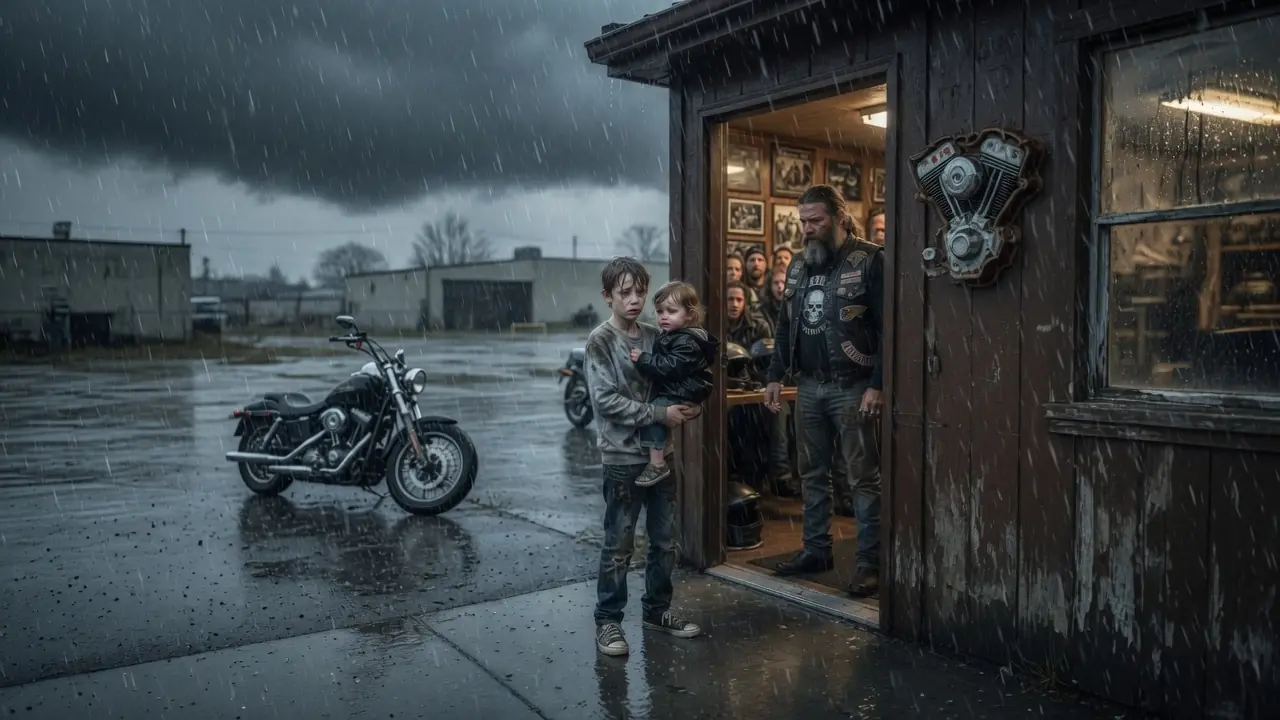
On her hip hung a child’s pink backpack.
“Where’s Lily?” Mason asked.
Rachel looked toward the playroom at the back of the clubhouse.
“With Tessa.”
Mason nodded.
Rachel studied him.
“You were looking at Caleb’s picture.”
A framed photograph hung among the memorials.
Caleb at six years old.
Brown hair.
Missing front tooth.
Red baseball shirt.
Mason looked away.
“It’s his birthday next week.”
“I know.”
“He’d be twenty-one.”
“I know.”
Rachel touched his arm.
“You can remember him without disappearing from the people who are still here.”
Mason’s face tightened.
Before he could answer, someone near the entrance shouted.
“Graves!”
The music continued.
Then the man shouted again.
“Turn that off!”
The volume dropped.
Conversations faded.
A rider named Bishop stood beside the front door, staring at something on the floor outside.
“What is it?” Mason called.
Bishop opened the door wider.
The nearest riders moved back.
Then they saw the boy.
Noah lay against the threshold with Lily still in his arms.
For one second, Mason did not understand what he was looking at.
Then he saw the small pink shoe beneath the soaked black jacket.
“Lily!”
Rachel screamed.
She ran across the room.
Mason reached the doorway first and dropped to his knees.
He pulled the jacket aside.
His granddaughter’s face was pale.
Her lips had turned blue.
Noah’s arms remained locked around her.
“Get a medic!” Mason shouted.
Several riders moved at once.
One was a retired paramedic.
Another had served as a combat medic.
They carried both children inside and cleared a long table.
Rachel tore at the knotted jacket sleeves.
“Lily, wake up.”
The toddler made a faint sound.
Rachel began crying.
“She’s breathing,” the medic said. “Weak, but she’s breathing.”
Mason looked at the boy.
Noah’s clothes were soaked through. His skin felt like ice. His bare fingers were scraped and bleeding. The soles of his shoes had partially separated.
“Who is he?” Bishop asked.
No one answered.
Rachel pressed her cheek against Lily’s hair.
“She was in the playroom.”
Tessa appeared from the hallway, white-faced and shaking.
“She was. I swear she was.”
“What happened?” Mason demanded.
“I went to the bathroom for two minutes. When I came back, the window was open.”
The room changed.
Nearly two hundred bikers stopped moving.
Mason looked toward the hallway.
“The window?”
Tessa nodded.
“The screen was cut.”
Mason’s grief turned into something colder.
“Lock every door.”
Riders spread through the building.
Others ran outside to search the parking lot.
Someone called 911.
The retired paramedic cut Noah’s sweatshirt open.
A silver chain fell against the boy’s chest.
A small metal disk hung from it.
Mason saw the engraving.
C.C.
His breath stopped.
He reached for the necklace.
The disk was scratched and blackened with age, but he knew it.
He had made it himself in a machine shop before Caleb was born.
The other side carried a date.
January 17, 2003.
Caleb’s birthday.
Mason stared at the unconscious boy.
“No.”
Rachel looked up.
“What is it?”
Mason held the disk between two fingers.
“This belonged to Caleb.”
No one spoke.
The medic continued checking Noah’s breathing.
Mason bent closer.
The boy’s wet hair was light brown. His face was thin from hunger, his cheeks hollow, but something about the shape of his nose felt familiar.
Rachel saw it too.
She covered her mouth.
“How old is he?”
The medic examined him.
“Fourteen. Maybe fifteen.”
Mason shook his head.
“Caleb would be twenty-one.”
Bishop looked at the necklace.
“Then how did he get that?”
Noah’s eyes opened.
He gasped and tried to sit up.
“Lily.”
“She’s here,” Rachel said quickly. “She’s safe.”
Noah turned his head.
He saw Lily wrapped in blankets beside her mother.
The tension left his body.
Then he saw the bikers surrounding him.
Fear returned instantly.
He tried to get off the table.
Mason placed one hand on his shoulder.
“Easy.”
Noah recoiled.
“Don’t touch me.”
Mason removed his hand.
“All right.”
Noah looked toward the exits.
Every door was blocked by men in leather vests.
He began breathing faster.
Rachel stepped between him and the crowd.
“You brought my daughter here.”
Noah looked at her.
“She said her daddy was here.”
“I’m her mother.”
His expression softened.
“She kept saying Daddy. Bike. Wings.”
Rachel looked at the winged emblem on the wall.
“How did you find this place?”
Noah swallowed.
“I saw the patch on a picture in her backpack.”
Mason looked at the pink backpack Rachel had carried earlier.
It now lay open beside the playroom door.
“Where did you find Lily?”
“In a van.”
Silence.
Mason leaned closer.
“What van?”
Noah’s eyes moved to the front windows.
“White. No plates.”
“Where?”
“Parking garage near downtown.”
Rachel gripped the edge of the table.
“What was she doing there?”
Noah looked down.
“A man was carrying her.”
Mason’s voice hardened.
“What man?”
“I don’t know.”
“Describe him.”
“Tall. Gray coat. Hurt hand.”
Noah rubbed his own wrist as though remembering.
“He put her in the back and closed the door.”
“What did you do?”
“I waited.”
Mason stared.
“You waited?”
“I thought he might come back.”
The boy’s voice carried no pride.
Only calculation learned from surviving alone.
“He didn’t. So I broke the side window.”
Bishop examined Noah’s scraped fingers.
“You broke a car window with your hands?”
“A piece of concrete.”
“How did you know where to bring her?”
“She had the picture.”
Rachel searched Lily’s backpack.
Inside was a family photograph taken six months earlier.
Rachel stood beside Mason in front of the clubhouse. Lily sat on Mason’s shoulders while the winged-skull emblem filled the wall behind them.
On the back, someone had written the clubhouse address.
Rachel had placed it there in case the backpack was ever lost.
Noah continued.
“I asked people for a ride.”
“No one stopped?”
He shook his head.
“One truck did. But there were two men inside. They kept asking where my parents were.”
Mason saw the way Noah’s expression changed.
“You didn’t trust them.”
“No.”
“So you walked.”
Noah looked at Lily.
“She was cold.”
Rachel touched the jacket wrapped around her daughter.
“This was yours.”
Noah nodded.
Mason still held the engraved disk.
“Where did you get this?”
Noah’s hand moved instinctively toward his chest.
The chain was no longer there.
His eyes widened.
“Give it back.”
Mason closed his fist around it.
“Tell me where you got it.”
“It’s mine.”
“It belonged to my son.”
Noah looked at him.
“Caleb?”
The name struck the room like a gunshot.
Mason’s voice dropped.
“How do you know that name?”
Noah stared at the memorial photograph.
He had not noticed it before.
Now his entire body became still.
The room waited.
Noah slid from the table despite the medic’s objection and walked toward the wall.
His legs shook beneath him.
He stopped before Caleb’s picture.
The six-year-old boy smiled from behind the glass.
Noah lifted one hand.
“He had that picture.”
“Who?” Mason asked.
“The man in the garage.”
Mason moved closer.
“What man?”
Noah turned.
“The one who gave me the necklace.”
Three weeks earlier, Noah had been sleeping behind a concrete support pillar on the third level of the Jefferson Parking Garage.
He had been homeless for twenty-two days.
Before that, he lived with his mother in a motel outside Santa Fe.
Her name was Laura Briggs.
She worked at a grocery store and cleaned offices at night. She rarely spoke about Noah’s father. She said he had disappeared before Noah was born.
When Laura died from an untreated infection, the motel manager called social services.
Noah ran before they arrived.
He feared being placed in a group home.
He had spent one night in foster care when he was seven and never forgotten the locked refrigerator, the shouting, or the older boy who entered his room after dark.
So he disappeared.
He walked south.
He slept wherever he could.
On his third night in the parking garage, he heard tires screech.
A dark sedan stopped near the far stairwell.
Two men pulled a third man from the back seat.
Noah hid behind the pillar.
The prisoner was thin, bearded, and badly injured. Blood covered one side of his shirt. His wrists were bound.
The men argued.
One called the prisoner Aaron.
The other called him a thief.
The prisoner laughed.
“If I stole it, you wouldn’t still be looking.”
One of the men struck him.
They dragged him toward the stairwell.
Noah stayed hidden until the sedan left.
Then he heard movement near the concrete barrier.
Aaron had crawled back.
Noah approached carefully.
The man’s breathing sounded wet.
“Kid,” he whispered.
Noah almost ran.
Aaron lifted one hand.
“Please.”
Noah stopped.
The man pulled the silver necklace from beneath his shirt.
“Take this.”
Noah shook his head.
“I don’t want it.”
“They’ll search me.”
“Who?”
Aaron looked toward the ramps.
“Men who’ve been searching a long time.”
He pressed the necklace into Noah’s hand.
Then he whispered five numbers.
“Seventeen. Four. Nine. Two. Thirty-one.”
Noah repeated them.
“Again,” Aaron said.
Noah did.
“Don’t write them down.”
“What are they?”
“Keys.”
“To what?”
Aaron coughed.
Blood touched his lips.
“The truth.”
Noah looked toward the stairwell.
“I can call someone.”
“No police.”
“Why?”
“Some of them work for the man who took me.”
Aaron grabbed Noah’s wrist.
“Find Mason Cole.”
Noah frowned.
“Who?”
“Desert Saints.”
Aaron pressed the necklace harder into his palm.
“Tell him Caleb lived.”
Noah stared at him.
“What does that mean?”
But Aaron’s eyes had closed.
Noah waited beside him until his breathing stopped.
Then he heard footsteps below.
He ran.
For three weeks, Noah repeated the numbers every night.
Seventeen.
Four.
Nine.
Two.
Thirty-one.
He did not know how to find Mason Cole.
He did not know who the Desert Saints were.
He kept the necklace because it was the only proof the man in the garage had been real.
Then, that night, he saw a white van in the same parking structure.
The gray-coated man carried Lily from an elevator.
Noah recognized him as one of Aaron’s captors.
The man placed Lily in the van and walked away while speaking on the phone.
Noah broke the window and took her.
Inside the van, he found a photograph of the Desert Saints clubhouse.
It was the same picture in Lily’s backpack.
That was how he understood the child and Aaron belonged to the same story.
When Noah finished, the clubhouse was silent.
Mason stood beneath Caleb’s photograph.
His face had lost all color.
“Tell him Caleb lived,” he repeated.
Noah nodded.
Rachel looked at her father.
“You think Aaron meant your Caleb?”
Mason held up the necklace.
“There was only one.”
Bishop stepped forward.
“Who was Aaron?”
Mason stared at the photograph.
“Aaron Vale.”
The name produced reactions among the older riders.
Some looked confused.
Others looked afraid.
Bishop whispered a curse.
Rachel looked between them.
“Who was he?”
Mason did not answer immediately.
Fifteen years earlier, Aaron Vale had been a prospect for the Desert Saints.
He was nineteen, eager, and desperate to belong. He spent most evenings at the clubhouse fixing bikes and cleaning tables.
Caleb liked him.
Aaron would let the boy sit on motorcycles while they were parked and pretend to steer.
The day Caleb disappeared, Aaron was at the county fair.
He claimed he had left early.
Two weeks later, he vanished.
Most club members assumed he ran because police wanted to question him.
Mason believed something worse.
“You thought he took Caleb,” Rachel said.
Mason nodded.
“I hunted him for seven years.”
“Did you find him?”
“Once.”
The memory still burned.
Mason located Aaron in a motel near El Paso. The young man had changed his name and grown a beard.
Mason broke into the room and demanded to know where Caleb was.
Aaron swore he had not abducted him.
He claimed someone inside the club had arranged it.
Mason beat him until he stopped speaking.
Then police arrived.
Aaron disappeared again before Mason could return.
Bishop lowered his voice.
“You never told Rachel.”
“I never told anyone what Aaron said.”
“What did he say?” Noah asked.
Mason looked at him.
“He said Caleb was alive.”
Rachel’s eyes filled with anger.
“And you didn’t believe him?”
“He also said he didn’t know where.”
“You nearly killed the only person who knew anything.”
Mason did not defend himself.
“I thought he was trying to save himself.”
Noah looked back at Caleb’s photograph.
“Maybe he was trying to save Caleb.”
The ambulance arrived at 2:36.
Lily and Noah were transported to St. Matthew’s Medical Center.
Two hundred bikers followed.
They could not all enter the emergency room, so they filled the parking lot, waiting beneath sleet and flashing lights.
Inside, doctors treated Lily for mild hypothermia and dehydration. The bruise above her eye had been caused by a fall, not a blow.
Noah’s condition was worse.
His body temperature had dropped dangerously low. Two toes showed early frostbite. He had a respiratory infection, cracked ribs from an older injury, and signs of long-term malnutrition.
Rachel remained beside Lily.
Mason sat outside Noah’s room.
At 5:10, a detective named Elena Ruiz arrived.
She was thirty-nine, sharp-eyed, and familiar with the Desert Saints.
“You brought half the state with you,” she told Mason.
“They came themselves.”
She looked through the glass at Noah.
“He says a man named Aaron Vale died three weeks ago.”
“He did.”
“You found the body?”
“Parking garage security found it the next morning. Classified as an overdose.”
Mason looked at her.
“Was it?”
Ruiz shook her head.
“Autopsy showed internal bleeding and a punctured lung. Someone beat him.”
“Why wasn’t it investigated as homicide?”
“It is now.”
Mason handed her the necklace.
Ruiz examined it.
“Caleb’s?”
“Yes.”
She looked toward the boy.
“You believe him?”
“I believe he carried my granddaughter six miles through a storm.”
“That doesn’t mean he understands what he heard.”
“No.”
Mason looked at Caleb’s initials.
“But Aaron understood.”
The five numbers became the next problem.
Seventeen.
Four.
Nine.
Two.
Thirty-one.
Detectives searched them as dates, addresses, locker combinations, and highway exits.
Nothing fit.
Then Noah woke and added one detail.
“Aaron tapped the necklace when he said them.”
Mason examined the metal disk again.
The engraving was handmade.
C.C.
January 17, 2003.
The chain clasp had been repaired.
Beneath the date, almost invisible, were five tiny scratches.
Bishop recognized them as markings from a machinist’s measuring tool.
Mason took the necklace to the workshop inside the clubhouse.
Under magnification, each scratch corresponded to a number.
Seventeen.
Four.
Nine.
Two.
Thirty-one.
The disk opened.
It was not solid metal.
It contained a microchip no larger than a fingernail.
The club fell silent when Mason placed it on the table.
In 2009, microchips that small were expensive and unusual.
Aaron had hidden something inside Caleb’s necklace.
Detective Ruiz transferred the chip to a digital-forensics unit.
It contained one encrypted file.
The five numbers were not the password.
They were coordinates within a book.
Page seventeen.
Line four.
Word nine.
Then page two.
Word thirty-one.
“What book?” Rachel asked.
Mason knew.
Caleb’s favorite book had been The Little Prince.
Mason had read it to him every night.
The first edition Caleb owned still sat in a box beneath Mason’s bed.
They used the numbers to extract five words.
DESERT.
BOY.
STAR.
HOME.
AGAIN.
That phrase opened the file.
The first image appeared on a computer screen at 11:42 the next morning.
It showed Caleb Cole alive.
He was older than six.
Perhaps eight.
He sat at a kitchen table wearing a blue sweater. A newspaper beside him showed the date March 18, 2011.
Rachel began crying.
Mason did not move.
The next photograph showed Caleb at eleven.
Then thirteen.
Then sixteen.
In the final image, he was nineteen.
The file contained documents.
School records under the name Caleb Vale.
Medical forms.
Addresses.
And a video recorded by Aaron six months earlier.
Aaron appeared on-screen with gray in his beard and exhaustion in his eyes.
“If Mason sees this, I’m probably dead.”
Mason leaned closer.
Aaron continued.
“I did not take Caleb. Dana did.”
Rachel looked at her father.
Mason closed his eyes.
Caleb’s mother had arranged the disappearance.
Not because she wanted to punish Mason.
Because she was afraid.
In 2009, the Desert Saints were involved in a violent territorial conflict with another motorcycle club. Mason had already survived two attempts on his life.
Dana believed Caleb would be used against him.
She asked Aaron to take the boy away temporarily.
Aaron agreed because Dana claimed Mason had approved.
By the time Aaron realized it was a lie, Dana threatened to report him as the kidnapper.
Then she disappeared into addiction.
Aaron raised Caleb with help from his older sister in rural Oregon.
“He knew his name,” Aaron said in the video. “He knew you were his father. But I told him you were dangerous.”
Mason looked away.
The statement was partly true.
Aaron continued.
“When Caleb turned sixteen, I told him everything. He wanted to contact you. Then we discovered the people tracking me.”
The kidnapping had become connected to something larger.
During his years hiding, Aaron worked as a mechanic for a shipping company. He discovered the company was transporting stolen weapons and trafficking people across state lines.
The owner was Victor Dane, a former Desert Saints treasurer.
Victor had been the man who encouraged Dana’s fear in 2009.
He convinced her Mason’s enemies would kill Caleb.
He helped arrange the disappearance.
Then he used Aaron’s crime to control him for years.
Aaron collected evidence against Victor.
Caleb helped.
The gray-coated man in the parking garage was Victor’s son, Miles.
They had kidnapped Lily because Rachel had recently accessed sealed financial records belonging to her mother.
Dana had hidden a ledger before she died.
Rachel found it while clearing a storage unit.
She did not understand what it contained.
Victor did.
Lily was leverage.
The file ended with an address in Oregon.
Mason left the hospital that afternoon.
Two hundred riders wanted to follow.
He allowed only Rachel, Bishop, and Detective Ruiz.
Noah remained hospitalized.
Before Mason left, he entered the boy’s room.
Noah was awake, staring at the ceiling.
“You found him?” he asked.
“We found where he was.”
“Is he alive?”
Mason hesitated.
“The last photograph is two years old.”
Noah nodded.
He understood uncertainty better than most adults.
Mason stood beside the bed.
“I was wrong about Aaron.”
Noah looked at him.
“I hurt him years ago.”
“Why?”
“I thought he took my son.”
“Did he tell you he didn’t?”
“Yes.”
“You didn’t believe him.”
“No.”
Noah studied the scars on Mason’s hands.
“People don’t believe you when you look guilty.”
Mason thought of the boy sleeping in garages, running from social services, being ignored by passing drivers.
“No,” he said. “They often don’t.”
He placed the silver necklace on the bedside table.
Noah looked at it.
“It belongs to you.”
Mason shook his head.
“Aaron gave it to you.”
“It was Caleb’s.”
“And Caleb may decide what happens to it.”
Noah touched the disk.
Mason continued.
“You saved Lily.”
“I found her.”
“You carried her six miles.”
“She couldn’t walk.”
“You gave her your jacket.”
“She was smaller.”
Mason almost smiled.
“You always answer like it was the only possible choice.”
Noah looked toward the window.
“It was.”
Mason understood then why Aaron had trusted him.
Not because Noah looked strong.
Because he still believed some choices were obvious.
The address led to a farmhouse outside Bend, Oregon.
It appeared abandoned.
Mason entered first.
The kitchen matched the photograph.
Same wooden table.
Same window.
Dust covered everything.
On the wall were pencil marks measuring Caleb’s height over the years.
Mason touched the highest line.
CALEB — 19.
Rachel found another photograph in a drawer.
Caleb beside Aaron.
Both smiling.
On the back, Caleb had written:
He was not my father, but he stayed when no one else did.
Mason sat down.
For fifteen years, he had imagined Caleb trapped, terrified, and calling for him.
The truth was more complicated.
Caleb had been stolen from him.
But he had also been raised by a man who sacrificed his life to protect him.
Detective Ruiz found a hidden compartment beneath the stairs.
Inside were passports, cash, and a second video.
Caleb appeared on-screen.
He was twenty-one.
Alive.
Mason stopped breathing.
“My name is Caleb Cole,” he said. “Aaron raised me as Caleb Vale.”
His face looked like Dana’s around the eyes and Mason’s around the mouth.
“I know my father has been searching for me.”
Mason’s hands began shaking.
“I wanted to go home. Aaron wanted me to wait until Victor Dane was arrested.”
Caleb looked off-camera.
Someone had entered the room.
Then he continued.
“If Aaron is dead, Victor found us.”
The video ended with a location.
An abandoned freight yard in New Mexico.
They were too late to stop Victor’s operation quietly.
But not too late to stop it.
Federal agents raided the freight yard two nights later.
The Desert Saints were ordered to remain outside the operation.
Mason ignored the order.
So did Rachel.
Inside a locked office, agents found Miles Dane, the gray-coated man who had taken Lily.
In a shipping container, they found six trafficking victims.
Victor attempted to escape in a truck.
Bishop blocked the exit with his motorcycle.
Victor crashed into a concrete barrier and was arrested.
Caleb was found in a locked maintenance room beneath the main warehouse.
He was injured, dehydrated, and alive.
Mason saw him through the open ambulance doors.
For fifteen years, he had rehearsed this moment.
He had imagined running forward.
Holding his son.
Apologizing.
Explaining.
Instead, he stopped ten feet away.
Caleb looked at him.
Neither moved.
Rachel began crying beside them.
Finally, Caleb spoke.
“You got old.”
Mason laughed once.
The sound broke.
“So did you.”
Caleb looked toward the Desert Saints waiting beyond the police line.
“You brought everyone.”
“They wouldn’t stay.”
Caleb nodded.
“Aaron said that.”
Mason’s face tightened.
“I’m sorry.”
“For what?”
“For not believing him.”
Caleb looked down.
“He understood.”
“I don’t.”
“He said grief made you dangerous because anger was easier than hope.”
Mason closed his eyes.
That sounded like Aaron.
Caleb continued.
“He never blamed you.”
“He should have.”
“Maybe.”
Caleb looked at him again.
“But he loved me.”
Mason nodded.
“I know.”
Caleb stepped from the ambulance.
Mason did not reach for him.
He allowed his son to decide.
Caleb closed the distance.
Then he put both arms around his father.
Mason held him like a man trying to recover fifteen years without breaking what remained.
When they returned to Arizona, Noah was still in the hospital.
Caleb visited him first.
The boy sat upright beneath a blanket, eating toast.
Caleb held the silver necklace.
“Aaron gave you this.”
Noah nodded.
“He said it was a key.”
“It was.”
Caleb sat beside him.
“He trusted you.”
“He didn’t know me.”
“Sometimes that makes trust harder.”
Noah looked at the necklace.
“Are you taking it back?”
Caleb turned it over in his hand.
“No.”
He placed it around Noah’s neck.
“It brought me home.”
Noah touched the metal disk.
Caleb continued.
“And you brought Lily home. I think it knows where it belongs.”
Noah looked toward Mason standing in the doorway.
“What happens to me now?”
No one answered immediately.
Social services had located no relatives willing to take him.
A temporary foster placement had been arranged.
Noah had already told the hospital counselor he would run.
Mason entered the room.
“You could stay with me.”
Noah looked suspicious.
“For how long?”
“As long as you need.”
“Why?”
Mason glanced toward Caleb.
“Because someone once took care of my son when I could not.”
“That doesn’t make me your son.”
“No.”
Mason pulled a chair closer.
“And saving Lily doesn’t make you owe us anything.”
Noah watched him.
“Then why?”
Mason answered honestly.
“Because I have a house with too many empty rooms.”
Noah looked toward the window.
“I don’t know how to live in a house.”
“We’ll learn.”
“I might leave.”
“I’ll leave the light on.”
Noah’s jaw tightened.
He did not cry.
He had trained himself too well for that.
But his fingers closed around the necklace.
Six months later, the Desert Saints gathered at the clubhouse again.
This time there were no memorial candles.
The steel door stood open to warm spring air.
Lily ran between tables wearing a pink helmet too large for her head.
Rachel chased after her.
Caleb sat near the wall beneath the photograph taken before his disappearance.
Beside it hung a new picture.
Caleb at twenty-one.
Mason stood between both photographs.
One showed the child he lost.
The other showed the man who returned.
Noah sat in booth seven near the back, pretending to read.
He had gained weight. His frostbite had healed without permanent damage. He attended school four days a week and spent Fridays learning motorcycle repair from Bishop.
He still slept with his shoes beside the bed.
He still counted exits in every room.
He still hid food in his backpack.
Mason never took it away.
One evening, Mason found three sandwiches beneath Noah’s mattress.
He placed a small refrigerator in the boy’s room and said nothing.
Noah understood.
At the clubhouse celebration, nearly two hundred riders formed a line outside.
They had decided to honor Aaron Vale.
Not as the man accused of stealing Caleb.
As the man who kept him alive.
A plaque was mounted beside the entrance.
AARON VALE
HE CARRIED THE TRUTH UNTIL SOMEONE BRAVE ENOUGH CARRIED IT HOME.
Caleb read the words.
“He would hate that.”
Mason nodded.
“He hated attention.”
“He would say Noah did more.”
Noah looked up from his book.
“I walked.”
Rachel smiled.
“Six miles through sleet.”
“Lily was cold.”
Caleb looked at Mason.
“He always answers like there was no other choice.”
Mason nodded.
“I know.”
Lily climbed into Noah’s lap.
She barely remembered the storm.
But she remembered the jacket.
Whenever she saw Noah wear it, she called it hers.
“That’s my coat.”
Noah looked down at the sleeves ending above his wrists.
“It was mine first.”
“I borrowed it.”
“For six months?”
She nodded seriously.
Noah smiled.
It was still a rare thing.
The clubhouse became quiet when Mason stepped forward to speak.
He looked at the riders.
“For fifteen years, I thought finding Caleb would answer every question.”
He looked toward his son.
“It didn’t.”
A few people smiled.
Mason continued.
“The truth was not simple. The man I blamed saved my son. The woman I loved helped take him away because she was afraid. The club I trusted protected people who did not deserve protection.”
He looked toward Noah.
“And the person who finally brought the truth to my door was a boy almost everyone had already decided not to see.”
Noah lowered his eyes.
Mason raised one hand.
“Three weeks before he found Lily, Noah slept in a parking garage. Hundreds of people passed him. Some saw him. Most looked away.”
The room remained silent.
“He heard a dying man. He remembered five numbers he did not understand. Then he found a child who needed help and walked six miles because no one stopped.”
Mason’s voice roughened.
“I spent fifteen years asking why no one brought my boy home.”
He looked at Noah.
“The answer was that sometimes the person trying to bring someone home has no home of his own.”
Noah stared at the table.
Lily wrapped both arms around his neck.
The riders stood.
Not one or two.
All of them.
Nearly two hundred men and women in leather vests rose in silence.
Noah looked around.
“What are they doing?”
Caleb answered.
“They’re thanking you.”
“I don’t want that.”
“I know.”
Mason walked toward him.
He placed a small brass key on the table.
Noah looked at it.
“What’s that?”
“Front door.”
“To the clubhouse?”
“My house.”
Noah did not touch it.
Mason waited.
“You said I could stay.”
“Yes.”
“You didn’t say I needed a key.”
“You do if you want to come back.”
Noah stared at the brass key.
For three weeks, he had counted steps because he had no address to count toward.
Parking garage to bridge.
Bridge to church steps.
Church steps to highway shoulder.
Six miles to the clubhouse.
He had measured his life by distance because distance did not make promises.
A key did.
Keys could be lost.
Doors could be locked.
People could decide you no longer belonged.
Mason seemed to understand.
“You don’t have to take it.”
Noah looked at him.
“Will the lock change?”
“Not unless you help me change it.”
Noah picked up the key.
The riders remained standing.
Lily leaned against him.
Caleb touched the silver necklace around Noah’s neck.
Fifteen years of secrets had been hidden inside it.
A disappearance.
A betrayal.
A father’s grief.
A man’s sacrifice.
But the final thing it unlocked was not a file.
It was a door.
That night, Noah returned to Mason’s house after everyone had gone.
He stood outside for a long time.
The porch light was on.
Through the window, he could see Caleb asleep on the sofa, Lily’s toys scattered across the floor, and Mason washing dishes in the kitchen.
Noah put the key into the lock.
It turned easily.
Mason looked up when the door opened.
He did not ask where Noah had been.
He did not ask whether he planned to stay.
He only nodded toward the stove.
“Soup’s warm.”
Noah closed the door behind him.
For the first time in twenty-five days, he did not count how many steps separated him from the next place he might sleep.
He walked toward the kitchen.
And the light stayed on.