She was a mail-order bride who arrived on a Wednesday afternoon and was left standing on the platform before the hour was out. The coach from the railhead came in at half past two, creaking and dust-covered, with tired horses and wheels that had carried more silence than conversation. Willa Hart was the last one off. She carried one bag, wore a dress that had been pressed before the journey and had not survived it, and kept her chin level in the way of a woman who had decided in advance not to fall apart.
Albert Pugh waited at the far end of the platform with a folded paper in his hand and the look of a man who had rehearsed bad news for so long that the rehearsing had made him worse. He had filed the contract eight months earlier with the agency. He had spent the months since then changing his mind. He had written no letter because a letter would have required courage before witnesses were present.
Willa had spent three years at the orphanage where she had grown up, staying on after she was old enough to leave, taking in mending and saving what little she could. When the marriage solicitation came, she read it twice, signed her name, and spent the last coin she had on the ticket west. She had not expected romance. She had expected a roof, honest work, and a chance to belong somewhere.
Albert said he could not go through with it loudly enough for half the platform to hear. That was the whole of the cruelty. The platform was not empty, and by supper half the town would know what had happened. By morning, the rest would know too.
Willa stood and let him finish. Her hands stayed at her sides. Her face did what she needed it to do. Albert waved the agency papers once, not like a deed, because everyone on that platform knew a woman was not land and could not be claimed as such, but he held them like a man who wanted the weight of paper behind him.
Then he put the papers back into his coat and walked away without looking back. The platform cleared around her slowly. People pretended not to stare while doing exactly that. Willa remained where she was, with her bag at her feet and the whole town spread out in front of her with no clear answer to what came next.
Across the street, a man came out of the hardware store with a paper bag of fittings in one hand. He stopped on the boardwalk step. He was thirty-two years old, broad in the shoulders, with a carpenter’s hands and sawdust still clinging to his sleeve from the morning. He looked like a man who had carried too much for too long, so long that he had stopped noticing the weight.
The man stood on the step and read the platform the way another man might read a piece of wood before cutting it. He saw the bag, the straight back, the empty space where Albert had just been, and the townspeople watching from a distance. Then he crossed the street. He stopped at the bottom of the platform steps and looked up at her.
“Seth Callan,” he said. “I have two children and a house that needs keeping. I do carpentry work three days a week, so mornings you would have the place to yourself.” He held her gaze, not pitying her and not pretending he did not understand what had happened. “It is temporary. Room and board until you have sorted what comes next.”
Willa looked at him for a moment, taking the measure of him. He did not look like a man making a performance of kindness. He looked tired, direct, and practical. “Can you cook?” he asked.
She met his eyes. “I can,” she said. “And I am not afraid of hard work.” She picked up her bag. “Then let’s go,” she added.
They walked off the platform together. Behind them, the town watched and stored the moment away for later. That was the way towns worked. What they did not understand became story, and what became story rarely belonged to the people who had lived it.
The cabin sat at the edge of town with a horse in the side pen and a porch step that had been meaning to be attended to. Willa noticed the loose board immediately but said nothing. Inside, the front room was clean in the way of a house managed by a man alone. Functional, orderly, and with nothing soft in it.
A workbench stood along the far wall. The stove did its steady work. On the shelf above the kitchen window sat a small sewing basket with a wooden lid. It had the look of something no one had touched in a long time, something everyone in the house had quietly agreed to leave alone.
Seth told her the room off the kitchen was hers. Her own door. Her own space. The children ate at six, and he ate when he came back. He said it all simply, laying out the facts, not making more of the arrangement than it was.
Jack came from the rear of the house with the timing of a boy who had been listening from somewhere he was not supposed to be. He was ten years old, with his father’s build already beginning in his shoulders and a face that kept its own counsel. He looked at Willa the way a person looks at something they have seen a version of before and are not ready to feel differently about. Then he looked at his father and turned back the way he had come without a word.
That said plenty. Willa did not follow him with her eyes. She understood children who had been made careful by loss. They did not need speeches, and they did not need a stranger trying to win them in the first hour.
Mary did not enter so much as materialize. She was six years old, with one ribbon tied properly and the other hanging loose. She stood near the bedroom doorway with the full and unguarded attention of a child who had not yet learned to want things quietly. She looked at Willa with her whole face.
Willa looked back, steady and even, performing nothing. “Are you hungry?” she asked. Mary considered the question seriously. “A little bit.” Willa nodded. “Come help me find what is in the larder.”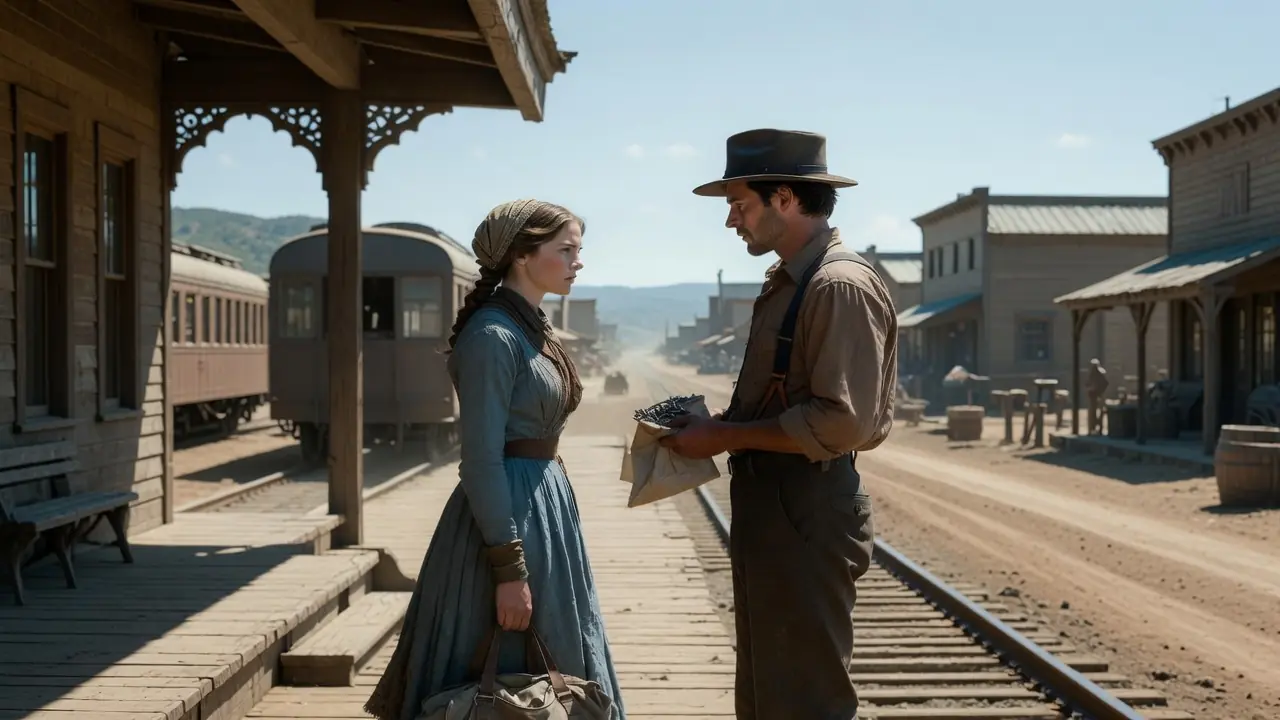
Mary came without hesitation. Supper that first night was beans, cornbread, and a broth that had no business smelling as rich as it did given what the larder held. The smell reached the front room before anyone sat down. Seth came in from the yard and stopped just inside the door, and something moved across his face before he set it aside.
Jack ate quietly. Mary ate with her eyes moving between her bowl and Willa in steady rotation. Partway through the meal, Mary set her spoon down and said the last woman who kept house for them had burned everything she touched. Seth said her name in warning.
Mary looked at Willa instead. “She did, though.” Willa kept her eyes on her plate. “Burned beans are a serious matter. I do not take them lightly.” Jack looked up.
The corner of his mouth moved once and returned to where it had been. He said nothing more, but when supper was finished, he stayed at the table a little longer than he needed to before going to bed. Seth noticed that without comment. Willa noticed Seth noticing it.
The next morning, Seth came off the porch and the loose step held solid under his boot. He stopped and pressed it again. The board did not move. He stood there for a moment, then went inside and poured two cups of coffee.
He left one on the counter near where Willa was working. Nothing was said about the step. She said nothing about it either. They drank their coffee in the early quiet while the cold morning settled around the house.
Jack tested her on the fifth day. He simply did not do the thing she had asked and settled in to wait. Willa appeared in the doorway of the back room. “Jack, the wood.”
He looked up. “I was getting to it.” “I know,” she said. “Get to it now, please.” He looked at her, held her gaze, found what he was looking for, and then got up.
He brought the wood in without argument. Willa thanked him plainly and went back to the kitchen. Seth had heard it from his workbench. He set his plane down and stood in the quiet for a while before picking it back up.
The days found their shape after that. Jack began staying at the table after meals, whittling or reading, present in a way he had not been. Mary followed Willa from room to room with the devotion of a small shadow, helping where she could reach and watching carefully where she could not. Seth started coming home from his carpentry work at the same hour every evening.
One evening, Willa read to Mary from the book of stories on the shelf, doing the voices without embarrassment. Mary pressed against her side with the complete trust of a child who had made a decision and saw no reason to revisit it. Jack sat at the far end of the room with something in his hands. He did not look up, but he did not leave.
By the time frost had settled into the mornings for good, Mary had stopped trailing Willa like a guest and started trailing her like a child at home. It happened on a gray, unremarkable morning. Mary was moving through the kitchen in her socks, still warm from sleep, absorbed in some private business. She caught her foot on the threshold between the kitchen and the hall and went down hard on both palms.
The sound she made was the startled kind, the kind that comes before a child has decided whether the moment warrants tears. Mary decided it did. Willa came down to the floor with her before the crying had fully started. She took both small hands in hers, looked at the palms, and held them steady without fussing and without going anywhere.
Then Mary, without meaning to say anything at all, said the word that was simply true. “Mama.” It went into the cabin and did not leave. Willa’s hands stayed where they were for one breath, no more.
Then she gathered the girl in and held her until the crying ran itself out. She was calm and certain, giving no outward sign of what the word had done to the room. Seth stood in the bedroom doorway. He had heard it.
He kept one hand on the frame and looked at the hallway floor without moving. Something was happening in him, and he kept his eyes away from it. Some things change the moment you look at them straight. At the table, Jack had gone still.
He was ten years old. He knew exactly what he had heard and exactly what it meant. Something in his face that had been shut for a long time was working slowly toward open. Seth went back into his room, sat on the edge of the bed with his hand flat on his knee, and stayed there while the morning moved quietly around the house.
Abigail Cutler came to stand beside Willa at the general store counter on a Friday afternoon. She carried the warm and practiced manner of a woman delivering concern she had prepared at home. She spoke about appearances, about what people were saying, and about the natural shape a situation found when it was left alone. She spoke about the confusion that came from children being given the wrong idea about what an arrangement was.
Abigail chose her words the way a person chooses tools for what they will do. Then she left without buying anything. Willa set her coins on the counter one at a time and walked home. She was twenty-five years old, and she had been assessed by women with prepared voices in enough rooms to build a durable patience for it.
It was the patience of a woman who knew another person’s measure of her was not the truth. At home, she stood at the kitchen window with her hands on the sill. She looked at the yard, the line of pines beyond it, and the cold flat sky longer than she needed to. Then she started supper.
That evening, Seth was at the stove while Willa finished the dishes. Without looking up from the fire, he asked, “You all right?” She kept her hands in the basin and thought about it honestly. “I am,” she said.
He nodded once at the fire. She went back to the dishes, and the room held its quiet around them both. It was not the silence from before, not empty or cold. It had begun to hold things.
Nearly a month later, Dale Marsh had no intention of causing trouble. He was at the saloon on a Tuesday evening, talking the way men talk at the end of a long day, easy and unhurried. He said the Callan place looked different lately. Smoke at the right hours, children steadier, and that woman from the platform, the one Albert had left standing in front of half the town, somehow had the place alive again.
Dale said the children had taken to her like he had not seen before. The older one was coming around, and the younger one had started calling her Mama. He reached for his glass without noticing Albert Pugh had gone still at the end of the bar. Dale kept talking because he did not know he had opened something.
Albert looked at the row of bottles across from him. He still had the agency papers in his coat. His pride had sat wrong since the platform. Now there was a picture forming in his head: warm light in the windows, children settled, smoke at the right hours, and a woman the children had begun to call Mama.
He set coins on the bar and stood. “Where does Callan live?” he asked. Two days later, on a Thursday morning cold enough to hold every sound sharp, Seth and Willa came out of the post office together. He had gone to collect a timber notice, and she had walked with him because the children were at school and the morning had made room for it.
Albert stepped into the middle of the street with the agency papers in his hand and his voice pitched to carry. “The fare was paid,” he said. “The contract was signed. An obligation does not dissolve because a woman found somewhere more comfortable to be.”
He held the papers up like a deed, though everyone on that street knew what they actually were. Then he used the word his, and the street heard it land. Everything slowed. A woman near the dry goods store stopped walking, and two men outside the feed store turned.
The cold air held everything in place. Willa stood beside Seth. She did not step back. She did not look at Albert.
She held herself the way she had held herself on the platform, still, straight, and not finished. But this time, someone stood beside her, and the whole street could see he had not moved. Seth looked at the papers. He looked at Albert.
Then he turned to Willa, his voice low and even. “Stay here.” It was not a command. It was the way a person speaks to someone he is coming back to.
Seth walked to the bank. Four minutes passed. He came back with money he had kept under the floorboards for two years, every dollar set aside toward buying back into a proper ranch. It was the slow and patient work of a man rebuilding from the ground up.
He crossed the street and pressed the money into Albert’s hand. He held it there until Albert’s fingers closed around it. “That settles the fare, the fee, and every excuse you rode in with,” Seth said. His voice was flat and final.
“It does not buy her. It frees her from you. Now go.” Albert looked at the money. He looked at the street looking at him.
Then he looked once at Willa. Whatever he found in her face was not what he had ridden into town for. He walked to his horse and rode out. The cold morning closed behind him.
The street held its breath. Seth turned, not to the crowd, but to Willa. She was already looking at him. Her hands were at her sides.
The exhaustion she had carried since the platform was gone from her eyes, and something steadier had taken its place. It was the look of a woman standing on ground that held. Seth stood in front of her while the wind came off the hills between them, clean and cold. He had crossed the street before deciding to.
He had left coffee on a counter and made nothing of it. He had just handed two years of savings to another man without pause because standing by while Willa was taken was not something he was able to do. He was not a man who dressed things up finer than they were. He was not going to start now.
“I would like you to stay,” he said. “As my wife. If that is what you want.” Willa looked at him and took the space that choosing for herself required. Nobody hurried her.
The cold street waited. “Yes,” she said quietly and completely, with nothing held back. “That is what I want.” Seth let out a long, slow breath.
His hand found hers and closed around it. Around them, the town came back to itself. Boots moved on the boardwalk. A door opened somewhere and fell shut.
The ranch would have to wait. For the first time in years, waiting did not feel like losing. Jack was at the table later that evening with a short length of wood and his father’s smallest plane, working the edge down by feel, the tip of his tongue between his teeth. Mary sat on the floor with her rag doll, deep in some matter of considerable importance that did not require adult involvement.
From the stove came the smell of something with molasses. It was a new thing Willa was working out, adjusting as she went. It was the kind of smell that gets into the walls of a kitchen and stays there for years. Then the door opened.
Cold air entered first, then Seth’s boots on the step. It was the sound of a man who knew he was coming home expected and had stopped taking that for granted. Mary raised the rag doll briefly in his direction by way of greeting and returned to her business. Jack looked up at his father in the doorway, then back down at the plane, and kept working.
The looking had carried something in it that had not been there at the start of things. Seth hung his coat, crossed to the stove, and stood beside Willa. He looked at what was on it. She moved the spoon toward him without a word.
He tasted it and considered it quietly without rushing. Then he looked at her. She took the spoon back. “I know,” she said. “More molasses.”
The corner of his mouth moved. He went to hang his coat properly and left her to it. On the shelf above the window, the sewing basket sat where it had always sat. The late light came through the glass, found the wooden lid, and rested there warm and still.
Outside, wind moved through the pines at the edge of the property. The horse shifted in the pen. Somewhere past the tree line, a bird called once, long and unhurried. The cabin held its warmth.
It was not waiting for anyone anymore. And that was the story of Willa Hart, a woman who arrived with nothing but a bag, a spine, and the courage not to fall apart. She had been left on a platform in front of half a town, but she did not remain abandoned. She answered one simple question, walked toward a broken house, and became the heart of a family that had forgotten what home could feel like.