The Runaway Bride Walked Through a Snowstorm Alone — Then a Widowed Father Opened His Car Door
The headlights cut through the falling snow like a blade through darkness.
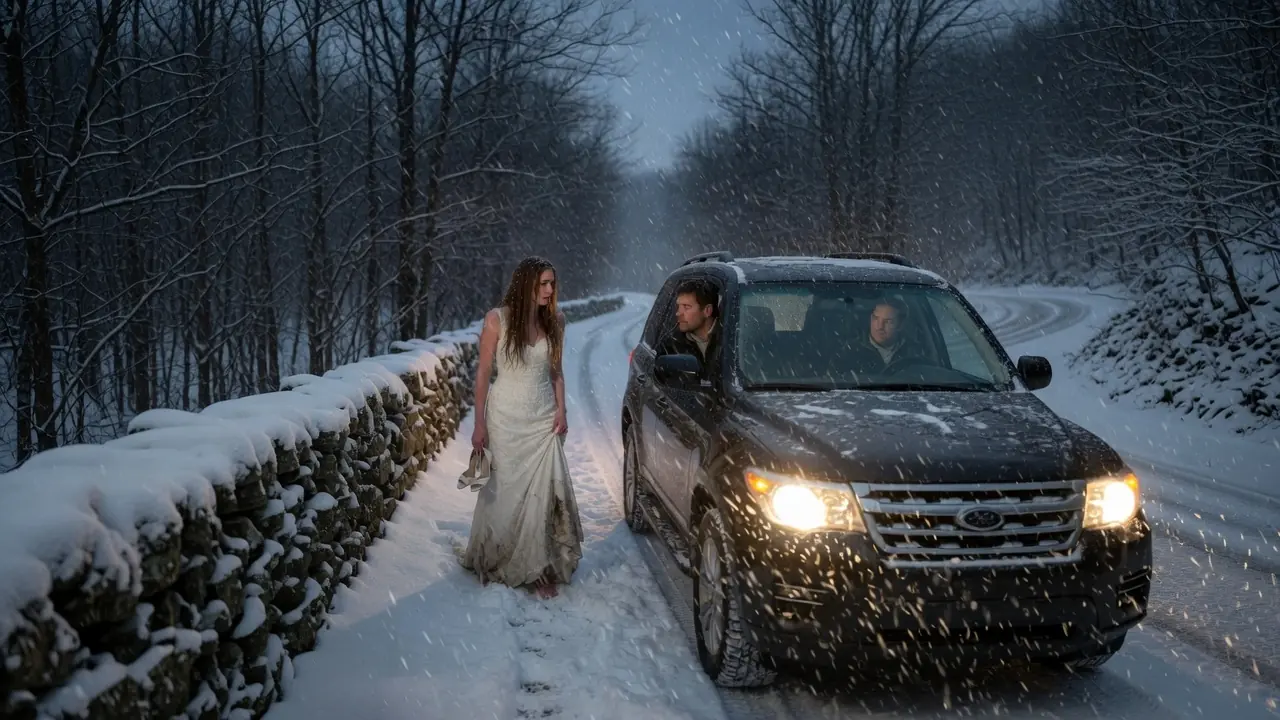
William Harrison slowed his car when a white shape appeared beside the road.
At first, he thought it was a sheet caught in the wind.
Then the figure stepped into the light.
A woman in a wedding dress was walking alone along Route Nine.
Her expensive gown was torn at the hem and soaked where it dragged across the wet asphalt. She carried her high heels in one hand. Her dark hair, which had clearly been arranged with great care only hours earlier, hung damp and disordered around her face.
She did not wave for help.
She did not look toward the passing cars.
She simply kept walking through the snow as though she were trying to put as much distance as possible between herself and everything behind her.
Normally, Will would have continued driving.
In the two years since his wife died, he had learned to avoid becoming entangled in the private disasters of strangers. His own life already required more strength than he often believed he possessed.
But there was something about the way the woman walked.
Not lost.
Not confused.
Escaping.
Will pulled onto the shoulder and lowered the passenger window.
“Do you need help?”
The woman stopped.
Snow collected on the delicate lace covering her shoulders.
She looked toward him with a mixture of defiance and exhaustion. Even in the weak light, Will could see that she was beautiful in the polished, carefully maintained way of someone raised around expensive salons, private schools, and country clubs.
Yet beneath that perfection was something raw.
Something broken open.
It reminded Will of his own face in the bathroom mirror the morning after Sarah’s funeral.
“I’m fine,” the woman said.
Her voice was controlled, refined, and entirely unconvincing.
Will shifted the car into park.
“Just taking an evening walk?”
A small smile flickered across her face before disappearing.
“When you put it that way, it does sound rather dramatic.”
“In a wedding dress.”
“Yes.”
“During a snowstorm.”
“I noticed the weather.”
“On an empty road.”
She looked down at the ruined hem of the gown.
“I didn’t plan this particularly well.”
Will studied her.
The temperature had fallen below freezing. The snow was becoming heavier, and the woman’s bare shoulders were already trembling.
He opened the passenger door.
“Look, I don’t know what happened tonight. I’m not asking you to tell me.”
She glanced toward the dark road behind her.
“No judgment,” Will continued. “No questions you don’t want to answer. Just a warm car and a destination of your choice.”
Her eyes moved toward him again.
The dress probably cost more than his car.
The beadwork reflected the headlights like tiny captured stars.
“I don’t actually have a destination,” she admitted.
Will rested one hand on the steering wheel.
“Sometimes that’s the best kind of journey.”
The woman hesitated.
Then she climbed into the passenger seat.
She gathered the enormous skirt around her knees and pulled the seat belt across it. The ordinary click of the buckle looked almost absurd beside the lace, silk, and hand-sewn crystals.
Will returned to the road.
“I’m Will.”
She stared through the windshield for several seconds.
“Tori.”
It was not her full name.
He could tell.
But he did not press.
“Thank you,” she added quietly.
They drove in silence.
Snow whispered against the windshield while the heater gradually filled the car with warmth.
Will found himself glancing toward her profile, trying to understand what kind of story ended with a bride walking alone beside a rural Connecticut highway.
The dress was too elaborate for a small ceremony.
Her earrings looked real.
The way she held herself suggested a lifetime of being observed.
But her composure seemed fragile now, like ice beginning to crack under pressure.
“Are you cold?”
“A little.”
Will reached into the back seat and found a worn wool blanket.
It belonged to his eight-year-old daughter, Charlie. Like most of her belongings, it had somehow migrated into his car and remained there.
He handed it to Tori.
“It’s not elegant, but it’s warm.”
The blanket was covered with faded cartoon animals.
Tori wrapped it around her shoulders.
The contrast was striking.
A luxurious wedding gown beneath a child’s old comfort blanket.
She noticed him looking.
“I suppose I look ridiculous.”
“You look like someone having the worst night of her life.”
Tori lowered her eyes.
She studied him more carefully.
“You sound like you’re speaking from experience.”
Will looked toward the road.
“I am.”
He had been driving home from Charlie’s parent-teacher conference when he found her.
Mrs. Peterson had spoken gently about Charlie’s increasingly withdrawn behavior.
She participated less in class.
She rarely played with other children during recess.
She seemed afraid of talking about her mother, as though saying Sarah’s name might make the loss happen all over again.
Will had sat across from the teacher feeling like a failure.
He knew how to prepare lunches.
Pay bills.
Repair a leaking faucet.
Remember library days most of the time.
But he did not know how to help his daughter carry grief that he had barely learned to hold himself.
The roads through Greenwich were familiar.
They curved past colonial estates, private driveways, and bare oak trees that would become green again in spring.
Will had traveled that route hundreds of times.
Yet that evening felt unlike any other.
The storm had arrived earlier than predicted.
And the woman beside him seemed to have stepped directly out of some damaged fairy tale.
“Where would you like me to take you?” he asked.
Tori remained quiet for a long time.
“My apartment is gone.”
“Gone?”
“My old apartment. I gave it up when I moved in with…”
She gestured toward the wedding dress.
“The man you were supposed to marry?”
“Yes.”
“Hotel?”
“I don’t have my handbag.”
“Friends?”
She looked toward the window.
“Not the kind I can call tonight.”
“Your parents?”
“They’re the reason I was wearing the dress.”
Will absorbed that.
His house was only a few miles away.
The colonial revival had been Sarah’s choice. She had loved the wide windows, the kitchen garden, and the old staircase that creaked near the top.
It was too large for Will and Charlie now.
But selling it felt like erasing the final shape of their life together.
“I have a guest room,” he said.
Tori turned sharply.
“It’s private. Warm. You can figure things out tomorrow.”
“You don’t know me.”
“That’s true.”
“I could be dangerous.”
Will glanced at the oversized wedding skirt.
“You’re hiding weapons very convincingly.”
She almost laughed.
Then her expression became serious again.
“Why would you do that for a stranger?”
Will thought of Sarah.
Of hospital rooms.
Of promises made during the final weeks of her life.
“Because you look lost.”
“That isn’t your responsibility.”
“No.”
He looked toward her.
“But I remember what it feels like.”
When they entered his driveway, Will felt a sudden nervousness.
He had not brought another woman into the house since Sarah died.
Not for dinner.
Not for coffee.
Certainly not for the night.
The house still carried his late wife’s choices everywhere.
Her framed photographs.
The yellow curtains she insisted made the kitchen cheerful.
The pottery bowl she bought during their honeymoon.
Even the garden visible beyond the back windows, now overgrown and neglected, still belonged emotionally to Sarah.
The porch light was on.
Charlie was spending the night with her friend Emma after the school conference, and Will was grateful for the timing. Explaining a stranger in a ruined wedding dress would have been difficult even under ordinary circumstances.
He opened the front door.
“Welcome to our humble home.”
Tori stepped inside.
Her heels clicked against the hardwood before she remembered she was still carrying them.
Family photographs covered the side tables.
Charlie’s drawings were attached to the refrigerator with colorful magnets.
A basket of unfolded laundry sat near the stairs.
The house was imperfect, warm, and unmistakably lived in.
Tori looked around slowly.
“You have a beautiful home.”
“My wife chose most of it.”
Will stopped.
“My late wife.”
Tori’s expression softened.
“I’m sorry.”
“Thank you.”
He took her wet blanket.
“Coffee?”
“At this hour?”
“I wasn’t sleeping tonight anyway.”
While Will worked in the kitchen, Tori moved through the living room.
She studied the photographs.
Will and Sarah on their wedding day, laughing at something outside the frame.
Sarah holding newborn Charlie.
Charlie’s first birthday.
A summer picnic.
A Christmas morning filled with wrapping paper.
There was genuine affection in every picture.
Not the polished performance Tori had spent most of her life mistaking for happiness.
When Will returned with two mugs, she was looking at a photograph of Sarah sitting in the garden.
“How long?” Tori asked.
“Two years.”
“What happened?”
“Cancer.”
Will sat in the armchair.
“It was fast. Which was both a blessing and a curse.”
Tori settled onto the couch, gathering the wedding dress around her.
“What was her name?”
“Sarah.”
“What was she like?”
Will looked down at his coffee.
“She was a nurse at the children’s hospital.”
He smiled faintly.
“She used to say healing people was just another form of love.”
“She sounds wonderful.”
“She was.”
They sat quietly.
Then Will looked toward Tori.
“What about you?”
She wrapped both hands around the mug.
“What about me?”
“You’re in my living room at midnight wearing a wedding dress.”
“I thought you promised no questions.”
“I promised no questions you didn’t want to answer.”
For several seconds, Will expected her to refuse.
Then something in the quiet room seemed to loosen the last of her defenses.
“I was supposed to marry Theodore Blackstone tonight.”
Will knew the name.
Almost everyone in Connecticut did.
The Blackstone family owned investment firms, real-estate companies, and enough political influence to make newspapers describe scandals as misunderstandings.
“The Theodore Blackstone?”
“There aren’t many of them.”
“Why did you leave?”
Tori looked toward the dark window.
“He is intelligent. Successful. Wealthy. My parents adore him.”
“But you don’t.”
“I tried.”
She tightened her hands around the mug.
“I was supposed to be the perfect daughter. Then the perfect fiancée. Tonight I was supposed to become the perfect wife.”
She swallowed.
“There were five hundred people in the church. Photographers. Business partners. Politicians. People my parents needed to impress.”
“What happened?”
“I stood at the back of the aisle and realized that if I walked forward, I was going to disappear.”
Will said nothing.
Tori continued.
“I would live in his house. Attend his events. Support his career. Wear what he liked. Smile when expected.”
Her voice became smaller.
“And everyone would call it a wonderful life.”
“So you ran.”
“I ran through the reception hall, past the wedding planner, past the photographers, and past my mother.”
Tori gave a broken laugh.
“I think she was more upset about the photographs than the marriage.”
“How far did you run?”
“Until my shoes became impossible.”
“And then?”
“I kept walking.”
She looked around the living room.
“Now I’m sitting in a stranger’s house, drinking coffee in a ruined dress, wondering what I’m going to do with the rest of my life.”
Will leaned back.
“That isn’t the worst place to start over.”
They spoke until nearly three in the morning.
Not continuously.
Some of the most important moments happened in silence.
Will told her about Sarah.
About raising Charlie alone.
About the guilt he felt whenever he imagined being happy again.
He confessed that he feared he was failing his daughter because Sarah had always understood the emotional parts of parenting better than he did.
Tori spoke about her upbringing.
The private schools.
The charity events.
The pressure to represent the Ashford family correctly.
Her parents had chosen the right friends, the right university, and eventually the right man.
Her full name was Victoria Ashford.
She had shortened it years earlier, but almost nobody respected the choice.
“When Theo called me Victoria, it always sounded like an instruction,” she said.
Near three, exhaustion finally overtook them.
Will showed her to the guest room.
He left clean towels and several pieces of Sarah’s clothing outside the door.
As he turned away, Tori spoke.
“Will?”
He looked back.
“Thank you.”
“For the room?”
“For stopping.”
Her eyes filled slightly.
“For not demanding an explanation before deciding I deserved help.”
Will nodded.
“Get some sleep.”
The next morning, he woke to voices in the kitchen.
For a moment, he forgot the night before.
He had become accustomed to silence.
Then he heard a child laughing.
Will hurried downstairs.
Charlie sat at the kitchen table wearing her winter coat, studying Tori with the intense curiosity only an eight-year-old could maintain without embarrassment.
Tori stood beside the stove making pancakes.
She wore one of Sarah’s old green sweaters and a pair of jeans. Her hair was tied into a simple ponytail.
Without the dress and elaborate makeup, she looked younger.
More human.
“Dad,” Charlie said. “Emma’s mom brought me home because Emma got sick.”
“I see that.”
“There was a lady in the kitchen.”
“I also see that.”
“She’s making pancakes.”
Tori looked toward him.
“I hope that was all right.”
Before Will could answer, Charlie asked, “Are you Dad’s girlfriend?”
“Charlie.”
“What? I’m asking.”
Tori crouched beside her.
“I’m just a friend who needed help.”
“My dad is good at helping people.”
Charlie said it with complete certainty.
“He helped me when Mom died.”
Will felt his throat tighten.
It was the first time in months Charlie had spoken about Sarah without being prompted.
Tori’s expression softened.
“Your mom must have been very special.”
“She was the best mom in the world.”
Charlie pointed toward the pancakes.
“She used to make those on Sundays. Dad tries, but his are too thick.”
“Mine are structurally sound,” Will objected.
“They’re like roof tiles.”
Tori covered a laugh.
“Maybe I can teach him the secret.”
During breakfast, Will watched Charlie change.
She asked Tori questions.
About the sweater.
The pancakes.
Her favorite color.
Whether she liked drawing.
Tori answered each one seriously.
She admired Charlie’s artwork and listened to a detailed explanation of a disagreement between three girls at school.
For months, Charlie had spoken only when necessary.
Now words spilled out of her.
Will was grateful.
“I have a client meeting,” he said reluctantly.
After Sarah died, he took extended leave from his finance position and eventually began consulting from home. The arrangement allowed him to be available for Charlie, but that morning’s meeting could not be postponed.
“I should start figuring out what to do next,” Tori said.
“Can she stay until you get back?” Charlie asked. “She promised to help with my art project.”
Will looked toward Tori.
“If you’re comfortable.”
“I’d like to.”
When he returned that afternoon, the house was empty.
Laughter came from the backyard.
Will found Tori and Charlie near the neglected garden, both wearing winter coats and boots.
Charlie held a wooden stake.
Tori had a notebook open.
“What are you doing?”
“We’re planting a garden,” Charlie announced.
“In frozen ground?”
“Not today.”
Tori smiled.
“We’re planning.”
Charlie pointed toward the overgrown beds.
“Tori says we can plant roses where Mom’s garden used to be.”
Will looked toward the tangled vines.
Sarah’s garden had been her pride.
After she died, he could not bring himself to care for it.
Every dead plant felt like another failure.
Eventually, he stopped going near it.
“That’s a large project,” he said.
“All the best things are,” Tori replied.
Then she softened.
“But we don’t have to decide anything yet. We’re only dreaming.”
That evening, after Charlie was asleep, Will and Tori sat on the covered porch with a bottle of wine.
Snow covered the garden in smooth white shapes.
“Thank you,” Will said.
“For what?”
“Charlie hasn’t been like this in months.”
“She’s a wonderful child.”
“She misses her mother.”
“So do you.”
Will looked toward the yard.
“I worry I’m not enough for her.”
“No parent is everything.”
“Sarah knew what to say. She understood the emotional things.”
“You’re there.”
“That doesn’t always feel like enough.”
“Love isn’t about being perfect.”
Tori turned toward him.
“It’s about showing up even when you’re frightened.”
The words stayed with him.
“What are you going to do?” he asked.
“I don’t know.”
She pulled the blanket more tightly around herself.
“I have a degree in marketing. I worked for several years, but I stopped when I became engaged.”
“Why?”
“Theo said my job was unnecessary.”
“And what did you say?”
“I told myself he was right.”
Her eyes moved toward the snow.
“I’ve spent so long being what everyone wanted that I’m not sure who I am without instructions.”
Will took a breath.
“You could stay.”
Tori turned.
“For a little while,” he added quickly. “Until you make a plan.”
“I couldn’t impose.”
“You aren’t.”
He looked through the window toward the staircase.
“If anything, you’re helping.”
“With Charlie?”
“With both of us.”
Tori studied his face.
“I’m not suggesting anything complicated,” he said.
“Good.”
“I’m only saying you have time.”
Three days later, their fragile peace ended.
Will was working in his home office when several vehicles entered the driveway.
Two black SUVs.
A silver Bentley.
He looked through the window and immediately understood.
Theodore Blackstone stepped from the Bentley wearing a charcoal overcoat and an expression shaped by a lifetime of never being denied.
Two security men remained near the vehicles.
Theo approached the front door.
Will met him outside.
“Mr. Harrison.”
“Mr. Blackstone.”
“I believe you have something that belongs to me.”
Will’s expression hardened.
“People don’t belong to other people.”
Theo smiled without warmth.
“Victoria is experiencing a breakdown. She isn’t thinking clearly.”
“She seemed very clear.”
“Her parents are worried.”
“Maybe they should have considered that before forcing her into a marriage.”
Theo’s eyes narrowed.
“You don’t understand the situation.”
“I understand that she said no.”
“She has obligations.”
“To you?”
“To her family. To the commitments she made.”
Will stayed in the doorway.
“She changed her mind.”
“You’re a stranger.”
“So are you, apparently.”
Theo stepped closer.
“You’re a widower with a child living in a house probably mortgaged beyond its value.”
His gaze moved toward the windows.
“What exactly do you think you can offer someone like Victoria?”
“Nothing.”
Theo looked surprised.
“I’m not trying to buy her.”
Will’s voice remained steady.
“I’m offering her the right to choose.”
Theo called toward the house.
“Victoria!”
Tori appeared in the hallway.
Charlie stood behind her.
Tori looked pale, but she walked forward with her chin raised.
“Hello, Theo.”
“Thank God.”
He moved toward her.
“Everyone is worried. Come home. We’ll handle this quietly.”
“Nothing is wrong.”
“Then stop behaving irrationally.”
Tori stood beside Will.
“That is exactly the problem. Everything was going according to plan.”
“Our plan.”
“Your plan.”
Theo’s expression hardened.
“You are thirty-two years old, Victoria. This is not a teenage rebellion.”
“No.”
Her voice grew stronger.
“It is the first adult decision I have made without asking permission.”
“I gave you everything.”
Theo gestured toward the Bentley.
“A home. Security. Position. A future.”
“You gave me a role.”
“I gave you a life.”
“It never felt like mine.”
Theo’s voice sharpened.
“You’re coming with me.”
“No.”
“Victoria.”
“No.”
Will stepped slightly forward.
“You should leave.”
Theo studied them.
Understanding, or something close to suspicion, entered his eyes.
“So that’s what this is.”
“What?” Tori asked.
“You think you can replace me with him?”
“This has nothing to do with replacing you.”
Theo looked toward Will.
“You believe she brings money with her?”
Will said nothing.
“She doesn’t.”
Theo turned back to Tori.
“Your trust depends on your parents’ approval. Without them, without me, you have nothing.”
Tori’s hands trembled.
But she did not move.
“Then I will start with nothing.”
“You’ll come back.”
“No.”
“When reality arrives, you will come crawling home.”
Tori looked directly at him.
“I would rather struggle as myself than live comfortably as your possession.”
Theo’s face turned cold.
“You may not find me so forgiving next time.”
Will stepped forward.
“There will not be a next time. Leave.”
For several seconds, Theo looked ready to argue.
Then he turned and walked toward the Bentley.
The vehicles disappeared down the road.
Inside, the house felt unnaturally quiet.
Charlie had retreated upstairs.
Tori stood in the living room with both arms wrapped around herself.
“Are you all right?” Will asked.
“I don’t know.”
She sat on the couch.
“Everything he said about the money is true.”
“That doesn’t make the rest true.”
“I have nothing of my own.”
“You have an education.”
“I haven’t worked in more than a year.”
“You can work again.”
“What if I can’t?”
She looked toward him.
“What if I’m exactly what they said? Someone incapable of surviving without them?”
“You walked away from a church filled with five hundred people.”
“That wasn’t survival. That was panic.”
“It was courage.”
Tori shook her head.
“Why are you doing this?”
“Doing what?”
“Helping me.”
She stood.
“You don’t know me.”
Will thought carefully.
“When Sarah was dying, she made me promise something.”
Tori waited.
“She said that if I ever had the chance to help someone find their way back to themselves, I should take it.”
His voice became quieter.
“She believed love was helping people become who they were meant to be.”
Tears moved down Tori’s cheeks.
“She sounds incredible.”
“She was.”
Will smiled faintly.
“And she would have liked you.”
That night, he found Tori standing in the kitchen, staring toward the snow-covered backyard.
She wore Sarah’s green sweater again.
“Can’t sleep?”
“Too much thinking.”
Will stood beside her.
“I keep wondering what I’m going to do.”
“One day at a time.”
“Is that how you survived losing Sarah?”
“Some days it was one hour.”
He looked toward the garden.
“Some days one minute.”
“Does it become easier?”
“Yes.”
“Better?”
“Not exactly.”
They stood quietly.
Then Tori asked, “Do you think you’ll ever love someone again?”
Will felt the familiar ache in his chest.
For two years, the question had brought guilt.
That evening, for the first time, it brought something else.
Possibility.
“I don’t know.”
He looked toward her.
“I used to think loving again meant replacing what I lost.”
“And now?”
“Now I think maybe love makes room.”
Tori’s eyes brightened.
“Will…”
“I’m not asking for anything.”
He spoke quickly.
“I only want you to know that wherever you go from here, you are not alone.”
“What if I want to stay?”
The question was barely more than a whisper.
“Then stay.”
The next morning, the house felt different.
Not fixed.
Alive.
Charlie immediately began showing Tori all of Sarah’s favorite places.
The window seat where she read.
The kitchen drawer where she hid chocolate.
The corner of the porch where she watched thunderstorms.
“Mom sat here when she was sad,” Charlie said, touching the cushion beneath the living-room window. “She said birds made her feel better.”
Tori sat beside her.
“That’s a beautiful memory.”
Charlie studied her.
“Do you think she would mind if you stayed?”
Tori’s expression changed.
“I don’t know. What do you think?”
Charlie considered carefully.
“I think she would like that Dad smiles more now.”
Tori looked toward the doorway.
Will stood there silently.
That afternoon, while Charlie was at school, Will and Tori visited a garden center.
It was still too early to plant, but the greenhouse was warm and smelled of damp soil.
Tori moved between displays with growing enthusiasm.
She discussed roses, lavender, herbs, and climbing vines with surprising knowledge.
“You really know what you’re doing.”
“My grandmother taught me.”
“What was her garden like?”
“The most beautiful place in the world.”
Tori touched a packet of flower seeds.
“I spent every summer there.”
“What happened to it?”
“My parents sold the house after she died.”
She looked down.
“The new owners tore out the garden and built a tennis court.”
Will heard the grief beneath her voice.
“We’ll plant another one.”
Tori looked up.
“Really?”
“Whatever you want.”
“What about Sarah’s garden?”
Will looked toward the greenhouse ceiling.
“She said gardens were about hope.”
He smiled.
“Planting something today for beauty you won’t see until later.”
They spent hours planning.
Tori sketched pathways on paper napkins.
Will chose vegetables.
Charlie demanded strawberries, sunflowers, and one section devoted entirely to flowers that attracted butterflies.
Spring arrived early.
The house changed with it.
Tori found a part-time position at a local nonprofit, helping with marketing and fundraising.
The salary was modest.
She loved it.
For the first time, the money entering her account belonged to work she had chosen.
She opened a bank account in her own name.
Bought her own phone.
Paid for groceries even when Will protested.
Charlie began speaking more at school.
Her teacher reported that she was playing with friends again.
She still grieved.
But Sarah’s name no longer silenced the house.
Tori never tried to replace her.
She asked about Sarah.
Listened to stories.
Helped Charlie create a memory box.
Will loved her for that before he admitted loving her for anything else.
One evening, they worked together in the new garden.
Tori knelt near the border, planting marigolds.
Charlie stood beside Will holding a watering can.
“Dad?”
“Yes?”
“Are you and Tori going to get married?”
Will nearly dropped the garden spade.
Tori kept her face lowered, though he could see her smiling.
“Why do you ask?”
“My friend Emma has a stepdad.”
“That does not answer the question.”
“She said her family got bigger.”
Charlie looked toward Tori.
“I like her.”
“I’m glad.”
“She doesn’t try to be Mom.”
Will looked at his daughter.
Charlie continued.
“But she’s not scared of Mom either. She talks about her.”
Tori’s hands stopped moving.
“And she makes you happy,” Charlie added.
Will’s throat tightened.
“She does.”
“Then you should marry her.”
“That is a large decision.”
“You should probably ask her first.”
That evening, after Charlie was asleep, Will joined Tori on the porch.
The garden had begun to take shape.
Green rows.
Fresh soil.
Small shoots promising what summer would bring.
“Charlie asked if we’re getting married.”
Tori looked toward him.
“What did you say?”
“That I hadn’t asked you.”
Her expression became unreadable.
“Tori, I know this is complicated.”
“Yes.”
“You left one life because everyone else planned it for you.”
“Yes.”
“I would never put you in another situation where you feel trapped.”
“Then what are you saying?”
Will took a breath.
“I love you.”
Tori’s eyes filled.
“I love who you are in the garden. I love how you listen to Charlie. I love that you are brave enough to start again.”
He took her hand.
“I love you when you’re frightened too.”
“I love you,” she whispered.
“But I’m terrified.”
“So am I.”
“What if I make another mistake?”
“Then it will be your mistake.”
Tori laughed through tears.
“That is not romantic.”
“It’s honest.”
Will touched her cheek.
“This life would be chosen. Not arranged.”
“What if I’m not ready?”
“Then we wait.”
“How long?”
“As long as you need.”
Three months later, Charlie ran into the kitchen holding a drawing.
“I finished it!”
Will and Tori looked up from breakfast.
The picture showed three people standing in front of the house.
Will.
Tori.
Charlie.
Behind them was the garden in full bloom.
At the bottom, in careful handwriting, Charlie had written:
MY FAMILY IS GROWING.
Tori stared at the picture.
In Charlie’s drawing, she was not replacing Sarah.
She was not pretending to be someone else.
She was simply present.
Part of the family’s future without erasing its past.
“Can we put it on the refrigerator?” Charlie asked.
Will took the picture.
“Of course.”
He placed it beside family photographs, grocery lists, school notices, and the small ordinary evidence of life continuing.
Tori felt something settle inside her.
Not the need to prove herself.
Not the pressure to perform.
Belonging.
Real belonging.
“I need to tell you both something.”
Will turned.
Charlie looked up.
Tori stood.
“I’ve been thinking about what Charlie wrote.”
“My family is growing?”
“Yes.”
She looked toward Will.
“I spent most of my life fitting into someone else’s idea of who I should be.”
She took a breath.
“I don’t want to do that anymore.”
Will waited.
“But I do want to grow with this family.”
Charlie’s eyes widened.
“You mean stay forever?”
Tori smiled through tears.
“If you’ll have me.”
Charlie launched herself into Tori’s arms.
Will wrapped both of them together.
For several seconds, they stood in the kitchen surrounded by coffee mugs, breakfast dishes, drawings, photographs, and the view of the garden beyond the window.
“Welcome home,” Will whispered.
Outside, the roses were beginning to bloom.
The garden was not Sarah’s old garden.
Nor was it entirely Tori’s.
It had grown from both memory and hope.
Will proposed later that summer beneath the window where Sarah once watched birds.
He did not plan a grand event.
There were no photographers.
No business associates.
No five-hundred-person audience.
Charlie hid nearby holding the ring and nearly revealed the surprise three times.
Will looked at Tori.
“I’m not asking you to complete my life.”
She smiled.
“Good.”
“I’m asking whether you want to keep building one together.”
Tori looked toward Charlie, who had stopped pretending not to listen.
Then toward the garden.
“Yes.”
Their wedding took place the following spring.
In the backyard.
Forty guests.
Simple flowers grown from the garden they planted together.
Tori wore a modest cream dress.
No long train.
No family jewels.
No expectations sewn into every inch.
She walked beside Charlie.
Will waited beneath a wooden arch covered in roses.
Theodore Blackstone married someone else the following year.
Tori’s parents did not attend her wedding.
For a long time, that hurt.
Eventually, she understood that freedom sometimes required accepting that certain people loved obedience more than they loved you.
She built a successful career at the nonprofit.
Later, she created a program helping women rebuild financially after leaving controlling relationships.
Will continued consulting from home.
Charlie grew older.
Sarah remained part of their family.
Her photographs stayed on the walls.
Her birthday was remembered.
Her favorite flowers grew beside Tori’s roses.
Years later, Charlie told friends that she had two mothers.
One taught her how to begin life.
The other taught her that life could begin again.
People often described Tori’s story as a fairy tale.
A runaway bride.
A kind stranger.
A warm house in a snowstorm.
A widowed father.
A new family.
But Tori never believed the most important moment was the wedding she escaped or the wedding she later chose.
It was the moment beside the road.
She had been walking without a destination, wearing a ruined dress that represented everything other people wanted her to become.
Cars passed.
Then one stopped.
Will did not know her name.
He did not know her family.
He did not know whether helping her would change his own life.
He simply saw someone lost in the snow and opened the door.
That was how their story began.
Not with love at first sight.
Not with destiny.
With kindness offered before explanation.
A warm seat.
A child’s old blanket.
A place to rest until morning.
And sometimes that is how people find their way home.
Not because someone rescues them.
Because someone gives them enough safety to choose the road for themselves.