The punch missed by less than an inch.
Jace Holloway’s right glove tore through the space where the old janitor’s jaw had been a fraction of a second earlier. The force of it stirred the silver hair above the man’s temple and carried Jace two stumbling steps across the mat.
The elderly man had not jumped away.
He had not ducked.
He had barely moved at all.
One small turn of the shoulder.
A short slide of the rear foot.
Two inches of empty space.
That was all.
Samuel Whitaker stood behind the young champion with one open hand resting lightly against Jace’s ribs. He had not struck him. He had only touched the exact place where a counterpunch could have ended the exchange.
The entire boxing gym went silent.
Forty people had been laughing only moments earlier.
Now no one seemed to remember how.
Phones remained raised around the training floor, their cameras capturing the strangest image Grant Street Boxing Club had seen in years: the undefeated state champion frozen beneath the fluorescent lights while a sixty-eight-year-old janitor stood close enough to knock him down and calmly chose not to.
Jace slowly turned.
The color had drained from his face.
“Again.”
Samuel lowered his hand.
“No.”
“You moved before I threw.”
“No.”
“You knew what punch was coming.”
“Yes.”
Jace’s jaw tightened.
“How?”
Samuel looked at the champion’s right shoulder.
“You showed me.”
Someone near the heavy bags released a nervous breath.
Jace heard it.
His humiliation spread through him faster than anger.
“That was luck.”
Samuel glanced toward the phones surrounding them.
“Then keeping your promise should not trouble you.”
The word promise changed the atmosphere.
Everyone remembered what Jace had said.
Dodge one punch, and I’ll bow to you.
Twenty minutes earlier, the idea had sounded cruel and amusing.
Now it hung above him like a judgment.
But the story had not begun with the punch.
It had begun with a plastic water bottle, a bad sparring session, and a young man who needed someone weaker than himself to blame.
Jace Holloway entered Grant Street Boxing Club that afternoon already angry.
At twenty-four, he had become everything local sports reporters wanted from a rising fighter.
Young.
Undefeated.
Photogenic.
Dangerous.
His professional record stood at nineteen victories, sixteen by knockout. He was the reigning state light-heavyweight champion, and a national promoter had already scheduled his first televised main event.
Posters bearing his face covered the gym’s front windows.
His name appeared across shirts worn by boys who trained there after school.
When Jace walked into a room, people made space.
For the first few years, that attention humbled him.
Then he began to believe it belonged to him.
On that particular afternoon, a twenty-year-old sparring partner named Luis Ortega landed the same jab against Jace three times.
The first made Jace blink.
The second snapped his head backward.
The third caused several young fighters near the ring to react with surprised shouts.
Jace answered by throwing a combination long after Coach Eddie Malone called for the bell.
The final hook caught Luis near the ear.
The younger boxer staggered into the ropes.
Coach Malone climbed between them.
“That’s enough.”
Jace shoved his mouthpiece into one glove.
“He dropped his hands.”
“The round was over.”
“He should protect himself.”
Malone stared at him.
“You should control yourself.”
That morning, Jace’s promoter had told him his next opponent was demanding more money.
His largest sponsor wanted him to appear more approachable in interviews.
His father had sent three messages asking for a loan.
None of those things could be punched.
Luis could.
Jace left the ring, ripped off his headgear, and crossed toward the heavy bags.
A bottle of imported mineral water sat beside his towel.
Samuel Whitaker was mopping around it.
Most members of the gym knew the old man only as Sam.
He arrived before sunrise wearing gray work trousers and a navy shirt embroidered with the gym’s logo. He cleaned the changing rooms, repaired damaged lockers, washed towels, replaced cracked floor tiles, and removed blood from the ring canvas without complaint.
He rarely joined conversations.
He never offered boxing advice.
If someone asked whether he had ever fought, he usually replied, “Long enough to know better.”
That answer became a small joke among the younger athletes.
They assumed he meant street fights.
No one noticed the scars across his knuckles.
No one wondered why he always watched sparring through the reflection in the mirrors instead of looking directly at the ring.
Jace stepped backward while pulling tape from his wrists.
His glove clipped the water bottle.
It fell and rolled beneath the nearest heavy bag.
Samuel’s mop bumped it as he turned.
Jace looked down.
“What did you do?”
Samuel stopped.
“Your glove caught it.”
“You knocked it over.”
“No.”
The answer was calm.
That made it sound disrespectful to Jace.
“What did you say?”
Samuel looked at the water spreading across the mat.
“I said your glove caught the bottle.”
Several teenagers had gathered nearby.
Jace noticed them watching.
He could have picked up the bottle.
He could have walked away.
Instead, he stepped close enough to force Samuel backward.
“Apologize.”
“For what?”
Jace placed one hand against the old man’s chest and shoved.
Samuel’s shoulder struck the painted brick wall.
The mop fell.
A sharp metallic sound crossed the gym.
Coach Malone emerged from beside the ring.
“Jace.”
The champion did not look at him.
The boys near the speed bags stared with excited expressions. One had already begun recording.
Samuel straightened.
He rubbed his shoulder once.
There was no fear on his face.
That irritated Jace more than resistance would have.
“You walk around here acting like you’re above everyone,” Jace said.
“I clean the building.”
“You watch us like you know something.”
Samuel looked toward the young fighters laughing behind Jace.
Then he looked back at the champion.
“I know the floor is wet.”
More laughter.
Jace smiled without humor.
“You think you’re funny?”
“No.”
“Then let’s see what you know.”
Coach Malone stepped forward.
“Leave him alone.”
Jace raised one wrapped hand.
“One punch.”
Samuel bent to retrieve the mop.
Jace placed his foot on the handle.
“You stand in front of me. I throw one punch.”
The gym quieted enough for everyone to hear him.
“If you dodge it, I’ll bow to you in front of the whole room.”
A few fighters laughed.
Jace spread his arms.
“But if you can’t, you apologize and admit you lied.”
Samuel looked at the phones.
Not at Jace.
At the boys holding them.
Some were fourteen or fifteen years old. They were smiling as if public humiliation were another kind of training.
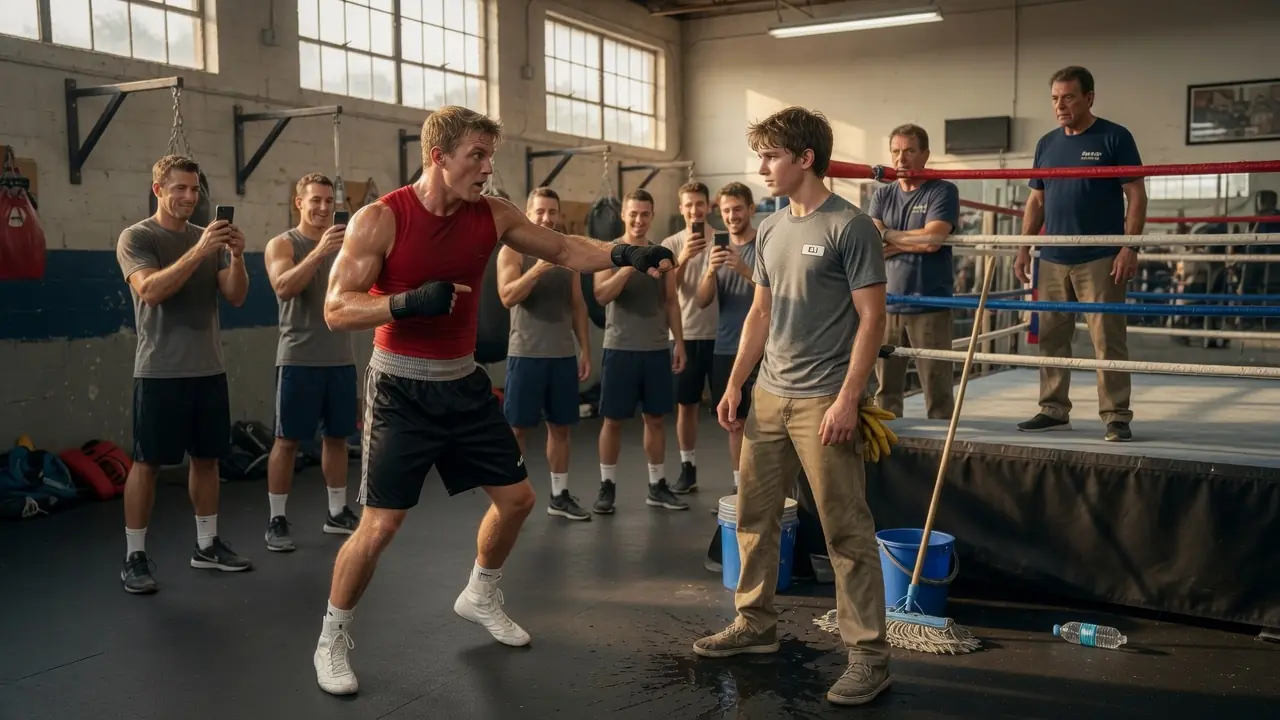
Coach Malone saw Samuel’s expression change.
He approached quickly.
“Sam, walk away.”
The old man met his eyes.
Something silent passed between them.
Malone knew the stance hidden beneath Samuel’s tired posture.
He knew the history no one else in the gym understood.
“You made a promise,” Malone whispered.
Samuel’s gaze remained on the teenagers.
“That was a long time ago.”
“You don’t owe them this.”
“Maybe they need it.”
Jace heard only the final sentence.
“So you accept?”
Samuel removed the keys from his belt.
He placed them beside the water cooler.
Then he rolled his sleeves to the elbows.
The laughter weakened.
His forearms were narrow, but the muscle beneath the skin had not disappeared. Pale scars crossed both wrists. The fingers of his left hand did not straighten completely.
He removed his work shoes and stepped onto the mat in his socks.
Coach Malone closed his eyes briefly.
Jace walked toward the ring.
Samuel stopped in the open training area.
“No ropes.”
Jace turned.
“Scared of the ring?”
“No.”
Samuel placed one foot slightly ahead of the other.
“You asked for one punch. You have enough room here.”
Nothing about his posture appeared impressive.
His hands were low.
His shoulders relaxed.
His chin barely moved.
Yet three older trainers near the ring stopped talking.
One leaned forward.
“Eddie,” he whispered to Coach Malone, “is that who I think it is?”
Malone did not answer.
Jace bounced on the balls of his feet.
Samuel remained still.
“Ready, old man?”
“I’ve been ready longer than you’ve been angry.”
The words brought another brief laugh.
Jace raised his guard.
He feinted with his left shoulder.
Samuel did not react.
He twitched his lead hand.
Nothing.
He shifted his weight as though preparing a hook.
The old man’s eyes remained fixed below Jace’s collarbone.
Jace circled.
Samuel turned with him using movements so small they were nearly invisible.
The champion’s confidence began to fracture.
Every trained opponent reacted to his speed.
They tightened.
Blinking exposed their fear.
A small shift in weight revealed the direction they wanted to escape.
Samuel offered him nothing.
Jace planted his lead foot.
He had promised one punch.
But nothing in the promise required him to hold back.
His hips rotated.
His right shoulder loaded.
He threw the hardest cross he had thrown all afternoon.
Several people shouted.
Samuel waited until the glove had almost reached him.
Then came the tiny movement.
The missed punch.
The open hand against Jace’s ribs.
The silence.
Now Jace stood in the center of that silence, staring at the janitor he had shoved into a wall.
“Again,” he demanded.
Samuel walked toward his shoes.
“One means one.”
“You tricked me.”
“You challenged me.”
“You’re a trained fighter.”
Samuel sat on a bench and pulled on one shoe.
“You never asked.”
Jace looked toward Coach Malone.
“You knew?”
Malone walked to a row of old photographs near his office.
Most had faded behind dusty glass.
He reached above a framed newspaper article and removed a photograph from the upper corner.
The picture showed a young boxer beneath the lights of Madison Square Garden.
He had thick dark hair, a narrow waist, and the same quiet eyes Samuel carried more than four decades later.
The caption beneath the image read:
SAMUEL “THE SHADOW” WHITAKER OUTPOINTS RANKED CONTENDER IN TITLE ELIMINATOR.
Jace stared.
“That isn’t him.”
Malone handed him the photograph.
“Thirty-six professional wins. Two losses. Never knocked out.”
Someone near the ring whispered the old nickname.
“The Shadow.”
Another trainer nodded slowly.
“My grandfather had one of his fights on tape.”
Samuel finished tying his shoes.
“This is unnecessary.”
Malone turned toward the room.
“No. What happened here was unnecessary.”
He pointed at Jace.
“You work in a boxing gym covered with pictures of men you’ve never studied. You walk past him every day. You order him to clean your blood from the canvas, and you never once asked who he was.”
Jace looked again at the photograph.
Samuel’s younger face seemed almost impossible.
The man in the picture stood beneath championship lights.
The man across the room carried a mop.
“What happened to you?” Jace asked.
Samuel took the mop from the floor.
“I got older.”
“That’s not what I mean.”
“I know.”
Samuel pushed the wet mop toward the spilled water.
“You made a promise.”
Jace looked around the room.
Every phone remained aimed at him.
He bent forward quickly, barely lowering his head.
Samuel stopped mopping.
“That is not a bow.”
Anger returned to Jace’s face.
“You don’t get to decide.”
“You decided when you spoke.”
Coach Malone folded his arms.
Jace realized no one would rescue him.
Slowly, he bent again.
This time he lowered his head fully.
When he straightened, Samuel had already returned to cleaning the water.
The video reached the internet before sunset.
By midnight, it had been watched more than seven million times.
Viewers replayed the punch in slow motion.
Sports accounts placed the clip beside old footage of Samuel Whitaker slipping combinations in packed arenas.
Former fighters explained the movement.
He had read Jace’s hips before the glove moved.
He had shifted only as far as necessary.
He had remained balanced enough to counter but deliberately withheld the strike.
Commentators debated which part had been more humiliating: the miss, the touch against Jace’s unprotected ribs, or the forced bow afterward.
Jace’s sponsors suspended planned advertisements.
His promoter, Calvin Redd, ordered him to release a public apology.
Jace refused.
“I’m not apologizing because the internet wants a show.”
Calvin sat across from him inside a private training facility.
“You shoved a sixty-eight-year-old employee.”
“He agreed to the punch.”
“That happened after you shoved him.”
“He embarrassed me on purpose.”
Calvin leaned forward.
“You embarrassed yourself. He simply failed to protect you from it.”
Jace left before the meeting ended.
For five days, he avoided Grant Street Boxing Club.
He trained in private, but every mirror returned the same image.
Samuel’s head moving two inches.
The glove cutting through empty space.
The open hand touching his ribs.
One night, Jace searched Samuel Whitaker’s name.
Old newspaper archives filled the screen.
Samuel had been ranked third in the country.
He defeated faster men, stronger men, and fighters expected to become champions. Writers described him as impossible to trap because he never fled the ring. He stood close enough to invite attack and moved only when the opponent had already committed.
Then the records stopped.
No farewell fight.
No retirement announcement.
Only one article from 1982.
BOXER LEON BROOKS REMAINS UNCONSCIOUS AFTER ELEVENTH-ROUND STOPPAGE.
Jace read the story twice.
Samuel had controlled the first nine rounds. The audience booed because he refused reckless exchanges. His manager warned him that promoters would never offer a championship bout to a fighter who made opponents miss instead of hurting them.
In the tenth round, Samuel stopped moving.
He stood and traded punches with Leon Brooks.
Samuel won by knockout.
Brooks died two days later from a brain injury.
Samuel never fought again.
While Jace read the article, Samuel sat alone at his kitchen table on the other side of the city.
An old film reel rested in a cardboard box near his feet.
He had not watched it in twenty-eight years.
He did not need to.
He still remembered Leon stepping forward.
The crowd demanding violence.
His manager shouting that caution looked like fear.
Samuel remembered deciding that everyone else must be right.
He remembered the final combination.
Left hook.
Right hand.
Leon’s knees bending.
The back of his head striking the canvas.
For years, people told Samuel it was legal.
Legal did not make the sound leave his memory.
After retiring, he worked construction, delivery routes, and maintenance jobs. He avoided boxing gyms until Eddie Malone found him seven years earlier.
Malone had once been a frightened fourteen-year-old who fought in parking lots because anger was the only language his father taught him.
Samuel had trained him for free.
He taught the boy defense before offense.
Patience before power.
Years later, Malone opened Grant Street Boxing Club and asked Samuel to coach.
Samuel refused.
He agreed only to maintain the building.
He wanted to remain near the sport without becoming responsible for what young men chose to do with it.
The morning Jace returned, the gym was still closed.
Samuel was repairing loose tape along the edge of the training floor.
Jace entered wearing a plain sweatshirt.
No camera crew.
No promoter.
No gloves.
Samuel continued working.
“You have forty minutes before the gym opens.”
“I need to ask you something.”
“You already did.”
“Why didn’t you hit me?”
Samuel pressed the tape firmly into place.
“You gave me many reasons.”
“I was open.”
“Yes.”
“You could have dropped me.”
“Possibly.”
“Then why only touch me?”
Samuel looked up.
“Because the point was not to prove I could hurt you.”
Jace sat on a bench.
“What was the point?”
Samuel returned to the tape.
“Those boys were laughing when you pushed me.”
Jace looked toward the empty speed-bag area.
“You wanted to humiliate me in front of them.”
“No.”
“That’s what happened.”
“You humiliated yourself in front of them.”
Samuel stood slowly.
“I wanted them to see that cruelty can be stopped without becoming crueler.”
Jace rubbed both hands together.
“My father watched the video.”
Samuel waited.
“He said I looked weak.”
“What did you say?”
“Nothing.”
“Is that unusual?”
Jace looked at the floor.
His father, Dennis Holloway, had fought in bars, garages, and parking lots. He hit Jace’s mother until she left. He hit Jace until the boy grew large enough to return one of the punches.
At sixteen, Jace knocked his father down in their kitchen.
Dennis never touched him again.
From that day forward, Jace confused fear with safety.
“If people aren’t afraid of you,” Jace said, “they use you.”
Samuel sat across from him.
“Is that what happened when you pushed me?”
Jace did not answer.
“You believed I could not hurt you,” Samuel continued. “So you chose me.”
The honesty was worse than accusation.
Jace stared at his hands.
“Teach me how you moved.”
“No.”
“I’ll pay you.”
“No.”
“I’m not asking for charity.”
“You are asking for a trick.”
“I want the defense.”
Samuel shook his head.
“You want something you can use in your next fight.”
“What’s wrong with that?”
“You still think the movement is the lesson.”
Jace stood.
“What do I have to do?”
Samuel handed him the roll of floor tape.
“Finish that line.”
For the next two weeks, Jace arrived before sunrise.
Samuel gave him no boxing instruction.
He made him fold towels.
Clean mirrors.
Scrub showers.
Replace torn padding.
Jace protested on the third morning.
“I have a televised fight in six weeks.”
Samuel handed him a toilet brush.
“Then work efficiently.”
Several young fighters began arriving early to see the undefeated champion cleaning the restroom.
They laughed once.
Samuel turned toward them.
“You enjoyed watching him humiliate someone. Do not enjoy watching him be humiliated.”
The boys became silent.
Jace heard.
Something changed after that.
He stopped complaining.
On the fifteenth morning, Samuel placed him in the center of the gym.
“Lower your hands.”
“I’ll be exposed.”
“No one is attacking you.”
Jace lowered them.
Samuel adjusted his feet by less than an inch.
“You begin every movement from tension.”
“I’m ready.”
“You’re afraid.”
Jace frowned.
Samuel touched the center of his chest.
“The gloves lie. The shoulders can lie. The eyes lie constantly.”
“Then what do I watch?”
“The decision.”
For an hour, Jace was not allowed to throw a punch.
Samuel taught him to see pressure gathering through the hips.
To notice when breathing changed.
To recognize the moment a fighter stopped considering an attack and committed to it.
“Defense does not begin when the fist moves,” Samuel said. “By then, you are already late.”
The lessons continued every morning.
Samuel never called himself Jace’s trainer.
He never stood in the corner during official sessions.
He simply appeared before sunrise, taught for an hour, and returned to his maintenance work.
Jace learned to move less.
He discovered that his speed had often been wasted on panic disguised as aggression.
He learned that staying near an opponent required more courage than charging toward one.
Three weeks before the fight, Calvin Redd arrived and found Jace sweeping the training floor.
“This has gone far enough.”
Jace continued sweeping.
“I’m training.”
“You are doing janitorial work.”
Samuel repaired a locker nearby without looking at them.
Calvin lowered his voice.
“Your image is built around knockouts. People pay to see destruction.”
Jace stopped.
“You told me they paid to see me win.”
“They pay to see you hurt someone.”
Samuel’s wrench became still.
The sentence carried him back forty years.
The crowd booing.
His manager demanding action.
Leon Brooks falling.
Jace saw the change in Samuel’s face.
Then he turned to Calvin.
“Leave.”
Calvin stared.
“I manage your career.”
“You arrange fights.”
“I made you.”
Jace looked toward Samuel.
“No. Men who think like you made me what I was last month.”
Calvin left with a warning about contracts.
Jace returned to sweeping.
Samuel resumed tightening the locker hinge.
Neither mentioned what had happened.
The televised fight took place before twelve thousand people.
Jace’s opponent, Marcus Vale, was thirty-two and known for breaking younger fighters with relentless pressure.
By the third round, the crowd grew restless.
Jace was not trading.
He slipped jabs by fractions.
Turned away from hooks.
Allowed Vale’s power punches to pass close enough for the television microphones to catch the air moving from them.
Commentators called it cautious.
Calvin shouted from ringside.
“Stand and fight!”
Jace heard him.
For one dangerous second, he planted his feet and prepared to exchange.
Then Vale’s right shoulder tightened.
Jace saw the decision.
The punch came.
He moved two inches.
Vale’s glove passed beside his face.
Jace placed a short left hand against the exposed ribs.
The shot was compact and almost quiet.
Vale dropped to one knee.
The crowd erupted.
Jace walked to the neutral corner.
He did not celebrate.
He did not chase the knockout when Vale stood.
He controlled the remaining rounds and won by unanimous decision.
Some fans booed because the violence they expected never arrived.
Others understood they had watched a different kind of dominance.
During the post-fight interview, a reporter raised the viral video.
“Was tonight’s defense connected to Samuel Whitaker?”
Jace looked into the camera.
“He taught me more than defense.”
“What did he teach you?”
Jace removed his mouthpiece.
“That needing everyone to fear you is another kind of fear.”
Samuel watched from the empty gym office.
He turned off the television before the interviewer asked another question.
The next morning, Jace entered Grant Street Boxing Club carrying his championship belt.
Samuel was mopping beneath the ring.
Jace placed the belt on a bench.
“You watched.”
“No.”
Coach Malone called from his office.
“He watched every round.”
Samuel glared toward him.
Malone smiled and closed the door.
Jace approached the old man.
“I used the movement.”
“You used patience.”
“I won.”
“Yes.”
Jace lowered his head.
Then he bent fully at the waist.
No phones recorded him.
No fighters surrounded them.
No promise forced him.
Samuel rested both hands on the mop handle.
“Stand up.”
Jace straightened.
“I blamed you for something I did.”
Samuel waited.
“I shoved you because I thought you couldn’t do anything about it.”
“Yes.”
“I wanted everyone to laugh at you.”
“Yes.”
Jace swallowed.
“I’m sorry.”
Samuel studied him for several seconds.
This apology cost more than the public bow.
“I accept.”
Jace exhaled.
“Will you train me officially?”
“No.”
“Why?”
Samuel looked around the gym.
At the clean floor.
The repaired lockers.
The ring where young fighters would arrive within the hour.
“Because I already have a job.”
Jace picked up a second mop.
Samuel raised an eyebrow.
“What are you doing?”
Jace pointed to a dry section of floor.
“You missed a spot.”
Samuel looked at the spotless mat.
Then at Jace.
For the first time, the young champion saw him smile.
A year later, Grant Street Boxing Club hosted an amateur tournament.
During the second match, a twelve-year-old boy lost a close decision. He threw his gloves, shouted at his father, and kicked a folding chair.
Jace saw him.
He crossed the gym before anyone else reacted.
The boy raised both fists.
Jace did not raise his own.
“You know why you lost?”
“He cheated.”
“No.”
“The judges hate me.”
“No.”
The boy’s anger faltered.
“Then why?”
“You became angry every time he refused to do what you wanted.”
Jace pointed toward Samuel.
The old man was cleaning near the far corner.
“That man once taught me the person controlling your anger is controlling the fight.”
The boy looked at Samuel.
“He used to box?”
Jace glanced toward the photograph now hanging near the entrance.
Samuel Whitaker beneath the lights at Madison Square Garden.
Beside it was another picture: the exact moment Jace’s fist passed beside the janitor’s face.
Beneath both photographs, Coach Malone had placed a single line:
POWER IS NOT PROVEN BY THE PUNCH YOU CAN THROW.
IT IS PROVEN BY THE PUNCH YOU DO NOT NEED TO THROW.
“He still boxes,” Jace said.
Samuel heard him but continued mopping.
Two mornings each week, before the doors officially opened, he now taught a small defensive class.
He still refused the title of coach.
The students called him Sam.
His first lesson never changed.
He placed each fighter in the center of the floor with their hands lowered.
“Do not watch the fist,” he told them.
“Watch the decision.”
The young champion had challenged an elderly janitor because he believed silence meant weakness.
Samuel accepted because an entire room of young fighters had started believing the same thing.
The punch lasted less than a second.
The dodge covered only two inches.
But inside that tiny space, the gym saw something larger than speed.
Jace possessed enough power to knock men unconscious.
Samuel possessed enough control not to.
And on the day the champion’s hardest punch struck nothing but air, everyone finally understood which of those abilities was rarer.