The sun was sinking behind the red desert hills when Caleb Walker was dragged into the center of the Apache camp. His wrists were bound with rough leather, his shirt was torn at one shoulder, and dust clung to his boots from three hard days across the frontier. Around him, hide lodges stood in a wide circle, small cooking fires glowed low, and horses shifted near wooden posts as children whispered from behind their mothers. Caleb kept his chin lifted, though every instinct in him warned that a man brought into a camp this way rarely walked out again.
He had been riding alone when the warriors came down from the rocky ridge like moving shadows. One moment the trail ahead had been empty, and the next, silent horsemen surrounded him with arrows ready and faces unreadable. Caleb had reached for his revolver too late, and the first warrior struck the weapon from his hand before he could even pull it free. Since then, he had been given water only when they stopped, food only when they chose, and no answer when he asked where they were taking him.
Now he stood before the gathered camp, trying not to show fear. His father had once told him that fear was like blood in water, and every cruel thing in the world could smell it. So Caleb breathed through cracked lips, straightened his back, and stared ahead as if the leather around his wrists were nothing more than a saddle strap. He was tired, thirsty, and alone, but he would not give the watchers the satisfaction of seeing him crumble.
A warrior shoved him forward, and Caleb stumbled one step before regaining his balance. Laughter rose from a few younger men near the fire, but it faded quickly when an older warrior spoke. Caleb could not understand the Apache words, but he understood tone well enough. The men were deciding whether he was worth keeping, trading, or ending before night fully covered the desert.
Then a woman stepped from the edge of the crowd, and the camp seemed to make room for her without being told. She wore a soft deerskin dress decorated with beadwork and traditional geometric patterns, the hem brushing against handmade moccasin boots dusted with red earth. A woven sash circled her waist, turquoise rested at her throat, and leather wrist bands framed her hands, one of them tied with a small carved feather talisman. Her long black hair was braided with small beads, and her dark eyes held a calm that unsettled Caleb more than anger would have.
She did not look at him like the others did. The warriors saw a captured stranger, a possible danger, a problem brought into their camp at dusk. The children saw a dusty cowboy with tied hands and a torn hat. But the woman studied him as if she were searching for something beneath the dirt, the rope, and the ruin of his pride.
Caleb met her gaze because looking away felt like surrender. She stood still, her face unreadable, while the firelight moved across the beadwork of her dress. In that strange moment, with the desert sky burning orange behind her, Caleb felt as if his fate had shifted from the hands of the warriors into hers. He did not know whether that was mercy or a new kind of danger.
The older warrior spoke again, this time gesturing toward Caleb. A younger man answered sharply, pointing toward the trail, then toward the camp’s horses. Caleb caught only one meaning: they did not trust him. A white cowboy riding alone near their lands could bring trouble, soldiers, vengeance, or lies dressed as innocence.
The woman raised one hand, and the voices quieted. She spoke in Apache, her tone firm but not loud. Caleb did not understand her words, yet he felt their weight in the way the others listened. When she finished, several warriors exchanged uneasy glances, as if she had made a request too bold to dismiss.
An older woman near the nearest lodge shook her head, but the young Apache woman did not move. She looked at Caleb once more, not with pity, but with decision. Then she turned and walked toward the horses tied beyond the ring of firelight. Caleb watched as she selected two strong horses, then pointed toward several wrapped bundles of supplies beside a lodge.
A murmur went through the camp. Even Caleb, who knew little of their customs, understood that she was offering something valuable. Horses were not given lightly in the frontier, not by anyone, not to anyone. Whatever she wanted, she was paying heavily for it.
The leader studied her for a long time. The fire cracked between them. At last, he nodded once, slow and final.
A warrior stepped behind Caleb and cut the leather binding his wrists. Caleb’s arms fell forward, numb and aching, and he nearly groaned from the sudden sting of returning blood. He rubbed the raw skin, confused by the release, while the crowd watched without smiling. The Apache woman walked back toward him and stopped only a few feet away.
“You traded for me?” Caleb asked, his voice rough.
She understood enough English to answer. “I did.”
Her eyes stayed steady. “Because you were going to die.”
The words settled into him colder than the desert wind. Caleb had suspected it, but hearing her say it made his legs feel unsteady. He looked toward the warriors, then back at the woman in the deerskin dress, trying to make sense of the impossible. “So I’m free?”
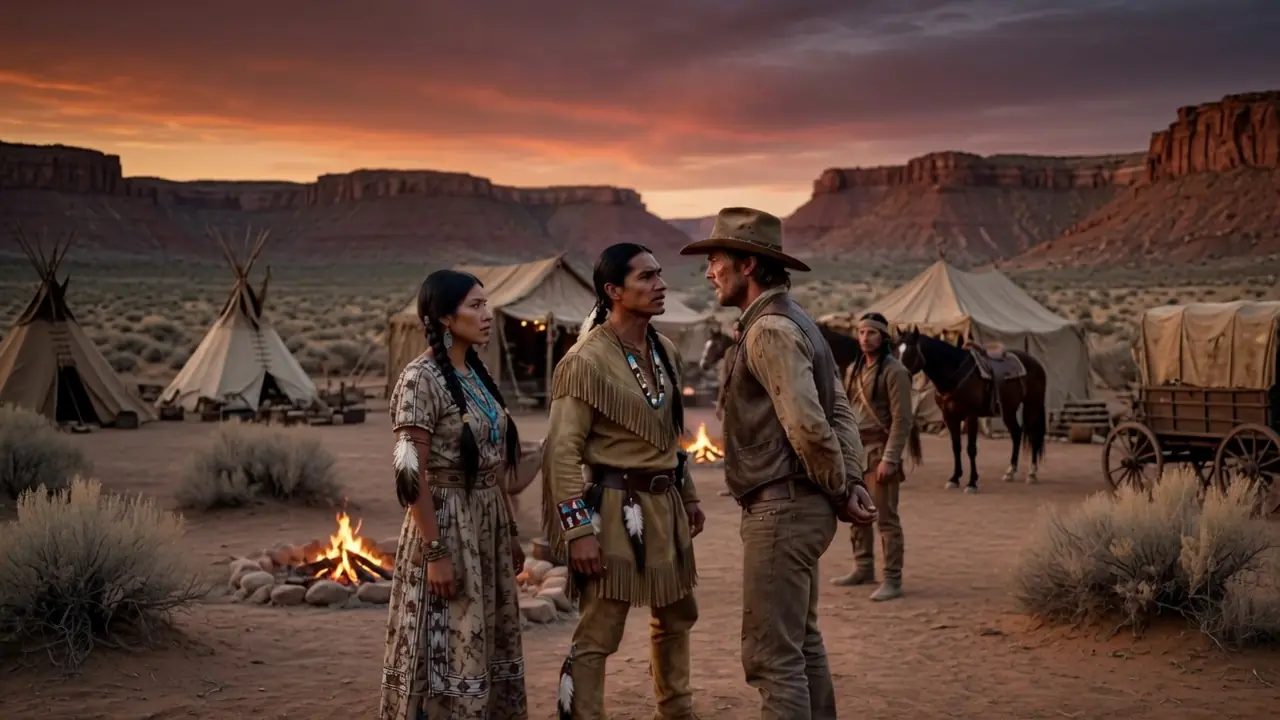
The faintest change crossed her face, not quite a smile, not quite sorrow. “You are alive.”
“That is not what I asked.”
“No,” she said. “It is not.”
She turned and began walking toward a small lodge made from wooden poles and stretched hides. Two warriors stood close enough to make it clear Caleb had a choice only in appearance. He followed because there was nowhere else to go. Behind him, the camp returned to motion, but every whisper seemed to brush against his back.
Inside the lodge, the air was warm with the smell of smoke, dried herbs, and earth. The woman motioned for him to sit across from the small fire, then handed him a bowl of water. Caleb drank too quickly, coughed once, and forced himself to slow down. She placed dried meat and flat bread before him, then sat opposite him with her hands resting calmly on her knees.
“What is your name?” he asked after a long silence.
“Nayeli.”
“Caleb Walker.”
“I know.”
His brow tightened. “How?”
“Warriors heard you say it when they took your horse.”
Caleb looked toward the lodge opening, where the last strip of sunset had faded into violet. Outside, children laughed somewhere near a fire, horses stamped the ground, and low voices passed through the evening. It was not the sound of a cruel place, only an unfamiliar one. Still, Caleb felt the weight of being alone among people who had every reason to distrust him.
“Why bring me here?” he asked. “If you saved me from death, why not send me away?”
“Because if I send you away tonight, some men will follow before morning,” Nayeli said. “They would say I wasted horses. They would say I weakened the camp for a stranger.”
“Then what am I?”
Nayeli looked into the fire. “A man whose fate I have claimed.”
Caleb sat back slightly. “Claimed.”
“That word frightens you.”
“It should frighten any man sitting where I am.”
For the first time, something almost amused touched her eyes. “You speak like a man who still believes words are more dangerous than warriors.”
“I’ve known words to start plenty of fights.”
“Then listen well,” Nayeli said. “You are not my slave. You are not here for punishment. But until I decide how to protect you from the men who wanted you dead, you stay under my name.”
Caleb studied her, searching for the hidden blade in her answer. “And what does that mean?”
“It means if they ask, I chose you.”
The fire popped softly. Caleb felt the air change, as if the lodge itself had leaned closer to hear. He remembered the way the warriors had stepped aside when Nayeli walked forward, the way her words carried authority without being shouted. This woman was not merely kind. She was strong enough to make a dangerous choice and stand beneath the weight of it.
Night deepened over the Apache camp. Nayeli gave Caleb a folded blanket and pointed to one side of the lodge, then placed herself near the opposite wall. She did not move toward him, did not command him to lie down, and did not treat his confusion as weakness. That restraint unsettled him more than a threat would have.
Before sleeping, Caleb looked at her across the low fire. “Why would you risk angering your own people for me?”
Nayeli’s fingers touched the carved feather at her wrist. “Because I have seen men die with fear in their eyes. You had fear, but it did not own you.”
“That is worth two horses?”
“In my people’s way, courage has value.”
“And in yours,” Caleb said carefully, “what does a woman do with a man she has chosen?”
Nayeli’s gaze lifted to his. “She watches whether he is truly the man she believed him to be.”
The answer stayed with him long after the fire sank lower. Caleb slept lightly, waking at every distant sound, every shift of hide against the lodge poles. But no one came for him. No one dragged him out. When morning arrived, he was still alive, and Nayeli was already outside speaking with an older woman near the cooking fire.
For three days, Caleb remained in the camp under Nayeli’s protection. He was watched but not harmed, questioned but not struck, tested but not broken. He hauled water, repaired a broken saddle strap, and helped calm a frightened horse that had kicked loose from its tie. When the horse settled under his hand, several men who had doubted him grew quiet.
Nayeli watched everything. She watched him work even when no one praised him. She watched him keep his temper when young warriors tried to provoke him. She watched him eat only after elders had taken food. With each small act, the judgment in her eyes changed from suspicion to something more thoughtful.
On the fourth evening, she brought him to a place just beyond the camp where the desert opened wide beneath the stars. Caleb followed with caution, though no warrior came beside them. Nayeli wore the same Apache clothing, her deerskin dress moving softly in the night wind, beadwork catching the fire glow behind them. In that light, she looked less like the woman who had bought him and more like a piece of the land itself, steady, dangerous, and alive.
“You asked why I chose you,” she said.
“I did.”
“My husband died two winters ago,” she said plainly. “He was brave, but proud in a way that burned others. Since then, men have spoken around me as if I am land waiting for a new owner.”
Caleb said nothing. He knew the silence after such a confession mattered.
“When I saw you in the camp,” she continued, “I saw a man with pride, but not cruelty. I saw fear, but not pleading. I saw someone who might stand beside a woman instead of over her.”
Caleb’s throat tightened. “You cannot know that from watching me stand tied in the dust.”
“No,” she said. “That is why I am still watching.”
A slow breath left him. “And if I disappoint you?”
“Then when it is safe, you leave.”
He looked at her, startled. “You would let me go?”
“I did not trade horses to become cruel.”
The words struck him harder than any threat. Caleb had spent the last days believing freedom had been taken from him completely. Now he realized Nayeli had built a narrow bridge between danger and choice, and she had placed herself on it with him. That changed everything, though he was not ready to admit how much.
The next morning, the camp leader called Caleb forward. Nayeli stood beside him, her chin high. Several warriors watched with stern faces as the older man spoke in Apache. Nayeli translated only the final part: “He asks if you will swear not to guide soldiers here, not to bring hunters against our families, and not to run before the debt of your life is answered.”
Caleb looked around at the camp. He saw children playing near the fire, old women preparing food, men mending gear, and horses flicking their tails in the sun. They were not the monsters frontier stories had made them into. They were people protecting a home in a world that wanted every home to become a battlefield.
“I swear,” Caleb said.
Nayeli repeated his words in Apache. The leader studied Caleb, then nodded. The camp released a breath Caleb had not known it was holding.
After that, his days changed. He was no longer dragged by fate but pulled into work. He helped with horses because horses understood tone better than language. He repaired gear with the careful hands of a cowboy raised by necessity. He learned which fires were for cooking, which lodges belonged to elders, and which paths he should not cross without invitation.
Nayeli taught him the words he needed first. Water. Fire. Horse. Thank you. Stay. Go. He repeated them badly, and she corrected him with a patience that made him smile despite himself. When he tried to say her name with the proper softness, she laughed for the first time, and the sound caught him completely off guard.
“You laughed at me,” he said.
“I laughed near you,” she replied.
“That sounds worse.”
“It was.”
Caleb found himself waiting for those moments. Nayeli’s smile was rare, but when it came, the whole desert seemed to shift. She was not gentle in the soft, fragile way he had expected from women back east. Her gentleness was like water in dry land, precious because it came from strength.
One evening, a young warrior named Taza shoved Caleb during a dispute over a horse blanket. Caleb turned, fists ready by instinct, but Nayeli stepped between them before either man moved. Her Apache words were sharp as flint. Taza’s face darkened, but he backed away.
Caleb exhaled. “You did not have to do that.”
“Yes,” she said. “I did.”
“I could have handled him.”
“I know.”
“Then why stop it?”
“Because some fights prove nothing except that men enjoy bleeding for pride.”
Caleb almost argued, then stopped. She was right, and he hated how quickly he knew it. In his old life, a man defended himself because reputation mattered. In Nayeli’s camp, survival mattered more, and respect was earned by knowing when not to draw trouble into the circle.
As weeks passed, the camp accepted him in small, reluctant ways. Children stopped hiding when he walked by. An older woman tossed him a piece of bread without looking at him. One warrior asked for help with a saddle knot and did not sneer when Caleb fixed it. Trust, Caleb learned, did not arrive like thunder; it came in quiet permissions.
Still, the question between him and Nayeli remained. He was under her name, chosen but not bound, protected but not free in any simple way. Some nights, Caleb wanted to demand an answer. Other nights, he feared the answer would send him away.
One sunset, he found Nayeli near the horses, brushing the mane of the mare she had traded to save him. The animal leaned into her hand as if forgiving the exchange. Nayeli’s dress was the color of pale earth, beadwork catching the last light, her turquoise necklace bright against the deerskin. Caleb stopped a few feet away, unwilling to disturb the peace of her.
“You look at me differently now,” she said without turning.
“I suppose I do.”
“How?”
Caleb struggled with the truth. “At first, I looked at you like a door I needed to get through. Then like a judge. Now I look at you and forget I was ever trying to leave.”
Nayeli’s hand paused on the horse’s mane. The desert grew very still around them. When she turned, her eyes held caution, but beneath it was something warm and guarded.
“Do not say such things because you are grateful,” she said.
“I am grateful,” Caleb replied. “But gratitude does not make a man listen for your footsteps.”
Her expression softened, then tightened again. “You still have a life beyond this camp.”
“I had a horse, a trail, and no one waiting at the end of it.”
“That is not the same as choosing here.”
“No,” Caleb said. “But maybe I am beginning to.”
Before Nayeli could answer, shouting rose from the far edge of the camp. A rider had arrived, one of the warriors who had first captured Caleb, bringing news from the lower trail. Soldiers had been seen two days away, asking about a missing cowboy. Caleb felt every eye turn toward him before anyone spoke his name.
Taza was the first to accuse him. His words came fast, angry, and sharp, pointing from Caleb to the horizon. Though Caleb understood only pieces, the meaning was clear enough: the stranger had brought danger. Others joined in, fear hardening into suspicion.
Caleb looked at Nayeli. “I did not send anyone.”
“I know,” she said.
But knowing did not quiet the camp. The leader called a council, and Caleb was ordered to stand before them as night fell. Fires burned higher than usual, casting hard lines across every face. Nayeli stood beside him in her Apache dress, shoulders squared, talisman at her wrist moving with the wind.
The leader spoke, then Taza, then two older men. Nayeli translated little, but Caleb heard enough of the repeated words: soldiers, risk, stranger, horses, blood. He knew what they wanted. Send him away before trouble reached them, or punish him before he could become a path for enemies.
Caleb stepped forward before Nayeli could stop him. “I cannot speak your words well,” he said slowly, using the few Apache words he knew mixed with English. “But I can leave tonight and draw them away if that protects your families.”
Nayeli turned to him sharply. “No.”
“It may be the only way.”
“You think sacrifice fixes everything because men taught you to call it honor.”
“If soldiers come here because of me, people could suffer.”
“And if you ride alone, they may kill you before you explain anything.”
Caleb met her eyes. “You once said you were watching whether I was the man you believed me to be. I will not hide behind children and elders.”
The camp fell silent as Nayeli translated his meaning. Her voice shook only once, and that one crack revealed more than tears would have. When she finished, even Taza looked away. Courage was a language every person there understood.
At dawn, Caleb rode out with two warriors and Nayeli, not as a prisoner but as a witness to his own truth. They reached the lower trail by midday and found the soldiers moving slowly near a dry wash. The captain recognized Caleb immediately and demanded to know whether he had been held against his will. Every answer Caleb gave mattered.
“I was captured,” Caleb said. “Then spared. I am leaving with no complaint.”
The captain’s eyes narrowed. “They forced you to say that?”
“No.”
“You expect me to believe you want to stay among them?”
Caleb looked back at Nayeli on her horse, dressed in deerskin and turquoise, sitting straight beneath the pale sky. He thought of the night fire, the children laughing, the old woman tossing him bread, and Nayeli telling him he could leave when it was safe. Then he turned back to the captain.
“I expect you to believe I am alive because one woman paid more than anyone owed for my life,” Caleb said. “And if you ride against her people on my account, you will be doing it against my word.”
The captain was not pleased, but Caleb’s statement made pursuit harder. There were papers to consider, witnesses to question, and a missing cowboy standing alive and unwilling to play the victim they had expected. By sundown, the soldiers turned back toward the fort, irritated but empty-handed. Caleb watched them go with a relief that left him nearly weak.
When they returned to camp, no one cheered. That was not their way. But the leader placed one hand on Caleb’s shoulder, and Taza, after a long silence, gave him a nod. In that gesture, Caleb understood he had crossed a line no map could show.
That night, Nayeli found him near the edge of camp, looking up at the stars. She stood beside him for a while without speaking. The silence was no longer uneasy. It had become a place where they could meet.
“You could have left with them,” she said.
“I know.”
“Why didn’t you?”
Caleb turned to her. “Because the only place I wanted to return to was here.”
Nayeli looked down, her fingers brushing the carved feather on her wrist. “When I said you would be my husband, I spoke to protect your life. I used words like a shield.”
“I know that now.”
“I cannot make that choice for you.”
“You are not making it,” Caleb said. “I am.”
Her eyes lifted to his, cautious and shining. “Do you understand what you choose?”
“A people who may never fully trust me. A life harder than the trail I knew. A woman who sees through every lie I tell myself.”
“And?”
“And the first home that ever felt like it was asking me to become better before it asked me to belong.”
Nayeli’s breath trembled. Slowly, she reached for his hand, not as owner, not as rescuer, but as a woman accepting what had become real between them. Caleb closed his fingers around hers, and the desert wind moved softly around them. No ceremony was spoken that night, but a vow passed quietly between their hands.
Their true wedding came weeks later, not as a command but as a choice made before the camp. Nayeli wore her finest Apache deerskin dress, bright with beadwork, turquoise at her throat, her braided hair shining with small beads in the sun. Caleb wore a clean shirt, his repaired hat, and a woven sash gifted by the old woman who once tossed him bread without looking. When the leader asked if he stood willingly, Caleb answered before the translation finished.
“I do.”
Nayeli’s eyes softened. “And I choose him,” she said.
The camp watched, some with approval, some with caution, but no one called him captive anymore. Caleb had entered their circle bound and dusty, certain his life was ending. Now he stood beside Nayeli with his hands free, not because every danger had passed, but because both of them had chosen to face danger together.
Years later, stories would twist the truth. Some would say an Apache woman bought a cowboy and made him her husband in a single night. Some would make it sound like magic, others like scandal, and a few like a warning about frontier ways no outsider understood. Caleb and Nayeli never cared much for those versions.
The truth was deeper than a trade. Nayeli had seen courage in a bound man before he could see anything beyond fear. Caleb had found honor in a woman the world would have tried to misunderstand. Between them, under red hills and desert stars, a captive’s fate became a chosen life.
And whenever Caleb remembered that first night, he did not remember the rope most clearly. He remembered Nayeli standing in her Apache dress, calm before the fires, looking at him as if his life still had meaning. He remembered the moment he thought she had claimed him. Only later did he understand that she had done something far greater.
She had given him the chance to choose.