Harold Coleman knew the sound of being ignored before the first cashier even opened her mouth. It was not silence exactly, but a kind of practiced absence, the way people looked through him while still seeing enough to judge his jacket, his shoes, and the old baseball cap pulled low over his forehead. He stood at the counter of Iron Brew Coffee’s Denver flagship store with cash folded in his hand and waited while the two women behind the register served the customers who had come in after him. Nobody greeted him, nobody asked for his order, and nobody recognized the man who had built the company whose logo hung above their heads.
Twenty-three years earlier, Harold had welded his first coffee cart together in his mother’s garage in Englewood. He had been twenty-nine years old, broke, stubborn, and tired of watching good neighborhoods get treated like bad investments. He borrowed from his mother’s retirement savings, bought a used espresso machine, and taught himself how to roast beans in a space barely big enough for a freezer and a workbench. The first cup he ever served was free because the woman who walked up to the cart told him she had never been offered coffee with a smile in that part of town.
That woman became a regular, then brought her sister, then her church friend, then a nurse who worked nights at the hospital. Harold wrote their names on paper cups before he had printed labels, remembered how they took their drinks, and kept a folding chair by the cart because his mother believed nobody should have to drink coffee standing if they were tired. That idea became the soul of Iron Brew Coffee. Years later, when he opened the first real storefront on Colfax Avenue, he printed the motto on every cup: Everyone deserves a seat.
Now Iron Brew had forty locations across Colorado, Utah, and New Mexico. The company had investors, regional managers, training videos, seasonal menus, employee handbooks, and quarterly meetings with charts that made everything look healthier than it was. Harold had an office on the fourteenth floor downtown, with glass walls, a framed photo of the original cart, and an assistant named Lisa who could move a meeting like a general moving troops. The numbers looked good, but numbers had a way of hiding rot if nobody bothered to smell the wood.
Lisa was the one who brought him the reviews. She walked into his office on a Tuesday morning with a folder and placed it on his desk without the usual greeting. “You need to read these today,” she said. Harold looked at her face and knew this was not about sales.
There were thirty-one printed customer reviews for the Denver flagship, the first store, the one Harold still privately thought of as home. Twenty-two mentioned rude staff, hostile service, ignored customers, and people being made to feel like they did not belong. One review came from a sixty-year-old woman who wrote that the cashier looked at her like she had walked into the wrong building. Another said, “I wanted coffee, but I left feeling ashamed.”
Harold read each page slowly. By the time he finished, he had stopped touching his coffee. The flagship store’s satisfaction score was the lowest in the company, but the sales remained strong because of its location, which meant the problem had been easy to dismiss. A store could make money while betraying the reason it existed.
He called the store manager, Craig, and asked what was happening. Craig gave him polished answers about difficult customers, subjective surveys, and people wanting free refills. Harold listened, said very little, and heard the smooth confidence of a man who had practiced sounding reasonable without being honest. When Harold hung up, he stared at the framed photograph of the original coffee cart and felt something hard settle behind his ribs.
That night, he drove to the flagship and parked across the street near closing time. Through the glass, he watched two cashiers behind the counter: Tiffany Grant and Jenna Moore. Tiffany leaned against the register with her phone in one hand, while Jenna wiped the espresso machine in a slow, careless loop. A man in a paint-stained shirt walked in and waited almost a full minute before Tiffany looked up.
The man ordered quietly, paid, and left without being thanked. Five minutes later, a young couple entered wearing expensive jackets, and Tiffany’s entire face changed. She smiled, leaned forward, recommended seasonal drinks, and wrote their names carefully on the cups. Harold sat in his car with both hands on the steering wheel and understood that the reviews were not exaggerations.
The next morning, Harold dressed like a man Tiffany Grant would underestimate. He wore an old brown jacket from the back of his closet, a plain gray shirt, dark jeans, scuffed shoes, and a baseball cap with the stitching loose near the brim. He left his watch at home, took cash instead of his company card, and rode the bus fourteen stops to Colfax Avenue. By the time he pushed open the door of his own store, he looked exactly like the kind of customer his employees had decided did not fit the brand.
The bell above the door chimed. Tiffany did not look up. Jenna glanced at him once from beside the espresso machine, then looked back at her phone with a smirk already forming.
Harold stood there while Tiffany took their order around him. She laughed at something the man said, suggested an upgrade, and wrote both names on the cups in neat marker. Jenna made their drinks quickly, adding foam art to one and a friendly “have a good one” to both. When they walked away, Tiffany turned back to her phone as if Harold had not been standing there the entire time.
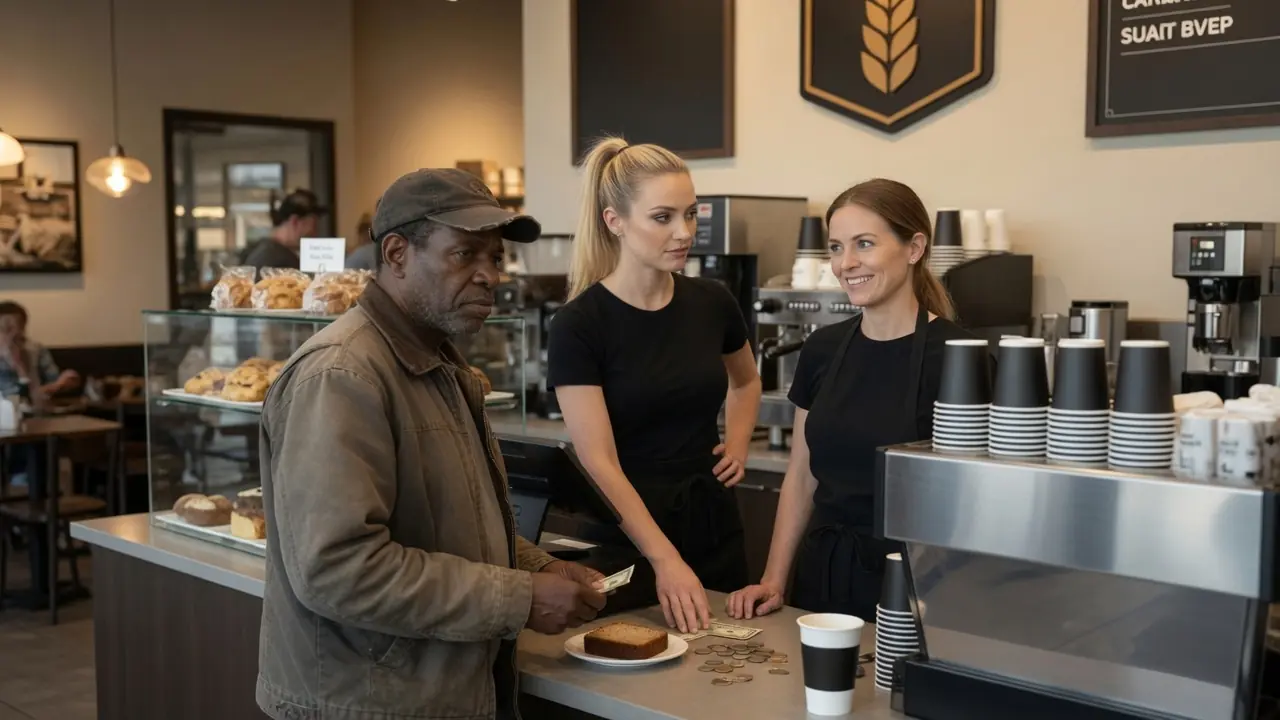
“Excuse me,” Harold said evenly. “I’d like to order.”
Tiffany looked up. Her eyes moved from his cap to his jacket, then down to his shoes, slow and deliberate. Her face did not hide what she thought. “What do you want?”
“A cortado, please,” Harold said. “And a slice of banana bread.”
Tiffany tilted her head. “A cortado?”
Jenna made a soft laughing sound beside the machine. Tiffany turned toward her with a smile. “He wants a cortado.”
Jenna looked Harold over and said, “That’s specific.”
Harold kept his voice calm. “A cortado and banana bread.”
Tiffany rested one hand on the register. “Are you sure you know what that is? A regular black coffee might be easier.”
“I know what it is.”
“Suit yourself.” She punched the order in without asking his name. Then she held out her hand for the cash, pinching the bills between two fingers when he gave them to her. His change was not placed in his palm; it was dropped onto the counter, where three coins rolled toward the edge.
Harold picked up the coins one by one. His hands were steady, but something old moved through him, something from before Iron Brew, before the office, before anyone called him founder. It was the memory of being a boy beside his mother in a downtown cafe, watching a waitress seat them by the kitchen door while empty tables sat near the window. He had built a company to make sure nobody felt that way in a coffee shop again.
The cortado was lukewarm when Jenna slid it across the counter. The banana bread came on a small plate. Harold took both to a corner table and sat down beneath a framed poster of Iron Brew’s motto. Everyone deserves a seat.
He took one bite of the banana bread and froze.
It was excellent. Moist, rich, perfectly balanced, with pecan and cinnamon layered into the sweetness without overpowering it. Harold had approved hundreds of menu items from reports and tasting notes, but he did not remember approving this one. Before he could think more about that, Tiffany’s voice drifted from behind the counter.
“Did you see him count the coins off the counter?”
Jenna laughed. “Painful.”
“I don’t know why people like that come in here,” Tiffany said. “They buy one drink, sit forever, never tip, and make the place feel cheap.”
Harold set the banana bread down.
Jenna leaned closer to the register. “We need to protect the vibe. Some people just don’t fit the brand.”
The words landed harder than the first insult. Harold had heard disrespect before; he had lived long enough as a Black man in America to know how quickly strangers could decide his worth. But “the brand” belonged to him. They were using his company, his language, his store, and his mother’s memory as a wall against people he built the wall to protect.
He sat there for forty-five minutes. He watched Tiffany greet well-dressed customers with warmth and hand others their cups without eye contact. He watched Jenna ignore an elderly man until he quietly left the line. He watched a woman in hospital scrubs correct the name on her cup, only for Tiffany to shrug and say, “Same thing.”
Harold did not reveal himself. He did not raise his voice. He opened the notes app on his phone and typed one word: rot.
Over the next four days, Harold went deeper. With help from his VP of operations, Ray, he was entered into the system as Henry Williams, a transfer trainee from the Colorado Springs location. He wore the same plain clothes, trimmed his beard shorter, and walked through the employee entrance before dawn. Nobody recognized him because nobody in that store had ever cared enough to study the face of the man on the founder page.
The opening shift belonged to Emma Sullivan. She was twenty-eight, Latina, quiet, efficient, and clearly exhausted in a way that came from carrying more than her job title. She moved behind the counter with perfect economy: pulling shots, steaming milk, restocking cups, wiping surfaces, checking pastries, and correcting small problems before they became visible. Within twenty minutes, Harold knew she was the best employee in the store.
“Lids are under the second sink,” Emma told him without looking up. “First sink is sanitizer. Mix them up and your espresso will taste like bleach for a week.”
Harold smiled faintly. “Good to know.”
At 6:40, an elderly Black man came in wearing a wool coat too heavy for the weather. Emma’s face softened. “Walter, oat milk cortado extra warm?”
Walter smiled like someone had remembered more than his drink. “You still know.”
“Every day for three years,” Emma said. “Sit down. I’ll bring it over.”
She carried the drink to his window table with both hands. Walter thanked her and told her she was the only reason he still came there. Emma smiled, but Harold saw how little of that smile reached her eyes.
When he asked if she liked working there, she paused just long enough for the truth to appear. “I like the coffee,” she said. Then she went back to wiping the bar.
At 10:00 a.m., Tiffany and Jenna arrived, and the air changed. Emma moved to the back without being asked, restocking shelves that were already stocked. Tiffany did not greet her. She only said, “Did you prep oat milk? I’m not doing your job today.”
“It’s done,” Emma replied.
“It better be.”
Then Tiffany turned to the next young customer and lit up like a stage light. “Hey, babe, have you tried the autumn maple cortado? It’s literally the best thing we’ve ever made.” Harold glanced toward Emma and saw her hand pause for half a second. Then she kept working.
That afternoon, Harold found the index card. It was folded inside the register drawer between receipt paper and a bill tray. On one side were hearts next to names and descriptions: tech guy, good tipper, Instagram girl, cute couple. On the other side were X’s: Walter, slow service; lady with kids, don’t encourage; flannel man, not brand fit.
Flannel man was him.
On the back, Tiffany had written, “If they’re not brand fit, slow service. They’ll leave on their own.”
Harold put the card back exactly where he found it, photographed it later, and felt the ugly shape of the problem sharpen. This was not a rude employee having a bad morning. It was a system.
The next day, he found the tip records. Tiffany and Jenna were taking the majority of the pooled tips, leaving Emma and two others with a fraction of what equal hours should have earned. When he casually asked Tiffany about the policy, she laughed. “Policy is policy. Real life is real life. Front counter earns the tips.”
“But Emma works front counter too.”
Tiffany’s expression cooled. “Emma supports the store. There’s a difference.”
Harold understood then why Emma worked the earliest openings and latest closings. Peak hours meant more tips, more visibility, and more influence. Tiffany had the hours, Jenna had the machine, and Emma had the work nobody wanted, even though customers like Walter clearly trusted her most.
In the break room, Harold saw Emma’s notebook. She had left it near her bag while helping a delivery driver, and it opened to a page full of drink notes: maple syrup ratio, espresso balance, cinnamon finish. The title at the top read Autumn Maple Cortado. The date was two months before the drink appeared in corporate records.
When Emma returned, Harold nodded toward the notebook. “You made that?”
She closed it gently. “I worked on it.”
“It’s on the menu.”
“Yes.”
“Your name on it anywhere?”
Emma gave him a tired look. “You ask a lot of questions for a transfer trainee.”
“I’m learning.”
She hesitated, then opened the notebook again. Summer Berry Cold Brew. Holiday Spice Latte. Banana Pecan Bread. Four of Iron Brew’s best-selling seasonal items, all written in Emma’s hand, all dated before regional submissions. Harold felt anger rise slowly, not hot but precise.
“Who submitted them?” he asked.
“Ron Hadley,” Emma said. “Regional manager.”
“Did he credit you?”
She laughed once without humor. “He said team ideas belong to the team.”
Later, Harold checked the records. Ron Hadley had submitted every one of those items as his own regional innovation. Emma had filed three complaints over eighteen months: schedule fairness, tip distribution, and recipe credit. All three were dismissed by Ron. In Tiffany Grant’s employee file, Harold found the final piece: emergency contact, Ron Hadley; relationship, uncle.
The loop was closed. Tiffany ran the floor, Jenna followed her, Ron protected them, and Emma’s complaints died on the desk of the man stealing from her. Customers who did not fit Tiffany’s idea of the brand were pushed out. Employees who spoke up were buried in bad shifts.
Harold sat alone in the manager’s office before dawn on Friday, staring at the evidence on his phone. Outside, the espresso machine hummed softly through the wall. In the break room, the ceramic tip jar sat on a shelf, hand-painted with sunflowers and the Iron Brew logo. On the bottom, in small faded letters, were the initials E.S.
Emma had made it for the team. The team had emptied it, hidden it, and taped a note to the front saying all tips went through Tiffany.
At 8:00 a.m., the flagship was closed to customers for a mandatory staff meeting. Fourteen employees sat in a small conference room behind the store. Tiffany sat near the front, annoyed, phone in hand. Jenna sat beside her, chewing gum. Ron Hadley arrived in expensive shoes and too much cologne, greeting Tiffany with a wink and ignoring Emma in the back row.
At 8:02, Harold walked in wearing the same worn jacket, old cap, and scuffed shoes he had worn as a customer. Tiffany squinted. Jenna stopped chewing. Ron looked at him like he was about to ask why a trainee had been allowed in.
Harold removed his cap and placed it on the table.
“Four days ago,” he began, “I walked into this store and ordered a cortado and a slice of banana bread. The two cashiers behind the counter looked at me, a Black man in a worn jacket, and decided I did not belong.”
Tiffany’s face froze.
“One of them asked if I knew what a cortado was,” Harold continued. “One laughed. My change was dropped on the counter. Then, while I sat under the motto my mother inspired, I listened to two employees talk about protecting the brand from people like me.”
The room went silent.
“My name is Harold Coleman,” he said. “I founded this company. I built this store.”
Tiffany’s color drained so quickly it looked as if the light had changed. Jenna’s mouth opened, but nothing came out. Ron uncrossed his legs.
Harold placed the index card on the table. “This was inside the register drawer. Hearts and X’s. Customers sorted by whether they fit the brand. Flannel man was me.” He let the words settle. “You put an X next to the man who built the room you were standing in.”
He turned on the screen behind him. Tip records appeared first. Twelve months of unequal distribution, Tiffany and Jenna receiving the majority while Emma and others were cut down to almost nothing. Then came recipe submissions beside photographs of Emma’s notebook, dates circled in red. Autumn Maple Cortado, Summer Berry Cold Brew, Holiday Spice Latte, Banana Pecan Bread.
“Four recipes,” Harold said. “All created by Emma Sullivan. All submitted by Ron Hadley as his own.”
Ron stood halfway. “Harold, I can explain.”
“I am not finished.”
The room went still again.
The final slide showed Emma’s complaints, each one dismissed by Ron. Harold looked directly at him. “Three formal complaints. Schedule fairness. Tip distribution. Recipe credit. All filed by Emma. All marked no action required by the same regional manager who stole her work and protected his niece.”
Tiffany stared at the table. Jenna looked like she might cry. Ron’s face hardened, not with shame, but with calculation.
Harold placed three folders on the table. “Tiffany Grant, you are terminated effective immediately for discriminatory customer profiling, manipulating the tip pool, and creating a hostile environment for customers and coworkers. Jenna Moore, you are terminated for participating in the same conduct. Ron Hadley, you are terminated for falsifying menu innovation reports, suppressing employee complaints, and abusing your authority to protect family while harming this company.”
Nobody spoke.
Ron picked up his folder and walked out first. Tiffany followed with shaking hands. Jenna lingered for one second as if waiting for someone to rescue her from consequences, but nobody moved. The door closed behind them, and the cologne left with Ron slowly, like the last trace of something spoiled.
Harold turned to the remaining employees. “This did not happen because three people were bad. It happened because the system allowed them to be bad for too long. That is my responsibility.”
He clicked to the next slide. New policies appeared: transparent digital tip pooling, employee recipe credit with royalties, third-party reporting directly to executive leadership, rotating peak-hour schedules, and quarterly undercover audits. Every store would be reviewed. Every manager would be retrained. Every complaint would have a path around the person it accused.
Then Harold turned toward the back row.
“Emma Sullivan,” he said.
Emma looked up, shoulders tense.
“You created four of our best-selling menu items. You filed complaints this company should have answered. You kept showing up when we gave you every reason not to.” His voice softened. “I owe you an apology, not just as a CEO, but as the man who built a company that failed to protect you.”
Emma pressed her lips together. Her eyes were bright, but she did not look weak. She looked like someone who had waited too long to be seen and refused to collapse now that it was happening.
Harold slid a thicker folder across the table. “I am offering you the position of regional innovation lead. Your recipes will carry your name retroactively. Your salary will reflect your contribution, and this includes back pay for stolen tips calculated from the records we found.”
Emma stood slowly and walked to the front. She opened the folder, saw the offer letter, the back pay check, and the new badge with her name and title. For several seconds, she did not speak. Then she closed the folder and held it against her chest.
“Thank you,” she said.
It was not the thank-you of someone receiving a gift. It was the thank-you of someone watching something stolen finally come back.
Three months later, the Denver flagship looked almost the same from outside. Same brick front, same glass door, same Iron Brew sign. Inside, everything had changed. The chalkboard near the entrance now listed seasonal menu items with employee names beside each one.
Walter came back to his window table. Patricia, the nurse who had once walked out after being dismissed, now worked part-time at the register after Harold personally invited her to help rebuild the place customers deserved. She greeted every customer with eye contact and wrote full names on cups. The ceramic tip jar Emma had painted sat front and center, full of bills instead of hidden on a shelf.
Harold visited once a month, always as a customer first. On one visit, he ordered a cortado and banana bread, then sat at the same corner table where he had frozen mid-bite. The coffee was hot. The bread was still excellent. This time, nobody talked about whether he belonged.
On the wall beside the menu board, Emma had placed a black-and-white photograph of Harold’s original coffee cart. Under it was a small plaque with the company motto. Everyone deserves a seat.
Harold looked at it for a long time before taking another bite.
He had thought success meant building forty stores, pleasing investors, and watching revenue climb. Now he understood success meant walking into any one of those stores and knowing a tired nurse, an old man in a wool coat, a parent with children, a worker in dirty boots, or a Black man in a worn jacket could order coffee without being made to feel small. That was the business he had meant to build.
And this time, he was going to stay close enough to make sure it stayed true.