The tapping of Ethan Walker’s white cane echoed through the rehabilitation center long before anyone noticed the man holding it.
Tap.
Step.
Tap.
Step.
The sound moved carefully along the tiled corridor, passing doors that smelled of disinfectant, wet fur, metal bowls, and the faint medicinal scent of veterinary ointment.
Ethan followed the wall with his left hand.
His right held the cane that had guided him through the world for the past three years.
He had once crossed hostile villages at night with no light except the green glow of military optics. He had led patrols through dust storms, entered buildings without knowing who waited inside, and stayed calm while bullets struck walls only inches from his head.
Now, at thirty-eight, walking into a canine rehabilitation center frightened him more than any battlefield had.
Not because he feared dogs.
Because he feared hope.
“Mr. Walker?”
A woman approached from the far end of the hall. Her shoes made quick, confident sounds against the tile.
“Ethan,” he corrected gently. “Please.”
She stopped beside him.
“I’m Karen Mitchell, the center’s placement coordinator. We spoke on the phone.”
“Yes. You said you had three dogs ready for evaluation.”
“We do. All of them have completed advanced mobility training. Calm temperaments, excellent obstacle awareness, strong response to directional commands.”
Ethan nodded.
Those were the qualities he had been told he needed.
A dog that would stop at curbs.
Guide him around construction barriers.
Refuse unsafe commands.
Lead him through crowded stations and remain quiet in restaurants, hospitals, and government buildings.
A perfect working animal for an imperfect man.
Karen touched his elbow lightly before guiding him forward.
“Is this your first placement assessment?”
“Yes.”
“You completed orientation training?”
“Six weeks.”
“And you’ve worked with dogs before?”
Ethan hesitated.
“Military dogs. Not guide dogs.”
“That is still useful experience.”
“No,” he said. “Military dogs are trained to move toward danger. A guide dog is supposed to keep me away from it.”
Karen smiled softly.
“Sometimes the difference is smaller than people think.”
They continued down the corridor.
Dogs barked behind reinforced doors.
Ethan listened to each one.
A high, excited bark from the left.
A nervous whine farther ahead.
The rapid scratching of claws against the floor.
Since losing his sight, sounds had not become magically sharper, despite what people often assumed. Ethan had simply learned to pay attention because ignoring details now carried consequences.
He heard a dog shift its weight before it barked.
He could tell whether nails moved across tile, concrete, or rubber matting.
He could identify fear by the way breathing became shallow between sounds.
Then a roar tore through the building.
It was not an ordinary bark.
The sound came from somewhere beyond the main kennel wing—deep, violent, and powerful enough to shake a metal door.
A second bark followed.
Then the sharp clang of a heavy body striking steel.
Karen stopped.
Her hand tightened around Ethan’s arm.
“Let’s continue this way.”
Ethan turned his head toward the sound.
“What was that?”
“A dog who is not part of the placement program.”
Another snarl rolled through the corridor.
This time Ethan heard something beneath it.
The aggression was real.
So was the desperation.
“What’s his name?”
Karen did not answer immediately.
“Thor.”
“What happened to him?”
“He is a retired police K-9.”
“That wasn’t my question.”
Karen exhaled.
“Thor has severe behavioral problems. He is housed in the secured rehabilitation wing. Visitors are not allowed near him.”
The barking stopped abruptly.
The silence that followed felt intentional.
As if the dog were listening.
Ethan tilted his head.
“How far away is he?”
“Two corridors.”
“He heard us.”
“He hears everyone.”
“No. He was barking before. Now he’s waiting.”
Karen guided him onward.
“We should meet the dogs selected for you.”
Ethan allowed himself to be led away, but the silence behind them followed him.
The first dog was a yellow Labrador named Grace.
She approached Ethan gently, placed her chin on his knee, and waited for permission before accepting his touch.
Grace was patient and professionally trained. During the walking assessment, she stopped cleanly at stairs and guided Ethan around a chair placed deliberately in the path.
“She’s excellent,” Karen said.
“She is.”
But when Ethan removed the harness, Grace immediately looked toward her trainer.
Her bond was there.
It simply was not with him.
The second dog, a black Labrador named Milo, was more energetic.
He worked well but became distracted by another dog barking outside the room.
The third was a golden retriever called Sunny.
She was affectionate, calm, and so gentle that Karen seemed certain the search was over.
Sunny rested beside Ethan for almost twenty minutes.
He stroked the fur behind her ears.
She would have been a safe choice.
A wise choice.
Perhaps the correct choice.
Yet Ethan felt like a man conducting an interview rather than meeting a partner.
Karen seemed to sense his hesitation.
“You don’t have to decide today.”
“They’re all good dogs.”
“They are.”
“That may be the problem.”
Karen sat across from him.
“What were you expecting?”
“I don’t know.”
“Mr.—Ethan, a working partnership does not always begin with an immediate emotional connection. Trust often develops during training.”
“I understand.”
“Then what’s missing?”
He rested both hands on the handle of his cane.
“Someone who understands what it is to be afraid of the world and angry about being afraid.”
Karen became quiet.
From the distant secured wing came the scrape of heavy claws across concrete.
Ethan turned toward the sound.
“Tell me about Thor.”
Karen’s posture changed.
“I told you he is not available.”
“I’m not asking to adopt him.”
“Then why do you need to know?”
“Because everyone in this building calls him dangerous. I want to know what made him that way.”
Karen looked toward the observation window.
Outside, Sunny sat beside her trainer, waiting calmly.
Then Karen closed the door.
“Thor served with the Metro Police Department for four years,” she said. “Explosive detection, tracking, building searches, suspect apprehension. His handler was Officer Daniel Reeves.”
“Was?”
“Daniel died during a warehouse operation fourteen months ago.”
Ethan’s hand tightened around the cane.
“Thor was there?”
“Yes.”
“What happened?”
“An explosive device detonated beneath a loading platform. Daniel was killed immediately. Thor was thrown into another room and injured by shrapnel.”
Karen spoke slowly.
“When the rescue team reached them, Thor was lying across Daniel’s body. He attacked anyone who tried to come close.”
“He was protecting him.”
“Daniel was already dead.”
“Thor may not have understood that.”
“The officers eventually sedated him. After surgery and physical recovery, the department attempted to pair him with another handler. Thor attacked the man during the first evaluation.”
“How badly?”
“Twelve stitches.”
Ethan waited.
Karen continued.
“During the second attempt, he broke a trainer’s wrist. He began reacting to uniforms, radios, sudden movements, metal equipment—almost everything associated with the warehouse.”
“So they sent him here.”
“The department considered euthanasia. Our director agreed to accept him because of his service record.”
“Has anyone tried trauma rehabilitation?”
“For more than a year.”
“And?”
“He tolerates food being placed through a protected opening. Sometimes he accepts commands from one senior handler. No one enters his kennel without a barrier team.”
Ethan listened to the words.
Tolerates.
Protected opening.
Barrier team.
The language of containment, not healing.
“What does he do at night?”
Karen looked surprised.
“I don’t know.”
“Does he sleep?”
“Not much. The overnight staff say he patrols the kennel.”
“Waiting for Daniel.”
“Perhaps.”
Ethan lowered his head.
Three years earlier, he had woken in a military hospital with bandages covering his eyes.
The last thing he remembered before the explosion was Sergeant Luis Moreno shouting his name.
Luis had been directly beside him when the vehicle detonated.
Ethan survived.
Luis and two others did not.
For months after returning home, Ethan woke at night convinced his unit was waiting for him to finish the patrol.
He heard radios in dreams.
Smelled burning rubber where none existed.
Reached for a rifle that was no longer beside the bed.
People called it post-traumatic stress.
The phrase was accurate but incomplete.
It did not describe the guilt of eating breakfast when friends never returned home.
It did not explain why silence could feel louder than an explosion.
“He isn’t waiting to attack someone,” Ethan said.
Karen studied him.
“What is he waiting for?”
“Permission to stop guarding the dead.”
A sharp bark sounded from the secured wing.
Then another.
Ethan stood.
“I want to hear him up close.”
“No.”
“I’m not asking to enter the kennel.”
“The secured corridor is restricted.”
“Then let me stand outside the safety line.”
Karen rose too.
“Thor has bent kennel bars.”
“I heard the staff discussing it.”
Her expression tightened.
“You were not supposed to hear that.”
“I was not supposed to hear a great many things after I lost my sight. People talk as if blindness affects the ears.”
“This is not about your disability.”
“It is exactly about my disability. You think I’m more vulnerable because I can’t see him.”
“You are more vulnerable.”
Ethan nodded.
“Yes. That is why I have learned not to confuse fear with danger.”
Karen remained silent for a long moment.
Finally, she called the facility director.
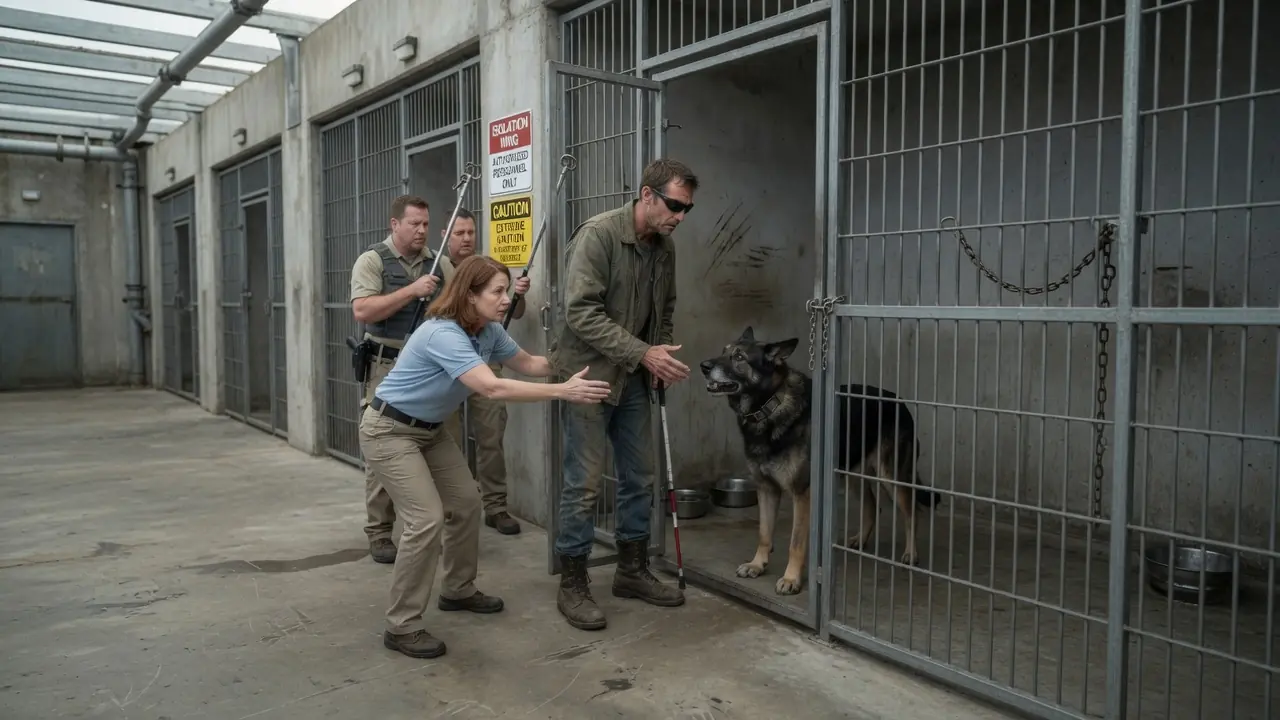
Twenty minutes later, Ethan stood behind a painted yellow line in the secured corridor.
Two handlers remained nearby carrying control poles. A third held a tranquilizer launcher, though Karen had instructed him not to raise it unless ordered.
The corridor felt colder than the main wing.
No music.
No windows.
Only heavy doors with reinforced viewing panels.
Thor’s kennel stood at the end.
Ethan heard the dog pacing before they reached it.
Four steps.
Turn.
Four steps.
Turn.
A repeated patrol.
Karen stopped him twelve feet from the bars.
“This is as close as you go.”
Ethan nodded.
Thor froze.
No bark.
No growl.
Only silence.
“What is he doing?” Ethan asked.
Senior handler Miguel Santos looked through the viewing panel.
“He’s facing you.”
Thor inhaled sharply.
Then his claws scraped once against the concrete.
Ethan rested both hands on his cane.
“My name is Ethan.”
A violent bark exploded from the kennel.
The handlers raised their equipment.
Ethan did not move.
Thor struck the bars.
Metal shook.
Karen stepped closer to Ethan.
“Back away.”
“Wait.”
The dog barked again.
Beneath it came a low, broken sound.
Ethan recognized it.
Not because he understood dogs better than the handlers.
Because he had made the same sound while alone in a hospital room after learning his friends were dead.
“Thor,” Ethan said.
The pacing stopped.
“I’m not Daniel.”
The handlers exchanged confused looks.
Ethan continued.
“I’m not here to replace him.”
A low growl moved through the kennel.
“I know you couldn’t save him.”
Thor slammed the bars once.
Then silence.
Ethan’s voice softened.
“I couldn’t save mine either.”
For several seconds, nothing happened.
Then the German Shepherd exhaled with a trembling whine.
Miguel lowered his pole slightly.
“I’ve never heard him do that.”
Karen whispered, “Neither have I.”
Ethan took one careful step toward the yellow line.
Thor moved closer to the bars.
His breathing remained fast, but the aggression had weakened.
“Describe him,” Ethan said.
Miguel looked through the panel.
“Large German Shepherd. About ninety pounds. Black saddle, tan legs. Gray beginning around the muzzle. Scar along the right shoulder.”
“His ears?”
“Forward.”
“Tail?”
“Low. Not tucked.”
“Teeth?”
“No longer showing.”
Ethan lowered himself carefully to one knee.
He remained behind the line.
Thor pressed his nose between the bars and inhaled.
A soft whine escaped him.
Ethan extended one hand but stopped several feet away.
“I’m here, boy.”
Thor lay down.
The handlers stared.
The dog had never lowered himself while a stranger stood in the corridor.
He usually remained upright until the person left.
Karen’s voice became unsteady.
“We should end this while it is calm.”
Ethan nodded.
He stood.
The moment his cane moved, Thor rose.
A growl returned.
“It’s all right,” Ethan said. “I’m leaving.”
Thor struck the gate.
“Stop,” Ethan told him firmly.
The dog froze.
Everyone in the corridor did the same.
Ethan had not shouted.
He used the tone he once used with soldiers beginning to panic under fire.
“You stay.”
Thor remained still.
“I’ll come back.”
The dog whined.
Ethan turned away.
Thor did not attack the bars again.
He stood watching until the tapping cane disappeared down the corridor.
Director Harold Halverson waited in Karen’s office.
He was sixty-two, broad-shouldered, and known for following procedure with the dedication other men reserved for religion.
“What occurred in that corridor was unusual,” he said. “It does not mean the dog is safe.”
“I didn’t say he was safe,” Ethan replied.
“You suggested he could become your guide dog.”
“No. Karen assumed that.”
Karen looked toward him.
Ethan continued.
“A guide dog requires specialized training and reliable behavior in every public situation. Thor is nowhere near that.”
Halverson relaxed slightly.
“Then we agree.”
“I want to help rehabilitate him.”
The director’s expression hardened again.
“You are not a canine behaviorist.”
“No.”
“You cannot see the warning signs.”
“I can work under supervision.”
“This is not a therapy project for a veteran who identifies with a damaged animal.”
Ethan absorbed the insult without reacting.
“I’m not trying to save myself through him.”
“Aren’t you?”
“Perhaps partly.”
Halverson leaned back.
“That honesty does not make it safe.”
“No. But pretending Thor’s only problem is aggression has not made him better either.”
Karen intervened.
“We could arrange controlled scent and voice exposure outside the kennel. No physical contact.”
Halverson looked at her.
“You are supporting this?”
“I am supporting an evaluation.”
Miguel spoke from the doorway.
“Thor obeyed him.”
“He obeyed one command.”
“He has not obeyed a new person in fourteen months.”
The director removed his glasses.
“If this proceeds, there will be barriers at all times. Ethan does not enter the kennel. Thor does not leave it. One sign of escalating aggression and the sessions end permanently.”
Ethan nodded.
“That is reasonable.”
Halverson pointed at him.
“This is not an adoption path.”
“I understand.”
It became one anyway.
Not immediately.
Not easily.
For the first two weeks, Ethan sat outside Thor’s kennel for thirty minutes a day.
He read aloud from an old book of military history.
The content did not matter.
The sound of his voice did.
Thor paced during the first session.
During the second, he barked whenever Ethan shifted.
On the fourth day, he lay down ten minutes after Ethan arrived.
Ethan learned the sounds of Thor’s movement.
The difference between alertness and panic.
The quick chuff that came before a bark.
The single scrape of a paw when frustration rose.
Thor learned Ethan’s rhythms too.
The tap of his cane.
The way he cleared his throat before speaking.
The smell of the canvas field jacket Ethan wore in cold weather.
One afternoon, Thor became agitated when a radio crackled on Miguel’s belt.
The dog struck the bars and barked violently.
The handlers prepared to end the session.
Ethan remained seated.
“Turn off the radio.”
Miguel did.
Thor continued pacing.
Ethan said, “Down.”
The dog ignored him.
“Thor. Down.”
The pacing slowed.
Then Thor lowered himself to the floor.
Miguel stared through the panel.
“He is using you to regulate himself.”
Ethan smiled faintly.
“Maybe we’re taking turns.”
After a month, they attempted contact through a double barrier.
Ethan placed his hand against an inner mesh screen.
Thor approached from the other side.
He smelled Ethan’s fingers for almost a minute.
Then he pressed his forehead gently against the mesh.
Ethan rested his palm against the place where the dog’s head touched.
Neither moved.
Karen stood behind the observation glass with tears in her eyes.
The next phase took another six weeks.
Thor entered a divided exercise yard while Ethan sat behind a secure fence.
Then the distance between them was reduced.
Thor wore a basket muzzle and two safety lines.
Ethan remained still while Miguel guided the dog within six feet.
Thor trembled.
He looked repeatedly toward the exit.
Ethan spoke quietly.
“No one is making you stay.”
The dog stopped pulling away.
On the fourth outdoor session, Thor approached willingly.
He sniffed Ethan’s shoes.
Then his hands.
Finally, he pressed his nose against Ethan’s jacket.
The dog became completely still.
“What is he smelling?” Karen asked.
Ethan touched the faded canvas.
“This belonged to Luis Moreno.”
“Your friend?”
“My team leader.”
The jacket had been returned to Ethan with other personal effects after the explosion. Luis had lent it to him the evening before their final patrol.
It still carried scents Ethan could no longer detect.
Dust.
Smoke.
Military storage oil.
Perhaps traces of a man who never came home.
Thor inhaled again.
A choked whine escaped him.
His legs began trembling.
The handlers tightened the lines.
“He’s escalating,” one warned.
“No,” Ethan said. “He’s remembering.”
Thor moved forward.
For one frightening second, everyone expected a lunge.
Instead, the dog lowered his enormous head against Ethan’s chest.
Ethan’s hand hovered above him.
“May I touch him?”
Miguel watched Thor’s posture.
“Slowly.”
Ethan rested his palm on the dog’s neck.
Thor closed his eyes.
The entire yard became silent.
“You couldn’t save him,” Ethan whispered.
The dog shuddered.
“It wasn’t your fault.”
Ethan did not know whether Thor understood the words.
He understood the voice.
The permission.
The absence of fear.
Thor leaned more heavily against him.
Ethan’s other hand found the scar along the dog’s shoulder.
“You’re not alone anymore.”
From that day, Thor’s progress accelerated.
There were setbacks.
A dropped metal tray caused him to attack a gate.
A police siren sent him beneath a bench, snarling at anyone who approached.
During one session, a man wearing a uniform entered unexpectedly and Thor tore the safety line from a handler’s grip.
Ethan commanded him to stop.
Thor froze three feet from the man.
The incident proved both how far the dog had come and how dangerous he could still become.
Halverson suspended physical sessions for two weeks.
Ethan returned anyway and sat outside the kennel.
“You made a mistake,” he told Thor. “That doesn’t make you the mistake.”
Thor lay against the bars and listened.
After four months, Halverson allowed Ethan and Thor to walk together in a secured training yard.
Thor wore a harness.
Not a guide harness.
A simple working harness with a handle Ethan could use for orientation.
Miguel held a backup lead several feet behind them.
At first, Thor pulled too quickly.
Ethan stopped.
“Slow.”
Thor adjusted.
They approached a traffic cone.
The dog attempted to pass too close.
Ethan’s shoulder struck it.
Thor immediately turned and sniffed him.
“I’m fine,” Ethan said. “But that was your job.”
On the next pass, Thor guided him around the cone with a wide margin.
The dog already understood searching, tracking, route memory, and environmental hazards. What he lacked was the temperament and consistency required for mobility work.
Training did not transform him overnight.
It gave his instincts a new direction.
He learned to stop at curbs.
To identify doors.
To ignore food on the ground.
To guide Ethan around obstacles without interpreting every stranger as a threat.
A specialist from a certified guide-dog organization joined the process.
She was clear from the beginning.
“Thor may never qualify for unrestricted public-access work.”
Ethan nodded.
“I need him healthy before I need him certified.”
That answer convinced her to stay.
Six months after Ethan first entered the center, Thor accompanied him through a controlled indoor course without a safety leash.
He guided Ethan past chairs, around an open cabinet door, and stopped at a short flight of stairs.
At the bottom, Thor looked back.
Ethan felt the shift through the harness.
“Good stop.”
Thor’s tail struck Ethan’s leg once.
It was the first time anyone had seen him wag while working.
The center staff gathered around when they finished.
Halverson stood near the door with his arms folded.
“He is improving,” the director admitted.
“That sounded painful,” Karen said.
“It was.”
Ethan knelt and touched Thor’s chest.
“I would like to take him home for a weekend trial.”
Halverson’s expression closed immediately.
“No.”
“Why?”
“He remains a retired apprehension dog with a bite history after retirement.”
“My apartment has been inspected.”
“Your mobility instructor has approved the route, not the dog.”
“The behavior team recommends a controlled trial.”
Halverson looked toward Miguel.
The senior handler nodded reluctantly.
“Thor’s separation behavior has improved. The home trial would tell us whether that holds outside the center.”
Halverson stared at Ethan.
“One weekend. Continuous tracking collar. Daily video check-ins. No public buildings. Muzzle available at all times. If he displays territorial aggression, he returns immediately.”
Ethan held out his hand.
“Agreed.”
Thor entered Ethan’s apartment on a Friday afternoon.
For the first twenty minutes, he inspected every room.
He smelled the doors, windows, furniture, and the space beneath the bed.
Then he positioned himself facing the entrance.
Ethan placed a folded blanket beside the sofa.
“You can sleep there.”
Thor remained by the door.
At midnight, Ethan woke from a dream of the explosion.
His breath came too quickly.
The room felt too small.
Before he could sit up, Thor placed his head against the side of the bed.
Ethan reached down.
The dog remained there until his breathing slowed.
“You heard me,” Ethan whispered.
Thor exhaled.
In the morning, Ethan found him asleep with one paw touching the bed frame.
The weekend passed without incident.
Thor alerted to a neighbor in the hallway but accepted Ethan’s command.
He guided Ethan through the apartment courtyard.
He ignored a barking terrier behind a fence.
On Sunday evening, Karen arrived to return him to the center.
Thor stood between Ethan and the door.
His body became rigid.
The old fear returned.
Karen stopped.
“Ethan.”
“I know.”
He crouched beside the dog.
“This is not Daniel again.”
Thor’s breathing quickened.
“I am not disappearing.”
The dog whined.
“You are going back for training. I will be there tomorrow.”
Thor resisted when Karen attached the leash.
Ethan placed both hands against his face.
“Trust me.”
Slowly, Thor stepped away.
He left the apartment looking back after every few steps.
The following morning, Ethan arrived before the center opened.
Thor was waiting beside the kennel door.
The final placement decision was scheduled two weeks later.
Then the fire began.
It started inside an electrical panel in the old rehabilitation wing shortly after noon.
The first alarm sounded while Ethan and Thor were completing an indoor mobility exercise.
Staff initially believed it was a drill.
Then smoke entered through a ceiling vent.
Emergency lights flashed.
Handlers began evacuating dogs through the western exit.
Thor stiffened at the alarm.
The sound resembled the warning siren from the warehouse operation.
His breathing became frantic.
Ethan felt the harness tremble.
“Thor. Forward.”
The dog did not move.
A section of ceiling popped loudly somewhere down the corridor.
Thor pulled backward.
Miguel grabbed the safety leash.
“We need to take him through the north exit.”
They reached the secured hallway when an automatic fire door closed between Thor and Ethan.
Miguel had released the backup line momentarily to open an emergency gate.
Thor remained on the far side.
Ethan heard the dog slam against the metal door.
“Thor!”
Smoke thickened.
Karen grabbed Ethan’s arm.
“We have to move.”
“He’s trapped.”
“The fire team will reach him.”
Thor barked from beyond the door.
Not aggressively.
Calling.
Ethan knew the layout from months of walking it.
The fire door separated the central corridor from the kennel wing. An emergency release should have been mounted six feet to the right.
He moved his cane along the wall.
Karen pulled him back.
“Ethan, stop.”
“The release is here.”
“The door may open into smoke.”
“Thor is in the smoke.”
A sprinkler activated overhead.
Cold water struck them.
Ethan found the metal cover.
He lifted it and pressed the emergency lever.
Nothing happened.
The electrical system had failed.
Thor barked again.
A maintenance worker shouted that there was a secondary manual release inside the adjacent supply room.
Miguel ran for it.
Ethan remained at the door.
“I’m here, boy!”
Thor scratched at the other side.
“Stay with my voice.”
The fire was not yet in their corridor, but smoke reduced visibility to almost nothing.
For Ethan, the darkness did not change.
For everyone else, it suddenly became his world.
Miguel returned and pulled the mechanical release.
The door opened six inches, then jammed against debris.
Thor forced his muzzle through the gap.
Ethan reached for him.
“Back,” Miguel ordered the dog. “Thor, back!”
The dog retreated.
Miguel and two employees pulled at the door.
It opened another foot.
Smoke poured through.
Thor squeezed between the metal edge and the wall.
He reached Ethan and pressed his body against his legs.
“We go together,” Ethan said.
The safest exit had become blocked by smoke.
Karen could no longer see the corridor signs.
Miguel’s eyes watered too badly to identify the route.
Ethan knew the distance between turns.
Thor knew the building.
“Find outside,” Ethan commanded.
The words were not part of standard guide work.
They were part of Thor’s old police training.
The dog lowered his nose.
Then he moved.
Ethan held the harness.
Karen placed one hand on his shoulder.
Miguel followed her.
Thor led them away from the thickest smoke.
At the first intersection, a burning ceiling panel fell in front of them.
Thor stopped so suddenly Ethan nearly collided with him.
The dog turned left.
They entered the laundry passage.
Heat pressed against their backs.
“Keep moving,” Ethan said.
Thor navigated around an overturned cart.
He stopped at a closed service door and scratched once.
Miguel felt along the surface.
“Emergency exit.”
He pushed the bar.
Fresh air struck them.
They stumbled into the rear parking lot as firefighters moved toward the building.
Ethan dropped to one knee, coughing.
Thor remained pressed against him.
A paramedic approached with an oxygen mask.
The dog growled.
Ethan touched his neck.
“Friend.”
Thor allowed the paramedic forward.
Karen sat on the pavement, crying and laughing at the same time.
“He guided all of us out.”
Miguel removed his smoke-darkened glasses.
“I couldn’t see five feet.”
Ethan rested his forehead against Thor’s.
“Neither could I.”
The dog licked his cheek once.
Director Halverson emerged from another exit minutes later.
He saw Thor lying beside Ethan, both covered in soot.
For once, the director had no rule prepared.
No warning.
No argument about liability.
He crouched near them.
“Is everyone safe?”
“Everyone in our section,” Karen said.
Halverson looked at Thor.
The dog raised his head but did not growl.
“He returned for the group,” Miguel said. “He could have run outside alone.”
Ethan shook his head.
“No. Thor doesn’t leave his people.”
The damaged wing remained closed for months.
The fire investigation found old wiring behind a wall and several failed safety systems. No animals or staff members died.
Thor’s actions did not erase his behavioral history.
They did prove that his protective instincts could function without uncontrolled aggression.
The placement committee met three weeks later.
This time, Halverson spoke first.
“Thor cannot be certified today as a traditional guide dog.”
Ethan nodded.
“We agree.”
“He will require continued behavioral monitoring, specialized public-access training, and restrictions during the transition period.”
“I understand.”
“He also cannot remain in this center.”
Ethan’s heart tightened.
Halverson allowed himself a faint smile.
“Because the committee has approved permanent placement with you under our rehabilitated service partnership program.”
Ethan said nothing.
Karen slid a document across the table.
“You can sign here.”
His hand trembled as he held the pen.
Thor sat beside him.
Ethan signed.
The first night after the placement became permanent, Thor slept at the apartment door.
The second night, he moved halfway toward the bedroom.
By the end of the week, he slept beside Ethan’s bed.
Training continued for nearly a year.
Thor never became a conventional guide dog.
He remained too alert to certain sounds and required commands tailored to his history.
But he passed a specialized mobility-assistance evaluation.
He learned Ethan’s regular routes.
The grocery store.
The veterans’ clinic.
The park.
The bus stop.
He stopped at every curb.
Avoided low branches.
Led Ethan toward empty seats.
When sudden noises triggered him, Ethan grounded him with a hand against his shoulder.
When crowded spaces overwhelmed Ethan, Thor guided him toward the nearest quiet wall.
They did not remove one another’s scars.
They learned how to move while carrying them.
One afternoon, Karen visited Ethan’s apartment.
Thor greeted her at the door with a toy in his mouth.
She laughed.
“I cannot believe this is the dog who tried to dismantle a kennel because I walked past with a clipboard.”
“He still dislikes clipboards.”
Thor dropped the toy at her feet.
Karen sat beside Ethan.
“How are you doing?”
“Better.”
“Because of the mobility?”
“Partly.”
“What is the other part?”
Ethan listened to Thor breathing near his feet.
“For three years, everyone wanted to help me return to the man I was before the explosion.”
Karen waited.
“I can’t return to him,” Ethan said. “He didn’t survive.”
Her expression softened.
“Thor never asked me to become that man. He only asked me to keep moving as the one who remained.”
Months later, Ethan and Thor were invited to a police-department memorial ceremony honoring Officer Daniel Reeves.
Some officers objected.
Thor had become a painful symbol of the warehouse disaster and the department’s failure to care for him afterward.
Daniel’s widow, Rebecca Reeves, personally requested their attendance.
The ceremony was held outside police headquarters.
Thor wore no apprehension collar.
He wore his mobility harness.
Ethan stood beside him before a crowd of officers, veterans, rehabilitation staff, and families.
Rebecca approached slowly.
Thor became still when he heard her voice.
“Hello, Thor.”
The dog lifted his nose.
Rebecca knelt.
For a moment, Ethan feared the memories would overwhelm him.
Thor stepped forward.
He smelled her hands.
Then he pressed his forehead against her shoulder.
Rebecca began crying.
“You remember me.”
Thor remained there.
She wrapped both arms around his neck.
Ethan turned his face away, giving them privacy he could not provide with distance.
When Rebecca stood, she took Ethan’s hand.
“Daniel would have wanted him to live.”
“I think Thor believed living meant abandoning him.”
“So did I for a while.”
They stood together beside the dog who had carried grief for both of them.
The police chief presented Thor with a service commendation for his actions during the rehabilitation-center fire.
Ethan accepted it on the dog’s behalf.
When asked to speak, he kept his remarks brief.
“People called Thor broken because pain changed the way he responded to the world.”
His hand rested on the dog’s back.
“People said similar things about me after I came home.”
The crowd became quiet.
“Neither of us needed someone to pretend the damage was not real. We needed patience, training, boundaries, and a reason to trust again.”
Thor leaned gently against his leg.
“I came to the center looking for a dog who could guide me.”
Ethan smiled.
“I found one who needed directions too.”
That evening, they walked home through the park.
The path curved beneath tall trees. Children played near a fountain. A bicycle passed from behind.
Thor guided Ethan safely to the side.
“Good boy.”
They reached a bench overlooking the river.
Ethan removed the harness so Thor could rest.
The dog placed his head on Ethan’s knee.
For years, Ethan believed blindness was the worst thing the explosion had taken.
It was not.
The greater loss had been his belief that he still had something valuable to offer.
Thor returned that belief without ever needing to say it.
The dog had been feared because everyone saw the force of his grief but not the loyalty beneath it.
Ethan had been pitied because people saw his cane before they saw the man holding it.
Together, they were not repaired versions of who they had once been.
They were something new.
A blind veteran who could navigate the city again.
A retired police dog who could sleep without guarding a body that was no longer there.
Two survivors moving forward, not because the past had released them, but because they had finally found someone willing to carry part of its weight.
Thor lifted his head as footsteps approached along the path.
Ethan felt the dog’s body become alert.
“Easy.”
Thor listened.
The footsteps passed.
The tension left his body.
Ethan scratched behind his ears.
“You’re learning.”
Thor sighed and returned his head to Ethan’s knee.
The river moved steadily beside them.
Ethan could not see the evening light reflecting across the water.
He could feel the cool air.
Hear the leaves shifting overhead.
Sense the warm, living weight of the dog beside him.
It was enough.
He had entered the rehabilitation center hoping to find an animal that could help him move safely through a world he could no longer see.
Instead, he found Thor behind reinforced steel, guarding an old grief as fiercely as he once guarded his handler.
Everyone else had heard a dangerous dog.
Ethan heard someone calling from the darkness.
And when he answered, neither of them had to remain there alone.