The first thing Noah Bennett asked about my motorcycle was not how fast it could go. He asked whether it remembered being loud. I had heard children ask strange questions before. I had spent most of my adult life around bikers, mechanics, veterans, and the kind of men who believed every serious conversation could be improved by adding horsepower, so strange questions did not bother me. But Noah's question stopped me because he was nine years old, blind, and standing three feet from a motorcycle he had never touched. His folded white cane rested beneath one arm, and his mother stood behind him with both hands wrapped around a paper coffee cup as if it were the only solid object in the room.
My name was Gideon Mercer, though almost nobody had used it regularly since I was twenty-two. The Iron Ridge Riders called me Hawk because one eye had always been better than the other, even before the bad one was gone for good. By sixty-three, I had a steel plate beneath my right cheek, a deep scar from my temple to the corner of my mouth, and enough ink across both arms and shoulders to make strangers assume I had opinions about trouble. Most days I let them assume whatever they wanted.
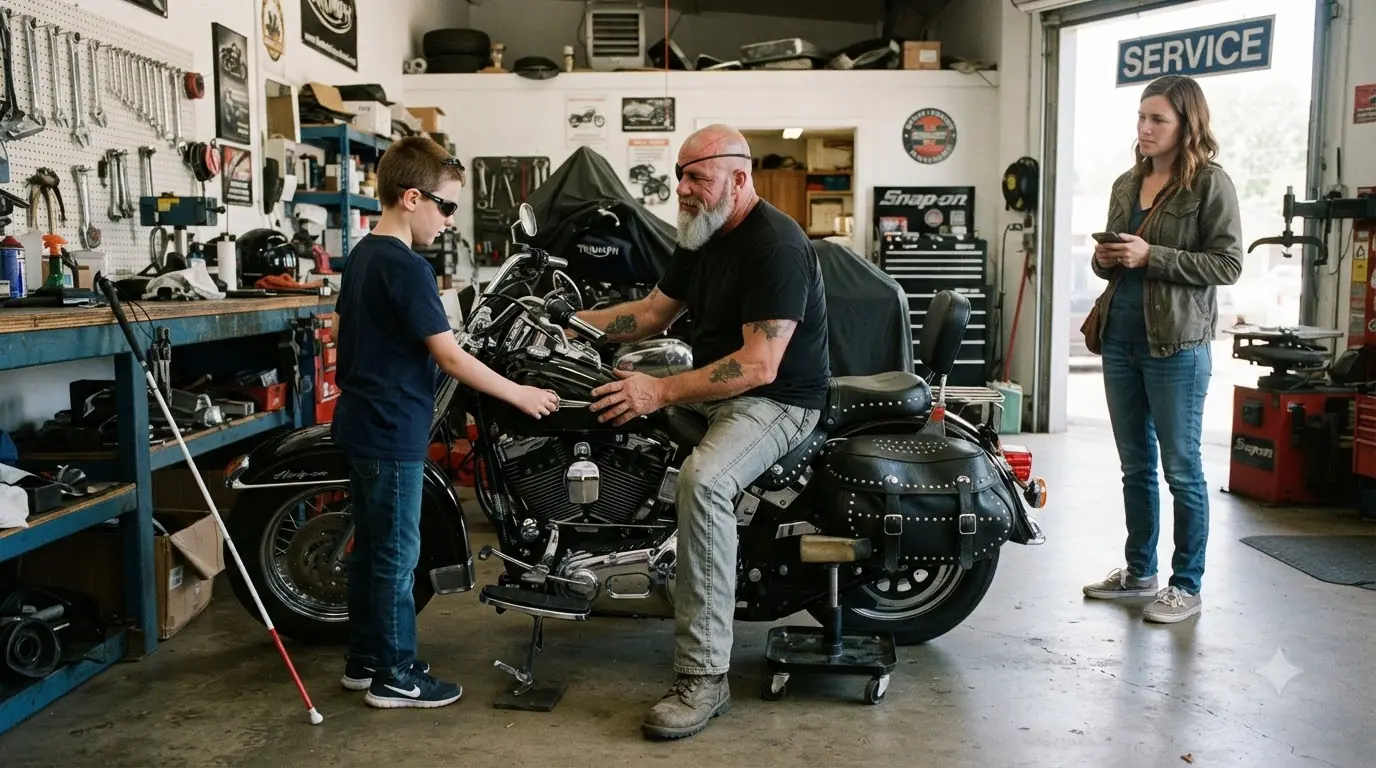
The motorcycle between Noah and me was a 2003 Harley-Davidson Road King Classic. Black paint, cream pinstriping, heavy saddlebags, floorboards worn smooth near the edges, and a dent on the left side of the tank that I had refused to repair for nineteen years. I owned a newer motorcycle that was faster and easier on my back. I rode the Road King anyway because some machines stop being transportation and become witnesses.
Noah could not see the paint, the scar on my face, or the faded Iron Ridge patch hanging on a nail near the workbench. What he knew was the temperature in the garage, the smell of old oil, the location of my voice, and the fact that somewhere in front of him was a motorcycle big enough to make his mother nervous. "It remembers," I told him. "Machines remember through wear. Bearings. Bolts. Metal. People do too."
Noah tilted his head. "Does that mean it gets scared?" His mother, Lena, looked at me as if she wanted to apologize for the question. I shook my head before she could.
"No," I said. "But sometimes the person sitting on it does." That answer was honest enough for both of us. Lena had found me through the Blue Ridge Adaptive Center outside Asheville. The Iron Ridge Riders donated to the center twice a year, mostly because one of our members had a granddaughter with cerebral palsy and because our club was old enough to have stopped pretending charity made us soft. I repaired adaptive equipment when they needed metalwork, built ramps when somebody gave me the right measurements, and occasionally helped with tactile mechanics workshops.
Noah had become fascinated with motorcycles after losing his sight nearly two years earlier. Fascinated was not the same as comfortable. The accident that blinded him had started with a tipped fireworks mortar at a family cookout. One shell had launched sideways instead of upward and exploded against a low brick wall near the children. Noah survived. His eyes did not recover.
What he remembered most was not the light. It was the sound. After the surgeries, any hard mechanical crack could lock his body before his brain understood what had happened. A dumpster lid slamming in an alley sent him under a restaurant table once. A truck dropping a metal loading ramp made him vomit in a parking lot. The first time a motorcycle backfired near their house, Lena said Noah had crawled into a closet and refused to come out for almost forty minutes.
That was why his interest confused everyone. He asked strangers what kind of motorcycles they rode. He listened to engines from the sidewalk and tried to tell them apart. He watched videos through audio descriptions and memorized the sounds of different exhaust notes. He was afraid of loud machines and drawn toward them at the same time.
His mobility instructor thought controlled exposure might help if Noah was the one directing it. She called me because my garage was private, predictable, and quiet when I wanted it quiet. Before Noah took a single step toward the Road King, I gave him one rule. "I will describe where things are," I said. "I will not move your hands for you. If I think you're about to touch something unsafe, I'll tell you to stop. If I need to move your arm or shoulder, I ask first. You can say no."
Noah was quiet for a moment. "Adults don't usually ask," he said. "Then adults need better training." Lena looked away. I could see that landed harder than she expected.
The first thing Noah touched was the front tire. He crouched slowly, found the rubber with his fingertips, then traced the tread from one groove to the next. He wanted to know why the sidewall felt smoother, why the grooves were different depths, why the metal wheel behind it felt colder than the rubber. I answered every question I could and admitted when I could not.
From the tire, he moved to the fender. From the fender to the fork. Then the brake line, the caliper, the handlebar, the clutch lever, and the mirror stem. He never squeezed or pulled anything without asking what would happen first.