Fifty tractors stood behind the auction barn in three crooked rows, their hoods sun-faded, tires flat, and engine covers filmed with the gray dust that settled over everything in Mercer County by late summer. Some had no seats. Others had missing wheels, broken steering columns, and oil stains dark enough to tell their own stories. The auctioneer called them fifty dead machines, and the men gathered beneath the corrugated roof laughed as if someone had finally given the wrecks a proper funeral. Then a nineteen-year-old boy in work boots raised his number and offered eight hundred dollars, every dollar of which he had earned on Saturdays, evenings, and holidays since his sophomore year of high school.
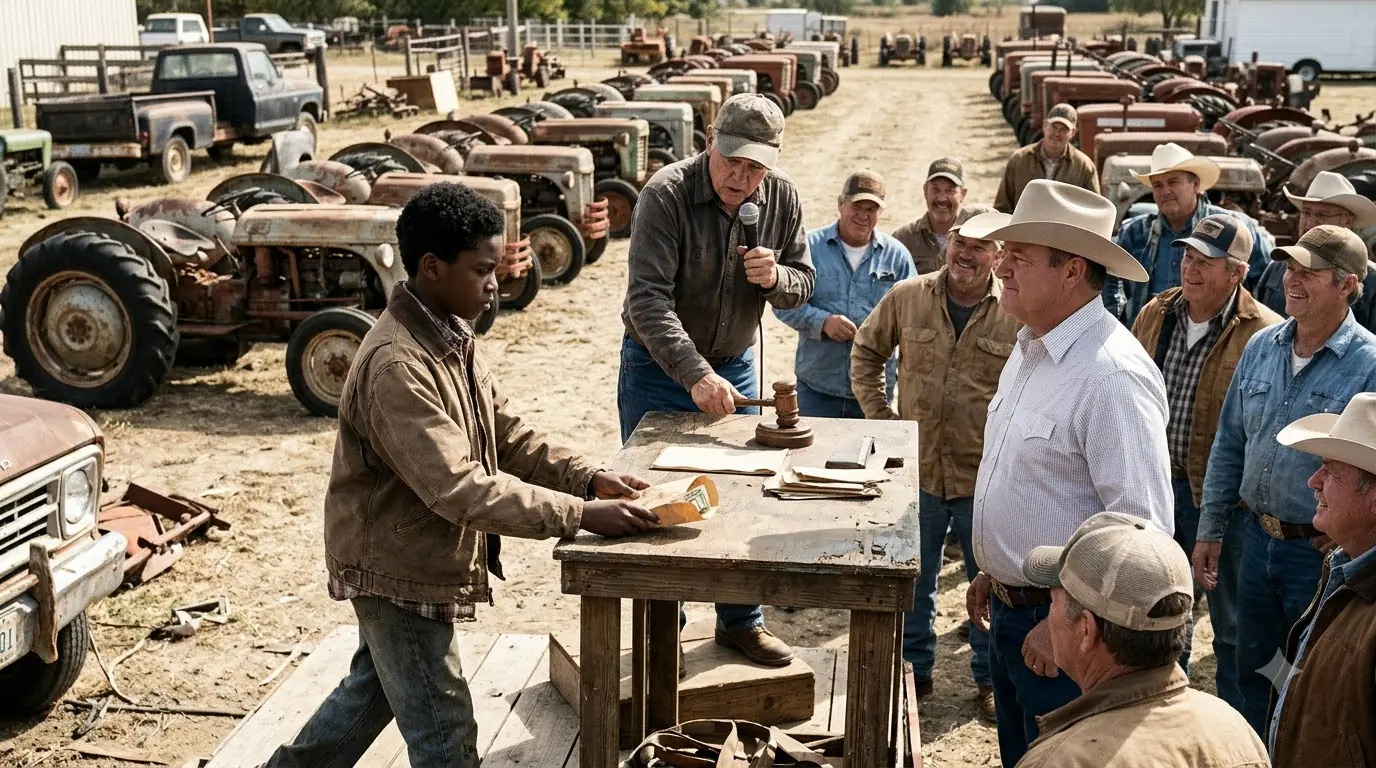
His name was Caleb Turner, although nearly everybody in the county still called him Amos Turner's grandson. Amos had spent forty years working behind the main dealership, repairing the equipment its prosperous customers thought too old or too troublesome to bring through the front doors. The owner of that dealership, Vernon Pike, was standing near the auctioneer with his son and two salesmen, smiling at the sight of Caleb's bid. Vernon had bought and sold machinery for thirty years and knew the value of a good joke when the joke cost somebody else his savings. He looked toward Caleb and said loudly, "Your granddaddy tell you those tractors were talking to him again?"
A ripple of laughter crossed the crowd. Caleb stood straight, holding a plain white envelope against his chest, while his grandfather watched from a folding chair beneath the shade of a livestock trailer. Amos was seventy-four, slow in one knee, and wore a clean blue shirt that had belonged to his working life before retirement became an argument with the electric bill. He did not tell his grandson to lower his hand. He simply leaned forward far enough to hear the next number.
The bidding climbed from eight hundred to nine hundred, then twelve hundred, thirteen hundred, and fifteen hundred. Caleb followed it with a face so still that Vernon began to enjoy the spectacle less. At nineteen hundred, one of Vernon's salesmen gave an exaggerated sigh, and the auctioneer pointed toward a cattle buyer near the aisle. "Two thousand," Caleb said, more clearly than before. Vernon raised his hand as though considering another bid, then dropped it with a generous smile. "Let the boy have them. He's earned the right to make his own mistakes."
The hammer struck wood. Fifty tractors became Caleb's for two thousand dollars, subject to the sale terms and the cost of getting them off the rented lot within forty-eight hours. He had not bought them because he thought fifty machines could be restored to showroom condition. He had bought them because their identification plates told him thirty-three had been built around the same engine and hydraulic system, with enough overlapping components to make careful rebuilding possible. That distinction was the difference between a mountain of scrap and an inventory. Nobody laughing under the auction roof had asked to see the plates.