The priest had just called her by the wrong name when the ground began to tremble.
“My friends, we gather here today to commit Margaret… Pike to her final rest.”
Her name was Margaret Price.
Everyone who had ever known her called her Maggie, though few people had known her well enough to use it.
Her son, Nathan, glanced impatiently at his watch but did not correct the priest. His flight back to Seattle left in four hours, and he still needed to sign papers with the funeral director, meet a real-estate agent, and decide what to do with the decaying house on the ridge.
Beside him, his wife, Claire, stared at the mud accumulating around the heels of her expensive boots.
There were no neighbors gathered around the grave.
No old friends.
No former coworkers.
Only Nathan, Claire, a distracted priest, and a funeral director sheltering beneath a black umbrella while cold November rain struck the cheap wooden coffin.
Maggie had died at seventy-three in a county hospital twenty miles away.
The official cause was complications from pneumonia and chronic lung disease. Years of smoking had weakened her body. A brutal winter illness had done the rest.
She had spent her final days much as she had spent the previous decade—stubborn, angry, and refusing to ask anyone for help.
Nathan had arrived six hours after she died.
He told himself the delay was unavoidable.
Work had been demanding.
Flights were limited.
Their relationship had been dead long before her heart stopped.
The priest cleared his throat and continued reading from a page that appeared to contain no personal details at all.
“She was a woman of quiet resilience who faced life’s hardships with—”
A low vibration moved through the cemetery.
Rainwater trembled inside the shallow puddles beside the grave.
Claire frowned.
“What is that?”
Nathan looked toward the wrought-iron gates.
At first, the sound resembled distant thunder rolling across the Montana plains.
Then it deepened.
The vibration entered the soles of their shoes and climbed into their chests.
The funeral director lowered his umbrella.
The priest stopped speaking.
Over the hill beyond the cemetery entrance appeared two motorcycles.
Then four.
Then twenty.
They entered in disciplined pairs, their headlights cutting through the gray rain. Chrome flashed beneath the storm clouds, and exhaust rolled behind them in pale clouds.
The first riders turned onto the cemetery road.
More followed.
The procession continued beyond the hill, stretching so far down the county road that Nathan could not see where it ended.
“What the hell is this?” Claire whispered.
The motorcycles filled every narrow lane inside the cemetery.
Some parked along the gravel road. Others moved carefully onto the wet grass. Riders dismounted in silence, their boots sinking into the mud.
There were hundreds of them.
Large men with gray beards.
Younger men with tattooed hands.
Women in heavy leather coats.
On the back of nearly every vest was the same winged skull.
The engines shut down in waves.
The sudden silence felt heavier than the roar.
Cooling exhaust pipes ticked beneath the rain.
Nathan stepped closer to the grave.
“Did she know these people?”
Claire gripped his arm.
“Maybe they’re at the wrong funeral.”
The crowd parted.
A man walked through the center.
He was enormous, broad enough that his leather jacket appeared stretched across a door frame rather than a human body. A thick scar crossed his forehead and disappeared into his dark hair. His beard carried streaks of gray, and he walked with a permanent limp in his right leg.
He stopped at the coffin.
The priest attempted a professional smile.
“Are you a relative?”
The man ignored him.
He removed one glove.
The exposed hand was scarred and mottled, several fingertips pale from old frostbite.
Then he reached inside his vest.
Nathan tensed.
The man withdrew a crumpled pack of Pall Mall cigarettes and a cheap plastic lighter.
He placed them gently on the coffin.
Rain darkened the red-and-white paper.
He rested his scarred palm against the wood.
“You kept the gate closed, Maggie.”
His voice sounded like stone dragged across gravel.
“Rest easy.”
Behind him, hundreds of riders lowered their heads.
Nathan stared.
The large biker finally turned toward him.
His eyes were pale blue and completely without warmth.
“You her boy?”
Nathan hesitated.
“I’m her son.”
The biker looked at Nathan’s tailored coat.
Then at the nearly empty graveside.
“You got here late.”
Nathan felt heat rise in his face.
“I lived in another state.”
The man glanced toward the coffin.
“So did most of us.”
Nathan looked past him at the hundreds standing in the rain.
“Who are you?”
The biker did not answer immediately.
He turned and raised one fist.
Hundreds of fists rose behind him in perfect silence.
No shouting.
No speeches.
Only the rain tapping against leather and the coffin lid.
Then the biker lowered his arm.
The crowd turned.
Engines started again in rolling waves.
Within minutes, the cemetery shook beneath the departing procession.
Nathan remained beside his mother’s grave, forgotten by people who had traveled hundreds of miles to honor a woman he had not called in four years.
He watched the scarred biker mount a black Harley-Davidson.
Before riding away, the man looked back once.
There was no threat in his face.
Only contempt.
Nathan turned toward the wet pack of cigarettes on the coffin.
For the first time since receiving the hospital’s call, he wondered who his mother had become after he stopped knowing her.
Fourteen months earlier, snow had buried the road to Maggie Price’s house before sunset.
It did not fall gently.
There were no soft white flakes drifting beneath peaceful streetlights.
The storm came sideways across the Montana plains, driven by wind powerful enough to shake the aluminum siding and lift frozen dirt from beneath the snow.
Maggie sat alone in a floral recliner wearing three wool cardigans.
The electricity had failed shortly after six.
The furnace had continued running weakly for another hour before producing a final metallic rattle and dying.
Now the living room smelled of burnt dust and overheated wiring.
A camping lantern glowed on the coffee table.
Its weak light reflected from the blank television screen, where Maggie could see the orange tip of her cigarette brightening and fading with every breath.
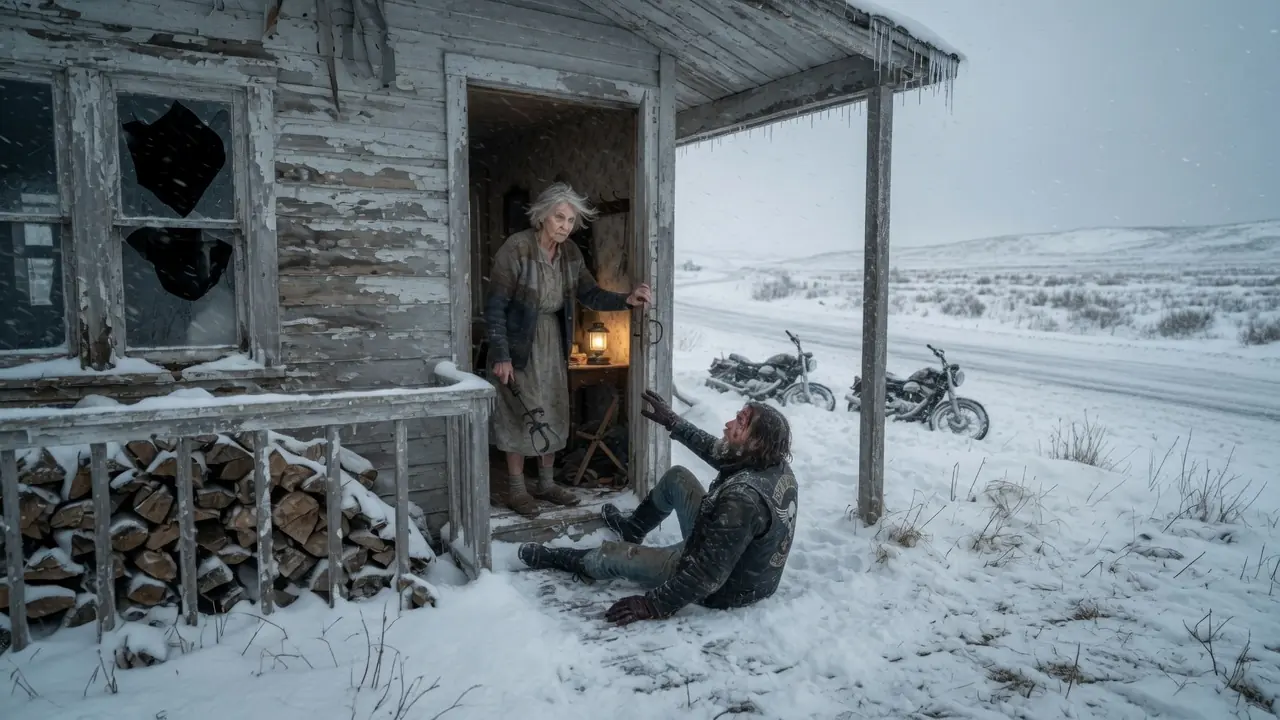
The temperature inside had fallen below forty-five degrees.
Frost spread along the windows.
Maggie watched it grow.
She had lived in the small house for thirty-eight years.
Her husband, Harold, bought it when the mining company still employed half the town. He died twelve years earlier, leaving behind a garage filled with rusted tools and a dining set Maggie had always hated.
Their son moved to Seattle and became a commercial real-estate broker.
Nathan wore expensive suits, spoke in carefully measured sentences, and had spent years telling Maggie to sell the house before it collapsed around her.
Their final argument happened four Christmases earlier.
He called the property unsafe.
She called his wife shallow.
He accused Maggie of using cruelty to keep everyone at a distance.
She told him distance was the only thing he had ever given freely.
Nathan left before dinner.
Neither called afterward.
Maggie preferred the silence.
At least that was what she told herself.
Silence never lied.
It never abandoned anyone.
It simply remained.
She lifted a glass of watered-down scotch.
The ice had melted long ago.
Then something struck the front door.
Maggie stopped moving.
The sound came again.
A heavy, uneven impact.
Not a branch.
Not wind-blown debris.
Something solid was hitting the wood.
She held the cigarette halfway to her lips and listened.
Another blow.
Weaker.
Then a scraping sound moved down the outside of the door.
Maggie considered ignoring it.
Anyone foolish enough to be outdoors in twenty-below weather had made a series of decisions she did not feel responsible for correcting.
She waited.
Nothing.
The absence of the sound bothered her more than the knocking.
She crushed the cigarette into a glass ashtray, pushed herself out of the recliner, and inhaled sharply as arthritis ground through her left knee.
Near the fireplace, she picked up a wrought-iron poker.
The metal felt cold and reassuring in her hand.
She limped toward the entryway.
The temperature near the front door was even lower. Wind forced snow through a crack beneath the threshold, leaving a white line across the floorboards.
The peephole was covered with frost.
Maggie raised the poker.
Then unlocked the deadbolt.
The wind ripped the door from her hand.
Snow exploded into the hallway.
A man fell through the opening.
He struck the floor face-first with enough force to bring down the wooden coat rack. Wet leather, snow, and a pair of enormous boots landed across Maggie’s braided rug.
She stumbled backward.
The man did not move.
“Get up!”
The storm screamed through the open doorway.
Maggie dropped the poker, grabbed the edge of the door, and pulled.
The wind fought her.
Her bad knee nearly folded.
She planted both slippers against the floor and used her entire weight until the latch finally caught.
Silence returned so suddenly that her ears rang.
Snow melted around the motionless stranger.
He was at least six feet three and weighed more than twice what she did. His leather jacket was covered in ice, and his jeans had frozen stiff around his legs.
Maggie knelt with difficulty.
“Wake up.”
No response.
She shoved his shoulder.
The man groaned and rolled partly onto his side.
That was when she saw the patch across his back.
The winged skull.
Hells Angels Montana.
Maggie stared at it.
Even in their dying town, people knew the reputation.
Violent men.
Outlaws.
Men who considered police sirens an inconvenience rather than a warning.
The biker’s beard was frozen to the collar of his jacket. A deep laceration crossed his forehead, and blood had turned black as it froze against his face.
He smelled of gasoline, wet leather, cheap whiskey, and copper.
Maggie placed two fingers against his neck.
A pulse moved beneath them.
Weak, but present.
She looked toward the front door.
If she pushed him outside, he would die.
If he died inside, deputies would spend hours asking questions and probably leave muddy footprints everywhere.
“Damn you.”
She grabbed his jacket by both lapels.
The man did not help.
For nearly twenty minutes, Maggie dragged him from the freezing hallway into the living room.
She moved him several inches at a time.
Pull.
Rest.
Breathe.
Pull again.
Her knee burned.
Pain wrapped around her chest.
By the time she reached the rug near the dead furnace, sweat covered her forehead despite the cold.
Maggie collapsed into her recliner and waited to see whether her heart would stop.
It did not.
The biker lay unconscious beside the coffee table.
“You’re ruining my floor,” she told him.
She found rusted garden shears beneath the kitchen sink.
His frozen gloves had bonded to his skin with ice and blood. Maggie cut along each cuff and peeled back the leather.
His hands were white in some areas and dark purple in others.
Frostbite.
She had seen it years earlier when Harold found a ranch hand trapped overnight in a broken truck.
Maggie filled a bowl with lukewarm water.
The pipes were already beginning to freeze.
She lowered the biker’s hands into it.
His eyes opened instantly.
Pale blue.
Wild.
One hand closed around her wrist with crushing force.
Maggie did not scream.
She pressed the garden shears beneath his jaw.
“Let go,” she said, “or I’ll open your neck like a feed sack.”
The man stared at her.
Confusion slowly replaced instinct.
He looked at the thin old woman in three cardigans, then at the rusty blades against his throat.
His grip loosened.
Maggie pulled away and rubbed the red marks around her wrist.
“Where am I?” he asked.
His voice sounded torn apart.
“My house.”
He tried to sit up.
A violent shiver moved through him.
His teeth struck together hard enough for Maggie to hear.
“What happened?”
“Bike went down.”
“Where?”
“Ridge road.”
“Only an idiot rides a motorcycle through a November storm.”
“Storm came early.”
“The weather service has been talking about it for three days.”
He closed his eyes.
“Didn’t listen.”
“That is the first believable thing you’ve said.”
The biker remembered black ice beneath the rear tire.
The machine sliding sideways.
His shoulder striking the road.
The motorcycle disappearing into a snow-filled ditch.
He remembered walking toward a distant porch light.
Three miles, perhaps more.
After that, nothing.
Maggie left him beside the dead furnace and returned with two chipped mugs.
“Coffee.”
He accepted one with trembling hands.
It was instant coffee, dark and bitter.
“Thanks.”
“Don’t thank me yet. You may still lose fingers.”
The biker took a careful drink.
“My name’s Rourke.”
“That your real name?”
“Close enough.”
“Mine’s Maggie.”
He looked around the room.
Frosted windows.
Peeling wallpaper.
One recliner.
No family photographs.
“You live alone?”
“What are you planning to steal?”
Rourke gave a short laugh that became a wet cough.
He held his ribs.
“Lady, you don’t have anything worth stealing.”
“Then we understand each other.”
Blood continued moving from the cut on his forehead.
Maggie tossed a roll of gauze, rubbing alcohol, and medical tape onto the rug.
“You’re still leaking.”
“You a nurse?”
“No.”
“You have the bedside manner for it.”
He poured alcohol onto the gauze.
The pain brought a harsh hiss through his teeth.
Maggie lit another cigarette.
“You smell like a dead animal.”
“You smell like an ashtray someone poured whiskey into.”
Maggie looked at him sharply.
Rourke expected anger.
Instead, a dry sound escaped her.
Almost laughter.
They sat without speaking while wind battered the house.
The temperature continued falling.
Rourke secured the gauze over his forehead and leaned against the sofa.
Maggie stared at the empty wall where family photographs once hung.
“I have a son.”
She had not intended to say it.
Rourke waited.
“Seattle,” she continued. “Sells buildings to people who already own too many.”
“He visit?”
“No.”
“Why?”
“Because I told him his wife was interested in his money.”
“Was she?”
“I believe so.”
“What did he say?”
“That I was a bitter old woman who would die alone.”
Rourke considered this.
“Sounds like you were both right.”
Maggie turned toward him.
Most people would have apologized immediately.
Rourke simply drank the terrible coffee.
After a moment, Maggie chuckled.
“Probably.”
By midnight, the cold felt alive.
It moved through wool, leather, bone, and thought.
The camping lantern failed.
Only the blue-white glow of snow behind the windows remained.
Maggie’s breathing became shallow.
Rourke’s violent shivering stopped.
That frightened her.
“Rourke.”
No response.
She kicked his boot.
“Don’t die on my rug.”
He groaned.
“Resting.”
“You’re freezing.”
“So are you.”
Maggie forced herself from the chair.
“We need a fire.”
“No wood.”
“I have furniture.”
Rourke opened one eye.
“You want to burn your furniture?”
“I want to burn the dining set.”
She pointed toward the dark archway.
“Mahogany. Harold bought it in 1978 to impress a supervisor who hated him. I’ve waited forty years for a good reason to destroy it.”
Rourke used the sofa to stand.
He swayed.
Then he limped into the dining room.
A moment later, wood struck the floor with a deafening crack.
Rourke returned carrying the broken back of an ornate chair.
He smashed the remaining pieces with the heel of his boot and the iron poker.
Maggie found old newspapers.
They built a fire in the neglected fireplace.
The varnish burned with an acrid chemical odor.
Smoke curled into the room before the chimney began drawing properly.
It was ugly and probably toxic.
It also produced heat.
Maggie moved the recliner closer.
Rourke sat on the floor with his damaged hands extended toward the flames.
“This smoke will kill us,” he muttered.
Maggie lit a Pall Mall from a burning chair leg.
“I smoke two packs a day. Varnish will have to wait its turn.”
Rourke laughed.
The sound became a cough that bent him forward.
When he recovered, he reached inside his jacket and withdrew a battered silver flask.
He took a drink, wiped the rim, and offered it to Maggie.
She swallowed without coughing.
Cheap whiskey burned down her throat.
“Why’d you open the door?” Rourke asked.
Maggie watched the fire consume the chair she had hated for decades.
“The knocking annoyed me.”
“That’s all?”
“If you died on my porch, the county would send people.”
Rourke waited.
“They leave the gate open.”
For several seconds, he stared at her.
Then genuine laughter shook his chest.
“You dragged a freezing outlaw through your house because you didn’t want deputies leaving your gate open?”
“Yes.”
“You’re a mean old woman.”
“You’re an idiot who rode into a blizzard.”
“Fair.”
The fire cracked between them.
Rourke looked at the Hells Angels patch on his chest.
“My club will be searching when the roads open.”
“Your gang?”
“Club.”
“Do you kill people?”
He looked into the flames.
“I protect my own.”
“That isn’t an answer.”
“It’s the one I have.”
Maggie accepted it.
“Must be convenient.”
“What?”
“Having people who show up.”
Rourke looked toward her.
“Your son wouldn’t?”
“He didn’t come to his father’s funeral.”
“You ask him?”
“No.”
“Then you don’t know.”
“I know him.”
“You knew him four years ago.”
Maggie’s jaw tightened.
Rourke continued before she could strike back.
“Blood isn’t the only kind of family.”
He tapped the patch.
“These men aren’t related to me. But if I called and said I was trapped, they’d ride into a wall trying to reach me.”
Maggie watched the last intact dining chair waiting in the shadows.
“Family is whoever comes when the furnace dies,” Rourke said.
The words stayed with her.
They burned a second chair before dawn.
Neither spoke much afterward.
Rourke fed wood into the fireplace.
Maggie kept them awake with insults whenever their eyes closed too long.
Two difficult people sat within three feet of the flames while the storm tried to bury the house.
The wind weakened near sunrise.
At nine, a snowplow passed along the road below the property.
Twenty minutes later, a modified four-wheel-drive truck forced its way through the drift near Maggie’s gate.
Two bikers climbed out before it stopped moving.
They shouted Rourke’s name.
He stood slowly.
His face had swollen around the cut, his ribs were likely cracked, and his right leg could barely carry weight.
Maggie remained in the recliner.
The night had made her look smaller.
Older.
Rourke opened the door.
Cold sunlight entered the hallway.
He raised one hand toward the men outside, silencing them.
Then he returned to the living room.
From his pocket, he removed the silver flask and placed it beside Maggie’s ashtray.
“You saved my life.”
“I saved my rug.”
He looked at her.
“Your roof needs work.”
“Leave.”
“The furnace too.”
“Rourke.”
“I’m going.”
He stopped at the doorway.
“Keep the gate closed.”
“Don’t crash on my mountain again.”
Rourke nodded once and walked outside.
The truck disappeared behind the snowbank.
Maggie expected never to see him again.
Three days later, twelve motorcycles and two work trucks arrived.
Rourke was not among them. He was recovering from surgery for broken ribs and frostbite treatment.
The men repaired Maggie’s furnace.
They replaced damaged wiring.
They patched the roof and brought enough split firewood to fill the shed.
Maggie stood in the doorway holding the iron poker.
“I didn’t hire you.”
A white-bearded biker handed her an envelope.
Inside was a note written in thick black ink.
Family comes when the furnace dies. Let them work. —R
Maggie allowed them inside.
She complained the entire time.
They returned in spring to repair the gate.
Rourke came with them.
A white scar had formed across his forehead, and two fingers on his left hand remained partly numb.
He carried a new dining chair.
Maggie stared at it.
“I don’t need furniture.”
“You burned yours.”
“I hated it.”
“This one is ugly too.”
She examined the heavy wooden chair.
It was not ugly.
That irritated her.
Over the following year, members of the club stopped occasionally.
Some brought groceries.
Others repaired a pipe or cleared snow from the walkway.
They never stayed long.
Maggie never became sweet.
She called them criminals, animals, and overgrown children.
They called her Ma, which she claimed to hate.
Rourke visited most often.
Sometimes they drank coffee without speaking.
Once, Maggie asked about the motorcycle crash.
Rourke admitted he had been riding toward the hospital where one of his club brothers was dying.
He knew the storm was coming.
He rode anyway because the man had no family beside him.
“Did you reach him?” Maggie asked.
“No.”
“He died?”
“Two hours before the road opened.”
Maggie handed him the silver flask.
“You were right.”
“About what?”
“Family is who comes.”
Rourke looked toward the repaired furnace.
“So call your son.”
“No.”
“Maggie.”
“He knows the number.”
“You know his.”
The conversation ended with Maggie throwing an ashtray at him.
It missed.
Several weeks later, she dialed Nathan’s number and hung up before the call connected.
She tried again another month later.
This time, Claire answered.
Maggie said nothing.
Claire asked who was calling.
Maggie hung up.
Her health declined during the following winter.
The blizzard had not created her lung disease, but the smoke, exposure, and infection that followed weakened a body already damaged by decades of cigarettes.
Rourke drove her to medical appointments when she allowed it.
Usually she did not.
In October, he found her collapsed beside the kitchen table.
She spent eight days in the hospital.
Nathan’s number appeared on her emergency-contact form, written years earlier.
A nurse called him.
He said he would come if the situation became critical.
Maggie overheard.
“Tell him not to bother.”
The nurse looked uncomfortable.
Rourke sat near the window.
After the nurse left, he leaned toward Maggie.
“You make it difficult for people to love you.”
“I make it difficult for people to lie about it.”
“Same result.”
“Go to hell.”
“Probably.”
Maggie returned home but never fully recovered.
In late November, she developed pneumonia.
Rourke wanted to take her back to the hospital.
She refused until she could no longer stand.
He carried her to his truck while she cursed him for leaving the front gate open.
Maggie died twelve days later.
Rourke was sitting outside the room because she would not allow him to watch.
A nurse found a folded note beneath her pillow.
It contained two names.
Nathan Price.
Rourke Maddox.
Beneath Rourke’s name, Maggie had written:
Make sure the gate gets closed.
Nathan arranged the cheapest private funeral package available.
He did not know about Rourke.
He did not know that hundreds of bikers had repaired his mother’s home, delivered fuel, taken her to appointments, and sat with her when winter evenings became too quiet.
Rourke learned about the burial from a nurse.
He contacted every chapter within riding distance.
The message contained only a location, a time, and one sentence.
The old woman who kept Dutch alive is going into the ground alone.
Five hundred riders came.
After they left the cemetery, Nathan remained in the rain.
The funeral director approached cautiously.
“Mr. Price, there’s something else.”
He handed Nathan a small cardboard box recovered from Maggie’s hospital room.
Inside were a silver flask, three photographs, and an unopened letter.
The first photograph showed Maggie standing in front of her repaired gate beside several bikers.
She was not smiling.
But her hand rested on Rourke’s arm.
The second showed the house in spring, its roof repaired.
The third showed Maggie sitting at the dining table across from Rourke.
Between them was a birthday cake with seventy-three candles.
Nathan opened the letter.
The handwriting was unsteady.
Nathan,
You were right about me being bitter. I was right about you being stubborn. That is the problem with families. Two people can be right and still lose everything.
I nearly called you. I decided you should call first. You probably decided the same thing. Four years passed while we both waited to win.
A stranger came to my door during a storm. He was bleeding, frozen, and too heavy for any sensible woman to drag inside. I helped him because I did not want him dying on my porch. That is the story I told him.
The truth is that I heard someone knocking, and for the first time in years, I wanted there to be a person on the other side.
I don’t know whether that makes me weak. I suppose it doesn’t matter now.
The men at my funeral look frightening. Most of them are. Do not insult them. They fixed the furnace.
Your mother,
Maggie
Nathan read the letter twice.
Claire stood beneath the umbrella behind him.
“Did she leave the house to us?”
He folded the paper carefully.
“I don’t know.”
The answer was true.
For the first time, he was thinking about something other than the property.
Rourke waited outside the cemetery gates.
Most of the riders had already departed.
He sat on the black Harley with the engine off, rain collecting across his shoulders.
Nathan approached alone.
“Mr. Maddox?”
Rourke looked at him.
“My mother wrote about you.”
“That so?”
“She said you repaired the furnace.”
“Wasn’t me.”
“Your club.”
“They showed up.”
Nathan held the box against his chest.
“Why did all these people come?”
Rourke looked toward the fresh grave.
“Because she opened the door.”
“To you?”
“To one of us.”
Nathan struggled with the answer.
“She wasn’t easy.”
“No.”
“She could be cruel.”
“Yes.”
“You respected her anyway?”
Rourke put on his gloves.
“She never pretended to be anything else.”
Nathan looked toward the cemetery.
“I didn’t know she was sick.”
“You didn’t ask.”
The words were blunt, but not shouted.
Nathan lowered his eyes.
Rourke started the motorcycle.
Before leaving, he said, “The house isn’t empty.”
“What does that mean?”
“You’ll see.”
Nathan drove to the ridge that afternoon.
The storm had weakened, but rain continued falling.
Maggie’s gate stood closed.
He unlocked it with the key from the hospital box.
Inside the house, the furnace was running.
Firewood filled the shed.
The roof did not leak.
On the wall above the fireplace hung a photograph of Maggie and Rourke sitting beside a burning pile of broken mahogany furniture.
Someone had written beneath it:
THE NIGHT THE FURNACE DIED
Nathan walked through the rooms slowly.
His childhood photographs had been removed years earlier, but they had not been thrown away.
He found them inside a cedar chest.
School portraits.
A photograph of him holding his first bicycle.
His university graduation.
His wedding announcement cut from a newspaper, though Maggie had not attended.
She had kept all of it.
On the dining table sat the new wooden chair Rourke had brought.
Maggie’s chair.
Nathan lowered himself into it.
He held the letter for a long time.
Then he called the real-estate agent and canceled the listing appointment.
The house remained in the family.
Nathan returned several times over the next year.
Sometimes he found flowers near the gate.
Sometimes split wood appeared beside the shed.
No one left names.
He eventually installed a small brass plaque near the front door.
It contained no dates.
Only six words:
SHE OPENED THE DOOR IN THE STORM.
Years later, Rourke still carried scars across his hands from the night he nearly froze to death.
Whenever a new member asked why the club maintained an old house on an empty Montana ridge, he told the story.
Not as a tale about a helpless old woman rescuing a dangerous man.
Maggie had not been helpless.
And Rourke had not felt dangerous while lying frozen on her floor.
He told them about two people who disliked the world for different reasons.
One had chosen a motorcycle club because blood relatives had failed him.
The other had chosen isolation before anyone else could leave.
A storm trapped them together.
Neither became kinder overnight.
Neither offered easy comfort.
They exchanged insults, terrible coffee, cheap whiskey, and truths no polite person would have dared to say.
Maggie opened the door because the pounding annoyed her.
That was the explanation she defended until the end.
Rourke never challenged it again.
Some acts of mercy were easier to perform than admit.
At her funeral, five hundred riders raised their fists beneath the cold Montana rain.
Her son believed he was watching strangers invade a family burial.
He was wrong.
The strangers were the family.
The man in the tailored coat was the one standing outside it.
Snow had covered the ridge again by December.
It buried the tire tracks near Maggie’s gate, the dead grass beside the house, and the scar where Rourke’s motorcycle left the road.
But Maggie had been right about snow.
It purified nothing.
It merely hid what remained beneath.
The broken furnace.
The empty rooms.
The years of anger.
The words never spoken between a mother and her son.
Spring would uncover all of it.
Yet the storm had also left behind something the snow could not bury.
A scarred silver flask beside an ashtray.
A dining chair burned for warmth.
A repaired gate.
And the memory of a bitter old woman who heard someone dying on the other side of her door—and opened it anyway.