“Get your hand away from me.”
The words came before anyone understood what had happened.
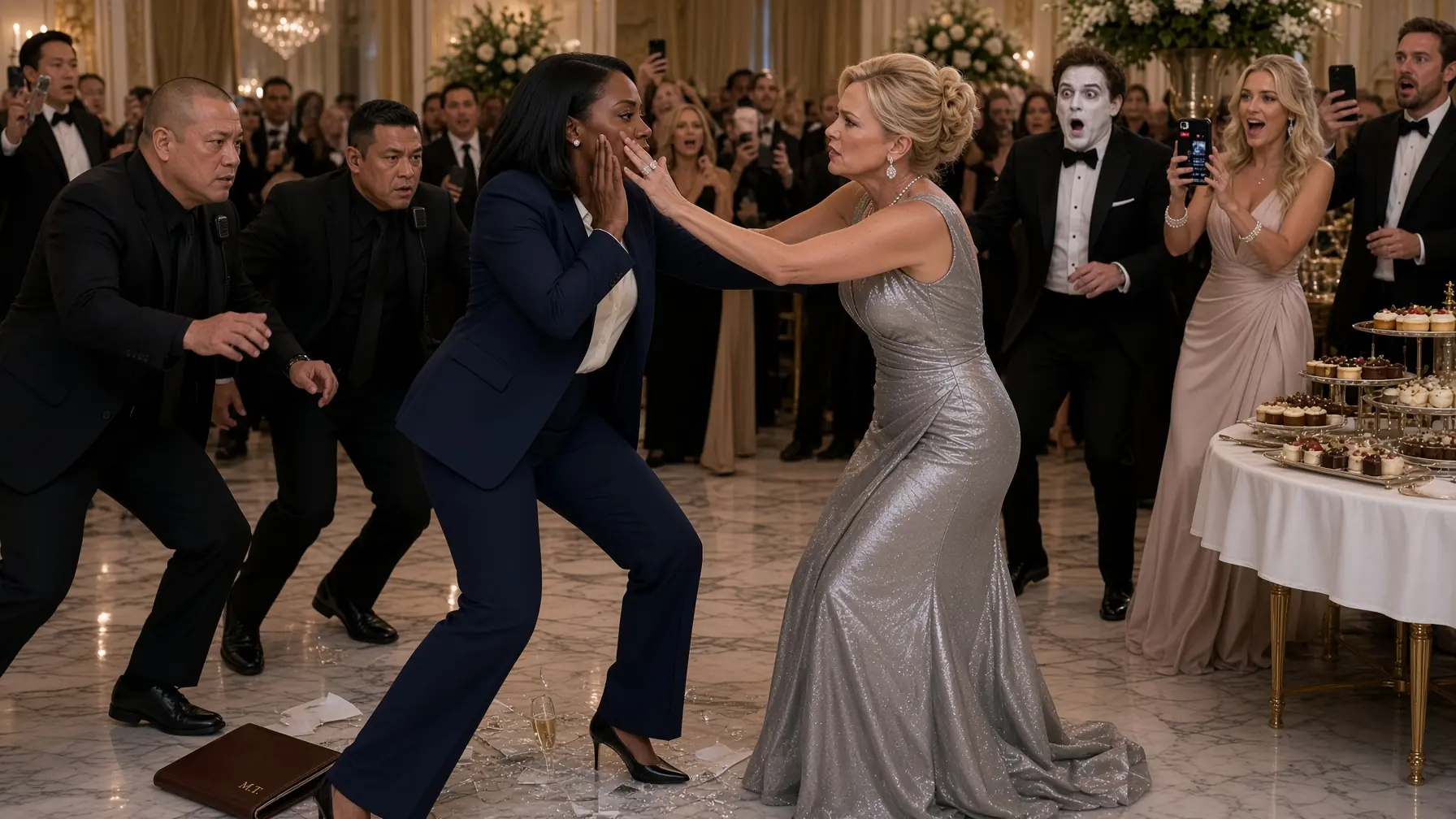
Dr. Camille Ross stood beside the dessert station at the Beaumont Grand Hotel with her right hand still half extended.
Across from her, Helena Carlisle pulled back as if Camille had tried to touch her with something filthy.
“I was only introducing myself.”
“I know what you were doing.”
Helena’s voice carried farther than she seemed to realize.
Around them, conversations began dying.
The Carlisle Foundation’s annual winter gala had drawn nearly six hundred guests into the Manhattan ballroom—investment bankers, politicians, technology executives, museum trustees, physicians, old-money families, and people accustomed to being recognized before they ever had to say their names.
Camille had arrived alone.
No entourage.
No press assistant.
No photographer.
A navy suit.
Low black heels.
A leather portfolio beneath one arm.
Helena Carlisle, chairwoman of the foundation and wife of Carlisle Industries CEO Jonathan Carlisle, looked Camille up and down.
Then she glanced toward the servers moving between tables.
“You need to return to whichever station you were assigned.”
Camille lowered her hand.
“I’m not working the event.”
Helena’s mouth curved.
“Of course not.”
“I’m a guest.”
That made Helena laugh.
Her daughter, Sloane, stood several feet away holding a phone.
Twenty-four years old.
Lifestyle influencer.
Foundation ambassador when it suited her.
Professional spectator the rest of the time.
She had already started recording.
“Mom,” Sloane whispered toward her livestream, “there’s some kind of staff drama happening.”
Camille heard her.
So did Helena.
Neither cared enough to stop.
Camille reached into her portfolio.
Helena stepped backward.
“What are you doing?”
“Getting my invitation.”
“Security.”
“I have identification.”
“Security!”
Two guards looked toward them.
The nearest started walking over.
Camille pulled out a cream-colored invitation card.
Before she could unfold it, Helena slapped her hand aside.
The movement was fast.
Careless.
Her diamond ring caught Camille’s cheek.
The invitation flew.
A champagne flute on the edge of the dessert table toppled.
Crystal shattered against marble.
Camille felt the sting before she felt the blood.
Then the entire ballroom seemed to stop breathing.
One red line appeared beneath her left cheekbone.
Helena stared at her.
For perhaps half a second, something resembling shock passed across her face.
Then instinct replaced it.
Not remorse.
Defense.
“She grabbed me.”
Camille looked at her.
“No.”
“You all saw it.”
Helena held up her hand.
“She came at me.”
“I extended my hand.”
“She was harassing me.”
Camille touched her cheek.
Her fingertips came away red.
Sloane’s phone remained raised.
The viewer count was climbing.
Helena pointed toward Camille.
“Remove her before she causes another scene.”
Camille looked past her toward the security director approaching from the eastern wall.
“Before anyone touches me,” she said, “I’d suggest you review your own cameras.”
The security director stopped.
His name was Isaac Moreno.
Fifty.
Former NYPD lieutenant.
Experienced enough to recognize when a wealthy client wanted certainty faster than evidence could provide it.
He looked at Camille’s bleeding cheek.
The shattered glass.
Helena’s ring.
Then Sloane’s phone.
“Mrs. Carlisle,” he said carefully, “did she strike you?”
“She threatened me.”
“That wasn’t my question.”
Helena’s face hardened.
“I am telling you to remove her.”
Isaac looked at Camille.
“Ma’am, can I see your invitation?”
Camille bent slowly.
Picked it up from the floor.
Handed it to him.
Isaac read the name.
Then read it again.
His eyes moved to Camille.
Something changed.
Not dramatically.
Just enough.
“Dr. Ross.”
Helena noticed.
“What?”
Isaac did not answer her immediately.
Camille said:
“I assume my invitation is valid.”
“Yes, ma’am.”
Helena laughed sharply.
“Anyone can get an invitation.”
Isaac looked toward her.
“This one came through the Carlisle Industries executive office.”
The ballroom became quieter.
Camille took her invitation back.
Then said:
“I’d still like to introduce myself.”
Helena stared at her.
Camille extended her hand again.
Second time.
“My name is Dr. Camille Ross.”
Helena looked at the hand.
Then at Camille’s face.
The blood had reached the collar of her jacket.
“I don’t care who you are.”
Camille lowered her hand.
“All right.”
Behind Helena, her son Gavin Carlisle smirked over a whiskey glass.
Thirty-one.
Vice president in the family investment office.
Born into the peculiar confidence of men who had rarely had to wonder whether a room wanted them.
He looked at Camille.
“Maybe take the hint.”
Several guests laughed.
Not many.
Enough.
Camille looked toward them.
Nobody met her eyes.
One older woman did.
She seemed embarrassed.
But embarrassment without action did not change the room.
Camille picked up her portfolio.
Then walked away.
Twenty minutes earlier, nobody in that ballroom had known what Dr. Camille Ross looked like.
That was not unusual.
Camille had spent fifteen years building Asteron Analytics while avoiding the machinery that converted founders into personalities.
She did not enjoy magazine covers.
Rarely accepted television interviews.
Had no public social-media account.
Her company handled data infrastructure, predictive systems, and industrial artificial intelligence for manufacturers, logistics networks, energy companies, and several of the largest retailers in the world.
Asteron was successful enough that financial publications discussed Camille far more often than ordinary people recognized her face.
At forty-three, she had become one of the most influential Black women in enterprise technology.
She still used the same private email address she had created in graduate school.
Still called her mother every Sunday.
Still carried a leather portfolio instead of a designer handbag because paper made her think more clearly than screens.
And thirty-six hours earlier, in Dubai, she had signed the largest agreement of her career.
Carlisle Industries was a century-old manufacturing and logistics conglomerate employing more than eleven thousand people worldwide.
Once dominant.
Now aging.
Their distribution software was years behind.
Several major retail contracts were under pressure.
European compliance changes were approaching.
Their board had approved a three-year modernization agreement with Asteron worth just over one billion dollars.
Not a magical rescue.
Not the only technology company in the world capable of helping them.
But changing providers now would cost Carlisle at least a year they did not have.
The partnership mattered.
To both companies.
Camille had signed beside Jonathan Carlisle himself.
He had been professional.
Prepared.
Surprisingly candid about the company’s weaknesses.
Before they parted, Jonathan had said:
“My wife’s foundation gala is tomorrow night.”
Camille smiled.
“I land tomorrow afternoon.”
“Come.”
“I’ll be asleep.”
“You’ll survive.”
“What’s the occasion?”
“Scholarship fund.”
He paused.
“And the board wants us to announce the partnership Monday morning. It might be useful if you met a few people beforehand.”
Camille thought about it.
Then agreed.
Jonathan’s office added her to the invitation list.
No public announcement.
No special entrance.
No photograph beside her name.
She preferred it that way.
She had gone to the gala to meet people.
Instead, within fifteen minutes, she learned exactly how some of them treated a person they did not recognize.
Camille sat alone at a table near the western wall.
A server named Elena brought her ice wrapped in a clean cloth.
“For your cheek.”
“Thank you.”
“Do you need medical attention?”
“It’s shallow.”
Elena hesitated.
Then quietly:
“I saw what happened.”
Camille looked up.
“Did you?”
“Yes.”
Elena glanced toward Helena.
“You didn’t touch her.”
“Thank you.”
The server disappeared before anyone could notice the conversation.
Camille pressed the ice to her face.
Her phone vibrated.
Jonathan Carlisle.
She declined the call.
Then another.
Asteron general counsel.
She answered that one.
“Camille?”
“I’m fine.”
“What happened?”
Camille looked toward Sloane, still speaking into her livestream across the room.
“Apparently I attended a charity gala.”
“I’m serious.”
“So am I.”
Her lawyer exhaled.
“We’re seeing video.”
“Already?”
“Your attacker’s daughter is broadcasting it.”
Camille almost laughed.
“Of course she is.”
“Do you want us to contact police?”
“Hotel security already has the footage.”
“Do you want to leave?”
Camille looked toward the stage.
The auction was scheduled to begin in twenty-five minutes.
“No.”
A pause.
“You sure?”
“Yes.”
“Why?”
Camille looked at Helena.
Because leaving would turn the night into a story about a Black woman being humiliated out of a room.
But staying only to reveal she was rich and powerful risked teaching an equally bad lesson.
That respect was owed because Camille Ross was important.
Not because she was a human being.
She said:
“I came to understand the company we just partnered with.”
“This is the foundation, not the company.”
“Helena sits on Carlisle Industries’ board.”
Silence.
“And Gavin?”
“Family office only.”
“And Sloane?”
“Foundation communications committee.”
Camille closed her eyes briefly.
“Preserve everything.”
“Already happening.”
“Do not invoke any contractual clause.”
Her counsel sounded surprised.
“Not yet?”
“Not because I’m angry.”
“Camille, you were assaulted.”
“I know.”
“And humiliated publicly.”
“I know.”
“Then what are you waiting for?”
“Facts beyond my own experience.”
Her lawyer went quiet.
Camille continued.
“Our contract includes ethics representations and a material-reputation review process.”
“Yes.”
“That process exists for a reason.”
“So?”
“So use it.”
She lowered the ice.
“Send notice that Monday’s public announcement is postponed pending review of tonight’s incident.”
“How long?”
“Until outside counsel evaluates whether this is an isolated act or evidence of a governance problem.”
“Jonathan is going to panic.”
“He can panic professionally.”
Her lawyer almost laughed.
“Anything else?”
“Yes.”
Camille looked toward Sloane.
“Download the livestream before someone develops better judgment.”
Dinner began.
Camille’s place card had originally put her at the head table beside Jonathan’s vacant chair.
Someone had moved it.
Isaac Moreno discovered that twenty minutes later.
He approached Camille.
“Dr. Ross?”
“Yes?”
“There’s been a seating problem.”
“I noticed.”
“Your assigned seat was at Table One.”
Camille looked across the ballroom.
Helena sat there.
So did Gavin.
Sloane.
Several donors.
“My place card was here when I arrived.”
“Yes.”
Isaac seemed uncomfortable.
“We checked the event log.”
“Who moved it?”
He hesitated.
Camille waited.
“Mrs. Carlisle’s assistant.”
“Before or after I arrived?”
“After.”
That mattered.
Camille put down her fork.
“Why?”
“We’re still determining that.”
“Thank you for telling me.”
Isaac nodded.
“I also preserved the camera footage.”
Camille studied him.
“You didn’t have to tell me that.”
“No.”
“Why did you?”
He looked toward Helena.
“Because the first thing she asked my team after the incident was whether the ballroom cameras could be deleted for guest privacy.”
Camille’s face changed.
“When?”
“Four minutes after she struck you.”
There it was.
Not proof of a larger culture.
But information.
“Were they deleted?”
“No.”
“Good.”
Isaac started walking away.
Camille stopped him.
“Mr. Moreno.”
He turned.
“You handled the situation carefully.”
He looked almost surprised.
“I nearly let my team remove you.”
“But you didn’t.”
“No.”
“Why?”
“Because the facts didn’t support it.”
Camille nodded.
“That’s the job.”
He walked away.
At 9:20, Helena took the stage.
The Carlisle Foundation crest illuminated the screen behind her.
She gave no indication that anything unusual had happened.
She thanked donors.
Praised generosity.
Spoke about opportunity.
The word landed strangely after what Camille had witnessed.
Then Helena said:
“Our family has always believed institutions have a responsibility to open doors for those who need them.”
Camille looked down.
That was when an elderly man at the next table leaned toward her.
“Quite a sentence.”
Camille turned.
He was perhaps seventy-five.
Silver hair.
Tuxedo slightly too large.
He held out his hand.
“Arthur Mason.”
Camille shook it.
“Camille Ross.”
“I know.”
“Do you?”
“I was on the Carlisle Industries board until two years ago.”
She studied him.
Arthur continued.
“I also know what Helena did.”
“You saw it?”
“Yes.”
“Did you say anything?”
He looked down.
“No.”
Camille waited.
Arthur sighed.
“I’m ashamed of that.”
She said nothing.
He continued:
“You learn something unpleasant about yourself when you realize you were waiting to see who had more power before deciding whom to defend.”
Camille looked at him more carefully.
“That’s unusually honest.”
“Age has removed some of my more decorative lies.”
She almost smiled.
Arthur lowered his voice.
“You should ask about Leona Pierce.”
“Who?”
“Former vice president of strategic accounts.”
Camille’s attention sharpened.
“She left Carlisle last year.”
“Why?”
“Officially?”
“Yes.”
“Family reasons.”
“And unofficially?”
Arthur looked toward Helena.
“Ask the board.”
Camille already knew the name.
Leona Pierce appeared in pre-partnership diligence.
Top performer.
Fourteen years.
Sudden resignation.
Exit documentation unusually thin.
Camille texted her attorney.
Add Leona Pierce to outside review. No contact yet. Preserve existing files first.
Then she watched Helena finish her speech.
Applause followed.
Camille did not clap.
Neither did Arthur.
Ten minutes later, Camille approached Helena a third time.
Not because she needed recognition anymore.
Because she wanted one final opportunity for the situation to correct itself naturally.
Helena had stepped down from the stage.
Several donors surrounded her.
Camille waited until the group opened.
“Mrs. Carlisle.”
Helena saw her.
Her smile vanished.
“You’re still here?”
“Yes.”
“I thought security handled you.”
“They verified my invitation.”
Helena’s face hardened.
Camille extended her hand.
Third time.
“My name is Dr. Camille Ross.”
Helena stared at it.
Then looked directly at Camille.
“What part of this are you failing to understand?”
“I’m trying to introduce myself.”
“I do not want your introduction.”
Several people nearby went quiet.
Sloane raised her phone again.
Gavin watched from behind his mother.
Camille kept her hand extended.
Helena stepped closer.
“You have disrupted my event.”
“I introduced myself.”
“You have embarrassed my family.”
“I was the one bleeding.”
Helena’s voice dropped.
“You people always do this.”
Camille’s hand remained still.
“What people?”
Helena realized too late that several phones were recording.
But pride carried her past the exit.
“People who force themselves into spaces they have not earned and then scream discrimination when someone notices.”
Camille lowered her hand.
There was no reason to continue.
“I understand.”
Gavin laughed.
“Finally.”
Camille looked at him.
Then at Helena.
“Enjoy the auction.”
She walked away.
At 9:34, the lights dimmed.
The auction host, Samuel Price, stepped onto the stage.
Helena returned to the head table.
Her confidence had recovered.
The unpleasant woman had been pushed away.
Security had not arrested her, but the evening could continue.
Samuel adjusted the microphone.
“Ladies and gentlemen, before tonight’s auction begins, we have one corporate announcement requested by Carlisle Industries.”
Helena frowned.
This was not on her program.
Gavin leaned toward her.
“What’s this?”
She shook her head.
Samuel continued.
“Carlisle Industries had planned to announce a major technology partnership Monday morning.”
Camille remained seated.
“This evening, our chairman, Jonathan Carlisle, authorized me to acknowledge the partner informally because its chief executive is with us tonight.”
Helena’s body went completely still.
Samuel looked toward the ballroom.
“It is my honor to welcome Dr. Camille Ross, founder and chief executive of Asteron Analytics.”
Nobody moved.
Then every face turned.
Toward the woman sitting at the half-empty table near the western wall.
The woman with dried blood on her navy collar.
The woman whose hand Helena had refused three times.
Gavin’s glass stopped halfway to his mouth.
Sloane slowly lowered her phone.
Arthur Mason closed his eyes.
Samuel continued, unaware for perhaps another two seconds that he had stepped into a catastrophe.
“Asteron and Carlisle Industries signed a three-year modernization agreement yesterday in Dubai—”
His voice faded as someone hurried toward the stage.
An event producer whispered in his ear.
Samuel looked toward Camille.
Then toward Helena.
His expression changed.
He stopped.
“Ladies and gentlemen…”
He placed both hands on the podium.
“We’re going to pause the program for a few minutes.”
Helena stood.
“Samuel.”
He did not look at her.
The ballroom began murmuring.
Phones rose everywhere.
For once, Sloane’s livestream was no longer the only camera.
Helena reached Camille before anyone else.
“Dr. Ross.”
Her voice had transformed.
Soft.
Almost desperate.
Camille looked at her.
“You knew who I was.”
“No.”
“I introduced myself three times.”
“I didn’t know what the name meant.”
Camille held her gaze.
Helena flinched.
“If I had understood—”
“That’s the problem.”
“Please.”
“No.”
Camille stood.
Not dramatically.
She was simply tired of speaking upward from a chair.
“If you had understood I controlled something valuable to your family, you would have treated me differently.”
Helena’s mouth trembled.
“I made a mistake.”
“You made several.”
“I was under enormous pressure.”
“From a handshake?”
“You were behaving aggressively.”
Camille touched the cut beneath her cheek.
“Your ring opened my face.”
Helena looked toward the blood.
Then away.
Camille continued.
“But I want you to understand something important.”
She lowered her voice.
“This would not become acceptable if I were a hotel employee.”
Silence.
“If I were catering staff, you would still be wrong.”
“If I were someone’s driver, you would still be wrong.”
“If I had no company…”
“No contract…”
“No wealth…”
“No name anyone in this room recognized…”
She stepped slightly closer.
“You would still be wrong.”
Helena’s eyes filled.
Camille did not know whether the tears came from shame or fear.
It did not matter yet.
“There is one more thing,” Camille said.
Helena swallowed.
“What?”
“Monday’s partnership announcement has been postponed.”
Her face collapsed.
“You can’t.”
“I can.”
“Jonathan signed.”
“So did I.”
“You’re terminating it?”
“No.”
That surprised her.
Camille continued.
“Our agreement requires both parties to maintain governance standards during implementation.”
“You assaulted the chief executive of the partner company while serving as chair of your family foundation and as a director of Carlisle Industries.”
“My legal team has initiated the review process.”
Helena whispered:
“You’re doing this to punish me.”
“No.”
Camille looked around the ballroom.
“If I wanted revenge, I’d make a decision tonight.”
“Instead, independent counsel will determine whether this evening is an isolated failure or part of something larger.”
Helena stared.
Camille continued:
“If it is isolated, the company will deal with your conduct.”
“And if it isn’t?”
Camille thought of Arthur Mason.
Leona Pierce.
The thin exit file.
“Then you have a larger problem than me.”
Jonathan Carlisle called moments later.
This time Camille answered.
“I’m told my wife struck you.”
“Yes.”
“Are you hurt?”
“Minor cut.”
Silence.
Then:
“I’m sorry.”
“You weren’t there.”
“She’s my wife.”
“She’s responsible for what she did.”
Jonathan breathed heavily.
“What happens to the contract?”
“The announcement is paused.”
“Camille—”
“Jonathan.”
He stopped.
“We signed a business agreement.”
“Yes.”
“I am not going to use eleven thousand employees as hostages in a personal conflict with your wife.”
He said nothing.
“But I’m also not going to pretend governance doesn’t matter because the financial consequences are inconvenient.”
“I understand.”
“Do you?”
Another silence.
Then:
“I think I’m beginning to.”
Camille looked toward Helena.
“Outside counsel will contact your board in the morning.”
“I’ll cooperate.”
“Good.”
“And Camille?”
“Yes?”
“I should have known.”
“Known what?”
“That something like this was possible.”
That answer interested her.
“Why?”
Jonathan went quiet.
Too long.
Camille’s voice changed.
“Jonathan.”
“There were complaints.”
“How many?”
“I don’t know.”
“That isn’t believable.”
“Three that reached the board.”
Camille closed her eyes.
“And?”
“We were told they had been resolved internally.”
“By whom?”
“HR.”
“Who chaired the committee overseeing HR?”
He did not answer.
Camille already knew.
“Helena?”
“Yes.”
Now the partnership review was no longer about one ugly night.
“Preserve everything.”
Jonathan understood immediately.
“I will.”
“No deletions.”
“No cleanup.”
“No conversations about aligning stories.”
“I said I’ll cooperate.”
“Then cooperate.”
She ended the call.
The gala never resumed properly.
Some guests left.
Others remained because catastrophe was more interesting than charity.
Camille declined every interview.
She gave police a statement after Isaac Moreno contacted them regarding the assault.
She did not demand Helena be handcuffed in the ballroom.
The evidence was preserved.
Witnesses identified.
Sloane’s video copied.
The hotel’s camera footage secured.
Whatever legal consequences followed could happen without theater.
Before leaving, Camille found Elena, the server who had brought ice.
“Thank you.”
Elena smiled.
“For ice?”
“For treating me like a person before anybody announced my résumé.”
That landed harder than Camille intended.
Elena looked down.
“You were bleeding.”
“Yes.”
“That seemed more important than who you were.”
Camille smiled.
“Exactly.”
The independent investigation lasted seven weeks.
What it found made the gala look less like an isolated explosion and more like a window.
Leona Pierce had not left Carlisle Industries for family reasons.
She had filed a discrimination complaint after Helena repeatedly questioned whether clients would “connect” with a Black woman leading major negotiations.
Another senior executive, Marisol Vega, documented being passed over for promotion after she was described as “too forceful,” while a white male colleague known for shouting in meetings was praised for executive presence.
A Black procurement director reported that Helena privately discouraged minority-owned suppliers because she considered them “too risky for flagship projects.”
The complaints reached HR.
HR softened the language.
The board committee chaired by Helena accepted the summaries.
Cases closed.
No outside review.
No interviews with several witnesses.
One email became particularly important.
Helena to the head of HR:
Do not let this become another diversity crusade. We hired these people to perform, not to force us into political theater. Resolve it quietly.
Another referred to Leona Pierce:
If she wants to make race the explanation for every disappointment, perhaps she is not mature enough for senior leadership.
That was not misunderstanding.
That was evidence.
Jonathan Carlisle read the emails in the board meeting where they were presented.
For a long time, he said nothing.
Then he asked:
“How long did we have these?”
The general counsel answered:
“Years.”
Jonathan looked around the table.
“And none of us read the originals?”
Silence.
Arthur Mason, invited back as a witness because he had served during part of the period, answered.
“No.”
Jonathan looked at him.
“Why?”
Arthur did not protect himself.
“Because the summaries were convenient.”
That sentence eventually appeared in the final report.
Convenience.
Not one villain alone.
A system full of people who benefited from believing the easiest version.
Helena resigned from the Carlisle Foundation before the board could remove her.
Carlisle Industries’ directors separately voted to remove her from the board.
Her family name did not save her.
Neither did Camille destroy her with one phone call.
Evidence did what spectacle could not.
The foundation commissioned its own review.
Several board members resigned.
The head of HR at Carlisle Industries was terminated after investigators concluded she had deliberately minimized complaints.
Two other HR employees were cleared.
Gavin Carlisle faced no corporate discipline because he did not work for Carlisle Industries, but video of his gala comments caused several nonprofit boards to ask for his resignation.
He gave an apology.
It was poorly received.
Then he stopped talking publicly.
Sloane removed the original livestream.
Too late.
Copies existed everywhere.
Her first apology centered mainly on how awful the experience had been for her.
The response was brutal.
Three weeks later, she issued another.
Shorter.
Less polished.
She admitted she had converted someone else’s humiliation into entertainment because she assumed the woman being humiliated had less social value than the people laughing at her.
Camille never commented on either apology.
The assault case ended without a dramatic criminal trial.
Helena entered into a court-approved disposition that included probation, restitution for Camille’s medical costs, and mandated counseling.
Camille accepted the outcome.
People online accused her of going too easy.
Others said she had used her corporate power to destroy a family.
Both versions annoyed her.
Human beings preferred endings that could fit inside a headline.
Reality resisted.
The partnership between Asteron and Carlisle Industries survived.
But not unchanged.
Camille refused to tie access to technology to arbitrary diversity scores.
That would have been unethical, commercially reckless, and almost impossible to govern fairly.
Instead, Asteron required something much more ordinary.
Independent compliance reporting.
Board oversight.
Whistleblower protection.
Supplier-review transparency.
Documented promotion criteria.
An external channel for reporting retaliation tied specifically to the joint program.
If Carlisle violated the governance terms, Asteron could suspend parts of the implementation through normal contractual procedures.
Not because Camille wanted to run Carlisle’s culture.
Because companies entering billion-dollar partnerships had the right to know whether the other party could manage legal and reputational risk.
Jonathan agreed.
His board agreed.
Then the harder work began.
Leona Pierce was invited to return.
She declined.
Jonathan called personally.
“I understand.”
“No, you don’t,” she told him.
He was quiet.
She continued:
“You want the story where you fix what happened and I return, because that feels complete.”
“Yes.”
“At least you’re honest.”
“What do you want?”
“For you to fix it for the next person.”
Jonathan wrote that sentence down.
Leona later agreed to serve as an outside adviser during the reform process, but she never returned as an employee.
That mattered.
Not every wound existed to provide a redemption arc for the people who caused it.
Six months later, Carlisle Industries published promotion and retention data internally for the first time.
The numbers were uncomfortable.
Good.
Camille believed useful numbers often were.
The company changed its executive-review process.
Not perfectly.
Several managers resisted.
One left.
Another complained that everything had become too political.
Jonathan answered:
“No. Everything became documented.”
Asteron’s implementation proceeded.
Slowly at first.
Then faster.
The modernization project eventually improved Carlisle’s logistics performance enough to stabilize several major accounts.
No single algorithm saved the company.
Hundreds of employees did.
Engineers.
Warehouse managers.
Analysts.
Drivers.
Operations teams.
People whose names never appeared in newspapers.
That mattered to Camille too.
The original story had become:
BLACK CEO HUMILIATED AT BILLIONAIRE GALA TURNS TABLES
She hated the phrase.
Turns tables.
As though dignity only arrived when power reversed direction.
A year after the incident, the Carlisle Foundation held its gala again.
Not at the Beaumont Grand.
A smaller venue.
Fewer photographers.
The new foundation chair was an attorney named Grace Kim.
She began the evening without a speech about generosity.
Instead she thanked the catering staff.
By name where she could.
Sloane attended quietly.
Gavin did not.
Helena stayed away.
Camille received an invitation.
She nearly declined.
Then accepted for one reason.
Elena, the server from the previous year, had been hired by the foundation as events operations manager after completing a hospitality-management program.
Camille wanted to see her.
Near the entrance, Elena spotted her.
“Dr. Ross.”
Camille extended her hand.
Elena shook it immediately.
“Welcome back.”
Camille smiled.
“Thank you.”
That handshake meant more to her than the announcement a year earlier.
No reveal.
No gasp.
No sudden understanding that she was important.
Just one person greeting another.
Later in the evening, a young analyst approached Camille.
Twenty-three.
Black.
Nervous.
Suit slightly too large.
He looked as though he had practiced the introduction three times before crossing the room.
“Dr. Ross?”
“Yes?”
“My name is Jordan Bell. I started at Carlisle four months ago.”
He extended his hand.
Camille shook it.
“Good to meet you, Jordan.”
“I just wanted to say…”
He stopped.
She waited.
“My mother showed me that video.”
Camille’s expression changed.
“She was angry.”
“So was mine.”
He laughed nervously.
“She told me, ‘You see? That’s why you have to become powerful.’”
Camille looked at him.
“What did you think?”
“I don’t know.”
He hesitated.
“Maybe she was right.”
Camille released his hand.
“No.”
Jordan blinked.
“No?”
“Power helps.”
She looked around the ballroom.
“Money helps.”
“A title helps.”
“Knowing lawyers helps.”
“All of those things helped me.”
Jordan listened.
“But if the lesson you take from what happened to me is that you need to become powerful enough that people regret disrespecting you, then Helena Carlisle still gets to write the rules.”
He looked confused.
Camille continued.
“I deserved not to be struck when she thought I was staff.”
“I deserved not to be humiliated if I had been unemployed.”
“If I had walked into the wrong room.”
“If I had been nobody that crowd considered useful.”
She smiled slightly.
“Become powerful if that’s what your work leads to.”
“But don’t confuse power with proof that you were worthy before you had it.”
Jordan stood very still.
Then nodded.
“I think my mother needs to hear that.”
Camille laughed.
“Mine too.”
Camille’s scar faded.
A thin line remained beneath her left cheekbone.
Sometimes makeup covered it.
Sometimes not.
She never called it a badge of honor.
She disliked turning injuries into trophies.
It was a scar.
Nothing more.
But whenever she saw it in a mirror, she remembered the ballroom.
Not Helena’s hand.
Not the announcement.
Not the frozen faces when people learned who Camille was.
She remembered something smaller.
Elena bringing ice.
Isaac asking what actually happened before following an order.
Arthur admitting he had stayed silent because he was waiting to see where the power was.
Those were the moments that interested her.
Because systems were rarely built only by monsters.
They were built by thousands of ordinary decisions.
Ask the question or assume.
Read the complaint or accept the summary.
Speak or remain quiet.
Shake the hand or decide the person offering it has nothing you need.
Months after the investigation ended, Camille visited her mother in Baltimore.
They sat at a kitchen table smaller than Camille’s executive desk.
Her mother examined the scar.
“Still there.”
“Barely.”
“You should’ve pressed harder charges.”
Camille smiled.
“You sound like the internet.”
“I’m your mother. I’m allowed.”
They drank coffee.
After a while, her mother said:
“You know what bothered me most?”
“What?”
“She said you didn’t belong.”
Camille looked down.
Her mother continued:
“When you were ten, you came home crying because a girl told you the same thing about a birthday party.”
“I remember.”
“I told you something.”
Camille smiled.
“You said, ‘Never beg somebody to let you belong where they’re committed to misunderstanding you.’”
Her mother nodded.
“Still true.”
Camille thought about the gala.
“But there was something you didn’t tell me.”
“What?”
“Sometimes you don’t leave.”
Her mother raised an eyebrow.
“No?”
“Sometimes the room matters.”
“The company matters.”
“The people who come after you matter.”
“So you stay.”
Her mother smiled.
“Sounds exhausting.”
“It is.”
“Then at least eat before you save corporate America.”
Camille laughed.
“I’m not saving corporate America.”
“Good.”
Her mother pushed a plate toward her.
“Eat.”
Years later, business schools studied the Carlisle case.
Most focused on governance.
Reputational risk.
Board oversight.
HR independence.
Contract design.
Some professors played part of Sloane’s video.
Camille permitted it under one condition.
They could not stop at the reveal.
Because the reveal was the easiest part.
A wealthy Black CEO turns out to be important.
People who mocked her panic.
Satisfying.
Shareable.
Simple.
The more difficult lesson came afterward.
The room had not become unjust because Camille Ross turned out to control a billion-dollar contract.
The room had been unjust while everyone believed she controlled nothing.
That was the part Camille wanted remembered.
Helena’s greatest mistake was not striking the wrong woman.
There had never been a right woman to strike.
The guests’ mistake was not failing to recognize a famous CEO.
They should not have needed fame before deciding humiliation was wrong.
And Camille’s power did not create her dignity.
It merely gave her enough leverage to force a system to confront what less powerful employees had been saying for years.
That distinction became the sentence she used whenever someone asked what the gala had taught her.
She never mentioned revenge.
Never talked about destroying Helena.
Never called herself victorious.
She simply said:
“Pay attention to how people behave before they know who can hurt them back.”
Then she would pause.
“That's usually where the truth is.”