The rain had been falling over Portland since noon.
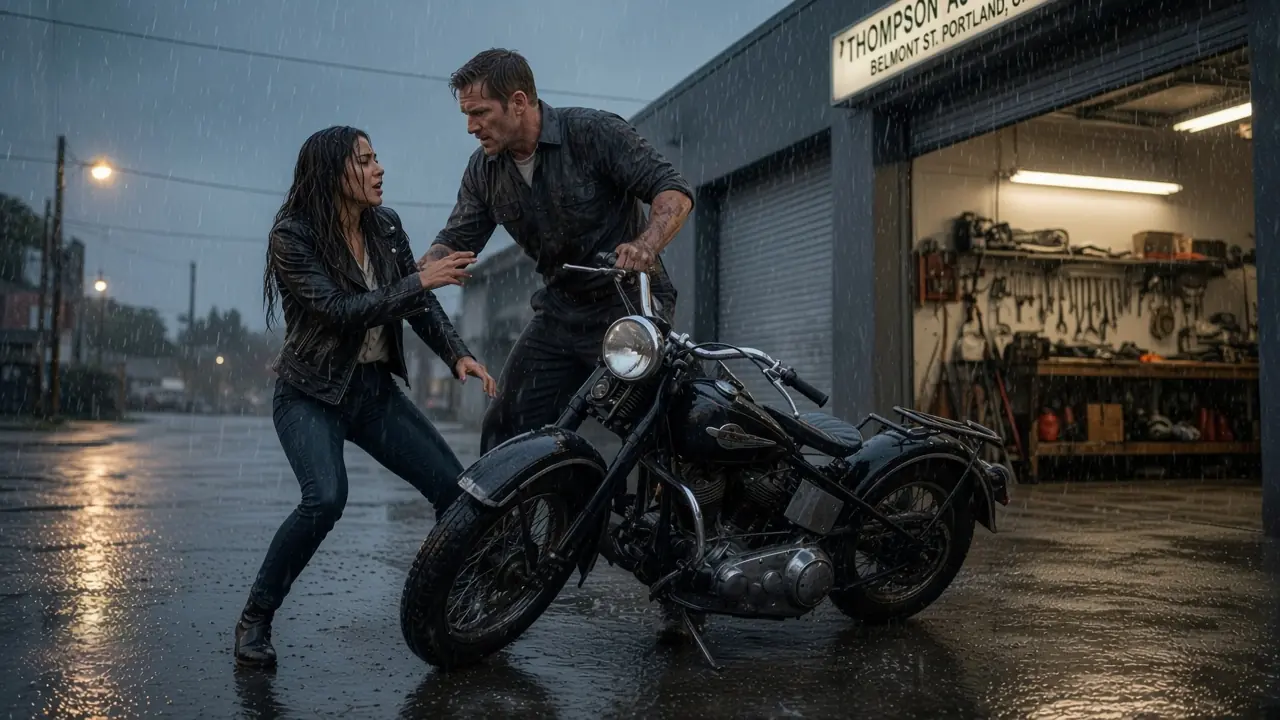
By late afternoon, it had settled into the steady gray rhythm the city seemed to know by heart, tapping against awnings, washing oil from the streets, and drumming softly on the tin roof of Bennett Auto & Cycle on Belmont Street.
Daniel Bennett was closing the second bay when he heard a motorcycle cough outside.
Once.
Twice.
Then silence.
He stopped with a shop rag in one hand.
Through the fogged front window, he could make out a woman standing beside a black Harley-Davidson.
She wore a leather riding jacket darkened by rain. Her long brown hair clung to her face and neck. One hand rested on the handlebar while the other hung uselessly at her side.
Daniel waited.
Most stranded riders immediately pulled out a phone.
She did not.
Most people cursed, kicked a tire, waved at traffic, or searched desperately for help.
She simply stood there in the rain.
There was something about her stillness that made Daniel put the rag down.
It was not calm.
It was the look of someone who had spent so long solving every problem alone that when one finally appeared she could not solve, she had forgotten what came next.
Daniel knew that feeling.
He walked outside.
“Bike quit on you?”
The woman turned.
She looked to be in her early thirties. Beautiful, though that was not what Daniel noticed first.
Her eyes looked exhausted.
Not physically exhausted.
The deeper kind.
The kind sleep did not fix.
“It died at the light,” she said. “I tried starting it again. Nothing.”
Daniel glanced at the Harley.
“Been sitting a lot?”
She hesitated.
“More than it should.”
“That’s usually bad news for machines.”
A trace of a smile appeared.
“I’m beginning to understand that.”
Daniel pushed the bike beneath the awning.
“Come inside before you freeze.”
“I don’t want to keep you.”
“You’re already wet and my floor is already dirty.”
That earned a real smile.
Small.
But real.
Neither of them knew it yet, but that broken motorcycle would become the first honest thing in both their lives in a very long time.
Daniel Bennett was thirty-six years old.
He owned Bennett Auto & Cycle, a narrow two-bay garage tucked between a coffee shop and an old bookstore.
It was not impressive.
The sign had been repainted twice.
The waiting area had three plastic chairs that did not match.
The coffee machine made coffee strong enough to remove paint.
But the floors were clean, the tools were organized, and Daniel had a reputation for telling customers when they did not need a repair.
That reputation had never made him rich.
It had made people trust him.
On one wall hung thank-you notes from customers.
Beside them was a faded photograph.
Daniel, ten years younger, standing beside a red 1969 Camaro.
His arm was around a blonde woman whose smile seemed to light everything around her.
Her name had been Rebecca.
Daniel's wife.
Rebecca died from breast cancer three years earlier.
She was thirty-one.
Their daughter, Sophie, had been five.
Daniel still remembered Rebecca’s last coherent conversation with him.
Hospital light.
Rain against the window.
Machines clicking quietly around them.
Rebecca squeezed his hand.
“Teach Sophie to be kind.”
Daniel nodded because speaking had become difficult.
Then Rebecca smiled weakly.
“And eventually, Danny…”
He leaned closer.
“Love yourself enough to live again.”
He promised.
Then spent the next three years breaking that promise.
Not intentionally.
He simply continued functioning.
Wake at six.
Make Sophie breakfast.
School.
Garage.
School pickup.
Homework in the office.
Dinner.
Laundry.
Bedtime stories.
Work after she slept.
Repeat.
He did not collapse.
People praised him for that.
They called him strong.
Daniel never felt strong.
He felt scheduled.
Sophie was eight now.
She had Rebecca’s blond-brown hair, Daniel’s hazel eyes, and the uncomfortable ability to notice things adults thought they had hidden.
One morning, while eating pancakes, she asked,
“Daddy, why don’t you laugh with your whole face anymore?”
Daniel nearly dropped his coffee.
“What?”
“When Mommy was here, your eyes laughed too.”
Children had cruel ways of finding wounds without intending to hurt them.
Daniel crouched beside her chair.
“I still laugh.”
“Not the same.”
He kissed her forehead.
“I’m working on it.”
Sophie nodded as if this were a mechanical repair she expected him to complete eventually.
“Okay.”
Daniel’s customers were delivery drivers, teachers, nurses, restaurant workers, students with cars held together by hope and discount parts.
He charged what the work was worth.
Sometimes less.
Mrs. Alvarez once brought him a fifteen-year-old Honda with a failing alternator and admitted she could not pay until the following Friday.
Daniel fixed it anyway.
“You need the car for work?”
“Yes.”
“Then pay me Friday.”
“What if you never see me again?”
Daniel smiled.
“Then I made one bad business decision.”
She paid him Friday.
With homemade tamales.
Sophie watched all of this.
Daniel made sure she did.
“Why did you fix her car if she didn’t have money?”
“Because she needed to get to work.”
“But what if she didn't pay?”
“Then we still did the right thing.”
Sophie considered that.
“So being nice is risky?”
“Sometimes.”
“Then why do it?”
Daniel looked at his daughter.
“Because being mean is easy.”
She seemed satisfied.
Daniel often wondered what Rebecca would think of the child they were raising without her.
Then he corrected himself.
The child he was raising.
Rebecca was gone.
That reality still arrived some days like new information.
The woman with the Harley sat near the workbench while Daniel inspected the bike.
“My name’s Daniel, by the way.”
“Claire.”
It came half a second too slowly.
Daniel noticed.
He did not challenge it.
“Claire what?”
Another hesitation.
“Morales.”
“All right, Claire Morales. Let’s see what you did to this poor motorcycle.”
“I did something?”
“You admitted it sits.”
“That counts?”
“That absolutely counts.”
He removed the side cover, checked fuel delivery, plugs, and the air intake.
Fifteen minutes later, he found the primary problem.
“Fuel system’s dirty. Nothing catastrophic.”
Claire stood.
“That’s all?”
“That’s enough.”
“How long?”
“An hour.”
“And how much?”
“Maybe sixty bucks if I don’t find anything else.”
Claire frowned.
“Sixty?”
“Yes.”
“That seems very low.”
Daniel looked at her.
“Compared to what?”
“San Francisco.”
“Portland apologizes for disappointing you.”
She smiled.
“I can pay more.”
“Why?”
“Because I want it done properly.”
Daniel stared at her for a moment.
Then pointed at the motorcycle.
“You determine whether I did good work by whether that starts when I’m done.”
He pointed toward her wallet.
“Not by how much money disappears from there.”
Claire went quiet.
It was such a simple sentence that Daniel forgot it almost immediately.
Claire did not.
In her world, price was often confused with value.
People spent more to prove they could.
Expensive dinners.
Expensive hotels.
Expensive watches.
Expensive friendships disguised as business relationships.
Daniel Bennett had just told her the work was worth sixty dollars because it was worth sixty dollars.
Nothing more.
No performance.
No manipulation.
No attempt to figure out how much money she had.
She had nearly forgotten people like that existed.
A small voice came from the office.
“Dad?”
Sophie appeared carrying half a sandwich.
Then noticed Claire.
“Oh.”
Daniel sighed.
“Sophie, this is Claire. Her motorcycle broke down.”
Sophie studied her.
“You’re really pretty.”
Daniel closed his eyes.
Claire laughed.
“Thank you.”
“I’m Sophie.”
“I’m Claire.”
“That’s my dad.”
“So I gathered.”
“He fixes everything.”
Daniel looked up sharply.
“Absolutely not everything.”
Sophie ignored him.
“He says machines tell you what’s wrong if you listen.”
Claire looked toward Daniel.
“He sounds wise.”
“He talks too much.”
“I see.”
Sophie approached the Harley.
“Is this yours?”
“Yes.”
“It’s cool.”
“Thank you.”
“Do you know how to fix it?”
“No.”
Sophie frowned.
“Why do you have it?”
Daniel nearly laughed.
Claire stared at the child.
That question had more weight than Sophie understood.
Claire had bought the Harley two years earlier as a birthday gift to herself.
She imagined long rides.
Freedom.
Empty highways.
Then parked it in a climate-controlled garage while work swallowed every available hour.
“I suppose,” Claire said slowly, “I bought it because I wanted to become the kind of person who rode motorcycles.”
Sophie nodded.
“Now you are.”
Claire looked at her.
“What?”
“You rode here.”
Daniel looked away because he suddenly felt something in his chest shift.
Children occasionally solved adult problems with insulting efficiency.
Claire Morales was not Claire Morales.
Her real name was Adriana Vega.
Thirty-two years old.
Founder and chief executive of Vega Systems, a cybersecurity and enterprise software company valued at several billion dollars.
Three months earlier, a business magazine had put her on its cover.
THE WOMAN REWRITING SILICON VALLEY
Adriana hated the photograph.
Her expression looked confident.
Untouchable.
Perfect.
Nothing like her.
She grew up outside Santa Fe, New Mexico.
Her mother cleaned offices.
Her father repaired boilers, appliances, plumbing, and anything else people would pay him to fix.
Money was tight.
Sometimes very tight.
Adriana learned early that poverty had a sound.
Bills being opened quietly.
Parents talking after children were supposed to be asleep.
The refrigerator door opening three times because somehow different food might appear.
She earned scholarships.
Worked through college.
Built the first version of what became Vega Systems while living on coffee, cheap noodles, and ambition.
Success came slowly.
Then suddenly.
Customers.
Investors.
Growth.
Headquarters.
Public recognition.
Money.
Adriana bought her parents a house.
Paid their debts.
Sent them traveling.
Everything she had once dreamed about became possible.
And somehow, somewhere inside all that success, Adriana disappeared.
Every conversation became strategic.
Every relationship carried an angle.
Three weeks earlier, she ended her engagement to Richard Caldwell.
Richard came from a wealthy investment family.
Smart.
Educated.
Polished.
At dinner one night, he spoke for ten minutes about how their marriage would strengthen several business relationships.
Adriana listened.
Then asked,
“What’s my favorite food?”
Richard laughed.
“Seriously?”
“Yes.”
“Sushi.”
She hated sushi.
“Favorite color?”
“Blue?”
Brown.
Earth brown.
The color of New Mexico after rain.
Adriana took off her engagement ring.
Richard stared at it.
“What are you doing?”
“You just described our marriage like a merger.”
“That’s not fair.”
“No.”
She stood.
“It’s accurate.”
Two days later, she told her executive assistant she needed time away.
“How long?”
“Two weeks.”
“Where?”
“I don’t know.”
“Should security go?”
“No.”
“Adriana—”
“Please.”
She took the Harley north.
No itinerary.
No private jet.
No chauffeured car.
No board.
No investor calls.
For several days, she became anonymous.
Then her motorcycle died in Portland.
And Daniel Bennett opened the door.
The rain did not stop.
By seven, Sophie announced that Claire was obviously staying for dinner.
“Sophie.”
“What?”
“You don’t invite people to dinner without asking me.”
Sophie turned to Claire.
“Do you want spaghetti?”
Daniel sighed.
Claire smiled.
“I would love spaghetti.”
“There. She said yes.”
Daniel pointed at his daughter.
“You are becoming dangerous.”
“I learned from you.”
Dinner happened in the small house behind the garage.
Pasta.
Jarred sauce.
Salad.
Garlic bread Daniel burned slightly.
Sophie talked almost continuously.
School.
A classmate named Emma.
A teacher who said octopuses had three hearts.
A dream about being a veterinarian.
Claire listened.
Actually listened.
No phone on the table.
No watch-checking.
No glances toward a door.
Daniel noticed.
Most adults tolerated children’s stories.
Claire seemed interested in them.
“What do you do?” Sophie asked.
Claire froze.
Daniel looked at her.
She reached for water.
“I work with computers.”
“Games?”
“Not exactly.”
“Robots?”
“No.”
“Can you make games?”
“Probably.”
“Then you should.”
Claire laughed.
“I’ll consider that.”
That night, the Harley started on the first attempt.
Claire handed Daniel sixty dollars.
Then stood beside the motorcycle longer than necessary.
“I’ll be in Portland a few days.”
Daniel nodded.
“Good city to get rained on.”
“Could I come back tomorrow?”
He looked at the motorcycle.
“Something wrong?”
“No.”
“Then why?”
Claire smiled awkwardly.
“Maybe you could teach me how not to destroy it.”
Daniel hesitated.
Then shrugged.
“Come after lunch.”
She returned the next day.
Then the day after.
Daniel showed her how to check tire pressure.
Chain tension.
Fluid levels.
Battery condition.
How to recognize a sound that meant stop riding immediately and one that meant get it checked sometime this week.
Claire asked dozens of questions.
She was intelligent.
Very intelligent.
She rarely needed something explained twice.
“You’ve never worked with tools?” Daniel asked.
“My father did.”
“Mechanic?”
“Handyman.”
“Same family of illness.”
“What illness?”
“Believing you can fix things other people throw away.”
Claire smiled.
“My father definitely has that.”
Sophie began waiting for her visits.
She drew pictures for Claire.
Claire brought her a book about animals.
They walked to the coffee shop next door.
Its owner, Rosa, had known Daniel and Rebecca for years.
Rosa watched Claire and Daniel talking near the counter one afternoon.
Then quietly told Claire,
“I haven’t seen him laugh like that in a long time.”
Claire felt her face grow hot.
“That’s not because of me.”
Rosa smiled.
“I’m old enough not to argue with people when they’re lying to themselves.”
A week passed.
Adriana postponed leaving.
She told herself she was resting.
Recovering.
Learning about motorcycles.
The truth was simpler.
She liked being Claire.
Claire ate spaghetti.
Claire sat on the garage floor with Sophie.
Claire got grease beneath her fingernails.
Claire drank bad coffee with Daniel.
Claire was not introduced at dinners.
Nobody asked for investment.
Nobody photographed her.
Nobody cared what her stock price was.
Daniel cared whether she tightened the drain plug too aggressively.
Sophie cared whether she remembered that her school presentation was Thursday.
It was the happiest Adriana had felt in years.
Which was exactly why the lie became heavier each day.
She almost told Daniel several times.
Once while they sat behind the garage.
Once after Sophie fell asleep against Claire’s shoulder during a movie.
Once after Daniel told her about Rebecca.
He did not tell the story dramatically.
He spoke quietly.
How they met.
How Rebecca laughed.
How cancer arrived.
How he still sometimes reached across the bed half-awake.
Claire listened.
Daniel looked at her.
“Sorry.”
“For what?”
“Dumping all that on you.”
“You didn’t.”
“I don’t talk about her much.”
“You should.”
“People get uncomfortable.”
“I’m not uncomfortable.”
He looked at Claire differently then.
That was the moment she should have told him.
My name is not Claire Morales.
I run a company worth billions.
I ended an engagement and ran away.
She almost did.
Then Sophie ran outside in pajamas yelling that there was a spider in her room.
The moment disappeared.
Adriana secretly felt relieved.
The truth arrived on a Friday.
Her phone had been off most of the week.
When she finally charged it, notifications exploded across the screen.
Her assistant, Hannah Kim, had called repeatedly.
On the fifteenth call, Adriana answered.
“Hannah.”
“Thank God.”
The voice came loudly through the phone before Adriana realized the speaker was on.
“Where are you? The board is losing its mind. Reporters are asking whether you’re sick. We have three client negotiations frozen because nobody knows when you’re coming back.”
Daniel looked up.
Sophie stopped coloring.
Adriana quickly disabled the speaker.
“I told you I was taking leave.”
“Yes, but not disappearing entirely. Adriana, the company needs—”
Adriana ended the call.
Silence.
Daniel stared at her.
“Adriana?”
She swallowed.
“My real name.”
His expression changed.
Not anger yet.
Confusion.
“What company?”
She sat down.
“Vega Systems.”
Daniel knew the name.
Everyone knew the name.
He had seen the building in articles.
He had seen her face before, now that context rearranged it.
The magazine cover.
The technology interviews.
He stepped backward.
“You’re Adriana Vega.”
“Yes.”
“The CEO.”
“Yes.”
Sophie looked delighted.
“You own a computer company?”
Adriana’s eyes remained on Daniel.
“Yes.”
Daniel’s face went still.
“How long were you planning to tell us?”
“I was going to.”
“When?”
“I don’t know.”
“Tomorrow?”
“I…”
“Next week?”
“Daniel.”
His voice remained low.
That hurt more than shouting.
“You gave me a fake name.”
“Yes.”
“You sat in my house.”
“I know.”
“My daughter got attached to you.”
“I know.”
“And you never thought maybe we deserved to know who was actually sitting there?”
Adriana stood.
“I didn’t lie about how I felt.”
“You lied about who you were.”
“Because everyone treats me differently when they know.”
Daniel laughed once without humor.
“So you wanted to experiment with being ordinary?”
“No.”
“What was this then?”
“A place where nobody wanted anything from me.”
Daniel flinched.
Immediately, Adriana knew she had chosen the wrong words.
He looked around his garage.
“You think we wanted nothing because we have nothing?”
“That’s not what I meant.”
“It sounded pretty close.”
“Daniel, please.”
Sophie looked between them.
“Daddy?”
Daniel closed his eyes.
“Sophie, go inside for a minute.”
“Are you mad at Claire?”
Adriana nearly broke at the name.
Daniel softened slightly.
“Go inside, sweetheart.”
Sophie left reluctantly.
Adriana stepped closer.
“What happened here was real.”
Daniel shook his head.
“I don’t know which part.”
“All of it.”
“You didn't trust me enough to tell me your name.”
“I was scared.”
“Of what?”
“That once you knew, you’d look at me the way everyone does.”
“And instead you decided for me.”
That silenced her.
“You decided I couldn’t handle the truth,” Daniel continued. “You didn’t give me the choice.”
Adriana’s eyes filled.
“I’m sorry.”
Daniel looked away.
“I need time.”
She nodded.
“Okay.”
“And Sophie needs stability.”
“I would never hurt her.”
“You already did.”
That landed.
Adriana picked up her jacket.
At the doorway she stopped.
“If I weren’t Adriana Vega…”
Daniel looked at her.
“If I were really just Claire, would this be different?”
Daniel’s expression softened with sadness.
“But you aren’t.”
She nodded.
Then left.
Adriana returned to San Francisco.
Her office looked exactly the same.
Glass.
Steel.
The bay beyond the windows.
People moved quickly around her.
Meetings resumed.
Contracts resumed.
Her absence became another managed corporate event.
But something inside her no longer fit.
She found herself remembering ridiculous details.
Sophie putting too much peanut butter on bread.
Daniel pushing his hair back with a greasy wrist.
The terrible coffee.
Rain on the garage roof.
The smell of engine oil and garlic bread.
One night, Hannah found her sitting alone after everyone left.
“You miss Portland.”
Adriana looked up.
“How do you know?”
“You’ve had the Portland weather open on your computer for twenty minutes.”
Adriana closed the window.
“I hurt them.”
“Then apologize.”
“I did.”
“No.”
Hannah sat opposite her.
“You said sorry because you were caught. That’s not the same thing as showing someone you understand why they were hurt.”
Adriana stared at her.
“Whose side are you on?”
“Yours.”
“Doesn’t sound like it.”
“It should.”
Two weeks later, Daniel was picking up Sophie from school when a car ran a red light near the crosswalk.
The vehicle never touched Sophie.
But she jumped backward, lost her balance, and struck her head hard against the curb.
Daniel heard the call while working.
Everything after that happened in fragments.
Hospital.
CT scan.
Doctors.
Concussion.
A small intracranial bleed that needed close monitoring.
Possibility of surgery if pressure increased.
Sophie was unconscious but stable.
Daniel sat beside her bed.
He did not move for hours.
Rebecca had died in a hospital.
The sounds brought everything back.
Monitors.
Rubber-soled shoes.
Curtains.
Clinical light.
He found himself whispering,
“Please don’t take her too.”
Rosa visited that night.
Daniel barely registered her.
The next morning, she stepped outside and made a phone call.
Adriana was halfway through a meeting when Hannah entered without knocking.
“Portland.”
Adriana stood immediately.
“What?”
“It’s Sophie.”
Within two hours, she was on a flight north.
When she entered the hospital room, Daniel looked up.
He had not shaved.
His face looked ten years older.
Adriana stopped several feet away.
“Rosa called me.”
Daniel said nothing.
“How is she?”
“Stable.”
His voice sounded empty.
“They’re watching the bleeding. If it increases, they may operate.”
Adriana moved closer.
“Can I sit?”
Daniel nodded.
For several minutes, neither spoke.
Adriana reached carefully toward Sophie’s hand.
Then stopped.
Daniel noticed.
“You can hold it.”
Adriana took the little girl’s hand.
It felt terribly small.
“I’m sorry,” she whispered.
Daniel looked at her.
“For what?”
“For not telling you the truth. For making the decision for you.”
He stayed quiet.
“I understand now,” she continued. “I thought I was protecting something real by hiding the part of me I thought would ruin it.”
Tears filled her eyes.
“But hiding it was what made it unreal.”
Daniel stared at Sophie.
“You came all this way to say that?”
“No.”
Adriana looked at him.
“I came because she’s here.”
Daniel’s mouth tightened.
“And because you’re here.”
The next three days changed something between them.
Not suddenly.
Not magically.
Adriana did not fix the hospital.
She did not make demands.
She did not attempt to buy Daniel’s forgiveness.
She simply stayed.
She slept badly in a chair.
Brought Daniel food.
Made him eat it.
Read Sophie stories.
Called Hannah from hallways and delegated work.
When Daniel panicked after a doctor ordered another scan, Adriana sat beside him.
When the scan showed the bleeding had stabilized, Daniel cried with relief.
Adriana did not tell him everything would be fine.
She only held his hand.
On the third morning, Sophie opened her eyes.
Her voice was weak.
“Daddy?”
Daniel stood so quickly the chair nearly fell backward.
“I’m here.”
Sophie blinked.
Then saw Adriana.
Her eyes widened.
“You came back.”
Adriana covered her mouth.
“Yes.”
Sophie looked between them.
“Are you still mad?”
Daniel laughed through tears.
“This child wakes up from a brain injury and immediately starts managing adults.”
Sophie frowned.
“That means yes.”
Adriana leaned closer.
“I made a mistake.”
Sophie considered that.
“Daddy makes mistakes.”
“Thank you,” Daniel said.
“He burned pancakes yesterday.”
“I did not make pancakes yesterday.”
“Before.”
Adriana began laughing and crying at the same time.
Daniel looked at her.
Something inside him loosened.
Not forgiveness completely.
Not yet.
But the beginning.
Sophie recovered slowly.
There was no dramatic miracle.
Doctors monitored her carefully.
She needed follow-up appointments.
Rest.
Temporary restrictions from sports and bicycle riding.
The road back was boring and frustrating, which everyone eventually learned was a blessing.
Adriana stayed in Portland longer than planned.
This time, she did not pretend to be anyone else.
She rented an apartment.
Took calls from the garage office.
Daniel occasionally overheard her discussing contracts worth more than his building.
Then she would hang up and ask,
“Is this the twelve-millimeter socket?”
“Nine.”
“They look the same.”
“They absolutely do not.”
“They’re three millimeters apart.”
“That sentence is why you are not touching customer vehicles unsupervised.”
Sophie laughed.
Trust returned slowly.
Daniel asked questions.
Adriana answered.
No fake name.
No disappearing.
No pretending money did not exist.
No pretending their lives were the same.
Because they were not.
Adriana’s company mattered.
Daniel’s garage mattered.
Sophie mattered.
So did Rebecca’s memory.
Love would not work by erasing any of those truths.
One evening, Daniel finally asked,
“What happens when you go back?”
Adriana sat beside him behind the garage.
“I don’t know.”
“That’s not comforting.”
“It’s honest.”
He nodded.
She continued.
“I’ve spent years believing that if I stopped controlling everything, everything would collapse.”
“And?”
“It didn’t.”
“Your board might disagree.”
“They usually do.”
Daniel smiled.
Adriana looked toward the house.
“I don’t want to abandon my company. People depend on it.”
“I wouldn’t ask you to.”
“I know.”
“And I don’t want you abandoning yourself because you think we need some version of you that doesn’t exist.”
Adriana looked at him.
“That sounds suspiciously wise for a mechanic.”
“I charge sixty dollars for wisdom.”
She laughed.
Then Daniel became serious.
“I was wrong about something too.”
“What?”
“I made your money the problem because it scared me.”
Adriana waited.
“I’ve spent my whole adult life believing people like you lived in another universe.”
“Sometimes it feels like we do.”
“I thought if I let Sophie love you, and you left, I’d be responsible.”
Adriana looked down.
“And because I already lost Rebecca…”
“You didn’t want another person you loved to become temporary.”
He nodded.
“That wasn’t fair to you.”
“No.”
She looked at him.
“But I understand it.”
Daniel reached for her hand.
This time neither pulled away.
Months passed.
Adriana restructured her role.
She remained executive chair but handed more operational control to people she trusted.
She divided time between Portland and San Francisco.
Some weeks were messy.
Flights were delayed.
Daniel got irritated when meetings interrupted dinner.
Adriana got irritated when Daniel treated exhaustion like a personality trait.
Sophie exploited both of them.
It felt imperfect.
Which was exactly why Adriana trusted it.
One Saturday morning, Sophie found Daniel beneath a truck and Adriana checking tire pressure on the Harley.
She leaned toward Rosa and whispered,
“Adriana is getting good.”
Rosa nodded solemnly.
“Dangerous.”
“She changed her own oil.”
“Then Portland has officially lost control.”
Sophie ran toward Daniel.
“Daddy.”
“Yes?”
“Do you love Adriana?”
Daniel hit his head lightly on the underside of the truck.
“Ow.”
“That’s not an answer.”
He rolled out.
“Sophie.”
“What?”
“Why are you asking?”
“Because you smile with your eyes now.”
Daniel went still.
Three years earlier, she had asked why he did not.
Now she had noticed the opposite.
He sat up.
“Would it bother you?”
“If you loved her?”
“Yes.”
Sophie thought.
“Would loving Adriana make you stop loving Mommy?”
“No.”
“Then why would it bother me?”
Daniel could not answer.
Sophie hugged him.
“Mommy told you to live again.”
He stared at her.
“How do you know that?”
“You told Grandma once.”
Of course.
Children heard everything adults whispered.
Sophie released him.
“I think Mommy would like her.”
Daniel swallowed.
“So do I.”
That evening, Daniel and Adriana sat outside under a string of old patio lights.
The city was unusually clear.
Adriana rested her head against his shoulder.
“I used to think peace was something you bought after success.”
Daniel took a drink.
“What did you buy?”
“Houses. Trips. A motorcycle.”
“The motorcycle worked.”
“Eventually.”
“You nearly killed it.”
“You have mentioned that enough.”
“Incorrect.”
She smiled.
Then grew serious.
“I don’t want to run away from San Francisco anymore.”
“Good.”
“I also don’t want to run away from this.”
Daniel turned toward her.
“What is this?”
Adriana took his hand.
“You.”
He did not speak.
“Sophie. The garage. Dinner when you burn something and pretend you meant to.”
“I do not—”
“Daniel.”
“Fine.”
“This is the first life I’ve had where people know me instead of knowing what I can do for them.”
Daniel squeezed her hand.
“I know what you can do for me.”
Adriana raised an eyebrow.
“What?”
“Replace the coffee maker.”
She laughed.
Then Daniel leaned toward her.
The kiss was quiet.
Unhurried.
Nothing dramatic.
No sweeping music.
Just two people who had both been afraid of loss deciding fear would no longer make every decision for them.
They did not marry six months later.
They waited.
That mattered.
Daniel needed time.
Sophie needed stability.
Adriana needed to prove to herself that she was not simply replacing one extreme life with another.
Two years later, Bennett Auto & Cycle had expanded into the neighboring storefront.
Adriana invested nothing in it.
Daniel insisted.
She respected that.
Instead, she helped him modernize scheduling software and laughed when he complained that computers were ruining civilization.
Sophie was ten.
She had resumed riding her bicycle.
Always with a helmet.
She wanted to become either a veterinarian, engineer, astronaut, or motorcycle mechanic depending on the day.
Daniel told her she had time.
Adriana’s Harley still occupied the same corner of the garage whenever she was in Portland.
Daniel maintained it.
Adriana claimed she maintained it.
This disagreement became permanent.
They married in the backyard behind the garage.
Small ceremony.
Family.
Friends.
Customers.
Rosa made the cake.
Sophie stood beside them holding flowers.
Before the ceremony, Daniel went alone into the garage.
Rebecca’s photograph still hung on the wall.
He touched the frame.
For years, he had felt guilty whenever happiness returned.
As if surviving were betrayal.
As if loving again meant Rebecca had mattered less.
He finally understood something.
Grief was not a room with one door.
He did not have to leave Rebecca behind to walk forward.
He could carry what she had given him.
The kindness.
The patience.
Sophie.
The years they had shared.
Then build something new beside it.
Daniel looked at the photograph.
“You were right.”
He smiled.
“I finally remembered.”
Then he walked outside.
Adriana stood beneath the lights.
Sophie beside her.
The woman who once arrived in the rain pretending to be someone else was now standing in front of him with nothing hidden.
No disguise.
No ordinary version.
No billionaire version.
Just Adriana.
Daniel took her hand.
During their vows, Adriana said something she had been thinking about since the afternoon her Harley died.
“When I met Daniel, I thought I was running away from my life.”
She looked at him.
“I wasn’t.”
“I was trying to find my way back to it.”
Daniel’s eyes filled.
Adriana continued.
“I spent years believing success meant becoming important enough that nobody could overlook me.”
She glanced toward Sophie.
“Then two people in a little garage treated me like I mattered before they knew anything about me.”
She smiled.
“That changed my definition of everything.”
Daniel squeezed her hands.
When it was his turn, he did not give a long speech.
He never liked speeches.
“I lost somebody I thought I would grow old with,” he said.
“And for a long time, I confused surviving with living.”
He looked at Adriana.
“You never replaced what I lost.”
Her eyes filled.
“You reminded me there could still be something ahead.”
Sophie started crying.
Rosa started crying because Sophie was crying.
Daniel laughed.
Then he kissed his wife.
Inside the garage sat three machines.
Daniel’s old pickup.
Adriana’s black Harley.
Sophie’s bicycle.
Nothing about them matched.
Different sizes.
Different purposes.
Different stories.
But every one of them belonged there.
So did the people.
Years later, whenever customers asked Daniel how he met his wife, he never mentioned magazines.
Or company valuations.
Or private jets.
He told them the truth.
“Her motorcycle broke down in the rain.”
Sometimes they laughed.
“That’s it?”
Daniel would glance toward Adriana, usually somewhere nearby correcting his computer system or arguing with Sophie.
Then he would smile with his whole face.
“No.”
“That was just the door.”