Yvonne Sinclair walked into Whittaker Tower at exactly 8:57 in the morning, carrying a black leather portfolio under one arm and wearing a navy suit so simple that most people in the lobby did not understand how expensive it was.
The lobby was built to impress people who already believed they were important. White marble stretched across the floor, glass walls rose four stories high, and a massive company emblem hung above the reception desk like a monument to power. Employees hurried past with coffee cups, phones, and nervous faces because everyone knew the company was hosting a major signing ceremony that morning. What none of them knew was that the woman walking quietly through the lobby was the only reason the ceremony existed at all.
Yvonne was forty-one years old, founder and chief executive of Sinclair Holdings, a private investment firm managing more than fourteen billion dollars in assets.
For ninety-one days, Hayden Whittaker had been trying to secure a two-billion-dollar capital rescue from her firm. His aerospace company was bleeding cash after failed contracts, supply chain delays, and debt problems that his board had spent months pretending were temporary. The money from Sinclair Holdings would stabilize the company, protect thousands of jobs, and keep Whittaker Industries from collapsing before summer. It was not simply a deal.
It was survival.
Hayden knew the name Sinclair Holdings.
He knew the amount.
He knew the deadline.
But he had never bothered to learn Yvonne Sinclair’s face.
That mistake began at the security desk.
The first guard looked up when she approached and immediately scanned her from head to toe. His eyes moved over her dark skin, her quiet suit, her plain portfolio, and the absence of an assistant walking beside her. His expression changed in that small familiar way Yvonne had seen too many times in too many expensive buildings. Before she even spoke, he had already placed her somewhere below the floor she intended to reach.
“Can I help you?” he asked.
“I’m here for the nine o’clock meeting with Mr. Whittaker,” Yvonne said calmly. “Sinclair Holdings.”
The guard frowned.
“Are you with catering?”
Yvonne looked at him for a long second.
“No.”
“Cleaning staff usually uses the service entrance.”
“I’m not cleaning staff.”
He stared at her, then slowly picked up the phone with the reluctance of a man doing someone else a favor.
Yvonne did not correct his tone.
She did not argue.
She had learned early that people who judged her quickly often revealed far more when she allowed them to keep talking. That was useful in business, useful in negotiations, and useful in life. So she stood quietly while he called upstairs, muttered into the receiver, and finally nodded toward the elevator.
“Forty-fourth floor,” he said.
No apology.
No smile.
No recognition of what he had assumed.
Yvonne walked past him without another word.
Inside the elevator, mirrored walls reflected her from three sides. She looked composed, but her right hand tightened slightly around the portfolio handle. It was not anger exactly. It was the familiar exhaustion of entering a building where the marble, the money, and the suits were always assumed to belong to someone else first.
The elevator chimed upward.
Twenty.
Thirty.
Forty.
Forty-four.
Through the glass doors ahead, she could see the boardroom lobby full of senior executives, board members, attorneys, advisors, and invited guests. Men in tailored suits stood in clusters, speaking in low confident voices. A table along the wall held untouched champagne flutes, silver coffee urns, and trays of expensive pastries no one was relaxed enough to eat. At the center of the room stood Hayden Whittaker.
He was sixty-three, silver-haired, broad-shouldered, and wealthy in a way that seemed to have settled into his bones.
His company bore his name, though his grandfather had built it and his father had expanded it. Hayden had inherited both the empire and the belief that he was entitled to keep it. For years, the world had rewarded his confidence even when it should have questioned his judgment. Beside him stood his wife, Caroline, blonde, elegant, holding a glass of sparkling water and laughing at something he had just said.
The glass doors opened.
Yvonne walked in.
The room did not fall silent all at once.
It shifted.
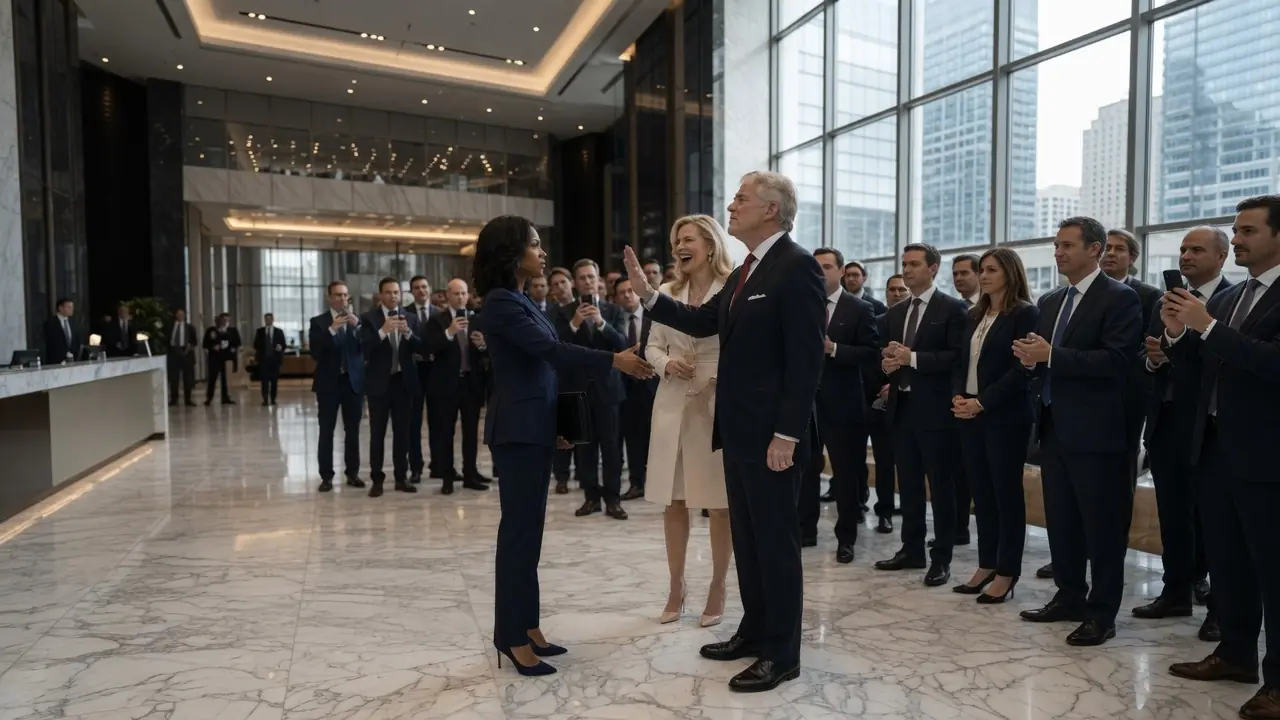
Faces turned slowly. A few smiles tightened. Several people looked past her, expecting someone else to enter behind her. She crossed the marble floor with her hand already extended because that was how business began, with a greeting, with a gesture of respect, with the smallest proof that both parties understood the room.
“Mr. Whittaker,” she said. “Yvonne Sinclair. It’s a pleasure to—”
Hayden cut her off before her sentence finished.
Hayden Whittaker (cold, dismissive, looking her up and down with contempt): “Sweetheart, I don’t know who let you past reception, but this is a closed executive meeting—leave.”
For a second, no one moved.
Yvonne’s hand remained in the air.
Not because she was stunned.
Because she wanted everyone to see the refusal clearly.
Caroline Whittaker gave a soft laugh, the kind meant to turn cruelty into entertainment.
Caroline Whittaker (amused, lifting her glass as she smiles at the room): “Maybe she’s here for catering, Hayden. She looks terribly lost.”
A few people smiled nervously.
Most looked away.
That was what Yvonne noticed first, not the insult itself, but the silence that followed it. Forty board members, advisors, lawyers, and executives stood close enough to hear every word, and not one of them stepped forward. They had all gathered to receive money from her firm, but they allowed Hayden to treat her like an intruder because none of them knew who she was either.
Yvonne slowly withdrew her hand.
Her face remained calm.
She placed the leather portfolio on the nearest table and opened it with steady fingers.
Yvonne Sinclair (calm, unshaken, placing the leather portfolio on the table): “Mr. Whittaker, I’m here regarding your two-billion-dollar funding request.”
Hayden’s expression changed slightly.
Only slightly.
Confusion crossed his face before arrogance pushed it aside.
He looked at the folder, then at Yvonne, then at the room around him as though expecting someone to explain the joke.
Hayden Whittaker (mocking, ignoring the folder as he folds his arms): “We don’t do business with strangers who walk in off the street.”
Yvonne looked directly at him.
Yvonne Sinclair (controlled, holding his stare as the room quiets): “No, Mr. Whittaker. You’ve been doing business with my firm for ninety-one days.”
The laughter died first.
Then the smiles.
One of the lawyers near the window leaned forward, his eyes suddenly sharp. Another board member whispered something to the man beside him. Caroline’s glass stopped halfway to her lips. Hayden’s face did not go pale yet, but the confidence in it cracked.
“Sinclair Holdings?” he said.
Yvonne turned the first page of the folder toward him.
At the top was the term sheet.
At the bottom was her signature.
Yvonne Sinclair.
Founder and CEO.
The room seemed to shrink around him.
Hayden looked at the page.
Then back at her.
“No,” he said, too quietly for a man who had been loud moments earlier.
Yvonne closed the folder.
The sound was soft.
Final.
Yvonne Sinclair (cold, final, lowering her voice so every board member listens): “Yes. And the woman you just refused to shake hands with decides whether your company survives the next quarter.”
The silence that followed was no longer awkward.
It was catastrophic.
Someone near the back exhaled sharply.
Caroline lowered her glass completely.
Hayden’s mouth opened, but nothing came out right away. For the first time since Yvonne entered, he saw her not as a stranger, not as staff, not as someone beneath the room, but as the person holding the one thing he needed most. The realization moved across his face slowly because men like Hayden Whittaker did not often confront the full cost of their own contempt in public.
Then survival instinct arrived.
“Ms. Sinclair,” he said quickly, adjusting his jacket. “There seems to have been a misunderstanding.”
Yvonne’s expression did not move.
“A misunderstanding?” she repeated.
“Yes,” Hayden said, forcing a thin smile. “Reception has been chaotic this morning. We were expecting your managing director, Mr. Holloway. I wasn’t aware you would be attending personally.”
“You were not aware because you never asked.”
Hayden’s smile tightened.
“Well, that is hardly—”
“You read the term sheet?”
“Of course.”
“You reviewed the capital structure?”
“Yes.”
“You signed the preliminary acknowledgment?”
He hesitated.
“Yes.”
“My name appears on every page.”
The sentence landed with quiet precision.
Hayden looked down.
He knew she was right.
Yvonne did not raise her voice.
She did not need to.
“You were willing to accept my money without learning whose hand you would need to shake.”
A board member near the table shifted uncomfortably.
The company’s general counsel, Martin Voss, stepped forward slightly.
“Ms. Sinclair,” he said carefully, “perhaps we can move into the boardroom and reset the conversation.”
Yvonne turned her eyes toward him.
“Did you hear what he said to me?”
Martin froze.
“I heard there was confusion.”
“That was not my question.”
His face tightened.
Yvonne continued.
“Did you hear what he said to me?”
Martin swallowed.
“Yes.”
“And did you say anything?”
No answer.
That silence was answer enough.
Yvonne looked around the room slowly, letting her gaze pass over every face that had looked away.
“Your company asked Sinclair Holdings for two billion dollars because you claimed Whittaker Industries still had strong leadership, strong governance, and strong values. I came here today to meet that leadership before signing. Instead, I walked into a lobby where security assumed I belonged to the cleaning crew. Then I came upstairs and watched your chairman insult me in front of the board.”
Hayden’s face reddened.
“Now, let’s not turn this into something it isn’t.”
Yvonne looked back at him.
“What is it, then?”
He gestured sharply, losing patience.
“A mistake. A poor choice of words.”
“No,” she said. “A poor choice of words is calling a Tuesday meeting a Wednesday meeting. What happened here was judgment. It was instinct. It was culture.”
Caroline stepped forward, her smile brittle.
“Ms. Sinclair, surely one tense moment shouldn’t affect a deal of this magnitude.”
Yvonne turned to her.
“One tense moment did not create your husband’s reaction. It revealed it.”
Caroline’s expression hardened.
The room felt colder now.
Hayden attempted to recover again, this time with forced charm.
“Let us apologize properly,” he said. “I spoke too quickly. You caught me off guard.”
Yvonne tilted her head slightly.
“I caught you off guard by being the investor?”
“You arrived unexpectedly.”
“I arrived at the scheduled time.”
“You arrived without your team.”
“I am the team that matters today.”
That sentence rippled through the room.
A man near the back lowered his phone.
Yvonne saw it.
She said nothing about it.
Hayden did.
“Put that away,” he snapped.
The man did immediately.
Yvonne’s eyes narrowed slightly.
“So your instinct is to stop the recording, not address the behavior.”
Hayden’s jaw tightened.
“Ms. Sinclair, with respect—”
“Do not use that word.”
He stopped.
“Respect is what you refused to offer when you thought I had no power.”
No one spoke.
Yvonne took one step closer to the table.
“My grandmother cleaned offices in Atlanta for twenty-six years,” she said. “She wore simple shoes. She carried lunch in a paper bag. Men in suits walked past her every day without seeing her. She used to tell me that people reveal their character by how they speak when they think no one important is listening.”
Her voice stayed steady.
“But you were worse than that, Mr. Whittaker. You thought someone important was listening. You simply decided I could not be that person.”
Hayden’s face drained now.
The board understood the danger before he did.
The issue was no longer merely personal.
It was judgment.
Governance.
Risk.
Character.
The same qualities investors weighed before trusting billions of dollars to a collapsing company.
Martin Voss stepped forward again.
“Ms. Sinclair, may I suggest we adjourn briefly and reconvene after tempers—”
“My temper is not the problem,” Yvonne said.
Martin stopped.
She opened her portfolio again and removed a single page.
It was the funding commitment letter.
Unsigned.
The room watched her hand.
Hayden watched too.
For the first time, real fear entered his expression.
“Ms. Sinclair,” he said quietly. “That letter is the difference between layoffs and stability.”
“I know.”
“Between default and recovery.”
“I know.”
“Between this company surviving and becoming an asset sale.”
“I know.”
His voice lowered.
“Then don’t punish thousands of employees because of one man’s mistake.”
Yvonne looked at him for a long moment.
“That is the first intelligent thing you have said today.”
Hope flickered across his face.
Then she continued.
“But if one man’s mistake reveals a board willing to stay silent, a security team trained to assume, and a leadership culture built on arrogance, then funding that culture becomes irresponsible.”
Hayden stared at her.
“You can’t be serious.”
Yvonne folded the commitment letter once.
Then twice.
She placed it back inside the portfolio without signing.
Yvonne Sinclair (cold, final, closing the leather portfolio in front of everyone): “I am withdrawing Sinclair Holdings from the two-billion-dollar investment, effective immediately.”
The room erupted.
Not loudly at first.
A gasp.
Then whispers.
Then voices overlapping.
Hayden stepped forward.
“You cannot do that.”
Yvonne looked at him.
“I just did.”
“We have preliminary agreements.”
“Non-binding.”
“Our teams spent months on this.”
“And you spent one minute destroying it.”
Caroline’s hand flew to her husband’s arm.
“Hayden,” she whispered, panic rising in her voice.
But Hayden pulled away.
He was no longer performing strength.
He was losing control in front of the very people who had spent years pretending he was untouchable.
“You’re going to tank a company over your feelings?”
Yvonne’s eyes sharpened.
“No. I’m refusing to rescue a company whose chairman cannot recognize the person keeping him afloat.”
One of the board members, an older man named Gerald Price, finally spoke.
“Hayden, stop.”
Hayden turned on him.
“Stay out of this.”
Gerald’s face hardened.
“No. You have done enough.”
That was the second shift in the room.
The first had happened when they realized who Yvonne was.
The second happened when the board realized Hayden was still making it worse.
Gerald turned toward Yvonne.
“Ms. Sinclair, on behalf of the board, I sincerely apologize for Mr. Whittaker’s conduct.”
Yvonne looked at him.
“You had time to apologize before the money left the table.”
Gerald lowered his eyes.
“Yes,” he said. “We did.”
That honesty mattered.
Not enough to save the deal.
But enough to separate him from the silence that had filled the room moments earlier.
Hayden laughed bitterly.
“Oh, now everyone grows a spine.”
Yvonne picked up her portfolio.
“You should listen to them, Mr. Whittaker. They are trying to save what you just endangered.”
He stepped closer, desperate now.
“Tell me what you want.”
Yvonne paused.
The question revealed him fully.
He believed every moral line was a negotiation if the number was high enough.
She turned back slowly.
“What I wanted was a handshake.”
No one breathed.
“I wanted to meet the chairman of a company that employed thousands of people and decide whether his leadership deserved rescue capital. I wanted to believe the reports were wrong, that the company’s financial wounds came from bad contracts and market timing rather than failed judgment at the top.”
Her voice lowered.
“Instead, you gave me the truth faster than due diligence ever could.”
Hayden’s anger collapsed into something smaller.
“Please,” he said.
That word was almost more shocking than the insult had been.
Yvonne studied him.
“You are not sorry you insulted me. You are sorry I mattered.”
Hayden said nothing.
Because for once, there was no lie strong enough to stand between them.
Yvonne turned toward the board.
“Sinclair Holdings will issue formal notice within the hour. We will not pursue the current investment structure. However, I will not sabotage the employees of Whittaker Industries. If the board removes Mr. Whittaker from operational control and submits revised governance terms within ten business days, we may consider participating in a restructuring package under new leadership.”
Gerald Price looked up quickly.
Hayden’s face twisted.
“You can’t demand that.”
Yvonne looked at him.
“I’m not demanding. I’m explaining the price of restored confidence.”
Caroline’s hand trembled around her glass.
The board members exchanged glances that said what no one wanted to say aloud.
The company might survive.
But not with Hayden.
He saw it happen.
He saw loyalty become calculation.
He saw men who had laughed at his jokes for years suddenly measure him as a liability.
That was the moment he truly understood what the handshake had cost.
Not the two billion.
Not only that.
It had cost him the myth of himself.
Yvonne walked toward the exit.
This time, no one blocked her.
At the glass doors, she stopped.
Without turning fully around, she spoke one final time.
“Mr. Whittaker.”
He looked at her.
She held the room without raising her voice.
“The next time someone offers you their hand, remember that dignity is not something you grant from above. It is something you lose when you refuse to see it in others.”
Then she left.
The elevator doors closed behind her.
Inside the boardroom lobby, no one moved for several seconds.
Then the whispers began again, lower now, sharper.
Hayden stood alone in the middle of the room he had controlled for decades.
His wife stared at him as if seeing him clearly for the first time.
The champagne remained untouched.
The signing pens remained unused.
The commitment letter remained unsigned.
Ninety seconds earlier, Hayden Whittaker had refused to shake Yvonne Sinclair’s hand.
Now his board was already discussing how to remove his.
By noon, the news began to leak.
By three o’clock, Whittaker Industries stock had plunged.
By six, an emergency board session was scheduled.
By morning, Hayden Whittaker had agreed to step down as chairman pending restructuring negotiations.
Sinclair Holdings did not return immediately.
Yvonne was too careful for that.
She reviewed governance changes, leadership replacements, employee protections, debt covenants, and the board’s revised oversight plan. She made them earn every inch of consideration. And when Sinclair finally returned to the table weeks later, it was under different terms, with a different chairman, and with Hayden Whittaker nowhere near the negotiations.
The company survived.
Barely.
Thousands of employees kept their jobs.
But the story traveled faster than the restructuring announcement.
People talked about the billionaire who refused a handshake and lost control of his company before lunch. They talked about the woman in the navy suit who did not shout, did not beg, and did not need to prove she belonged because the money, the documents, and the room eventually proved it for her. They talked about how arrogance can ruin what spreadsheets cannot measure.
Yvonne rarely spoke about that morning afterward.
When asked in interviews why she withdrew the investment, she answered the same way every time.
“Capital follows trust. Trust follows character.”
Then she moved on.
But privately, she remembered every detail.
The marble floor.
The extended hand.
The laughter.
The silence.
And the moment Hayden Whittaker realized that the woman he dismissed as powerless had been holding his future the entire time.