The first thing Rowan Mercer noticed was the silence.
Not the silence of the river, because the river was never truly silent. Water moved softly against the wooden dock, birds called from the trees, and a boat engine hummed somewhere far beyond the bend. It was the kind of silence that lived inside a person after too many bad phone calls, too many hospital bills, and too many nights pretending to be strong for a child who deserved more than fear. Rowan sat at the edge of the dock with his grease-stained hands hanging between his knees, staring at the water like it might give him an answer.
He had just left the hospital.
His daughter, Isla, was sleeping when he walked out, pale and small beneath a thin blanket, one hand resting beside a plastic bracelet that had become too familiar for a seven-year-old girl. The doctors had spoken gently, which Rowan hated more than bluntness. Gentle words usually meant the news was expensive, uncertain, or both. Isla needed another round of specialized treatment, and insurance had already decided to cover less than anyone with a conscience should allow.
Rowan had nodded when the doctor explained everything.
He had asked the right questions.
He had written down the medication names, the treatment schedule, the estimated cost, and the phrase “possible clinical program review.” He had thanked the nurse, kissed Isla’s forehead, and promised he would be back before she woke up. Then he drove without thinking until he found himself at the river, sitting beside the water with the weight of the world pressing against his chest.
Rowan was thirty-seven years old, a mechanic, a widower, and a father who had learned to survive by narrowing life down to one responsibility.
Keep Isla alive.
That was the rule.
Everything else came second.
His wife, Claire, had died shortly after Isla’s birth from complications no one saw coming fast enough. One week, Rowan was painting a nursery and laughing about baby names. The next, he was holding a newborn daughter while signing paperwork no husband should ever have to sign. People told him he was strong, but strength had never felt like a compliment to him. It felt like something life demanded when it had already taken away every easier option.
For seven years, he worked as much as his body would allow.
He repaired engines at a local shop during the day, picked up roadside calls at night, and took weekend jobs fixing boats, generators, and old trucks no one else wanted to touch. He came home smelling like oil and metal, washed his hands until the cracks burned, and made pancakes shaped like animals because Isla laughed when the ears came out uneven. He never told her how often rent was late. He never told her how many bills stayed unopened in the drawer until he had the courage to look.
That afternoon, courage felt far away.
He rubbed both hands over his face, leaving a faint black streak of grease along his jaw. His work shirt was wrinkled, his boots were worn, and his shoulders ached from a morning spent under a delivery van with a bad transmission. The hospital bracelet around his wrist felt too tight, though he knew it was only paper. It marked him as a visitor, but lately he felt more like a prisoner of waiting rooms, test results, and numbers he could not outrun.
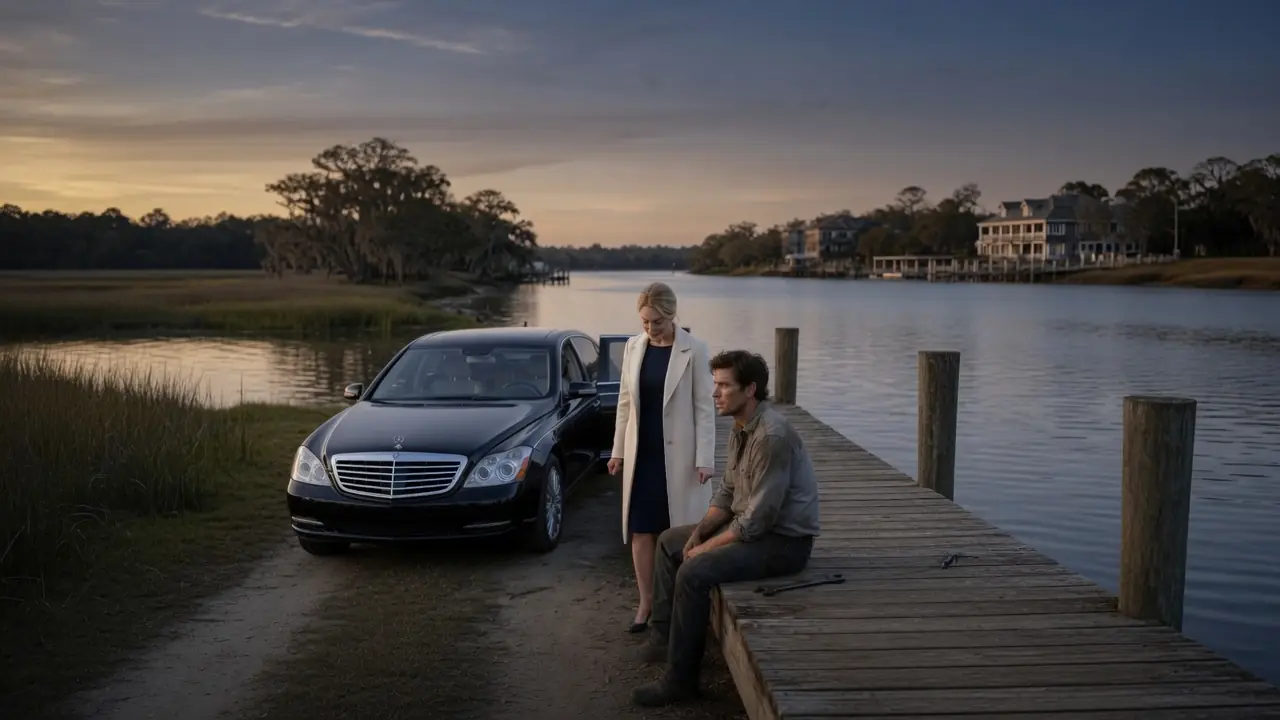
A black luxury car stopped near the river path behind him.
Rowan heard the tires crunch lightly over gravel, but he did not turn.
The rear door opened.
A woman stepped out.
She wore a white coat over a dark dress, simple but unmistakably expensive. Her blonde hair was pinned neatly, her posture calm, and the driver closed the door behind her with quiet respect. She looked like someone who belonged to a world of clean conference rooms, private elevators, and decisions made far above men like Rowan. Still, she did not walk past him like he was part of the scenery.
She stopped a few feet away.
For a moment, she looked at the river.
Then she looked at him.
Serafina Vale had spent most of her adult life surrounded by people who wanted something from her.
Investors wanted reassurance. Reporters wanted statements. Executives wanted approval. Politicians wanted donations. Strangers wanted selfies, signatures, access, money, attention, answers. Even kindness directed at her often carried a hidden invoice. That was why she had started walking alone near the river whenever she visited the city, with only one security car keeping distance behind her.
She did not come there to be recognized.
She came there to breathe.
That afternoon, though, she noticed the man on the dock before she noticed the water. He sat with the posture of someone fighting not to collapse in public. His work clothes were stained, his hair was messy, and his hands looked like they belonged to a man who fixed things for a living. But what caught her attention was the hospital bracelet on his wrist and the way he stared at the river like he had run out of places to put his pain.
Serafina knew that look.
Years earlier, she had seen it on her mother’s face outside an ICU room.
She stepped closer.
“May I join you for a moment?” she asked gently.
Rowan looked up.
For a second, he thought he recognized her, but exhaustion blurred the thought before it formed completely. Maybe he had seen her in a magazine at the hospital, or on one of those business news screens above the pharmacy counter. Maybe she only had the kind of face wealth made familiar. He did not have the energy to care.
“If you don’t mind silence, ma’am,” he said, rubbing his dirty hands together, “I’ve got plenty of it.”
Serafina gave a small, sad smile.
She sat beside him on the dock, close enough to share the view but not close enough to intrude. For several minutes, neither of them spoke. The river moved in front of them, catching late sunlight in silver strips. Behind them, the black car waited quietly, and Rowan tried to pretend he did not notice how carefully the driver watched them from a distance.
Serafina’s eyes moved to his wrist.
Someone in the hospital had fastened that kind of bracelet around her years ago.
She remembered the plastic bite of it, the smell of antiseptic, the hush of doctors speaking outside her door, and the fear in her mother’s hands when she thought Serafina was asleep.
“Someone you love is fighting for their life, aren’t they?” she asked quietly.
Rowan’s throat tightened.
He looked down at the water.
“My daughter,” he said. “And I’m running out of ways to save her.”
Serafina did not respond immediately.
That made him keep talking.
Maybe because she did not offer pity too quickly.
Maybe because she was a stranger, and strangers sometimes felt safer than friends who wanted cheerful answers.
“Her name is Isla,” he said. “She’s seven. She likes dogs, drawing sea turtles, and telling nurses they should use brighter stickers after blood tests.”
Serafina smiled softly.
“She sounds wonderful.”
“She is.”
His voice broke slightly on the word.
He cleared his throat and looked away.
“She has a rare blood disorder. We’ve been managing it for years, but managing isn’t the same as winning. Doctors think there’s a treatment that could help, maybe more than help, but it’s expensive, complicated, and apparently every door opens only halfway unless you have the right kind of insurance or the right last name.”
Serafina’s face changed.
Not dramatically.
But enough.
Rowan noticed.
“You work in healthcare?” he asked.
“Something like that.”
He gave a tired laugh.
“That usually means yes, but complicated.”
“It does.”
She looked back at the river.
“I founded a healthcare technology company. We work with hospitals, patient systems, research networks, donor registries, things like that.”
Rowan finally studied her more closely.
“Wait,” he said. “You’re Serafina Vale.”
She gave a small nod.
“I am.”
He immediately looked embarrassed.
“I’m sorry. I didn’t mean to—”
“Please don’t apologize.”
He laughed under his breath.
“Well, if I’d known I was sitting next to a billionaire, I probably would’ve wiped the grease off my face first.”
Serafina smiled.
“I prefer honest faces.”
That sentence quieted him.
Most people with money said charming things because charm cost nothing. But the way she said it did not feel polished. It felt true.
They sat together while the light softened over the river. Rowan told her more than he meant to. He told her about Claire, about working double shifts, about Isla collapsing at school three days earlier, about hospital rooms where he pretended not to be scared because Isla watched his face for clues. He told her about selling his truck, borrowing against tools, and skipping meals when money ran short.
Serafina listened.
Not like someone collecting tragedy.
Like someone honoring confession.
When Rowan finally stopped talking, he shook his head.
“I don’t know why I told you all that.”
“Sometimes pain needs a witness.”
He looked at her.
“That sounds like something someone says after surviving something.”
Serafina’s fingers tightened around the edge of her coat.
“I did.”
For the first time, Rowan realized there was more behind her calm than confidence. There was memory. Maybe grief. Maybe gratitude. He did not ask, because the one kindness poor people often give rich people is not assuming their money removed all sorrow.
Serafina looked toward the hospital district in the distance.
“Years ago, I was very sick,” she said. “Doctors didn’t know if I would survive. I needed a compatible donor, and they told my family it might be impossible.”
Rowan listened quietly.
“Then, somehow, they found one. An anonymous donor. Someone who did not know my name, did not know whether I was kind or selfish, rich or poor, deserving or not. That person said yes anyway.”
Her voice softened.
“Everything I built came after that. Every company, every award, every morning I woke up and kept living. All of it began with a stranger who never asked me for anything.”
Rowan looked at the river.
“That’s a good person.”
“I think about them often.”
“Did you ever find out who they were?”
“No,” she said. “Confidentiality rules. Records. Legal barriers. Time.”
Rowan nodded slowly.
“Maybe they didn’t need to be thanked.”
Serafina turned toward him.
“Why would you say that?”
He shrugged.
“Some people do the right thing because it’s right. They don’t think about the rest.”
She studied him.
The hospital bracelet.
The dirty hands.
The tired eyes.
Something about the sentence stayed with her.
Years earlier, long before Isla got sick, before Claire died, before life reduced Rowan to bills and hospital schedules, he had joined a donor registry at a community health fair. Claire had been pregnant then, glowing and laughing because Rowan nearly fainted when they drew blood for the sample. He had joked that he was only brave around engines. Still, when the volunteer explained that one day he might be able to help save someone, Rowan signed the form.
Months later, the call came.
A match had been found.
A young woman somewhere in the country needed a compatible donor urgently.
The process was harder than he expected. There were appointments, tests, travel, injections, discomfort, exhaustion, and recovery. He did it anyway. Claire held his hand through the worst of it and told him their child would grow up knowing her father helped save someone before she was even born.
Then life happened.
Isla was born.
Claire died.
Grief swallowed years.
The donation became something far away, a chapter from a life before hospitals became his own battlefield.
He never knew who received it.
He rarely thought about it.
By the time Serafina sat beside him on the dock, the connection between them already existed, deep and invisible, but neither of them had any reason to see it.
The conversation ended naturally as sunset lowered across the water.
Serafina stood first.
Rowan rose more slowly, wiping his palms on his jeans.
“I should get back to the hospital,” he said.
Serafina nodded.
“I hope Isla gets what she needs.”
He looked at her, then gave a small tired smile.
“Me too.”
She hesitated.
Then handed him a card.
Not the kind assistants usually gave out.
This one had only her name and a direct number.
“If you need someone to help you navigate the system, call me.”
Rowan stared at it.
“I can’t take charity.”
“It is not charity.”
“Then what is it?”
Serafina looked at him carefully.
“Maybe it is one stranger refusing to let another one sit alone.”
He did not know what to say.
So he took the card.
That night, Serafina returned to her hotel suite and could not sleep. She stood at the window overlooking the city, thinking of Rowan’s daughter, of the hospital bracelet, of the way he described donor kindness as something that needed no reward. Around midnight, she opened her laptop and searched the archives of her foundation’s donor programs. Then she stopped, hands resting over the keyboard.
For years, she had respected the sealed wall between herself and the anonymous donor who saved her life.
But regulations had changed.
Some records could now be reviewed if both parties consented.
She had never requested the process because part of her feared disturbing someone who had chosen anonymity. But after meeting Rowan, after hearing him speak about doing good without needing thanks, something in her shifted. She submitted the formal inquiry before she could talk herself out of it.
Weeks passed.
Rowan’s life got harder.
Isla’s numbers worsened, then stabilized, then worsened again. Doctors moved between cautious hope and careful warnings. Rowan worked until his hands cramped, then went to the hospital and slept in a chair beside his daughter’s bed. He did not call Serafina at first. Pride and fear took turns stopping him.
Then Isla asked him one evening, “Daddy, why do you look tired even when you smile?”
That broke him.
The next morning, he called the number on the card.
Serafina answered herself.
Not an assistant.
Not a secretary.
Herself.
Within two days, one of her foundation’s medical advocates contacted Rowan. Specialists reviewed Isla’s case. A treatment program that had previously seemed unreachable suddenly became possible. Rowan still resisted the feeling that help was arriving from a world he did not belong to, but Serafina never made him feel purchased, pitied, or small.
She simply opened doors.
Then, six weeks after the river meeting, Serafina received a call from her legal team.
The donor identification review had returned preliminary consent options and medical file markers. Her original donor profile matched one man in the registry database. The name sat on the screen for several seconds before her mind accepted it.
Rowan Mercer.
The mechanic from the river dock.
The single father whose daughter was fighting for her life.
The man whose exhausted eyes had held no recognition when he sat beside the woman he had once saved.
Serafina did not speak for a long time.
Her assistant asked if she was all right.
She was not.
She was overwhelmed by the strange, impossible circular mercy of it. The man she had been helping because he was kind, tired, and alone was the same man whose body had given her the chance to build the life that now made helping possible. She sat at her desk with tears in her eyes, staring at the name as if it were both a miracle and an accusation.
For years, she had wondered who saved her.
He had been sitting beside her by the river, apologizing for grease on his face.
A formal meeting was arranged only after the required consent process. Rowan was told that the foundation wished to discuss donor records related to an old registry file. He did not understand what that meant, but he agreed because Serafina asked gently and because, by then, he trusted her more than he knew how to admit.
The meeting took place in a quiet conference room overlooking the city.
Rowan arrived in his cleanest shirt, still smelling faintly of soap and machine oil.
Serafina stood when he entered.
Her face looked different.
Softer.
Almost shaken.
“Is Isla okay?” he asked immediately.
“Yes,” Serafina said quickly. “This is not bad news about Isla.”
He exhaled in relief.
“Then what is it?”
She gestured for him to sit.
On the table lay a sealed folder, a glass of water, and a packet of documents signed by lawyers whose job was to protect privacy until truth was ready.
Serafina sat across from him.
“Years ago,” she said, “you joined a donor registry.”
Rowan blinked.
“That was a long time ago.”
“You were matched with a patient.”
He frowned slightly.
“Yeah. I remember. A woman, I think. They didn’t tell me much.”
“They could not.”
He looked at her face.
Something in the room changed.
Serafina’s voice trembled for the first time since he had known her.
“It was me.”
Rowan stared at her.
“What?”
She placed one hand gently over the folder.
“You were my donor, Rowan. You saved my life.”
The words did not land all at once.
They arrived slowly, like light entering a dark room through a cracked door.
Rowan looked at the folder.
Then at Serafina.
Then back down at his own hands.
“No,” he said softly, not in denial, but disbelief. “That can’t be right.”
“It is.”
“I didn’t know.”
“I know.”
“I didn’t even…” He stopped, overwhelmed. “I barely remembered.”
Tears filled Serafina’s eyes.
“I never forgot.”
Rowan leaned back in his chair, stunned.
For years, he had believed his life had only narrowed after Claire died. Work, bills, hospitals, fear. He had forgotten that once, before all of that, he had made a choice that gave another person a future. He had not known that future became companies, medical programs, scholarships, research centers, and now hope for his own daughter.
Serafina wiped a tear from her cheek.
“Everything I built after my illness exists because you said yes.”
Rowan shook his head.
“I was just on a list.”
“No,” she said firmly. “You were a person who answered.”
He looked down.
“I didn’t do it for thanks.”
“I know.”
“I didn’t do it thinking someone would owe me.”
“I know.”
He looked up, eyes wet now.
“Then don’t make it feel like that.”
Serafina’s face softened.
“I am not trying to repay a debt.”
“Then what are you doing?”
She took a slow breath.
“I am honoring a life you helped make possible by using it the way it should be used.”
The room became very quiet.
Rowan covered his mouth with one hand.
For the first time in years, he let himself cry in front of someone who was not asleep, dying, or seven years old.
Serafina did not reach across the table immediately.
She let him have the dignity of breaking without being managed.
When he finally lowered his hand, his voice was rough.
“I just want Isla to live.”
“I know.”
“She’s all I have.”
Serafina leaned forward.
“Then we fight for her together.”
That sentence changed something.
Not the diagnosis.
Not the bills already stacked at home.
Not the years Rowan had spent carrying everything alone.
But for the first time, the burden shifted.
Not off him.
Beside him.
Over the next months, Isla’s care changed.
Specialists reviewed her case in detail. A clinical program accepted her after emergency consideration. Medications were adjusted. New testing revealed treatment options that had never been fully explained to Rowan before. Serafina paid quietly through foundation channels, shielding Rowan from both public attention and private shame.
Isla improved slowly.
Then noticeably.
Her color returned.
Her appetite came back.
She began drawing again, filling hospital paper with sea turtles, dogs, and a tall woman in a white coat standing beside her father by a river. Rowan taped every picture to the wall. Nurses started smiling when they entered the room. Doctors used words like “strong response” and “encouraging progress.”
Rowan still feared.
Parents do not stop fearing because one result improves.
But hope returned in pieces.
A laugh.
A meal finished.
A morning without fever.
A doctor who walked in smiling before speaking.
Serafina visited when she could, always quietly, never with cameras or announcements. To Isla, she became “Miss Sera,” the rich lady who brought good colored pencils and knew too much about hospitals. To Rowan, she became something harder to name. Not a savior. Not a benefactor. A witness. A friend. Someone bound to him by a kindness neither had understood when it happened.
One afternoon, Isla asked Serafina, “Did my dad really save your life?”
Rowan froze.
Serafina looked at him, asking permission without words.
He nodded.
Serafina sat beside Isla’s bed.
“Yes,” she said. “Before you were born, your dad helped me when I was very sick.”
Isla looked at her father with wide eyes.
“Daddy, you never told me you were a superhero.”
Rowan laughed through tears.
“I’m not, bug.”
Isla frowned seriously.
“You kind of are.”
Serafina smiled.
“He is.”
Rowan looked away, embarrassed and overwhelmed.
He had spent years feeling like he was failing his daughter because he could not make illness disappear. But in that room, he saw himself through two sets of eyes that did not measure him by money, exhaustion, or fear. He saw a man who had kept going. A man who had given life once without knowing it and fought for life every day after.
Months later, Isla’s major treatment showed extraordinary progress.
Not perfect.
Not guaranteed forever.
But extraordinary.
The doctors spoke carefully, but their faces betrayed relief. Isla’s numbers stabilized in a way no one had dared promise. Rowan sat beside her bed and cried openly while Isla patted his arm like she was the parent and he was the child.
“Daddy,” she said, “you’re doing the worried face again.”
He laughed and wiped his eyes.
“I’m trying not to.”
“Try harder.”
Serafina stood in the doorway, watching them.
She placed one hand over the small gold necklace at her throat, the one she had worn since her own recovery years earlier. For so long, she had wondered what she would say if she ever met the person who saved her. Thank you had always felt too small. Now she understood that gratitude was not a sentence. It was a way of living after the gift.
On the anniversary of the day they met, Serafina returned to the river dock.
This time, Rowan came with Isla.
The girl wore a yellow sweater, carried a sketchbook, and walked slowly but proudly along the wooden boards. Rowan stayed close without hovering too much, fighting every instinct to wrap her in caution. Serafina waited near the bench, dressed simply, her black car parked farther away than before.
Isla ran the last few steps.
Not fast.
But enough.
Serafina crouched to hug her.
Rowan stood nearby, smiling in a way Serafina had not seen on his face the first day.
Light.
Tired still.
But light.
They sat together on the dock as boats moved across the river.
No reporters.
No foundation photographers.
No speeches.
Only three people connected by something no one could have planned.
Isla drew sea turtles while Serafina and Rowan watched the water.
After a while, Rowan said, “I still don’t know how to accept all of this.”
Serafina looked at him.
“You don’t have to accept it all at once.”
“I feel like I owe you.”
She smiled gently.
“That is strange, because I feel the same way.”
He shook his head.
“You don’t owe me.”
“And you do not owe me.”
Isla looked up from her sketchbook.
“Then nobody owes anybody.”
Rowan laughed.
Serafina laughed too.
Isla went back to drawing.
Rowan looked at the river.
“Maybe that’s the point.”
Serafina nodded.
“Maybe kindness is not a debt. Maybe it is a circle.”
The words settled between them.
Years earlier, Rowan had made a choice in a clinic, not knowing whether the person on the other end would live, what she would become, or whether he would ever hear her name. Years later, Serafina made choices in conference rooms, hospital networks, and foundation offices that helped Isla find treatment. Neither act erased pain. Neither made life simple. But both proved something Rowan had almost forgotten.
Goodness travels farther than the person who gives it can see.
Sometimes it disappears for years.
Sometimes it crosses cities, hospitals, grief, wealth, poverty, and silence.
Sometimes it returns as a woman in a white coat asking, “May I join you for a moment?” beside a river when you believe you are completely alone.
Rowan looked at Serafina.
“Thank you,” he said.
She looked back at him.
“Thank you.”
Neither explained.
Neither needed to.
Isla held up her drawing.
It showed three people sitting on a dock beside the water.
Above them, in careful uneven letters, she had written: The day we found our miracle.
Rowan took the picture gently.
His eyes filled again.
Serafina looked at the river, then at the child, then at the man whose anonymous kindness had given her every tomorrow she had ever lived.
For the first time in years, the unanswered question inside her was gone.
She knew who had saved her.
And Rowan knew something too.
He had not spent his life only surviving.
Without knowing it, he had already changed the future of someone who would one day help him protect the person he loved most.
That was the mystery of kindness.
It did not always return as applause.
It did not always return quickly.
But sometimes, after years of silence, it sat down beside you by the river and reminded you that no good thing is ever truly lost.