Mara was forty-eight years old when the biker slammed her backward into the diner’s neon jukebox hard enough to crack the thick plastic cover over the lights.
The music skipped once and died in the middle of an old country chorus. The whole room seemed to inhale at the same time, then hold it. Gage Harlan stood over her with one fist knotted in the collar of her faded pink uniform, stale beer and exhaust coming off his leather vest. "I said bring the pitcher, sweetheart," he laughed, as if the sound of her shoulder striking the jukebox had been part of the joke.
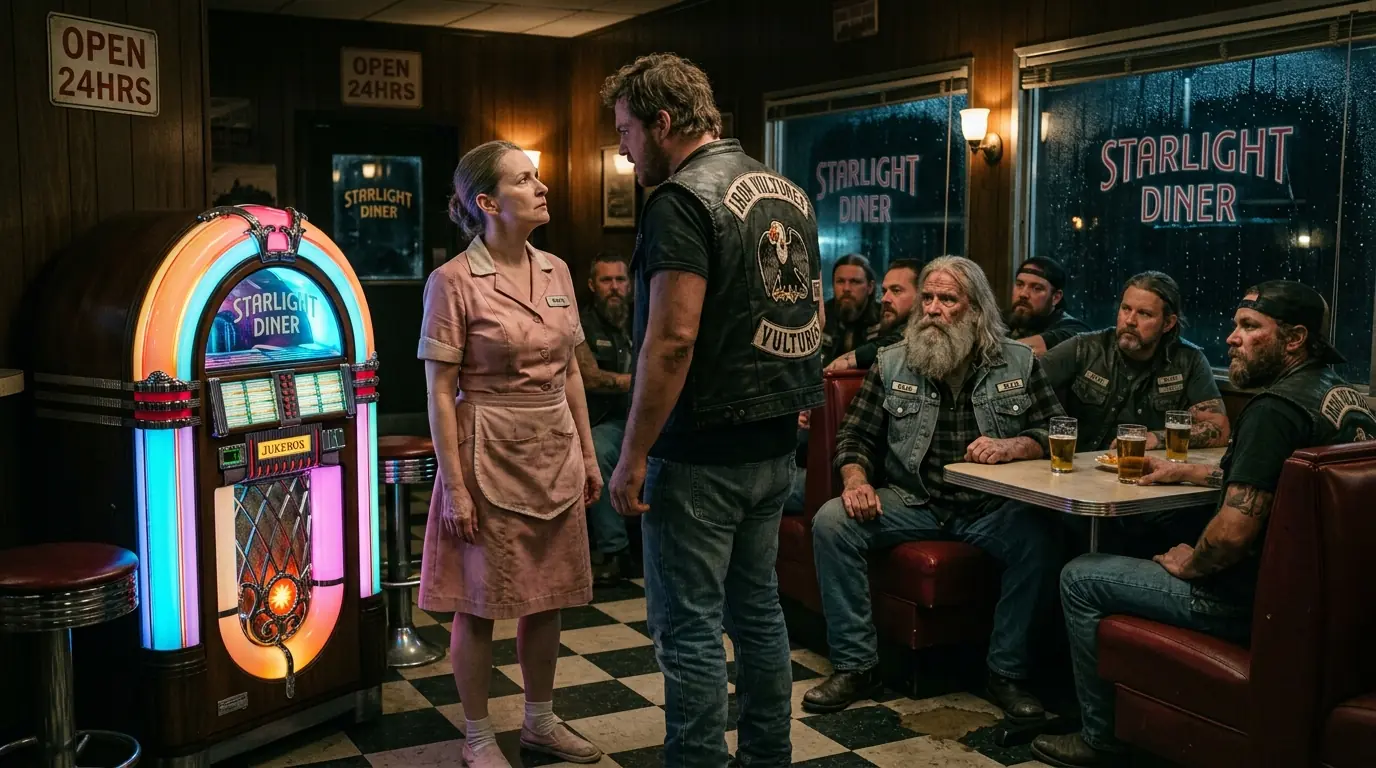
Mara slid down until one knee touched the sticky linoleum. Pain ran from her ribs to the base of her neck, but she kept her breathing slow. "I told you you're cut off," she said. "It's past two, and you've had enough." Gage's steel-toed boots stopped inches from her fingers while the other five men in matching Iron Vultures patches watched from the booths.
Nobody else moved. Six men in cheap flannel shirts sat shoulder to shoulder at the counter with half-finished slices of cherry pie in front of them. A night-shift trucker in the far booth lowered his eyes. The cook behind the pass-through window had gone still with a spatula in his hand. Rain tapped against the black windows while the red OPEN sign painted the glass in weak pulses.
Gage leaned down and caught Mara by the collar. He did not simply pull her upright. He yanked her forward hard enough to tear the shoulder seam from the neckline to the sleeve, the rip sounding unnaturally loud in the silent diner. Mara gasped and brought one hand up to cover herself, but the movement came too late.
A crescent-shaped birthmark curved over her left collarbone, dark against pale skin, cut through by a thin natural line near the center. Gage grinned and reached toward it. "Look at that. What is that, some kind of tattoo? Cute. Now go get the—"
"Don't touch her."
The voice came from behind him.
Bear Talbot, the oldest Iron Vulture in the room, had pushed himself to his feet. At sixty-four, Bear still looked enormous in a denim riding vest worn gray at the seams, but all the color had vanished from his face. He stared at Mara's birthmark as though he had seen a photograph come alive. "Gage," he whispered, "step back."
Gage kept his grip on Mara's torn shirt. "What's your problem, old man?"
"I said let her go." Bear's voice actually shook. "That's the Moon Widow. You're touching the Moon Widow."
The name changed the room.
Knox Delaney stopped smiling. Vincent Rourke looked from Bear to Mara and then toward the door. Two younger members, Reed Danner and Cole Mercer, exchanged the kind of glance men shared when a story they had always treated as myth suddenly acquired a face. Gage was the only one who laughed.
Years earlier, long before the Iron Vultures had become a cover for stolen firearms and intimidation, the Rossi organization had controlled a smuggling corridor that ran from the Pennsylvania river towns into Ohio and West Virginia. Federal cases had eventually gutted that network. Safe houses were exposed, shell companies seized, corrupt officials charged, and men who had treated whole counties like private property went to prison.
The person criminals blamed most was a young federal prosecutor named Mara Ellison. In reality, she had been one lawyer among dozens of agents, analysts, witnesses, and investigators. Criminal folklore rarely respected teamwork. It preferred monsters, saints, traitors, and ghosts.
A courthouse photograph had once caught the crescent birthmark above Mara's blouse. Someone inside the Rossi organization began calling her the Moon Widow after three senior figures were convicted within the same month. The nickname spread faster than her real name. By the time the case ended, stories claimed she carried a pistol into interrogations, ran informants personally, and could ruin a man with one phone call.
Most of it was nonsense.
The threats were not.
Gage looked down at Mara again. He saw a middle-aged waitress with tired eyes, sensible shoes, and a torn pink uniform. "That's your ghost?" he said. "This?"
Bear took one step toward him. "We need to leave. Right now."
"Sit down."
"Gage, listen to me."
Gage shoved Bear backward. The older man struck the edge of a booth hard enough to rattle the table. A salt shaker rolled to the floor and broke. Gage turned back toward Mara, grabbed her upper arm, and dug his fingers directly into the bruise forming there.
Mara let him pull her halfway upright.
Then her free hand moved.
It was not dramatic. No spinning kick, no cinematic throw. She pressed her thumb into the tendons inside his wrist and rotated just enough to trigger the reflex she had learned in a self-defense class years before. Gage's grip opened. Mara stepped away, straightened, and pulled the torn fabric as high as it would go.
Her frightened expression disappeared.
Bear saw it first.
"Gage," he said. "Look at the counter."
The six men with pie had stopped chewing.