The first thing anyone noticed about Pete Callahan was the beard. It was gray, thick, and split by the wind the way old riverbanks split after winter, hanging over the collar of a faded black leather vest covered in road dust and stitched patches.
The second thing they noticed was the scar that ran from his left temple toward his ear, a pale line earned in Afghanistan twenty-seven years earlier when a piece of shrapnel had opened his helmet and left him with headaches that still arrived when the weather changed.
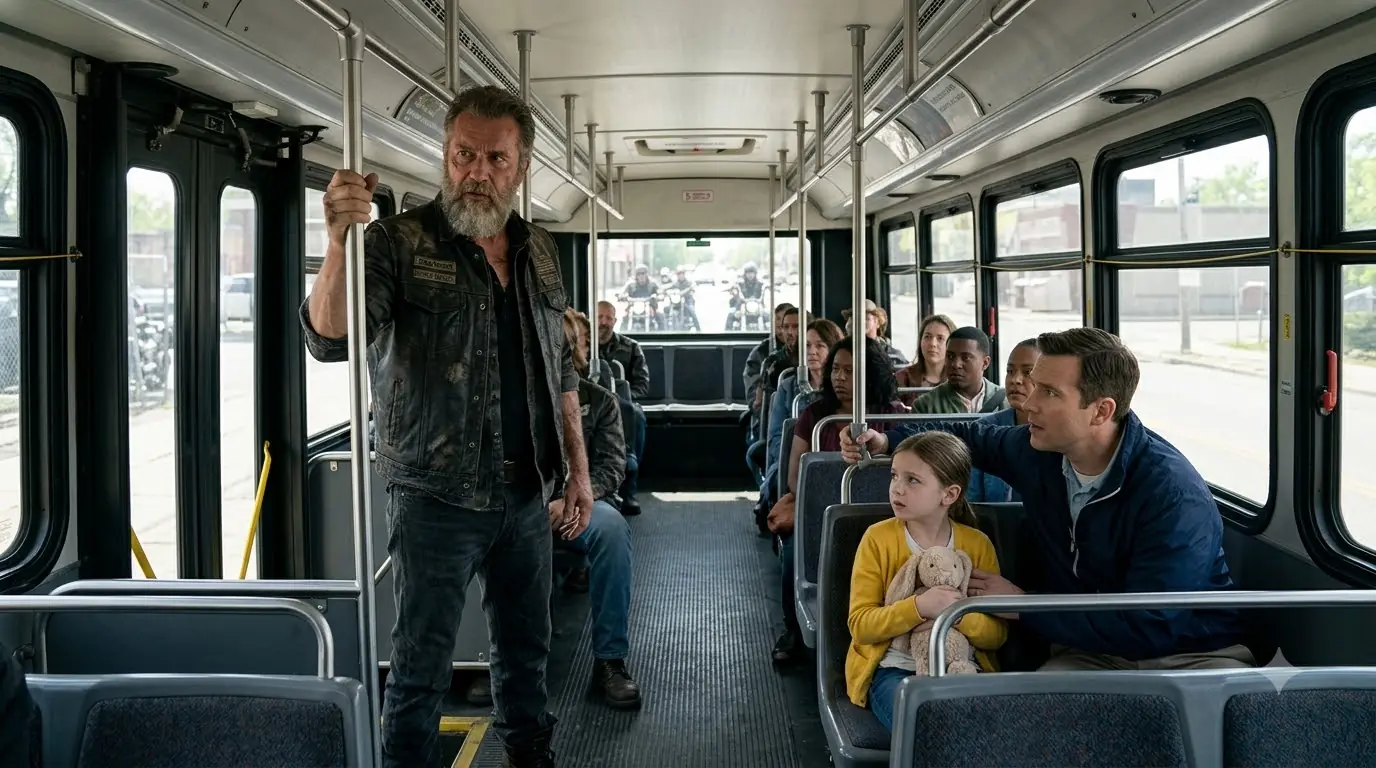
The third thing, on that crowded Dayton bus at four-ten on a Thursday afternoon, was that he looked like trouble. By the time he planted one boot in the aisle and told the driver to stop the bus, nearly everyone inside had already decided what kind of trouble he was.
Sarah Coleman, the driver, had worked city routes for eighteen years and had seen enough chaos to distrust theatrics. She was forty-six, broad-shouldered, patient when patience was useful, and fast with the emergency radio when it was not.
Pete did not wave a weapon or threaten anyone; he simply pointed toward the dashboard and said, “Stop here. Please. Right now.” The please barely softened the command. Sarah glanced at the mirror, saw motorcycles filling both lanes behind them, and felt every muscle in her back tighten.
A dozen bikes rolled up around the bus in a disciplined stagger, engines low, riders spreading along both sides without touching the vehicle. There were men and women among them, Black, white, Latino, young enough to still color their hair and old enough to have stopped caring, most wearing the same small patch of a lantern inside a wheel. They did not shout. They did not pound on windows. They simply closed the space around the bus until traffic stalled and horns erupted behind them.
Passengers reacted exactly as Pete had feared they would. A college student lifted his phone. An elderly woman clutched her handbag against her ribs. A man in a delivery uniform whispered that somebody should call 911, while a teenager in the back did it without whispering.
Sarah’s right hand slid toward the silent alert button beneath the steering wheel. Then she saw Pete’s eyes move past all of them toward three rows from the rear, and something about the way his face changed stopped her hand.
The girl sat beside a clean-cut man in a navy windbreaker. She looked eight, maybe nine, with brown hair tucked behind one ear, a yellow cardigan, leggings, and a stuffed rabbit crushed against her stomach. Her left shoe was untied. Her face was pale in a way that had nothing to do with the warm bus, and she watched the window as if she had been told the glass was the only safe place to look. The man beside her smiled at no one in particular and kept one hand resting over her shoulder like an affectionate father, except his fingers did not move with affection.
Pete had carried Emma Riley’s picture for six months. He had seen it under diner plastic, taped to gas pumps, tucked beneath windshield wipers, taped crookedly inside truck-stop bathrooms, and printed on the back of a thousand cards passed from gloved hand to gloved hand.
In the photograph, Emma was laughing so hard her eyes almost disappeared. On the bus she looked smaller, thinner, and much older than eight. Still, Pete knew the curve of her nose, the tiny notch in her right eyebrow, and the habit her mother said she had of tugging her left ear whenever she was afraid but trying not to show it.
Emma tugged her left ear once.
Pete stopped breathing.
Six months earlier, on a rainy Saturday in April, Emma had vanished from a spring street fair in Springfield. Her mother, Rachel, had turned away for less than a minute to pay for two lemonades. When she looked back, the space beside the balloon vendor was empty.
Police treated the case seriously from the beginning, but the fair had thousands of people, poor camera coverage, and three roads leading out of town. A grainy frame from a storefront showed a man in a baseball cap walking near a child in a pink jacket. It was not enough to identify him.
Pete had been at the fair with his motorcycle club, the Lantern Riders, raising money for a veteran’s wheelchair ramp. Rachel was his younger sister. Emma was the niece who had once painted his fingernails purple because she said all warriors deserved armor.
Pete never forgave himself for being two blocks away when she disappeared. Rationally, he knew he had done nothing wrong; emotionally, the distance between two blocks and one missing child was a canyon he crossed every night in his sleep.
Rachel had barely slept after that day. She built search maps across her dining room wall and learned to speak to detectives, reporters, shelter coordinators, transit employees, and strangers with the forced steadiness of someone who feared that one crack in her voice would make the whole world collapse.
Pete became the engine beside her. The Lantern Riders printed flyers, rode rural roads, checked rest stops, posted in parent groups, met truckers, and passed Emma’s photo into networks that stretched across Ohio, Indiana, Kentucky, and West Virginia.
At first, police had tolerated the bikers as determined relatives. Later, detectives quietly began using them as eyes. Pete’s club contained retired nurses, two mechanics, a social worker, a former state trooper, a school counselor, three veterans, and a woman named June Calder who had spent twenty-one years as an emergency dispatcher. They were not investigators, and Pete made that boundary clear. They reported tips, documented sightings, and stayed out of active scenes.
Then came a phone call three days before the bus.
A waitress at a highway diner outside Richmond, Indiana, had seen Emma’s flyer taped by the register. She called the number and described a little girl who had been traveling with a man claiming to be her father. The girl never spoke unless he prompted her. She had stared at a woman’s yellow cardigan hanging on a chair long enough for the waitress to notice. The man paid cash and left before anyone could get a plate number, but a trucker remembered a dark blue sedan with one damaged taillight.
That clue led nowhere until June found a pattern hidden inside public transit reports shared through a volunteer missing-child network. A man matching the description had been seen asking about cash-only motel rates near bus terminals in three cities. Each time, he stayed less than a week. Each time, he used buses or rideshares instead of keeping a vehicle nearby. Pete understood the method immediately: movement without a clear trail, constant changes, no loyalty to one city.