The first thing Caleb Bennett noticed about Red Mesa was that the dust had not changed. It still came off the flats in low red sheets, curling under bumpers and crawling into cuffs, saddlebags, carburetors, teeth. Thirteen years had passed since he had ridden away from the place with half a right leg and no intention of ever seeing it again, but the dust met him like an old enemy that had been standing exactly where he left it.
It slid across the windshield of Daniel's Ford pickup and blurred the hand-painted sign ahead: RED MESA RUN — WELCOME RIDERS. Daniel leaned forward over the steering wheel and squinted through the streaked glass. At twenty-six he had his mother's narrow face and his father's tendency to look at a machine as if it had personally offended him. His dark work shirt carried three small burns from welding, and a fresh bandage crossed the knuckle of his left hand. He had spent the last nine hours driving because Caleb's prosthetic socket had begun biting hard into the stump before they were halfway across northern New Mexico. "Could've mailed the box," Daniel said.
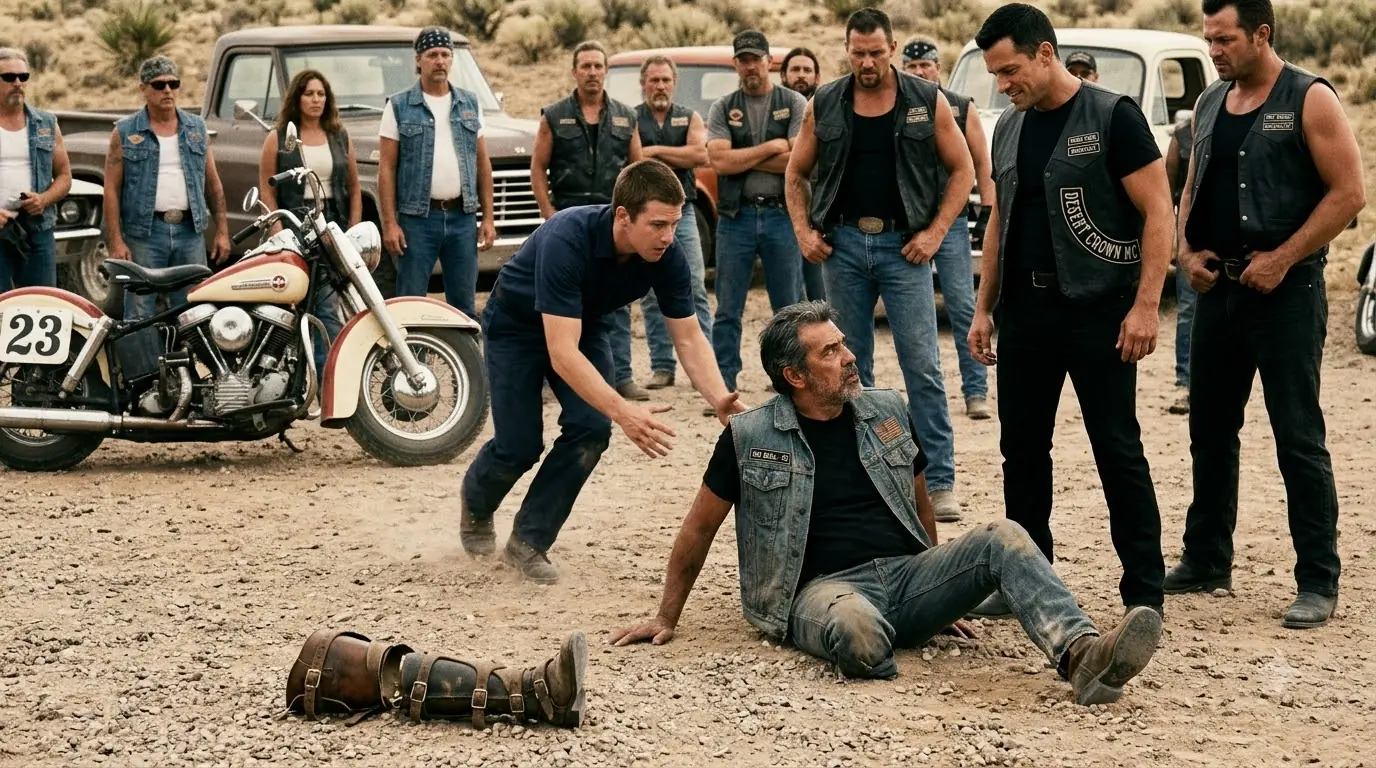
Caleb sat with his right leg angled toward the passenger door, the old leather socket hidden beneath denim tailored wider around the knee. "Rabbit didn't trust mail." "Rabbit trusted a man with one leg to drive nine hours." "Rabbit was smart." Daniel looked at him, then back at the road. "That doesn't answer anything."
"Usually why I say it." The pickup crested a rise, and Red Mesa spread below them: a dry lake burned white under the afternoon sun, the remains of a wartime airstrip drawn across it like a scar, and a town that seemed to have been assembled out of tin roofs, cinder block, old gas pumps, and stubbornness. Campers and panel vans had already filled the fields around the airstrip. Motorcycles stood in crooked lines between tents—Panheads, Shovelheads, Triumphs, chopped Sportsters, a few Hondas and Kawasakis that older riders pretended not to stare at. Homemade banners snapped between telephone poles.
A flat-track oval had been scraped into the dirt beside the runway, and somewhere beyond the vendor tents an engine revved hard enough to make Daniel wince. Caleb did not flinch. He had spent years telling himself this place had become just another mark on a road map. Yet when he saw the old roadhouse near the airstrip, with its corrugated roof and the faded black crown painted over the front doors, something inside his chest tightened before he could stop it. Daniel noticed. "You okay?"
"Prosthetic's rubbing." "That's not what I asked." Caleb rested one hand over the brass buckle of his belt. "Then ask something easier." They parked near a line of swap-meet tables where men sold carburetors, leather bags, bent handlebars, old racing trophies, and milk crates full of parts that seemed to have survived three wars and two divorces. Daniel climbed out first. Caleb waited until he was around the truck before opening his own door. The old habit irritated Daniel because Caleb always waited until help was close, then refused it.