The first thing Miriam Vale noticed was not the blood, because there was none.
It was the way the little girl stopped breathing whenever the white church van rolled into the school loop.
Lily Hart was eight years old, but she climbed onto Bus 14 every morning as if the yellow steps led into a courtroom. Her brother Noah came behind her, one hand always gripping the back bar of her wheelchair, pushing with the careful seriousness of a boy who had learned too early that if he did not protect his sister, nobody else would.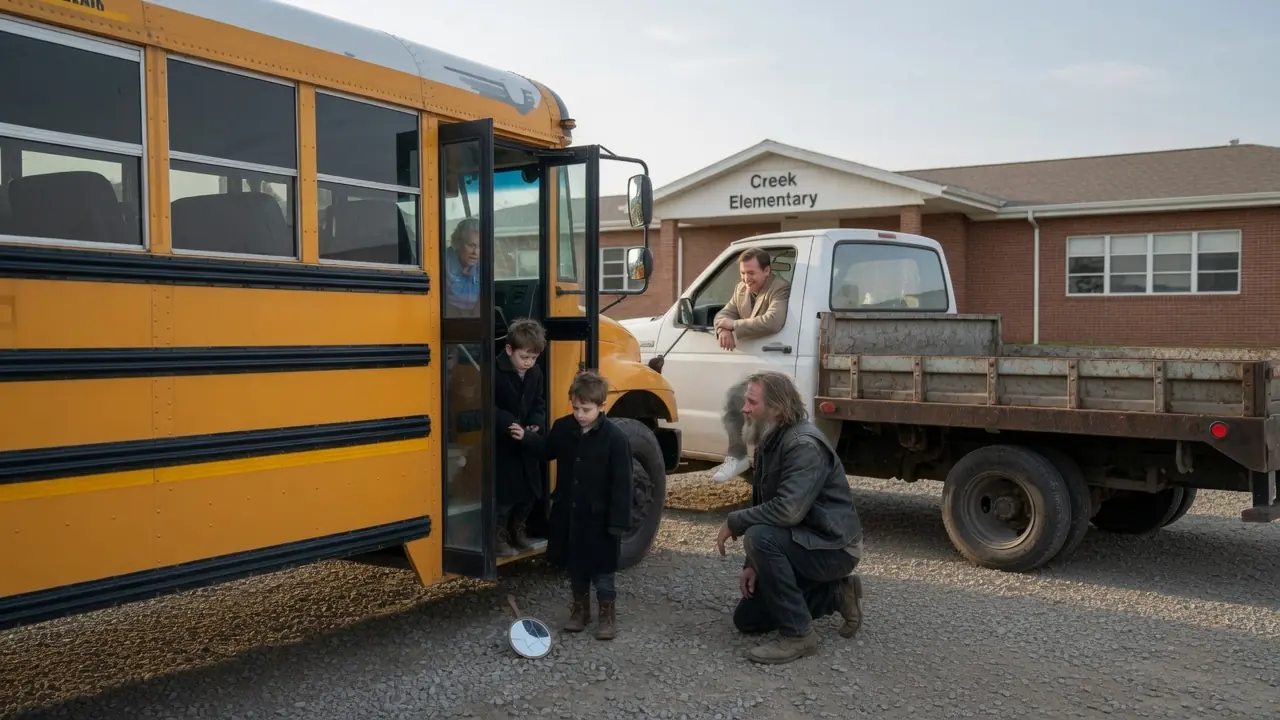
They were not twins, but grief had made them look like two halves of the same broken thing.
Noah was ten, narrow in the shoulders, all elbows and watchful eyes, with black hair that never stayed combed because he kept running his fingers through it when he was afraid. Lily was small enough to seem younger, her knees covered with an old plaid blanket even in weather that was not cold, her shoes polished but too tight, her wheelchair wiped clean every morning as if someone cared more about appearances than comfort.
Miriam saw that too.
She saw the blanket never changed. She saw the frayed cuffs of Noah’s coat. She saw how Lily’s hands trembled when she lifted herself from chair to bus seat. She saw how the children flinched when adults spoke too quickly.
She told herself foster homes were complicated.
She told herself St. Bartholomew’s Children’s Residence had a good name.
She told herself Reverend Alden Pike was respected by half the county, invited to every charity luncheon, photographed every Christmas with toy drives and smiling donors.
She told herself someone with authority must already know more than she did.
That lie became easier because everyone in Briar County told it together.
Then, on the last Friday before Thanksgiving break, Lily dropped a small blue music box into the gravel.
It happened so quietly that Miriam almost missed it.
The music box was no bigger than Lily’s palm, painted with chipped blue roses and a silver moon worn nearly white by years of touching. It slipped from the pocket of her cardigan when Noah lifted her from the wheelchair. It hit the frozen gravel with a tiny wooden crack, and the lid sprang open.
A weak, broken melody drifted out beneath the rumble of the bus engine.
Lily went still.
Noah froze with one hand under his sister’s elbow.
The church van idled ten yards away, white paint gleaming, gold cross on the side, tires clean even though every road in town was muddy from three days of rain.
Reverend Alden Pike rolled down the driver’s window and smiled.
“Leave it, Lily,” he called softly.
His voice sounded gentle enough for a nursery.
That was what made Miriam’s skin turn cold.
“We do not need old trash from the past,” he added.
Lily’s face emptied.
Noah looked down at the music box as if the ground had opened under it.
Miriam’s fingers tightened around the wheel.
She should have opened the bus door. She should have stepped down. She should have said something. Instead, she heard her own heartbeat and the heater under her seat and the rainwater dripping from the bus roof.
Before she moved, a man crossed the school loop from the diner parking lot.
Caleb Rusk was seventy-four years old, broad across the back despite his bent knees, with a gray beard falling over the collar of his worn black leather vest. People in Briar County had a dozen names for him.
Old biker.
Trouble.
Ex-con.
Hells Angel.
The man with the scar.
They said those words with the comfort of people who believed a leather vest was the whole story. They did not know Caleb had grown up in a state home where children learned the sound of every adult’s footsteps. They did not know he had buried a daughter after a drunk driver took her on a wet highway outside Tulsa. They did not know he still carried her hospital bracelet in the inside pocket of his vest, folded into a square like a prayer.
They did not know the first thing Caleb noticed in any room was the child who had gone quiet.
Caleb reached the music box before Noah could bend for it.
He did not snatch it.
He did not glare at Reverend Pike.
He lowered himself onto one knee in the gravel, slow enough that Lily could see both his hands, and picked up the little blue box as if it were made of glass and breath.
The broken melody stuttered once, then stopped.
Lily whispered, “That was Mama’s.”
Her voice barely carried over the idling van.
“She played it when my legs hurt.”
Noah’s jaw tightened, but he said nothing.
Caleb turned the music box in his scarred hands. The painted roses were nearly gone on one side, and the lid had split along the hinge. It was not valuable in any way a pawnshop would recognize.
But Caleb understood value better than pawnshops.
He had seen men carry worthless things through war and prison and hospitals. A button. A photograph. A child’s drawing. A key to a house that had burned down years ago. Objects did not have to survive whole to keep a person alive.
He held the box out to Lily.
Not above her.
Not toward Noah.
Straight to her.
“Then it rides with you,” Caleb said.
Lily’s hands lifted slowly.
She took the box and pressed it against her chest.
Reverend Pike’s smile did not change.
But something behind it did.
“Mr. Rusk,” he called. “These are children under state-supervised care. Please do not interfere.”
Caleb stood, the gravel popping under his boots.
“I am not interfering,” he said.
His voice stayed low.
“I am returning property.”
Noah looked at Caleb then. Really looked at him. There was suspicion in the boy’s eyes, but something else too, something dangerous because it was so close to hope.
Miriam saw it in the mirror above her windshield.
The bus camera saw it too.
That mattered later.
The camera saw the white van. It saw Reverend Pike telling Lily to leave the last thing she owned from her mother in the gravel. It saw Caleb Rusk kneel like the object mattered. It saw Noah waiting to see whether the world would punish an old man for treating a child’s memory like gold.
What the camera did not see was the basement room at St. Bartholomew’s.
It did not see the black mold behind the shelves where donated blankets were kept for inspection days.
It did not see the locked medication cabinet where Lily’s pain pills disappeared faster than the prescription said they should.
It did not see the donation checks routed through Pike Family Outreach LLC.
It did not see the county caseworker who had not visited in nine months but still signed monthly reports.
It did not see the three complaints that had been filed, reviewed, softened, and closed.
It did not see the aunt in Cedar Bluff who had begged to take both children and been told that love was not a placement plan.
It did not see the rule Reverend Pike called humility.
Children who complained lost dessert.
Children who cried after lights-out lost heat.
Children who spoke of old homes, dead mothers, or wanting to leave were sent to the prayer room until they learned gratitude.
But on that Friday morning in the school loop, something small and blue broke open.
Still, it was loud enough to wake the dead parts of a town.
Fourteen months earlier, Noah and Lily Hart had belonged to a woman named April Hart.
April was not a saint. She was tired, stubborn, too proud to ask for help until asking felt like failure. She worked the early shift at Moore’s Laundry, then cleaned exam rooms at the clinic three nights a week. She had a laugh that filled small rooms and a temper that came quick when people looked down on her children.
Lily had been born with a spinal condition that left her legs weak and unpredictable. Doctors used long words, but April translated them into ordinary love. Wheelchair for distance. Braces for standing. Pain days and good days. No pity allowed.
Noah learned to push Lily’s chair before he learned long division.
April kept the blue music box on the kitchen table. When bills stacked high or Lily cried from pain or Noah worried he was too small to be useful, April would wind the little silver key and let the melody wobble through the house.
“Listen,” she would say. “Even broken songs know where to go.”
Then the flood came.
A September storm sent Briar Creek over its banks in the night. April drove the children toward higher ground in a car with bad tires and one headlight dim. A cottonwood snapped across the county road. The car slid, rolled once, and landed in a ditch filling fast with rainwater.
Noah remembered the sound of Lily screaming.
He remembered April telling him to push his sister up, push, baby, push now.
He remembered the cold water at his chest.
He remembered a stranger’s flashlight.
He did not remember being pulled out.
April did not come out alive.
After that, adults spoke in corners.
They spoke about placement, liability, disability accommodations, available beds, medical needs, sibling priority, state supervision, and faith-based residential care.
They spoke so much that nobody seemed to hear the only sentence Noah kept saying.
“We have Aunt Jo.”
Jo Hart lived forty-three miles away in Cedar Bluff, in a green trailer with a ramp she had built herself when Lily started visiting on weekends. She had pay stubs, a clean record, a spare room, and a heart that had already made space for both children.
But Jo worked nights at a poultry plant, had one old bankruptcy, and did not know how to speak to county officials without sounding angry.
Reverend Pike knew exactly how to speak to them.
He arrived with polished shoes, grant language, a waiting wheelchair-accessible room, and donors ready to support a tragic sibling placement.
The judge did not say Jo was unfit.
That almost made it worse.
The court simply placed the children somewhere cleaner on paper.
St. Bartholomew’s Children’s Residence sat on a hill outside town, all white siding, tidy flower beds, and scripture painted on a wooden sign by the gate. On its website, children smiled beneath autumn leaves. Donors saw photos of full plates and cheerful bunk rooms. The annual report spoke of healing, structure, and Christian service.
Noah and Lily learned the part of St. Bartholomew’s not photographed.
They learned that the building was warmest when visitors came.
They learned that the good cereal was locked away except on tour days.
They learned that Reverend Pike prayed with one voice in the chapel and spoke with another when no one important stood nearby.
They learned that children who were easy were loved publicly.
Children who needed too much were corrected privately.
Lily needed too much.
Her chair squeaked. Her medicine cost money. Her exercises took time. Her pain made her cry some nights, and tears offended Pike because they suggested his home had failed to create gratitude.
Noah began taking punishment for her before he understood that punishment could become a habit.
If Lily dropped a cup, Noah said he had bumped the table.
If Lily’s braces rubbed her ankles raw, Noah said he had forgotten to tighten them.
If Lily cried after lights-out, Noah coughed loudly until the staff came for him instead.
By winter, his ribs showed when he changed for gym.
By spring, Lily stopped asking for her medicine unless the pain made her shake.
By summer, Noah knew the sound of the prayer room lock.
Miriam Vale noticed pieces.
She noticed Noah’s sleeves pulled over his knuckles.
She noticed Lily’s blanket smelled sour some mornings.
She noticed how Noah cut Lily’s pancake at school breakfast and put the bigger half on her tray when he thought no one watched.
She noticed Lily say thank you too often.
Miriam had driven school buses for twenty-one years. She had raised three children and buried one husband. She knew the difference between shyness and fear.
Still, she did not call.
Not at first.
The county had forms for suspicion, and suspicion felt too thin in her hands.
A child’s smell. A glance. A wrong-sized coat. A brother too old in the eyes.
What if she was wrong?
What if she made it worse?
What if Reverend Pike truly was overwhelmed but decent?
What if poor children simply looked like that because poverty left fingerprints everywhere?
There are a hundred ways for a conscience to sound reasonable while it backs away.
Miriam used most of them.
Then Caleb knelt for the music box.
After the bus pulled away, Caleb did not return to his coffee at Mae’s Corner Diner.
He sat in his old pickup for twelve minutes, both hands on the wheel, breathing through the anger until it became useful.
That was the first discipline.
Not the motorcycles people feared.
Not the old stories about fights at roadside bars.
The real discipline was refusing to let rage make a child less safe.
A man could storm St. Bartholomew’s and shout until deputies came. That would give Pike exactly what respectable men wanted from men like Caleb: proof that leather meant danger.
Children did not need Caleb arrested.
Children needed paper.
So Caleb drove to the Briar County Administration Building and walked through the glass doors at 8:58 a.m.
The security guard looked at his vest, then at his face, then back at the vest.
Caleb signed in.
He asked for the name of the caseworker assigned to Noah and Lily Hart.
The clerk behind the desk had tired eyes and a desk plant that was dying by inches.
She typed, frowned, typed again.
Caleb watched the frown.
“When did that person last lay eyes on them?” he asked.
The clerk did not answer right away.
That silence already knew it was guilty.
Finally, she said, “Nine months, according to the last in-person entry.”
Caleb pulled a pen from the chain by her desk and wrote on the back of his hand.
9 months.
Large.
Black.
Then he asked who supervised medical compliance for Lily’s wheelchair accommodations.
More typing.
Another frown.
A note from a contractor. A delayed repair request. A clinic transfer. A medication review marked completed without a physician signature.
Caleb wrote three more words on his hand.
Chair. Meds. Review.
The clerk’s mouth tightened.
“I cannot release protected records to you,” she said.
“I did not ask you to,” Caleb replied.
His voice was not unkind.
“I asked where the holes were.”
She looked at his hand.
Then she looked away.
Outside, rain started again, tapping the hood of his truck in small impatient knocks.
Caleb stood beside the driver’s door and made one phone call.
Deacon Voss answered on the second ring.
Deacon had ridden with Caleb for thirty years and led the Iron Saints Motorcycle Club with a calm that made violent men seem childish. He had gray hair braided to his collar, a voice like gravel under tires, and a talent for making men who loved noise understand silence.
Caleb told him about Noah.
He told him about Lily.
He told him about the music box.
He told him what Pike had said.
He told him about the nine-month gap.
He told him about the wheelchair note and the missing medical signature.
There was a long pause.
Then Deacon said, “Spell the children’s names.”
Caleb did.
“Do not go to the home,” Deacon said.
“I know.”
“No threats.”
“I know.”
“No gifts to Pike. No easy victim story for him.”
Caleb looked at the number on his hand.
“I know.”
Deacon exhaled once.
“Then we build the record.”
By noon, five people were moving.
Rhea Morales, called Ledger because she could make numbers confess, sat in the back room of her tax office and opened state payment records. She had been a forensic accountant before grief made her leave courtrooms for small business filings. She still trusted spreadsheets more than people.
Owen Briggs, called Wrench, paused work on a transmission rebuild and pulled up corporation filings, donor reports, inspection schedules, grant renewals, contractor invoices, and every public document tied to St. Bartholomew’s and Pike Family Outreach LLC.
Thomas “Anchor” Reed, a process server with a clean suit under his leather vest and a patience that terrified liars, requested certified records in person because offices lied less when stamps were involved.
Marisol Quinn, called Mercy by everyone except the children she had once protected as a county advocate, drove toward Mae’s Corner Diner to talk with Miriam Vale.
And Deacon called every chapter president within three counties.
Not to gather riders.
Not yet.
To gather restraint.
“No one goes near those children without legal authority,” he said.
“No one posts online.”
“No one corners Pike.”
“No one feeds the county the story they expect from us.”
A younger rider asked what they were supposed to do if they found proof.
Deacon’s answer was quiet.
“We make the proof too heavy to bury.”
Miriam Vale was sitting in the last booth at Mae’s when Mercy arrived.
The diner was half-empty, smelling of coffee, bacon grease, and rain-soaked coats. Mae herself stood behind the counter pretending not to listen, which meant she heard everything.
Miriam’s hands were wrapped around a mug she had not touched.
Mercy sat across from her without accusation.
That made Miriam’s shame worse.
“What did you see?” Mercy asked.
Miriam stared at the coffee.
Then she began.
The blanket. The coats. Noah lifting Lily wrong because nobody had taught him how to protect his own back while lifting her. Lily’s lips turning white when the van came too close. Noah eating fast at school breakfast. The church van waiting even on mornings Pike claimed staff shortage in reports. The way Lily’s wheelchair brake slipped on the bus ramp. The day Miriam heard Pike tell Noah that gratitude sounded better than whining.
Mercy wrote it down.
“How long?” she asked.
Miriam closed her eyes.
“Since October.”
“Last October?”
Miriam nodded.
The diner noise swelled.
A fork hit a plate.
The coffee machine hissed.
Mae turned her back to wipe the same clean counter twice.
“Why didn’t you call?” Mercy asked.
Miriam’s face tightened.
“Because the first time I said something, the school counselor told me St. Bartholomew’s was one of the best placements in the county.”
She swallowed hard.
“Because Pike gave the commencement prayer last year.”
“Because I was scared of making trouble.”
Her voice broke.
“And because trouble would have asked me what took so long.”
Mercy wrote every word.
Not to punish her.
To preserve the truth.
“What changed today?” she asked.
Miriam looked through the rain-streaked window toward the school road.
“That old biker knelt,” she said.
“For something everybody else would have called trash.”
Her eyes filled.
“And I realized I had been stepping over it too.”
Miriam gave Mercy access to the bus footage.
That was the first door.
Mae opened the second.
Mae Corrigan had run the diner since her husband died and believed there were only two kinds of people in the world: those who fed children and those who needed watching. For months, Pike’s staff had brought the children in after appointments or Sunday donation events. They ordered coffee for themselves and water for the kids.
Mae began sliding pancakes toward Noah and Lily, pretending the kitchen had made extras.
At first, Noah refused.
Then he asked if Lily could have his.
That sentence stayed with Mae.
Now, standing at the booth with a towel twisted in both hands, Mae told Mercy the truth.
“I fed them because calling would mean admitting I knew they were hungry,” she said.
Her chin trembled.
“I wanted to be kind without being brave.”
That went into the record too.
By evening, more pieces surfaced.
A custodian at the school had found Lily’s leg braces rubbing bloodless grooves at her ankles and been told by the nurse to document it. The note never left the school file.
A pharmacy tech remembered prescriptions for Lily being filled late, then suddenly not at all, replaced by cheaper alternatives without proper documentation.
A volunteer at St. Bartholomew’s had once seen Noah carrying a laundry basket down a basement staircase at eleven at night.
A retired sheriff’s deputy named Amos Bell kept a notebook of vehicles that visited the residence after hours because his fishing cabin overlooked the lower road.
He had never shown anyone.
“Nobody asked,” he said when Anchor found him.
Anchor did not let the sentence pass.
“Children should not have to wait for the right adult to ask the right question,” he said.
Amos looked down.
Then he handed over the notebook.
Ledger’s numbers turned ugly by midnight.
State subsidy payments had increased after Lily’s placement because of her disability classification. Donor funds had doubled after Pike used her wheelchair in a fundraising video. Medical grants had been issued. Accessibility grants had been approved. Yet the chair repair invoice appeared unpaid. The ramp contractor listed on forms had dissolved two years earlier. A vendor number connected to Pike Family Outreach LLC appeared again and again under different descriptions.
Mobility support.
Residential improvement.
Child wellness programming.
Faith-centered rehabilitation.
Rhea stared at the totals until the numbers arranged themselves into a shape.
The children were not just neglected.
They were profitable.
That was when the story stopped being sad and became something colder.
Wrench found the older ghost at 2:13 a.m.
Her name was Sophie Bellamy.
Nine years old.
Placed at St. Bartholomew’s three years before Noah and Lily.
Died after an asthma attack during what the file called an overnight spiritual retreat in the basement chapel.
The report said staff responded promptly.
The call log said emergency services were contacted thirty-four minutes after the first witness heard coughing.
The witness was another child.
That child had later been moved out of state.
Sophie’s grandmother had petitioned for custody twice before the death and lost both times because Pike filed letters describing behavioral instability and spiritual resistance.
After Sophie died, a memorial fund had raised $118,000.
Ledger found the fund.
Most of it went to a building renovation that did not appear in contractor permits.
She called Deacon.
Her voice was flat.
“There is a dead child in the money.”
Deacon said nothing for a long moment.
Then he said, “Wake Caleb.”
Caleb was already awake.
He sat at his kitchen table with April Hart’s obituary printed before him. Noah and Lily smiled in the photo beside their mother. Noah still had softness in his cheeks. Lily wore a pink bow. April had one hand on each child’s shoulder and a look in her eyes that dared the world to try taking them.
Caleb touched the printed page with two fingers.
He thought of his own daughter, Maren, twenty-nine forever, laughing in a hospital hallway the week before she died because Caleb had brought terrible vending machine coffee and pretended it was gourmet.
He had not been able to save Maren.
That was not a reason to fail every child after.
Saturday became the line.
Not because anyone wanted drama.
Because the state compliance review at St. Bartholomew’s was scheduled for Monday, and Pike would clean the house like a stage.
The false files would be prepared.
The warm rooms would be shown.
The quiet children would be kept away.
Lily would be dressed neatly, maybe even given fresh ribbons. Noah would be warned. The basement would be locked for another reason.
By Monday, the home would know how to lie again.
They had forty-eight hours.
On Saturday morning, Briar County woke to the sound of engines.
Not screaming engines.
Not reckless engines.
A low, measured thunder rolled in from the highway just after nine.
People stepped out of the bakery, the feed store, the pharmacy, the barber shop, and the courthouse annex.
The motorcycles came in two-by-two, rain shining on black helmets and silver handlebars. Some riders wore vests patched with wings, saints, flags, memorial names, old war units, and club colors faded by years. Some were men. Some were women. Some were young enough to look out of place and some old enough to make Caleb look less alone.
They did not shout.
They did not block traffic.
They did not rev for attention.
One hundred and ninety-three riders parked in disciplined rows in the municipal lot across from the courthouse.
Then every engine cut off.
The quiet struck the town harder than noise would have.
People had expected a mob.
What arrived was witness.
Deacon stood at the front with his hands folded over the head of his cane. Caleb stood beside him, one hand closed around the old hospital bracelet in his pocket. Anchor carried two banker’s boxes of certified documents. Ledger carried a laptop and printed spreadsheets. Mercy carried statements. Miriam Vale walked behind them with the bus footage drive in her coat pocket and the expression of a woman walking toward her own failure because children waited on the other side.
The courthouse deputy looked at the riders, then at the boxes.
He swallowed.
“You expecting trouble?” he asked.
Deacon looked past him at the county seal on the wall.
“No,” he said.
“We brought it written down.”
Inside the emergency guardianship review chamber, the air smelled like carpet cleaner and fear.
The county had convened only because two things happened at once: the prosecutor received Sophie Bellamy’s reconstructed file at dawn, and the local news station learned that nearly two hundred bikers were standing silently outside the courthouse with evidence involving children.
Respectable systems often move slowly until embarrassment touches them.
Then they discover speed.
Council members sat behind a long table. Some looked irritated. Some looked frightened. Some wore the blank faces of people calculating how much they had signed without reading.
Reverend Pike’s chair was empty at first.
Then the door opened.
He entered in a navy suit, silver cross at his throat, white Bible tucked beneath one arm, and a face prepared for misunderstanding.
He smiled at the room.
“I understand there has been concern,” he said.
Caleb did not move.
No one answered.
Pike’s eyes passed over the leather vests in the back of the room and settled on Caleb with careful sadness.
“I would caution this council against allowing intimidation to influence child welfare decisions.”
Deacon leaned on his cane.
“No one here is intimidated,” he said.
“That may be the first problem you have had all year.”
The chairwoman called the meeting to order before Pike could reply.
Ledger went first.
She did not dramatize. She did not raise her voice. She did not call Pike names.
She read numbers.
She read subsidy payments tied to Lily’s disability classification.
She read medical grants marked used but not reflected in care.
She read contractor payments to dissolved companies.
She read donor fund transfers into Pike Family Outreach LLC.
She read the Sophie Bellamy memorial fund.
Every number landed like a nail.
Pike smiled at first.
Then less.
Then not at all.
“These are complex nonprofit structures,” he said finally. “A layperson can misunderstand—”
“I am not a layperson,” Ledger interrupted.
She clicked to the next spreadsheet.
“And neither is the state auditor I sent this to at 5:40 this morning.”
The room changed.
That was the first crack.
Miriam came next.
Her voice shook when she said her name.
It steadied when she said Noah’s.
She told them about the bus. The blanket. The loose wheelchair brake. The way Lily held her breath when Pike’s van appeared. The music box. The command to leave it. The way Caleb knelt.
Then she laid the flash drive on the table.
“That contains fourteen months of route footage,” she said.
“I should have brought it sooner.”
Her eyes moved to Pike.
“I let your reputation speak louder than those children.”
Pike’s mouth tightened.
“You are a bus driver,” he said gently. “You are not trained to interpret trauma behaviors.”
Mae Corrigan stood from the gallery before anyone called her.
“Neither are pancakes,” she said.
The chairwoman blinked.
Mae stepped forward anyway, apron still tied around her waist because she had walked out of the diner mid-shift.
“But I fed those babies enough times to know hunger when it sits at my counter.”
She told them about the plates.
How Noah always pushed food toward Lily first.
How Lily asked whether leftovers were allowed.
How staff from St. Bartholomew’s drank coffee while children watched food under heat lamps.
A council member asked, quietly, why Mae did not report it.
Mae’s face flushed.
“Because feeding them let me feel decent without being useful.”
No one spoke for several seconds.
That was the second crack.
Amos Bell came next with his notebook of plates.
Anchor matched them to visitor logs.
Vehicles had entered St. Bartholomew’s on nights when no visitor was recorded. County cars appeared on days inspection notes claimed independent observation. A blue sedan connected to a licensing office employee appeared four times after midnight.
Then Mercy read Sophie Bellamy’s timeline.
That broke the room open.
Sophie entered as paper, but she did not stay paper.
A nine-year-old girl with asthma.
A basement retreat.
A delayed 911 call.
A grandmother ignored.
A memorial fund spent through shadows.
Dell Aron, the oldest council member, stared at the page as if it had teeth.
He had introduced Pike at fundraisers. He had called St. Bartholomew’s a blessing. He had told nervous parents and anxious donors that Alden Pike was the kind of man a community should trust.
Now his hand trembled on Sophie’s file.
“I put my name beside his,” Dell whispered.
Pike’s composure returned in a rush.
“Councilman Aron, grief is being weaponized here. We serve difficult children. We cannot allow fringe groups and emotional women to rewrite years of ministry.”
Caleb stood.
He had not planned to speak.
His knees hurt. His back hurt. The old scar across his ribs burned when storms rolled in, and the room smelled too much like institutions he had survived as a child.
But Pike had said emotional women as if women had not been the only people in the room brave enough to tell the truth.
Caleb walked to the table and placed the blue music box in front of the council.
He had not taken it from Lily.
Lily had given it to Miriam that morning with one instruction.
Make them hear it.
Caleb turned the tiny silver key.
The room watched.
The melody came out broken.
Three clear notes.
A pause.
Two more, trembling.
Then the song caught and played crookedly, fragile but stubborn.
“This is what he told her to leave in the gravel,” Caleb said.
His voice stayed low, but the room leaned toward it.
“Not junk.”
“Not trash.”
“Her mother.”
He looked at every person behind the table.
“You built a county where a child had to watch adults decide whether her mother’s memory was worth bending down for.”
Pike stood abruptly.
“I will not be slandered by a criminal in leather.”
Caleb turned his head.
For the first time, anger showed in his eyes.
“I have been called worse by better men.”
Pike took one step toward him.
Deacon’s cane tapped once on the floor.
Not loud.
Enough.
Pike stopped.
Outside, one hundred and ninety-three riders remained silent.
Inside, the council finally voted.
Emergency suspension of St. Bartholomew’s license.
Immediate removal of all current placements.
Referral to the prosecutor for fraud, medical neglect, child endangerment, and obstruction.
Reopening of every complaint tied to the residence.
Full review of the Sophie Bellamy case.
Emergency placement review for Noah and Lily Hart with kinship priority.
The vote was unanimous.
Nobody cheered.
That mattered.
Cheering would have made it about winning.
This was not winning.
This was a door opening after children had been left outside too long.
Deacon stepped into the hall and made two calls.
One to Chapel Reyes, the rider people called when children needed a voice softer than uniforms.
One to Jo Hart.
“Pack two beds,” he told Jo.
Her breath broke on the line.
“Are they coming home?”
Deacon looked through the courthouse doors at the rain and the riders and the county finally moving.
“Not yet,” he said.
“But the road just opened.”
The removal from St. Bartholomew’s was quiet.
People later imagined sirens, shouting, doors broken off hinges, bikers storming hallways.
That was not how it happened.
The bikers stayed away.
They had done their part by making silence impossible.
Deputies, caseworkers, and a medical team entered the residence with warrants and emergency authority. They found twelve children, three staff members, locked food storage, incomplete medication logs, one wheelchair repair request marked completed beside a chair that still pulled sharply left, and a basement prayer room with a lock on the outside.
Noah and Lily were in that basement.
Not chained.
Not visibly beaten.
That was how Pike had survived so long.
Cruelty does not need to leave bruises when it teaches children to punish themselves with silence.
Lily sat in her chair with the blanket tight around her knees. Noah stood beside her, one hand on the handle, eyes fixed on the door.
When the lock opened, both children flinched.
Chapel Reyes entered first.
He was a large man with brown skin, silver hair, and a face that looked built for patience. He crouched before he spoke.
“Noah,” he said. “Lily.”
Noah’s grip tightened.
“Where is Reverend Pike?”
Chapel kept both hands visible.
“With deputies.”
“Is he mad?” Lily whispered.
“No,” Chapel said.
Then he corrected himself because children who lived with fear deserved precision.
“He may be mad.”
He paused.
“But he is not in charge of you anymore.”
Lily looked at Noah.
Noah looked at the caseworker behind Chapel.
“Do we get split up?” he asked.
Three words.
The whole room stopped around them.
Chapel answered before paperwork could.
“No.”
The caseworker nodded quickly, tears bright in her eyes.
“Emergency sibling placement together,” she said. “That part is already ordered.”
Noah’s face did not change.
But his fingers released the wheelchair handle for half a second.
Then he gripped it again.
A safe child can let go.
A frightened child checks whether letting go changes the floor.
They brought Lily’s chair up the ramp slowly because no one wanted to rush her. Noah walked beside her, shoulder brushing the wheel.
Outside, the rain had stopped.
Across the road, beyond the legal boundary, Caleb stood beside his truck.
He did not wave.
He did not call their names.
He simply put one hand over his heart.
Lily saw him.
Her hand went to the place where the music box should have been.
Miriam stepped from behind Caleb and held it up carefully.
Lily’s face trembled.
Miriam brought it to her.
No speech.
No apology.
Not there.
Just the blue box returning to the child it belonged to.
Lily held it against her chest and cried for the first time anyone in Briar County had ever seen.
Noah did not cry.
He watched every adult in the road as if memorizing who came and who did not.
That was fair.
Children have a right to keep records too.
Reverend Alden Pike was arrested that evening in the chapel he had used for donor photographs.
Deputies found him near the pulpit, removing files from a cabinet behind the baptismal curtain. He had already filled one trash bag with shredded paper.
His white shoes were smudged with toner dust.
When Deputy Ramos read the warrant, Pike closed his eyes as though praying.
“This is persecution,” he said.
Ramos did not argue.
Good police work is sometimes the refusal to grant performance an audience.
Charges began with fraud, medical neglect, and child endangerment. More followed when investigators opened the basement records, found the second ledger, and located staff texts discussing which children should be kept from inspectors.
The Sophie Bellamy file reopened within a week.
So did three older complaints.
The county administrator resigned by Christmas.
A licensing supervisor was placed on leave.
Two staff members accepted plea deals.
Pike’s sermons vanished from the church website overnight.
But none of that fixed Lily’s chair.
None of that put weight back on Noah’s bones.
None of that made a basement stop existing in a child’s sleep.
Justice makes headlines.
Healing wakes up quietly every morning and does the dishes.
Jo Hart filed for permanent guardianship with Anchor beside her and Mercy across the aisle.
This time, Jo did not sit alone with a folder shaking in her hands.
She brought pay stubs, medical planning, a school transportation plan, Lily’s clinic referrals, and photographs of the ramp she had built before any court told her she was allowed to love her niece.
She brought Noah’s old baseball glove from summers before the flood.
She brought Lily’s favorite pillow.
She brought a blue music box with chipped roses because Lily asked to carry it herself.
The judge asked Noah if he understood what guardianship meant.
Noah looked at Jo, then at Lily.
“It means we go home together,” he said.
The judge’s face softened.
“Yes,” she said. “That is what it means today.”
When the order was granted, Jo covered her mouth with both hands.
Lily leaned from her chair and wrapped both arms around her aunt’s waist.
Noah stood beside them, stiff at first, then slowly folded into the embrace.
Caleb watched from the back row.
He did not remove his sunglasses because sometimes old men deserve privacy too.
Life at Jo’s trailer did not become easy.
It became real.
That was better.
The ramp needed repairs. The bathroom door was too narrow for Lily’s chair until Wrench and three riders widened it on a Saturday morning. Jo worked nights and slept in pieces. Noah panicked the first time Lily’s pharmacy refill took longer than expected. Lily hid crackers under her pillow for six weeks.
Jo did not shame her.
Mercy told her not to punish survival.
So Jo placed a snack basket on the kitchen counter and wrote a note in marker.
Food stays.
At first, Lily checked it every hour.
Noah checked it when he thought nobody watched.
By February, Lily forgot for a whole afternoon.
By March, Noah ate the last granola bar without asking whether more would come.
Jo cried in the laundry room over that.
Not because the granola mattered.
Because trust often returns disguised as ordinary appetite.
Caleb came every Wednesday after school.
He taught Noah to fix small engines and taught Lily to identify tools by sound. He never asked about the basement. He never told them they were brave so many times that bravery became another chore. He let the shop be a place where nothing was required except curiosity.
The first time Lily laughed there, it was because Caleb dropped a socket into an oil pan and swore under his breath, then remembered a child was present and apologized to the ceiling.
Noah stared at his sister like he had forgotten laughter could still come out of her.
Caleb pretended not to notice.
That was mercy.
Miriam kept driving Bus 14.
On the first morning Noah and Lily returned to school from Jo’s house, both children climbed aboard in coats that fit. Lily’s wheelchair brake had been repaired. Noah’s boots were new. The blue music box sat in Lily’s lap.
Miriam had hot chocolate in paper cups behind her seat.
She handed them back without ceremony.
Noah looked at the cup.
Then at her.
“You called?” he asked.
Miriam gripped the wheel.
“Late,” she said.
Her voice shook.
“But yes.”
Noah studied her for a long second.
Then he nodded once and took the hot chocolate.
It was not forgiveness.
It was something smaller and more honest.
Acknowledgment.
Miriam accepted it like grace she had not earned.
Mae’s diner became part of the children’s new map.
Every Friday, Jo brought them in after Lily’s therapy. Mae served pancakes with the good butter and never pretended they were accidental anymore. Noah learned to leave syrup on his plate. Lily learned to ask for extra napkins without whispering.
One afternoon, a man at the counter complained that the children were taking up a booth too long.
Mae leaned over the register and smiled without warmth.
“There are three other diners in this county,” she said.
He left.
Caleb, sitting two stools down, lifted his coffee in salute.
Mae pointed at him with the pot.
“Do not start.”
He smiled.
“I would not dare.”
The county changed in ways that looked boring on paper.
That meant the changes mattered.
Every child in residential care received an independent medical review.
Every sibling placement required a kinship search that could be audited.
Every inspection now required unannounced access to all rooms, including basements, locked storage, and medication records.
Three new caseworkers were hired.
One licensing supervisor was indicted.
The Sophie Bellamy memorial fund was reconstructed in court, and money recovered from Pike’s accounts went into a trust for children leaving residential care without family support.
Sophie’s grandmother attended the hearing.
She held a photograph of Sophie in a yellow dress.
When Mercy asked whether the truth helped, the old woman looked at the photo for a long time.
“It does not help,” she said finally.
Then she looked toward Pike, seated beside his attorney.
“But it stops him from keeping her.”
That sentence followed Mercy home.
Pike’s trial came in spring.
He looked smaller without the pulpit.
Respectable men often do.
His attorney argued administrative confusion, overworked staff, financial complexity, ministry under attack, impossible standards, and the danger of letting public emotion distort facts.
Then Ledger testified.
Numbers do not care about sermons.
Then Miriam testified.
Video does not care about reputation.
Then Mae testified.
Hunger does not care about explanations.
Then Sophie Bellamy’s grandmother testified.
Grief does not care about public relations.
Noah was not made to testify.
Lily was not made to testify.
That was one of the first good decisions adults made for them.
Instead, the prosecutor played the bus footage.
The courtroom watched Lily’s music box fall.
Watched Pike smile.
Watched him tell her to leave it.
Watched Caleb kneel.
The clip lasted less than a minute.
It did more than an hour of argument.
Because cruelty had shown its face in a soft voice.
Pike was convicted on multiple counts. More charges remained pending in Sophie’s reopened case. The sentence did not satisfy everyone because no sentence ever gives back childhood. But he did not return to St. Bartholomew’s. He did not return to the children. He did not return to the pulpit where he had turned kindness into a costume.
After the verdict, reporters chased Caleb outside the courthouse.
They wanted the old biker hero.
They wanted the line.
They wanted thunder.
Caleb gave them almost nothing.
“I picked up a music box,” he said.
“That is all.”
A reporter asked whether the Iron Saints had saved the children.
Caleb looked across the courthouse lawn at Miriam, Mae, Jo, Mercy, Ledger, Anchor, Wrench, Deacon, and the riders standing farther back than cameras preferred.
“No,” he said.
“The truth did.”
Then he walked away.
Summer came to Briar County with heat rising off the pavement and cicadas screaming in the trees.
At Jo’s trailer, the blue music box moved from Lily’s lap to a small shelf by the kitchen window. Its song still caught halfway through. Wrench offered to fix it once, then stopped himself before the sentence finished.
Lily smiled.
“It is okay,” she said.
“Mama said broken songs still know where to go.”
So the box stayed broken.
Morning light touched the chipped roses and made them brighter than paint.
Noah grew two inches by August.
His face rounded. His shoulders loosened. He still checked rooms before sitting with his back to a door, but not every time. He joined the school robotics club because engines had taught him that complicated things could be taken apart and understood.
Lily’s new chair arrived in September, fitted properly, light enough for her to turn without straining her wrists. The first time she raced it down Mae’s empty diner aisle after closing, Mae shouted about scuff marks and laughed so hard she had to sit down.
Caleb watched from the counter, coffee cooling in his hand.
For one wild second, Lily looked exactly like any child breaking rules in a place that loved her enough to complain.
That was healing too.
On the anniversary of the school loop morning, Miriam parked Bus 14 outside Mae’s Diner after her route ended.
No ceremony had been planned, but people came anyway.
Jo brought the children. Mae made pancakes. Mercy brought a stack of updated policy manuals nobody wanted to read but everyone respected. Ledger brought a cake because she said accounting had taught her that survival deserved line items. Deacon and Caleb arrived last, engines low.
Lily placed the music box on the counter.
“Can we wind it?” she asked.
The diner quieted.
Caleb looked at Noah.
Noah nodded.
Lily turned the key.
The song played three notes.
Caught.
Stopped.
Then, for the first time anyone could remember, it slipped past the broken place and finished the melody.
No one moved.
Mae covered her mouth.
Miriam cried openly.
Caleb looked down at his hands.
Lily stared at the box, stunned.
Noah whispered, “Mama found the end.”
No one corrected him.
Some truths do not need to be factual to be real.
People kept asking later what shocked them most about the story.
Some said it was the money.
Some said the basement.
Some said Sophie Bellamy.
Some said the sight of one hundred and ninety-three bikers standing silently outside a courthouse until polite people stopped pretending.
Miriam always answered differently.
For her, the shocking thing was how ordinary the failure had been.
No single monster could have done it alone.
Cruelty needed help.
It needed a bus driver who doubted herself.
A diner owner who fed but did not call.
A school file that stayed closed.
A donor board that loved photographs.
A court that preferred clean paperwork to messy love.
A county that mistook a soft voice for a safe one.
A town that found leather suspicious and a silver cross comforting.
Pike was guilty.
But silence had held the door for him.
That was the lesson Briar County had to live with.
The Iron Saints did not save Noah and Lily because motorcycles are magic.
The bikes were never the point.
The point was that one old man saw a child’s hand reach for a broken object and decided the feeling in his gut deserved action.
Then other people decided their small pieces were not too small.
Miriam gave footage.
Mae gave testimony.
Amos gave license plates.
Jo gave a home.
Ledger gave arithmetic.
Wrench gave records.
Anchor gave procedure.
Mercy gave language for a system that hid behind its own forms.
Deacon gave restraint.
Caleb gave the first kneeling moment in the gravel.
Noah and Lily gave the courage of telling the truth after truth had cost them so much.
Together, it became enough.
Not loud enough.
Connected enough.
On a clear morning in late fall, Bus 14 rolled past the road where St. Bartholomew’s sign used to stand. The building had been sold to the county and would reopen as a family advocacy center under a new name. The basement door had been removed. The prayer room lock had been melted down by Wrench and turned into a small metal plaque.
It hung by the entrance.
No child should have to earn warmth.
Miriam slowed at the turn, then drove on.
In the mirror above her seat, she saw Noah and Lily sitting together but not clinging.
That was new.
For so long, Noah’s hand had lived on the back of Lily’s chair like a lifeline. Now both children sat with space between them.
Not distance.
Safety.
There is a difference.
At Jo’s house that afternoon, the blue music box waited in the kitchen window. Sunlight caught the chipped roses and turned the silver moon bright. Lily rolled to the table and opened her math book. Noah dropped his backpack by the door and forgot to check whether the snack basket was full.
Jo noticed.
Of course she noticed.
This time noticing moved outward as gratitude instead of fear.
Caleb arrived before supper with grease on his fingers and a box of parts in the truck. Noah ran outside to meet him. Lily followed, pushing hard enough that the chair bumped over the threshold and made Jo yell about slowing down.
Lily laughed.
Noah laughed too.
Caleb stood in the yard with autumn light on his old vest and watched two children make ordinary noise.
He had lived long enough to know ordinary noise was sometimes the holiest sound on earth.
That night, after homework and dishes and one argument about whether Lily had cheated at checkers, the house settled quiet. Jo checked the children’s room before bed.
Noah slept on his side, one arm hanging off the mattress.
Lily slept with her blanket kicked half to the floor.
No one watched the door.
No one listened for the lock.
No one took turns guarding the dark.
In the kitchen window, the blue music box sat open beneath the moonlight.
Its lid was still cracked.
Its roses were still chipped.
Its melody still caught sometimes when the air turned damp.
No one in that house wanted it perfect.
Perfect things had almost fooled a county.
A perfect white van.
Perfect shoes.
Perfect reports.
Perfect prayers.
The music box was better than perfect.
It was proof.
Proof that something fragile had fallen into gravel and still been picked up.
Proof that a child’s memory had weight.
Proof that seeing is not kindness unless it becomes action.
Proof that concern is not courage until it costs comfort.
Proof that a call made too early can be corrected, but a call made too late has to live with ghosts.
And proof that sometimes the smallest object in a story is the one that breaks the lock.
Noah and Lily did not need one hundred and ninety-three motorcycles every night.
They needed warm food.
They needed a chair that worked.
They needed a room where the door opened from the inside.
They needed an aunt who had always been waiting.
They needed adults who stopped treating fear as someone else’s department.
Still, on that one Saturday, the engines mattered.
They mattered because the county had grown comfortable with quiet suffering.
They mattered because silence had been used against children.
They mattered because nearly two hundred people standing still made everyone else feel the weight of sitting down.
Years later, when Lily would wind the music box for children at the advocacy center, she would not tell them every detail. She would not speak of the basement unless the child beside her already knew what locked rooms felt like. She would simply turn the key and let the crooked melody play.
Then she would say what her mother once told her.
Broken songs still know where to go.
And across town, when Caleb Rusk heard a motorcycle pass in the distance, he would sometimes touch the folded hospital bracelet in his vest and think of all the people he had failed to save, all the doors he had reached too late, all the ghosts that rode with him.
Then he would remember Lily laughing in Mae’s diner aisle.
He would remember Noah forgetting to check the snack basket.
He would remember one blue music box finishing its song.
And for a moment, the road behind him would feel less haunted.
Some things you do not fix.
You carry them somewhere warm.
Then you let the light find them.