The defense attorney made his mistake eleven minutes into cross-examination.
Until then, he had been disciplined.
He kept his questions short, avoided unnecessary arguments, and spoke with the smooth confidence of a man accustomed to controlling courtrooms.
Then he turned toward the witness stand and smiled at eighty-one-year-old Margaret Hale.
She sat beneath the bright courthouse lights wearing a charcoal dress and a small silver brooch. Her white hair had been pinned neatly at the back of her head. Both hands rested calmly over a leather notebook in her lap.
“Mrs. Hale,” the attorney began, “you were living alone, grieving your late husband, and observing events from a considerable distance. Isn’t it possible that your conclusions were influenced by fear, isolation, or your age?”
Margaret considered the question.
“No.”
Several jurors shifted in their seats.
The attorney’s smile tightened.
“You were watching the warehouse from an upstairs window more than one hundred yards away.”
“One hundred nine yards from my attic window to the eastern loading bay.”
“You measured it?”
“My husband measured it in 1987 when the previous owner disputed our property line.”
The attorney picked up a nighttime photograph.
“This image is blurred.”
“It was taken through heavy rain at 2:41 in the morning.”
“And yet you considered it important.”
“The image alone was not important.”
Margaret leaned slightly forward.
“The vehicle was.”
“What vehicle?”
“The white cargo van partly visible behind the loading door. It arrived on seven separate nights over four weeks. Every arrival occurred on either Tuesday or Thursday between 2:00 and 3:30 in the morning. Each visit lasted between seventeen and twenty-two minutes.”
The attorney glanced toward his notes.
Margaret continued.
“The rental company identified it as belonging to a fictitious customer named Paul Mercer. Federal investigators later connected the prepaid telephone used for that rental to a bookkeeper employed by your client.”
At the defense table, Gabriel Knox lowered his eyes.
Six months earlier, people in Pine Valley had been afraid to speak his name above a whisper.
Now the leader of the Black Talons Motorcycle Club could not bring himself to look at the elderly woman who had dismantled his organization with a pair of binoculars and a notebook.
The attorney tried another approach.
“You have never worked in law enforcement.”
“No.”
“You have no formal surveillance training.”
“No.”
“Then why should this jury trust your observations?”
Margaret looked toward the twelve people seated in the jury box.
“I worked in emergency medicine for thirty-six years.”
“That is not an answer.”
“It is exactly the answer.”
Her voice remained quiet.
“Patients arrived unconscious, intoxicated, frightened, or unable to explain what happened. We learned to observe injuries, compare details, record times, and distinguish what we knew from what we suspected.”
She turned back toward the attorney.
“Your client’s men were not as complicated as trauma patients.”
A few jurors smiled.
The judge lowered his face behind one hand.
The federal prosecutor had warned the defense not to underestimate Margaret Hale.
Gabriel Knox had ignored the warning because underestimating her was the same mistake that had built the case against him.
Pine Valley sat between forested hills in western Oregon, far enough from Portland to remain quiet and close enough for residents to believe help was always available if something truly dangerous occurred.
Before the Black Talons arrived, the town’s most serious disputes involved property boundaries, barking dogs, and arguments during school-board meetings.
People left wheelbarrows beside garden sheds overnight.
Children rode bicycles until porch lights came on.
The local police department employed thirteen officers, including the chief.
Margaret had lived at the end of Briarwood Road for forty-three years.
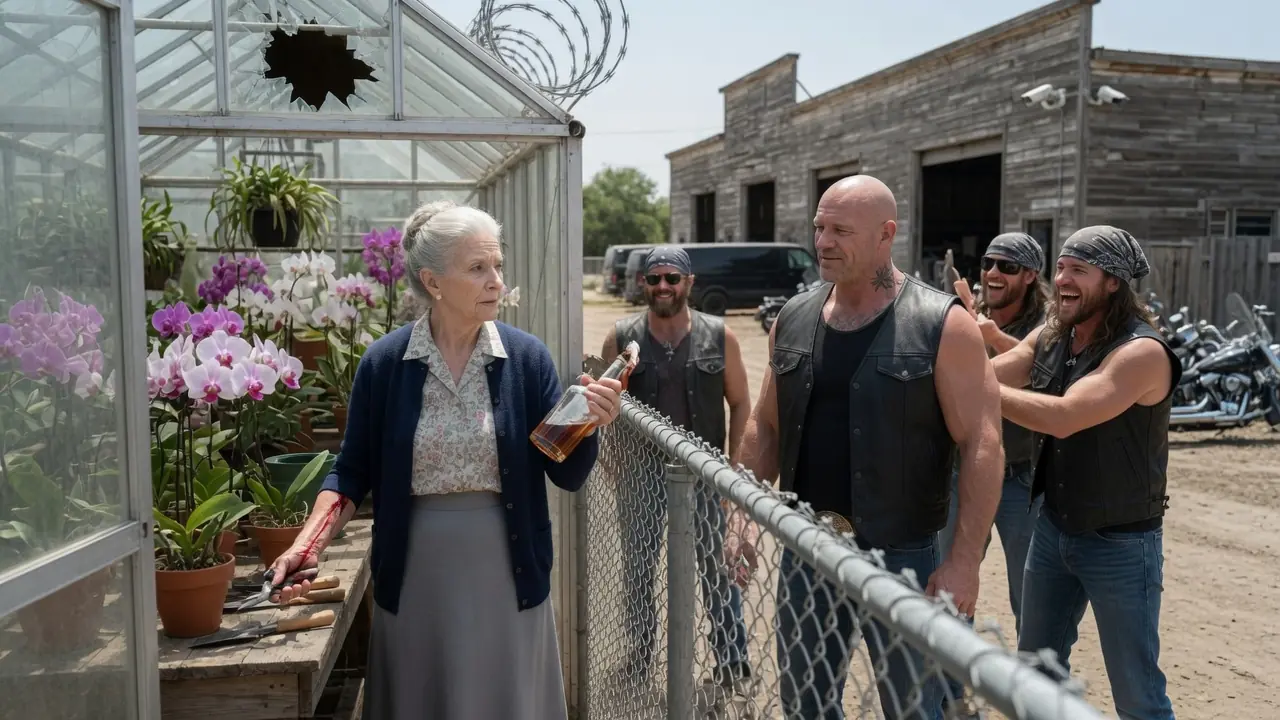
Her property included a modest two-story house, a vegetable garden, and a glass greenhouse built by her late husband, Arthur.
Arthur Hale had served in military intelligence before retiring.
He seldom discussed his work, but he believed careful observation was a skill every person should possess.
“Most people see only what they expect,” he once told Margaret. “That is why arrogance creates such poor security.”
Arthur died nine years before the Black Talons entered Pine Valley.
Margaret mourned him without allowing grief to make her passive.
She volunteered at the county health clinic.
She baked bread for the church pantry.
She grew tomatoes, herbs, hydrangeas, and difficult orchids that rewarded patience more reliably than most people did.
An abandoned timber warehouse stood beyond the ravine bordering her property.
For years, the building remained empty.
Its windows broke one by one. Rust spread across the loading doors. Owls nested in the rafters.
Then, in late July, motorcycles arrived.
The first convoy contained more than thirty riders.
Two black SUVs followed them, along with three cargo vehicles.
Within a week, contractors installed an eight-foot fence around the warehouse. Razor wire appeared along the top. Cameras covered the road entrance. Floodlights illuminated the property throughout the night.
The Black Talons had established a new regional headquarters.
Their leader, Gabriel “Grave” Knox, was forty-seven, six feet five inches tall, and built like a man who had spent his life using size before language.
A black raven tattoo covered the left side of his neck. Another tattoo, shaped like a chain, circled one wrist.
Knox had recently escaped conviction in a federal racketeering case after critical evidence was excluded because of procedural errors.
He interpreted the result as proof that he was untouchable.
The Black Talons understood how to occupy a town without creating immediate grounds for a major police operation.
The warehouse permits appeared legitimate.
A corporation owned the property.
Attorneys answered complaints.
Club members did not threaten residents in front of cameras when a gesture, a stare, or an anonymous act of vandalism would achieve the same result.
Motorcycles roared after midnight.
Men urinated beside neighboring fences.
Empty bottles appeared in gardens.
People who complained discovered slashed tires, broken porch lights, or dead animals left near their doors.
The first serious assault involved seventy-two-year-old shopkeeper Walter Finch.
A motorcycle blocked the loading area behind his hardware store. Walter asked the rider to move it.
That evening, someone attacked him behind the building.
He suffered a broken jaw, fractured ribs, and damage to one eye.
Walter remembered hearing two voices.
He saw no faces.
No witness admitted being nearby.
Detective Aaron Mills visited Margaret the following afternoon.
Aaron had worked in Pine Valley for twenty-four years. He understood the law, the town, and the limitations of his department.
They sat at Margaret’s kitchen table while engines shook the windows.
“We’re documenting everything,” he said.
Margaret poured tea.
“Documenting is not the same as stopping.”
“I need evidence that gives us legal authority to enter that property.”
“They attacked Walter.”
“He cannot identify anyone.”
“He knows who did it.”
“Knowing is not enough in court.”
Margaret looked toward the warehouse.
“Then perhaps you should collect better evidence.”
Aaron sighed.
“Mrs. Hale, I came here because your property is closest. I want you to be careful.”
“That is not why you came.”
He looked at her.
“You came to ask whether I saw anything.”
“Did you?”
“No.”
The answer was true.
She had heard motorcycles and distant shouting. She had not seen the assault.
Aaron lowered his voice.
“Knox is dangerous.”
“So was infection before antibiotics.”
“This isn’t a hospital.”
“No. In hospitals, people eventually admit something is wrong.”
Aaron rested both hands around his glass.
“I’m asking you not to provoke them.”
Margaret gave him a thoughtful look.
“You believe existing beside them is provocation.”
“I believe they may see it that way.”
“Then their eyesight is the problem.”
One week later, a whiskey bottle crashed through the roof of Margaret’s greenhouse.
She had been repotting an orchid when the glass exploded.
A sharp fragment cut her left forearm.
Blood ran down her hand and fell into the potting soil.
Margaret stepped away from the broken panel, pressed a cloth against the wound, and assessed it.
The cut was deep but clean.
It required closure, not panic.
She entered the house, irrigated the wound, used medical adhesive strips, and wrapped the arm.
When she returned, Knox stood beyond the fence with two Black Talons.
One was Bryce Nolan, the club’s chief enforcer.
The other was a heavyset man called Wade Mercer.
Knox held a cigar.
“Rough day, Grandma?”
His men laughed.
Margaret looked at the broken greenhouse roof.
“Your bottle damaged my property.”
“Prove it was ours.”
“You were watching when it landed.”
“That prove anything?”
“It proves you find vandalism entertaining.”
Bryce stepped closer to the fence.
“You calling us vandals?”
Margaret collected the broken bottle neck using gardening gloves.
“No.”
She placed it inside a metal bucket.
“I am documenting damage.”
Knox blew smoke toward her.
“Maybe you should move before something worse happens.”
Margaret met his eyes.
“You have made an error.”
The laughter weakened.
“What error?”
“You assumed frightening me would make me less observant.”
Bryce gripped the fence.
“Is that a threat?”
“No.”
Margaret turned toward the house.
“It is a diagnosis.”
That evening, she entered the basement and opened Arthur’s old equipment chest.
The contents had remained untouched for years.
Inside were binoculars, maps, notebooks, compact cameras, voice recorders, measuring tools, and an old military field compass.
Nothing made Margaret an intelligence operative.
Arthur had never trained her to become one.
But decades of marriage had taught her habits.
Record exact times.
Separate observation from interpretation.
Never rely upon memory when a written note is possible.
Look for patterns, not dramatic moments.
Most importantly, never allow the subject to know which detail matters.
For nearly a month, Margaret gave the Black Talons what they expected.
She closed her curtains.
Stopped reading on the porch.
Visited the grocery store early.
Avoided looking toward the warehouse whenever riders passed.
The bikers assumed the broken greenhouse had frightened her.
From the attic, she began studying them.
She ignored the drinking and noise.
Those things were meant to attract attention.
Margaret searched for the activity designed not to be noticed.
She recorded shift changes among the guards.
She noted which gates opened for deliveries.
She logged vehicles arriving during darkness.
Patterns emerged.
Cargo vans appeared twice each week, usually on Tuesday and Thursday.
The same black pickup left approximately twenty minutes after each arrival.
Certain members were permitted inside the rear loading area.
Others remained outside.
Men who behaved recklessly during parties became disciplined when particular vehicles arrived.
Margaret photographed plates when possible.
If an image was unclear, she wrote that it was unclear.
She did not enhance uncertainty into fact.
One white van appeared seven times.
A dark-blue delivery truck appeared four.
A refrigerated trailer entered three times despite the warehouse having no known food operation.
Margaret created a chart.
Dates ran down one side.
Vehicles, drivers, arrival times, departure times, and weather conditions filled the columns.
Then she noticed a pipe emerging from the warehouse property into the ravine.
The warehouse cameras covered the gates, parking area, and road.
They did not cover the steep wooded ground behind the fence.
Knox believed the ravine formed a natural barrier.
Margaret knew it better than he did.
Arthur had built stepping points there years earlier so they could reach the creek after storms.
Wearing dark gardening clothes, Margaret entered the ravine before dawn.
She remained on her own property and on the public drainage boundary.
Near the outlet pipe, the vegetation had changed.
Ferns were yellow.
Moss had died.
A strange sheen moved across shallow water.
The smell contained solvents and ammonia.
Margaret had encountered both in emergency rooms involving industrial exposure and illegal drug production.
She did not assume the source.
She collected samples.
Each container was labeled with time, date, weather, and location. She photographed the collection points and documented how every sample was sealed.
A private environmental laboratory tested them.
The results identified multiple chemical compounds consistent with waste from synthetic narcotics manufacturing.
Margaret sat at her kitchen table with the report.
The warehouse was not merely a gang clubhouse.
It contained an active drug laboratory.
She prepared two evidence binders.
One included photographs, timelines, vehicle charts, laboratory results, maps, and written explanations of what she personally observed.
The second was an exact duplicate.
One remained hidden beneath a loose board in the greenhouse.
The other was delivered to Special Agent Daniel Ross at the federal narcotics office in Portland.
Arthur had known Daniel’s father during military service.
Margaret included a brief note.
I believe this material may document narcotics production and interstate distribution at the former Pine Valley Timber Warehouse. Please verify all information independently.
She did not call the local police.
Aaron Mills was trustworthy.
Margaret worried that ordinary communication between departments could alert someone unintentionally.
Federal agents began surveillance from a distance.
Vehicle data matched several known trafficking contacts.
The laboratory findings were independently confirmed.
Still, obtaining warrants required time.
Knox’s operation became more active.
Larger trucks arrived.
The drainage discharge increased.
Families began moving away from Briarwood Road.
Walter Finch refused to reopen his hardware store.
Margaret understood that the bikers believed fear had become permanent.
She decided to disturb that confidence.
Knox’s greatest weakness was not greed.
It was pride.
He needed the town to believe he controlled everything around him.
An invisible investigation could continue for months.
A public hint that an elderly widow had outmaneuvered him would demand an immediate response.
At the grocery store, Margaret saw Bryce Nolan near the beverage aisle.
She approached the cashier and spoke loudly enough for him to hear.
“My nephew received the photographs.”
The cashier blinked.
“What photographs?”
“The nighttime ones.”
Margaret placed apples on the counter.
“He was particularly interested in the rented vans.”
Bryce stopped moving.
Margaret paid without looking at him.
That night, two vehicles left the warehouse unexpectedly.
Men inspected the rear fence.
Knox doubled the guards.
Margaret photographed the changes.
The following morning, she sat on her porch drinking coffee.
Knox appeared behind the fence.
Margaret raised her cup.
He stared at her.
She smiled.
Three nights later, the electricity to Margaret’s house failed at 1:17 in the morning.
The surrounding homes remained lit.
Margaret sat inside her locked bedroom with a fully charged phone, a battery-powered lamp, and Arthur’s revolver secured on the bedside table.
She had already contacted Agent Ross after noticing unusual movement at the warehouse.
Federal agents were still several miles away.
Aaron Mills and the local department remained closer.
Margaret heard wire cutters at the rear fence.
Then footsteps crossed her garden.
Three people.
The back door shattered.
Flashlights moved through the kitchen.
“Find the files,” Knox whispered.
Another voice asked, “What about the old woman?”
“Make it look accidental.”
Margaret activated the emergency call function on her phone.
The dispatcher remained silent, following instructions for an active intrusion.
Knox stayed upstairs.
Bryce and Wade moved toward the basement.
Margaret had prepared the lower level.
An old laptop sat on a workbench displaying what appeared to be an evidence-upload screen.
It was not connected to federal systems.
The screen existed only to confirm what Knox already feared.
When Bryce and Wade entered the basement storage room, Margaret pressed a remote switch.
A reinforced security door closed behind them.
Arthur installed it decades earlier to protect supplies during severe storms.
The men struck the door.
The laptop display changed.
TRANSFER COMPLETE
FEDERAL RECIPIENT CONFIRMED
Bryce began shouting.
Upstairs, Knox moved rapidly toward the hallway.
Margaret activated the home alarm.
High-intensity security lights flooded the rooms.
Knox stumbled and dropped his flashlight.
Margaret remained behind her bedroom door.
She did not emerge with the revolver.
She did not confront him.
She spoke clearly into the emergency call.
“Three armed men entered my residence. Two are contained in the basement. One is in the upstairs hallway. They stated that they intended to make my death appear accidental.”
Aaron Mills arrived five minutes later with Officer Jacob Price and two additional patrol units.
They entered through the damaged rear door.
Knox stood in the hallway covering his eyes.
His handgun lay several feet away.
“Hands behind your head!” Aaron shouted.
Knox looked toward the stairs.
Four weapons were trained on him.
He obeyed.
Margaret disabled the alarm and opened the bedroom door.
Her hair remained pinned, though several strands had fallen loose. She wore a dark robe over her nightclothes.
The revolver remained pointed toward the floor.
Aaron stared at her.
“Are you hurt?”
“No.”
“What did you do?”
“Delayed them until you arrived.”
A voice shouted from behind the basement door.
“We surrender! Don’t bring the federal agents!”
Jacob Price looked toward Aaron.
“Federal agents?”
Margaret placed the revolver on a dresser.
She retrieved the duplicate evidence binder from a locked cabinet and handed it to Aaron.
He opened the first page.
His expression changed.
The photographs were clear.
The timelines precise.
The environmental reports professionally documented.
Every inference was identified as inference.
Every confirmed fact was supported.
“You’ve been collecting this alone?”
“Yes.”
“For how long?”
“Twenty-seven days.”
His radio interrupted.
Dispatch announced that federal and state tactical teams were entering Pine Valley with search and arrest warrants for the Black Talons warehouse.
Aaron closed the binder.
“You built the investigation.”
Margaret looked toward the broken greenhouse visible through the rear window.
“I noticed what they believed nobody important would see.”
By sunrise, Briarwood Road was filled with federal vehicles.
Tactical teams entered the warehouse.
Several Black Talons surrendered immediately.
Others attempted to destroy records before being arrested.
Hazardous-material crews discovered a large synthetic-drug laboratory in the lower level.
Agents seized weapons, cash, stolen motorcycles, chemical precursors, and financial ledgers connecting the operation to distribution sites in Oregon, Washington, and Idaho.
Special Agent Daniel Ross entered Margaret’s kitchen shortly after dawn.
She offered him coffee and a slice of bread.
Daniel placed her evidence binder on the table.
“This is the most disciplined civilian submission I’ve seen in twenty-three years.”
“My husband disliked careless paperwork.”
“You documented an entire criminal operation from an attic.”
“They made little effort to be quiet.”
“You placed yourself in serious danger.”
“They were poisoning the creek.”
Daniel looked toward her bandaged arm.
“That does not explain why you remained here.”
Margaret’s eyes moved toward Arthur’s photograph.
“They expected every decent person to surrender one house at a time.”
She buttered her bread.
“I did not wish to participate.”
The arrests continued for weeks.
Bryce Nolan began cooperating after believing federal agents already possessed all financial records.
Wade Mercer followed.
Storage sites, shell companies, and distribution garages were identified.
Forty-eight people were eventually indicted.
Charges included narcotics manufacturing, racketeering, weapons trafficking, environmental crimes, assault, conspiracy, and attempted murder.
The Black Talons’ power collapsed faster than investigators expected.
Knox had controlled his organization through the belief that he could not be challenged.
Being arrested inside the home of an elderly widow destroyed that belief.
Members who feared him began protecting themselves.
Associates traded information for reduced sentences.
Partners emptied accounts and disappeared.
Fear reversed direction.
During the federal trial, Knox’s attorneys attempted to transform Margaret from a careful witness into a confused old woman.
The strategy failed.
When they questioned a photograph, she explained its limitations.
When they challenged the samples, she described the collection procedure.
When they suggested loneliness had made her obsessive, she produced volunteer schedules, medical work, and ordinary daily records demonstrating that her life extended far beyond watching the warehouse.
The defense attorney grew impatient.
That impatience produced the question about her age, grief, and isolation.
Margaret’s answer dismantled the final attempt to discredit her.
The jury convicted Knox on every major charge.
He received forty-six years in federal prison.
Bryce received twenty-three after cooperation.
Wade received nineteen.
The seized warehouse property underwent environmental cleanup.
Contaminated soil was removed.
The structures were demolished.
Pine Valley later purchased the land and created a public garden, walking trail, and small community health center.
A path connected the new clinic to Margaret’s greenhouse.
Walter Finch reopened the hardware store.
Aaron Mills became police chief two years later.
At his first public meeting, he refused praise for solving the case.
“We kept waiting for evidence to arrive in a form we recognized,” he said. “Mrs. Hale reminded us that observation is work. Documentation is work. Seeking help from agencies with greater resources is not weakness.”
Margaret disliked hearing her name from the stage.
She disliked the applause even more.
When a national television crew asked to interview the “Grandmother Who Defeated a Biker Empire,” she declined.
The crew parked beside her garden anyway.
Margaret activated the sprinklers.
The cameras remained dry.
The producer did not.
She returned to ordinary life.
Volunteers repaired the greenhouse.
Margaret replanted the damaged orchid.
She continued serving at the clinic and bringing bread to the church pantry.
Police officers waved when passing her home.
Teenagers lowered their voices near her property.
One afternoon, Aaron visited while she pruned hydrangeas.
“Half this town is afraid of you.”
“That seems unnecessary.”
“Knox was afraid of you.”
“No.”
Margaret cut a dead flower from its stem.
“He was afraid of losing control over how people saw him.”
“Isn’t that the same?”
“No. Fear of another person recognizes their power. Knox never recognized mine.”
She handed Aaron the shears.
“Cut the damaged branch.”
He clipped the wrong one.
Margaret frowned.
“Not that far down.”
“You said the damaged branch.”
“I assumed you could distinguish damage from inconvenience.”
Aaron smiled.
“You enjoy this.”
“Only slightly.”
Years later, Pine Valley dedicated the trauma room inside the community clinic to Margaret Hale.
She was eighty-eight when she died peacefully at home.
The dedication display contained her nursing pin, gardening gloves, binoculars, and the first black notebook used to record warehouse traffic.
The revolver was not included.
Neither was the false computer screen.
Those objects had become the most dramatic parts of the public story.
Margaret understood that they were not the reason Knox lost.
The weapon was never fired.
The security door only delayed two men.
The raid merely completed work already made possible by months of evidence.
Knox lost because he believed Margaret was too old, too small, and too ordinary to matter.
That belief allowed her to observe without attracting attention.
It convinced him her closed curtains meant surrender.
It encouraged his men to become careless.
It brought him into her house because he assumed an elderly widow could possess only fear, never strategy.
Gabriel Knox built fences, hired armed guards, installed cameras, and terrorized an entire town through noise.
Margaret Hale sat beside him with a notebook.
Power did not announce itself.
It wore gardening clothes.
It remembered license plates.
It labeled water samples.
It waited behind lace curtains while arrogant men created the evidence that would bury them.
And when the time came, it entered a federal courtroom, folded its hands calmly, and corrected the attorney who made the final mistake of believing age had made it harmless.