The first motorcycle struck the puddle at nearly fifty miles per hour.
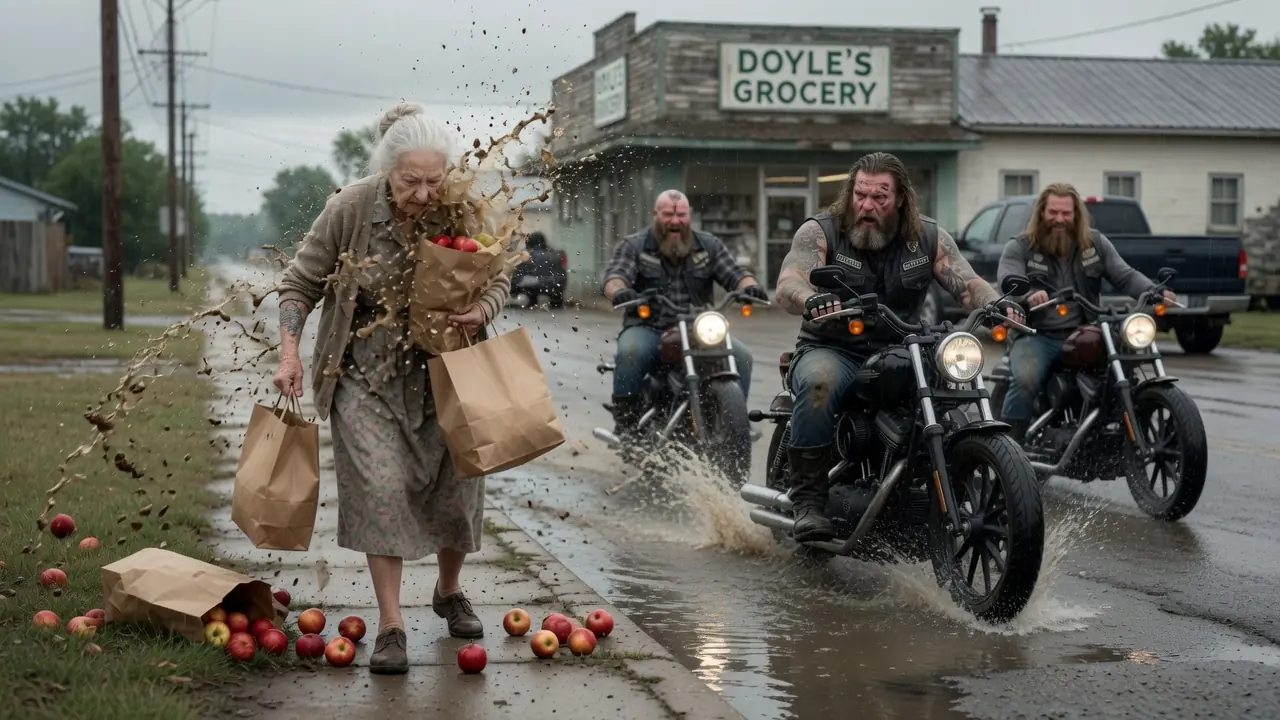
Dirty rainwater rose from the roadside in a wide brown sheet and crashed over the elderly woman walking beside the highway.
It soaked her gray hair.
It filled the paper grocery bag in her arms.
It covered her glasses and darkened the front of her long wool coat.
Two apples rolled across the gravel shoulder. A carton of eggs fell from the torn bottom of the bag and broke near her shoes.
The six motorcycles behind the first rider could have slowed down.
They did not.
One after another, they drove through the same puddle, throwing more muddy water over the woman until she disappeared behind the spray.
Laughter followed the engines.
At the front of the convoy rode Mason Crowley, president of the Black River Riders Motorcycle Club’s local chapter. He looked into his mirror and saw the woman standing motionless beside the ruined groceries.
He lifted one hand from the handlebars and made an exaggerated gesture of apology.
Then he laughed again.
The other riders followed him toward the gas station half a mile ahead.
Only the youngest member looked back.
His name was Cody Miles.
He was twenty-two and still wore a plain leather vest without the full club colors. The Black River Riders called him a prospect, which meant he did the work nobody else wanted and spoke only when invited.
Cody saw the elderly woman bend slowly to retrieve the apples.
Her left hand shook.
One knee appeared stiff.
She lowered herself with difficulty, but the mud-covered glasses prevented her from seeing where the groceries had fallen.
A delivery truck passed dangerously close to her.
Cody looked toward the men ahead.
Mason had already entered the gas-station parking lot.
The others followed.
Cody slowed his motorcycle.
He knew what would happen if he broke formation without permission.
Mason would accuse him of weakness.
The other riders would laugh.
He might lose the chance to receive the club patch he had spent nearly a year earning.
Then Cody saw the woman reach toward the road for an orange that had rolled near the white line.
He turned around.
The roar of his motorcycle faded as the other riders continued toward the gas station.
The woman heard him approaching and stepped away from the shoulder.
“I’m not going to hurt you,” Cody called.
He parked several yards away and removed his helmet.
Mud dripped from the woman’s coat.
“You’ve already done enough,” she said.
Her voice was steady.
Cody looked down.
“Yes, ma’am.”
He retrieved the orange before another vehicle crushed it. Then he collected the apples, canned soup, bread, and a small package of coffee from the gravel.
Most of the food was ruined.
The woman removed her glasses and wiped them with the only dry corner of her scarf.
Cody picked up the broken carton.
“I’m sorry.”
“You weren’t leading.”
“I still rode through the water.”
“You slowed down.”
“Not enough.”
The woman studied him.
He had expected anger.
Instead, she seemed to be deciding what kind of man stood in front of her.
“Young people often believe being less cruel than the person ahead of them makes them innocent,” she said.
Cody had no answer.
The wind moved across the empty fields beside the highway.
It was early November in northern Arkansas, and the afternoon had turned colder after the rain. The woman’s wet coat would soon become dangerous.
“Do you live nearby?” Cody asked.
“Two miles east.”
“I can take you.”
She looked toward his motorcycle.
“My days of climbing onto the back of a stranger’s bike are finished.”
“I could call someone.”
“My telephone is in the bag.”
Cody found the small phone beneath a crushed loaf of bread. Water had entered the cracked screen.
It would not turn on.
“I’ll buy replacements,” he said. “There’s a store at the gas station.”
“You don’t have to do that.”
“Yes, ma’am. I do.”
He gathered the remaining groceries.
As he lifted the torn paper bag, something beneath the woman’s open coat caught his attention.
Black leather.
At first, Cody assumed she wore an ordinary vest beneath the wool.
Then the wind pulled the coat wider.
He saw a faded patch stitched across the back of the leather.
A black river curved beneath a silver moon. Above it spread the wings of a red-tailed hawk. The words surrounding the emblem were nearly worn away, but Cody recognized them immediately.
BLACK RIVER RIDERS
His hands stopped moving.
The current club patch used the same river and bird.
But this one was older.
The hawk faced left instead of right. The river had three silver lines rather than two. Along the lower edge was a narrow rocker Cody had never seen on any modern vest.
Its gold thread had faded, but the words remained visible.
FOUNDING CHARTER — 1968
Cody stared.
The woman pulled her coat closed.
“Something wrong?”
“Where did you get that vest?”
Her expression changed.
The frail woman beside the highway seemed to disappear.
In her place stood someone far more alert.
“Why are you asking?”
“That’s our club patch.”
“No.”
She looked toward the gas station.
“Your patch came from this one.”
Cody’s mouth went dry.
Only one original founding vest was known to have survived.
The old members spoke about it inside the clubhouse after midnight, when stories became more honest and less concerned with impressing younger riders.
It belonged to a woman called Maggie Hawk.
Some claimed she had been the wife of the club’s first president.
Others said she was the real reason the club survived its early years.
According to the oldest stories, Maggie rode a red 1962 Harley-Davidson Panhead and carried medical supplies in one saddlebag. She stitched wounds after crashes, found work for unemployed veterans, and once rode through a snowstorm to deliver medicine to the child of a stranded member.
No one agreed on what happened to her.
Some said she died.
Some said she disappeared after her husband was killed.
A few believed she remained alive but wanted nothing to do with the club the Black River Riders had become.
Cody looked at the elderly woman’s face.
“What is your name?”
“Margaret Hayes.”
His breath caught.
The name from the stories was Margaret “Maggie” Hayes.
Cody almost dropped the groceries.
At the gas station, Mason Crowley noticed the missing motorcycle.
He stepped outside with four riders behind him.
Cody stood beside the old woman half a mile down the road.
Mason climbed onto his motorcycle.
The others followed.
They returned quickly, engines rolling across the wet highway.
Margaret did not move as the bikes surrounded her.
Mason removed his sunglasses.
“What are you doing, prospect?”
“Helping her.”
“I can see that.”
Mason glanced at the ruined groceries.
Then he looked at Margaret.
“Sorry about the shower, Grandma. You should stay farther from the road.”
Margaret wiped mud from her cheek.
“You should learn how to control a motorcycle.”
The riders exchanged looks.
Nobody spoke to Mason that way.
He smiled without humor.
“I’ve been riding longer than you’ve probably been walking straight.”
Margaret’s eyes moved toward the front tire of his customized touring bike.
“You entered the water with the front wheel turned three degrees right because you were looking into your mirror. Your left hand loosened when the tire lost traction. The bike corrected you. Not the other way around.”
One rider looked down to hide a smile.
Mason stepped closer.
“You always talk this much to strangers?”
“Only the poorly trained ones.”
Cody moved between them slightly.
“Boss, you need to see something.”
“I need to see you back in formation.”
“The vest.”
Mason frowned.
“What vest?”
Margaret’s wet coat had fallen open again.
The original Black River patch was visible.
The riders became silent.
A man named Caleb Morgan climbed off his motorcycle.
Everyone called him Grizzly. At sixty-four, he was the oldest active member of the local chapter. His beard was white, his shoulders still broad, and one leg dragged slightly from an old crash.
Grizzly approached Margaret carefully.
His face changed as he examined the faded stitching.
He removed his gloves.
“No,” he whispered.
Margaret looked at him.
“You were Samuel Morgan’s boy.”
Grizzly stared.
“My father was Samuel.”
“You were eight when he brought you to the old clubhouse. You stole two bottles of root beer and hid behind the tool shed because you thought your father would beat you.”
Grizzly’s eyes filled with something Cody had never seen there.
“My father didn’t find me.”
“No. I did.”
Margaret’s voice softened.
“I told him the bottles broke when a toolbox fell.”
Grizzly removed his sunglasses.
“Maggie?”
Mason looked from him to the elderly woman.
“You know her?”
Grizzly ignored the question.
He lowered his head.
The gesture was not submission.
It was respect.
“Mrs. Hayes.”
The other riders shifted uneasily.
Mason’s confidence weakened but did not disappear.
“Who is she?”
Grizzly turned.
“She founded the Black River Riders.”
Mason laughed once.
“No woman founded this club.”
Margaret looked at the president’s patch.
“That attitude explains much of what I’ve heard.”
Mason stepped toward her.
“The club was founded by Walter Hayes and six veterans in 1968.”
“Five veterans,” Margaret corrected. “One mechanic who had never served, and me.”
She pointed toward the hawk emblem.
“I drew that bird at Walter’s kitchen table. I chose the black river because all of us had crossed something dark before finding one another.”
Grizzly nodded slowly.
“My father said you designed the colors.”
“I stitched the first seven patches by hand.”
Mason looked toward the vest.
“Anyone could copy an old design.”
Margaret almost smiled.
“Inside your clubhouse office is a steel safe beneath the floorboards. The combination is written in reverse beneath the left drawer of Walter’s oak desk.”
The smile disappeared from Mason’s face.
Margaret continued.
“The safe contains the original national charter, property deed, and emergency trust documents. The Black River Riders’ insignia and clubhouse land are owned by the Hayes Brotherhood Trust.”
Grizzly closed his eyes.
He knew where the conversation was going.
Mason did not.
“What does that have to do with you?”
“I am the surviving trustee.”
The highway became quiet except for the ticking engines.
Margaret held out one muddy hand.
“Give me your telephone, Caleb.”
Grizzly immediately gave her his phone.
Mason watched in disbelief.
Margaret dialed a number from memory.
A man answered after two rings.
“Daniel,” she said. “This is Margaret Hayes.”
She listened.
“Yes, I’m alive.”
Another pause.
“I need you at the Black River clubhouse within the hour. Bring the trust documents and the chapter review forms.”
She ended the call.
Mason stepped forward.
“You don’t walk into my town and review my chapter.”
Margaret returned the phone to Grizzly.
“This was my town before you learned to ride.”
“You abandoned the club.”
“I buried my husband.”
The words stopped him.
Walter Hayes had died in 1989 after being struck by a drunk driver while helping a stranded family beside an interstate.
The club’s official history described his death in two paragraphs.
It never explained what followed.
Margaret had spent twenty-one years helping build the Black River Riders into an organization that transported medicine, repaired veterans’ homes, escorted funeral processions, and protected stranded travelers.
After Walter’s death, younger leaders began changing it.
Helping the community became less important than being feared by it.
Clubhouses grew louder.
Members used the patch to intimidate bartenders, store owners, and motorists.
Margaret fought the changes for two years.
Then a new national president told her she was only a widow and should leave club business to men.
She placed the founding vest in a trunk and disappeared from club life.
But Walter had placed the charter and original property into a trust before his death.
Margaret remained its final surviving trustee.
For thirty-five years, she never used that authority.
She believed the club might correct itself.
Standing beside the highway with broken eggs at her feet, she realized how wrong she had been.
Mason looked toward the other riders.
“This is ridiculous. We’re not taking orders from some old woman because she has an antique vest.”
Grizzly’s expression hardened.
“That antique vest is the reason yours exists.”
Mason faced him.
“You choosing her over your president?”
“I’m choosing the charter.”
Cody picked up the ruined groceries.
Mason pointed at him.
“Put that down and get back on your bike.”
Cody looked at Margaret.
Then at the full patch he had spent eleven months trying to earn.
He had cleaned the clubhouse bathrooms.
Guarded motorcycles through cold nights.
Accepted insults.
Fought men he did not hate because Mason considered violence a test of loyalty.
That morning, becoming a full member had seemed like the most important thing in his life.
Now the patch looked different.
It did not represent brotherhood merely because men said it did.
It represented the choices made while wearing it.
“No,” Cody said.
Mason stared.
“What?”
“I’m helping her replace the groceries.”
“You’re finished with this club.”
Margaret looked toward Cody.
“Perhaps he is finished with your version of it.”
Mason’s hands closed into fists.
Grizzly moved between them.
“You touch either of them, and we’ll settle this without waiting for the lawyer.”
The other riders did not move toward Mason.
For the first time since becoming president, he stood alone while surrounded by his own chapter.
Margaret gathered her wet coat.
“Caleb, take me to the clubhouse.”
Grizzly looked toward his motorcycle.
“You able to ride?”
She examined the machine.
“Your rear suspension is set too soft, and that exhaust is unnecessarily loud.”
A surprised laugh escaped him.
“I’ll take that as a yes.”
“There’s a sidecar in the old storage building.”
Grizzly blinked.
“You know about that?”
“It belonged to Walter.”
The Black River Riders clubhouse stood on twelve wooded acres outside town.
A weathered sign marked the entrance. Motorcycles, trucks, and rusting parts filled the yard.
Margaret arrived in Grizzly’s pickup instead of the sidecar. Cody followed with replacement groceries he purchased at the gas station.
By the time they reached the property, club members had heard that someone wearing an original patch was coming.
Nearly thirty people waited outside.
Some were young.
Others had ridden with the club for decades.
Mason arrived last.
He entered through the gate aggressively, throwing gravel behind his rear tire.
Margaret stepped out of the truck.
Nobody laughed at her wet clothes.
Several older members recognized her immediately.
One man removed his cap.
Another whispered, “Road Mother.”
Margaret walked toward the clubhouse.
Her limp became more visible on the uneven ground, but she refused assistance.
Inside, the building smelled of engine oil, tobacco, and old wood.
Photographs covered the walls.
Walter Hayes appeared in several.
In one picture, he stood beside a young Margaret wearing the vest beneath her coat.
Her hair was dark.
One hand rested on the handlebars of a red Panhead.
Someone had cut her half of the photograph away from the display.
Only the edge of her arm remained.
Margaret stopped.
“Who did that?”
Nobody answered.
Mason entered behind her.
“I cleaned up the club history.”
“You removed what embarrassed you.”
“I removed what didn’t matter.”
Grizzly’s chair scraped against the floor.
Margaret raised one hand.
He remained seated.
She walked into the office.
The old oak desk still stood against the wall.
Mason had covered its surface with trophies, liquor bottles, and unpaid invoices.
Margaret opened the left drawer and reached beneath it.
A series of numbers had been carved into the wood in reverse.
She read them aloud.
Then she pointed toward the floor.
“Move the desk.”
Several members obeyed.
Beneath a loose plank was a steel safe.
Mason’s face darkened.
“I’ve been president four years. I never knew that was there.”
“Because leadership and ownership are not the same thing.”
A black sedan entered the yard.
Daniel Preston, a sixty-year-old attorney representing the Hayes Brotherhood Trust, entered carrying a leather case.
He greeted Margaret, then placed several documents on the clubhouse table.
The original charter recognized Margaret and Walter Hayes as co-founders.
The insignia licensing agreement prohibited chapter members from using the colors for harassment, criminal activity, personal profit, or conduct damaging to the club’s founding mission.
The clubhouse property could be reclaimed by the trust if a chapter violated those conditions.
Daniel opened another file.
During the previous two years, Mason’s chapter had accumulated complaints involving threats, vandalism, unpaid restaurant bills, assaults, and intimidation.
Most had never resulted in convictions.
The charter did not require convictions.
It required conduct consistent with the founding purpose.
Mason looked around the room.
“You all going to let her take the clubhouse?”
Margaret faced the members.
“I have no interest in taking anything.”
She removed the soaked wool coat.
The original leather vest was fully visible.
Its surface carried scratches, repaired seams, and road wear from another era.
“What I want is to know whether the Black River Riders still exist.”
Mason laughed bitterly.
“You’re standing inside the clubhouse.”
“I see motorcycles. I see patches. I see men who enjoy being feared.”
Margaret looked toward the old photographs.
“I have not yet seen the club Walter and I built.”
A younger member crossed his arms.
“What exactly did you build?”
“A group that collected groceries for injured workers.”
Margaret pointed toward another photograph.
“We repaired roofs for widows. We found jobs for veterans. We carried children to hospitals when snow closed the roads.”
She looked toward Mason.
“We did not use puddles to humiliate elderly women.”
Mason’s expression twisted.
“It was water.”
“No.”
“It was a choice.”
The room became quiet.
Margaret turned toward Cody.
“This young man returned.”
Cody lowered his eyes.
“He helped collect what you destroyed. He apologized without explaining why the rest of you were worse.”
She looked around the table.
“That is closer to brotherhood than anything your president demonstrated today.”
Mason pulled the president’s patch from his vest.
“You want this?”
He threw it onto the table.
“Take it.”
Margaret looked at the patch.
“I do not want your title.”
“Then what do you want?”
“One year.”
Several members exchanged glances.
“For the next year, this chapter operates under trust supervision. No intimidation. No unpaid debts. No violence except lawful defense. Every member contributes time to community work.”
Mason laughed again.
“You’re turning us into a charity club.”
Margaret looked toward Grizzly.
“What was Walter doing when he died?”
Grizzly answered quietly.
“Helping a family with a broken car.”
“What was Samuel Morgan doing when the club paid his rent in 1971?”
Grizzly’s jaw tightened.
“Recovering from surgery.”
“What did the club do after the Miller house burned?”
An older member near the wall spoke.
“Built them another one.”
Margaret nodded.
“We were always a service organization. The motorcycles only helped us reach people faster.”
Mason walked toward the door.
“Anyone who agrees to this is weak.”
No one followed him.
He stopped with one hand on the frame.
“I made this chapter respected.”
“You made it avoided,” Margaret said. “Fear leaves when the threat leaves. Respect remains.”
Mason looked toward the members.
Cody expected at least a few to stand with him.
Nobody did.
He removed the rest of his club colors, dropped them onto a chair, and left.
His motorcycle roared through the gate.
The sound faded into the woods.
The first trust-supervised meeting lasted nearly four hours.
Members argued.
Some left.
Twenty-three remained.
Grizzly was appointed temporary chapter president.
Cody’s probation was extended, not as punishment, but because Margaret told him a patch should never be accepted before a person understood what it required.
His first assignment was to deliver the replacement groceries to her home.
When they arrived, Margaret unlocked a small white house at the edge of town.
The property appeared ordinary except for a detached garage behind it.
Cody carried the bags inside.
“Where should I put these?”
“Kitchen counter.”
He noticed framed photographs along the wall.
Margaret and Walter beside motorcycles.
Club members building a porch.
A funeral procession stretching down a highway.
One photograph showed Margaret kneeling beside an injured rider while using her belt as a tourniquet.
“You were really the club medic?”
“I was a nursing student when we started.”
“Did you save people?”
“Some.”
She removed the wet vest and placed it carefully across a chair.
Cody noticed an old scar running from her shoulder toward her elbow.
“What happened there?”
“Truck mirror.”
“You got hit?”
“In 1974.”
“And kept riding?”
“The motorcycle was less damaged than I was.”
Cody smiled.
Margaret opened the garage.
Beneath a dusty canvas stood a red Harley-Davidson Panhead with a sidecar.
The chrome had dulled, but the machine remained beautiful.
Cody stared.
“Does it run?”
“It did when I parked it.”
“When was that?”
“1991.”
He looked horrified.
“You left a Panhead sitting for thirty-four years?”
“I had other concerns.”
Cody walked around the motorcycle.
“We could restore it.”
Margaret looked toward him.
“We?”
“The chapter.”
“You have not earned the chapter patch.”
“Then it can be part of earning it.”
For the first time that day, Margaret smiled fully.
“Perhaps you are teachable.”
Over the following months, the Black River Riders became visible around town for different reasons.
They repaired the roof of the food pantry.
They delivered firewood to elderly residents.
They escorted a school bus carrying children from military families during a Veterans Day parade.
They paid old restaurant bills Mason had ignored.
Members who had once frightened local business owners returned to apologize.
Not everyone was forgiven.
Margaret reminded them that changing conduct did not require immediate praise.
“You are not helping people so they will call you good,” she said. “You are helping because the patch requires it.”
Cody worked on the Panhead every Saturday.
Grizzly rebuilt the engine.
Other members restored the sidecar, replaced wiring, cleaned the fuel system, and repaired the red paint without erasing every scratch.
Margaret supervised from a chair beside the garage.
She rejected modern modifications.
“No electronic display.”
“It would be safer,” Cody argued.
“I survived fifty years without a glowing rectangle telling me where I was.”
“You also got hit by a truck mirror.”
“That was unrelated.”
By spring, the motorcycle ran.
The first start filled the garage with smoke and noise.
Margaret stood without assistance.
She placed one hand on the handlebars.
For several seconds, she was not an elderly woman with a weak knee.
She was Maggie Hawk again.
On the anniversary of Walter’s death, the Black River Riders organized a ride benefiting families of injured highway workers.
More than one hundred motorcycles gathered outside town.
Margaret wore the founding vest.
Cody had finally earned his full patch.
Before the ride began, he approached her.
“You want the sidecar?”
Margaret looked offended.
“I’m driving.”
Grizzly laughed.
“You haven’t ridden since 1991.”
“I was riding motorcycles before either of you could spell the word.”
Cody adjusted the old helmet for her.
Margaret climbed onto the Panhead.
Her knee protested, but her hands remembered the controls.
The engine settled beneath her.
The riders lined up.
As the convoy approached the stretch of road where Mason had splashed her months earlier, they found another puddle left by overnight rain.
Cody slowed.
Then Grizzly.
Then every motorcycle behind them.
Margaret rode through the shallow edge at walking speed.
Not one drop reached the elderly man standing beside the road with a grocery bag.
He lifted one hand.
The riders returned the greeting.
That was the lesson Cody remembered long after Margaret stopped riding.
The patch had never made them brothers.
The motorcycles had never made them strong.
Those things were only symbols.
Their meaning came from what the riders chose to do when nobody could force them to be decent.
Months earlier, six men had followed their president through a puddle because cruelty felt easier when performed as a group.
One prospect had turned around.
One old patch had reminded them of a history they had nearly erased.
And one elderly woman, soaked in muddy water beside a highway, had forced an entire club to decide whether it wanted to be feared for a moment or respected for generations.