The coffee pot shattered across the diner floor hard enough to make every conversation stop.
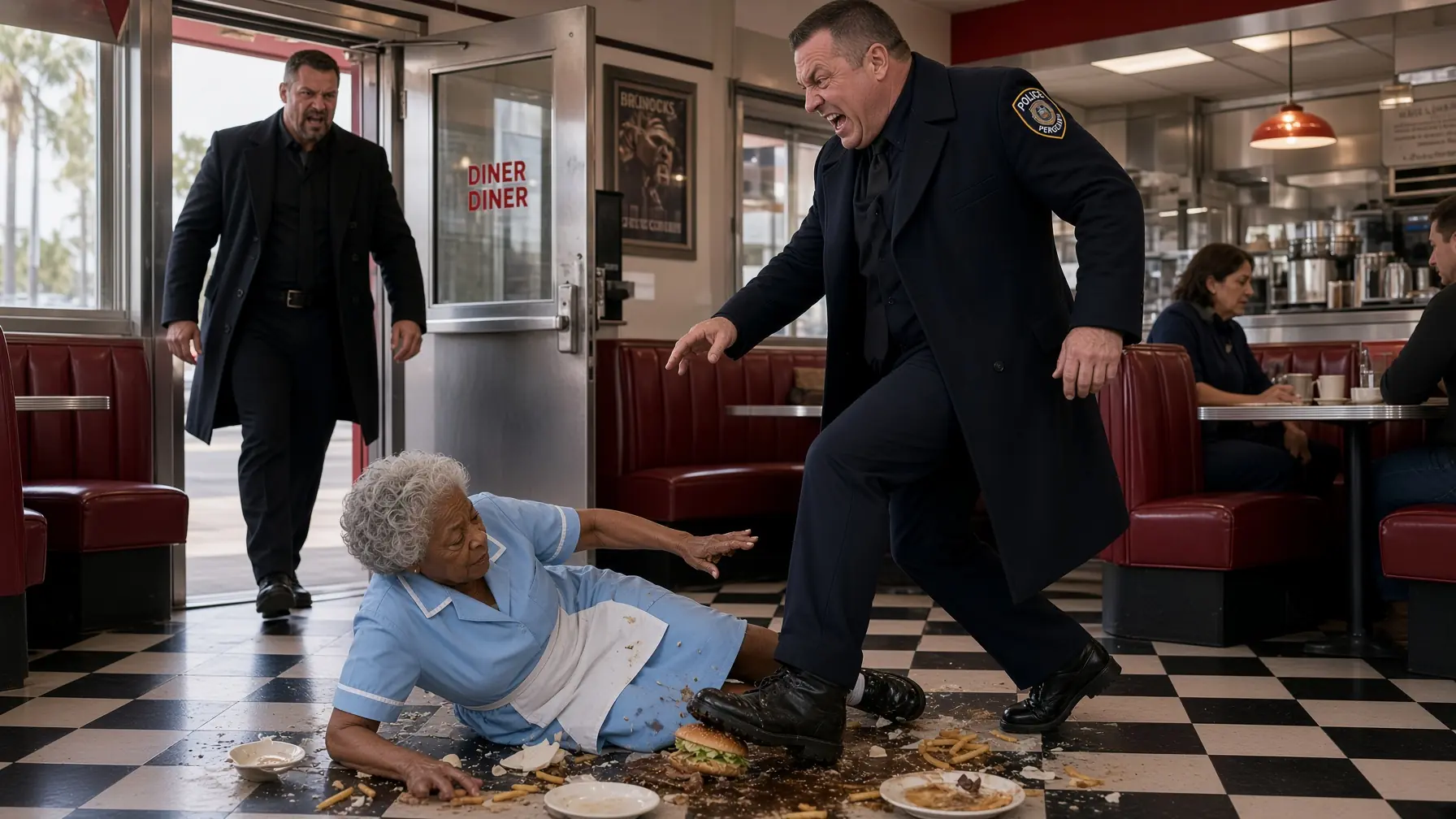
Dark coffee splashed over Sergeant Thomas Keene’s uniform sleeve, across the polished toes of his duty boots, and over the white sneakers of the elderly waitress standing beside his booth. The glass pot hit the checkered tile a second later and broke into glittering pieces beneath the table. For a moment, nobody moved. Steam curled between Thomas and the waitress while coffee ran in thin brown streams toward the legs of two empty chairs.
“I’m sorry,” the woman whispered.
Thomas looked down at his sleeve. He had been awake nearly nineteen hours, had spent half the morning standing beside an overturned SUV while paramedics tried unsuccessfully to save a nineteen-year-old driver, and had spent another two hours arguing with an insurance investigator who kept walking through an active crash scene. None of that had anything to do with the woman in front of him. But exhaustion has a way of looking for the nearest person to punish.
“You should watch where you’re going,” he said.
The words were not shouted.
That almost made them worse.
The waitress flinched as if he had raised his voice. “Yes, sir. I’m sorry.”
She immediately bent to pick up the broken glass.
“Don’t,” Thomas said.
But she had already reached down.
Her fingers were shaking.
Across the diner, a massive man in a black leather motorcycle vest stopped eating.
His name was Luke Quinn, though most people had called him Bear since he was twenty-two and broad enough to fill a doorway. He was forty-seven now, six-foot-four, close to two hundred and seventy pounds, with a gray-streaked beard, tattooed forearms, and the heavy shoulders of a man who had spent nearly thirty years repairing diesel engines, dragging broken trucks from ditches, and lifting things that sensible people used machinery to move.
His vest carried the patch of the Iron Harbor Veterans Motorcycle Association.
Not an outlaw club.
Not a gang.
Mostly mechanics, veterans, electricians, linemen, and men whose knees hurt more than they admitted.
Bear slowly lowered his fork.
The men at his booth noticed.
Conversation died there first.
Then at the next table.
Then farther across the diner as Bear pushed his chair backward.
The leather vest creaked across his shoulders when he stood.
Heavy boots crossed the checkered floor.
Thomas noticed him approaching and straightened.
His partner, Officer Melissa Grant, had gone to the counter to pay. She turned when she sensed the room changing and immediately saw the problem.
Large biker.
Uniformed sergeant.
Elderly woman crouched between them.
Broken glass.
Melissa took one step forward.
Bear stopped inches from Thomas.
The waitress looked up.
Fear filled her face.
“Please,” she whispered. “Don’t.”
Bear did not look away from Thomas.
“She cut?”
Thomas glanced down.
“No.”
Bear’s jaw tightened.
“Good.”
The waitress stood slowly.
“Luke, please.”
Thomas’s eyes moved toward her.
Luke.
Then back toward the biker.
Something about the name brushed against an old memory.
Bear’s voice remained low.
“That’s my mother.”
Thomas looked at the waitress again.
Really looked this time.
Silver hair pinned back.
Thin face.
Deep lines around the mouth.
A pale scar below her left eyebrow.
The scar did it.
Not the voice.
Not the name.
The scar.
Thomas stopped breathing for a second.
The diner disappeared.
So did the coffee on his sleeve.
He saw a twenty-seven-year-old woman standing behind this same counter nearly thirty years earlier, except her hair had been dark then and the diner had smelled more strongly of cigarettes because smoking was still allowed near the back booths. He saw a plate of meatloaf sliding across Formica toward a nineteen-year-old boy who had not eaten properly in two days. He heard a woman say, You can owe me tomorrow. Tonight you eat.
Thomas looked at the old waitress.
“Margaret?”
Her fingers opened.
The piece of glass she had been holding dropped onto the floor.
She stared at him.
For several seconds, her expression showed nothing except confusion.
Then her eyes widened.
“Tommy?”
Bear turned toward his mother.
Then back toward the sergeant.
The anger on his face changed.
Not gone.
Changed.
Thomas swallowed.
Nobody in the Brookfield Police Department called him Tommy.
Nobody had for twenty-six years.
Margaret Quinn lifted one trembling hand toward her mouth.
“Oh my God.”
Thomas whispered, “It’s me.”
Bear looked between them.
“Wait.”
Margaret’s eyes filled.
“Tommy Keene?”
Thomas nodded.
Bear stared at him.
Then something from his own childhood returned.
A skinny young man sleeping above his father’s repair garage.
Army surplus jacket.
Bad haircut.
Always hungry.
Always defensive.
A nineteen-year-old who once taught twelve-year-old Luke Quinn how to throw a baseball because Luke’s father worked until dark.
Bear looked at the sergeant’s face again.
“No way.”
Thomas almost smiled.
It would not come.
Because the last thing he had said to Margaret Quinn before recognizing her was:
You should watch where you’re going.
And the last thing she had done was apologize to him.
Thomas looked down at the broken pot.
Then at the coffee covering Margaret’s shoes.
Then at his own sleeve.
He had never wanted to disappear from a diner more in his life.
“Margaret…”
She shook her head.
“Look at you.”
The words came out softly.
Not accusing.
Almost amazed.
Thomas had imagined seeing her again hundreds of times when he was younger. Sometimes he pictured arriving in uniform. Sometimes after making detective. Once, after receiving his first commendation, he considered driving back to Brookfield just to show Margaret and her husband Earl that the hungry kid they had once fed had made something of himself.
He never did.
Life kept providing reasons.
Army.
Marriage.
Divorce.
Night shift.
Promotions.
His mother’s funeral.
Earl Quinn’s death.
Then years accumulated until returning became harder because every additional year required a larger explanation.
Now he had returned without meaning to.
And he had treated her like an inconvenience.
Bear folded his arms.
“You know my mother.”
Thomas looked at him.
“Yes.”
“How?”
Margaret answered before he could.
“He lived with us.”
Bear frowned.
“Not lived with us.”
Margaret gave him a look.
“You slept above the garage for seven months, Tommy. That counts.”
Thomas glanced toward Bear.
“You were twelve.”
“Thirteen.”
“You were twelve when I got there.”
“Thirteen before you left.”
Thomas almost smiled again.
Bear did not.
The anger was still there.
Good.
Thomas deserved some of it.
Melissa Grant approached carefully.
“Sergeant?”
Thomas looked at her.
She had clearly realized there was history here, but not what kind.
He pointed toward the glass.
“Can you ask Nancy for a broom?”
Margaret immediately said, “I’ll get it.”
“No.”
Thomas’s voice came out sharper than intended.
Margaret flinched again.
He saw it.
Closed his eyes briefly.
Then started over.
“No, Margaret. Please.”
He crouched.
“I’ll take care of this.”
She stared.
“You’re in uniform.”
“So?”
“You don’t clean diner floors.”
Bear said quietly, “She does.”
Thomas looked at him.
Bear held his gaze.
That sentence landed exactly where it needed to.
Thomas nodded.
“Then today I do.”
He began gathering the larger pieces with a dustpan Melissa brought from behind the counter.
Bear remained standing.
Margaret touched his arm.
“Luke.”
“I’m not doing anything.”
“You’re thinking very loudly.”
A few people laughed nervously.
Bear finally looked at her.
“You okay?”
“I’m fine.”
“He embarrassed you.”
Margaret’s expression changed.
“I dropped coffee on him.”
Thomas stopped sweeping.
“No.”
Everyone looked toward him.
Thomas stared at the broken glass.
“I don’t think you did.”
Margaret frowned.
“What?”
Thomas remembered the moment.
His radio had sounded.
He had turned quickly.
Pushed his chair backward.
Something struck the tray.
He had assumed she hit him.
Had she?
He looked toward the ceiling.
The Riverside Diner had security cameras.
One above the register.
One facing the front booths.
Another near the kitchen door.
Thomas stood.
“Nancy.”
The owner, Nancy Doyle, had been watching from behind the counter.
“Yes?”
“Does that camera cover this booth?”
“It should.”
Thomas looked toward Margaret.
“Can we check it?”
She seemed confused.
“Why?”
“Because I think I caused the spill.”
Bear’s eyes narrowed.
Thomas continued.
“I pushed my chair back when my radio went off.”
Margaret shook her head.
“No, honey. I should’ve been farther from the table.”
The word honey almost hurt.
Thomas remembered it.
She had called him that when he was nineteen too.
He looked toward Nancy.
“Please.”
Five minutes later, half the diner was pretending not to watch a security monitor behind the counter.
The footage was grainy but clear enough.
Margaret approached with the coffee pot in her right hand and two mugs balanced on a small tray.
Thomas’s radio activated.
He reached toward his shoulder microphone.
Then pushed his chair backward.
The upper edge of the chair caught Margaret’s hip.
She stumbled.
The pot struck the table.
Coffee flew.