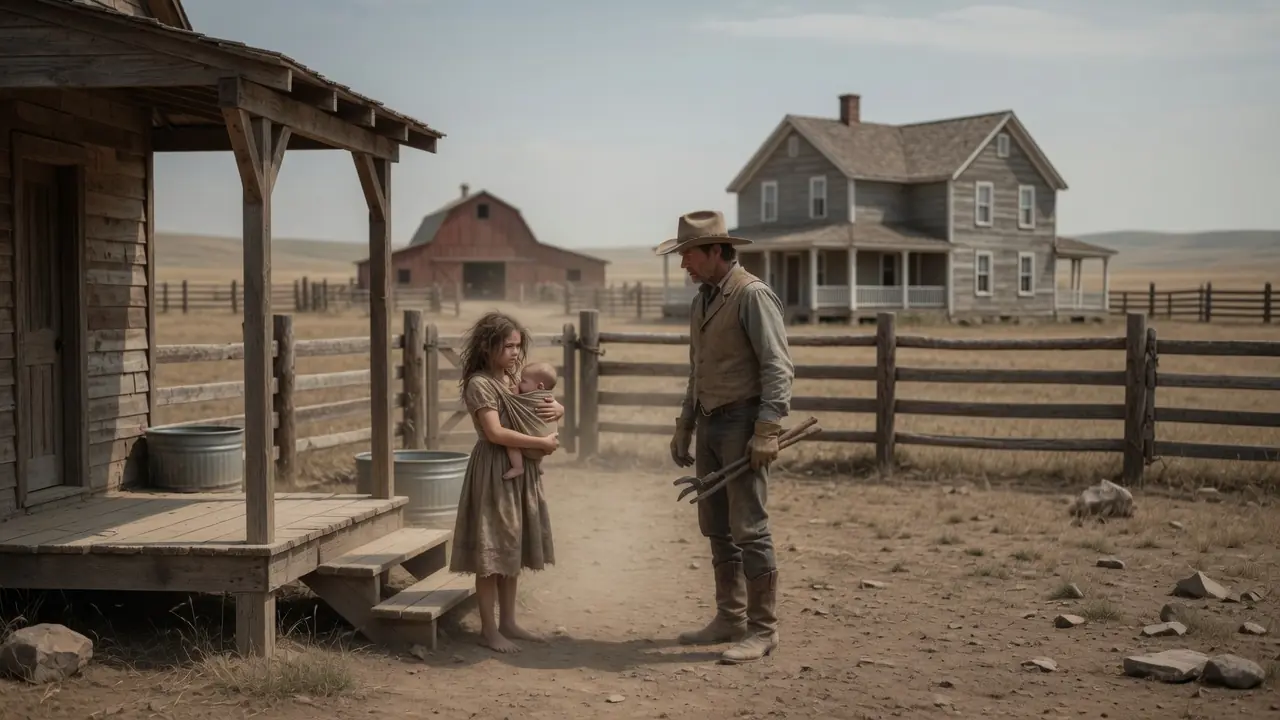
The summer wind moved across Harrow County like it had forgotten mercy. Dust rolled low over the empty road, slipping beneath the fence rails and curling around the legs of a small girl who should never have been walking alone in that kind of heat. Abigail Cross stood just inside the gate of Ryder Ranch, her thin cotton dress stiff with dirt, her hair tangled around her cheeks, and her arms wrapped tightly around the baby pressed against her chest. Across from her, Caleb Ryder stood with fence tools in one hand, staring as if the whole dry yard had turned silent around them.
She was only ten years old, though her eyes looked older than some grown men he had known. The baby in her arms barely stirred, wrapped in a rough cloth sling against Abigail’s small body. Behind Caleb stood a weathered ranch house, a wooden corral, a water trough, a distant barn, and all the ordinary things that meant survival on the Wyoming plains. Abigail looked at those things the way a starving person looks at bread.
Caleb took one step closer, slow enough not to frighten her. “Where did you come from, child?” he asked. Abigail swallowed, but she did not answer that first. She looked down at the baby, then back up at him with a kind of dignity that made his chest tighten. “I can work, sir,” she said. “I don’t eat much.”
For a moment, Caleb did not understand what he had heard. She was standing in front of him with dust on her face, her feet ruined by the road, and a sickly quiet baby in her arms, yet she was offering labor instead of asking for mercy. Her voice did not shake, but her arms did. The baby’s head rested against her shoulder, far too still for Caleb’s comfort.
He lowered the tools to the ground. “Child, did you carry that baby all this way?” Abigail’s lips pressed together. “She needs water first,” she said. “I can earn ours after.” That answer did something to Caleb Ryder that grief, loneliness, and three years of silence had failed to undo. He opened his front door and said, “Then come inside before courage wears you both out.”
The kitchen was the coolest room in the house, shaded by stone walls and a north-facing window. Caleb drew water from the pump and filled a clean cup, but Abigail tried to guide it straight to the baby’s mouth. He stopped her gently but firmly. “You drink first,” he said. “If you fall over, she has nobody left to hold her.”
Abigail looked at him as if weighing whether he could be trusted with that much authority. Then she drank three careful swallows and handed the cup back. “Now Rosie,” she said. Caleb took the baby with hands larger than the child’s whole body seemed to require, and to his own surprise, his touch became soft. “Easy now,” he murmured. “We’ll take it slow.”
The baby’s name was Rosie, eight months old, and so close to the edge of exhaustion that Caleb felt fear move through him like a cold hand. He gave her tiny amounts of water, waiting between each sip, watching for any sign that her body could accept it. Abigail stood near the table, swaying slightly, her eyes fixed on her sister with fierce concentration. She did not ask for food, did not ask for a bed, did not ask whether she could stay.
Caleb had known hunger, drought, loss, and harsh weather, but he had not known a child like this. Abigail watched everything, noticed everything, and wasted no words. When Caleb asked her name, she answered clearly. When he asked how far she had walked, she said, “Maybe sixty miles,” as if the number belonged to someone else’s story.
Sixty miles.
Caleb looked down at her bare feet and felt the full weight of the answer. He had ridden distances like that and cursed the saddle by the end. This girl had walked it carrying a baby. The thought left him quiet.
He did not ask all the questions that pressed against his teeth. He did not ask why no adult had brought her. He did not ask what kind of home a child had to flee with an infant in the middle of a Wyoming summer. Some truths come out more safely when they are not forced. So he said only, “You and Rosie can stay tonight.”
Abigail did not look relieved in the way ordinary children might have. She nodded once, like a person accepting terms. “I can cook,” she said. “I can clean, too.” Caleb almost told her she did not need to prove anything, but he saw at once that proof was the only language she believed adults respected. So he pointed to the pantry and said, “Then show me what you can do after Rosie rests.”
By sundown, Rosie had begun to respond. Her eyes opened more often, and she made a small sound when Abigail touched her cheek. That tiny sound nearly broke the girl’s composure. She leaned over the baby, whispered her name, and brushed one finger over her face with the tenderness of someone who had done that gesture a thousand times in fear.
Caleb looked toward the window to give her privacy. He had not seen devotion that complete in years. Not since Margaret, his wife, had sat beside their son Thomas’s cradle in the deep of winter, humming through her own exhaustion. Margaret had been gone three years now, and Thomas had left after a hard argument neither father nor son had known how to repair.
That night, Abigail cooked supper from what little he had in the house. Salt pork, potatoes, beans, and cornmeal became a meal better than anything Caleb had made for himself in months. She moved around the kitchen with quiet efficiency, too practiced for a ten-year-old. Rosie slept in a drawer Caleb had lined with folded blankets, the safest cradle he could make quickly.
“You have done this a long time,” Caleb said, watching Abigail stir the pan.
“Since I was seven,” she replied.
“Your mother was sick?”
“For a long while.”
He heard the finality in the answer and did not press. After supper, he showed Abigail to a small back room with a bed, a basin, and a window facing the barn. She stood in the doorway and looked at it as if it were a hotel suite. “Rosie sleeps with me,” she said.
“Rosie sleeps where you can hear her,” Caleb answered. “But tonight I’ll take one watch, and you will sleep.”
“I don’t need—”
“I know,” he interrupted. “But in this house, nobody earns sleep. They take it because they’re human.”
She stared at him for a long moment, trying to understand the rule. Then she nodded and carried Rosie inside. Caleb returned to the porch after the house went quiet, sat with cold coffee in his hands, and looked out at the Wyoming stars. For the first time in three years, the house behind him did not feel empty.
Morning came before the sun. Caleb woke to the sound of the stove being lit and water being pumped. For a few seconds, he lay still, unsure whether memory had betrayed him and Margaret was alive in the kitchen again. Then he remembered the girl. He dressed quickly and found Abigail already making coffee.
Rosie sat propped in a basket with blankets around her, awake and blinking at the ceiling. Abigail had fed her soft oats and cleaned the bowl. The kitchen table had been wiped down, the ashes cleared, and the kettle set. Caleb stood in the doorway, caught between gratitude and the uneasy feeling that no child should be this useful before breakfast.
“Coffee’s almost ready,” Abigail said.
“You sleep?”
“Enough.”
“That was not my question.”
She looked at him, then lowered her eyes. “Some.”
Caleb sat at the table. “Today, we tend to your feet, wash Rosie properly, and then talk about where you came from.” Abigail’s shoulders stiffened, but she did not argue. Her fear was visible only in the smallest things: a tightening of her mouth, a glance toward the door, one hand moving instinctively toward the baby. Caleb noticed and softened his voice. “No one is sending you anywhere this morning.”
By the second day, Abigail began to tell pieces of the truth. Her mother had died of fever two months earlier. Her father had been gone long before that. Her aunt Eleanor had taken the girls because there was no one else, but Eleanor’s house had never become a home. Then there was Victor Langford, the man Eleanor lived with, a wealthy Cheyenne businessman who wanted no burdens that did not serve him.
Abigail spoke of him carefully, without childish drama. That made Caleb believe her more, not less. She said Victor wanted Rosie sent to the county home. She said Eleanor had not argued. She said she had heard enough through a thin hallway wall to know that if she waited another day, Rosie would be taken somewhere Abigail could not follow.
“So you left,” Caleb said.
“Yes.”
“In the middle of the night.”
“Yes.”
“With no shoes?”
“There was no time.”
Caleb turned away for a moment because he did not trust his face. He had fixed fences in snow, pulled calves in bitter wind, buried animals he had raised from birth, and survived the kind of losses that make men hard. But the thought of this small girl wrapping a baby into a sling and stepping into the dark alone nearly undid him. When he turned back, Abigail was watching him as if his reaction mattered more than the story itself.
“You think I was foolish,” she said.
“No,” Caleb answered. “I think you were brave because no one left you a safer choice.”
From then on, the ranch changed one small thing at a time. Abigail cleaned the kitchen, but Caleb made sure she ate before starting chores. She mended torn linens, but he bought her proper boots on his next trip to town. She cooked because she took pride in it, not because he demanded it. He purchased cloth for a new dress, a baby spoon, a worn spelling primer, and a stuffed rabbit that Rosie seized as if it had been waiting for her all along.
Abigail said thank you only once, quiet and serious. Caleb pretended not to notice how her fingers lingered over the new boots. He had guessed the size well enough, and when she walked across the kitchen without wincing, he felt absurdly proud. She began lessons at the table every morning after breakfast. He helped her with reading, arithmetic, and spelling, though he claimed he was not teaching, only “checking what she already knew.”
Rosie recovered with the astonishing determination of babies. Within weeks she laughed at the ranch dog, slapped her hands on the table, and raised her arms every time Caleb entered the room. The first time she demanded to be picked up, Caleb froze. Abigail watched from the stove, saying nothing.
Then he lifted Rosie carefully against his chest.
The baby grabbed his shirt with one tiny fist and looked pleased with herself. Caleb stood there stiffly, as if holding a treasure that might accuse him of tenderness. Abigail turned back to the stove before he could see her face. But he saw enough.
The house began to live again. Curtains were washed, corners swept, old quilts aired in the sun, and meals arrived at regular hours. Caleb found himself returning from the pasture and listening for sounds inside: Rosie babbling, Abigail reading aloud, the scrape of a chair, the clink of dishes. These were ordinary sounds, but after years of silence, ordinary felt miraculous.
One evening in late July, Abigail came onto the porch after putting Rosie to sleep. She sat on the top step, not beside him, still careful of boundaries that existed mostly in her mind. The sky was wide and purple over the ridge. Caleb waited because he had learned that Abigail spoke important things only after carrying them alone for a while.
“Victor will come,” she said.
Caleb looked at her. “You know that?”
“He doesn’t like losing things,” she replied. “Even things he didn’t want.”
The words were too clear, too old. Caleb set down his coffee. “Then let him come.” Abigail’s head turned sharply. For the first time, fear broke openly through her controlled expression. “I won’t let him take Rosie.”
“No,” Caleb said. “Neither will I.”
The next morning, Caleb wrote to his old lawyer in Cheyenne, a careful man named Aldridge. He asked about guardianship, abandonment, and what standing a rancher might have to protect two orphaned girls who had arrived at his door half-starved and alone. The reply came a week later: difficult, but possible. Evidence would matter. Witnesses would matter. Abigail’s own testimony would matter most.
When Caleb explained it, Abigail listened without blinking. “If we go to court, will they make me talk about all of it?” she asked. Caleb nodded. “Maybe not everything, but enough.” She looked toward Rosie, who was sleeping in her crib with the stuffed rabbit beside her face. “Then I’ll talk.”
“You do not have to be brave every minute,” he said.
“Yes,” Abigail replied. “I do.”
“No,” Caleb said, firmer this time. “That is what adults told you when they made their failures your burden. In this house, you can be tired.”
She looked at him then, and something in her face shifted. Not trust fully, not yet, but the beginning of it. Trust, Caleb had learned, did not arrive like a storm. It came like grass after drought, small and almost invisible until one morning the ground looked different.
The first hearing came in October. Caleb wore his dark suit, Abigail wore a blue dress she had helped sew, and Rosie stayed with a neighbor woman named Clara Hobbs. The Harrow County courthouse smelled of dust, paper, and coal heat. Eleanor Cross was there, small and pale beside Victor Langford, who looked exactly like the kind of man who believed money could settle any moral question.
Victor’s lawyer argued that Caleb was a stranger with no blood claim. He spoke warmly of family, duty, and the aunt’s right to reunite with her nieces. Caleb sat still, listening as if the words were weather to be endured. Abigail sat beside him with both hands folded in her lap.
Then the judge allowed her to speak.
Abigail stood. Her voice was not loud, but it carried. She described her mother’s death, Eleanor’s house, Rosie’s condition, the conversation she overheard, and the decision to walk west. She did not cry. She did not beg. She told the truth like someone laying boards across a flood so others could cross safely.
“Eleanor could have said no,” Abigail said. “She could have told him we were family. She could have kept Rosie safe. But she made a choice.” She turned slightly toward Caleb. “Mr. Ryder made a different one. He didn’t know us. He didn’t owe us anything. He opened his door.”
The room stayed silent after that.
The judge granted temporary emergency guardianship to Caleb Ryder. Victor’s face did not change much, but Caleb saw the calculation begin behind his eyes. This was not over, and everyone in the room knew it. Caleb took Abigail home that afternoon with the ruling in his pocket and six months of uncertainty ahead.
Victor spent those six months trying to break what Caleb had built. First came rumors in the county paper, written carefully enough to injure without accusing. Then came technical legal challenges, welfare inspections, letters to the school board, and one smooth-talking man from Cheyenne who arrived at the ranch with a settlement offer disguised as mercy. He placed a bank draft on Caleb’s fence post and suggested the girls could be placed in a “proper arrangement.”
Caleb looked at the money for one second.
Then he looked up. “Those girls are not for sale.”
The man tried to explain.
Caleb opened the gate wider. “Leave while I am still being polite.”
Inside the house, Abigail had watched through the kitchen window with Rosie on her hip. When Caleb came in, she said, “He offered you money.” Caleb hung his coat by the door. “A lot of it.” Abigail’s voice grew very small. “You should have taken it.”
Caleb turned toward her. “Stop testing me, Abigail. You already know the answer.”
She looked down at Rosie, then nodded. “Yes,” she whispered. “I do.”
Winter came, and Abigail started school in Harrow. Some children whispered at first, repeating words they had heard from adults who should have known better. Abigail answered insults without anger and earned respect through work, intelligence, and the stubborn refusal to appear ashamed. Her teacher, Miss Watts, recognized her hunger for learning and gave her extra lessons. Caleb found homework beside ranch ledgers on the kitchen table each night and corrected arithmetic while Rosie crawled under the chairs.
By spring, the rumors had thinned because truth, when lived daily, wears lies down. The welfare report praised the cleanliness of the house, the girls’ health, Abigail’s school progress, and the stable care Caleb provided. Miss Watts spoke before the school board when Victor’s attorney tried to create another inquiry. Neighbors who had once watched from a distance began quietly standing closer.
Then, three days before the final hearing, Eleanor Cross wrote through a new attorney. She had left Victor Langford. She wished to speak in court. Abigail read the message twice, then stared out the kitchen window for a long time. Caleb did not ask what she felt until she was ready.
“I’m not forgiving her in three days,” Abigail said.
“No one asked you to.”
“But if she tells the truth, I want to be able to see that she did.” Abigail’s jaw tightened. “I don’t want Victor to make me cruel just because he was.”
Caleb looked at her, this eleven-year-old girl doing moral work that would shame many adults. “He hasn’t,” he said. “And he won’t.”
The final hearing took place under a gray June sky. This time Victor was absent. Eleanor sat apart from his former lawyers, wearing plain clothes and no longer shrinking beside him. She looked at Abigail when they entered, and Abigail looked back. No love passed between them, not yet, but something honest did.
When Eleanor spoke, she did not defend herself. She said she had not wanted the girls, that she had allowed Victor’s convenience to become her conscience, and that Abigail had been right to leave. She said there had been no real love in the home she had offered them. Then she looked at Caleb and said, “Whatever I should have been to those girls, he has been.”
Abigail’s face stayed still, but her hands tightened in her lap.
The judge asked Abigail one final question. “Where do you want to live?”
“With Caleb,” she answered without hesitation.
“Why?”
“Because he never treated me like a problem,” she said. “He treated me like a person. And he treated Rosie like she mattered before anyone told him he had to.”
The ruling came quickly. Permanent guardianship of Abigail Cross and Rose Cross was granted to Caleb Ryder, effective immediately. Caleb sat motionless for a moment, as if his body needed time to understand that the fight was over. Abigail looked at the judge’s bench, then at Caleb’s hand resting open on the table. Slowly, she placed her hand in his.
Outside the courthouse, Eleanor approached. “I am sorry,” she said quietly. Abigail looked at her for a long moment. She did not say it was all right. She did not offer forgiveness as if pain were a debt easily paid. She only said, “I know.”
That was enough for that day.
They collected Rosie from Clara Hobbs and drove home in the late afternoon light. Rosie sat on Abigail’s lap, chewing on the stuffed rabbit’s ear, then reaching for Caleb’s sleeve. The road stretched ahead, dusty and familiar. Abigail watched the horizon with a different expression than she had worn the day she first arrived.
“Caleb,” she said after a while.
“Yeah?”
“Is this what you wanted, or just what happened?”
He thought before answering. “It started as what happened. You knocked, and I opened the door.” He glanced at her. “Somewhere along the way, it became what I wanted.”
“When?”
“The morning I came downstairs and you had already made coffee,” he said. “Rosie looked at me like she had been waiting for me specifically.”
Abigail looked down, almost smiling. “That was the third day.”
“I counted.”
The ranch appeared ahead: weathered house, red barn, water tower, fence line, porch steps. Abigail had once climbed those steps with the last of her strength, holding Rosie like the whole world depended on her not falling. Now she stepped down from the wagon with Rosie on her hip and walked to the door without fear. She did not knock this time.
She opened it.
Inside, the kitchen waited with its familiar light. Abigail set Rosie on the floor with the rabbit, tied on her apron, and went to the stove because usefulness had become not a bargain for survival, but a part of belonging. Caleb stood in the doorway watching her for a moment, understanding that his house had not simply taken them in. They had brought it back to life.
Years later, people in Harrow County would tell the story in many ways. Some said Caleb Ryder rescued two orphaned girls from the wilderness. Some said Abigail Cross saved her sister by sheer force of will. Some said the old widower found a family because he opened his door at the right moment.
But Caleb knew the truest version.
A barefoot girl came to his ranch carrying a baby and asked for work instead of mercy.
He opened the door.
And from that one act of ordinary decency, three lonely lives became a home.