The bank tried to take Raymond Holt’s farm for $50,000.
They had lawyers, documents, and a court date already set. For three weeks, it looked like they were going to win. Raymond was 68 years old, a widower, and the last Holt still living on the 240 acres his grandfather had cleared by hand more than a century earlier. First Continental Rural Bank had held his farm loan for 22 years, and Raymond had paid them every single month.
He trusted that bank because his father had trusted it before him. His grandfather had once kept a savings account there when it was still called Dawson County Farmers Trust. To Raymond, the bank was not some distant company. It was part of town, like the courthouse clock, the feed store, and the grain elevator by the tracks.
That trust turned out to be a mistake.
The letter came on a cold Tuesday morning. It was not waiting on his kitchen table. It was in the mailbox at the end of his long gravel driveway, tucked between a seed catalog and a grocery store flyer. Raymond saw the blue bank logo and stopped before opening it.
When he unfolded the letter, he read the first line twice.
According to the bank, his loan carried an unpaid balance of $50,000 due to “long-standing payment discrepancies.” If the balance was not resolved within 30 days, First Continental Rural Bank would begin foreclosure proceedings under the collateral terms of the original agreement.
Collateral meant the land.
Two hundred forty acres. The farmhouse where Raymond had been born. The red barn his father had built after the tornado of 1968. The pasture, the soybean fields, the creek bed, the timber line, and the little family cemetery beneath the oaks where his wife, Martha, had been buried six years earlier.
All of it was suddenly on the line for a debt he had never agreed to owe.
Raymond went back to the house and called the bank. He waited on hold for 18 minutes. When a woman finally answered, her voice was calm and professional. She confirmed the balance. She confirmed the deadline. She confirmed that foreclosure would begin automatically if the matter was not resolved.
“There has to be a mistake,” Raymond said. “I’ve paid that loan every month for 22 years.”
“I understand your concern, Mr. Holt,” she said. “But our records indicate discrepancies over time.”
“What kind of discrepancies?”
“I’m not authorized to provide a full breakdown over the phone.”
Raymond stared at the wall above the telephone, where Martha’s old calendar still hung. “So after 22 years of taking my payments, your bank is just now saying I owe fifty thousand dollars?”
“That is what our records indicate.”
Records.
Raymond looked toward the old oak desk in the corner of the kitchen. Inside the bottom drawer were folders. Every year had one. Every bank statement. Every payment stub. Every loan notice. Every dull sheet of numbers most people would have thrown away.
Raymond had kept them all.
Not because he expected the bank to betray him, but because his father had taught him to keep records. His father used to say a handshake was fine between honest men, but paper remembered what people forgot.
Raymond hung up and called his son, Daniel, who lived two hours away in Lexington.
“Dad?” Daniel answered.
“Got a letter from the bank.”
“What kind of letter?”
“They say I owe fifty thousand dollars.”
Silence.
“How is that even possible?”
“That’s what I’m trying to figure out.”
“Dad, you need a lawyer. Not the bank. A real lawyer.”
“I know.”
But the $50,000 was not the only number bothering Raymond. Another number had already been sitting in his mind for three weeks.
Forty-seven dollars.
It appeared on his January statement the way it appeared on every statement before it. A small line near the bottom. “Service and processing fee.” $47.
Raymond had seen it for years. He had grumbled about it once or twice, the way a farmer grumbles about feed prices or a gate that will not hang straight. But he had never truly questioned it. Banks charged fees. That was what banks did.
Except now, with the foreclosure letter on his table, the number felt different.
Why $47? Why every month? And why did he not remember agreeing to it?
The next morning, Raymond met Sandra Cole.
She drove up to the farmhouse in a gray sedan with mud on the tires. Sandra was 52, with short brown hair, sharp eyes, and the calm expression of someone who had spent years sitting across from frightened people. She had handled property disputes and banking cases across western Kentucky.
She sat at Raymond’s kitchen table and read the bank’s letter from start to finish. Then she read it again.
“How long have you been paying this loan?” she asked.
“Twenty-two years.”
“Every month?”
“Every month.”
“Has the bank ever mentioned discrepancies before this?”
“No.”
“Do you still have the statements?”
Raymond stood, crossed to the desk, and pulled out folder after folder. He stacked them on the table until Sandra raised her eyebrows.
“That all of them?”
“Every one they sent.”
For the next two hours, Sandra worked through the records. She started with the newest statements and moved backward. Raymond made coffee, but she barely touched hers. She wrote down dates, payments, fees, balances, and interest amounts on a yellow legal pad.
Then she stopped on the January statement.
Raymond saw her finger pause.
“What is it?”
Sandra tapped the line near the bottom. “This fee.”
“That’s always been there,” Raymond said.
“Every month?”
“As far back as I can remember.”
Sandra wrote something down. “Service and processing fee. Forty-seven dollars.”
“Is that important?”
“It might be.”
She opened the original loan agreement from 1996. Raymond remembered signing it. He had been 46 then, still strong enough to toss hay bales all afternoon without feeling it in his back. Martha had sat beside him at the bank. They had taken the loan to repair equipment, fix irrigation, and keep the farm steady after a bad season.
Sandra turned page after page. She read the fee section once, then again.
“This fee isn’t in your agreement,” she said.
Raymond frowned. “What does that mean?”
“It means the bank has been charging you $47 every month for something they were not authorized to charge under this contract.”
The kitchen went quiet.
Raymond looked down at the statement. “For how long?”
Sandra began checking the older folders. One year. Three years. Seven years. Twelve years. The same line appeared again and again.
Forty-seven dollars. Month after month. Year after year.
When Sandra finally looked up, her expression had changed.
“Raymond,” she said, “this may not be just about whether you owe them money.”
“What else would it be about?”
“It may be about whether they owe you.”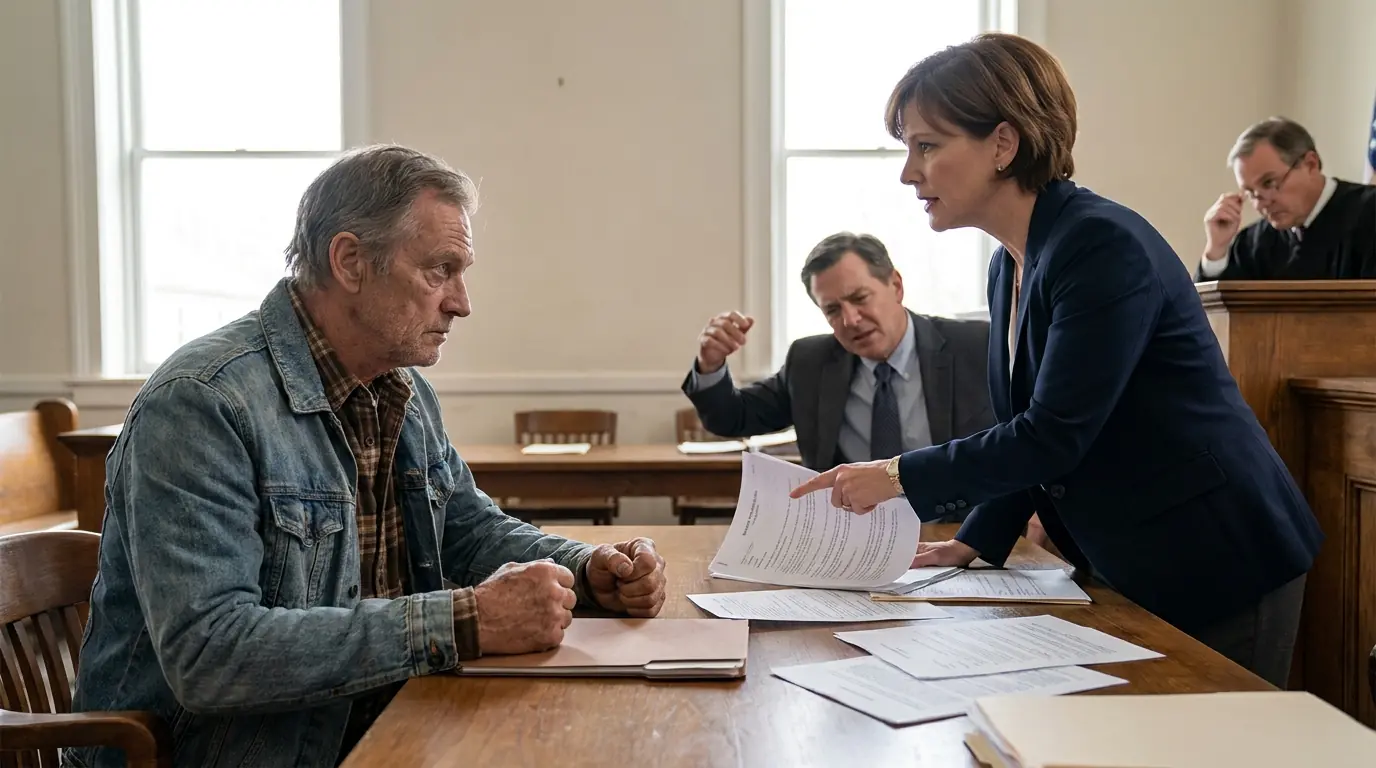
The idea seemed too large for his kitchen. Banks did not owe farmers. Banks told farmers what they owed. Banks approved loans, denied loans, collected payments, and held land as collateral. Men like Raymond signed papers and hoped the weather, markets, and machinery did not all fail at once.
Sandra took copies of the records back to her office that evening. Raymond reminded her he only had 27 days before foreclosure could begin.
Sandra nodded. “Then we won’t waste one.”
That night, Raymond barely slept. He sat in the living room with the lamp low, thinking about Martha. She had handled most of the household bills when she was alive. She liked order. Every January, she sat at the kitchen table with a calculator, checking what they had paid and what they still owed.
Then Raymond remembered something.
Years earlier, Martha had held up a statement and asked, “Do you know what this is?”
Raymond had been tired from the barn. “Bank fee, I guess.”
“Forty-seven dollars every month?”
“They charge for everything now.”
Martha had stared at it, then placed the paper in the folder.
She had seen it, too.
Two days later, Sandra called and asked whether Raymond had any letters from the bank around 2001. Raymond searched the desk and found an envelope in a folder labeled “Loan Updates.” He drove it to her office above the pharmacy in town.
Twenty minutes after taking the letter, Sandra returned with a serious look.
“I found something.”
Raymond stood.
“In 2001, the bank sent you a routine account update. It included a change in how your loan interest was calculated.”
“What kind of change?”
“They moved it from simple interest to compound interest.”
“I don’t know what that means.”
“It means interest began building on interest. Over time, that can grow fast.”
“Was that allowed?”
Sandra held up the letter. “Only if you properly agreed to it. Signed it. Acknowledged it. Accepted it under the loan terms.”
“I don’t remember signing anything.”
“You didn’t. Not in the records I’ve seen.”
By the end of the week, Sandra had the full picture.
The $47 monthly fee alone added up to more than $12,000 over 22 years. Then she found another fee that started in 2003: $23 per month, labeled “rural account maintenance.” That fee was not in the original agreement either.
Together, the unauthorized fees added up to more than $27,000.
But that still did not explain the bank’s claimed $50,000 balance.
The interest change did.
When Sandra recalculated the loan under the original terms, without the unauthorized fees and without the improper compound interest change, the numbers told a completely different story. Raymond did not owe the bank $50,000.
He had overpaid.
And when Sandra added penalties, damages, improper charge recovery, and interest on the money the bank had taken, the number became staggering.
$1.2 million.
Sandra called Raymond just after midnight.
“You don’t owe them,” she said.
Raymond sat up in bed. “You’re sure?”
“Yes. Their claim is wrong.”
“Then why are they saying I owe fifty thousand?”
“Because their records are built on charges and interest calculations they should not have applied.”
Raymond stared at the wall.
“And there’s more,” Sandra said. “You have a case against them.”
“How much?”
“With penalties and damages, possibly over a million.”
The words sounded unreal. A million dollars did not belong in Raymond’s farmhouse. It belonged to people in glass offices and men with watches worth more than tractors.
“You’re telling me the bank tried to take my farm over a mistake they made, and now they might owe me a million dollars?”
Sandra’s voice stayed calm. “Not a mistake, Raymond. A pattern.”
The hearing was scheduled two weeks later.
By then, word had begun to move through town. People knew Raymond Holt was fighting the bank. Some shook their heads with sympathy. Others avoided looking at him too directly, as if losing land might be contagious.
A few told him to settle.
“Banks don’t make mistakes like that,” one man said outside the hardware store.
Raymond looked at him. “They sent me the statements themselves.”
The man shrugged. “Still. I’d be careful.”
Raymond almost smiled. “I am being careful.”
On the morning of the hearing, Daniel drove in from Lexington. Raymond wore his best shirt, a dark jacket, and boots he had polished the night before. Daniel wore a suit and looked more nervous than his father.
Inside the courtroom, the bank’s legal team was already seated. Three attorneys sat behind neat stacks of documents. Behind them was Martin Keller, the senior loan officer who had once shaken Raymond’s hand after Martha died and told him the bank valued long relationships with families like his.
Martin looked away when Raymond entered.
That told Raymond more than any legal filing could.
Sandra met Raymond near the front with two boxes of documents.
“Remember,” she said quietly, “they will make this sound complicated. It isn’t. The contract says what they could charge. The statements show what they did charge. The difference is the case.”
The judge entered, and the bank’s attorney spoke first. His name was Charles Vinton, a tall man with silver hair and a smooth voice.
He presented the case cleanly. Raymond Holt had signed a farm loan agreement. The loan was secured by the property. Bank records showed unpaid discrepancies totaling $50,000. The bank had given notice. If the balance was not resolved, foreclosure was allowed.
It sounded simple.
That was what frightened Raymond most.
A simple lie was easier to believe than a complicated truth.
Then Sandra stood.
She did not begin with anger. She did not accuse the bank of greed. She began with the contract.
“This is the original loan agreement signed by Mr. Holt and First Continental Rural Bank in 1996,” she said. “It lists the principal, the interest terms, the payment schedule, the collateral, and the permitted fees.”
Then she lifted Raymond’s January statement.
“This statement includes a $47 service and processing fee. That fee does not appear in the contract.”
Charles stood. “Routine administrative fees are common in rural lending.”
Sandra looked at him. “Common is not the same as authorized.”
The judge glanced up.
Sandra continued. “The same $47 fee appears every month across Mr. Holt’s account history. We have statements going back 22 years.”
She placed a thick stack of copies on the table.
Then she presented the second fee.
“Beginning in 2003, the bank added a $23 monthly charge labeled rural account maintenance. That fee also does not appear in the agreement.”
Charles frowned. “Those charges were disclosed.”
“They were printed on statements after being charged,” Sandra said. “That is not the same as being agreed to.”
Then Sandra presented the 2001 letter.
“This account update states that the bank began calculating Mr. Holt’s loan under a compound interest structure. The original agreement calls for simple interest. There is no signed modification, no acknowledgment, no consent, and no amended loan agreement.”
Charles stood again. “The borrower received notice.”
Sandra turned toward him. “Notice is not consent.”
The courtroom became very quiet.
Sandra walked the judge through the numbers. She showed what Raymond had paid, what he should have owed, the unauthorized charges, and the effect of the improper interest change across two decades.
The bank’s $50,000 claim did not survive the math.
When Sandra finished, the judge looked at the bank’s attorney.
“Do you dispute these calculations?”
Charles looked down at his notes. For the first time all morning, he did not answer quickly.
“We would request additional time to review the records.”
The judge’s expression did not change. “These are your client’s records.”
Charles cleared his throat. “Yes, Your Honor, but given the volume of material…”
The judge interrupted. “Your client has had more than twenty years to know what it was charging this borrower.”
Raymond looked down at his hands. They were rough, scarred, and restless. Hands that had fixed gates, buried calves, lifted his wife when she was too weak to stand, and written check after check to a bank that now claimed he had failed.
The judge reviewed the documents again.
“What I see here is not a simple discrepancy,” she said.
A pause.
“It is a pattern.”
Raymond felt the word move through him.
“A pattern of charges that were not included in the original agreement, and a material change in interest calculation that does not appear to have been properly authorized by the borrower.”
Charles tried once more. “The bank acted in accordance with its understanding of internal policy.”
The judge looked at him.
“Internal policy does not rewrite a signed contract.”
No one from the bank spoke after that.
The foreclosure claim was dismissed.
For a second, Raymond did not understand the words. Daniel exhaled beside him. Sandra placed a hand near Raymond’s folder, close enough to steady the moment.
Then the judge continued. Based on the evidence, the court found sufficient grounds for liability regarding improper charges and unauthorized financial modifications. Damages would be assessed according to the submitted calculations, subject to final review.
Three weeks later, the final order arrived.
$1.2 million.
The number appeared on plain white paper. It did not look like justice. It looked like paperwork. But when Raymond held it in his hands, he felt 22 years of weight loosen inside his chest.
He did not celebrate in any grand way. He did not buy a new truck. He did not stand outside the bank waving the order. He drove home, parked beside the barn, and walked to the small cemetery beneath the oaks.
Martha’s stone was clean. He kept it that way.
“They tried,” he said quietly.
The wind moved through the branches.
“But they didn’t get it.”
After the ruling, First Continental Rural Bank changed quickly on the outside. Martin Keller resigned. The bank announced a voluntary internal audit of long-term rural accounts. People in town began checking their own statements.
That was when the story grew bigger than Raymond.
A dairy farmer found a fee he did not recognize. A widow found an interest adjustment on a land note from 2007. A young couple asked Sandra Cole to review their loan before signing anything new.
For years, people had trusted the bank because it was local. Raymond’s case taught them that local did not always mean loyal.
Raymond used some of the money to repair the barn roof, replace old fencing, and buy a newer tractor. He set aside college funds for his granddaughters. He donated quietly to the small church Martha had loved.
Then he did something no one expected.
He built a records room.
It was a converted storage room off the back of the farmhouse, with shelves, cabinets, a scanner, and a long table. On the wall, he hung a framed copy of the original loan agreement and one monthly statement with the $47 fee circled in red.
Every other Saturday, farmers came by with boxes of papers. Raymond did not give legal advice. He always made that clear. But he helped them organize what they had. He showed them where to look: fees, interest changes, balloon clauses, renewal terms, insurance add-ons, and late charges applied on dates when checks had already cleared.
He taught people what his father had taught him.
Paper remembers what people forget.
Years later, when Raymond was 74, a young reporter came to interview him. She asked what he felt when he first read the foreclosure letter.
Raymond sat on the porch, looking across the green fields.
“I felt small,” he said.
“Small?”
“That’s what a letter like that is meant to do. It makes you feel like the decision has already been made. Like someone bigger than you has counted everything, checked everything, and all that’s left is for you to obey.”
“What changed?”
Raymond looked toward the house, toward the room where the records were kept.
“I remembered they were just numbers,” he said. “And numbers can be checked.”
The part that stayed with people was not only the $1.2 million. It was the 22 years.
Every month for 22 years, the wrong number had sat there in plain sight. Not hidden in a vault. Not buried under secret codes. Printed in black ink and mailed directly to the man being charged.
That was the frightening part.
The mistake had not survived because it was invisible.
It had survived because it looked normal.
Raymond still woke early. He still fed the hens before breakfast. He still walked the fence line when his knees allowed it. Some mornings, he passed the mailbox and remembered the day he opened the letter that almost took everything.
He used to think that was the moment the fight began.
Later, he realized the fight had started long before that.
It began when his father taught him not to throw away statements. It began when Martha questioned the $47 fee over tea. It began every month Raymond opened the envelope instead of tossing it aside. It began in the ordinary habit of paying attention.
The bank had lawyers, documents, and a court date.
Raymond had the truth.
But truth is not enough if you cannot prove it. Proof sits in drawers. It waits in folders. It hides in small numbers until someone cares enough to look closely.
First Continental Rural Bank came for 240 acres over $50,000.
They left owing $1.2 million.
But Raymond never believed the money was the real victory. The real victory was walking his land after the case was over and knowing no one could take it from him with a false number. It was seeing Daniel bring his daughters to the farm without fear of a foreclosure sign at the gate.
One evening, Raymond’s oldest granddaughter, Emily, sat beside him on the porch. She was 13 and still thought her grandfather had beaten the bank in one grand moment.
“Grandpa,” she asked, “how did you know they were wrong?”
Raymond looked at her.
“I didn’t at first.”
“But you figured it out.”
He nodded. “Because one number didn’t feel right.”
“Just one?”
“Sometimes that’s all it takes.”
She thought about that.
“So you saved the farm because of forty-seven dollars?”
Raymond smiled.
“No,” he said. “I saved it because I didn’t stop at forty-seven dollars.”
The sun dropped lower beyond the ridge. Somewhere near the barn, a gate creaked in the wind. Raymond sat quietly, listening to the farm breathe around him.
For 22 years, the bank had sent him the same statement.
For 22 years, one number had been wrong.
And when they finally came for his land, that one number was waiting for them.