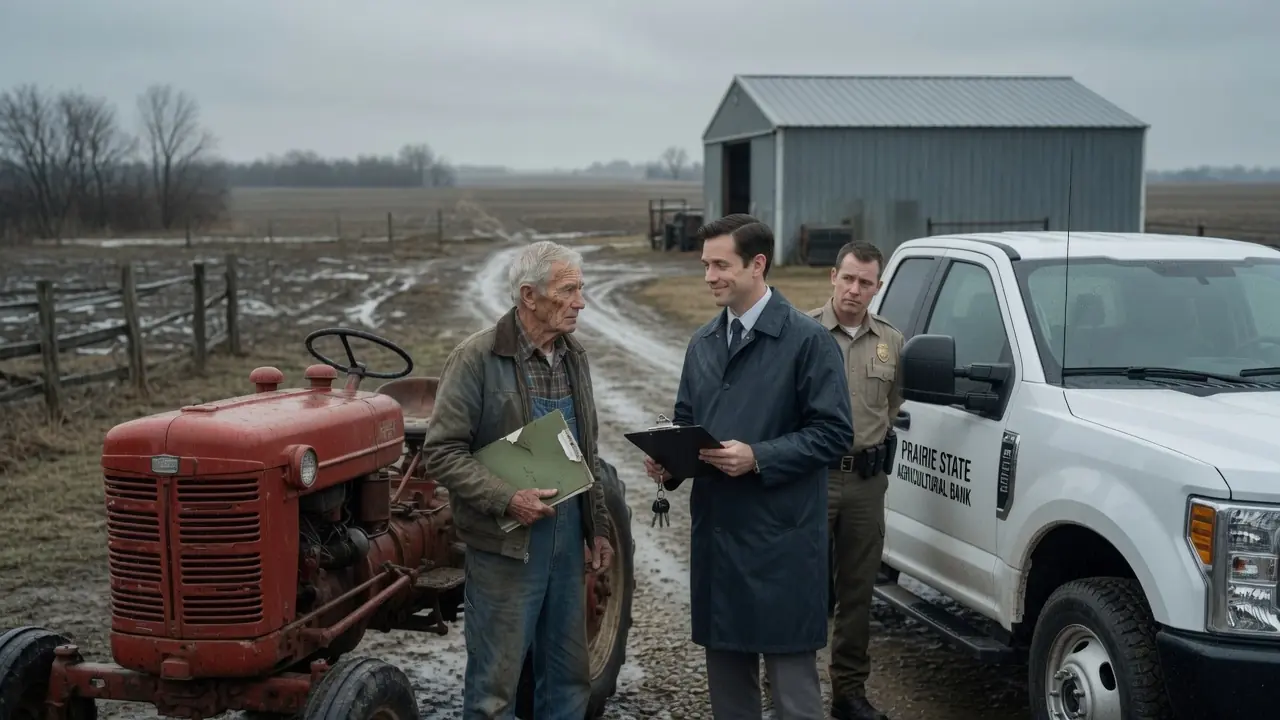
At 6:15 on a gray Missouri morning, Prairie State Agricultural Bank sent a white pickup down Harold Beckett’s gravel drive.
The truck stopped beside the machine shed just as the last rainwater slipped from the barn roof. For seven straight days, storms had soaked Miller County, filling drainage ditches and turning the low fields into dark, shining mud.
Harold had already walked the north field twice.
If the wind held and the morning stayed dry, he could begin turning the soil before noon. The planting window had narrowed to less than a week, and every farmer in the county knew that a missed week in spring could become an empty grain bin in winter.
At seventy-eight, Harold felt time differently than younger men.
He felt it in the stiffness of his left knee before weather changed. He heard it in the uneven idle of an engine that needed repair. He saw it in soil that was almost ready but not quite.
That morning, the field was ready.
His tractor was ready.
Then Dean Holloway stepped out of the bank truck.
Dean wore polished brown shoes, a blue tie, and a raincoat too clean for a farmyard. He carried a clipboard under one arm and wore the confident expression of a man whose authority had been printed somewhere else.
A reserve sheriff’s deputy climbed out of the passenger side.
The deputy was a local man named Carl Jennings. Harold remembered him as a boy fishing from the bridge near Miller Creek. Carl avoided Harold’s eyes as he adjusted his belt.
Dean walked directly toward the tractor.
“Mr. Beckett?”
Harold stood beside the front tire, an oil rag in one hand.
“That depends on what you’re selling.”
“I’m Dean Holloway with Prairie State Agricultural Bank, Regional Collections.”
Harold looked at the white pickup.
The bank logo was printed across both doors.
“I figured.”
Dean opened the clipboard.
“We’ve attempted to contact you regarding the delinquent balance on your seasonal operating line.”
“You sent two letters.”
“And made four telephone calls.”
“I answered one.”
“You did not cure the default.”
“The crop insurance payment arrived late. Your loan officer knows that.”
“Collections operates from posted balances, Mr. Beckett.”
Harold glanced toward the deputy.
Carl studied the gravel.
Dean continued.
“Under the cross-collateral provisions of your lending package, Prairie State has authority to secure listed machinery pending resolution.”
Before Harold could respond, Dean reached through the open side of the tractor and removed the keys.
He set them briefly on the hood.
Just long enough for Harold to see them.
Then he placed them in his coat pocket.
The action was small.
It carried the weight of a door being locked.
“Until the delinquent amount is cured,” Dean said, “this equipment is under bank immobilization. You may not operate, move, sell, or alter it.”
Harold did not raise his voice.
He had learned long ago that anger made hurried men feel taller.
“Which note lists this tractor?”
“The current operating line.”
“Which schedule?”
Dean flipped through several pages.
“Legacy machinery schedule incorporated into the cross-collateral package.”
“What year?”
“I don’t see how that matters.”
“It matters to me.”
Dean found the line.
“Original equipment certificate, 1968. Updated through successor lending agreements.”
Harold looked at the tractor.
The machine was not the same tractor he had driven home in 1968. That one had been a state-surplus International Harvester with faded paint and a cracked seat.
But the protected equipment certificate had later been amended through a state replacement process when the original machine became unsafe. The John Deere standing before them had inherited the same equipment status.
Prairie State’s computer system had apparently inherited only the words farm tractor.
“You picked the wrong machine,” Harold said.
Dean gave a quick laugh.
“A tractor is a tractor.”
Harold looked at him.
“No.”
The old farmer’s voice remained quiet.
“Some tractors belong to a longer story than your screen does.”
Dean’s smile weakened.
“If you have a dispute, you can contact the bank.”
“You are the bank.”
“I represent Collections.”
“Then you should know what you’re collecting.”
Dean closed the clipboard.
“Mr. Beckett, I’m not here to debate historical paperwork.”
“I know.”
Harold turned toward the farmhouse.
“That’s the problem.”
He returned five minutes later carrying an olive-green folder.
Its edges had worn white. A dark water stain marked one corner, and an old piece of black tape reinforced the spine.
Dean looked at it with amusement.
Harold placed the folder on the hood of the bank truck and opened it.
The first page was a military discharge form from 1968.
Dean’s expression changed into the patient look people sometimes gave old veterans when they believed memory had wandered into the wrong conversation.
“Mr. Beckett, your service is not relevant to the bank’s present security interest.”
Harold turned several pages.
“Read this.”
Dean did not take the document.
“What is it?”
“State Farm Rehabilitation Equipment Rider.”
“That program no longer exists.”
“The program doesn’t have to exist. The paper does.”
Dean glanced at the typed language.
The page listed one tractor, tillage equipment, and a pump assembly. Beneath the equipment schedule was a paragraph printed in small type.
Harold placed one finger below the sentence.
“No participating lender or successor lender may seize, disable, transfer, or otherwise obstruct the use of listed essential agricultural equipment without countersigned approval from the State Veterans Rehabilitation Board.”
Dean read it once.
Then he smiled again.
“This is more than fifty years old.”
“Yes.”
“The original lender no longer exists.”
“Your bank bought it.”
“That does not necessarily make every historical restriction enforceable.”
“Maybe not.”
Harold closed the folder.
“But it should have made you ask before taking my keys.”
Dean looked toward the deputy.
Carl finally met Harold’s eyes.
“What do you want me to do?” Dean asked. “Call an archive office at six in the morning?”
“I wanted you to read the file before driving here.”
“We followed the bank’s current records.”
“And I’m standing here with the rest of the record.”
Dean’s irritation returned.
“You can present that to our legal department.”
“I will.”
“Until then, the equipment remains immobilized.”
Harold looked at the tractor, then at the north field beyond the barn.
“How long will your legal department take?”
“I can’t estimate that.”
“Three days?”
“Possibly.”
“A week?”
“It depends.”
“The field does not.”
Dean picked up his clipboard.
“Mr. Beckett, interfering with secured collateral may expose you to additional legal action.”
Harold looked at the keys inside Dean’s pocket.
“Taking something first and deciding whether you had the right later may expose you too.”
Dean walked back to the truck.
The deputy remained behind for a moment.
“I’m sorry, Harold.”
“You saw what he did.”
Carl nodded.
“Then remember it accurately.”
The truck left.
Harold stood in the machine yard while the sound of its tires faded along the gravel road.
The tractor remained beneath the open shed door.
Ready.
Silent.
Beyond it, the north field waited beneath a sky already gathering new clouds.
Harold Beckett had returned from Vietnam in October 1968.
He was twenty-one years old and carried everything he owned inside a green duffel bag.
A steel plate held part of his left knee together. His hearing had been damaged by an explosion near Da Nang, though he denied the problem for another fifteen years.
His father had died while Harold was overseas.
The Beckett farm outside Miller County had been left to Harold and his mother, Evelyn, along with unpaid taxes, a failing well, and one tractor too damaged to repair.
Harold considered selling.
Then a county veterans officer told him about the Missouri Returning Service Agricultural Rehabilitation Program.
The program was small and temporary. It helped returning veterans obtain essential equipment, training, and state-backed credit for farms or trade businesses.
Most of the forms were written in language Harold barely understood.
He signed where the county officer pointed.
But Evelyn read every line.
Harold remembered her sitting at the kitchen table beneath a yellow light, moving one finger across each sentence.
“This part matters,” she told him.
She tapped the equipment rider.
“The bank can’t take the tools you need to make the payments.”
Harold had laughed.
“Why would they lend me money and then stop me from earning it?”
His mother looked at him with the tired patience of a woman who had survived the Depression.
“Because banks are buildings full of people, and people forget what the building promised.”
The program provided a used tractor, a plow, a disk harrow, and partial funding for a pump.
Harold rebuilt the farm slowly.
He married Ruth in 1972.
They raised two daughters, buried one infant son, survived droughts, floods, three collapses in grain prices, and the year a fire destroyed half the equipment shed.
Harold paid every land note.
When he could not pay on time, he called the banker before the banker called him.
Local banks changed names.
Miller County Savings became First Prairie Trust. First Prairie merged with Mid-State Rural. Prairie State Agricultural Bank purchased Mid-State and transferred decades of paper records into a digital lending system.
During those changes, Harold kept every important document.
Ruth teased him about the olive-green folder.
“You trust that thing more than most people.”
“Paper doesn’t change its story.”
“Paper burns.”
“That’s why I keep copies in the courthouse box.”
After Ruth died from cancer, Harold found a note inside the folder in her handwriting.
Keep this where the next banker can find it.
For fifty-five years, no one had challenged the equipment rider.
Until Dean Holloway drove into the yard.
By nine that morning, Harold sat inside the Miller County Legal Aid office.
Mara Ellis occupied a narrow second-floor suite above a pharmacy. Her practice handled farm foreclosures, veterans’ claims, probate disputes, boundary fights, and the kind of drainage cases that caused relatives to stop speaking at funerals.
She was forty-three, direct, and known for reading the footnotes that more expensive lawyers ignored.
Harold placed the olive folder on her desk.
“The bank took my tractor keys.”
Mara looked up.
“Physically took them?”
“Out of the ignition.”
“Who?”
“Dean Holloway from Collections. Deputy Jennings watched.”
“Was there a court order?”
“Not that I saw.”
“A repossession notice?”
“He called it immobilization.”
Mara opened the folder.
She read the discharge papers first, then the original equipment certificate.
When she reached the rider, she stopped.
She read it again.
“Was this ever released?”
“No.”
“Was the original tractor replaced through the program?”
Harold removed an amendment from the rear pocket.
“1979, then again in 2004.”
Mara examined both documents.
Each replacement carried forward the original protection unless the state board approved a release.
The 2004 amendment identified the John Deere by serial number.
Mara sat back.
“This is not military memorabilia.”
“That’s what I told him.”
“It is a recorded restriction on enforcement rights.”
She turned toward her computer.
“If the chain is intact and the state never released the condition, Prairie State may have no authority to disable that tractor.”
“May?”
“I’m a lawyer. We use that word until someone pays us enough to say definitely.”
Harold almost smiled.
Mara continued.
“The bank can still pursue the debt. This does not erase your operating loan.”
“I never said it did.”
“But the rider may prevent them from taking the equipment essential to cure the debt.”
“That was the point.”
“Yes.”
She began typing.
“We’re sending a demand letter immediately. Then I’m filing for an emergency temporary restraining order.”
“How fast?”
“Today, if Judge Pike is available.”
“The field needs turning.”
“I know.”
“No, Mara. I mean it has maybe two dry days before the next storm.”
She looked at him.
“How many acres?”
“One hundred twelve.”
“What happens if you miss it?”
“Reduced corn yield if I plant late. Soybeans if I miss corn entirely. Maybe no crop on the low section.”
“Financial estimate?”
“I can get numbers from the extension office.”
“Do that.”
She picked up the telephone.
“I’m calling the state archive.”
Prairie State replied before noon through outside counsel.
The email called Harold’s documents “historically significant but commercially superseded.”
Mara read the sentence aloud.
Then she looked at Harold.
“They wrote that before reviewing the archive.”
“How do you know?”
“Because I asked for the release, and they didn’t attach one.”
At 2:37, the Missouri state archive supervisor returned Mara’s call.
Harold’s rehabilitation file still existed on microfilm and in a partially digitized index.
The original rider was valid.
Both replacement-equipment amendments were recorded.
No countersigned release had ever been issued.
Then the supervisor found something else.
During Prairie State’s acquisition of Mid-State Rural Bank, the state banking division had required a review of accounts carrying public-program restrictions.
A merger memorandum listed eleven borrowers whose collateral records required manual legal confirmation.
Harold Beckett’s name appeared sixth.
Mara asked the supervisor to send a certified copy.
When the document arrived, she read one line twice.
Do not rely solely on automated collateral classification. State-linked veteran restrictions may remain binding on successor lender.
She turned the paper toward Harold.
“They were warned.”
He studied the page.
“Who signed it?”
“A Prairie State acquisition attorney and the state examiner.”
“So somebody at the bank knew.”
“Somebody did.”
Harold looked through the office window toward the courthouse roof.
“Mara, I don’t want a speech about serving my country.”
“You won’t get one from me.”
“I want the keys.”
“I know.”
“And enough time to plant.”
“That part may already be damaged.”
Harold said nothing.
Mara understood.
The case was no longer only about permission to use a tractor.
Every hour mattered.
Judge Lorena Pike held the emergency hearing the following morning.
The courtroom filled only half its benches.
Dale Mercer and two neighboring farmers sat in the rear. Deputy Jennings occupied the end of the first row, still unable to look comfortable.
Prairie State sent Preston Vail, a litigation partner from St. Louis.
Preston wore bright shoes, an expensive watch, and the smooth expression of a man accustomed to explaining rural problems to rural people.
He placed a thick binder on the defense table.
Mara arrived with the olive-green folder.
Harold noticed the difference.
The bank brought volume.
He brought history.
Judge Pike entered at 8:30.
She reviewed Mara’s emergency filing and looked toward Preston.
“Counsel, did your client physically remove the ignition keys from the listed tractor?”
Preston stood.
“Your Honor, the bank exercised its contractual right to secure collateral following a documented default.”
“That was not my question.”
“Yes, the keys were removed.”
“Pursuant to a court order?”
“No, Your Honor. Pursuant to the loan documents.”
Mara rose.
“The loan documents contain a state restriction prohibiting exactly that action.”
Preston opened his binder.
“Mr. Beckett relies on a program form created more than half a century ago. Whatever historical purpose it served, subsequent lending agreements—”
“Show me the release,” Judge Pike said.
Preston stopped.
“Your Honor?”
“The countersigned release required by the rider. Show it to me.”
“We do not concede that one is required.”
“I did not ask what you concede.”
Preston glanced toward his associate.
No document appeared.
Mara handed certified copies to the clerk.
“Original equipment certificate, state rider, 1979 replacement amendment, 2004 replacement amendment identifying the current tractor by serial number, and archival certification that no release exists.”
Judge Pike reviewed each page.
Preston attempted to recover.
“The bank contends that ordinary principles of commercial lending supersede a rehabilitation restriction never incorporated into the modern loan agreement.”
Mara handed up the merger memorandum.
“Prairie State’s own acquisition review says otherwise.”
Judge Pike read the warning line.
Then she looked over her glasses.
“Counsel, did your client perform the required manual review?”
Preston turned toward the bank representative seated behind him.
“I am not yet in a position to answer.”
“Your client immobilized a man’s essential equipment during a planting window, but you are not in a position to say whether it completed the review it was specifically told to perform?”
“The acquisition involved thousands of accounts.”
“Administrative complexity is not authority.”
Mara did not smile, but Harold saw satisfaction in the way she folded her hands.
Judge Pike turned toward Harold.
“Mr. Beckett, please take the stand.”
He was sworn in.
Mara asked only a few questions.
“What are you requesting today?”
“My keys.”
“Are you asking the court to erase your loan balance?”
“No.”
“Are you refusing to repay the operating line?”
“No.”
“Then why challenge the bank?”
“They took the one thing I need to make the crop that pays them.”
Preston stood for cross-examination.
“Mr. Beckett, you were delinquent, correct?”
“Yes.”
“You signed agreements granting the bank security rights?”
“I signed a lot of agreements.”
“That is not an answer.”
“Yes.”
“And the bank contacted you multiple times?”
“Yes.”
“You did not pay the full delinquent amount?”
“The insurance payment was late.”
“But the bank did not cause the storm damage.”
“No.”
“It did not cause the insurance delay.”
“No.”
“So the bank responded to a default it did not create.”
Harold looked at him.
“By creating another one.”
Preston frowned.
“What do you mean?”
“They stopped me from planting.”
The attorney returned to his table.
Judge Pike issued the temporary order before noon.
Prairie State was required to return the keys by five that afternoon.
The bank was prohibited from disabling, moving, repossessing, or interfering with the listed equipment pending a full hearing.
It also had to produce the complete collateral chain, merger review notes, internal messages, and all communications concerning Harold’s account.
Dean Holloway returned to the farm at 4:42.
He came alone.
The keys were inside a small white envelope.
Harold stood on the porch as Dean climbed the steps.
“The bank is complying with the court order,” Dean said.
Harold accepted the envelope.
Dean looked toward the tractor.
“I was following instructions.”
“Most bad decisions arrive dressed that way.”
Dean’s face tightened.
“I didn’t know about the rider.”
“You saw it.”
“After the action had already been taken.”
“And then you left with the keys.”
Dean had no answer.
Harold opened the envelope.
The metal key rested inside.
Before Dean could leave, Harold spoke again.
“Next time your bank sees an old folder, tell it not to smirk.”
Dean walked back to his truck.
Harold started the tractor before the white pickup reached the road.
The engine fired on the second turn.
Its familiar diesel rumble filled the yard.
Mason, Harold’s twelve-year-old grandson, stood beside the fence with both hands pressed over his ears.
Harold raised one hand.
The boy waved.
Then Harold drove toward the north field.
He worked until after dark.
The tractor’s headlights cut two pale lanes through the soil. His knee ached, and every turn at the edge of the field reminded him that he no longer had the body of the twenty-one-year-old who first drove a state tractor across that ground.
But the machine moved.
The earth opened behind it.
The next morning, he worked again.
By the time rain returned, eighty-three acres had been prepared.
Not all of it.
Enough to save most of the planting.
Three days later, Prairie State produced its records.
Mara and Harold reviewed them inside her office.
Most were ordinary.
Scanned loan documents.
Insurance correspondence.
Collateral lists.
Automated warnings.
A note from Dean stating that the borrower “appeared uncooperative and relied on obsolete military documentation.”
Then Mara found the email chain.
The first message had been sent forty-eight hours before Dean came to the farm.
A collateral manager named Beth Lawson wrote:
Legacy account contains possible state veterans-program restriction. Merger memo requires manual review. Recommend enforcement hold pending confirmation from archive or counsel.
The regional collections director replied seven minutes later.
Proceed. Borrower likely bluffing with old military paperwork. Timing pressure may encourage immediate payment.
Harold read the message.
He did not curse.
He breathed out slowly through his nose, the way he did when pain moved through his damaged knee.
Mara looked across the table.
“They used the planting deadline against you.”
Harold nodded.
“They knew I couldn’t wait.”
“This changes the case.”
“They were wrong before the email.”
“Yes.”
She touched the printed page.
“Now they were warned and chose to proceed.”
The bank’s strategy shifted immediately.
Its lawyers stopped calling the rider irrelevant.
They began calling the immobilization an unfortunate procedural error.
At the final hearing, Preston Vail argued that no individual employee intended to violate Harold’s rights.
Mara called the archive supervisor by video.
The woman confirmed that the rider remained unreleased and legally attached to the replacement tractor.
A retired state agricultural administrator explained the original program.
“The purpose was rehabilitation through productive work,” he said. “If a lender could seize the essential equipment during a temporary restructuring or payment dispute, the veteran lost the ability to generate income. The protection did not forgive debt. It preserved the means of repayment.”
An agronomist from the University of Missouri testified next.
Using weather records, soil conditions, and regional planting data, she estimated that the bank’s interference had delayed field preparation by nearly two days before the court order.
The delay forced Harold to plant twenty-nine acres later than optimal.
Expected yield loss ranged from sixteen to twenty-three percent on those acres, depending on summer weather.
Preston tried to minimize the damage.
“Farm yields are always uncertain, correct?”
“Yes.”
“So you cannot guarantee any loss.”
“I can state that the bank materially worsened his planting position.”
“You cannot know what the harvest would have been.”
“No farmer can.”
She looked toward the judge.
“That does not make the planting calendar imaginary.”
Then Harold took the stand.
Mara approached.
“Mr. Beckett, why did you keep the folder?”
“My mother told me to.”
A faint smile moved through the courtroom.
“What did she say?”
“She said banks are buildings full of people, and people forget what the building promised.”
Mara held up the regional director’s email.
“What did the bank forget here?”
Harold looked at Preston, then at the Prairie State executives seated behind him.
“It didn’t forget.”
The courtroom became still.
“It was reminded,” Harold continued. “Then it decided I was bluffing.”
Mara nodded.
“What do you want from this court?”
“I want the record corrected.”
“Anything else?”
“I want them to admit they did not have authority to take the keys.”
“Are you asking the court to admire your military service?”
“No.”
Harold’s voice remained level.
“I am asking the court to read the paper that came with it.”
He looked toward Judge Pike.
“If I am wrong, the document will say so. If I am right, they should have read before they reached.”
Judge Pike did not rule immediately.
She ordered the parties into settlement discussions after stating that Prairie State faced “serious exposure arising from deliberate action following an internal warning.”
The first offer covered estimated crop loss and attorney fees.
Harold refused.
The second included additional compensation but required confidentiality and no admission of wrongdoing.
He refused again.
Mara asked him what he wanted.
“Three things before money.”
She took out a legal pad.
“Go ahead.”
“The lien record corrected.”
She wrote.
“A written admission that immobilizing the tractor was unauthorized.”
She wrote again.
“And notice sent to the banking regulators and veterans office so they check every old account from those mergers.”
Mara looked up.
“That last term will be difficult.”
“Then they can explain why.”
“What about confidentiality?”
“No.”
“They will pay more for it.”
“I spent fifty-five years keeping the paper. I’m not taking money to hide what it says.”
Negotiations lasted six days.
Prairie State’s regional president joined on the fourth.
The bank ultimately agreed to correct Harold’s records, acknowledge that it lacked authority to disable the protected tractor, and report the incident to the state banking division.
It also agreed to review every legacy agricultural account acquired through the two mergers for unresolved public-program restrictions.
The financial settlement totaled $2.3 million.
The amount included crop damages, emotional distress, statutory penalties, attorney fees, and compensation for the bank’s knowing decision to proceed after the internal warning.
Harold looked at the figure once.
Then he asked whether the written admission would be attached to the final order.
Mara smiled.
“Yes.”
“Then sign it.”
News traveled through Miller County before the papers were filed.
People called it the case of the veteran’s tractor.
Local television crews drove to the farm.
Harold turned them away.
One reporter asked through the screen door whether he felt he had defeated a powerful bank.
Harold answered, “The document did.”
Then he closed the door.
Prairie State’s regional president requested permission to apologize in person.
Harold allowed him to visit.
The man arrived in a dark sedan wearing a gray suit. He stood beside the porch rail holding a typed statement.
“Mr. Beckett, on behalf of Prairie State Agricultural Bank, I wish to express—”
“Leave the paper.”
The president stopped.
“I would like to read it to you.”
“Voices wander.”
Harold nodded toward the porch.
“Paper stays put.”
The president looked down at the apology.
Then he placed it on the rail.
“I am sorry.”
“That sounded better.”
The man returned to his car.
Harold carried the letter inside and placed it in the olive-green folder.
He did not buy a new truck.
He did not enlarge the farmhouse.
He repaired the barn roof, replaced the failing well pump, and paid off the remaining operating debt.
He placed a portion of the settlement into trusts for his grandchildren.
Then he created the Ruth Beckett Veterans Agricultural Scholarship at the county technical college.
The scholarship paid for training in diesel repair, welding, irrigation systems, and farm management.
Mara asked why he named it after Ruth.
“She kept the second copy of the folder.”
“I thought your mother told you to save it.”
“She started the habit. Ruth made sure I didn’t lose it.”
That autumn, Harold harvested less corn than he had hoped.
The late-planted acres suffered during a dry August.
The agronomist’s estimate proved close.
Still, the crop was enough.
Mason rode in the combine beside him during the final field.
The boy looked toward the John Deere moving in the distance, pulling a grain wagon.
“Did the bank try to steal your tractor?”
Harold adjusted the combine speed.
“No.”
“They took the keys.”
“They tried to assume.”
Mason frowned.
“What does that mean?”
“They assumed an old man at the end of a gravel road would not have the right paper.”
“Was that worse than stealing?”
Harold considered the question.
“Stealing knows the thing belongs to somebody else.”
He watched the corn rows enter the header.
“Assuming never bothers to ask.”
After harvest, Prairie State completed its required account review.
Four other legacy borrowers had restrictions missing from the digital system.
Two were veterans.
One was the widow of a farmer who had entered a state disability-rehabilitation program in the 1970s.
Another involved water rights tied to a public irrigation grant.
No equipment had yet been seized in those cases.
The bank corrected the records.
Beth Lawson, the collateral manager who recommended the original hold, sent Harold a private letter.
She apologized for not stopping the action more forcefully.
Harold wrote back with one sentence.
You put the warning in writing. That mattered.
Dean Holloway left Collections several months later.
One spring morning, he returned to Harold’s farm in an old pickup with no bank logo.
Harold was replacing a bearing on a disk harrow.
Dean stopped several feet away.
“I don’t work for Prairie State anymore.”
Harold continued packing grease into the housing.
“I heard.”
“I took a job with an equipment dealer.”
“That seems safer.”
Dean looked toward the tractor.
“I wanted to apologize without a lawyer or supervisor telling me what to say.”
Harold waited.
Dean removed his hat.
“I saw the rider. I knew I should pause. But I wanted to finish the assignment and prove I could handle difficult accounts.”
“You thought I was difficult.”
“I thought you were old and behind on a payment.”
“That wasn’t the question.”
Dean lowered his eyes.
“I thought you couldn’t do anything about it.”
Harold wiped his hands on a rag.
“That is closer.”
“I’m sorry.”
Harold studied him.
“Do you inspect trade-ins?”
“Yes.”
“Do you read the service records?”
“Now I do.”
“Good.”
Dean almost smiled.
“Does that mean you forgive me?”
“It means you may have learned something.”
Harold returned to the bearing.
“Forgiveness takes longer.”
Dean nodded.
“That’s fair.”
He left without asking again.
Years passed.
The John Deere remained on the farm.
Its paint faded.
The seat was replaced twice, and the hydraulic pump began whining during cold weather.
When Harold finally stopped farming full-time, he transferred the productive acreage to his daughter and leased the rest to a young veteran named Daniel Ortiz.
Daniel had served in Afghanistan and returned with an injured shoulder, a young family, and no land of his own.
The Ruth Beckett scholarship had paid for his agricultural-systems certificate.
On Daniel’s first morning working the north field, Harold handed him the tractor keys.
“Listen for a change in the hydraulic sound.”
Daniel nodded.
“And don’t force the range lever.”
“I won’t.”
Harold kept holding the keys.
“One more thing.”
“What?”
He pointed toward the farmhouse.
“In the front room is an olive-green folder.”
Daniel smiled.
“I’ve heard about it.”
“People heard the interesting part.”
“What’s the uninteresting part?”
“Debt still has to be paid. Fields still have to be planted. Paper only protects what it says.”
Daniel nodded seriously.
“I understand.”
Harold released the keys.
The tractor moved toward the field.
He stood beside the fence and listened until the engine became a distant rumble.
At eighty-four, Harold no longer walked the north field twice before breakfast.
His knee had stiffened, and Mara had made him promise not to climb onto equipment alone.
But he still checked the weather.
Still read every letter from the bank.
Still kept the olive-green folder inside a fireproof box near the kitchen.
Behind the discharge papers lay the state rider.
Behind the rider lay Judge Pike’s order.
Behind that lay Prairie State’s written admission.
Old record.
New record.
One life between them.
People in Miller County told the story in different ways.
Some said a Vietnam veteran defeated a powerful bank with a forgotten law.
Others said Prairie State learned too late that Harold Beckett was not an ordinary farmer.
Harold disliked both versions.
He was an ordinary farmer.
That was the point.
A man should not need medals, money, or a special history before institutions read the documents governing his life.
The bank did not lose because Harold was secretly powerful.
It lost because it treated inconvenience as permission and silence as surrender.
On the anniversary of Ruth’s death, Harold sat on the porch holding the olive folder.
Mason, now seventeen, joined him.
“Grandpa, why did you keep all that paper for so long?”
Harold looked across the yard.
The John Deere stood beneath the machine shed. Its keys hung from a nail inside the farmhouse, exactly where they belonged.
“My mother read the agreement when I was too young to understand it.”
“And then?”
“Your grandmother kept it when I was too busy to remember.”
“What if they hadn’t?”
Harold considered the empty north field.
“The bank would have had a cleaner story.”
Mason looked confused.
Harold touched the worn edge of the folder.
“Power likes clean stories. Default. Collateral. Enforcement. Those words make everything sound simple.”
He opened the folder.
“But lives are usually in the pages somebody skipped.”
Mason looked at the 1968 rider.
The paper had yellowed, but the typed sentence remained clear.
“Do you think the bank will ever try again?”
“Not with this tractor.”
“How do you know?”
Harold closed the folder.
“Because now they have their own copy.”
Rain began tapping against the porch roof.
The north field darkened beneath the clouds.
Harold listened to it for a while.
He thought about the young man who returned from Vietnam believing that a bank would honor an agreement simply because it had signed one.
He thought about Evelyn reading the small print.
Ruth making copies.
Mara finding the merger memorandum.
Judge Pike asking for the release Prairie State could not produce.
He thought about Dean’s hand removing the keys and the sound of the tractor starting again two days later.
That sound remained the part he remembered most.
Not the settlement.
Not the courtroom.
Not the headlines.
The engine turning.
The machine moving.
The field opening behind it.
A bank had taken Harold Beckett’s tractor keys because its employees believed age, silence, and an old gravel road meant weakness.
Then Harold opened a folder from 1968.
And Prairie State Agricultural Bank discovered that some promises survive mergers, computers, and the confidence of men who never bothered to read them.
After that, the keys stayed where they belonged.