Nathan Cole understood that his banking career was over before the attorney finished asking the question.
“Mr. Cole, when you delivered the title-review notice to Thomas Reed, did First Heritage Bank already possess a signed document proving Mr. Reed’s ownership?”
Every person in the county courtroom seemed to stop breathing.
Farmers filled the wooden benches behind Thomas. Reporters stood along the back wall with notebooks open. Three executives from First Heritage sat beside the bank’s attorneys, their faces motionless beneath the fluorescent lights.
Nathan looked toward the man he had visited six months earlier.
Thomas Reed sat beside his daughter, wearing a dark jacket that was slightly too large through the shoulders. At seventy-four, he looked smaller than he had that October morning beside the eastern fence.
But his eyes had not changed.
They were steady.
Waiting.
Nathan glanced at the bank president, Harold Voss.
Voss gave no signal.
He did not need to.
Nathan had spent twelve years learning what that silence meant.
Protect the institution.
Use careful language.
Remember who signs the paycheck.
The attorney repeated the question.
“Did the bank possess that document?”
Nathan placed both hands flat on the witness stand.
“Yes.”
A murmur moved through the courtroom.
Thomas did not react.
That was worse.
Nathan continued before fear could close his throat.
“The bank knew the document existed before I drove to the Reed farm.”
One of First Heritage’s attorneys stood.
“Objection. The witness is offering a legal conclusion.”
Judge Miriam Hale looked over her glasses.
“He stated a fact. Sit down.”
The attorney obeyed.
Thomas’s lawyer approached the witness stand.
“Then why were you sent?”
Nathan looked toward the evidence table.
There, inside a clear protective sleeve, lay a yellowed affidavit signed fifty years earlier by the previous owner.
A single page.
One page that First Heritage had hidden beneath layers of corporate language, archive codes, and intentional delay.
Nathan answered.
“I was sent to frighten Mr. Reed into selling.”
The courtroom erupted.
Judge Hale struck the gavel.
“Order.”
Farmers continued whispering.
One man near the aisle muttered something about bankers that caused several others to nod.
Nathan did not blame them.
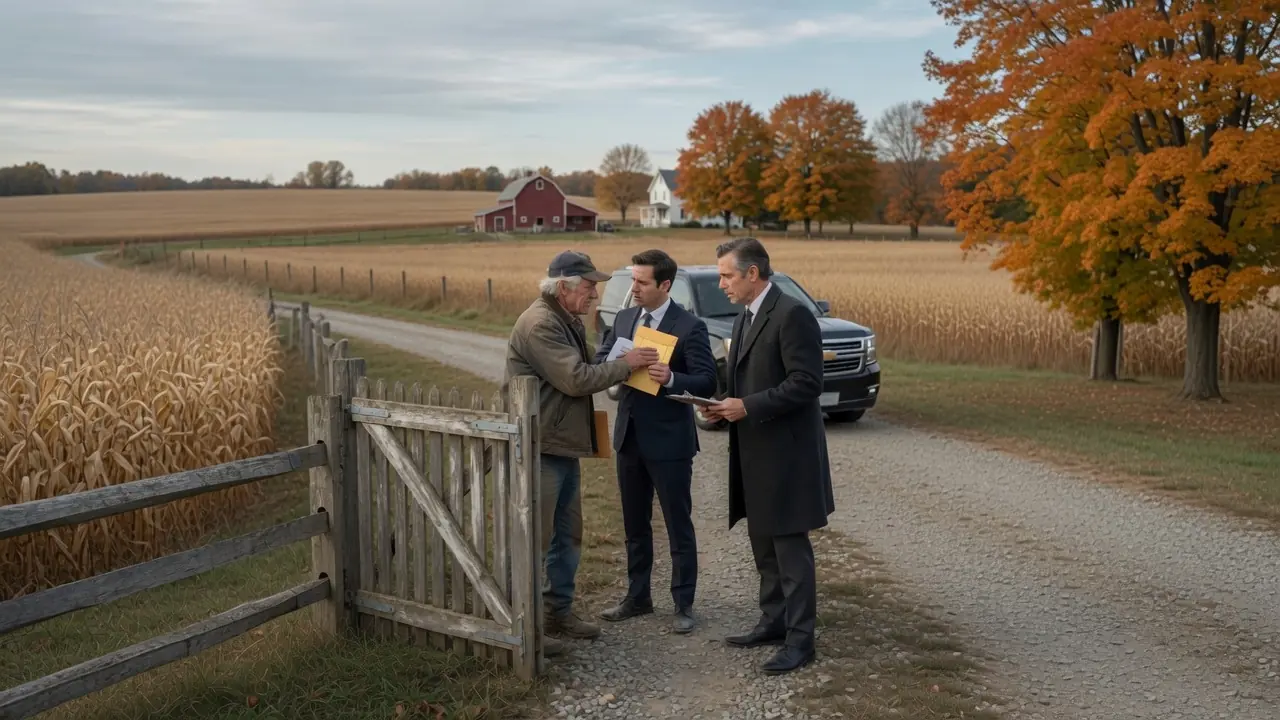
Six months earlier, he had arrived at Thomas Reed’s farm in a polished black SUV wearing a dark suit and carrying a leather folder.
At the time, Nathan believed he was delivering a difficult but lawful notice.
He did not yet understand that the folder in his hand contained a carefully constructed lie.
The farm appeared at the end of a gravel road twelve miles outside Fairview, Missouri.
Nathan had never been there before.
From the highway, the Reed property looked ordinary. A white farmhouse stood beneath tall maple trees. A red barn faced the road. Fencing divided the pastures into irregular sections shaped by hills, water, and generations of practical decisions.
Only when Nathan drove farther in did he understand the labor contained in the place.
Stone drainage channels followed the eastern field.
A restored creek bank curved behind the barn.
Rows of winter wheat covered soil that should have been exhausted decades earlier.
The farmhouse porch had been rebuilt with hand-cut oak posts, each one weathered but solid.
Nothing appeared accidental.
Thomas stood beside a wooden fence repairing a gate hinge.
He wore work jeans, a faded canvas jacket, and a cap darkened by years of sun and sweat.
When Nathan stepped from the SUV, Thomas looked first at the polished shoes.
Then at the folder.
The old farmer did not smile.
“Mr. Reed?”
“Yes.”
“I’m Nathan Cole. I represent First Heritage Bank.”
The farmer’s attention sharpened.
First Heritage had owned a small branch in Fairview until the late 1980s, when it merged with a regional institution. Thomas had not conducted business there in decades.
“What does your bank want?”
Nathan opened the folder.
“I’m here regarding the title to this property.”
Thomas rested one hand against the fence.
“What about it?”
“There may be a defect in the original transfer documents.”
The wind moved through the winter wheat.
Thomas stared at him for several seconds.
“Original transfer?”
“From 1973.”
“You drove from St. Louis to tell me somebody found a mistake after fifty years?”
Nathan had practiced his response during the drive.
Now it sounded absurd.
“The bank recently digitized several historical files. During that process, counsel identified a possible irregularity in the foreclosure that preceded your purchase.”
Thomas stepped away from the gate.
“What irregularity?”
“The acknowledgment from the previous owner may not have been completed correctly.”
“Elias Boone?”
“Yes.”
“Elias signed the property to the bank.”
“That is what the recorded documents indicate.”
“What does the bank indicate now?”
“That the foreclosure chain may be incomplete.”
Thomas looked toward the farmhouse.
Then the barn.
Then the fields.
The movement was slow, as though he needed to confirm they remained where he had left them.
“I paid one dollar for this place.”
Nathan knew.
Everyone at First Heritage’s legal department knew.
The transaction was the reason the file attracted attention.
In 1973, the bank had advertised the abandoned eighty-acre parcel for one dollar plus recording costs. The property was flooded, overgrown, and generating taxes without income.
Thomas Reed, then twenty-four and working as an automobile mechanic, accepted the offer.
The bank believed he would abandon it within a year.
Instead, he stayed for half a century.
“The purchase price is not the concern,” Nathan said.
“It should be.”
“Why?”
“Because nobody buys a farm for one dollar unless everyone understands what is being transferred.”
Nathan looked toward the eastern field.
Thomas followed his gaze.
“That ground held water for a week after every storm,” the farmer said. “My wife and I dug the first drainage trench with shovels because we couldn’t afford equipment.”
Nathan remained quiet.
Thomas pointed toward the creek.
“I rebuilt that bank three times.”
Then toward the barn.
“My father and I replaced every roof beam.”
Nathan noticed a framed opening above the barn doors where the original boards had been repaired rather than replaced.
Thomas continued.
“My son learned to drive in that lower pasture. He died before he was old enough to inherit it.”
Nathan lowered his eyes.
“I’m sorry.”
“Don’t be.”
The farmer’s voice hardened.
“Just don’t call fifty years of work a paperwork irregularity.”
Nathan removed the formal notice.
Thomas did not take it.
“What happens if I refuse?”
“The notice is considered delivered whether you accept it or not.”
Thomas looked at the envelope.
“Who wants the land?”
Nathan hesitated.
He had been instructed not to discuss potential acquisitions.
“First Heritage is conducting a title review.”
“That isn’t what I asked.”
“I’m not authorized to discuss third parties.”
Thomas gave a short, humorless laugh.
“Then there is a third party.”
Nathan said nothing.
The farmer looked toward the clean SUV.
“Halcyon Development?”
Nathan’s face revealed the answer before he could stop it.
Thomas nodded.
“They offered me nine hundred thousand dollars last year.”
“I wasn’t aware.”
“They want access from the new interstate connector to the industrial tract.”
Nathan knew that too.
The Reed farm had become strategically valuable after the state approved a highway exit two miles west. Halcyon Development had purchased nearly every neighboring parcel.
Thomas’s land divided the proposed distribution complex from the county road.
Without it, Halcyon would need to construct an expensive alternate route through wetlands.
“You people are not reviewing history,” Thomas said. “You’re pricing a driveway.”
Nathan held out the envelope.
“I’m required to give you this.”
Thomas finally took it.
“Then you’ve done what you came to do.”
“Mr. Reed, no final decision has been made.”
“A man doesn’t drive this far in polished shoes unless somebody already made one.”
Nathan returned to the vehicle.
Before opening the door, he looked back.
Thomas stood alone beside the fence holding the notice.
The wind moved the wheat behind him.
Nathan had delivered hundreds of difficult letters during his career.
Foreclosures.
Loan defaults.
Business closures.
Estate disputes.
He believed professionalism required emotional distance. Banks dealt in contracts, not memories. Land was collateral. Buildings were assets. History mattered only when recorded properly.
Yet during the drive back to St. Louis, Thomas’s final sentence followed him.
You’re pricing a driveway.
Nathan reached the bank headquarters shortly before five.
First Heritage occupied twelve floors of a glass building overlooking the river. Its executive offices smelled of polished wood and expensive coffee.
Harold Voss summoned him immediately.
The bank president sat behind a desk large enough for six people.
Beside him was Cynthia Vale, general counsel, and a representative from Halcyon Development named Marcus Trent.
“Did Reed accept service?” Voss asked.
“Yes.”
“Reaction?”
“Angry.”
“That was expected.”
“He knows Halcyon is involved.”
Marcus Trent leaned back.
“How?”
“He guessed.”
“Did you confirm it?”
“No.”
Trent looked toward Voss.
“The sooner he understands he has limited options, the better.”
Nathan placed his copy of the delivery receipt on the desk.
“He has a recorded deed and nearly fifty years of tax payments.”
Cynthia Vale folded her hands.
“Possession is not necessarily title.”
“Are we certain the foreclosure was defective?”
“We have enough uncertainty to justify review.”
Nathan noticed the phrasing.
“Enough uncertainty for what?”
Voss answered.
“To encourage a negotiated resolution.”
“You mean a sale.”
“A sale would avoid lengthy litigation.”
“For Thomas?”
“For everyone.”
Nathan looked toward Marcus Trent.
“How much would Halcyon offer?”
Trent smiled faintly.
“That depends on how realistic Mr. Reed becomes.”
Nathan left the meeting uneasy.
That evening, he opened the Reed title file from his office.
The digital folder contained hundreds of scanned pages.
Foreclosure notices.
Old correspondence.
Tax records.
The 1973 one-dollar deed.
Several pages were marked incomplete or illegible.
Nathan found the disputed acknowledgment from Elias Boone.
The notary seal was visible.
The signature line appeared partially damaged.
He understood why counsel could claim uncertainty.
Then he noticed an archive reference at the bottom of an internal index.
SUPPLEMENTAL RELEASE — SEE BLUE FILE 73-B
Nathan searched the database.
No file appeared.
He assumed the scan had failed.
The next morning, he asked the records department.
A clerk named Denise Harper looked uncomfortable.
“Blue files were private executive records.”
“Where are they stored?”
“Most were destroyed during the 2016 archive conversion.”
“Most?”
“Some were scanned separately.”
“Who has access?”
“Legal.”
Nathan emailed Cynthia Vale.
Her response arrived nine minutes later.
The supplemental materials are privileged. Continue assigned duties only.
That should have ended his interest.
Instead, it deepened it.
Two weeks later, Halcyon-funded attorneys filed a title action naming Thomas Reed and Caroline Boone Ellis, the sixty-three-year-old daughter of Elias Boone.
Caroline claimed she had recently learned that her father never legally surrendered ownership.
If the court accepted her argument, the one-dollar sale could be invalidated.
Halcyon agreed to pay her legal costs in exchange for an option to purchase the property.
Nathan read the complaint late at night.
The language made Caroline sound like a daughter restoring land stolen from her family.
Yet one question remained.
If Elias Boone believed the bank had wrongfully taken the farm, why had he remained silent for the rest of his life?
Nathan’s own grandfather had lost a hardware store during the recession of the early 1980s.
The bank called it a voluntary liquidation.
Nathan remembered his grandfather calling it theft.
He remembered shelves emptied into trucks while his grandmother cried in the office.
That memory was partly why Nathan entered banking.
He believed he could become the kind of person who treated struggling borrowers fairly.
Somewhere between junior loan officer and vice president of special assets, that purpose became buried beneath procedure.
The Reed case forced it back into view.
Nathan drove to Fairview again without telling anyone.
He did not visit Thomas.
Instead, he went to the county records office.
The clerk allowed him to examine the original land books.
Thomas’s deed had been recorded publicly in April 1973.
Every annual tax entry listed him as owner.
Improvement permits appeared under his name.
No Boone heir had ever filed an objection.
At the courthouse café, Nathan overheard farmers discussing the lawsuit.
One man said Thomas had converted useless swamp into the best wheat ground east of the river.
Another said Halcyon had been circling the farm for years.
“They don’t want the ground,” the man said. “They want the road through it.”
Nathan returned to St. Louis and requested the blue file again.
This time, Harold Voss called him upstairs.
“Why are you still looking into archived materials?”
“Because I delivered the notice.”
“You completed that task.”
“If we already possess a supplemental release, the lawsuit may be improper.”
Voss’s expression remained calm.
“Legal has evaluated the evidence.”
“Has legal seen the blue file?”
“That is not your concern.”
“It became my concern when I represented the bank to Mr. Reed.”
Voss leaned forward.
“You are not personal counsel for a farmer in Fairview.”
“No.”
Nathan looked through the glass wall at the city below.
“I’m an officer of the bank.”
“Then behave like one.”
Nathan left knowing two things.
The bank had seen the file.
And whatever it contained threatened the strategy.
Meanwhile, Thomas and his daughter, Anna, hired Margaret Sloan, a Fairview property attorney.
The bank received document requests.
Tax histories.
Foreclosure records.
Executive correspondence.
Archive indexes.
Cynthia Vale objected to nearly all of them.
Nathan watched the legal department describe the blue-file notation as an unexplained clerical reference.
He knew that was false.
Denise Harper knew too.
One evening, she appeared at his office door carrying a small portable drive.
“I shouldn’t be here.”
Nathan closed the door.
“What is it?”
“The 2016 archive log.”
She inserted the drive into his computer.
A spreadsheet listed every box scanned before destruction.
One entry read:
BLUE FILE 73-B — BOONE/REED PARCEL — 14 PAGES
“Where are the scans?” Nathan asked.
“Restricted legal archive.”
“Can you access them?”
“Not anymore.”
“Who changed permissions?”
“Cynthia Vale’s office, three days after Halcyon first contacted the bank.”
Nathan felt cold.
“Do you have proof?”
Denise pointed toward the access log.
The timing was clear.
Halcyon asked about the Reed property.
Legal restricted the blue file.
Months later, the bank asserted that ownership was uncertain.
“Why are you showing me this?” Nathan asked.
Denise looked down.
“My father owns forty acres near the southern connector route.”
Nathan understood.
Halcyon had approached her family too.
The company’s representative mentioned “possible historical boundary questions” after they declined to sell.
“This may not be only about Reed,” she said.
Nathan began looking at similar cases.
He found four.
Each involved elderly rural landowners.
Each property lay near a proposed development corridor.
Each contained minor historical defects that had gone unchallenged for decades.
In two cases, owners sold below market rather than risk litigation.
Halcyon purchased both.
First Heritage received consulting or financing fees after each transaction.
Nathan printed nothing.
He took handwritten notes and stored them at home.
Then Thomas found the yellow envelope.
It had been hidden inside a wooden box belonging to his late father.
The envelope contained the original conditional purchase agreement and letters from Arthur Whitman, the First Heritage loan officer who handled the one-dollar transfer.
One letter stated that Thomas would receive permanent equitable ownership after five years of continuous occupation, tax payment, and documented improvements.
A second, dated 1978, confirmed he had satisfied every condition.
Thomas’s lawyer sent copies to the bank.
Cynthia dismissed them as informal correspondence lacking final authentication.
But Nathan knew the letters mattered because the archive index contained a corresponding entry:
COMPLETION CERTIFICATE — BLUE FILE 73-B
The hidden file likely contained the missing legal proof.
Thomas’s attorney located Arthur Whitman in a Kansas City assisted-living home.
He was ninety-seven.
His memory was inconsistent, but he recognized the transaction immediately.
“The one-dollar farm,” he said during a recorded interview.
Arthur remembered something else.
Elias Boone had visited the bank before Thomas’s purchase.
Boone signed a private release surrendering any remaining interest.
The release was placed in a blue file because the bank president wanted sensitive foreclosure corrections separated from ordinary records.
Nathan listened to the recording in Cynthia’s conference room.
When it ended, no one spoke.
Finally, Harold Voss said, “An elderly man’s recollection is not a document.”
Nathan looked at him.
“The document is in the restricted archive.”
Voss’s face hardened.
“You have no evidence of that.”
“I have the scan log.”
Cynthia turned sharply.
“How did you obtain it?”
Nathan realized he had revealed too much.
Voss stood.
“You are suspended effective immediately.”
Nathan surrendered his access badge and company laptop.
Security escorted him from the building he had entered almost every weekday for twelve years.
The following morning, Halcyon’s attorneys offered Thomas a settlement.
One million dollars.
He could keep living in the farmhouse for the rest of his life, but the surrounding land would transfer immediately.
Thomas refused.
Halcyon increased the offer to $1.4 million.
He refused again.
People called him foolish.
Anna asked whether he understood how much money that was.
Thomas answered, “I understand exactly what they think they’re buying.”
Nathan remained home for three days.
He barely slept.
First Heritage sent him a letter reminding him of confidentiality obligations.
His wife, Rebecca, found him at the kitchen table surrounded by handwritten notes.
“What happens if you release this?”
“I lose my job.”
“You already lost it.”
“They could sue.”
“Would they win?”
“I don’t know.”
Rebecca sat across from him.
“What happens if you don’t?”
Nathan looked toward the window.
His grandfather’s old hardware-store sign hung in their garage. The paint had faded, but the family name remained visible.
“I become the man who delivered the lie and then protected it.”
Rebecca nodded.
“You already know what to do.”
Nathan contacted Margaret Sloan.
They met after dark at Thomas’s farmhouse.
Thomas opened the door.
When he saw Nathan, his expression became cold.
“You came back.”
“Yes.”
“Another notice?”
“No.”
Thomas did not invite him inside.
Nathan held up the portable drive.
“The bank knew the title claim was false before I visited you.”
The farmer stared at him.
Anna appeared behind her father.
“Let him in.”
They gathered around the kitchen table.
Margaret arrived twenty minutes later.
Nathan explained the archive log, the restricted blue file, the Halcyon contacts, and the similar pressure campaigns against other landowners.
Thomas listened without interruption.
When Nathan finished, the old farmer looked toward a framed photograph of his late wife.
“Did you know when you stood beside my fence?”
“I knew there were missing documents. I did not know what they contained.”
“But you suspected.”
“Yes.”
“And you still delivered the notice.”
“Yes.”
“Why?”
Nathan could have said he was following orders.
He could have said he trusted legal counsel.
Both were true.
Neither was enough.
“Because my salary depended on me not asking the final question.”
Thomas looked at him for a long time.
“Why are you answering it now?”
Nathan placed the drive on the table.
“My grandfather lost his store after a bank pressured him into signing away property. I spent years telling myself I entered banking to prevent that from happening to others.”
He looked down.
“Apparently, I only entered the room where it happened.”
Thomas did not forgive him.
But he allowed Margaret to copy the files.
The next day, she filed an emergency motion accusing First Heritage and Halcyon of concealing evidence and abusing the court process.
Judge Hale ordered the bank to preserve and produce the complete blue-file archive.
First Heritage claimed the relevant scan was corrupted.
The judge ordered an independent forensic examination.
A technology firm recovered fourteen pages from a deleted server folder.
The first was Elias Boone’s notarized release.
The second was Thomas’s five-year completion certificate.
The remaining pages documented the bank board’s approval of permanent title in 1978.
Thomas had owned the farm legally for nearly fifty years.
There had never been a genuine ownership dispute.
There had only been a valuable parcel and a corporation willing to manufacture doubt.
The recovered archive also contained an internal Halcyon email:
If title pressure persuades Reed to settle below market, acquisition compensation to First Heritage increases by fifteen percent.
That email placed Nathan in the witness stand.
Thomas’s attorney asked the questions slowly.
Did the bank possess the release?
Yes.
Did executives know?
Yes.
Did Halcyon offer financial incentives?
Yes.
Why was Nathan sent to the farm?
“To frighten Mr. Reed into selling.”
The truth cost Nathan his career.
It cost First Heritage much more.
Judge Hale ruled that Thomas held clear title and that the bank knowingly concealed evidence. She imposed sanctions, awarded legal fees, and referred the conduct to banking regulators and the state attorney general.
Caroline Boone withdrew her claim after learning that her father had signed the release.
Outside the courtroom, she approached Thomas.
“I believed they had found proof the bank cheated my father.”
Thomas looked toward Nathan, who stood alone near the steps.
“The bank cheated both families,” he said. “Just in different ways.”
Caroline’s eyes filled.
“My father spent years saying the property was taken from him.”
“Maybe that was easier than saying he gave it up.”
“He was trying to pay for my mother’s treatment.”
“I know that now.”
She looked toward the courthouse doors.
“I thought winning your farm would repair something.”
“It would have created another broken family.”
Caroline nodded.
“I’m sorry.”
Thomas offered his hand.
She took it.
The state investigation uncovered four other title-pressure cases connected to Halcyon.
Two families had sold their land below market value after receiving threats of litigation.
Their cases were reopened.
First Heritage’s president resigned.
Cynthia Vale lost her law license after investigators proved she had ordered the blue file restricted and later directed employees to describe it as nonexistent.
Halcyon paid millions in penalties and abandoned the Fairview development route.
Nathan remained unemployed for eight months.
Other banks considered him disloyal.
Law firms considered him risky.
He submitted applications and rarely received interviews.
Then the state attorney general hired him as an investigator in a small financial-protection unit focused on land and lending fraud.
His salary was lower.
His office had no river view.
For the first time in years, he slept well.
Thomas did not suddenly become Nathan’s friend.
Trust did not grow because one man eventually admitted the truth he had helped conceal.
Still, their paths crossed.
A year after the court ruling, Nathan visited a community farm outside Fairview while investigating another lending complaint.
Thomas was repairing a fence there.
Nathan held one post while a volunteer poured concrete around it.
The post leaned several inches to the left.
Thomas stared at it.
“You planning to build the entire fence in that direction?”
Nathan stepped back.
“I thought it was straight.”
“That is why levels were invented.”
Thomas took the tool from him.
They adjusted the post before the concrete hardened.
Nathan looked toward the old farmer.
“You didn’t have to help.”
“No.”
“Why did you?”
“Because a crooked post gets worse when everyone stands around discussing who caused it.”
Nathan smiled faintly.
“That sounds like a banking lesson.”
“It’s a fence lesson.”
They never discussed forgiveness.
They did not need to.
Thomas returned to his farm.
The lawsuit changed how he thought about inheritance.
For decades, he believed a recorded deed and tax receipts were enough. After the case, he placed the land into a family trust.
Anna became co-trustee.
His grandchildren received future stewardship rights.
No sale outside the family could occur without unanimous consent and independent legal review.
The blue-file documents were stored in three places.
One copy at home.
One in a secure deposit box.
One with the county historical society.
Thomas refused to allow the truth to become difficult to find again.
Caroline Boone visited the farm the following spring.
She brought photographs of her father as a boy.
One showed Elias standing beside the same creek Thomas later restored. The barn behind him still had its original roof.
Thomas placed the picture inside the workshop.
Anna was surprised.
“After everything?”
“Elias lived here before us.”
“He nearly took it back.”
“No. People using his name nearly took it.”
Thomas studied the photograph.
“History doesn’t become false because parts of it are uncomfortable.”
The community held a gathering in the barn that autumn.
Arthur Whitman joined by video from his assisted-living home.
The ninety-seven-year-old banker could not remember every guest, but he remembered the farm.
“They thought you would quit,” he told Thomas.
“They were almost right,” Thomas answered.
Arthur smiled.
“No. You were too stubborn.”
Thomas’s grandchildren laughed.
On one wall hung the original one-dollar deed.
Beside it was the 1978 completion certificate.
Below both documents, Anna placed a photograph taken shortly after the purchase.
Thomas stood alone in an overgrown field beside a rusted pickup.
The farmhouse windows were broken.
The barn roof sagged.
Water covered part of the ground.
A handwritten caption appeared beneath it:
THE DOLLAR WAS THE SMALLEST PAYMENT.
Years passed.
The interstate connector opened farther west.
Fairview grew slowly.
Developers continued making offers.
Thomas declined each one.
He converted part of the barn into a workshop where local teenagers learned equipment repair and soil conservation.
Nathan occasionally spoke there about contracts, debt, and the importance of keeping records.
The first time he addressed the students, one boy asked why anybody should trust a banker.
Nathan looked toward Thomas, who stood near the rear wall.
“You should not trust a title alone,” Nathan answered. “Trust the evidence. Read the contract. Keep copies. Ask what happens when the person making the promise leaves.”
The boy frowned.
“That sounds like not trusting anybody.”
“No.”
Nathan shook his head.
“It means good people document promises so bad people cannot rewrite them later.”
Thomas approved of that answer.
Two years after the ruling, Thomas died peacefully in the farmhouse bedroom he and his wife, Grace, had rebuilt during their first winter together.
Anna sat beside him the night before.
Rain moved gently across the roof.
“Are you worried about the farm?” she asked.
Thomas looked toward the eastern window.
“No.”
“The trust documents are finished.”
“I know.”
“The blue file is safe.”
“All three copies?”
“Yes.”
“Tax receipts?”
“Dad.”
“Just checking.”
She smiled through tears.
“You taught us.”
Thomas closed his eyes.
“Your mother did most of the teaching.”
At sunrise, cattle moved beyond the barn.
A tractor started in the lower pasture.
Wind passed through the maple trees Grace had planted.
The farm continued without asking permission.
That comforted him.
At the funeral, an old neighbor described the first day Thomas saw the property.
“I told him it was a swamp with a collapsed house,” the man said.
Thomas’s grandson, Henry, stood beside the framed one-dollar deed during the reception.
A newspaper reporter asked him whether his grandfather had truly purchased the entire farm for one dollar.
Henry nodded.
“Was it the best deal in county history?”
The thirteen-year-old looked toward the fields.
“No.”
The reporter appeared confused.
“Why not?”
“Because he paid for it every day after that.”
The quote appeared on the front page the following morning.
Nathan clipped the article and placed it inside his office drawer beside a copy of the notice he once delivered.
He kept that notice not as proof of corruption.
As proof of his part in it.
The paper reminded him how easy wrongdoing could look when divided among ordinary tasks.
One executive designed the strategy.
One lawyer buried a file.
One corporation funded the claim.
One employee drove to a farm and delivered an envelope.
Each action seemed smaller than the harm it created.
Together, they nearly erased fifty years of another man’s life.
People later told the story as though a mysterious old envelope suddenly defeated a greedy bank.
The truth was slower.
Thomas’s father kept receipts.
Arthur Whitman preserved letters.
A records clerk saved an archive log.
Thomas refused to sell.
Caroline listened when evidence contradicted the story she wanted to believe.
Nathan finally answered the question his career had trained him to avoid.
The envelope mattered.
But paper did not save the farm by itself.
People did.
People who understood that truth could disappear unless someone carried it forward.
Thomas Reed had believed the hardest part of owning the land was transforming flooded soil into productive ground.
For decades, it was.
Then a bank arrived and tried to turn a life into a technical uncertainty.
Its executives believed age made Thomas vulnerable.
They believed expensive litigation would frighten him.
They believed fifty years was long enough for the right document to vanish.
They were wrong.
The records remained.
So did the fields.
So did the barn, the maple trees, the repaired creek, and every mark left by the family that built its life there.
Nathan first saw the property as a parcel standing between a developer and a highway.
By the end, he understood why Thomas refused every offer.
The farm’s value did not begin when land prices rose.
It began when a young mechanic stood in knee-deep weeds and saw a home where a bank saw only liability.
The deed said one dollar.
The fields said fifty years.
And when Nathan finally sat beneath oath and told the truth, he did not save Thomas Reed’s farm.
Thomas, his family, and the people who preserved the record had already done that.
Nathan only stopped helping the bank steal it.