The boy had been sitting beside the janitor’s closet for thirty-seven minutes when the branch manager finally ordered security to remove him.
Ten-year-old Marcus Hill rose from the cold metal chair without arguing.
His shoes made almost no sound against the marble floor.
They were old black sneakers with cracked soles and laces that no longer matched. The left toe had been repaired with glue. His oversized brown jacket had come from a neighborhood donation center and still carried the faint smell of someone else’s laundry detergent.
In one hand, Marcus held a worn envelope containing his bank card and legal documents.
In the other, he clutched a handwritten letter from his grandmother.
Customers watched him cross the lobby.
Some looked uncomfortable.
Others looked entertained.
One man near the investment desk laughed openly.
Grant Bellamy, the manager of Heritage Trust Bank’s most prestigious downtown branch, stood beside the teller counters with both hands resting on his hips.
“Next time you want a handout,” he called after Marcus, “try the shelter three blocks over. This is a bank.”
The words followed the boy to the automatic doors.
Marcus did not turn around.
His grandmother Evelyn had taught him never to give cruel people the satisfaction of watching him break.
He kept his shoulders straight until he stepped outside.
Only when the doors closed behind him did his face collapse.
Inside the bank, Grant adjusted the cuffs of his custom shirt.
“That,” he told the senior teller beside him, “is how you deal with scammers before they waste everyone’s time.”
Rachel Dunn gave a nervous smile.
She had laughed earlier.
Now the sound of Grant’s voice made something unpleasant settle in her stomach.
Neither of them noticed the dark sedan entering the parking lot.
An hour earlier, Marcus had arrived believing the visit would take only a few minutes.
His grandmother had died eight weeks before.
Evelyn Hill had raised him from the age of three, after his mother was killed in a highway accident and his father disappeared from his life.
She had been an elementary-school teacher for forty-one years.
Her apartment was small.
Her furniture was old.
Her winter coat had been repaired so many times that three different shades of thread held the lining together.
Marcus had always assumed they lived modestly because teachers did not earn much money.
He did not understand how carefully Evelyn had saved.
After her death, his uncle Adrian became his legal guardian.
Adrian was Evelyn’s only son and Marcus’s mother’s older brother. He traveled often for work and spent most days inside meetings Marcus did not fully understand.
On the morning of the bank visit, Adrian had planned to accompany him.
An emergency board meeting delayed him.
“I’ll meet you there by ten fifteen,” Adrian had promised over breakfast.
“Can’t we go another day?”
“You’ve been asking to know what Grandma left you.”
Marcus looked toward the brown envelope on the table.
The envelope contained a letter, an account card bearing his name, and copies of the trust documents Evelyn’s attorney had prepared.
“She said the money was for school.”
“It is.”
“How much is it?”
Adrian smiled.
“You’ll see at the bank.”
Marcus took the bus into the city with a family driver who dropped him outside the branch before continuing to another appointment. Adrian expected to arrive within twenty minutes.
The Heritage Trust building looked more like a hotel than a bank.
Marble columns framed the entrance.
Brass letters covered the wall behind reception.
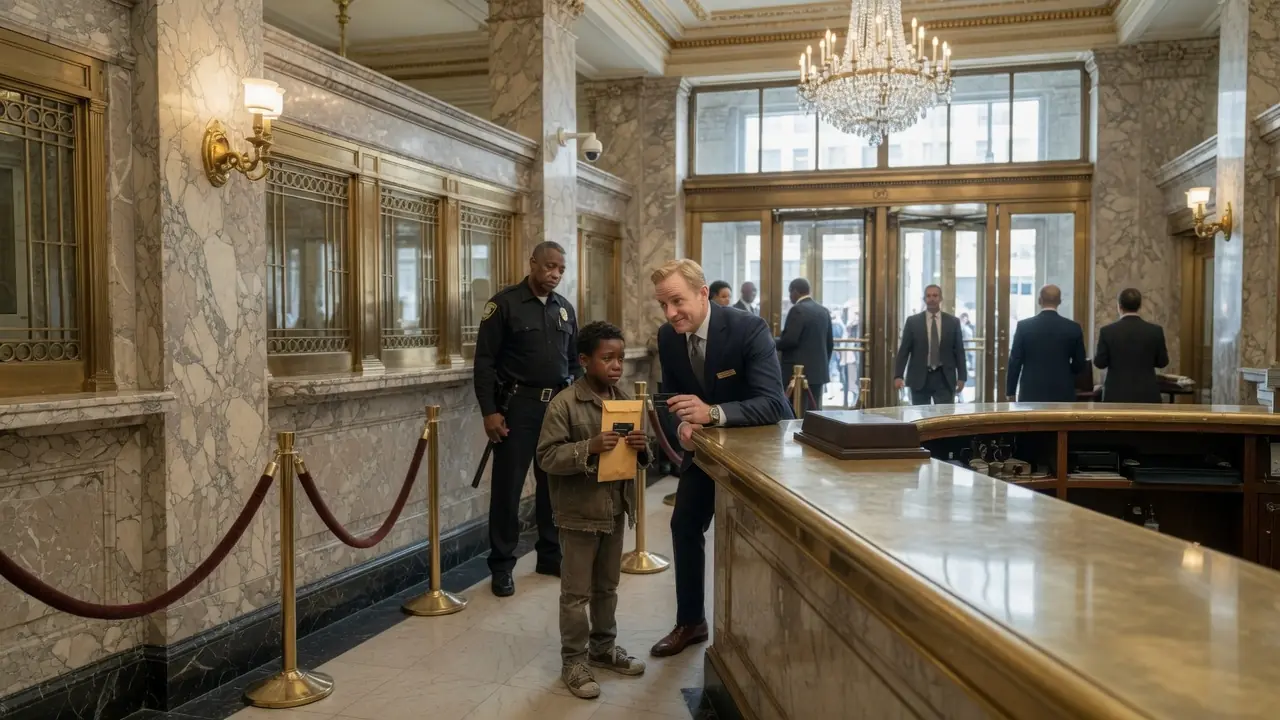
A security guard stood beside the doors while classical music played quietly from speakers hidden in the ceiling.
Marcus hesitated before entering.
He looked down at his shoes.
Evelyn had bought them at a thrift store the previous spring.
Two dollars.
She had apologized because they were already worn.
Marcus complained once after a classmate laughed at them.
Evelyn knelt in front of him and tied the loose laces.
“Shoes tell people where you walked,” she said. “They do not tell people who you are.”
He remembered those words as the doors opened.
The security guard watched him enter.
His name was Samuel Reed.
Samuel was fifty-four, broad-shouldered, and tired in the way of a man who had spent years swallowing words because speaking them could threaten his paycheck.
He had worked at the branch for eleven years.
He saw the boy’s worn shoes.
He also noticed the envelope held carefully against his chest.
“Can I help you?” Samuel asked.
“I need to check my account balance.”
Before Samuel could respond, Grant Bellamy appeared from behind a glass office.
Grant was forty-six, polished, ambitious, and proud of managing the branch used by many of the city’s wealthiest clients.
His gray suit fit perfectly.
His silver watch cost more than Marcus’s grandmother had spent on groceries in a year.
Grant looked at the boy.
Then he laughed.
“Your account?”
Marcus nodded.
“Yes, sir.”
The laughter carried across the lobby.
Several customers turned.
Grant stepped closer.
“This is Heritage Trust Bank.”
“I know.”
“Not a public-assistance office.”
Marcus did not understand why those things were connected.
“I only need someone to check the balance.”
Grant looked toward the customers as though inviting them into the joke.
“Do your parents know you’re here?”
“My uncle is coming.”
“Of course he is.”
Grant looked down at the sneakers.
“And where did you get those?”
Marcus lowered his eyes.
“My grandmother bought them.”
“A bank account, a mysterious uncle and a dead grandmother.”
Grant shook his head theatrically.
“You children need better stories.”
A wealthy man standing behind Marcus sighed impatiently.
“Can someone move him? Some of us have business to conduct.”
Rachel Dunn leaned over her teller counter.
“Should I call the police?”
Marcus’s fingers tightened around the envelope.
“I’m not doing anything wrong.”
Grant’s smile disappeared.
“Then show me what you have.”
Marcus opened the envelope and removed the card.
It was black with a narrow silver line.
The words Private Reserve appeared beneath the Heritage Trust emblem.
Grant’s eyes changed for the briefest moment.
Private Reserve cards were not issued through ordinary branch applications.
They belonged to trust accounts, family offices and clients whose assets required dedicated banking teams.
Marcus’s name was printed across the front.
MARCUS E. HILL
Grant took it from him.
“Where did you steal this?”
Marcus looked shocked.
“I didn’t steal it.”
Grant held the card up for the lobby to see.
“You expect me to believe this belongs to you?”
“My name is on it.”
“Names can be printed.”
“My grandmother opened the account.”
Rachel left her station and joined Grant.
She examined the boy as though searching for evidence of deception in his clothes.
“Maybe someone sent him in to test a stolen card.”
Marcus reached for the documents.
“The papers explain everything.”
Grant snatched the envelope before the boy could open it.
He removed the trust summary and Evelyn’s death certificate.
He barely glanced at either.
“Sit over there.”
Marcus looked toward the comfortable chairs near the account desks.
Grant pointed in the opposite direction.
A row of hard metal seats stood near the restrooms and supply closet.
“Not there. In the back.”
“How long will it take?”
“However long it takes me to determine whether I should call the police.”
Marcus walked to the corner.
No one stopped Grant.
No one asked why a ten-year-old had been accused before the documents were verified.
Samuel remained beside the entrance.
His hands tightened around his belt.
He wanted to speak.
He also pictured his mortgage payment.
His daughter’s college tuition.
The pension he would receive after four more years.
Grant had removed employees for less than open disagreement.
Samuel remained silent.
Marcus sat alone.
He unfolded Evelyn’s letter.
Her handwriting shook near the end, but every word remained clear.
My brave Marcus,
The world may try to measure you by things that have nothing to do with your heart. Your clothes. Your address. Your skin. The amount of money people believe you have. Do not let their small measurements become your truth.
You are worth more than they will ever know.
Marcus read the lines twice.
His phone buzzed.
A message from Adrian appeared.
Meeting running late. Fifteen more minutes. Stay strong, champ.
Marcus typed:
Okay.
He did not mention the accusations.
He did not want Adrian to worry.
Customers arrived and received immediate assistance.
A man wearing a golf shirt opened an account without being asked where he obtained his money.
A woman carrying a designer bag deposited a large check while Rachel offered her coffee.
Another customer, Margaret Lane, finished a mortgage transaction near the main desk.
Margaret was sixty-seven and had banked at the branch for years.
She noticed Marcus in the corner.
She had heard Grant’s laughter.
She had watched him hold up the black card and accuse the child of theft.
Her face tightened.
For one moment, Marcus believed she might approach him.
Instead, Margaret pulled her handbag closer and walked toward the exit.
The doors closed behind her.
She reached her car but did not start it.
Something about the boy’s face remained with her.
Inside, twenty minutes became thirty.
Grant helped three customers before returning to Marcus.
“Come here.”
The boy carried his documents to a small desk near the back wall.
It was not one of the desks used for private clients. There was no carpet, no comfortable chair and no privacy.
Grant sat behind it.
Rachel stood beside him.
Samuel watched from the entrance.
“You claim this account belongs to you,” Grant began.
“It does.”
“You have no government identification.”
“I’m ten.”
“That is not my problem.”
“I have my school ID.”
Marcus placed it on the desk.
Grant lifted it using two fingers.
“Lincoln Elementary. Fifth grade.”
He dropped it.
“This proves nothing except that someone made you a school card.”
“The bank card has my name.”
“Where are your parents?”
Marcus became very still.
“My mother died.”
Grant leaned back.
“And your father?”
“I don’t know.”
Rachel’s expression shifted slightly.
Grant did not soften.
“So you live with this uncle?”
“Yes.”
“Where is he?”
“In a meeting.”
Grant laughed.
“An important one, I assume.”
Marcus nodded.
“He runs a company.”
“Of course he does.”
Grant looked toward Rachel.
“Maybe he owns an airline too.”
She smiled, but less confidently than before.
Marcus pushed the trust papers forward.
“Please read them.”
Grant ignored the documents.
“What did your grandmother do?”
“She was a teacher.”
“A teacher left you a Private Reserve account?”
“She saved.”
“How much?”
“I don’t know. That’s why I came.”
Grant’s expression hardened.
He had made up his mind before Marcus finished the sentence.
“I’m freezing the account pending investigation.”
Marcus’s eyes widened.
“You can’t.”
“I can prevent access to suspicious funds.”
“They’re not suspicious. They belonged to Grandma.”
“What kind of teacher saves enough money for this card?”
“She worked for forty-one years.”
Grant stood.
“Spare me the story.”
The lobby quieted again.
Grant raised his voice.
“Ladies and gentlemen, I apologize for the delay. Unfortunately, banks regularly deal with people attempting to use stolen financial information.”
Marcus felt every face turn toward him.
Grant pointed.
“This child entered with a card that obviously does not match his circumstances.”
One customer nodded.
Another lifted a phone as though recording entertainment.
Marcus’s throat tightened.
“My grandmother didn’t steal anything.”
Grant faced him.
“I didn’t say she did.”
“You asked if she robbed a bank.”
“I asked a reasonable question.”
“No, you didn’t.”
The response surprised everyone, including Marcus.
Grant stepped closer.
“What did you say?”
Marcus remembered Evelyn’s voice.
Dignity is not given. It is carried.
“I said you didn’t ask a reasonable question.”
Grant’s face reddened.
He turned toward Samuel.
“Remove him.”
Samuel’s stomach tightened.
“Mr. Bellamy, perhaps we should verify—”
Grant looked at him sharply.
“That was not a suggestion.”
Samuel walked forward.
Each step felt heavier than the last.
Marcus gathered the documents.
He rose before Samuel reached him.
“I can walk.”
Samuel extended one hand but could not meet his eyes.
Marcus headed toward the exit.
Grant followed far enough to make sure everyone heard him.
“Do not come back without an adult and legitimate identification.”
“My uncle is coming.”
“Tell him to take you somewhere that accepts begging.”
Laughter came from near the investment desk.
Samuel saw Marcus flinch.
Still, he said nothing.
At the doors, Marcus’s phone rang.
UNCLE ADRIAN
He tried to answer, but his hands were shaking.
The phone slipped and struck the marble.
A crack appeared across the screen.
Samuel picked it up.
Their eyes met.
Marcus saw shame there.
Deep, painful shame.
But shame did not defend him.
Samuel handed over the phone.
“I’m sorry,” he whispered.
Marcus took it.
Then he walked outside alone.
Grant returned to the tellers.
“And that,” he said, “is how you protect a bank.”
Rachel stared at the closed doors.
The satisfaction she expected to feel never came.
Grant’s computer chimed with an email.
URGENT: INSTITUTIONAL INVESTOR VISIT — REGIONAL DIRECTOR EN ROUTE
He deleted it without reading the details.
Outside, the November wind cut through Marcus’s thin jacket.
He sat on a stone bench near the entrance.
Cars arrived and departed.
People passed without stopping.
A jogger’s dog pulled toward him, but its owner tightened the leash and continued walking.
Marcus placed the cracked phone beside him and reopened Evelyn’s letter.
A tear struck the page.
Then another.
Everything I saved is for your education and your future. Not because money makes you important. You were important before I saved the first dollar.
Remember that dignity is not something another person can hand to you or take away. Carry yours proudly.
Marcus pressed the letter against his chest.
Evelyn had once promised that the bank would treat him with respect.
She believed people would call him sir, explain the account and help him understand what she had built.
Instead, they had called him a thief.
Inside, Margaret Lane had returned from the parking lot.
She stood near the entrance, watching Marcus through the glass.
Her conscience had brought her back.
Courage had not yet taken her the final few feet.
Samuel also watched.
He remembered being twenty-two and standing in another bank while a teller refused to cash his paycheck without “additional verification.”
He remembered apartment managers suddenly claiming units were unavailable after seeing him.
He remembered being followed through stores.
He had promised himself that if he ever held authority, he would not become part of the machinery that made people feel smaller.
Yet when Marcus needed him, Samuel obeyed.
Grant called from across the lobby.
“Delivery at the rear entrance.”
Samuel looked toward the boy once more.
Then he turned away.
A black Mercedes entered the parking lot.
It stopped near the stone bench.
Adrian Hill stepped out.
He was forty-eight, tall, and dressed in a charcoal suit. Silver had begun appearing at his temples. He moved with calm authority, but the sight of Marcus bent over Evelyn’s letter stopped him immediately.
“Marcus?”
The boy looked up.
His face broke.
Adrian crossed the distance and lowered himself in front of him.
“I’m here.”
Marcus threw both arms around his uncle.
The expensive suit did not matter.
Adrian held him until the shaking eased.
Then he listened.
Marcus described the laughter, the accusations, the waiting, the questions about his parents and the order to leave.
Adrian said nothing until the boy finished.
His face remained controlled.
Only his eyes revealed what the story was doing to him.
“You did nothing wrong,” he said.
“They said the card was stolen.”
“It wasn’t.”
“They froze Grandma’s account.”
“They had no legal reason to.”
“I don’t want to go back inside.”
Adrian looked toward the bank.
“I understand.”
“Can we just leave?”
“We could.”
He paused.
“But then they would remember you as the boy they pushed out.”
Marcus lowered his eyes.
“You do not have to shout,” Adrian continued. “You do not have to fight them. You only have to walk back in and let them see that they did not take your dignity.”
Marcus held Evelyn’s letter.
“What would Grandma do?”
“She would enter through those doors with her head high.”
Marcus wiped his face.
“Okay.”
Another vehicle arrived.
Helena Price, regional director of Heritage Trust Bank, stepped from a dark SUV.
She had been traveling to the branch for a quarterly investor meeting when Adrian called.
Adrian was founder and chief executive of Northbridge Capital, an investment group holding thirty-one percent of Heritage Trust’s parent company.
He explained the situation in less than a minute.
Helena changed course immediately.
She approached the bench.
“Mr. Hill, Marcus, I am deeply sorry.”
Adrian stood.
“We will discuss apologies inside.”
Helena nodded.
The three of them entered together.
The lobby became silent.
Grant saw Helena first.
His face changed instantly.
“Ms. Price.”
He hurried forward with a smile.
“We weren’t expecting you until—”
“My plans changed.”
Then Grant noticed Adrian.
The suit.
The manner.
Helena’s respect.
Finally, he saw Marcus holding his uncle’s hand.
The smile disappeared.
Helena’s voice carried across the lobby.
“Grant, this is Adrian Hill, founder and CEO of Northbridge Capital.”
The name landed like a physical blow.
Grant knew Northbridge Capital.
Every senior manager did.
The firm was Heritage Trust’s largest institutional shareholder.
Adrian looked toward Marcus.
“You have already met my nephew.”
Grant’s mouth opened.
“I didn’t realize—”
“That sentence is the problem,” Adrian said.
Grant stepped backward.
“If I had known who he was—”
“He told you who he was.”
Adrian released Marcus’s hand and moved closer.
“He gave you his name, his account card and the legal documents.”
“There were irregularities.”
“Name one.”
Grant swallowed.
“He had no government-issued identification.”
“He is ten.”
“We must prevent fraud.”
“Did fraud prevention require mocking his shoes?”
Grant said nothing.
“Did it require asking whether his grandmother stole the money?”
The customers began looking away.
The wealthy man who laughed earlier suddenly appeared fascinated by his phone.
Adrian continued.
“My nephew walked into this branch to check an account balance. You looked at his clothes and decided he was a criminal.”
“I was following my judgment.”
“Yes.”
Adrian’s voice became colder.
“That is precisely what we are examining.”
Helena motioned toward Rachel.
“Open the account.”
Rachel’s hands trembled over the keyboard.
She entered Marcus’s card number and the verification codes from the trust documents.
The account appeared.
MARCUS E. HILL EDUCATION AND FAMILY TRUST
CURRENT BALANCE: $486,920.14
Grant stared at the number.
His face lost its remaining color.
Marcus stared too.
“Grandma saved all that?”
Adrian placed one hand on his shoulder.
“She opened the account the week you were born.”
Rachel covered her mouth.
Adrian looked at Grant.
“My mother taught elementary school for forty-one years. She took the bus because she considered a car an unnecessary expense. She worked summer tutoring programs. She wore the same coat for fifteen winters.”
He pointed toward the balance.
“Every sacrifice is represented there.”
Grant attempted to speak.
“I had no way to know how much was in the account.”
“And if it had contained fifty dollars?”
Adrian waited.
“Would he have deserved less respect?”
Grant looked down.
“Your courtesy depends on a balance,” Adrian said. “That means it is not courtesy. It is service purchased by wealth.”
Marcus looked toward the screen.
Adrian lowered himself beside him.
“Your grandmother did not save this because money determines your value.”
“I know.”
“She saved it because she loved you.”
Marcus’s eyes filled again.
“I’m going to make her proud.”
“You already have.”
Helena turned toward Grant.
“My office.”
Grant’s legs seemed unwilling to move.
“I can explain.”
“You will have the opportunity.”
He followed her toward the glass office.
Adrian joined them after asking Marcus to remain with a private-banking specialist.
Inside, Helena sat behind Grant’s desk.
She played the branch security footage.
The recording showed Marcus entering calmly.
Grant laughing.
The racial insults.
Rachel’s participation.
The long wait.
The public accusation.
Samuel escorting the boy out.
Grant watched himself become increasingly smaller on-screen.
Helena opened an incident report.
“You filed this twenty-four minutes ago.”
Grant recognized his own writing.
The report stated that Marcus became aggressive, refused to provide identification and threatened employees.
“The footage shows none of that,” Helena said.
“I wrote it quickly.”
“You falsified an official record.”
“I was protecting the branch.”
“You were protecting yourself.”
Helena closed the laptop.
“Effective immediately, you are suspended without pay. Your access credentials have been revoked. Your annual bonus is forfeited. Human Resources and Legal will begin a formal discrimination investigation today.”
Grant stared at her.
“Fifteen years.”
“What?”
“I gave this bank fifteen years.”
Helena’s expression remained still.
“In fifteen years, you should have learned that dignity does not belong only to wealthy customers.”
Grant looked toward Adrian.
“Please.”
Adrian shook his head.
“If Marcus had not been my nephew, he would have left here believing the complaint process was useless.”
Grant said nothing.
“He should not need a powerful relative to be treated as human.”
A security supervisor escorted Grant from his office.
Employees watched their manager carry a cardboard box through the lobby.
The same marble floor that amplified his laughter now amplified each uncertain step.
Rachel was called in next.
She admitted she knew Grant’s behavior was wrong.
She also admitted she laughed because challenging him might have harmed her career.
Helena issued a formal reprimand, removed her senior status and required extensive training.
“Silence is not neutral,” Helena told her. “Participation does not become harmless simply because another person began it.”
Rachel accepted the consequences through tears.
Samuel expected to be fired.
Instead, Adrian asked to speak with him privately.
“You picked up Marcus’s phone.”
Samuel lowered his head.
“I should have protected him.”
“Yes.”
“I was afraid for my job.”
“I understand fear.”
Adrian looked toward the lobby.
“But fear does not change what the child experienced.”
Samuel’s voice became rough.
“I have spent my whole life wishing somebody would step in. Then I became the person who could have stepped in, and I didn’t.”
“What will you do next time?”
Samuel looked at him.
“Speak.”
“Even if it costs you?”
Samuel thought of his mortgage and pension.
Then he remembered Marcus walking through the doors alone.
“Yes.”
Adrian offered his hand.
The handshake did not erase what happened.
It marked a responsibility that would have to be proven later.
Margaret waited near the exit.
When Marcus and Adrian approached, she stepped into their path.
“I’m sorry.”
Marcus looked at her.
“I saw what was happening. I left because I didn’t want to become involved.”
Her hands trembled.
“Then I sat in my car and realized I had just watched adults attack a child while pretending it wasn’t my responsibility.”
She looked toward customer service.
“I’m filing a witness statement.”
Marcus held Evelyn’s letter close.
“You came back.”
“It was late.”
“But you came back.”
Margaret began crying.
“Your grandmother raised a remarkable boy.”
Marcus looked down at his old shoes.
“She tried.”
Within seventy-two hours, Heritage Trust terminated Grant for discrimination, customer abuse and falsification of records.
There was no severance package.
The bank could not erase what happened by removing one manager, however.
Helena ordered a regional review.
Other complaints surfaced.
Immigrant customers described being denied service because of language difficulties.
Elderly clients reported being mocked for confusion with digital banking systems.
Low-income customers were subjected to verification procedures not required of wealthier clients.
The branch had not developed its culture in a single morning.
Grant merely exposed it publicly.
Heritage Trust introduced new standards throughout the region.
Every customer inquiry had to be acknowledged promptly.
Verification procedures were standardized.
Anonymous reporting channels were created for employees and customers.
Independent evaluators began visiting branches without warning.
Training alone was not treated as a solution. Complaints were reviewed by teams outside the branch where they occurred.
Helena also contacted Adrian with a proposal.
“We disciplined the employees,” she said. “That addresses consequences. It does not honor your mother.”
Adrian discussed it with Marcus.
Three weeks later, the bank and Northbridge Capital established the Evelyn Hill Memorial Scholarship.
Each year, it would provide full university tuition, books and living expenses for two students from underserved communities pursuing education degrees.
Teachers creating future teachers.
Marcus became a junior adviser to the selection committee.
When Adrian told him the name, Marcus sat quietly beside Evelyn’s framed photograph.
“She gets to keep helping children.”
“Yes.”
“She would cry.”
Adrian’s voice tightened.
“She would.”
Marcus placed the old sneakers on a shelf beneath the photograph.
He refused to throw them away.
Eight months later, Samuel faced the promise he had made.
A young woman entered the branch with her father.
They spoke limited English and struggled to explain a transfer problem.
A teller became impatient.
His voice grew louder.
He began rolling his eyes.
Samuel left the entrance.
“This family is asking for help,” he said.
The teller looked surprised.
“I’m trying, but they don’t understand.”
“Then explain differently.”
“I have other customers.”
“They are customers.”
Samuel’s heart pounded.
For eleven years, he had believed keeping the peace meant remaining silent.
Now he understood that silence often protected only the person causing harm.
The teller apologized and found a bilingual employee.
Samuel returned to his post.
His hands shook for several minutes.
He felt lighter than he had in years.
Rachel completed her disciplinary period but eventually left banking.
She returned to school and became a social worker.
The decision did not transform her into a hero or erase what she had done.
It gave her daily opportunities to choose differently.
Margaret joined the bank’s community advisory group.
She spoke in schools about the danger of passive spectatorship.
“I once believed not participating meant I was innocent,” she told students. “I was wrong. When cruelty depends on a room remaining quiet, silence helps it continue.”
Grant disappeared from the financial industry.
Rumors followed him.
Some claimed he moved to another state.
Others said he managed a small check-cashing business in a strip mall.
Marcus never asked.
Evelyn had taught him that consequences belonged to the person who created them.
He did not need to spend his future watching Grant’s punishment.
Eight years later, Marcus entered Georgetown University as a first-year student.
He had grown tall.
His voice had deepened.
The frightened ten-year-old from the marble lobby still lived somewhere inside him, but that boy no longer controlled every room he entered.
On the shelf in his dormitory sat Evelyn’s photograph.
Beside it were the old sneakers.
His roommate picked one up.
“These are completely destroyed.”
“They cost two dollars.”
“Why did you bring them?”
Marcus ran one thumb across the repaired sole.
“My grandmother bought them when she was saving almost everything she earned for my education.”
His roommate looked toward the photograph.
“She saved enough for Georgetown?”
“She saved enough to give me choices.”
Marcus returned the shoe to the shelf.
“She thought she was apologizing because she couldn’t afford better sneakers. I didn’t understand that she was wearing old clothes so I could have a future.”
“That’s heavy.”
“It’s love.”
Marcus carried Evelyn’s letter in his wallet.
The paper had been laminated to protect the fading handwriting.
Before leaving for orientation, he read the final lines.
Dignity is not given. It is carried. Carry yours proudly, and when you are strong enough, help someone else carry theirs.
His phone buzzed.
A message from Adrian appeared.
First day. Nervous?
Marcus replied:
A little.
Grandma would be proud.
Marcus looked at her photograph.
I know.
He put the phone away.
On his feet were new shoes purchased for college.
The old pair remained safely on the shelf.
He no longer needed to wear them to remember the lesson.
A person’s value did not rise with an account balance.
It did not increase when a powerful relative entered the room.
Marcus deserved respect before anyone knew his grandmother had saved nearly half a million dollars.
He deserved it while standing alone at the counter.
He deserved it while sitting beside the janitor’s closet.
He deserved it when adults laughed at his worn shoes.
That truth had always existed.
The money only forced the people in the bank to confront how completely they had ignored it.
Marcus closed the dormitory door behind him and walked toward the future Evelyn had spent her life building.
His head was high.
His name was his own.
And the dignity Grant Bellamy tried to take had never belonged to Grant in the first place.