“The valley remembers what people forget.”
That was what Clara Bennett’s grandfather used to tell her before sunrise, when the shadows were still blue and mist moved slowly out of the low fields.
He would stand on the porch of the Bennett farmhouse with both hands wrapped around a coffee mug and study the land as though it were speaking.
“The ground keeps records,” he said. “Water writes most of them.”
Clara had been listening since she was old enough to walk beside him without getting lost in the grass.
At fourteen, she could not explain everything she noticed in the language of engineers.
She did not know the correct formulas for subsurface flow.
She had never heard the term paleochannel.
But she knew where the deer drank when the river was low.
She knew which patches of grass stayed green during drought.
She knew where frost remained until noon and where the cattle refused to cross after several days of rain.
She knew that when the Cottonwood River appeared calm, water could still be moving beneath the fields.
The Bennett farm occupied three hundred acres along the eastern bend of the river in a quiet part of Montana.
The farmhouse had been built in 1911.
Its porch tilted slightly toward the south, and one corner of the barn had been leaning for so many decades that Clara’s father claimed it had become structurally committed to the position.
The land contained hay fields, cattle pasture, cottonwood groves, and a strip of timber older than any recorded deed.
Clara’s grandfather, Amos Bennett, had farmed it for more than fifty years.
Two summers earlier, a stroke weakened his left side and took most of his speech.
He now lived with Clara’s aunt in Great Falls, where medical care was closer.
His notebooks remained in a wooden crate inside the farmhouse loft.
There were fifty-three of them.
Every year had its own book.
Dates of planting.
River levels.
First frost.
Last frost.
Calving problems.
Flooding.
Dry wells.
Unusual bird behavior.
Places where machinery sank.
Places where grass appeared healthy but roots rotted below.
Amos never attended college.
He recorded the valley with patience instead.
Clara had read every notebook.
She kept her own inside the kitchen drawer.
It was green, spiral-bound, and already swollen from loose maps and photographs tucked between the pages.
That spring, the river ran lower than usual.
Only three or four inches below its normal mark near the ford, but Clara noticed.
The killdeer nested farther from the bank.
The cattails in the southern slough came in thin.
A wet patch near the lower pasture behaved strangely.
Its surface looked dry, but when Clara pushed a wooden stick into the soil, it passed through six inches of firm earth before entering cold, soft material beneath.
She recorded everything.
April 9. River below normal.
April 12. South slough thinner than last year.
April 18. Lower pasture dry on top, wet underneath. Cattle avoiding east corner.
Her father, Michael Bennett, saw her writing one morning before school.
“You planning to publish that?”
“Maybe.”
He smiled tiredly.
Michael was forty-six but looked older during difficult months.
He had managed the farm almost alone since Amos’s stroke.
Fuel prices were high.
Hay prices were uncertain.
A veterinary bill for a difficult calf delivery remained unpaid on the kitchen table.
He believed in his daughter.
He simply lacked the energy to investigate every concern she carried from the fields.
The trucks arrived near the end of April.
Three white pickups appeared on the old Pruitt property west of the Bennett fence.
Each carried the same logo on the door: a blue shield above the words Meridian Continental Bank, Commercial Development Division.
A low trailer followed with surveying equipment.
Then came a black SUV polished too perfectly for the gravel road.
The Pruitt ranch covered nearly five thousand acres.
For generations, it had remained in one family. The last Pruitt brother died the previous year, and his heirs sold the land rather than return to Montana.
Meridian Continental purchased it through a development subsidiary.
Rumors spread quickly.
A livestock-processing center.
Cold storage.
Distribution warehouses.
Rail loading.
Possibly a feed mill.
Michael watched the trucks from the kitchen.
“They’re starting early.”
Clara stood beside the sink.
“Starting what?”
“A major agricultural logistics center. That’s what they’re calling it.”
“On all five thousand acres?”
“Eventually.”
Three people had left the trucks.
One held a tablet and pointed toward the lower ground beside the river.
Clara followed the direction of his hand.
Her stomach tightened.
“They can’t build down there.”
Michael pulled on his work jacket.
“It’s their land.”
“The ground is wrong.”
“They’ll have engineers.”
“The river used to run through there.”
Michael looked at her.
He understood what she meant.
Amos had taken both of them across the old channel many times.
But understanding the land and challenging an international bank were different things.
“Clara, they’ll test it.”
“What if they test the wrong place?”
“They know what they’re doing.”
His voice held no confidence.
Only exhaustion.
“They can do what they want with their property.”
Clara nodded.
Then she retrieved her notebook.
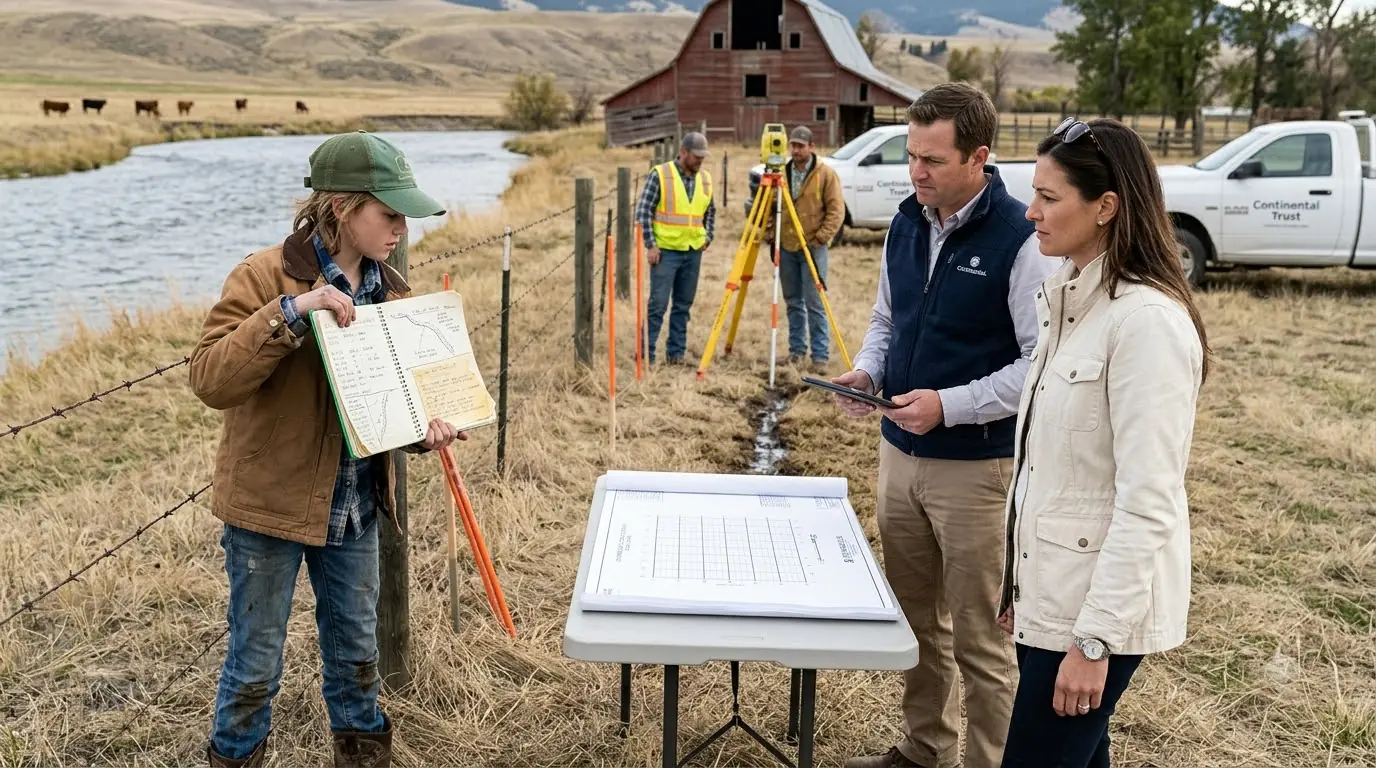
She first met the bank’s project team on a Tuesday afternoon.
She was walking the Bennett fence, checking wires and marking a damaged post, when she saw a folding table on the other side.
Five people stood around a set of construction plans weighted down by river stones.
The woman leading the discussion noticed Clara.
She appeared about forty, with blonde hair tied neatly behind her head and boots that still carried the stiffness of new leather.
“Hello,” she called. “Do you live nearby?”
Clara pointed toward the farmhouse.
“Over there.”
“Then we’ll be neighbors.”
The woman approached the fence.
“I’m Julia Mercer. I’m managing development for Meridian Continental.”
“Clara Bennett.”
Julia smiled and offered her hand across the wire.
Clara shook it.
The woman seemed sincere.
That made the next part more difficult.
Clara looked toward the plans.
A long rectangular structure had been drawn across the river bottom.
Truck yards surrounded it.
Rail tracks ran along one edge.
Additional phases climbed the slope toward the timber.
“You’re putting the first building down there?”
“The processing and distribution building,” Julia said. “We need access to the existing rail spur.”
Clara studied the lower field.
“That’s a bad place.”
A man wearing a fleece vest looked up from his tablet.
He was older than Julia, with gray hair and a bank logo embroidered across his chest.
“Why is that?”
“The river used to run through it.”
He glanced toward the modern channel.
“The river is over there.”
“Now.”
Julia’s smile weakened slightly.
Clara continued.
“There’s another channel under the field. It starts near the northern bend and curves back through the bottom. My grandfather watched it carry water during floods.”
The man introduced himself as Richard Wynn, a regional vice president.
“We have a licensed geotechnical firm scheduled to drill next week.”
“The channel isn’t straight.”
“We use a full sampling grid.”
“You could miss it.”
Richard’s expression remained polite.
“We appreciate local observations. Our engineers will investigate the subsurface conditions.”
Clara pointed toward the lower slope.
“The grass changes there during dry years. The channel curves like an S.”
One of the younger men near the table smiled.
Not cruelly.
The way adults smiled when a child explained something imaginative.
Julia asked, “How do you know?”
“My grandfather recorded it.”
“Do you have maps?”
“His notebooks.”
Richard nodded.
“That’s interesting history. But formal design decisions require certified studies.”
Clara understood the dismissal.
They did not think she was lying.
They thought she was harmless.
“The drilling points need to follow the curve,” she said.
Richard looked back at his tablet.
“We’ll let the specialists handle it.”
There was nothing left to say.
Clara walked home.
Behind her, someone spoke quietly.
A small laugh followed.
That evening she climbed into the loft and found Amos’s notebook from 1987.
On May 14, he had written:
Bottom field flooded again. Third time in eleven years. Old channel running. Cattle refused south trough. Water muddy for two days.
Clara copied the entry into her notebook.
Beneath it, she added:
Bank warned April 27. They will drill on a grid.
The drilling rig arrived the following Thursday.
Clara watched from the fence.
The geotechnical contractor was led by Dr. Sameer Patel, an experienced engineer from Billings.
He was not careless.
He followed the contract exactly.
That was the problem.
The bank’s designers had ordered test borings at fixed intervals across the planned footprint.
The rig began on high ground and moved downhill.
Samples from the upper slope showed dense soil and shallow rock.
The lower borings revealed brown silt, layers of clay, and occasional river stones.
At each test point, the drill reached firm material near eleven feet.
The contract specified twelve-foot borings.
Patel labeled each core, photographed it, and recorded the results.
What the rectangular grid failed to capture was the buried channel curving diagonally beneath the site.
The drill points landed on either side of it.
Twenty feet west at one location.
Thirty feet east at another.
The crew surrounded the channel without penetrating its deepest material.
Clara could see the pattern.
She remembered walking its path with Amos when she was nine.
He had pointed to differences in grass and told her to watch where snow melted first.
“Water below makes its own weather,” he said.
Patel’s machines followed the plans.
The plans followed straight lines.
The valley did not.
Clara considered speaking again.
Then she remembered Richard’s polite expression.
The specialists would handle it.
She returned home.
Construction began in June.
Bulldozers removed the topsoil.
Excavators dug the foundation pad and loading-dock pits.
At a depth of six feet, water began seeping into the riverside excavation.
Workers installed pumps.
Patel returned.
He examined the seepage and concluded it was ordinary groundwater associated with the nearby river.
The project specifications were revised to include additional drainage gravel, a vapor barrier, and sump systems.
Meridian Continental approved the expense.
Clara recorded the date.
June 18. Water in excavation. Bank says normal groundwater.
The footings were poured the final week of June.
The slab followed in July.
Steel columns rose by August.
From the Bennett porch, the new building looked enormous.
Michael rarely discussed it.
He had other problems.
One cow required surgery.
A section of irrigation pipe failed.
The bank controlling his operating loan requested updated financial statements.
Clara knew he did not need another source of worry.
Still, she continued writing.
The first visible crack appeared eight weeks after the slab was poured.
Clara saw it from the fence during an afternoon walk.
A thin line crossed the northeastern corner.
Construction workers marked it with orange paint.
By October, the crack had widened.
Two more appeared nearby.
All ran in the same direction.
The building’s steel frame added weight.
The slab settled unevenly.
Engineers visited.
One blamed concrete curing.
Another suspected the mix.
A third requested additional monitoring.
Then a young structural engineer named Elena Vasquez arrived.
She had recently joined the project as an independent reviewer after the bank’s insurer raised questions.
Elena spent two hours walking the site.
She measured cracks.
Studied elevation changes.
Reviewed the boring logs.
Then she asked Patel a question.
“Did anyone drill deeper than twelve feet?”
“No.”
“Did anyone conduct off-grid borings after water appeared?”
“The seepage was considered normal.”
“By whom?”
“The design team.”
Elena looked toward the Bennett property.
“What is downhill from this foundation?”
“A spring and cattle pasture.”
She requested historical aerial photographs.
The problem became more serious in November.
The Bennett cattle stopped drinking from the southern trough.
The trough was supplied by a spring emerging near the base of the slope, below the construction site.
For generations, the water had run clear.
Michael dipped a metal cup into the trough and tasted it.
He spat immediately.
The water carried a faint metallic bitterness.
Cloudy sediment collected near the bottom.
He called the county extension office.
An environmental technician collected samples.
The laboratory report arrived two weeks later.
The spring contained elevated suspended sediment and trace petroleum compounds consistent with construction runoff.
The contamination levels were not immediately life-threatening, but the water could not be used safely for cattle until further notice.
Michael read the report twice.
Then he walked onto the porch and looked across the fence toward the bank’s half-finished building.
When he returned, he spoke to Clara.
“Bring your notebook.”
The first official meeting took place at the county extension office in early December.
Michael and Clara sat together.
Across the table were Julia Mercer, Richard Wynn, Dr. Patel, Elena Vasquez, a county commissioner, an environmental regulator, and an attorney representing Meridian Continental.
The purpose of the meeting was supposed to be narrow.
Determine whether construction activity had contaminated the Bennett spring.
Elena expanded it.
She placed a large map on the table.
It combined historical aerial photographs, soil surveys, topographic measurements, and new deep-ground radar data.
A red line curved beneath the development site.
It formed a long S.
Clara stared at it.
The curve matched the path Amos had shown her.
Elena spoke carefully.
“This is a buried river channel, likely abandoned several centuries ago.”
She explained that the channel had filled with sand, gravel, and loose alluvium extending more than forty feet beneath the surface.
The surrounding ground consisted of denser soil.
The original twelve-foot borings had landed on the channel’s shoulders.
None reached its central portion.
The foundation crossed directly over the deepest section.
Differential settlement caused the cracks.
Construction runoff entered the exposed channel near the excavation and moved downhill through permeable material.
The Bennett spring emerged from the same subsurface system.
Richard looked toward Patel.
“Why wasn’t this identified?”
Patel opened the boring plan.
“The drilling grid followed the footprint supplied by the design team. The channel runs diagonally between the sample locations.”
“You had groundwater.”
“Groundwater alone is expected near a river.”
Elena added, “The channel’s shape would have been difficult to identify without historical information or off-grid exploration.”
A long silence followed.
Richard asked, “Did anyone mention the possibility before construction?”
Julia looked at Clara.
Her expression changed.
Michael answered quietly.
“My daughter told you in April.”
The attorney stopped taking notes.
Richard turned toward Clara.
“What exactly did you say?”
She opened the green notebook.
“I said there was an old channel under the bottom. I said it curved. I said the grass changed and the ground was soft beneath the surface.”
Julia lowered her eyes.
“I remember.”
Richard looked toward her.
“Was it documented?”
“No.”
“Why not?”
“We believed the geotechnical survey would address it.”
Clara did not feel victorious.
Her father’s spring was contaminated.
The building was failing.
Millions of dollars had been spent.
Being right did not repair any of it.
The state environmental agency issued a stop-work order.
Meridian Continental was required to fund a complete hydrogeological investigation, provide clean water for the Bennett cattle, and remediate the spring.
The initial financial estimate exceeded four million dollars.
That did not include the seventeen million already invested in the development.
The foundation would have to be removed or extensively redesigned.
Part of the structure might be relocated.
The bank’s internal review began immediately.
People who had ignored Clara now wanted copies of her grandfather’s notebooks.
She refused to surrender the originals.
Elena visited the farmhouse and scanned selected pages with Michael’s permission.
Amos’s records described flooding years, groundwater changes, cattle behavior, and locations where equipment had sunk.
His entries did not replace professional analysis.
They showed professionals where to look.
A second meeting took place in January.
This time, a senior executive named Jonathan Avery flew from Denver.
He did not bring a speech.
He brought revised plans and a blank notebook.
He introduced himself to Clara directly.
“I understand we should have listened to you.”
Clara looked toward Michael.
Her father nodded.
Jonathan unrolled the new plans.
“We know about the buried channel now. I’d like to know what else the land does that our reports may not show.”
Clara opened her notebook.
She explained the frost pocket beneath the northern ridge.
The spring seep that appeared only during wet years.
The area where wind formed deep snowdrifts.
The section of upper pasture where clay held water until midsummer.
The dry bench east of the original site that had remained stable through every flood described in Amos’s records.
Elena asked questions.
Clara answered only when she knew.
When she did not know, she said so.
That impressed Jonathan more than certainty would have.
The conversation lasted seventy minutes.
At the end, Richard remained behind.
He stood near Clara while the others packed their materials.
“How long have you kept that notebook?”
“Since I was eight.”
“And your grandfather?”
“Since 1971.”
Richard looked tired.
“We should have asked to see it.”
“Yes.”
“Why didn’t you insist?”
Clara thought about the question.
“You had engineers.”
“That isn’t an answer.”
“It was your answer.”
Richard accepted that.
He offered his hand.
Clara shook it.
The revised development placed the main facility on the upper bench, nearly three hundred yards east of the original foundation.
Deep borings confirmed stable ground.
The rail connection required a longer spur, but the additional cost was lower than attempting to stabilize the original channel.
The bottom land entered a permanent conservation easement.
No structures could be built there.
The bank also agreed to restore native vegetation, monitor groundwater, and protect the Bennett spring.
The contaminated trough was replaced.
Clean water was delivered until testing showed the spring had recovered.
Michael received compensation for lost grazing access, veterinary monitoring, and disruption to the farm.
He did not become wealthy.
The settlement covered the damage and his legal expenses.
That was enough.
Construction resumed the following summer.
The new facility rose slowly on the high ground.
This time, Elena’s team drilled deeper and beyond the planned footprint.
They examined historical records.
They spoke with ranchers whose families had lived in the valley for generations.
The engineers did not surrender authority to folklore.
They learned that local observation could reveal which questions formal studies needed to ask.
Clara turned fifteen in May.
In June, she returned from school and found a large envelope on the kitchen table.
Inside was a professionally bound copy of the new site plan.
A handwritten note from Elena had been clipped to the cover.
Clara,
The buried feature will appear in future county hydrogeological records as the Bennett Paleochannel.
Your grandfather documented it.
You recognized it.
We finally measured it.
Knowledge becomes science when people take the time to test what careful observers already know.
Thank you for making us look again.
—Elena
Michael read the note over Clara’s shoulder.
He said nothing for several seconds.
Then he placed one hand on the back of her head.
“You were right.”
Clara closed the plan.
“I know.”
He laughed.
For the first time in months, the sound carried no exhaustion.
Amos received a copy in Great Falls.
His speech remained limited after the stroke, but when Clara pointed to the channel named after the family, he touched the map with one finger.
Then he tapped his own chest.
“You,” Clara said.
Amos shook his head.
He pointed toward her.
“Both of us?”
He smiled.
The Meridian facility opened the following year.
Jonathan invited the Bennett family to the ceremony.
Michael considered refusing.
Clara asked to attend.
From the stage, bank representatives discussed new jobs, agricultural distribution, environmental safeguards, and lessons learned during development.
Richard spoke briefly.
He did not disguise the failure.
“We trusted a sampling grid more than evidence outside it,” he said. “The mistake cost money, time, and damage to a neighboring water source.”
He looked toward Clara.
“The person who first warned us was fourteen years old. Her age did not make her observation less accurate. Our assumptions made us less capable of hearing it.”
After the ceremony, Julia approached Clara.
“I owe you an apology.”
“You already apologized.”
“Not properly.”
Julia looked toward the lower field, now filled with native grass instead of concrete.
“I heard you. I simply didn’t treat what you said as information.”
Clara considered the distinction.
“That was the problem.”
“Yes.”
Julia handed her a small package.
Inside was the stone that had once held down the corner of the original construction plan.
A brass plate had been attached beneath it.
LISTEN BEFORE YOU BUILD.
Clara kept it on the shelf beside her notebooks.
Life in the valley returned to familiar rhythms.
The killdeer nested near the river.
Cattails thickened along the slough.
Cattle drank from the restored spring.
The abandoned foundation site was broken apart and removed.
After two wet seasons, grass covered most traces of construction.
Clara continued walking the fence.
She recorded rain, snow, river levels, birds, and cattle behavior.
Her entries became more detailed as she grew older.
She studied geology in college.
Elena helped her apply for a summer field program.
Clara eventually returned to Montana as a hydrogeologist, working with farmers, tribes, counties, and engineers on groundwater management.
She never claimed local knowledge was always correct.
People misremembered.
Stories changed.
Notebooks contained mistakes.
But she also never allowed a project team to dismiss a rancher, child, or elderly landowner merely because the information arrived without professional language.
Years later, Clara returned to the Bennett farm before sunrise.
Amos was gone.
Michael had begun moving more slowly.
The barn still leaned south.
Mist rose from the low ground.
Clara stood on the porch holding her grandfather’s oldest notebook.
Her father joined her with two cups of coffee.
“The valley remembers,” he said.
Clara looked toward the conserved bottom land.
“No.”
Michael raised an eyebrow.
“Grandpa was wrong?”
“The valley keeps the evidence.”
She touched the notebook.
“People have to remember how to read it.”
Across the fields, the upper facility lights began glowing as the morning shift arrived.
The bank’s building stood on stable ground.
Below it, hidden beneath grass and soil, the old channel continued carrying water along the curve it had followed for centuries.
No report had created it.
No engineering plan had moved it.
No adult’s disbelief had made it disappear.
The land had told the truth from the beginning.
A fourteen-year-old girl was simply the first person willing to listen carefully enough to hear it.