The first thing Judge Adrian Cole noticed about Courtroom Four was the silence.
It was not the respectful silence of a courtroom waiting for proceedings to begin. It was the hollow, early-morning quiet of a government building that had not yet remembered its purpose.
The lights above the gallery were still dim.
Rows of wooden benches stood empty.
A pale stripe of sunlight entered through the high windows and fell across the state seal behind the bench.
Adrian checked the time on his phone.
6:42 a.m.
He had arrived almost two hours before his first official session as a circuit court judge.
That was intentional.
He wanted time to understand the room before it filled with lawyers, defendants, officers, families, and reporters. He wanted to learn which drawer held the emergency procedures, how the microphone sounded, and whether the old wooden chair behind the bench was as uncomfortable as it looked.
He also needed to change clothes.
Adrian had begun the morning with a run along the river, an old habit from his years as a public defender when exercise was the only quiet hour he could reliably protect. He wore gray sweatpants, a dark hooded sweatshirt, and running shoes. His judicial robe and suit hung inside a garment bag in chambers.
The chief clerk had given him an electronic access card the previous afternoon.
“Come whenever you like,” she had said. “The building opens to staff at six.”
Adrian entered through the secured employee entrance, greeted the overnight security officer, and walked upstairs without incident.
He expected to spend fifteen private minutes sitting behind the bench.
He picked up the wooden gavel.
It was heavier than he expected.
Most modern judges rarely used gavels, but this one had belonged to the first judge assigned to Courtroom Four almost sixty years earlier. A small brass plate beneath the sound block carried four surnames.
Adrian traced the last one with his thumb.
COLE
The courthouse maintenance team had added it the previous evening.
His mother would have photographed the plate from every possible angle.
She had died three years earlier, before seeing him elected.
Adrian gently placed the gavel against the block.
One soft tap echoed through the empty room.
“Who do you think you are?”
The voice came from the rear entrance.
Adrian turned.
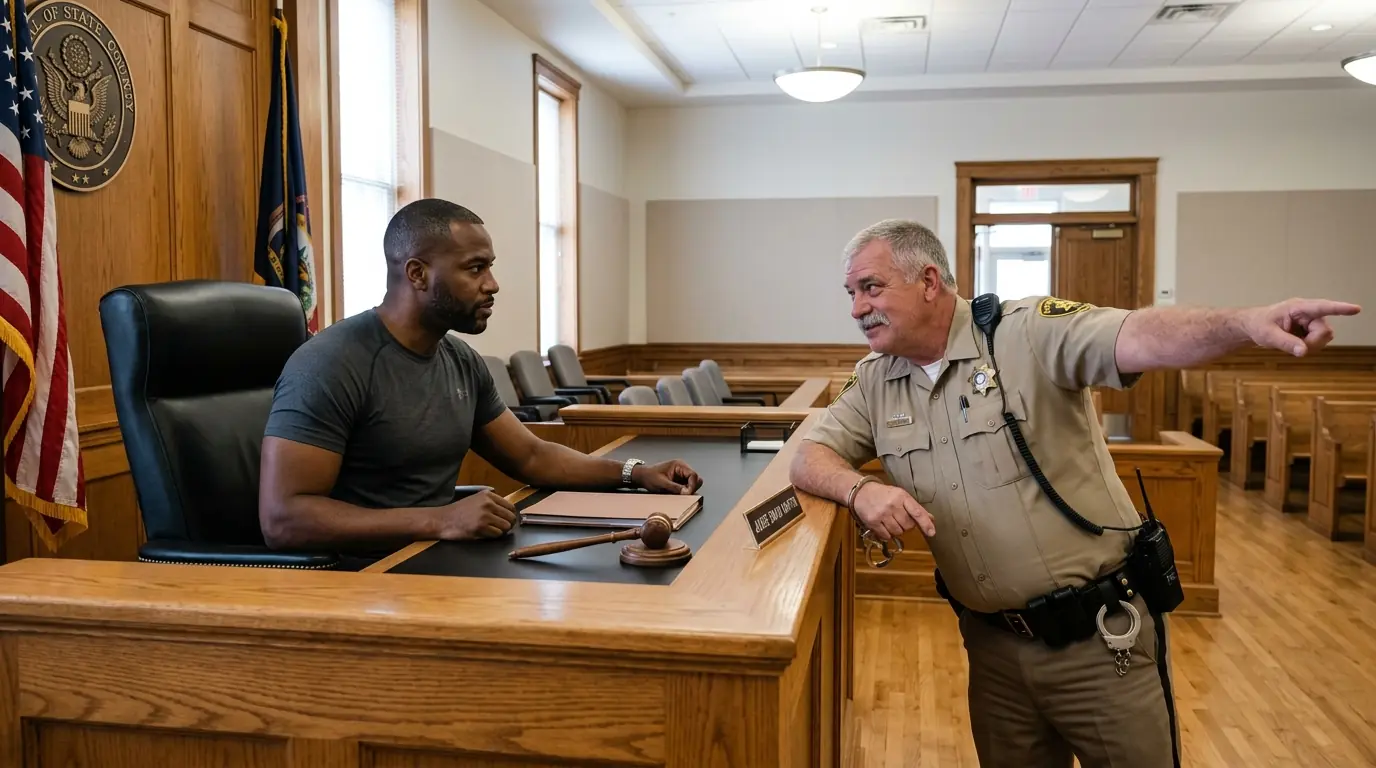
A uniformed bailiff stood in the aisle.
He was a broad white man in his late fifties, with close-cropped gray hair and a heavy belt carrying handcuffs, pepper spray, and a radio. His nameplate read:
D. KELLER
The bailiff stared at Adrian as though he had discovered someone breaking into his house.
“Good morning,” Adrian said.
The man did not return the greeting.
“How did you get in here?”
“Through the employee entrance.”
“That entrance requires authorization.”
“I have authorization.”
The bailiff walked closer.
His boots struck the floor with deliberate weight.
“You need to step away from the bench.”
Adrian remained seated.
“May I ask why?”
“Because you are sitting in the judge’s chair.”
“I’m aware.”
“You think this is a playground?”
“No.”
“You wandered in here, found a robe somewhere, and decided to play courthouse?”
Adrian looked toward the garment bag visible through the open chambers door.
He had not put on the robe.
“I didn’t wander in.”
The bailiff stopped near the counsel tables.
“Stand up.”
Adrian’s expression remained calm.
“Before I do anything, I would like to understand who you believe I am.”
“I don’t care who you think you are.”
“That is becoming clear.”
The bailiff’s eyes narrowed.
“You have five seconds to get out of that chair.”
Adrian placed the gavel carefully on the bench.
“Mr. Keller, is it?”
The use of his name seemed to increase the bailiff’s suspicion.
“How do you know my name?”
“You’re wearing it.”
Keller glanced down as though briefly forgetting the nameplate existed.
Then he pointed toward Adrian.
“Do not get smart with me.”
“I’m trying to have a conversation.”
“No. I ask the questions.”
Adrian leaned back slightly.
The bailiff’s anger did not come from anything Adrian had done.
That much was already obvious.
It came from the picture Keller believed he was seeing: a Black man in casual clothes sitting in a place of authority.
Every answer Adrian gave was being forced into that picture.
“I asked how you entered,” Keller said.
“I used my court access card.”
“Show it to me.”
“It is in chambers with my wallet.”
“Convenient.”
“I can retrieve it.”
“Do not move toward chambers.”
Adrian paused.
“You have ordered me to leave the chair while also ordering me not to move.”
“Stand up and walk toward me.”
“Why?”
“So I can detain you.”
“For what offense?”
“Trespassing.”
“I have authorized access.”
“We will determine that after you are restrained.”
Adrian looked at the bailiff’s hand.
It had moved closer to his cuffs.
“Is that your standard procedure?”
Keller gave a humorless laugh.
“My standard procedure is to remove people who don’t belong here.”
Adrian let the words settle.
“People who don’t belong.”
“You heard me.”
“I did.”
Keller moved another step forward.
“Get out of that chair, boy.”
The word changed the room.
Adrian had been called many things during his career.
Overly ambitious.
Too young.
Too sympathetic to defendants.
Too aggressive with prosecutors.
Too calm when people wanted anger.
But “boy” carried its own history.
It was not an accidental word between two adult men.
Adrian’s voice became quieter.
“Do not call me that again.”
Keller smiled.
“You going to tell me how to speak now?”
“I am telling you how you will address me.”
“You have no authority over me.”
Adrian looked toward the state seal.
“Are you certain?”
Keller’s face hardened.
“Stand up.”
Adrian did not.
The bailiff reached for his radio.
“Control, I have an unauthorized male inside Courtroom Four.”
The radio crackled.
A dispatcher answered.
“Description?”
Keller looked directly at Adrian.
“Black male. Approximately forty. Wearing a dark hoodie and sweatpants. Acting hostile.”
Adrian raised one eyebrow.
“I am sitting down.”
Keller continued into the radio.
“Possibly entered through a restricted area. Refusing lawful instructions. Requesting an officer.”
The dispatcher acknowledged.
Keller lowered the radio.
“You made this harder than it needed to be.”
Adrian looked at the empty gallery.
“Did I?”
“You could have walked away.”
“From my courtroom?”
Keller laughed.
“Your courtroom.”
“Yes.”
“You really expect me to believe you’re an attorney?”
“I did not say I was an attorney.”
“You certainly aren’t the judge.”
“What makes you certain?”
Keller looked him over.
The sweatpants.
The hoodie.
The running shoes.
Then his eyes returned to Adrian’s face.
“I know the people who work here.”
“This is my first day.”
“I heard we had a new judge.”
“Apparently not very carefully.”
Keller’s expression shifted for a fraction of a second.
Then his certainty returned.
“The new judge is supposed to be some former federal prosecutor.”
“Public defender.”
“Whatever.”
“His name?”
Keller hesitated.
“Judge Cole.”
Adrian waited.
Keller stared at him.
“No.”
“Why not?”
“The new judge isn’t you.”
“You have seen a photograph?”
“I don’t need a photograph.”
“That is an interesting answer.”
The bailiff reached the gate dividing the gallery from the well of the courtroom.
He unlatched it.
“Last chance.”
Adrian rose.
Keller immediately pulled out his handcuffs.
“Turn around and place your hands behind your back.”
Adrian remained behind the bench.
“Why would I do that?”
“Because I am ordering you.”
“Under what legal authority?”
“Criminal trespass and obstruction.”
“Obstruction of what?”
“My investigation.”
“What facts support criminal trespass?”
Keller’s face reddened.
“You are in a restricted courtroom.”
“So are you.”
“I work here.”
“So do I.”
“You cannot prove that.”
“You have prevented me from retrieving identification.”
“You could have stolen someone’s access card.”
“From whom?”
“I don’t know.”
“Then you have no report of a stolen card.”
Keller stepped toward the side of the bench.
“Do not make me come up there.”
Adrian’s gaze moved toward the courtroom camera mounted above the clerk’s station.
A small green light glowed beneath it.
The recording system was active.
“Is this interaction being recorded?” Adrian asked.
Keller glanced at the camera.
“That is none of your concern.”
“It should concern you.”
The bailiff’s hand tightened around the cuffs.
“You think a camera is going to help you?”
“I think facts usually help.”
Keller opened the small swinging door beside the bench.
“You people always think you can talk your way out of consequences.”
Adrian’s face became still.
“You people?”
Keller stopped.
For the first time, he seemed to realize that his own words might be moving faster than his ability to control them.
“I mean trespassers.”
“No, you didn’t.”
“Turn around.”
Adrian did not move.
Keller reached toward his arm.
The courtroom door opened.
“David?”
A woman carrying three folders entered from the rear.
She was in her early sixties, with silver hair and glasses hanging from a chain around her neck. Her name was Margaret Ellis, chief clerk of the circuit court.
She looked from Keller to Adrian.
Then to the handcuffs.
“What is happening?”
Keller straightened.
“I found this man trespassing behind the bench.”
Margaret stared at him.
“This man?”
“Yes. He claims he belongs here.”
Margaret set the folders on the nearest table.
“He does.”
Keller’s confidence faltered.
“He said he was staff.”
“He is not staff.”
Keller looked relieved for less than a second.
Margaret continued.
“He is Judge Adrian Cole.”
The handcuffs slipped slightly in Keller’s grip.
Silence filled the room.
Adrian stood behind the bench in his running clothes.
Margaret turned toward him.
“Your Honor, are you all right?”
“I have not been touched.”
Keller looked between them.
“This is the new judge?”
“Yes.”
“Nobody told me what he looked like.”
Margaret’s expression hardened.
“His photograph was attached to the transition bulletin sent to every courtroom employee.”
“I didn’t receive it.”
“You acknowledged the email.”
“I acknowledge dozens of emails.”
“You attended yesterday’s security briefing.”
“I stepped out early.”
“Before Judge Cole’s introduction?”
Keller did not answer.
The courtroom door opened again.
A courthouse security officer entered, followed by a sheriff’s deputy responding to Keller’s radio call.
The deputy slowed after seeing Margaret.
“Is assistance needed?”
Keller quickly returned the cuffs to his belt.
“Misunderstanding.”
Adrian looked at him.
“No.”
Keller turned.
“Your Honor, I apologize. You weren’t dressed—”
“That is not the misunderstanding.”
“I was doing my job.”
“You reported that I was hostile.”
“You refused instructions.”
“You called me ‘boy’ repeatedly.”
Keller looked toward the others.
“He was provoking me.”
Adrian’s voice remained even.
“I asked what crime I had committed.”
“You were sitting in the judge’s chair.”
“Because I am the judge.”
“I didn’t know.”
“That explains your mistake. It does not explain your conduct.”
Keller’s mouth opened.
Adrian continued.
“You could have asked my name.”
“I did.”
“No. You told me who you believed I was.”
The responding deputy looked down.
Margaret removed her glasses.
“David, surrender your radio and access badge.”
Keller turned toward her.
“You can’t suspend me.”
“I can remove you from courtroom duty pending review.”
“This is ridiculous.”
Adrian stepped down from the bench.
Keller moved back instinctively.
The reaction was small, but everyone saw it.
Adrian stopped several feet away.
“If I had been a confused visitor, would your behavior have been acceptable?”
Keller said nothing.
“If I had been a defendant who entered through the wrong door, would calling me ‘boy’ have been appropriate?”
Still nothing.
“If I had no title at all, would I deserve less dignity?”
Keller looked toward Margaret.
“I want my union representative.”
“You may contact one,” she said. “After you surrender the badge.”
He removed it slowly.
The responding security officer escorted him from the courtroom.
At the rear door, Keller looked back.
He seemed to expect Adrian to appear satisfied.
Adrian felt no satisfaction.
Only concern.
A bailiff controlled access to courtrooms.
He stood near defendants, jurors, witnesses, and families during some of the most frightening moments of their lives.
If Keller behaved this way toward someone who remained calm and understood the law, Adrian wondered what happened to people who were frightened, confused, poor, or unable to defend themselves with precise language.
Margaret seemed to read his thoughts.
“This needs a full review.”
“Yes.”
“I am sorry.”
“You did not do it.”
“I supervised the department that allowed it.”
Adrian looked toward the door through which Keller had left.
“Then let’s find out whether this morning was unusual.”
It was not.
By seven thirty, Adrian had changed into his suit and robe.
He should have been studying the morning docket.
Instead, he sat inside chambers with Margaret and the courthouse administrator reviewing Keller’s personnel file.
Three complaints had been filed during the previous four years.
The first came from a twenty-two-year-old Black defendant who said Keller called him “animal” while moving him from a holding room.
The complaint was closed because no witness confirmed it.
The second came from a Hispanic woman attending her brother’s sentencing. She alleged that Keller searched her purse, mocked her accent, and threatened removal when she asked why white visitors were not being searched.
Keller denied the accusation.
The third came from a public defender who said Keller used unnecessary force against a teenager after the boy asked to speak privately with counsel.
That complaint was classified as a misunderstanding during a tense proceeding.
Adrian read every page.
“What corrective action followed?” he asked.
The administrator shifted in his chair.
“Verbal counseling.”
“Documented?”
“Not formally.”
“Training?”
“He completed annual bias and de-escalation modules.”
“Online?”
“Yes.”
Adrian closed the file.
“A person can click through a course without changing anything.”
Margaret looked ashamed.
“We should have connected the complaints.”
“They were treated as isolated events.”
“That was the policy.”
“That was the failure.”
At eight twenty, the courtroom began filling.
Attorneys arranged files at counsel tables. Defendants whispered with family members. Deputies moved prisoners from holding rooms. Reporters waited near the back because the new judge’s first session had attracted local attention.
No one outside the administrative office knew what happened that morning.
Adrian considered delaying the docket.
He decided against it.
The people waiting had cases that mattered to them more than his humiliation mattered to him.
He entered at eight thirty.
“All rise.”
The replacement bailiff’s voice carried through the room.
Adrian took the bench.
For one brief moment, he thought about Keller ordering him out of the same chair.
Then he looked at the people before him.
An elderly landlord disputing repairs.
A young father asking for more time to pay a fine.
A woman seeking protection from an abusive former partner.
Three defendants awaiting arraignment.
The chair did not make Adrian important.
The decisions made from it affected lives.
That distinction mattered.
He began.
Throughout the morning, he explained procedures plainly. He asked defendants whether they understood their rights rather than merely whether they heard them. He corrected a prosecutor who referred to a man as “the body in orange.”
“He has a name,” Adrian said.
The prosecutor apologized.
At eleven forty, a young Black defendant named Terrence Wallace entered for sentencing on a probation violation.
Terrence was nineteen.
His hands shook.
The prosecutor requested six months in county jail, arguing that he had repeatedly missed appointments.
The public defender explained that Terrence worked overnight at a warehouse and cared for his younger brother after their grandmother became ill. He missed two meetings because the probation office refused evening scheduling.
Adrian reviewed the record.
“Keller was the bailiff during your last appearance?” he asked.
Terrence looked startled.
“Yes, sir.”
“Did anything occur?”
The public defender turned toward him.
Terrence lowered his eyes.
“No.”
Adrian waited.
“You will not be punished for answering honestly.”
Terrence swallowed.
“He told me if I looked at him again, he’d make sure I went downstairs in cuffs.”
“Why?”
“I asked whether I could call my grandmother.”
“Was that reported?”
“No.”
“Why not?”
Terrence gave a tired smile.
“Who was going to believe me?”
The sentence struck Adrian harder than Keller’s insults had.
Who was going to believe me?
It explained the empty spaces between complaints.
People did not always report misconduct because systems had already taught them what their words were worth.
Adrian rescheduled Terrence’s probation appointments, ordered transportation assistance, and imposed no jail sentence.
Then he instructed the clerk to preserve the courtroom audio from Terrence’s previous appearance.
By the end of the day, two additional attorneys had submitted statements about Keller.
A courthouse custodian reported hearing racial slurs near the holding cells.
A deputy admitted he had once told Keller to stop calling adult Black defendants “boys.”
The deputy had not filed a report because Keller was popular with senior staff.
The investigation expanded.
Keller was placed on administrative leave.
His union representative argued that he had made a reasonable security mistake involving an unidentified man in restricted space.
Adrian agreed that the initial question was reasonable.
Everything after it was not.
A formal hearing took place two weeks later.
Keller sat beside his representative in a conference room.
Adrian attended only as a witness.
The investigator played the courtroom recording.
Keller’s voice filled the speakers.
You people always think you can talk your way out of consequences.
Then:
Boy, you need to get out of that chair.
Keller shifted in his seat.
His representative argued that the words were spoken under stress.
The investigator asked why Keller described Adrian as hostile when the video showed him seated and speaking calmly.
Keller said Adrian’s refusal to comply created danger.
The investigator asked why identification was not requested before an arrest was threatened.
Keller said he believed Adrian might be armed.
Nothing in his radio report mentioned a weapon.
The investigator reviewed earlier complaints.
Keller denied each one.
Then the custodian testified.
The deputy testified.
Terrence testified by video.
A former courthouse employee came forward after seeing a brief news report about Keller’s suspension. She said she had resigned after he repeatedly made comments about Black families who attended court.
The pattern could no longer be called a misunderstanding.
Keller was terminated for discriminatory conduct, falsification of a security report, failure to follow identification procedure, and repeated violations of professional standards.
The decision was not Adrian’s alone.
That mattered to him.
He did not want a personal insult transformed into personal revenge.
The evidence was reviewed by an independent panel.
Keller had representation.
Witnesses were heard.
The same process Adrian expected for every person in his courtroom applied to the man who had humiliated him.
After the decision, reporters gathered outside.
One asked whether Adrian felt vindicated.
“No,” he said.
“Why not?”
“Because this should have been addressed before it reached me.”
Another reporter asked whether Keller would have kept his job if he had recognized Adrian immediately.
Adrian considered the question.
“That is exactly the problem.”
He looked toward the courthouse steps.
“A person should not receive dignity only after someone learns his title.”
The incident led to broader changes.
Court security officers received in-person de-escalation training rather than online modules.
Complaints were reviewed collectively so patterns could be recognized.
Visitors detained inside restricted areas had to be asked for identification before force or restraints were considered, unless an immediate safety threat existed.
Body cameras were added for bailiffs assigned to high-conflict courtrooms.
Most importantly, defendants and families received a clear way to report mistreatment without submitting complaints through the same officers they were accusing.
Some staff members resented the changes.
They said one bad morning had created unnecessary bureaucracy.
Margaret responded during a staff meeting.
“It was not one morning. It was years of mornings no one considered important because the victims did not wear robes.”
Adrian heard about the statement later.
He wrote it inside a notebook he kept in chambers.
Months passed.
Courtroom Four became known for strict procedure and plain language.
Adrian was not lenient.
He imposed prison sentences when evidence and law required them.
He also refused unnecessary humiliation.
He prohibited lawyers from calling defendants by numbers when names were available.
He required interpreters to be given time to translate fully.
He asked deputies to remove handcuffs from nonviolent defendants during hearings unless a specific safety concern existed.
Some prosecutors called him demanding.
Some defense attorneys did too.
Adrian considered that a healthy balance.
One year after his first day, he arrived early again.
This time, he wore a suit.
He entered the empty courtroom and sat behind the bench.
The gavel remained beside the brass nameplate.
He did not touch it.
A new bailiff entered through the rear door.
Her name was Denise Harper, a former military police officer known for her calm manner.
“Good morning, Judge.”
“Good morning.”
She looked toward the gallery.
“Quiet in here.”
“It never lasts.”
Denise smiled.
Before leaving to prepare the security station, she paused.
“May I ask something?”
“Of course.”
“Why do you still arrive this early?”
Adrian looked around the room.
“Because an empty courtroom is honest.”
She waited.
“No applause. No anger. No one asking for anything. It reminds me that the room belongs to the public before it belongs to any judge.”
Denise nodded.
“That sounds like something they should put on the wall.”
“It would be ignored if it were on a wall.”
After she left, Adrian opened the morning docket.
The first case involved a young man charged with trespassing inside a government building.
The defendant had entered through an employee door that failed to lock properly. He said he was looking for a restroom and became frightened when security approached.
The prosecutor requested thirty days in jail because the man had refused to place his hands behind his back.
Adrian read the report carefully.
The security officer had asked the man’s name.
Had explained why he needed to leave.
Had offered him the opportunity to comply.
The officer’s body camera confirmed the account.
The facts were nothing like Adrian’s first morning.
That was important too.
Fairness did not mean assuming every officer was wrong because one had been.
It meant examining the evidence without allowing fear, status, race, or personal memory to decide first.
Adrian dismissed the trespass charge after learning the building’s door had malfunctioned, but upheld a citation for property damage caused when the frightened man pushed over a security scanner.
He explained the decision.
The defendant listened.
Then nodded.
As deputies escorted him out, he turned back.
“Thank you for hearing me.”
Adrian sat quietly after he left.
That was all most people wanted from a courtroom.
Not guaranteed victory.
Not special treatment.
The assurance that someone had heard them before deciding who they were.
David Keller had looked at Adrian and seen a criminal before asking a single meaningful question.
He saw clothing.
Skin.
A place he believed Adrian could not rightfully occupy.
The uniform on Keller’s body gave that assumption power.
But authority did not make an assumption true.
A badge could control a doorway.
It could not decide who belonged on the other side.
Adrian often thought about the moment Margaret entered carrying the morning docket.
People later described it as the moment Keller discovered Adrian was his new boss.
That was not how Adrian remembered it.
Keller’s true failure did not begin when he insulted a judge.
It began when he believed an ordinary Black man was entitled to less patience, fewer questions, and no dignity.
The robe merely made everyone else notice.
On the anniversary of Adrian’s appointment, his father visited Courtroom Four.
He was seventy-two and walked with a cane after two knee surgeries.
He stood below the bench and looked at the brass nameplate.
“Your mother would have liked this,” he said.
“She would have complained that the letters were too small.”
His father laughed.
Then he touched the rail separating the gallery from the courtroom floor.
“When I was your age, I came into a courthouse to contest a traffic ticket.”
Adrian looked toward him.
“You never told me that.”
“The officer called me ‘boy’ in front of your grandfather.”
His father’s smile faded.
“I paid the ticket even though the license plate number was wrong. Your grandfather told me getting home mattered more than being right.”
Adrian stepped down from the bench.
“Was he right?”
“At the time, probably.”
His father looked around the room.
“But every generation is supposed to make the next one choose less often between safety and dignity.”
Adrian thought about Keller.
Terrence.
The complaints that disappeared.
The young trespassing defendant who thanked him for listening.
“Did we?”
His father rested one hand on his shoulder.
“You’re sitting where men once told us we didn’t belong.”
“That isn’t enough.”
“No.”
His father nodded.
“But it’s a place to work from.”
They left the courtroom together.
The next morning, Adrian returned before sunrise.
He passed through the employee entrance, greeted security by name, and walked upstairs.
Courtroom Four waited in darkness.
He turned on the lights.
Placed the morning docket on the bench.
Then opened the doors.
That, he had learned, was the real purpose of authority.
Not deciding who looked as though they belonged.
Making sure the law remained open to everyone who did.