“My uncles beat me with a tire iron, Dad… and Mom just watched.”
First Sergeant Marcus Vance felt the heat of the Mojave Desert disappear beneath his boots.
One moment, he had been standing outside a temporary operations building at a remote training base in California, watching wind drag dust across the floodlights. The next, the entire world had narrowed to the faint breathing of his nine-year-old daughter.
The call came at 2:17 in the morning.
Marcus was two days away from completing an eight-month assignment when Lily’s name appeared on his phone. She was not supposed to have access to her phone after bedtime, and she had never called him at that hour.
He answered before the second ring.
“Lily?”
At first, he heard only breathing.
Then a whisper.
“I’m at the hospital in Asheville.”
Marcus closed his eyes.
“Are you safe right now?”
“I think so.”
“Is a nurse with you?”
“She went to get water.”
“Good. Listen to me, sweetheart. Don’t try to sit up. Don’t move anything that hurts. Just breathe slowly with me.”
He kept his voice calm.
The military had taught him that panic traveled faster than orders. When someone was frightened and injured, the fear of the person listening could become another burden they were forced to carry.
Marcus would not place that weight on his daughter.
“Tell me what happened,” he said.
Lily began crying.
Not loudly.
The sound was small and exhausted, as though even crying caused pain.
“Uncle Rowan came home drunk. Uncle Jaxson was with him. I spilled soda on Rowan’s boots.”
Marcus gripped the phone so tightly that the plastic creaked.
“What happened after that?”
“They took me outside.”
“Where was your mother?”
“Upstairs.”
“Did she see you?”
“Yes.”
The answer came immediately.
Marcus leaned against the wall of the operations building.
“What did your uncles do?”
Lily’s breathing became uneven.
“They got the metal thing from the truck.”
“What metal thing?”
“The thing they use for tires.”
A tire iron.
Marcus looked out at the dark desert.
“They took turns, Dad.”
He heard movement on the other end of the call. A woman’s voice spoke softly, and Lily began to sob.
Then the nurse came onto the line.
“First Sergeant Vance?”
“Yes.”
“My name is Claire Bennett. I’m one of Lily’s nurses. She needs to rest.”
“Tell me how badly she’s hurt.”
There was a pause.
“The physician should explain that.”
“I am twelve hours away if I take the first available military flight. I need to know whether my daughter will still be alive when I land.”
The nurse’s voice softened.
“She is stable. Her injuries are serious, but she is stable.”
Marcus lowered his head.
“Was law enforcement notified?”
“Yes.”
“Did they arrest Rowan and Jaxson Sterling?”
Another pause.
“I don’t know.”
Marcus knew what the hesitation meant.
Sterling Falls, North Carolina, was a town where people spoke the family name carefully.
The Sterlings owned the largest timber operation in three counties. Their finance company held mortgages on farms, homes, and small businesses throughout the valley. Their radio station shaped local opinion, their lawyers financed political campaigns, and their family foundation placed plaques on schools, churches, and hospital wings.
People praised them in public.
In private, they lowered their voices.
“I’m coming,” Marcus said. “Please tell Lily I’m coming.”
“I will.”
“And don’t let Miranda Sterling remove her from the hospital.”
“Sir—”
“Write this down. I share legal custody. I am expressly objecting to Lily being released into Miranda’s care or into the care of any member of the Sterling family. Contact hospital legal counsel and child protective services.”
The nurse was quiet for a moment.
“I’ll document it.”
“Thank you.”
Marcus ended the call and stood alone beneath the desert lights.
Every instinct inside him demanded movement.
Find a vehicle.
Reach an airport.
Get to North Carolina.
But training had carved another rule deeper than instinct.
Before entering a dangerous situation, establish what is known.
Lily was alive.
She was in a hospital.
The attackers were family members with money, influence, and access to local law enforcement.
Marcus called his operations commander.
Twenty-three minutes later, emergency leave was approved.
By sunrise, he was on a military transport heading east.
He did not sleep.
He did not imagine revenge.
He built a timeline.
He wrote down every word Lily had spoken.
He contacted a military family attorney and requested emergency custody guidance. He emailed copies of the divorce order, medical consent documents, and past complaints involving Miranda’s family.
There were six of those complaints.
Rowan Sterling had once fired a rifle over Marcus’s truck during a custody exchange.
Jaxson had threatened to “teach Lily which side of the family mattered.”
Miranda had repeatedly refused scheduled visitation and claimed that military service made Marcus an unreliable father.
Each incident had been reported.
Each had disappeared into the same courthouse where Charles Sterling’s campaign donations paid for new computers, new furniture, and a bronze plaque in the lobby.
Marcus had spent years believing restraint would protect Lily.
Now she was lying in a hospital bed with broken bones.
He landed in Charlotte shortly after noon and drove west through the mountains.
The closer he came to Sterling Falls, the more familiar the landscape became.
Dark ridges.
Narrow roads.
Timber trucks descending steep grades.
Billboards bearing the Sterling name.
STERLING VALLEY FINANCE — BUILDING FAMILIES SINCE 1968.
STERLING TIMBER — ROOTED IN COMMUNITY.
STERLING FAMILY FOUNDATION — PROTECTING OUR CHILDREN.
Marcus passed the final billboard without slowing.
At the hospital, a pediatric trauma physician met him outside Lily’s room.
Dr. Jane Archer was in her forties, with tired eyes and the controlled directness of someone who had delivered too much bad news to waste words.
“Before you see her,” she said, “I need to explain the injuries.”
Marcus stood perfectly still.
“Go ahead.”
“Both forearms are fractured. She has three broken ribs, a severe fracture of the left femur, and injuries to two fingers on her right hand. There are extensive bruises across her back and legs.”
“Head injury?”
“No intracranial bleeding. She does have a mild concussion.”
“Internal organs?”
“No major damage that we can detect.”
“Will she walk?”
“We believe so. Recovery will take time.”
Marcus nodded once.
“What about emotionally?”
Dr. Archer held his gaze.
“That recovery may take longer.”
She opened the door.
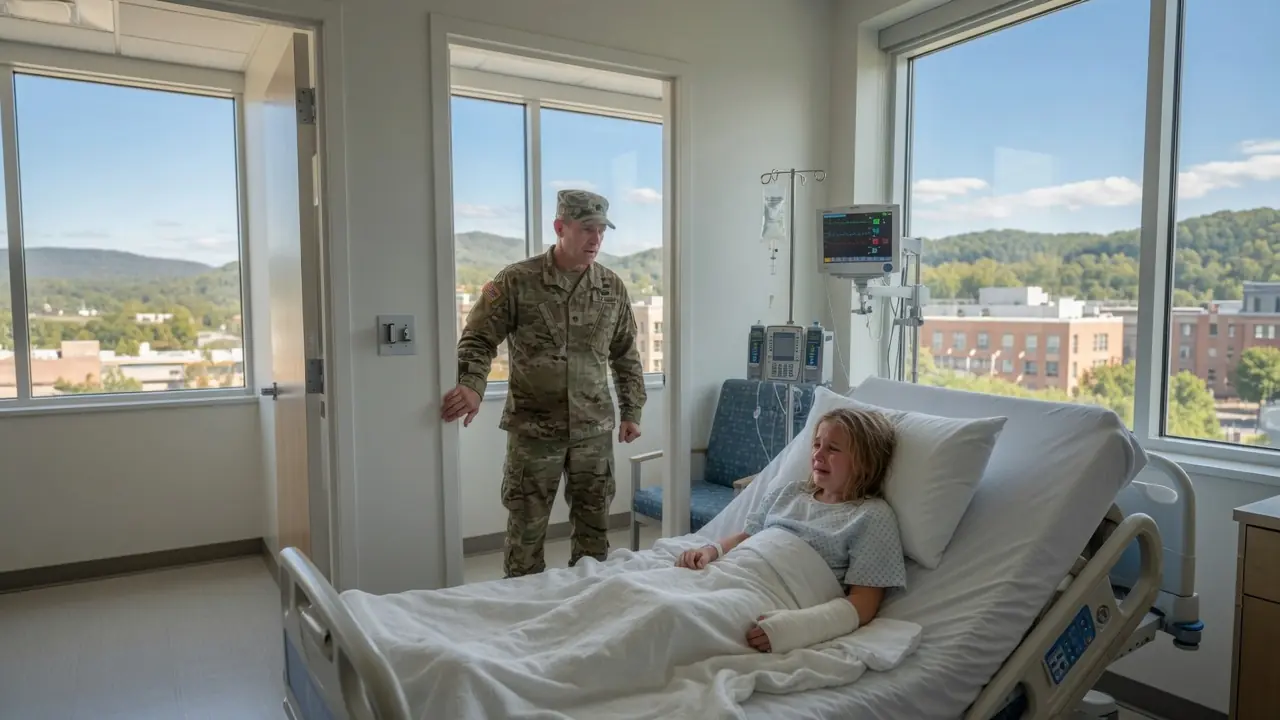
Lily looked impossibly small beneath the white blankets.
Both arms were wrapped. Her left leg was elevated inside a rigid brace. Purple bruising darkened one side of her face.
Marcus stopped in the doorway.
For the first time since receiving the call, his control nearly failed.
Lily saw him.
“Dad.”
He crossed the room in three steps and lowered himself beside the bed.
“I’m here.”
Her lips trembled.
“You came fast.”
“As fast as I could.”
“I thought they wouldn’t let you.”
“Nothing was going to keep me away.”
She tried to lift one arm.
Pain crossed her face.
Marcus leaned closer instead, allowing her fingers to rest against his cheek.
“I’m sorry,” she whispered.
His eyes closed.
“For what?”
“The soda.”
Marcus looked at her.
“You did nothing wrong.”
“Uncle Rowan said I ruined boots that cost more than your truck.”
“That does not matter.”
“Mom said I should have known better.”
Marcus’s voice remained gentle.
“Your mother was wrong.”
Lily stared toward the window.
“She watched.”
“I know.”
“She was upstairs.”
“I know.”
“I called for her.”
Marcus took the only uninjured part of her hand.
“She should have come.”
“She closed the curtain.”
The words were almost inaudible.
Marcus bowed his head over her fingers.
For years, he had tried not to speak badly about Miranda in front of Lily. He had believed children should not be forced to carry the failures of their parents.
But there were truths that could not be softened without becoming lies.
“What your mother did was wrong,” he said. “None of this was your fault. Not the soda. Not the boots. Not their anger. Nothing.”
Lily began crying.
Marcus stayed beside her until exhaustion pulled her back into sleep.
When he stepped into the hallway, two sheriff’s deputies were waiting.
One was young and visibly uncomfortable.
The other was Chief Deputy Nolan Reeves, a thickset man Marcus remembered from courthouse hearings.
Reeves extended a hand.
“Sergeant Vance.”
Marcus did not take it.
“Where are Rowan and Jaxson Sterling?”
Reeves lowered his hand.
“We’re still collecting statements.”
“They attacked a child with a metal bar.”
“That’s one version.”
Marcus stared at him.
“Whose version says otherwise?”
“Rowan claims Lily fell near the truck after he tried to stop her from running into the driveway.”
“Both her arms broke from a fall?”
“We’re waiting for medical analysis.”
Dr. Archer appeared behind Marcus.
“You have it.”
Reeves glanced toward her.
“We need a formal report.”
“I submitted one three hours ago.”
“We haven’t received it.”
“I sent it electronically, faxed it, and had a staff member deliver a printed copy.”
The younger deputy looked at Reeves.
The chief deputy’s expression tightened.
Marcus stepped closer.
“Did you interview Lily?”
“Briefly.”
“Without me present?”
“Her mother gave consent.”
“The woman who watched the assault?”
Reeves lowered his voice.
“Be careful.”
Marcus did not move.
“Is that advice or a threat?”
The younger deputy shifted uneasily.
Reeves looked down the corridor, then back at Marcus.
“You’ve been gone a long time. People here know the Sterling family. They know what they’ve done for this county.”
“My daughter knows what they did to her.”
“We’ll follow the evidence.”
“No. You’ll follow the Sterlings until someone forces you to look at the evidence.”
The chief deputy stepped close enough that their shoulders nearly touched.
“You military people come home believing the world follows your orders. It doesn’t.”
Marcus’s expression remained flat.
“I’m not giving an order.”
“What are you doing?”
“Documenting your response.”
Reeves looked at Marcus’s shirt pocket.
A small recording device was clipped inside.
The chief deputy took one step backward.
Marcus had learned long ago that powerful men behaved differently when they believed memory belonged only to them.
Four days passed.
No arrests were made.
Rowan and Jaxson continued appearing in public. The Sterling radio station described the incident as “an unfortunate family accident being exploited by an angry former spouse.”
Miranda never visited Lily.
She sent an attorney.
The attorney carried a petition requesting that Marcus be prohibited from removing Lily from the state after discharge. It accused him of emotional instability, military-related aggression, and plans to abduct the child.
Marcus read every page beside Lily’s bed.
The petition included a statement from Sheriff Thomas Landry calling Miranda “a loving and responsible mother.”
It included a letter from a local judge praising Charles Sterling’s character.
It included photographs of Marcus in uniform holding weapons during overseas training exercises.
They had turned military service into evidence that he was dangerous.
That afternoon, his phone rang.
The caller ID showed a blocked number.
Marcus stepped into an empty consultation room and answered.
“First Sergeant Vance.”
A woman laughed softly.
Evelyn Sterling.
The family matriarch was seventy-two, elegant, wealthy, and feared by nearly everyone who worked for her husband.
“I heard you’re back, soldier boy.”
Marcus activated the recorder.
“I’m with my daughter.”
“For now.”
“What do you want?”
“To save you from embarrassing yourself.”
Marcus waited.
“My sons are protected,” Evelyn continued. “Charles controls the mill, the bank, the council, and everyone in that little sheriff’s office. The courthouse knows who keeps this county alive.”
“Your sons beat a child.”
“My granddaughter is dramatic.”
“She has a shattered leg.”
“Children heal.”
Marcus closed his eyes.
Evelyn’s voice became colder.
“Take Lily after the hospital releases her. Leave town quietly. Be grateful we are allowing that much.”
“Allowing?”
“Don’t pretend you have options.”
Marcus said nothing.
Silence encouraged arrogant people to fill it.
Evelyn did.
“Rowan says if you come looking for him, he’ll finish what he started with her.”
The words settled between them.
Marcus asked one question.
“Is that a threat against my daughter?”
“It is advice for her father.”
The call ended.
Marcus saved the audio file in three separate locations.
Then he called Colonel Arthur Mitchell.
Mitchell had commanded Marcus during two deployments and later become director of a joint military fraud and logistics task force. He knew the difference between a soldier asking for emotional support and a first sergeant reporting a threat.
Marcus played the recording.
Mitchell listened without interruption.
When it ended, he remained silent for several seconds.
“What do you intend to do?” the colonel asked.
“My first instinct would create problems.”
“Good. Ignore it.”
“I need people who can examine land records, contracts, banking activity, law enforcement conduct, and federal timber agreements.”
Mitchell understood.
The Sterling empire depended on more than intimidation.
It depended on paperwork.
“Assemble your people,” he said. “But we are not going to war.”
“No, sir.”
“We’re going to audit.”
Marcus contacted no armed teammates.
He called a military attorney, a forensic accountant, a former federal procurement investigator, and an investigative journalist who had once exposed contractor fraud at an overseas base.
Each person received a narrow assignment.
Trace Sterling Valley Finance.
Review federal timber leases.
Compare county arrest records with Sterling employees.
Examine judicial campaign donations.
Find every complaint involving Rowan and Jaxson.
Marcus remained beside Lily.
He did not drive to the estate.
He did not confront Miranda.
He waited.
That night, at 11:42, a message appeared on the burner phone his attorney had instructed him to establish.
The sender identified herself as Brooke Sterling.
Jaxson’s sixteen-year-old daughter.
Lily’s cousin.
I HAVE VIDEO.
Marcus replied with instructions for transferring the file securely.
Several minutes later, a video appeared.
It had been recorded from an upstairs bedroom window.
The image shook at first.
Then the driveway came into focus.
Rowan stood near a black pickup truck. Jaxson held Lily by one arm. The metal bar was visible in Rowan’s hand.
Marcus forced himself to watch without turning away.
He did not need to see every impact.
The sound was enough.
Lily screaming for her mother.
Jaxson laughing.
Rowan telling her to stop making noise.
Then the camera shifted upward.
Miranda stood at the second-floor window.
Her face was pale but expressionless.
Lily called to her.
Miranda looked down.
For several seconds, mother and daughter stared at each other through the glass.
Then Miranda reached for the curtain.
And closed it.
Marcus stopped the recording.
He sat in darkness for a long time.
Then he called Brooke.
She answered in a whisper.
“Are you safe?”
“For now.”
“Why did you record it?”
“Because they always say things didn’t happen.”
“Have they hurt you?”
A long silence.
“Not like Lily.”
“That wasn’t my question.”
Brooke began crying.
Marcus kept his voice steady.
“Is there somewhere safe you can go?”
“My teacher. Ms. Carter. She said I could call her if things got bad.”
“Call her now. Don’t tell your family. Take only what you need.”
“What about my phone?”
“Leave it somewhere they expect you to be. Use the school tablet you’re contacting me from.”
Brooke inhaled shakily.
“Will my dad go to prison?”
“If the evidence proves what happened, he will answer for it.”
“I still love him.”
“You’re allowed to love someone and tell the truth about what they did.”
By morning, Brooke was in the temporary custody of child protective services in another county.
The video was delivered directly to the state bureau of investigation and the United States Attorney’s Office.
Local sheriff’s deputies never had the opportunity to lose it.
Two days later, federal and state vehicles entered Sterling Falls before sunrise.
They did not go first to the manor.
They went to the sheriff’s office.
Investigators seized body-camera records, dispatch logs, evidence files, and computer servers.
Chief Deputy Reeves was removed from duty.
Sheriff Landry tried to call Charles Sterling.
His phone had already been placed under court-authorized monitoring.
At 7:05, agents entered Sterling Valley Finance with warrants covering fraud, coercive lending, and money laundering.
At 7:20, environmental investigators closed Sterling Timber’s main yard after discovering falsified safety reports and illegal dumping near protected waterways.
At 7:43, election officials requested records from three judges whose campaigns had received money through Sterling-controlled companies.
At 8:00, Rowan and Jaxson Sterling were arrested at the family estate.
Rowan shouted that the sheriff would have everyone fired.
The sheriff was already in an interview room.
Jaxson demanded to call his father.
Charles Sterling’s attorneys were busy responding to federal subpoenas.
Miranda stood on the front steps in a silk robe as agents approached her.
She insisted she had done nothing.
An investigator showed her a still frame from Brooke’s video.
Miranda looked at the image of herself holding the curtain.
For the first time, she had no answer prepared.
Evelyn Sterling attempted to leave through a rear service road.
State troopers stopped her vehicle.
The recorded threat against Lily played during her detention hearing.
Her attorney argued that it had been taken out of context.
The judge asked what context could possibly make threatening a nine-year-old acceptable.
The Sterlings had spent decades believing power meant controlling which facts reached the room.
Now every room contained evidence they could not remove.
Marcus watched none of the arrests.
He was in Lily’s hospital room helping her eat applesauce.
A nurse entered with tears in her eyes.
“They got them,” she said.
Marcus looked at Lily.
“Your uncles have been arrested.”
Lily stopped moving her spoon.
“What about Mom?”
“She was arrested too.”
The child looked toward the window.
“Is it my fault?”
Marcus placed the spoon down.
“No.”
“But she’s my mom.”
“What happened is the fault of the adults who chose to hurt you or chose not to help.”
“Will I have to talk in court?”
“Maybe. But not alone.”
Lily’s eyes filled.
“What if they say I’m lying?”
“Then the video will speak when you can’t.”
“Brooke sent it?”
“Yes.”
“Is she in trouble?”
“She is safe.”
Lily looked down at her wrapped hands.
“Mom closed the curtain.”
“I know.”
“Why?”
Marcus wished he had a better answer.
“Some people protect the truth. Some protect the family name. Your mother made the wrong choice.”
“Did she love me?”
Marcus felt the question enter the deepest part of him.
He refused to answer with cruelty.
“She may have believed she did.”
“That’s not the same.”
“No,” he said. “It isn’t.”
The legal case expanded rapidly.
The assault charges were only the beginning.
Investigators discovered that the Sterling family had used its finance company to trap struggling families in predatory loans. When borrowers fell behind, Sterling Timber purchased their land for a fraction of its value.
The local radio station publicly attacked people who challenged the company.
Sheriff’s deputies arrested union organizers, ignored workplace injuries, and intimidated witnesses.
The family foundation’s charity accounts funded political campaigns and personal travel.
Charles Sterling called it business.
Federal prosecutors called it conspiracy.
The town changed almost overnight.
People who had remained silent for years began speaking.
A mill worker described losing three fingers in equipment that inspectors had declared safe after accepting bribes.
A widow produced records showing the finance company had altered her husband’s loan documents after his death.
A former deputy admitted he had been ordered to destroy a report involving Rowan’s assault on a teenage employee.
Truth arrived not as one dramatic revelation, but as hundreds of small voices finally discovering they were not alone.
Marcus testified only once before the grand jury.
He described Lily’s call.
He described the hospital.
He played Evelyn’s threat.
When the prosecutor asked why he had not confronted the family directly, Marcus answered simply.
“Because my daughter needed a father beside her bed more than she needed another angry man in the driveway.”
Months passed.
Lily left the hospital in a wheelchair.
Her first home after discharge was not Sterling Falls.
Marcus rented a small house near a military medical center in Virginia, where she could attend physical therapy and trauma counseling.
The first nights were difficult.
Lily woke screaming.
Sometimes she believed she was still on the gravel driveway.
Sometimes she called for a mother who had chosen not to come.
Marcus learned how to sit beside her without asking questions.
He learned which songs calmed her.
He learned to leave the hallway light on.
Recovery was not a triumphant march.
It was small, repetitive work.
One more bend of the knee.
One more night without a nightmare.
One more meal eaten without fear.
One more day in which Lily understood that a mistake did not deserve punishment.
Brooke came to live with a foster family nearby.
The cousins saw each other every weekend.
At first, Brooke apologized every time she entered the room.
“I should have come outside,” she said.
“You were scared,” Lily replied.
“I recorded it instead.”
“You saved me.”
Brooke shook her head.
“I didn’t stop them.”
“You made people believe me.”
That was the moment Marcus understood something the military had never taught him.
Courage did not always look like entering a fight.
Sometimes courage was a frightened sixteen-year-old holding a camera steady while powerful adults committed a crime.
Rowan and Jaxson eventually accepted plea agreements after prosecutors presented the video, medical evidence, and testimony from former victims.
Both received long prison sentences.
Miranda went to trial.
Her defense argued that she had frozen in fear.
The prosecutor showed the jury the video.
Miranda did not merely freeze.
She watched.
She heard Lily call for her.
Then she closed the curtain and waited nearly twenty minutes before contacting emergency services. Even then, she reported that Lily had suffered an accident.
The jury convicted her of child abuse, obstruction, and criminal neglect.
At sentencing, Miranda asked to speak to Lily.
Marcus left the decision to his daughter.
Lily declined.
“She heard me when I needed her,” she said. “She doesn’t get to make me listen now.”
Charles and Evelyn Sterling faced separate federal trials involving fraud, bribery, money laundering, witness intimidation, and conspiracy.
Their properties were seized.
Sterling Valley Finance was dissolved.
The timber operation was placed under court supervision and later sold to an employee cooperative.
The radio station changed ownership.
Sheriff Landry resigned before pleading guilty to obstruction.
Chief Deputy Reeves was convicted of falsifying reports and intimidating witnesses.
Three judges were removed from office.
For the first time in decades, Sterling Falls held an election in which no candidate received money from the family.
People expected Marcus to celebrate.
He did not.
Justice had not restored Lily’s childhood.
It had not erased the driveway or reopened the curtain.
It had only ensured that the people responsible could not pretend nothing happened.
Two years after the call, Lily walked without crutches for the first time.
The physical therapist stood at one end of the room.
Marcus waited at the other.
Lily took one step.
Then another.
Her left leg trembled.
She stopped halfway.
“I can’t.”
Marcus did not rush toward her.
“Yes, you can.”
“It hurts.”
“I know.”
“What if I fall?”
“I’ll be here.”
She looked at him.
“You always say that.”
“Because it’s always true.”
Lily took another step.
Then another.
When she reached him, Marcus knelt and opened his arms.
She fell against his chest laughing and crying at the same time.
The therapists applauded.
Brooke recorded the moment.
Years later, Lily would keep that video.
Not the one from the driveway.
That remained sealed inside evidence archives.
She kept the video of herself walking.
The moment was not dramatic to anyone who did not know the story.
A girl crossing a therapy room.
A father waiting with open arms.
But to Lily, it represented the truth the Sterlings had never understood.
Power was not owning the mill.
It was not controlling the sheriff, the courthouse, or the local news.
It was not having enough money to frighten people into silence.
Power was surviving what was meant to destroy you.
It was telling the truth after someone taught you to be ashamed.
It was learning to walk again while the people who hurt you sat behind locked doors.
On the third anniversary of the hospital call, Marcus and Lily returned to North Carolina.
They did not visit the Sterling estate.
The property had been sold and converted into a rehabilitation center for children recovering from abuse.
Lily had asked that part of the seized family assets be directed toward it.
They stood outside the main building as workers removed the final stone bearing the Sterling name.
A new sign waited nearby.
THE OPEN CURTAIN CENTER
A PLACE WHERE CHILDREN ARE SEEN, HEARD, AND PROTECTED
Marcus looked at Lily.
“You chose the name?”
She nodded.
“Because Mom closed the curtain.”
Marcus waited.
Lily looked toward the windows.
“I wanted this place to do the opposite.”
The dedication ceremony was small.
Doctors.
Counselors.
Former mill workers.
Families who had testified.
Brooke stood beside Lily.
When it was time to speak, Lily walked to the microphone without assistance.
She was twelve now.
Taller.
Stronger.
Still healing.
“My father didn’t save me by hurting the people who hurt me,” she said. “He saved me by believing me. My cousin saved me by keeping proof. The doctors saved me by telling the truth. And the people in this town saved each other when they finally stopped being afraid to speak.”
She paused.
“When a child asks for help, don’t close the curtain.”
The crowd remained silent for a moment.
Then applause rose across the lawn.
Marcus stood behind everyone else.
He had worn no dress uniform.
No medals.
Only a dark jacket and the expression of a father watching his child reclaim something that had nearly been taken from her.
Colonel Mitchell stood beside him.
“You did well, First Sergeant.”
Marcus shook his head.
“She did.”
“You came home without starting a war.”
Marcus looked toward the new sign.
“No, sir.”
He watched Lily step down from the platform and take Brooke’s hand.
“We conducted an audit.”
Mitchell smiled.
“And what did you find?”
Marcus looked across the town that had once belonged to one family.
The mill workers now owned shares in their workplace.
The sheriff’s department answered to independent oversight.
The courthouse plaque bearing Charles Sterling’s name had been removed.
People who once crossed the street to avoid the family now stood openly together.
“A lot of things that should have been found years ago.”
That evening, Marcus and Lily drove into the mountains.
They stopped at an overlook where the valley spread beneath them.
The sun lowered behind the ridges, turning the distant town into a collection of small lights.
Lily sat on the hood of the truck.
“Dad?”
“Yeah?”
“Do you ever wish you had gone to their house that first night?”
Marcus considered the question.
“Yes.”
She looked surprised.
“You do?”
“I wanted to.”
“What stopped you?”
“You.”
“I was in the hospital.”
“That’s why.”
He sat beside her.
“If I had gone there angry, I might have given them exactly what they wanted—a reason to call me dangerous and take me away from you.”
“So you weren’t scared?”
“I was terrified.”
“Of them?”
“No.”
He looked at his daughter.
“Of failing you.”
Lily rested her head against his shoulder.
“You didn’t.”
Marcus watched the final sunlight disappear.
He knew better than to believe every wound had closed.
Some nights, Lily still woke from nightmares.
Some sounds made her freeze.
Some questions had no answer that would ever feel sufficient.
But healing did not require forgetting.
It required building a life larger than the worst thing that had happened.
Below them, the lights of Sterling Falls flickered on one by one.
The family that once controlled the valley had believed Marcus would arrive with anger, weapons, and threats.
They had prepared for a soldier.
They had not prepared for a father disciplined enough to remain beside his child.
They had not prepared for a frightened girl with a camera.
They had not prepared for records, witnesses, warrants, and people who had finally grown tired of lowering their voices.
Most of all, they had not prepared for Lily to survive.
Marcus placed one arm around her.
“Ready to go home?”
Lily looked across the valley one last time.
Then she smiled.
“Yeah, Dad.”
Together, they climbed into the truck and drove away from Sterling Falls.
Behind them stood a building where curtains would remain open.
Ahead of them waited a life no longer controlled by the family name, the hospital room, or the night a frightened child whispered into a phone.
The Sterlings had believed their power made them untouchable.
They were wrong.
Because power built on silence collapses the moment one child finds the courage to speak—and one father chooses to listen.