Walter Hayes did not step between two thieves and a custom motorcycle because he was brave.
He did it because his back hurt, his coffee had gone cold, and the sound of a crowbar scraping against polished steel was the final insult in a week already filled with small frustrations.
At seventy-two, Walter had stopped expecting the world to reward good intentions.
He had also stopped pretending he enjoyed helping people.
He wanted his television to work, his knees to hurt less, and Elm Street to remain quiet long enough for him to finish one cup of terrible instant coffee.
Instead, on a humid Wednesday afternoon, he found himself bleeding beside a motorcycle owned by a man everyone in the neighborhood was afraid to look at directly.
And by the following morning, the street outside Walter’s house would be covered in leather, chrome, and hundreds of silent riders.
It began on his porch.
The boards beneath Walter’s chair gave their familiar exhausted groan whenever he shifted his weight. Dry rot and rusted nails ground against each other beneath him, sounding remarkably similar to the cartilage inside his own knees.
He sat beneath the narrow shade of the porch roof with one hand wrapped around a chipped coffee mug and the other resting on a heavy hickory walking stick.
Across the street stood the motorcycle.
Walter had watched its owner arrive three hours earlier.
The man had been enormous, dressed in faded denim, black leather, and heavy boots. Gray threaded through his beard, and the patches on his vest identified him as a senior member of the Iron Vultures Motorcycle Club.
He had parked the machine near the curb, glanced once toward Walter’s porch, and disappeared inside an apartment building farther down the block.
The motorcycle remained.
It was a sprawling, low machine painted matte black, with polished chrome pipes and wide handlebars. A single iridescent drop of oil hung beneath the engine before falling onto the cracked asphalt.
Walter hated it.
He hated the violent roar it made when it arrived.
He hated the way its engine shook the loose glass in his front windows.
He hated motorcycles in general, mostly because his neighbor had once spent an entire summer rebuilding one and testing the engine every Sunday morning before church.
But Walter hated the two young men circling the motorcycle even more.
They were thin in the unhealthy way that suggested hunger had become chemical rather than physical.
One wore an oversized gray sweatshirt despite the heat. The other had a stained baseball cap pulled low over his eyes.
Their movements were quick and uneven.
They kept glancing toward windows, alleyways, and intersections.
Walter smelled stale tobacco and the sharp chemical odor of sweat carried across the road when the wind shifted.
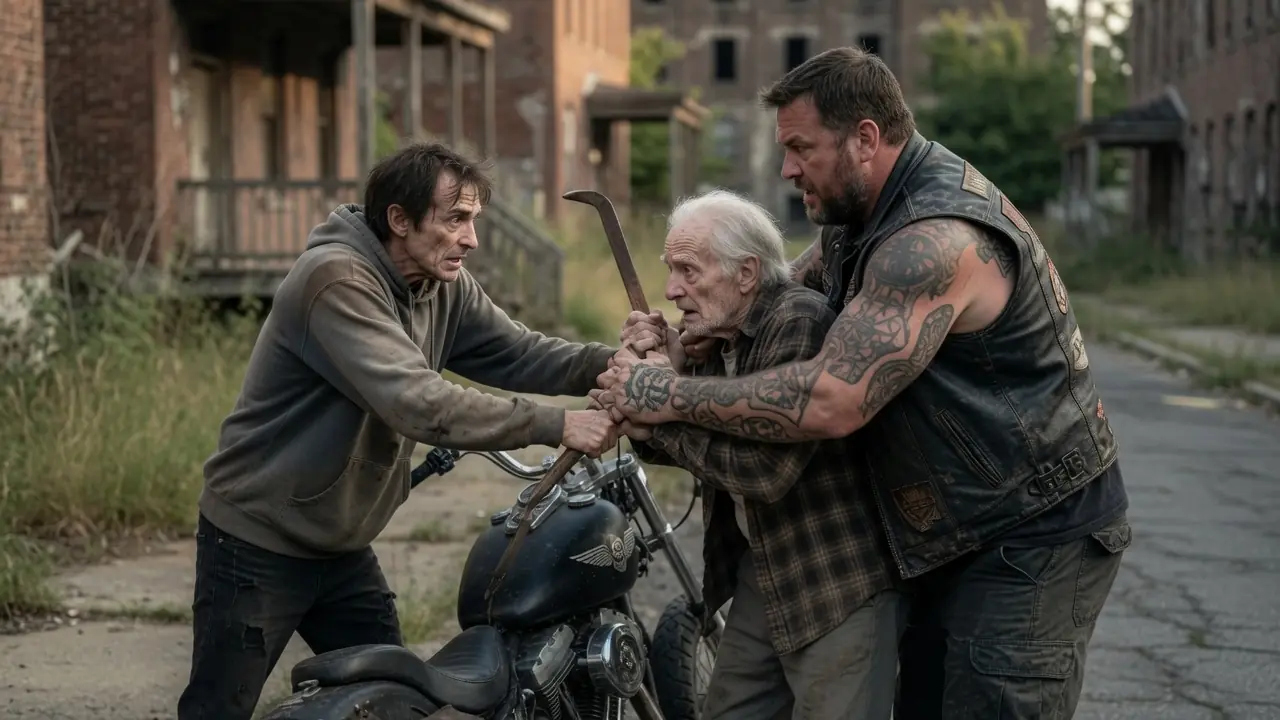
The man in the sweatshirt pulled a rusted pry bar from beneath his clothing.
He shoved it against the motorcycle’s ignition housing.
Metal scraped against chrome.
The sound drove through Walter’s skull.
He stared for several seconds, hoping they would stop.
They did not.
The pry bar slipped.
It struck the exhaust pipe with a loud metallic crack.
Walter placed his coffee on the porch railing.
He told himself to remain seated.
The motorcycle did not belong to him.
The owner looked like someone capable of handling his own problems.
Walter was old, bruised by years, and one careless fall away from spending the rest of his life in a rehabilitation center that smelled of boiled vegetables and disinfectant.
The pry bar scraped again.
Walter tightened his grip on the cane.
His television had stopped working that morning.
The refrigerator compressor had begun rattling.
A medical bill sat unopened on the kitchen table.
His left knee had been swollen for three days.
That grinding sound across the road became the final small irritation his patience could not absorb.
Walter pushed himself upright.
His knee cracked loudly.
“Hey!”
The word was meant to boom.
It emerged as a rough, gravelly croak.
He cleared his throat and stepped down from the porch.
“Get away from that thing.”
Both men turned.
The one in the cap took a step backward.
“Mind your business, Grandpa.”
Walter crossed the street slowly.
His slippers scuffed against the asphalt.
Each step tightened something inside his chest, reminding him of the clogged artery his doctor wanted to discuss at his next appointment.
He should have turned around.
Instead, he stopped three feet from the front wheel and planted his hickory stick firmly on the pavement.
“You’re making too much noise.”
The man in the sweatshirt laughed.
“That your bike?”
“No.”
“Then go home.”
Walter looked toward the scratched ignition.
“Whoever owns it is going to tear you both apart. I don’t want to wash pieces of you off the street.”
The man sneered, showing inflamed gums.
“It’s a free country.”
He yanked the pry bar harder.
Walter swung the cane.
There was no plan.
No heroic decision.
Only irritation boiling over into movement.
The heavy hickory struck the thief across the ribs with a dull crack.
The young man gasped and dropped the pry bar.
“You crazy old bastard!”
The man in the cap lunged.
Walter tried to pivot, but his left knee buckled beneath him.
The young man’s shoulder slammed into his chest.
To someone younger, the impact might have been little more than a hard shove.
To Walter, it felt like being struck by a slow-moving truck.
He fell backward.
His shoulder hit the curb first.
Then the side of his face scraped across rough concrete.
Pain flashed white behind his eyes.
He tasted blood.
Through the ringing in his ears, Walter heard the man in the cap panic.
“Leave it. He’s bleeding.”
Footsteps slapped toward the alley.
Then silence returned.
Walter lay beside the motorcycle, staring beneath the engine.
A drop of oil gathered above him.
“Idiots,” he muttered.
He spat blood onto the pavement and rolled carefully onto his good side.
His shoulder burned.
Every breath felt sharp.
He reached for the front wheel, pulled himself into a sitting position, and leaned his back against the tire.
The thieves were gone.
The motorcycle remained.
Walter could have returned home.
He should have called the police.
Instead, he stayed beside the machine with the cane across his knees, waiting for his heart to settle.
The sun moved lower behind the abandoned textile mill at the end of Elm Street.
Purple light stretched between the buildings.
Blood dried against Walter’s cheek.
His shoulder throbbed with every heartbeat.
He had no one to call.
His wife, Evelyn, had died ten years earlier.
Their only son lived more than a thousand miles away and called twice a month out of obligation rather than affection.
The police would arrive late, ask several questions, and look at Walter with the tired patience reserved for elderly men who created unnecessary problems.
So he waited.
Ten minutes later, heavy boots approached.
Walter did not turn.
Moving his neck hurt too much.
A pair of worn engineer boots stopped in front of him.
Walter raised his eyes.
Faded jeans.
A thick silver chain hanging from a belt loop.
A black leather vest.
Then the biker’s face.
The man was built like a concrete wall left outside through several winters. His beard was gray and brown, and dark glasses concealed his eyes despite the fading daylight.
His name was stitched onto the front of the vest.
ROOK.
The biker looked at the dropped pry bar.
Then the damaged ignition.
Finally, he studied Walter’s bloody cheek and swollen jaw.
Neither man spoke for several seconds.
“You bled on my front wheel,” Rook said.
His voice was low and flat.
Walter wiped his mouth with the back of one hand.
“I tried not to.”
Rook’s gaze moved toward the alley.
“What happened?”
“Two young fools tried to steal it.”
“And?”
“I asked them to stop.”
Rook looked again at Walter’s injuries.
“You ask them with your face?”
“I used the stick first.”
The biker crouched.
Up close, he smelled of tobacco, dust, engine oil, and strong coffee.
He picked up the pry bar, examined it, and tossed it into a storm drain.
It struck the bottom with a hollow splash.
Then Rook reached into his vest and removed a dark bandanna.
He held it toward Walter.
“I’m fine.”
“You look like something a truck dragged for three miles.”
Walter glared at him.
Rook did not lower his hand.
“Wipe your face.”
Walter snatched the cloth and pressed it against the scrape.
The fabric stung.
“You shouldn’t leave this loud piece of junk on the street,” Walter muttered. “It attracts rats.”
Something moved at the corner of Rook’s mouth.
It might have been a smile.
“Name?”
“Walter.”
“Rook.”
“That your real name?”
“No.”
“Good. It would be a terrible real name.”
Rook stood.
He lifted the motorcycle from its stand as if it weighed nothing, swung one leg over the seat, and started the engine.
The roar shook the air.
Walter flinched.
Rook looked down at him.
“Can you walk?”
“I walked out here.”
Walter planted the cane and tried to stand.
His knee shook.
He reached halfway upright before his balance failed.
A massive hand caught him beneath his uninjured arm.
Rook lifted him with humiliating ease.
“Take your hand off me.”
Rook waited until Walter could stand alone.
Then he released him.
“Lock your doors tonight.”
Walter wiped blood from his chin.
“Why? Are you leaving that thing here again?”
“No.”
Rook kicked the motorcycle into gear.
“Those men have bruised ribs and worse pride. They may return.”
“For the bike?”
“For you.”
Before Walter could answer, Rook accelerated down Elm Street.
The exhaust echoed between brick buildings until the motorcycle disappeared around the corner.
Walter remained beside the curb holding the stained bandanna.
The neighborhood became quiet again.
His porch light flickered.
The shadow of the house stretched across the lawn.
Rook’s warning settled into Walter’s chest beside the pain.
They may return.
Walter spat another mouthful of blood onto the pavement.
Then he began the slow walk home.
Inside, the house smelled of old paper, dust, and peppermint candy.
The air felt trapped.
Walter did not turn on the lights.
A streetlamp filtered through the yellowed curtains, drawing narrow bars across the floral wallpaper Evelyn had chosen thirty-two years earlier.
Walter moved through the rooms by memory.
His cane tapped the threadbare rug.
In the bathroom, the fluorescent light exposed every injury.
A dark bruise had begun spreading along his jaw.
The scrape on his cheek remained wet.
His right shoulder looked swollen and tight.
Walter stared at his reflection.
“Stupid old man.”
He opened the medicine cabinet.
Expired aspirin.
An unfinished tube of ointment.
Evelyn’s old prescription bottles that he could never bring himself to discard.
He cleaned the scrape, then went to the kitchen and pressed a bag of frozen peas against his ribs.
The adrenaline was gone.
Fear took its place.
Walter knew the neighborhood.
The thieves who moved through the alleys were not clever enough to fear consequences until consequences arrived in front of them.
They might throw a brick through his window.
They might kick in the back door.
They might return with knives or friends.
Walter looked at his shaking hands.
He was defenseless.
He stayed at the kitchen table until nearly two in the morning.
Every noise became a threat.
Branches against the siding.
A pipe shifting inside the wall.
A distant car door closing.
Eventually, exhaustion forced him into bed.
He did not undress.
He placed the cane beside him on the mattress and watched headlights move across the ceiling until sleep came.
When Walter awoke, the clock read 11:15.
Silence filled the house.
He sat up slowly.
His body had stiffened overnight.
It took several minutes to reach the kitchen.
He boiled water, stirred instant coffee into a mug, and looked through the rear window.
The alley was empty.
Relief loosened his chest.
Rook had been exaggerating.
The thieves were gone.
Walter unlocked the front door and stepped onto the porch to collect the mail.
He stopped.
The mug fell from his hand.
It shattered against the porch boards.
Elm Street had disappeared beneath motorcycles.
They lined both sides of the road in precise rows.
They filled the vacant lot.
They stood across intersections and beneath the old mill.
Black paint, chrome, leather, and heavy machines stretched as far as Walter could see.
Hundreds of riders stood beside them.
Some smoked.
Others leaned against handlebars.
Most watched the alleyways, rooftops, and intersections.
No one shouted.
No one played music.
The silence was more frightening than noise could have been.
The crowd across from Walter’s house separated.
Rook stepped through.
He wore the same vest and heavy boots, but no sunglasses.
His eyes were dark, steady, and impossible to read.
A white paper bag rested in one hand.
Rook crossed the street and stopped at the foot of the porch.
He looked at the broken coffee mug.
Then he pulled a large foam cup from the bag.
“Black,” he said. “Real coffee this time.”
Walter stared at the cup.
Then at the street.
“What is this?”
Rook took a drink from his own cup.
“You watched my back.”
“I stopped two thieves.”
“You bled for one of ours.”
“I bled because my knee stopped working.”
Rook ignored the explanation.
“Those two men tried to return before sunrise.”
Walter’s fingers tightened around the porch railing.
“What happened?”
“Some prospects found them two blocks away.”
“Are they dead?”
“No.”
The answer came quickly enough to make Walter uncertain whether it was true.
“They won’t return.”
Rook held out the coffee again.
Walter accepted it.
The heat warmed his hand.
Several bikers across the road gave him brief nods.
No smiles.
No cheering.
Only acknowledgment.
“We’re staying a few days,” Rook said.
“Why?”
“To make the situation clear.”
“To whom?”
“Everyone.”
Walter looked at the sea of motorcycles.
“You are blocking the street.”
“We’ll move for emergencies.”
“The mail truck?”
Rook considered it.
“Maybe.”
“This is ridiculous.”
A faint amusement entered Rook’s eyes.
“Hope you don’t mind the noise.”
The occupation began immediately.
Canvas tents rose in the vacant lot.
A barrel smoker appeared from the back of a pickup truck.
Within half an hour, charcoal and hickory smoke replaced the usual odor of exhaust and stagnant drains.
Men established watch positions at each end of the block.
The organization made Walter more uncomfortable than chaos would have.
These were not random men gathering for entertainment.
They had assignments.
Schedules.
Signals.
Walter went inside and locked the door.
From behind the curtain, he watched a massive biker lean against his chain-link fence until one steel post bent sideways.
Walter’s jaw tightened.
He grabbed the cane and returned outside.
“Get away from my fence!”
The giant turned.
Mirrored glasses covered his eyes.
He continued smoking.
“You’re bending it!”
Walter started down the steps.
Rook appeared and placed one hand on the giant’s shoulder.
He said something quietly.
The man stepped away from the fence and gave Walter a slow nod.
Rook rested his forearms on the top rail.
“Calm down before your heart stops.”
“I didn’t ask for an army.”
“We’re holding the line.”
“Against two starving thieves?”
“They were the symptom.”
“What does that mean?”
“It means people believed this block was easy.”
Rook’s voice hardened.
“They stole copper from empty houses. They broke into cars. They watched old people through windows.”
Walter said nothing.
“Someone touched a club motorcycle and an old man was the only person who came outside. That message travels.”
“When are you leaving?”
“When the other message travels farther.”
Walter understood the answer.
He also understood that he possessed no authority capable of removing hundreds of bikers.
“Fix my fence before you go.”
He turned and limped back inside.
That evening, a knock shook the front door.
Walter looked through the peephole.
A younger biker stood outside holding a paper plate wrapped in foil.
The man wore a plain black shirt and a vest with only a lower patch, identifying him as a prospect.
Walter opened the door with the chain still attached.
“What?”
“Rook said you haven’t left the house.”
“So?”
“He told me to bring food.”
“I don’t need charity.”
The prospect shifted the heavy plate.
“This isn’t charity. You protected club property.”
The smell of barbecue slipped through the doorway.
Walter’s stomach growled loudly.
The prospect heard it.
“My arm is getting tired.”
Walter removed the chain.
He accepted the plate.
“What is your name?”
“Eli.”
The young man gave a quick nod.
“Lock the door.”
The plate contained two pork ribs, baked beans, and thick bread.
Walter ate at the kitchen table with his fingers.
The food was better than anything he had cooked in months.
Later, while checking the back door, he noticed something strange.
The hinge did not squeak.
For five years, it had screamed whenever the door moved.
Evelyn had complained about it before she died, and afterward Walter had deliberately left it alone.
The squeak became part of the house.
Now the door moved silently.
Fresh grease darkened the hinge.
Walter stared.
Someone had entered his backyard.
A cold sense of violation moved through him.
Then another feeling followed.
He was not afraid.
For the first time in years, he did not expect someone to break the window.
He did not look twice at the shadows in the alley.
Hundreds of dangerous men surrounded his home.
Yet Walter had never felt safer.
He hated that contradiction.
He hated needing them.
He hated that a group of outlaws had accomplished in one day what police patrols had failed to do in a decade.
That night, Walter pulled the quilt over himself instead of sleeping on top of it.
He left the cane on the floor.
The distant murmur of engines carried through the walls.
He slept without dreaming.
By the fourth morning, Walter had become accustomed to the occupation.
The street woke at five thirty.
Not with engines.
The riders remained surprisingly respectful before sunrise.
Instead, Walter heard boots across pavement, lighters clicking, and low conversations thickened by sleep and tobacco.
He stepped outside with coffee.
Two men polished a blue motorcycle across the road.
Several others tossed a football in the intersection.
A young prospect collected trash from the alley.
The giant who had bent Walter’s fence approached carrying a steel wrench.
Walter tightened his grip on the cane.
The man said nothing.
He knelt beside the damaged post, wrapped one enormous hand around the steel, and pulled.
Metal groaned.
The post shifted upright.
Then he tightened the top rail and tested the connection.
When he finished, he looked toward Walter and nodded.
“I didn’t ask you to fix it.”
The giant walked away without answering.
Walter watched him return to his motorcycle.
Every repaired object felt like a debt.
The oiled hinge.
The straightened fence.
The hot meal.
Walter had accepted none of it, yet each kindness tightened an invisible connection he did not want.
A white municipal vehicle turned onto Elm Street.
Parking enforcement.
The driver moved twenty feet into the block before realizing what lay ahead.
Brake lights flared.
The street stopped.
Rags lowered from chrome.
The football rolled into the gutter.
Hundreds of faces turned toward the city vehicle.
No one threatened the driver.
No one approached.
They simply watched.
The municipal vehicle reversed the entire length of Elm Street and disappeared around the corner.
For three seconds, no one moved.
Then a rider whistled.
The football game continued.
Walter sat back in his chair.
A dark satisfaction moved through him.
Then shame followed.
The city had ignored Elm Street for years.
Streetlights remained broken.
Abandoned buildings became shelters for thieves.
Calls about vandalism received no response until hours later.
Now one city employee saw the consequences of neglect and fled.
Walter knew he should have disapproved.
Instead, he enjoyed it.
That frightened him more than the bikers did.
By the fifth afternoon, tents were coming down.
The smoker had been loaded into a truck.
Men strapped bags to their motorcycles.
The occupation was ending.
Walter had wanted this moment since the first engine arrived.
Yet as he watched the riders prepare to leave, a knot tightened inside him.
He stepped onto the porch.
Rook stood at the bottom of the stairs.
His motorcycle idled at the curb.
“Message delivered?” Walter asked.
“Clearly.”
“The thieves?”
“Gone.”
“The others?”
“Word moved through the neighborhood.”
Rook looked toward the alley.
“Elm Street is no longer considered easy.”
“Good.”
Walter leaned on the cane.
He should have returned inside.
Instead, he remained.
Rook reached into his vest.
Walter’s grip tightened reflexively.
The biker removed a folded piece of paper and placed it beneath the metal flap of Walter’s mailbox.
“What is that?”
“A telephone number.”
“I’m not calling your club.”
“If you see someone watching your windows, call.”
“I call the police.”
Rook breathed out through his nose.
It was nearly laughter.
“You can call them too.”
“I’m not paying for protection.”
“You already paid.”
Walter frowned.
“With what?”
“The moment you stepped off your porch.”
Rook studied him.
“Most people lock their doors. They look through curtains. They wait for someone else.”
“They were making noise.”
“Of course.”
“I wanted to drink my coffee.”
Rook nodded solemnly.
“Then you took a beating for peaceful coffee.”
Walter scowled.
Rook swung onto the motorcycle.
Down the street, an engine revved.
Another answered.
Then another.
The air filled with the roar of hundreds of American V-twin engines.
The sound pushed against Walter’s chest.
Windows rattled.
Exhaust rolled through the street.
Rook raised one hand.
Every rider waited.
Then he dropped it.
His motorcycle surged forward.
The others followed two by two, becoming a river of black leather and chrome.
Walter watched the giant pass.
Then Eli, struggling to maintain formation on a smaller motorcycle.
The departure lasted almost ten minutes.
When the final bike disappeared, silence crashed over Elm Street.
The vacant lot was empty.
The repaired fence stood straight.
A warm breeze moved through Mrs. Grady’s neglected shrubs across the road.
Walter returned inside.
Dust and peppermint greeted him.
The grandfather clock ticked in the hallway.
He locked the door.
He was safe.
He was alone.
For the first time, Walter did not know which condition frightened him more.
For several days, phantom vibrations remained inside his jaw.
He would sit reading the newspaper and suddenly feel engines through the floor.
He would look toward the window expecting to see the giant at the fence or Eli collecting trash.
Nothing was there.
The neighborhood slowly returned to normal.
The mail truck came back.
Mrs. Grady swept her porch.
Children rode bicycles through the intersection.
Walter watched them from behind the curtain.
The folded paper remained inside his mailbox.
Every morning, he removed catalogs and advertisements while refusing to touch it.
The paper felt like an admission.
Taking it inside meant accepting that the club had claimed a connection to him.
It meant acknowledging that the safest week he had experienced in years had been created by men the city officially considered dangerous.
So he left it there.
By Friday, the bruises on his face had faded to green and yellow.
His ribs hurt only when he coughed.
But his house felt larger than before.
The silence he once desired pressed against him.
He began walking into the kitchen simply to move the back door.
It no longer squeaked.
The hinge opened smoothly every time.
Walter could not decide whether the repair was an act of kindness or trespass.
It was both.
That was what disturbed him.
On Saturday afternoon, a storm moved across the valley.
The sky turned dark purple.
Rain struck the roofs and flooded the gutters.
Walter stood at the front window.
Then he remembered the mailbox.
Its bent metal flap leaked.
He grabbed his cane and hurried outside.
Cold rain soaked his shirt before he reached the steps.
Water had already gathered inside the mailbox.
Walter reached into it and seized the folded paper.
One corner was damp.
He carried it inside and unfolded it.
Ten digits written in blue ink.
No name.
No message.
Only a local telephone number.
Walter stared until his eyes burned.
He hated Rook.
He hated the giant.
He hated Eli.
They had forced him to see what he had become.
For ten years after Evelyn’s death, Walter had called his isolation independence.
In truth, it was fear arranged into a routine.
He kept people away before they could leave.
He rejected help before anyone could disappoint him.
He sat on the porch judging the street while refusing to participate in it.
The bikers had entered his life without permission.
They had disturbed his silence.
They had reminded him the world was still capable of reaching him.
Walter walked into the kitchen.
He did not throw the number away.
He pinned it to the corkboard beside the refrigerator.
Late October arrived with cold winds and fallen leaves.
Walter sat on the porch wearing a heavy wool coat and scarf.
A mug of hot coffee rested on the table beside him.
His face had healed.
A pale scar crossed one cheek.
His shoulder still clicked, but the worst pain was gone.
Elm Street had changed.
Not dramatically.
The houses remained old.
The asphalt remained cracked.
The abandoned textile mill still shadowed the far intersection.
But the thieves did not return.
Cars were no longer broken into at night.
People stopped testing back doors.
Word had traveled.
The house with the repaired fence belonged to the old man protected by the Iron Vultures.
Walter did not know how much of the story was true by then.
Perhaps people believed he had once been a member.
Perhaps they thought Rook was his son.
Perhaps they imagined weapons hidden beneath his floorboards.
Walter made no effort to correct them.
A boy rode past on a rusted bicycle.
He removed a granola-bar wrapper from his pocket and tossed it toward the gutter.
A year earlier, Walter would have shouted.
He would have struck the porch railing with his cane and cursed the boy’s entire generation.
Instead, he watched.
The wrapper moved along the pavement.
The boy reached the end of the block.
Then he turned his bicycle around.
He rode back toward Walter’s house.
He stopped near the gutter and looked up.
Walter said nothing.
He did not glare.
He simply met the boy’s eyes.
The child dismounted, picked up the wrapper, and placed it inside his pocket.
Then he rode away quickly.
Walter’s mouth moved.
Not quite a smile.
But close.
He wrapped both hands around the warm mug.
The repaired fence stood straight.
The back door opened silently.
Ten blue numbers remained pinned inside the kitchen.
Walter had never called them.
Perhaps he never would.
Their existence was enough.
For years, he had believed the world was a machine designed to take things from him.
His wife.
His youth.
His strength.
His sense of safety.
He fought that loss by becoming bitter and unreachable.
Rook and his riders had not brought law to Elm Street.
They brought consequence.
They reminded the neighborhood that respect still carried weight.
They reminded Walter that one seemingly foolish decision could travel farther than expected.
He had stepped into the street because two thieves were interrupting his coffee.
At least that was the explanation he preferred.
But somewhere beneath the irritation, the aching joints, and the bitterness, another part of him had remembered what it meant to care whether something wrong happened in front of him.
Walter Hayes was not a biker.
He was not brave in the way people used the word in speeches.
He was an old widower with damaged knees, a hickory cane, and terrible coffee.
But he was no longer hiding.
The cold wind moved across Elm Street.
Dead leaves scraped against the pavement.
Walter tightened his coat and remained on the porch.
He watched the intersections.
He watched the alleys.
He watched children riding home from school.
He had become the street’s watchman.
Not because anyone appointed him.
Not because a motorcycle club demanded it.
He stayed because this was his porch.
His neighborhood.
His life.
And neither two thieves with a pry bar nor the slow, quiet pull of loneliness would take it from him without a fight.