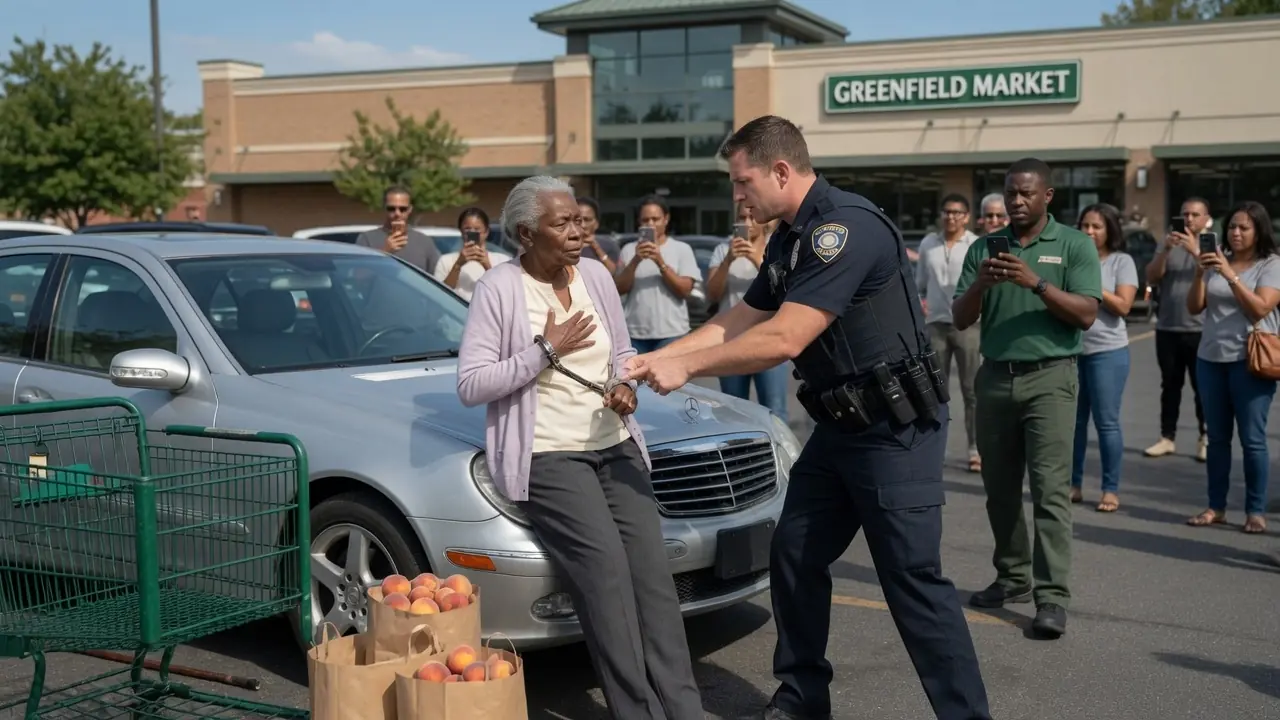
“Hands on the car. Now.”
Evelyn Carter turned slowly.
She was sixty-eight years old, six days out from heart surgery, and standing beside a silver Mercedes she had owned for three years.
Her cane rested against the rear bumper.
The keys were in her right hand.
A bag of groceries sat at her feet.
And directly in front of her stood a young police officer with one hand near his holster.
“Officer,” Evelyn said carefully, “this is my car.”
“Hands on the hood.”
“My registration is in my purse.”
“I said hands on the hood.”
People were beginning to stop.
A man pushing shopping carts.
Two women leaving the grocery store.
A delivery driver beside a white van.
Phones came out almost automatically.
Nobody knew what had happened.
Nobody knew who Evelyn was.
They only knew that a police cruiser had stopped at an angle behind an expensive car and that an older Black woman was being ordered against the hood.
Evelyn looked around once.
Then she placed her hands on the Mercedes.
The metal was hot beneath her palms.
Her chest tightened.
The surgeon’s instructions returned to her.
No lifting.
No sudden exertion.
Avoid stress.
She almost laughed.
The officer stepped closer.
“Whose vehicle is this?”
“Mine.”
He glanced at the Mercedes.
Then at her faded cardigan, orthopedic shoes, and grocery-store tote.
His expression told her he had already decided what he believed.
“Right.”
Evelyn looked at him.
“Excuse me?”
“I said, who does the car belong to?”
“I told you. Me.”
The officer gave a small humorless laugh.
“People steal keys too.”
Evelyn felt something old move through her.
Not fear exactly.
Recognition.
She had spent most of her life recognizing that look.
The one that said the facts would have to work harder because of the person carrying them.
“My name is Evelyn Carter,” she said. “Run the plate.”
He did not.
That was the moment everything could still have ended quietly.
One plate check.
Thirty seconds.
Her name would have appeared.
The address would have matched her driver’s license.
The Mercedes would have come back legally registered to Evelyn Marie Carter.
Instead, Officer Ryan Cole reached for his handcuffs.
And somewhere across the parking lot, a woman who had started all of it watched from behind the windshield of an SUV.
Three hours earlier, Evelyn had been sitting in a hospital wheelchair signing discharge papers.
St. Matthew Regional Hospital smelled of disinfectant, coffee, and flowers that had been sitting too long in warm rooms.
A nurse named Carla knelt in front of her.
“Mrs. Carter, I want you to promise me something.”
Evelyn smiled.
“At my age, people usually ask for money before they ask for promises.”
Carla laughed.
“I’m serious.”
“So am I.”
“Rest.”
“I will.”
“No errands.”
Evelyn looked away.
Carla narrowed her eyes.
“You already have an errand planned.”
“It is hardly an errand.”
“What is it?”
“Peaches.”
Carla stared.
“Peaches?”
“Fresh ones.”
“You can buy peaches tomorrow.”
“No.”
“Why not?”
Evelyn looked toward the window.
“Tomorrow would have been my anniversary.”
Carla’s expression softened.
Evelyn’s husband, James, had been dead for four years.
Forty-three years of marriage.
Four years of learning how quiet a house could become after one person disappeared from it.
Every anniversary, James bought fresh peaches because Evelyn once told him the first week they were dating that a good peach tasted like summer deciding to forgive everybody.
It became their thing.
Some years they ate them on the porch.
Some years in the kitchen.
One year, when money was tight, James bought only one and cut it in half.
After he died, Evelyn continued the tradition.
Not because she believed rituals kept people alive.
Because sometimes memory needed something physical to hold.
“I’m buying six peaches,” Evelyn told Carla. “Then I’m going home.”
“You’re driving?”
“My doctor cleared me.”
“For short distances.”
“The market is seven minutes away.”
Carla sighed.
“You are difficult.”
“I was difficult before the surgery.”
“That I believe.”
The nurse helped her into the hospital lobby.
Evelyn’s silver Mercedes waited outside.
The car looked extravagant beside her.
That was part of why her son bought it.
For most of her adult life, Evelyn drove used sedans.
Cars with dents.
Cars with windows that did not always roll down.
Cars that rattled at highway speed.
She never complained.
Her son had.
When he was promoted three years earlier, he arrived at her house holding a key.
She refused it immediately.
“No.”
“You haven’t seen it.”
“I don’t care.”
“Mom.”
“I raised you better than to waste money.”
“You raised me exactly well enough to know why I’m doing this.”
He took her outside.
The Mercedes was parked at the curb.
Evelyn stared at it.
“You have lost your mind.”
Her son smiled.
“You worked two jobs for twenty years.”
“That was my responsibility.”
“You cleaned offices at night.”
“It paid.”
“You came home at two in the morning and got up at six to make my breakfast.”
“You were a child.”
“You wore the same winter coat for seven years because you kept buying me new ones.”
Evelyn looked away.
Her son placed the key in her hand.
“You spent half your life making sure I never felt poor.”
His voice softened.
“Let me make sure you never feel invisible.”
She cried then.
Not because of the car.
Because her son remembered.
The grocery store was less than ten minutes from the hospital.
Evelyn parked in a regular space near the front.
She moved slowly.
Her cane touched the pavement first.
Then one foot.
Then the other.
Inside, she bought milk, bread, chicken soup, medication-safe crackers, and six peaches.
She held each peach gently before placing it in the paper bag.
Across the parking lot, Linda Grayson noticed her.
Linda lived four houses down from Evelyn.
They were not friends.
They had never been friends.
Linda had complained about Evelyn’s grandchildren playing too loudly during one summer visit.
She complained about Evelyn’s flower beds spreading too close to the sidewalk.
Once, she complained to the homeowners’ association because Evelyn’s nephew parked a work truck outside overnight.
Evelyn had learned to ignore her.
Linda had not learned to ignore Evelyn.
She watched the older woman emerge from the store.
Then watched her approach the Mercedes.
Something about the sight irritated her.
Evelyn.
The Mercedes.
The hospital bracelet still around her wrist.
The expensive car.
Linda picked up her phone.
She called 911.
“I think someone is breaking into a vehicle at Greenfield Market.”
The dispatcher asked for a description.
“Older Black woman.”
“Is she forcing entry?”
Linda watched Evelyn press the key fob.
The Mercedes unlocked.
“No, but she has keys.”
“Do you know the vehicle?”
“No.”
“Do you see a weapon?”
Linda hesitated.
This was the moment she could have stopped.
Instead she said:
“She keeps reaching into a large purse. I can’t tell what’s inside.”
That changed the call.
Possible vehicle theft.
Possible weapon.
Officer Ryan Cole received the dispatch less than two miles away.
He was twenty-nine.
Three years on the force.
He had enough experience to feel confident and not enough to understand how dangerous confidence could become when it replaced curiosity.
He arrived fast.
Too fast.
By the time he stepped from his cruiser, he was not approaching a person to investigate a report.
He was approaching a suspect.
That distinction mattered.
“Step away from the vehicle!”
Evelyn had just placed the peaches on top of her groceries.
She turned.
“Officer?”
“Hands where I can see them.”
She raised them immediately.
“Is something wrong?”
“Move away from the car.”
“This is my car.”
“Ma’am, do not make me repeat myself.”
Evelyn slowly set her groceries down.
The peaches remained balanced on top.
She stepped away from the Mercedes.
Her cane clicked against the pavement.
Officer Cole walked around her.
“Where did you get the vehicle?”
“I bought it.”
“With what?”
Evelyn stared.
“What do you mean?”
He looked at the car again.
“You’re telling me this Mercedes belongs to you?”
“Yes.”
“How long?”
“Three years.”
“Registration?”
“In my purse.”
She reached slowly.
Cole’s hand moved toward his holster.
“Don’t reach.”
“I’m getting what you asked for.”
“I told you not to reach.”
Evelyn froze.
“All right.”
A few shoppers had stopped.
The delivery driver moved closer.
His name was Marcus Hill.
Twenty-four.
He had just finished unloading bakery supplies and was returning to his van when he saw the officer confronting Evelyn.
Marcus took out his phone.
Not because he knew who was right.
Because something about the scene bothered him.
An older woman.
A cane.
Groceries.
An officer whose voice kept getting louder while hers stayed quiet.
Evelyn tried again.
“Please run the plate.”
Cole ignored her.
“Do you have identification?”
“Yes.”
“Where?”
“In the same purse you told me not to touch.”
A few people murmured.
Cole heard them.
His posture changed.
The encounter had become public now.
That seemed to make him more determined not to appear uncertain.
“Turn around.”
Evelyn’s heart began beating faster.
“Why?”
“You’re being detained while I investigate vehicle theft.”
“You don’t need to detain me. Run the plate.”
“Hands on the hood.”
“Officer, I left the hospital three hours ago.”
“Hands. On. The hood.”
Evelyn placed the cane against the rear bumper.
She put her palms on the car.
Cole positioned himself behind her.
“Spread your feet.”
“I cannot stand this way for long.”
“You’ll be fine.”
“I had heart surgery six days ago.”
“Everybody has a story.”
Evelyn slowly turned her head.
“That is not a story.”
He grabbed the cane and moved it away.
Not violently.
Carelessly.
It fell onto the pavement and slid partly beneath the neighboring car.
Evelyn instinctively reached for it.
“Hands back on the vehicle.”
“My cane.”
“You don’t need it right now.”
“I do.”
Marcus stepped forward.
“Officer.”
Cole turned.
“Stay back.”
“Just check the registration.”
“I said stay back.”
“She’s asking you to run the plate.”
Cole pointed toward him.
“Do not interfere.”
Marcus stopped.
Then raised his phone higher.
“I’m not interfering. I’m recording.”
The handcuffs came next.
Evelyn heard the first metallic click before she fully believed he intended to use them.
“Officer.”
“Hands behind your back.”
“I cannot.”
“What do you mean you cannot?”
“My incision. My shoulder. Please put them in front.”
Cole took her left wrist.
Pain moved across her chest.
Evelyn gasped.
“Please.”
“Stop pulling.”
“I’m not pulling.”
He guided the arm farther back.
Too far.
“Please, I can’t move like that.”
“Stop resisting.”
The words traveled across the parking lot.
People heard them.
Some shifted.
A woman near the shopping carts whispered, “Is she resisting?”
Marcus answered without looking at her.
“No.”
The first cuff closed.
Then the second.
Evelyn shut her eyes.
The steel pressed hard against the skin of her wrists.
Her breathing shortened.
Officer Cole stepped back.
“Now we can figure out what’s going on.”
Evelyn turned as much as the cuffs allowed.
“You could have figured that out before touching me.”
Her purse slipped from her shoulder.
It hit the pavement.
Everything spilled.
Lipstick.
Wallet.
A bottle of heart medication.
Hospital discharge papers.
Car registration.
The white registration card landed face up.
Marcus saw it.
“So did one of the women near the entrance.”
“Officer!” Marcus shouted. “Her name is on the paperwork.”
Cole looked down.
Evelyn Carter.
Mercedes-Benz.
License plate matching the vehicle behind her.
He could have ended it then.
No one expected perfection.
A mistake had been made.
Mistakes could still be corrected.
Cole bent slightly.
Read the card.
Then stood again.
“This alone doesn’t verify identity.”
Marcus laughed in disbelief.
“What else do you want?”
Cole turned.
“You need to back up.”
“Her medication is on the ground.”
“Back up.”
“You’re not even checking.”
Cole’s face tightened.
“That paperwork could belong to the vehicle owner.”
Evelyn looked at him.
“It belongs to me.”
“We haven’t established that.”
“My driver’s license is in the wallet beside your shoe.”
Silence.
Someone in the crowd said,
“Oh, come on.”
Officer Cole looked toward the gathered phones.
For the first time, uncertainty entered his expression.
But instead of correcting course, he doubled down.
A second patrol officer arrived.
Her name was Dana Price.
She was twenty-seven and less than a year out of field training.
She walked toward the scene.
Older woman.
Handcuffs.
Hospital papers on the ground.
Medication bottle.
Cane several feet away.
Dana frowned.
“What have we got?”
“Possible stolen vehicle,” Cole said.
“Plate run?”
“Not yet.”
Dana looked at him.
“Not yet?”
“Caller reported suspicious activity and possible weapon.”
“Did you find a weapon?”
“Still investigating.”
Evelyn spoke.
“Officer, would you please get my cane?”
Dana looked at her.
Then at the cane.
“Yes, ma’am.”
Cole immediately said:
“Leave it.”
Dana stopped.
“She says she needs it.”
“I’ve got the scene.”
Something cold moved through Dana’s stomach.
She had been taught to follow senior officers on active scenes.
She had also been taught to observe independently.
Those two instructions had never felt as incompatible as they did now.
Evelyn swayed.
Dana noticed.
“Ryan, she doesn’t look well.”
“She’s fine.”
“She has hospital paperwork.”
“Dana.”
The way he said her name ended the conversation.
And Dana let it.
That decision would bother her long after the shift ended.
Cole told Evelyn to walk toward the patrol car.
She took one step.
Then another.
Without her cane, her balance failed.
Her knees buckled.
Because her hands were restrained behind her, she could not catch herself.
She went down hard.
A cry escaped her.
Marcus swore loudly.
Dana moved forward.
Cole raised one hand.
“She’s fine.”
Evelyn remained on her knees.
Her chest felt wrong now.
Not simply sore.
Tight.
Heavy.
Pressure spread beneath the surgical site.
“I need to sit.”
“You can sit in the car.”
“I’m dizzy.”
“We’re almost there.”
Marcus shouted:
“She just fell!”
Cole turned.
“You need to leave.”
“No.”
That surprised everyone, including Marcus.
His own hands were shaking.
But he did not lower the phone.
“No. I’m staying right here.”
Cole stared at him.
Marcus swallowed.
“You can tell me to back up. Fine. I’ll back up. But I’m not leaving.”
He stepped farther away.
Then continued filming.
It was not dramatic heroism.
He was scared.
That mattered.
Courage usually did.
Evelyn eventually reached the patrol car.
Dana opened the rear door.
Cole guided her inside.
The cuffs remained behind her.
The afternoon had turned warm after the rain.
Heat had built inside the vehicle.
Evelyn immediately struggled to breathe comfortably.
“Please leave the door open.”
Cole shut it.
Dana looked at him.
“Should we call EMS?”
“No.”
“She said heart surgery.”
“She’s talking.”
“That doesn’t mean—”
“Dana, I said I have it.”
The younger officer looked through the rear window.
Evelyn’s face had gone gray.
Sweat had formed along her hairline.
She leaned her head against the glass.
Dana’s instincts were now screaming.
She walked toward the car.
Cole blocked her.
“What are you doing?”
“Checking her.”
“She’s fine.”
“No.”
It was the first time Dana openly contradicted him.
“She isn’t.”
She opened the rear door.
Cooler air entered.
Evelyn took a shallow breath.
Dana crouched.
“Ma’am, do you have chest pain?”
“Yes.”
“How bad?”
“Getting worse.”
“Any shortness of breath?”
“Yes.”
Dana immediately reached for her radio.
Cole stepped closer.
“She’s exaggerating.”
Dana stared at him.
“Maybe.”
Then she keyed the radio.
“But I’m not gambling her heart on maybe.”
She requested an ambulance.
Cole’s face went hard.
Evelyn turned toward Dana.
“Thank you.”
Then she said:
“I need to call my son.”
Cole exhaled.
“She can call at the station.”
Dana looked at him.
Evelyn’s voice became very quiet.
“I may not make it to the station.”
That ended the argument.
Dana removed her own phone.
“What’s the number?”
Evelyn gave it from memory.
Ten digits.
Dana dialed.
The phone rang once.
Twice.
A man answered.
“Carter.”
Evelyn closed her eyes.
“Michael.”
Her voice broke for the first time.
“It’s Mom.”
A pause.
Then the voice changed completely.
“Mom?”
“I need you.”
“Where are you?”
“Greenfield Market.”
“Are you hurt?”
“I don’t know.”
“What happened?”
“There’s been a misunderstanding.”
Dana looked down.
Even now.
A misunderstanding.
Evelyn was still trying to make the situation smaller than it was.
Then the man asked:
“Who is with you?”
“A police officer.”
Dana’s face changed.
She knew the voice now.
Everybody in the department knew it.
Police Commissioner Michael Carter.
Not because he was famous.
Because his signature appeared on department-wide policy memos, training notices, promotion orders, disciplinary directives.
Dana slowly raised her eyes toward Cole.
He noticed.
“What?”
She covered the phone.
“Her son is Commissioner Carter.”
Cole stopped moving.
For perhaps two seconds, his expression went completely blank.
Then color left his face.
Evelyn heard her son through the phone.
“Mom, I’m coming.”
“Michael—”
“I’m already moving.”
“You don’t need to bring the whole county.”
“I’m bringing an ambulance if they haven’t.”
“One is coming.”
“Stay with me.”
Evelyn almost smiled.
“I’m not going anywhere.”
Michael Carter did not arrive with a dramatic convoy.
He arrived eight minutes later in an unmarked county vehicle with his driver and a lieutenant from headquarters.
The ambulance arrived first.
Paramedics were checking Evelyn when Michael crossed the parking lot.
He was fifty years old.
Tall.
Close-cropped gray hair.
Dark suit instead of uniform.
People in the crowd did not immediately know who he was.
Then Dana stood straighter.
Several officers did too.
Cole did not.
Michael saw only his mother.
The cuffs.
The marks on her wrists.
The oxygen cannula beneath her nose.
Her cane still lying near another vehicle.
He stopped.
His face changed.
“Mom.”
Evelyn looked up.
“There you are.”
Michael knelt beside her.
“Why are you still cuffed?”
No one answered.
Michael looked toward Dana.
“Key.”
Dana removed the cuffs immediately.
Michael saw the skin beneath them.
Deep red marks.
One wrist had been scraped enough to bleed.
His jaw tightened.
He took his mother’s hands gently.
“What happened?”
Evelyn looked toward Cole.
“He received a call.”
Michael followed her eyes.
Officer Cole stood fifteen feet away.
“Sir,” Cole began, “we had a report of possible vehicle theft and a weapon.”
Michael nodded once.
“Did you locate a weapon?”
“No, sir.”
“Did you run the plate?”
Silence.
Michael waited.
“No, sir.”
“Why not?”
“I was controlling the scene.”
“Did you examine the registration?”
Cole looked toward the ground.
Michael noticed the paperwork.
He walked over.
Bent.
Picked up Evelyn’s registration.
Looked at it.
Then at the Mercedes.
Plate matched.
Owner matched.
Address matched.
He held the card for several seconds.
“How long did it take you to read that?” Evelyn asked.
Michael looked at his mother.
“About three seconds.”
She nodded.
“That sounds right.”
Michael did not shout.
That frightened Cole more.
“Officer,” Michael said, “step away from the scene.”
“Sir, I can explain.”
“You will.”
Michael looked at the paramedic.
“Does my mother need transport?”
The medic nodded.
“Absolutely. Recent cardiac procedure, chest pain, elevated pressure. We need her monitored.”
Michael immediately returned to Evelyn.
She caught his sleeve.
“Don’t turn this into something because I’m your mother.”
His expression softened.
“You are my mother.”
“That’s exactly why.”
She looked toward Cole.
“Do what you would do if I were somebody else.”
Michael stared at her.
Evelyn’s eyes remained steady.
“If your answer changes because I’m your mother, then nothing gets fixed.”
That silenced him.
He nodded.
“All right.”
He stood.
“Lieutenant, Officer Cole is relieved from field duty pending review. Secure body-camera footage. Get the original 911 recording. Preserve store surveillance. Take witness names.”
Cole looked shocked.
“Sir—”
“This is not discipline.”
Michael’s voice was controlled.
“It is preservation of an investigation.”
Then he turned toward Dana.
“You called EMS?”
“Yes, sir.”
“You removed the cuffs?”
“Yes.”
“You arrived after the detention?”
“Yes.”
“Write everything you observed.”
Dana swallowed.
“Yes, sir.”
“And include what you didn’t do.”
She looked at him.
He held her eyes.
“If you believed something was wrong and stayed quiet because another officer had more seniority, put that in the report too.”
Her face reddened.
But she nodded.
Michael was not interested in protecting anybody from discomfort.
Including his own officers.
Then he noticed Marcus.
The delivery driver still stood beside the van with his phone raised.
Michael approached.
“You recorded?”
“Yes, sir.”
“From when?”
“Almost the beginning.”
“Would you be willing to preserve the original video?”
“Yes.”
Marcus lowered the phone.
“I kept telling him to check the paperwork.”
Michael nodded.
“My mother heard you.”
Evelyn called from the stretcher.
“So did everybody else.”
She looked toward Marcus.
“Come here, young man.”
He approached awkwardly.
She took his hand.
“You were frightened.”
Marcus smiled nervously.
“Yes, ma’am.”
“Good.”
He looked confused.
Evelyn continued.
“People think bravery means you weren’t afraid.”
She squeezed his fingers.
“It usually means you were afraid and did something useful anyway.”
Marcus’s eyes filled.
“Thank you.”
“No.”
She smiled weakly.
“Thank you.”
The paramedics began moving her toward the ambulance.
Michael walked beside the stretcher.
Then Evelyn saw the peaches.
Three had rolled beneath the Mercedes.
Two were bruised near the grocery cart return.
One had been crushed.
“The peaches.”
Michael stared.
“What?”
“My peaches.”
“Mom, you’re going to the hospital.”
“I know where I’m going.”
“You’re worried about peaches?”
“It’s tomorrow.”
He understood.
Their anniversary.
Michael stopped.
Then smiled despite himself.
“I’ll get new ones.”
Evelyn squeezed his hand.
“Good boy.”
The ambulance doors closed.
And the most powerful man at the scene stood in the parking lot for several seconds holding a paper sack full of bruised peaches.
The story did not end with Michael firing Officer Cole in front of cameras.
Evelyn would not allow that.
The video spread online anyway.
Marcus’s recording showed the first commands.
The refusal to run the plate.
Evelyn explaining the registration was in her purse.
The cuffs.
The fall.
Dana hesitating.
The medication on the pavement.
The request for medical help.
The department opened an internal investigation.
The 911 call was reviewed.
Linda Grayson’s statements became part of it.
Investigators found that Linda had never seen Evelyn force entry into the Mercedes.
She had watched Evelyn unlock it normally.
She had no factual basis to claim a weapon.
Her history of neighborhood complaints became relevant when detectives examined whether the call had been deliberately misleading.
She was eventually cited and charged under applicable laws relating to false reporting after prosecutors reviewed the recording and surrounding evidence.
Officer Cole’s case took longer.
That mattered to Evelyn.
She wanted process.
Not revenge wearing a uniform.
The investigation concluded that Cole had reasonable grounds to approach and ask questions after receiving the dispatch.
What he did after that was the problem.
He failed to independently verify basic information.
He treated Evelyn’s refusal or inability to follow commands quickly as resistance.
He ignored obvious documents.
He failed to adjust restraint methods after she repeatedly described a recent medical procedure.
And he discounted signs of medical distress until another officer intervened.
The department sustained multiple policy violations.
Cole was terminated after the disciplinary process.
The state later reviewed his certification.
He lost it.
He would not return to law enforcement.
Dana Price received discipline too.
Not the same level.
But she received formal corrective action for failing to intervene sooner after recognizing a potential medical emergency.
She accepted it.
In her statement, she wrote something she would later repeat during training:
I believed the scene was wrong before I had the courage to say it was wrong. Those are not the same thing.
Evelyn kept a copy.
She spent two nights in the hospital.
Her heart had not suffered permanent damage.
The stress had caused significant symptoms and required observation, but the surgery itself remained intact.
Michael stayed both nights.
On the second evening, he sat beside the bed eating a bad hospital sandwich.
Evelyn looked at him.
“You’re angry.”
“Yes.”
“Good.”
“That surprises me.”
“Anger isn’t useless.”
She adjusted the blanket.
“It just needs a job.”
Michael leaned back.
“What job do you want to give mine?”
Evelyn thought.
“You know what bothered me most?”
“The cuffs?”
“No.”
“The fall?”
“No.”
“Linda?”
“Not even her.”
He waited.
“The moment he saw my registration.”
Michael became quiet.
“He saw it,” Evelyn said. “I watched his face. For one second he knew.”
“And kept going.”
“Yes.”
“That’s what bothers you.”
“That’s what frightens me.”
She looked toward the dark hospital window.
“People make mistakes every day.”
“Sure.”
“But there was a doorway there.”
“A doorway?”
“He could have said, ‘Ma’am, I may have this wrong.’”
She looked back at her son.
“He chose not to walk through it because the people watching might see him admit a mistake.”
Michael nodded.
Evelyn continued.
“I don’t want a department full of officers trained never to make mistakes. That’s impossible.”
“What do you want?”
“Officers trained to recognize the moment they can still correct one.”
Michael sat very still.
That was the beginning.
The department reviewed accessible verification procedures.
Not because every detention could be solved by paperwork.
Not because every 911 caller lied.
Not because officers should ignore potential threats.
The lesson was narrower and more practical.
Verify what can be verified.
Update your understanding when facts change.
Do not treat embarrassment as evidence.
Do not treat a citizen’s age, clothing, race, neighborhood, vehicle, or apparent wealth as proof that something “doesn’t fit.”
And when medical distress appears, investigate the health risk as seriously as the suspected crime.
Michael also expanded duty-to-intervene training.
Dana volunteered to speak during the first session.
She stood in front of forty officers.
“I didn’t hurt Mrs. Carter.”
She paused.
“At least that’s what I told myself.”
No one moved.
“I didn’t put the cuffs on her. I didn’t knock away her cane. I didn’t ignore the registration.”
Dana looked around the room.
“But I saw things going wrong and waited too long because I didn’t want conflict with a senior officer.”
She took a breath.
“That means I was part of the scene.”
The room remained silent.
“That is not an accusation against everyone who hesitates.”
She glanced at Evelyn, who had chosen to attend.
“It’s a warning.”
Evelyn nodded once.
Marcus Hill was invited to join a civilian advisory group reviewing department-community interactions.
At first, he refused.
“I deliver bread.”
Michael smiled.
“My mother cleaned offices.”
“What does that have to do with anything?”
“It means job titles are not qualifications for having a conscience.”
Marcus joined.
He was often the youngest person in the room.
He also asked questions others did not.
“What would a normal person understand this command to mean?”
“What happens if someone is scared?”
“What if their English isn’t good?”
“What if they have a disability we can’t see?”
“What if the officer realizes halfway through that the original caller was wrong?”
The meetings were not exciting.
No cameras.
No speeches.
Mostly arguments over language.
Policy wording.
Training scenarios.
Complaint systems.
That was exactly why Evelyn liked them.
Real change was often boring.
Revenge was fast.
Policy was slow.
She had lived long enough to know which lasted longer.
Several months later, Evelyn requested a meeting with Ryan Cole.
Michael objected.
“You don’t owe him anything.”
“I know.”
“Then why?”
“Because I have something to say.”
They met in a conference room at a neutral office.
No media.
No uniforms.
Ryan looked different without a badge.
Smaller somehow.
Tired.
He began immediately.
“Mrs. Carter, I’m sorry.”
Evelyn raised one hand.
He stopped.
“You’ve said that before.”
“I know.”
“Why are you sorry?”
Ryan struggled.
“For hurting you.”
“Keep going.”
“For not listening.”
“Keep going.”
He stared down at his hands.
“For assuming.”
Evelyn said nothing.
Ryan’s eyes filled.
“I saw the car first.”
She waited.
“Then I saw you.”
His voice cracked.
“And I decided the two didn’t make sense together.”
There it was.
Not a speech written by an attorney.
Not a policy phrase.
The truth.
Evelyn leaned back.
“Do you know what I saw when you got out of your patrol car?”
Ryan shook his head.
“A young man.”
He looked surprised.
“I thought maybe you were somebody’s son.”
His face tightened.
“I thought maybe your mother worried when you worked nights.”
Ryan lowered his eyes.
Evelyn continued.
“You looked at me and saw a category.”
She tapped one finger against the table.
“I looked at you and saw a person.”
For a while, neither spoke.
Then Ryan began crying quietly.
Evelyn did not comfort him.
She did not punish him either.
She simply allowed the discomfort to remain where it belonged.
Finally she said:
“I don’t forgive you because you lost your job.”
He nodded.
“I don’t forgive you because my son asked me to.”
Another nod.
“I’m not even sure forgiveness is something I owe you.”
“I understand.”
“But I hope you become a man who would behave differently if the same moment came again.”
Ryan wiped his face.
“I’m trying.”
“Good.”
Evelyn stood with her cane.
At the door, she stopped.
“Oh.”
He looked up.
“My car really is mine.”
For the first time, Ryan almost smiled.
“Yes, ma’am.”
“Good.”
Then she left.
One year later, Evelyn stood before a new class of police recruits.
On the projector behind her was a photograph from Greenfield Market.
No handcuffs.
No dramatic image of her on the pavement.
Only the registration card.
Lying face up near the tire.
Her name clearly visible.
Evelyn pointed at it.
“This is the most important photograph from that day.”
A recruit raised his hand.
“Not the video?”
“No.”
“Why?”
“Because the video shows what happened.”
She looked at the card.
“This shows where it could have stopped.”
The room became quiet.
Evelyn continued.
“The officer did not need to know my son.”
“He did not need to know my job history.”
“He did not need to know my husband.”
“He did not need to know whether I was a good woman or a difficult woman or a rich woman or a poor woman.”
She turned toward the recruits.
“He needed to read.”
A few people smiled.
Evelyn did not.
“He needed to allow new evidence to change the story he had already written in his head.”
That landed differently.
She rested both hands on the handle of her cane.
“The most dangerous sentence in the world is not ‘I made a mistake.’”
She paused.
“It is ‘I cannot be wrong now because too many people are watching.’”
At the rear of the room, Dana Price listened.
So did Marcus Hill.
Michael stood outside the doorway rather than inside.
This was Evelyn’s room.
Her lesson.
Her story.
He had learned not to take over things simply because he possessed the authority to do so.
Afterward, a young recruit approached Evelyn.
“My grandmother is about your age.”
“That happens when people get older.”
He laughed nervously.
“She would’ve been terrified.”
“I was terrified.”
The recruit looked surprised.
“You didn’t look scared in the video.”
Evelyn smiled.
“That’s because fear and dignity can occupy the same body.”
She tapped his arm gently.
“Remember that when somebody’s voice shakes.”
Evelyn still drove the Mercedes.
She refused Michael’s suggestion that she replace it.
“Absolutely not.”
“Mom, it’s getting old.”
“So am I.”
“That is not the same.”
“It is if you’ve been properly maintained.”
Every year on her anniversary, Michael brought peaches.
Eventually, he stopped pretending it was because he happened to be nearby.
They sat on Evelyn’s porch.
One peach each.
Sometimes they talked about James.
Sometimes they did not.
The parking-lot incident gradually became something people elsewhere remembered more clearly than Evelyn wanted to.
Occasionally strangers recognized her.
Some praised her.
Some apologized for something they had not done.
Some told her stories of their own.
What remained most important to Evelyn was not that her son had arrived.
In fact, that became the part of the story she corrected most often.
People loved the reveal.
The powerful son.
The stunned officer.
The moment authority met greater authority.
Evelyn understood why.
It was satisfying.
It was also the wrong lesson.
Whenever someone said, “He picked the wrong woman because her son was the commissioner,” Evelyn shook her head.
“No.”
Then she would lean forward slightly.
“He picked the wrong woman because every woman is the wrong woman to treat that way.”
The son did not make her worthy.
The Mercedes did not make her worthy.
Her age did not make her worthy.
Her surgery did not make her worthy.
Her husband’s memory did not make her worthy.
She had been worthy before anyone learned her name.
That was the lesson.
And there was another.
One that belonged to Marcus.
People had criticized the crowd afterward.
Forty people watched.
Many recorded.
Most did not speak.
Evelyn understood them more than commentators did.
Fear was powerful.
Authority was intimidating.
People had families waiting for them.
They did not know the whole story.
But Marcus did something small.
He spoke.
He stayed.
He recorded.
He kept saying:
“Check the paperwork.”
Nothing dramatic.
No heroic tackle.
No movie speech.
Just one frightened young man refusing to join the silence.
Years later, when Evelyn told the story, she always mentioned him before Michael.
People found that strange.
“Your son was the one who changed everything.”
Evelyn would smile.
“My son arrived after the worst part.”
Then she would think of Marcus standing twenty feet away with a shaking phone.
“The person who matters most is often the one who speaks before the powerful person arrives.”
On a spring afternoon two years after the incident, Evelyn left Greenfield Market carrying groceries.
Peaches were in the top bag.
The silver Mercedes waited in the sun.
She opened the trunk.
A police cruiser passed slowly along the lane.
For one involuntary second, her body tightened.
Memory lived in muscles.
Then the cruiser continued.
Evelyn breathed out.
She loaded the groceries.
Closed the trunk.
And before getting into the car, she looked across the parking lot.
People everywhere.
Going somewhere.
Carrying something.
Living lives invisible to one another.
Any one of them could misunderstand the person beside them.
Any one could make an assumption.
Any one could decide to remain silent.
And any one could choose differently.
Evelyn touched the key in her palm.
Then smiled.
James would have complained that she bought too many peaches.
She could almost hear him.
She climbed into the Mercedes.
Started the engine.
And drove home.
Not because anyone powerful had finally given her permission to belong there.
But because the car was hers.
The life was hers.
The name was hers.
It always had been.