Seventeen million dollars was disappearing into the mud so slowly that, for the first few minutes, nobody was willing to admit the machine was still moving.
I was.
My name is Russell Callaway, and in September of 2003 I was the lead geotechnical engineer for North American Extraction’s Pit Seven expansion in Canada’s Northwest Territories. My job was simple to describe and unforgiving to perform: tell people whether the ground beneath their machines would hold.
On September 14, I had given them the wrong answer.
The Liebherr LR 1300 crawler crane lay at an angle on the eastern margin of the Mackenzie peat plain, sixty kilometers southeast of Fort Providence. It was a 300-ton-class crane, although its working configuration that week weighed somewhat less, and it had been brought north at enormous expense to install sections of an underground conveyor system. The crane itself represented several million dollars in equipment. The schedule, recovery exposure, contract penalties, idle crews, and delayed conveyor installation pushed the amount at risk toward seventeen million.
And every few minutes, another centimeter of the machine disappeared.
From a distance the terrain looked harmless. Low sedge grass. Dwarf willow. Shallow pools reflecting a sky that seemed too large for the earth beneath it. Walk across that landscape in September and the ground could feel firm enough beneath your boots.
That was the lie.
Under the upper peat sat old lake deposits: clay, silt, buried sand seams, organic lenses, and water that had nowhere to go. Some layers could carry a road. Others behaved like cold pudding once disturbed.
Three weeks before the accident, my team had drilled six boreholes around the proposed crane pad. The results looked good. Stiff material to roughly four meters, then denser sand and gravel. We calculated the track bearing pressures, enlarged the working platform, placed heavy timber crane mats, and approved the position.
The Liebherr worked eleven days without complaint.
On day twelve, operator Derek Johansen lifted conveyor section eighteen.
Thirty-eight tons of steel came off its cribbing.
The boom swung slowly toward the trench.
Then the eastern track mat dropped.
Not much at first.
Maybe eight centimeters.
Derek felt it before anyone on the ground understood what was happening.
He stopped the swing.
The track dropped again.
The timber mat beneath it punched through the stiff upper crust and into a narrow band of saturated clay none of my six boreholes had encountered.
Derek lowered the load as fast as the geometry allowed.
The clay continued yielding.
The eastern crawler disappeared.
The crane leaned.
At roughly twenty degrees, Derek released the suspended section completely onto the prepared trench support rather than risk taking it with him.
At thirty degrees, the boom contacted the opposite trench wall.
At something between thirty-five and forty, the machine stopped.
For a while.
Derek climbed out of the cab onto the high side rather than jumping blindly into unstable ground. Two riggers guided him across the rear walkway to a temporary mat path. He reached firm ground shaking hard enough that somebody had to remove his gloves for him.
Nobody was injured.
At the time, that felt like the one fact we could hold onto.
Twenty minutes later, Project Director Grant Forsyth arrived.
Grant was fifty-two, a mining engineer with twenty-five years behind him and the rare habit of becoming quieter as situations became worse.
He stood beside me looking across the exclusion zone.
The Liebherr’s western crawler still rested on the mats. Its eastern side had vanished almost to the carbody. The boom lay partly supported by the trench edge. The counterweight sat high and ugly against the gray sky.
Grant finally asked, “Still moving?”
“Yes.”
“How much?”
“Maybe a centimeter every ten minutes.”
He nodded.
“And the clay?”
“Undrained failure. Once the mat punched through, the load remolded it.”
Grant looked at me.
“You signed the pad?”
“Yes.”
He did not accuse me.
That was worse.
We both knew six boreholes had passed within meters of the weak lens without finding it.
Geotechnical work often gives people an illusion of certainty. You drill a few narrow holes into thousands of cubic meters of earth, collect samples, run laboratory tests, make calculations, and then draw boundaries between materials you never actually see as continuous layers.
Most days, experience and statistics make that work.
On September 14, the earth found the space between our data points.
By sundown the crane was fenced off behind an eighty-meter exclusion radius.
The first recovery firm flew in the following morning.
Then another.
Then three more.
Brandt Heavy Lift sent two specialists from Calgary. Viking Crane Recovery sent a team out of Edmonton. Northern Industrial came down from Yellowknife. Two engineering consultants reviewed our ground investigation remotely before sending people north.
Everybody started from the same instinct.
Bring something bigger.
A second heavy crane could support the Liebherr’s upper structure while crews stabilized the sunken track and pulled it upright.
The problem was that anything heavy enough to make the lift created the same ground problem.
The peat around the accident had been stressed for almost two weeks by the Liebherr’s repeated movements. Pore pressures were elevated. Additional investigation showed the saturated clay band widened east and south of the pad.
The safe distance for another large crane was too great.
At eighty meters, even the biggest machine we could mobilize quickly did not have enough practical capacity at radius.
Someone proposed building a temporary causeway.
Another proposed screw piles.
Then the recommendation everyone gradually converged on: cementitious grouting.
A dense injection grid beneath the recovery area, combined with a reinforced working platform.
Three to four weeks.
Approximately $1.2 million before the recovery crane itself arrived.
Grant put the estimate on the site-office wall.
He stared at it for several seconds.
Then wrote beneath it:
$34,000/DAY LEASE
Below that:
PENALTIES BEGIN WEEK 3
Nobody needed the mathematics explained.
By the fifth morning, I had barely slept.
I stood outside the site office drinking coffee that tasted like diesel fuel and looking toward the stranded crane.
A young engineer named Matt Patterson came outside beside me.
Twenty-six.
Smart.
Annoyingly optimistic.
“You going to keep staring at it until it stands up?”
“Yes.”
“Good plan.”
“I’m refining it.”
He smiled.
Then we heard the engine.
Not a pickup.
Not one of the mine loaders.
Something slow.
Deep.
Individual combustion pulses arrived clearly enough to count.
Matt looked toward the access road.
“What is that?”
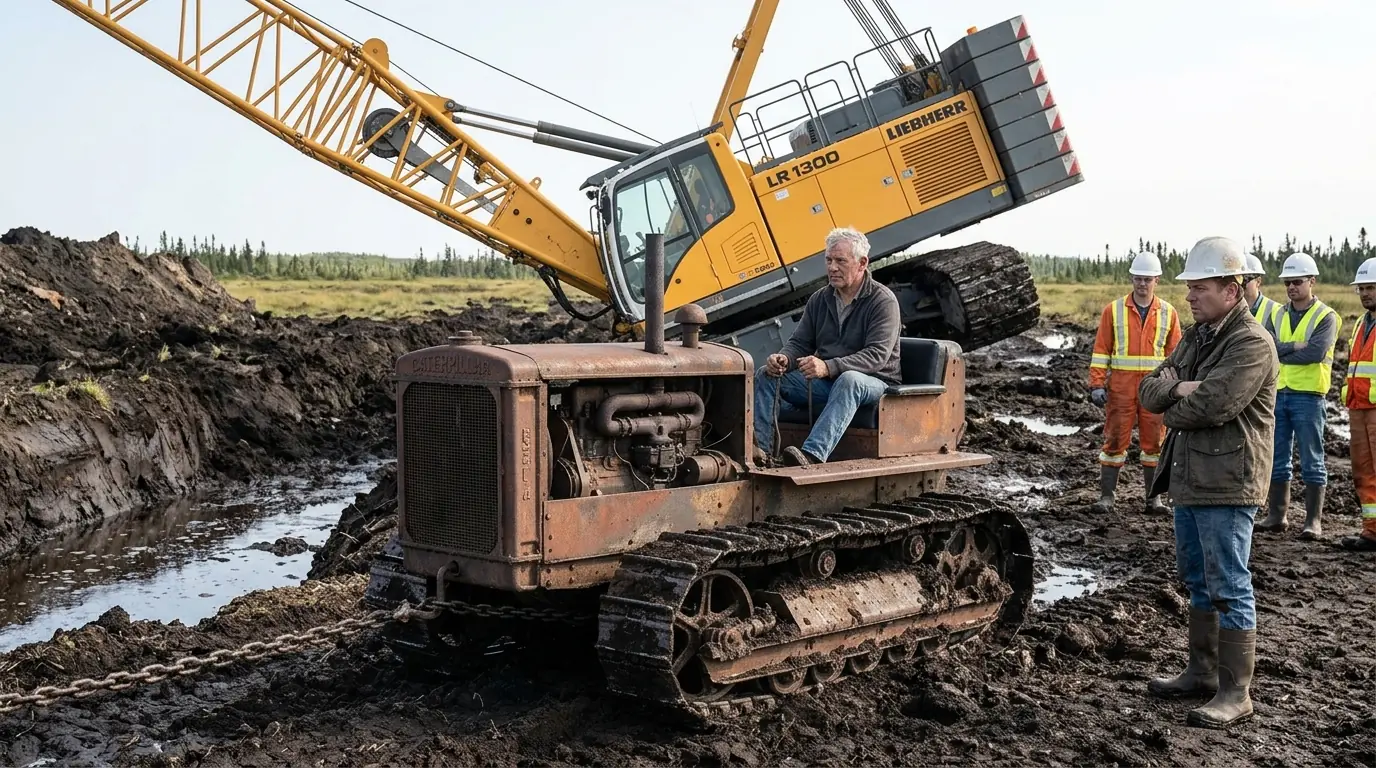
A crawler came over the rise.
At first I assumed it was some small vintage bulldozer being transported between farms.
Then I realized it had driven there under its own power.
The machine rode on two long steel tracks. There was no cab, only an open operator’s station. The engine sat exposed beneath a rounded hood. An old towing winch occupied the rear.
Paint that had once been yellow had faded through decades into a dull ocher beneath grease, soot, and rust.
Matt squinted.
“No way.”
“What?”
“That’s a Caterpillar Sixty.”
I stared.
“You sure?”
“My grandfather collects old tractor magazines.”
“That may be the saddest sentence you’ve ever said.”
He ignored me.
“Late twenties, maybe 1929.”
The crawler continued toward us.
It weighed around ten tons, depending on configuration. Roughly sixty-five horsepower when new. Built long before electronic controls, hydrostatic steering, GPS, load cells, or enclosed cabs.
Sitting on the sprung steel seat was Earl Pritchard.
Seventy-one years old.
He farmed six hundred acres along the western edge of the extraction lease and had been there longer than almost anyone employed by the mine had been alive.
Earl stopped at the security line, shut off the engine, and climbed down.
The sudden absence of the old Caterpillar’s exhaust made the morning sound unnaturally quiet.
Grant approached him.
“Morning, Earl.”
“Grant.”
“You know this is restricted.”
“I saw the signs.”
“Then why are you here?”
Earl nodded toward the crane.
“I can help you stand that thing up.”
Grant looked over Earl’s shoulder.
Then back at him.
“With that?”
Earl followed his gaze toward the Caterpillar.
“Yes.”
One of the Brandt recovery engineers, a man named Peter Sorenson, came out of the office.
He heard enough to understand.
“That crawler weighs what? Nine tons?”
“Closer to ten.”
“The crane’s over two hundred.”
“I know.”
“You’re not pulling two hundred tons with that.”
Earl looked at him.
“I’m not proposing to pull two hundred tons.”
Peter folded his arms.
“What are you proposing?”
“To stop thinking about the crane like it’s lying flat.”
That got my attention.
Earl walked to the edge of the exclusion zone.
He did not cross.
He simply stared at the machine for almost a minute.
Then he pointed.
“Your western track is still carrying.”
“Yes,” I said.
“Eastern one sunk.”
“Yes.”
“Boom is touching the trench wall.”
“Partially.”
“Counterweight’s high.”
“Yes.”
He looked at Peter.
“You keep trying to calculate what it takes to lift the crane.”
“That’s because it has to come upright.”
“No.”
Earl shook his head.
“It has to rotate.”
Peter’s expression changed slightly.
Earl continued.
“You don’t need a machine strong enough to pick up the whole crane. You need enough controlled pull to initiate rotation around the supported side while you crib the sinking track. Once the center of gravity comes back toward the crawler frame, the crane’s own weight helps you.”
I stepped closer.
“Assuming the boom doesn’t bind in the trench.”
Earl looked at me.
“Clear mud from around it.”
“We can’t get an excavator close enough.”
“You don’t need one.”
“What then?”
“Men, pumps, boards, and time.”
Peter shook his head.
“We’ve calculated initial line pull north of fifteen tons, maybe twenty depending on suction and boom drag.”
Earl nodded.
“Probably.”
“Your Caterpillar doesn’t make twenty tons.”
“No.”
“Then we’re finished.”
Earl looked behind him at the towing winch.
“You ever use blocks?”
Peter went quiet.
That was the first moment the conversation became serious.
Earl was not suggesting hooking a chain from a ten-ton crawler directly onto a two-hundred-ton crane and driving away.
He wanted mechanical advantage.
“There’s an old gravel spine under the peat northwest of this pad,” Earl said.
I frowned.
“What gravel spine?”