1. You Stop Explaining Yourself to Everyone.
One of the first signs of emotional maturity is realizing that not everyone needs to understand or approve of your choices.
People with healthy self-esteem tend to make decisions based on their values rather than constantly seeking external validation. They know the difference between communicating respectfully and feeling obligated to justify every decision.
This does not mean becoming defensive or secretive. Instead, it reflects growing confidence in your own judgment.
When feedback comes from trusted people, it can be valuable. But trying to satisfy everyone's expectations often creates unnecessary stress and anxiety.
Healthy interpretation:
Mentally strong people explain themselves when it is helpful—not because they constantly seek approval.
2. You Forgive, Not for Them but for Peace.
Forgiveness is often misunderstood as excusing harmful behavior.
Psychological research suggests that forgiveness primarily benefits the person who forgives by reducing chronic anger, resentment, and emotional distress. It does not require forgetting what happened, reconciling with someone who continues to cause harm, or abandoning healthy boundaries.
Forgiveness allows people to stop carrying emotional burdens that continue to affect their own well-being.
In some situations, forgiveness and distance can exist at the same time.
Healthy interpretation:
Forgiveness is about freeing yourself from ongoing emotional suffering, not pretending the harm never happened.
3. You Let People Leave and Don't Chase.
Relationships naturally change over time.
Mentally strong people recognize that not every friendship, romantic relationship, or professional connection is meant to last forever.
Trying to force someone to stay often creates more pain than acceptance.
Healthy attachment involves caring deeply while recognizing that every relationship requires mutual effort.
Letting go does not mean giving up easily. It means accepting reality when respect, trust, or commitment no longer exists despite honest effort.
Healthy interpretation:
Healthy relationships are built through mutual choice—not constant pursuit.
4. You Face Discomfort Instead of Avoiding It.
Growth rarely happens inside a comfort zone.
Psychologists describe psychological flexibility as the ability to experience uncomfortable thoughts and emotions while continuing to act according to personal values.
Avoiding difficult conversations, challenges, or fears may provide temporary relief but often strengthens anxiety over time.
Facing discomfort gradually—whether learning a new skill, exercising, speaking publicly, or having an honest conversation—helps build confidence and resilience.
Healthy interpretation:
Mental strength grows by facing manageable challenges instead of avoiding every uncomfortable situation.
5. You Keep Your Emotions in Check.
Being emotionally strong does not mean suppressing emotions.
Instead, it means recognizing feelings without allowing them to completely control your behavior.
Emotionally regulated people may still feel anger, disappointment, sadness, or fear. The difference is that they pause before reacting.
Skills such as mindfulness, deep breathing, reflection, and problem-solving help create space between emotion and action.
Responding thoughtfully often leads to healthier relationships and better decisions than reacting impulsively.
Healthy interpretation:
Mental strength involves managing emotions—not denying that they exist.
6. You Seek Growth, Not Attention.
People with an internal sense of purpose often focus more on learning than on recognition.
Instead of asking, "How can I impress others?" they begin asking, "How can I improve?"
Research on intrinsic motivation shows that pursuing personal growth, mastery, and meaningful goals is associated with greater long-term satisfaction than constantly seeking approval or status.
Recognition may come naturally, but it is no longer the primary motivation.
Healthy interpretation:
Mentally strong people measure success by progress rather than popularity.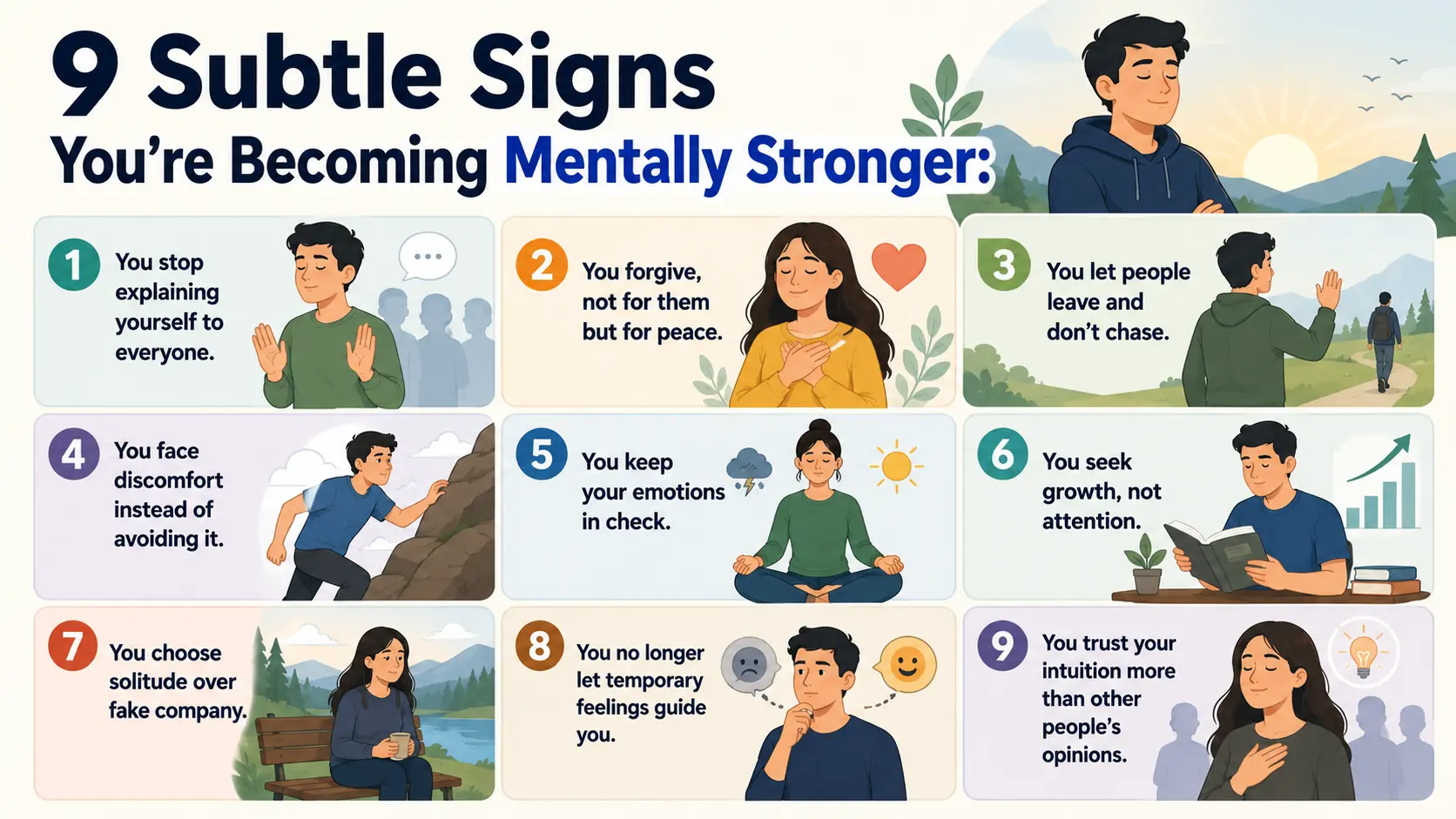
7. You Choose Solitude Over Fake Company.
Humans naturally benefit from meaningful social connection.
However, being surrounded by unhealthy relationships can be more emotionally damaging than spending time alone.
Healthy solitude allows people to reflect, recover, pursue hobbies, strengthen creativity, and better understand themselves.
At the same time, prolonged social isolation is linked to poorer mental and physical health.
The goal is not isolation—it is choosing authentic relationships over superficial ones.
Healthy interpretation:
Quality relationships matter far more than simply avoiding loneliness.
8. You No Longer Let Temporary Feelings Guide You.
Emotions naturally change throughout the day.
Making major decisions based solely on temporary anger, excitement, fear, or sadness often leads to regret.
Psychological resilience includes recognizing that emotions provide useful information, but they should be balanced with logic, long-term goals, and personal values.
Mentally strong people learn to pause before making important decisions during emotionally intense moments.
Healthy interpretation:
Feelings deserve attention—but they should not always make the final decision.
9. You Trust Your Intuition More Than Other People's Opinions.
Intuition develops from accumulated experience, knowledge, and pattern recognition.
Research suggests that intuition can be helpful, particularly in areas where a person has substantial experience.
However, intuition is not always correct. It can also be influenced by fear, bias, anxiety, or limited information.
The healthiest approach combines intuition with evidence, critical thinking, and trusted advice when needed.
Rather than blindly following others or relying only on instinct, mentally strong people learn to balance both.
Healthy interpretation:
Confidence grows when intuition is supported by thoughtful reflection and reliable information.
The Bigger Lesson
Mental strength is rarely dramatic.
It develops through countless small decisions made every day—setting boundaries, accepting change, regulating emotions, learning from mistakes, practicing self-compassion, and choosing growth over comfort.
Being mentally strong does not mean never struggling.
It means recovering more effectively, adapting more wisely, and continuing to move forward despite uncertainty.
Psychological resilience is not about becoming emotionless. It is about becoming emotionally healthy.
The strongest people are not those who never fall—they are the ones who continue growing every time they stand back up.