Dia vaugh thought it was just another automated system flag until she opened the report and read what it said by 9:47 a.m. on a Monday. Dileia sat at her desk in the Mil Haven County Public Library staring at six book checkouts. Each one timestamped between 2 and 4 in the morning. Each one from the account of an 8-year-old girl.
Each one placed on a different night for six nights straight. from a library that locked its doors at 8:00 p.m. The coffee beside her keyboard had gone cold. Her hands were trembling. Because if this child had been carefully spelling a message in book titles for six straight nights, she had exactly 17 days until August 1st.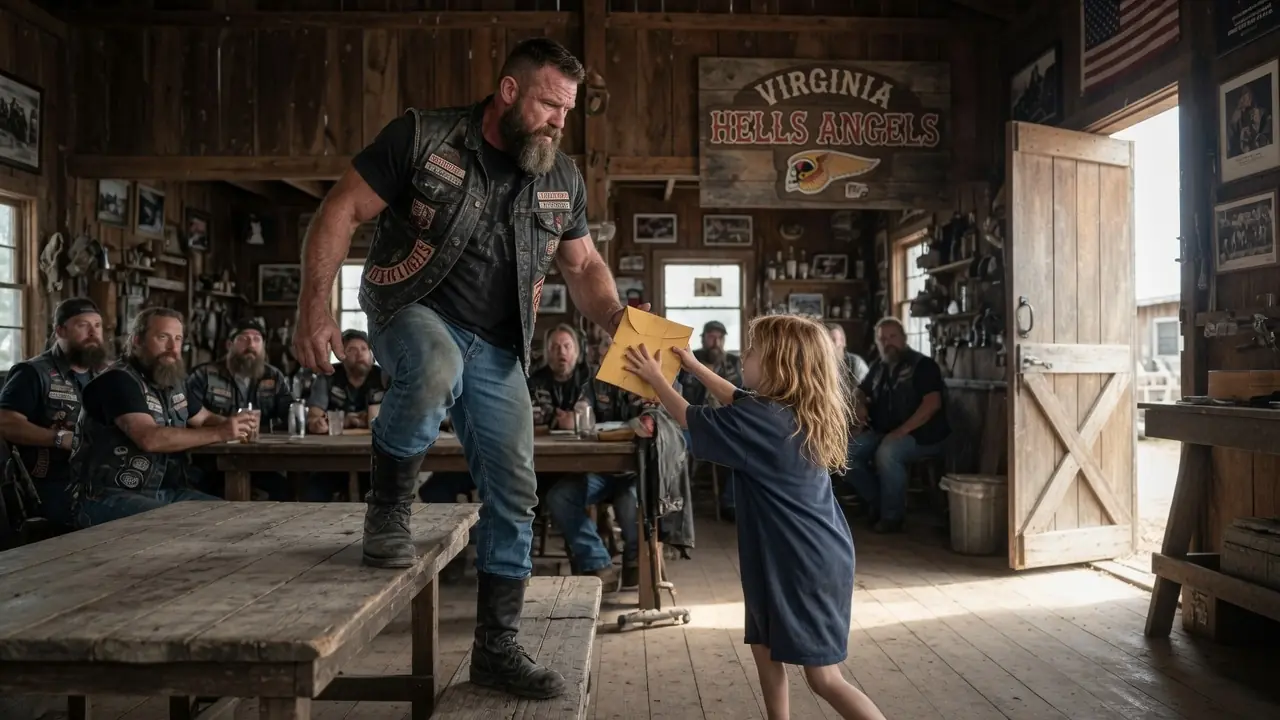
That's when a calendar entry read s delivery. That's when an insurance policy would activate after she supposedly ran away. That's when Petra Holloway might simply disappear the same way one other little girl had disappeared from this county 3 years before. All Dileia had was a library card number, a digital trail no one else had noticed, and one phone call, the kind that would bring 192 Hell's Angels to Mil Haven before nightfall.
If you believe every child deserves someone who answers when they call, subscribe and tell me what city you're watching from. Because this story starts with one woman who looked closer when everyone else looked away. Now back to that morning. Books are the only place he can't follow me.
Petra Holloway had whispered those words to herself three weeks earlier. crouched on the concrete floor of a basement divided into 8 by10 sections by hanging sheets, counting prime numbers in her head the way she always did when the fear got too loud. 2 3 5 7 11. She was 8 years old.
She weighed 58 lb. She had been in that basement for 14 months. The Mil Haven County Public Library sits at 214 Courthouse Road, a two-story brick building with tall windows, humming air conditioning, and a red front door that Petra remembered from before. Before her mother died, before Clint Marsh pulled her out of Tilden Elementary and told the school she'd be homeschooled, before the basement, she still had her library card.
Marsh had missed it, tucked in the spine of a composition book he'd never opened. Card number L2142016H. He'd given her access to his laptop for 30 minutes each morning to complete homeschool assignments, though the assignments were nothing but Bible verse memorization worksheets he printed and never graded.
What Marsh didn't know, what none of them knew, was that Petra had memorized his laptop password on the first day she arrived. She'd watched his fingers from behind a door frame. R I G H T I O U S1. She never forgot a sequence, numbers, letters, patterns. her mind locked onto them the way other children locked on to cartoon characters or soccer scores.
Every morning at 7:15 when Marsh stepped into the shower and water ran through the pipes overhead, Petra had 20 minutes. She used 15 for his worksheets. She used the other five in silence, heart hammering, fingers precise, accessing the Mil Haven County Library online catalog. She couldn't call anyone.
Marsh monitored the phone. She couldn't pass a note. She'd tried that before, and the mailman had handed it right back to him. She couldn't scream. The basement ceiling was packed with thick foam panels Marsh had installed himself. $42,000 of renovation that neighbors had assumed was a home recording studio.
But the library system left a record, a permanent timestamped, unalterable record of every checkout, and Petra was 8 years old and brilliant and out of options, and she had read enough books to know exactly what a code was. July 9th, 2:47 a.m. She checked out Hunter in the Dark by Monica Hughes.
H. July 10th, 3:14 a.m. Escape from Mr. Lemonchello's Library. E July 11th, 2:58 a.m. Locked in by Victoria Gibson. L July 12th, 3:22 a.m. Prisoner of Thron P. July 13th, 2:41 a.m. My dad the kidnapper. M July 14th 3:07 a.m. Emergency contact.
E h e l p m e. She'd chosen those hours because she'd read once in a book about library science she'd checked out the summer before her mother died that automated activity reports flagged off hours account use. She didn't know if anyone would notice.
She didn't know if the flag would fire. She didn't know if anyone at that library would look closely enough to see what she'd spelled. But she knew that hope, even the smallest kind, was better than silence. The safety pin holding her mother's navy blue dress at the waist, three sizes too large, the only piece of her mother she had left, pressed against her hip when she moved.
She touched it like a compass. Every time the fear rose up and threatened to swallow her hole, she touched the safety pin and counted primes and kept thinking. 13 17 19 23. She was still thinking.
She was still here. She hadn't given up. And on Monday, July 15th, at 9:47 a.m., someone finally noticed. Dileia Vaughn had worked at Mil Haven County Public Library for 8 years. She had a master's in library science and a minor in criminal justice.
The second degree, a quiet tribute to her childhood, to a father whose rages had been documented three times by CPS without result. To a mother who'd kept her and her brother Russ safe until she couldn't anymore. Dileia understood patterns.
It was the core of library science, and she had always believed the core of survival. Everything in both her degrees had taught her the same thing. If you look carefully enough at scattered data, it stops looking scattered.
She was reviewing the automated systems weekly activity report over her morning coffee, a task most librarians delegated to an assistant when the flag caught her eye. Off account activity review required. Standard language.
Usually a staff member forgot to log out or a scheduled renewal had processed overnight, but the name on the account was Holloway Petra, age 8. Dileia clicked through, saw the six checkouts, 247, 314, 258, 3:22, 241, 30:07.
All after midnight. All the same account, all exactly 24 hours apart. First thought, system glitch. Parent using a child's card. Second thought stopped her completely.
Help me. By the time someone found it and reported it, and a warrant was issued, 72 hours, Zoe was gone. Russ had driven to that house and found an empty room and a caseworker who filed the paperwork and a system that shrugged and moved on.
Dileia set the cup down. Not again. She opened the patron record. Holloway Petra, age 8. Address 3312 Hollowbrook Lane. Guardian listed. Marsh Clint R. She typed Clint Marsh's name into the county property records database.
3312 Hollowbrook Lane, 4.2 acres, owned outright. Occupation listed on a 2022 refinancing document. Director, Blue Ridge Christian Homeschool Cooperative. Her hands were shaking now. She picked up her phone, dialed a number she knew by memory.
Russ. Her voice was even but barely. I need you at the library right now. If you believe a child's intelligence should never be silenced, comment noticed below and subscribe because in the next part, Russ Callaway is about to hear those six book titles and recognize something he's been carrying for six years.
There are things that change a person for good. Russ Callaway, road captain, Hell's Angels, Virginia. Chapter, age 38. Two tours in Iraq as a combat engineer and 12 years on the road.
Had one of those things happen to him in November 2018. His daughter Zoe had been 7 years old. Brown curls, two missing front teeth, a stuffed rabbit named Sergeant that went everywhere with her. He kept a photograph in the breast pocket of his leather vest.
Zoe at six grinning her gaptothed grin. He'd looked at it so many times the edges had gone soft. Zoe's foster father, Dennis Barker, respected church elder per the pastor who'd vouched for him, had heard her for 11 months before a neighbor noticed scratching on the bathroom wall.
Help me. Authorities got a warrant in 72 hours. Barker's lawyer slowed it to a crawl. By hour 68, Zoe was dead. Accidental fall downstairs. Barker was acquitted.
The case worker faced no consequences. The system had failed her completely. Step by step, person by person, signature by signature. Russ had nearly ended Barker with his own hands. His brothers had stopped him.
Frank Anvil Ree had held him back in that courthouse parking lot with both big hands gripping his shoulders and said, "Prison won't bring her back. Don't give them that, too." So Russ had done something harder than revenge.
He'd stayed. He'd turned grief into a mission. Every tip about an abused child, every phone call from Dileia that started with, "I need you right now," he answered. He was at the library in 4 minutes.
Dileia met him at the side entrance. She'd printed the checkout report. She handed it to him without speaking. He read it. His jaw set just once. Then his expression went flat. the particular calm that his marines had recognized right before the hardest moments, the kind that meant he'd moved past fear into clarity.
"First letters," he said. Dileia pointed to her notepad. He read each title. "Hunter in the dark, escape from Mr. Lemonchello's library. Locked in. Prisoner of Tehran. My dad the kidnapper. Emergency contact.
His hand moved to his breast pocket. He didn't take the photo out. He just pressed his palm flat against it. H E L P E. Dileia said she's 8 years old. Last checkout was yesterday.
Russ, the last title is emergency contact. I think she's telling us she's out of time. Russ looked at the address. 3 312 Hollowbrook Lane, 25 mi out, isolated. Marsh, he said quietly.
I know that name. Deacon at Cornerstone Drive Church. Runs the homeschool co-op. Half the county thinks he's a saint. He stopped. How many kids? Dileia pulled up the county records.
His co-op lists 12 enrolled students, ages 6 to 12, no school district on record, no CPS flag, no welfare checks required under Virginia homeschool statute. 12 children invisible to every mandatory reporter in the state.
What's the earliest calendar entry you can find? Russ asked. She'd pulled Marsha's public homechool website events page. August 1st, spiritual retreat, Blue Ridge Lodge.
What he didn't know yet was what retreat meant in Marsh's encrypted communications. But the word August 1st was enough. 17 days, Russ said.
He pulled out his phone. What followed was a call that lasted less than 90 seconds. Sergeant, it's Russ. A pause, the kind that precedes serious things.
I need every brother within 150 mi at Foundry Road today. 3 p.m. Silence on the other end. Then what's going on? 8-year-old girl spelling H E L P with library books at 3 in the morning.
12 kids total. Homeschool cover. calendar shows a transfer date 17 days out. We are not waiting for the state to schedule a wellness check. Gerald Sergeant Knox, 52 years old, chapter president for 11 years, son of a Vietnam veteran, former steel worker who had built things with precision and preferred to solve problems the same way, said four words.
Say no more. We're coming. The line went dead and that was it. No debate, no questions about legal exposure, no requests for more evidence, just four words and a dial tone.
Because that's what brotherhood meant when a child was counting down. By 2:30 p.m., Russ and four of his best brothers had made the drive to Hollowbrook Lane before the chapter rally, running reconnaissance the way Russ had learned in Fallujah.
patient, systematic, every detail noted. Troy Cipher Benton sat in the passenger seat of the second truck, laptop open, three browser windows running, 36 years old. Former NSA cyber analyst recruited out of Virginia Tech at 22, left the agency after 14 years of watching surveillance tools aimed at the wrong people.
Cipher's specialty was digital forensics, finding what people buried inside computers, inside financial records, inside systems they assumed were sealed. He had accessed Marsh's professional email through a public library IP trace.
Dileia had quietly provided. Within 40 minutes, he had what he needed. Russ. Cipher's voice was steady, but the color had drained from his face. Encrypted folder. 47 files.
I'm seeing life insurance policies on 12 children. Marsh listed as sole beneficiary on each one. He paused. Combined payout potential $780,000. Walt chapter Diaz leaned over from the back seat.
63 years old, 30 years FBI, retired with silver beard and the patient expression of a man who had seen the worst things paperwork could describe and still believed in the rule of law. He'd joined the chapter 5 years earlier because the official channels had failed his granddaughter and he'd decided there were better ways to use 30 years of federal procedure knowledge.
premeditated, chapter said immediately. Those policies have minimum seasoning periods. Some of those kids have been insured for 6 months, maybe longer. He looked at Russ.
When was the earliest policy taken out? Oldest one is 14 months, Cipher said quietly. He looked at Russ. The policy on Petra Holloway was opened within 3 weeks of her mother's accident.
The word accident sat in the vehicle like something rotten. What they didn't know yet, what Cipher was still pulling from a deeper encrypted partition was that this was not the first time Clint Marsh had done this.
Frank Anvil Ree, 51, former Marine Military Police, tactical operations specialist, had done the property walk at distance using binoculars while Russ drove past at normal speed. Four exterior cameras, barred basement windows, single entrance front, one at the back through the kitchen.
Marshia's green Ford F350o in the driveway. Listen, Anvil said, handing the binoculars back. Through the afternoon heat, faint and rhythmic, came the sound of children's voices, all in unison, reciting, flat and mechanical.
The particular tone of voices that have repeated the same words so many times, the meaning has been worn out of them entirely. Bible verses. 12 children underground reciting scripture in the summer heat because Marsh had built a schedule and deviation was punished.
Russ touched his breast pocket. Zoe's photo soft at the edges. Not this time. And that's when Cipher said a name that changed everything.
Lily Parsons, he said. He'd pulled the county probate records. 7 years old. died November 2021. Listed a student of the Blue Ridge Christian Homeschool Cooperative. Accidental drowning.
Harker Creek. He scrolled. Insurance payout to Clint Marsh. $100,000. Policy taken out in May 2021. Mother died in a car accident. March 2021.
Marsh took Lily as a charitable placement in April. He looked up. She drowned in 3 ft of water. Her kindergarten records show she passed the full 25 m swim test. Nobody spoke.
He's done this before. Russ said at least once we can document. Chapter said there may be others. The vehicle sat on the shoulder of Hollowbrook Lane, engines ticking in the heat.
12 children reciting Bible verses underground. 17 days. a dead little girl who could swim. 14 months of a safety pin and prime numbers and a library card no one had bothered to take.
Russ picked up his phone again. Now armed with Cipher's evidence with Lily Parson's file with 12 insurance policies and one encrypted trafficking calendar, Russ Callaway was about to make the call that would end Clint Marsh's operation before August 1st ever came.
By 6 p.m. on July 15th, every available member of the Virginia, Maryland, West Virginia, and North Carolina chapters had received the same message through the club's encrypted chain. Virginia, 67, Maryland, 52, West Virginia, 43, North Carolina, 30.
192 men, most of them ex-military, ex-law enforcement, or trades people who had built things with their hands, and understood that precision mattered more than force. They converged on 88 Foundry Road, the chapter's staging area, a converted industrial building on the south edge of Milhaven.
not roaring and revving, but arriving in steady groups of 10 and 15, engines dialed low, parking in disciplined rows until the lot was full and the overflow lined the street beside it. Earl Rivet Saunders stood at the front of the room when the last group arrived, 67 years old.
chapter founder, Korean War veteran's son, former iron worker who had helped build three Virginia highway bridges and had the hands to prove it. He'd been riding for 48 years. He had a particular quality that comes from outlasting things, a stillness that wasn't passivity, but patience, the kind that knows it can afford to wait because it has already decided.
He didn't shout. He didn't need to. 192 men and the room was already quiet. Been doing this 48 years, Rivet said. Every generation we find a kid the system threw away.
Every generation we ask the same question. How did they get here? Every generation we get the same answer. The system was built to protect itself, not children.
He paused. So, we protect children. That's why we're here tonight. We do it smart. We do it clean. And we do it so that when those 12 kids come out of that basement, the case against Clint Marsh is ironclad.
No shortcuts, no vigilantism. We are not giving him one procedural escape route. Not a single voice raised against this. Sergeant Knox laid out the operational plan in 12 minutes.
Military clean. Element one, chapter and his law enforcement contacts. Three former FBI, two former Virginia State Police filing emergency child welfare applications with the circuit court judge on call, not the Milhaven circuit, where Marsh had donated to two judges campaigns state level with Cipher's full documentation as supporting evidence.
Element two, cipher completing the digital forensics package organized timestamped Jensen it chain of custody notation on every file for direct handoff to the Virginia State Police special victims unit who had been notified by chapter's contact at 5:45 p.m.
Element three, the physical perimeter. 192 motorcycles not at the property. That risked giving Marsha's defense team something to work with. Instead, every road leading to 3312 Hollowbrook Lane, every exit in the dark on a rural road 25 miles from town with no way in or out that wasn't watched.
We don't touch him, Sergeant Knox said. We don't threaten him. We park and we stand. When state police arrive with that warrant, they arrive knowing nobody left this property tonight.
That is our job. That is the only job. Now, you might be imagining what happens next. 200 motorcycles, leather vests, a man with Marsh's crimes getting the confrontation he deserves.
That's the version that fits the picture, isn't it? But here's what actually unfolded and why the real version was more powerful than anything a crowd scene could have been. Leo Stitch Marin, 47 years old, Army Ranger combat medic, 22 years of field medicine in conditions most doctors never encounter, had already loaded two vehicles with medical supplies, malnutrition, anemia, possible fractures, rope abrasion injuries.
He'd read Dileia's notes on Petra's physical description and had stocked accordingly. IV fluids, high calorie refeeding supplements, wound dressings, pediatric dosage charts, 12 children, ages 6 to 12, 14 months underground.
Stitch had treated children in Mosul and Kandahar. He moved efficiently in situations that would make most people freeze tonight. He moved efficiently. The rumble started at the county line at 8:30 p.m.
Low at first, like weather building over the mountain. Then it spread along Hollow Brook Road. Motorcycles rolling in from four directions, headlights steady and deliberate in the dark.
They parked one by one in the pulloffs, gravel shoulders, and field approaches on every road within a mile of the property. Engines cut one by one until the silence that followed sat heavy and expectant in the summer night.
192 motorcycles, 192 men standing in the Virginia dark, not moving, not shouting, simply present. Inside the property, Clint Marsh had no idea.
He'd spent the evening, as he spent most evenings, in his home office, reviewing documents on his laptop, eating the dinner he'd prepared for himself, while 12 children in the basement below received measured portions through the slot in the door. He'd balanced a spreadsheet.
He'd responded to two encrypted messages. He'd watched 30 minutes of a history documentary. The second phone call at 9:18 p.m. was to a contact who was not in Virginia.
A man ciphers files identified only as Casarov. Location unknown. Everything on schedule, Marsh said, voice pleasant. Reasonable. The voice he used for parents, for church committees, for CPS workers who came and left satisfied.
17 days. Everything's in order. He didn't know that Cipher had made a complete authenticated copy of every encrypted file on his laptop.
He didn't know that Chapter had been on the phone with a Virginia State Police captain for 3 hours. He didn't know that 192 motorcycle engines had gone silent on every road around his property.
At 11:14 p.m., the warrant was signed at the state circuit level. At 11:31 p.m., four state police units turned onto Hollow Brook Lane.
When the knock came, Clint Marsh answered his front door with a dish towel over his shoulder and an expression of pure confusion, the look of a man who had genuinely never expected this moment. He was wearing reading glasses.
He had a small coffee stain on the front of his shirt. He had been washing his dinner dishes, humming something that might have been a hymn when the lights swept across his front windows.
The same hands that had locked 12 children in a basement, washing a plate. Clint Rearen Marsh. Yes.
Still confused, still performing it. You're under arrest. They read him his rights on his own porch.
The dish towel fell when they put his arms behind his back. He looked to every officer who processed him that night. Startlingly ordinary, interrupted, like a neighbor whose routine had been unexpectedly disrupted.
That was the thing that stayed with them, how completely normal he looked. because to him this had been normal. The charges listed by the state prosecutor were as follows.
12 counts of felony child endangerment, 12 counts of criminal confinement, insurance fraud across 12 policies valued at a combined payout potential of $780,000. Benefits fraud totaling $8,400 monthly in false dependent claims.
Three counts of wire fraud in connection with trafficking communications, conspiracy to commit trafficking across state lines, and one charge the chapter had specifically ensured was included. Conspiracy in connection with the death of Lily Gene Parsons, age 7, whose drowning in November 2021, was formally reclassified pending forensic reinvestigation.
Bail was set at $1.2 $2 million. Marsha's attorney filed the request for reduction. The judge denied it without comment.
Inside the basement, Stitch was the first adult who wasn't Clint Marsh that the children had seen in over a year. He came in quietly, didn't rush, crouched low at the doorway of the first section.
8 by 10 ft concrete floor, single bare bulb, mold smell so thick you could almost see it and said, "My name is Leo. I'm a medic. I'm here to help you.
The man who lives upstairs is being taken away right now. You're safe. A small girl in the second section had pressed herself against the far wall.
Navy dress three sizes too large. Safety pin at the waist. Strawberry blonde hair, green gray eyes enormous in a face made smaller by 14 months of food restriction. Rope burned scars circling both ankles.
A healing split lip, left side. Petra Holloway, 58 lb. She was watching Stitch with an expression he recognized. Not hope exactly, not yet, but the very first edge of it.
The moment before a person allows themselves to believe. He didn't move toward her. He crouched. He waited.
"There's a woman outside," he said. Her name is Dileia. She's the librarian. She saw your books. Petra's breath caught.
Just once, a single sharp intake. Then something in her shoulders, held rigid for so long, dropped about half an inch. She noticed, Petra said.
Her voice was a horse whisper, vocal cords roughened by 14 months of basement mold. But the words were precise, formal. She spoke like someone who had learned to make every word earn its place.
I didn't know if anyone would. She noticed on the first morning, Stitch told her. July 15th, 9:47 a.m. 6 checkouts, six nights, Help PME.
He paused. That was the smartest thing I've ever seen, Petra. She touched the safety pin at her waist. pressed it between her fingers.
"I used titles alphabetically by first word," she said. "I picked books about being trapped because I thought the pattern might be more obvious. I wasn't completely sure the letters alone would be sufficient."
Stitch had to look at the ceiling for a moment. An 8-year-old had built a redundant signal system because she wasn't sure one layer of evidence would hold. It was sufficient, he managed.
Outside in Marshia's driveway, as the state police units processed the arrest, four witnesses gave statements to investigators. Norma Grant, 63, church choir member, who had seen the children at Sunday service for a full year, stood with her hands clasped, pressing hard.
"They were so thin," she said. Brother Marsh said they were fasting for spiritual growth. I told myself someone who knew better would say something.
I knew something was wrong. I just didn't want to be the one who made it worse. Her voice broke on the last word. She couldn't look at the ambulance loading two of the younger children for evaluation.
Deputy Carl Briggs, 44, Mil Haven PD, had the expression of a man who had just understood something he didn't want to understand. He'd responded to an anonymous call about a crying child at this address 7 months earlier.
Marsh had shown him curriculum binders. The children had been presented clean and coached. I should have insisted on speaking to each child individually, he told the state investigator.
I accepted what I saw on the surface. I had 12 documented complaint files sitting in my office. I should have connected them. I didn't.
Dr. Ruth Aldridge, 58, pediatrician, had seen Petra at a mandatory checkup in February, noted concerns re weight, bruising, possible neglect in the chart. accepted Marsha's fabricated meal plan documentation.
I documented the concerns, she said. I didn't escalate. I convinced myself the paperwork was enough. She almost died because I chose the easier path.
Documentation is not protection. I knew that difference. She stopped. I just didn't act on it. and Miriam Cole, 38, CPS social worker, who had visited 3312 Hollowbrook Lane twice and marked both cases unsubstantiated within 48 hours each time.
I had 87 cases, she said. Her voice was flat with the weight of it. I know that is not an excuse.
I know it will never be an excuse, but it is the truth. When a case worker carries 87 cases, children fall through.
Not because workers don't care, but because the system decided that number is acceptable. She looked at the basement entrance where Stitch was carefully helping a six-year-old girl into the open air, into the night, into her first breath of unfiltered outdoor air in 11 months.
It is not acceptable. It has never been acceptable. Four witnesses, four different failures, not one of them evil, all of them part of the architecture that had held 12 children underground for over a year.
Inside the chapter's staging vehicle, Chapter set down the final evidence packet, 214 pages, authenticated, flagged, annotated. He looked at Russ, at Cipher, at Anvil, at Rivet.
Every child accounted for. The room was quiet. A clock ticked on the wall.
State police radios crackled in the distance. All 12, Anvil said. Every hand that could have gone up went up.
Not a moment's hesitation, not a single piece missing. State takes it from here.
Chapter said justice had been served, but justice wasn't the ending. It was only the beginning. The 12 children of 3 312 Hollowbrook Lane were transported to Mil Haven Regional Medical Center at 12:08 a.m. on July 16th.
Stitch rode in the lead vehicle. He held the hand of the youngest child, a girl named Be, 6 years old, whose parents had paid Marsh $400 a month for a year, believing she was receiving accelerated Christian education in a structured residential program.
Bee hadn't seen her parents in 11 months because Marsh had told them the first year required total immersion, no contact for spiritual formation. They were in the hospital parking lot when the ambulance arrived.
They didn't know how to put into words what they felt when they saw her. They held her for a long time in the fluorescent parking lot light.
Nobody said anything. It was enough. Petra was treated for malnutrition and anemia. consistent with 14 months of significant caloric restriction, the admitting physician wrote in the careful clinical language that holds enormous things very quietly.
She had rope abrasion scars on both ankles, a healed fracture in her left index finger that had never been set. Iron levels so low she required a transfusion.
She asked when Stitch finished his initial assessment if she could see the librarian. Dileia came in at 2:30 a.m. still in her work clothes, cardigan, sensible flats, her mother's silver bracelet on her wrist.
She sat beside the bed. She didn't say anything immediately. She just was there, which was Petra later said, exactly right. You saw it, Petra said.
Her voice was still a horse whisper. First thing Monday morning, Dileia told her a pause. Then I wasn't completely certain the system flag would activate for off hours checkouts.
I read about the function in a library science book 2 years ago. I thought there was maybe a 70% chance it activated, Dileia said. And I was the one reviewing reports that morning.
and I've been looking for patterns my whole life because of my brother and because of what didn't happen when we needed it to. She paused. So, it was the right system and the right person at the right moment.
Petra considered this. That's a lot of variables, she said. It is, Dileia said. But it worked.
It worked. Petra touched the safety pin still threaded through the fabric of her mother's dress folded on the bedside table.
I want to keep this, she said. Even when I get real clothes. You should keep it forever, Dileia said. The legal architecture around Clint Marsh assembled with the precision chapter had promised.
He was held without bail. The circuit court judge reviewing the evidence package used the word unconscionable three times in her pre-trial ruling.
Marsha's attorneys filed two motions to suppress the digital evidence. Both were denied. The trafficking conspiracy charge once Virginia State Police connected his encrypted communications to a network operating across six states, four confirmed buyers, 31 documented transactions since 2019, moved from state to federal jurisdiction.
Cipher provided expert testimony on the digital evidence chain. He spent 4 hours on the stand. The defense cross-examined him for 45 minutes and sat down looking tired.
Pastor Douglas Hol, senior pastor of Cornerstone Drive Church, who had accepted $4,740 per month in donations from Marsh for 2 years and had actively discouraged congregants from reporting their concerns. was placed under separate investigation for criminal facilitation.
His case was referred to the state attorney general's office. Lily Parsons's case was formally reopened. A forensic pathologist engaged by the state investigators reviewed the 2021 examination findings and documented physical evidence inconsistent with simple accidental drowning.
A second charge was added, murder in the second degree. The $100,000 insurance payout on Lily Parsons, paid to Marsh in December 2021, was recovered as a fraudulent dispersement and placed into a victim restitution fund for the surviving children.
The 11 other families, parents who had trusted a man who presented as a godly educator, who had paid tuition and accepted no contact policies and believed the reassuring newsletters, were connected with victim advocates from Mil Haven County's Family Services Office.
The club contributed $68,000 to the fund pulled from all four chapters without announcement, enough to cover six months of therapy for each child and 3 months of family support services. Anvil handled the logistics of placing each child with temporary safe housing during reunification assessments.
He was precise and thorough and updated a shared spreadsheet every 24 hours, cross-referencing therapy appointments, medical follow-ups, school enrollment timelines, and family services visits. Russ came by Mil Haven Regional every day for the first week.
He brought nothing dramatic. Sometimes coffee for the nurses, once a jigsaw puzzle that ended up in the common room. Once a photograph he asked if Petra would like to see.
Zoe, six years old, gaptothed grin, stuffed rabbit. The photograph with the soft edges. She tried to ask for help.
Russ said he kept his voice steady. Scratched it on a bathroom wall. I was too late.
6 years ago, I was too late. A pause. You spelled it with library books.
And I wasn't too late. Petra looked at the photograph for a long time. I'm sorry about Zoe, she said.
I know, he said. I'm sorry about your mom. They sat with that for a moment.
Two people who had both lost the person they counted on most, one of whom was 8 years old and had survived anyway. I counted prime numbers, Petra told him.
When it got bad, 2 3 5 7 11 up as high as I could get. It kept me thinking instead of panicking. Russ was quiet.
"How high did you get?" he asked finally. "433," she said.
"That was my record last February." He almost laughed.
Not from amusement, from something harder to name. The feeling of encountering a mind that had refused to go out.
"That's our number," he said. "433. The number that got you through." Petra touched the safety pin.
"Okay," she said. "But this story isn't really about library codes or insurance fraud or 192 motorcycles converging on a quiet Virginia road.
It's about what a child does when every door closes. What intelligence looks like when it isn't being used for school or games or any of the things 8-year-olds are supposed to use it for.
But simply to survive, one year after the arrest, July 15th, 2025, at Mil Haven County Public Library, Dileia Vaughn had a small framed display case mounted on the wall beside her desk.
Inside it a library card L-214-2016-H Holloway Petra Age 8. Beside it, a typed card listing six book titles.
Hunter in the Dark. Escape from Mr. Lemonchello's Library. Locked in. Prisoner of Tyrron. My dad, the kidnapper, emergency contact.
H E L P M E. Below the titles, a small plaque. Petra Holloway used this card to spell help when words were taken from her.
Intelligence saves lives. Pattern recognition is protection. July 9th to 14th, 2024. Dileia had added one line in pencil on a small card pinned beside it.
Someone noticed. July 15th, 2024, 9:47 a.m. 3 miles across town, a 9-year-old girl was walking home from her first day of fourth grade at Tilden Elementary.
backpack printed with stars. Strawberry blonde hair growing back properly now, thick and bouncing, no longer held in a limp, exhausted braid. 68 lb, 10 gained in 12 months of real food, real sleep, real safety.
Petra Holloway still in therapy twice a week with a counselor named Dr. Yates, who Petra had decided she liked because, as Petra told Stitch at her last checkup, "She doesn't pretend things aren't what they are."
She'd made honor role in the spring semester. Her fourth grade teacher sent home a note that said, "Petra has an extraordinary mind.
We are honored to have her. She was president of the school's library club. She checked out books every week with her own card.
During library hours across town at the Hell's Angels Virginia Chapter Clubhouse on Foundry Road, Russ Callaway was briefing a new group of brothers on what the chapter had started calling the Petra Protocol, a formal child welfare checklist developed with Miriam Cole, who had left CPS to join a private child advocacy nonprofit after the Marsh case and with Chapter's 30 years of federal ederal procedure knowledge.
Since July 2024, the Virginia chapter had used the protocol on six separate cases. Four had resulted in law enforcement action. Two were ongoing.
Virginia's homeschool legislation had been amended in March 2025, requiring annual in-person welfare checks for all homeschool enrolled children.
The change had been advocated by a coalition including chapter three state legislators, a pediatric medical association, and one statement entered into the legislative record from Petra Holloway, who had written two precise paragraphs about why oversight of children should not stop simply because their classroom was inside a private home.
The statement was 79 words long. Legislators on both sides cited it in their floor remarks. Bullying reports at Tilden Elementary dropped 71% in the year after the school's library club under Petra's presidency launched a peer awareness program about recognizing signs of distress in classmates.
This story is not about bikers. It's not about library systems or forensic accounting or the mechanics of a warrant application.
It's about the fact that an 8-year-old girl in the dark running on 433 prime numbers and the memory of her mother reading to her refused to stop trying. She tried to tell her aunt.
She was called a liar. She tried to pass a note. It was handed back.
She tried calling for help through official channels three times. Every door closed.
So she went through the only window left, a library card, a digital footprint, a system flag that fired at 9:47 on a Monday morning, and landed on the desk of someone who had been looking for patterns her entire life.
That is not luck. That is the intersection of one child's refusal to stop and one adults refusal to look away.
There are children spelling help. Right now, not necessarily in library books, but in behaviors, in body language, in the way they eat when food appears as though they aren't sure when it will come again.
In the stillness that replaces the noise children are supposed to make. In the carefully formal speech of a child who has learned that sounding childish was punished.
In the flinch before the door opens. The systems designed to catch these signals are underststaffed, overburdened, and in some places actively obstructed by the very institutions claiming to protect children.
That is not theory. That is the documented reality of what happened at 33812 Hollowbrook Lane for 14 months while four separate authorities visited and walked away satisfied.
So, here is what one person can do. Look closer. When something seems off about a child's situation, not just different from what you expect, but genuinely wrong, look closer.
Ask the question, not aggressively, not accusingly, with genuine attention. Are you okay? I noticed this.
Is there something I can help you with? Make the call.
Anonymous reports to child welfare exist for a reason. They are imperfect. They are sometimes dismissed.
Make the call anyway. Document what you saw.
Create the paper trail that the system may eventually be forced to answer to. Believe children.
When a child speaks in precise, formal sentences about things 8-year-olds shouldn't have to know. When their account is detailed and consistent and careful, believe them.
The history of child protection failures is largely a history of children who were not believed. And pay attention to patterns, the checkout times, the way the child never finishes a sentence when the adult is present.
The way someone always speaks for them, the safety pin holding together a dress three sizes too large. Patterns don't lie.
Sometimes they are the only voice a child has left. Petra used hers perfectly.
The safety pin, the library card, the two AM timestamps, the prime numbers counted into the dark until someone finally finally looked.
All of it said the same thing. I am still wear. I have not stopped trying.
Please look closer. Someone did.
Be that someone. If this story stayed with you, if Petra's intelligence moved you, if Russ's grief and determination stayed with you, if the image of 12 children walking up from a basement into the July night gave you something you can't quite name, subscribe to Grace Riders and share this video with someone who needs to believe that real protectors still exist.
Drop your city in the comments below and tell us, have you ever been the one who noticed? Have you ever looked closer when it would have been easier not to?
Tell us you stand with Petra. Tell us you stand with every child who is still counting prime numbers in the dark, waiting for someone to see.
We're paying attention. The sun rose over Milhaven on a warm July morning, one year after the checkout report had appeared on Dileia's desk.
At 214 Courthouse Road, the library opened at 9 a.m. The red door swung out.
The air conditioning hummed. The fluorescent lights came on. At the checkout desk, the morning librarian settled in with her coffee and pulled up the automated system activity report.
Standard routine, the task that most librarians delegate to an assistant. She scrolled through it and she looked because Petra had taught them all what looking closer could mean.
Because Dileia had shown them how much one person's attention could change. Because somewhere another child might be spelling their name in the only language left to them.
H E L P M E. Help me notice. Help me care. Help me look. Help me be the someone who saves a life.