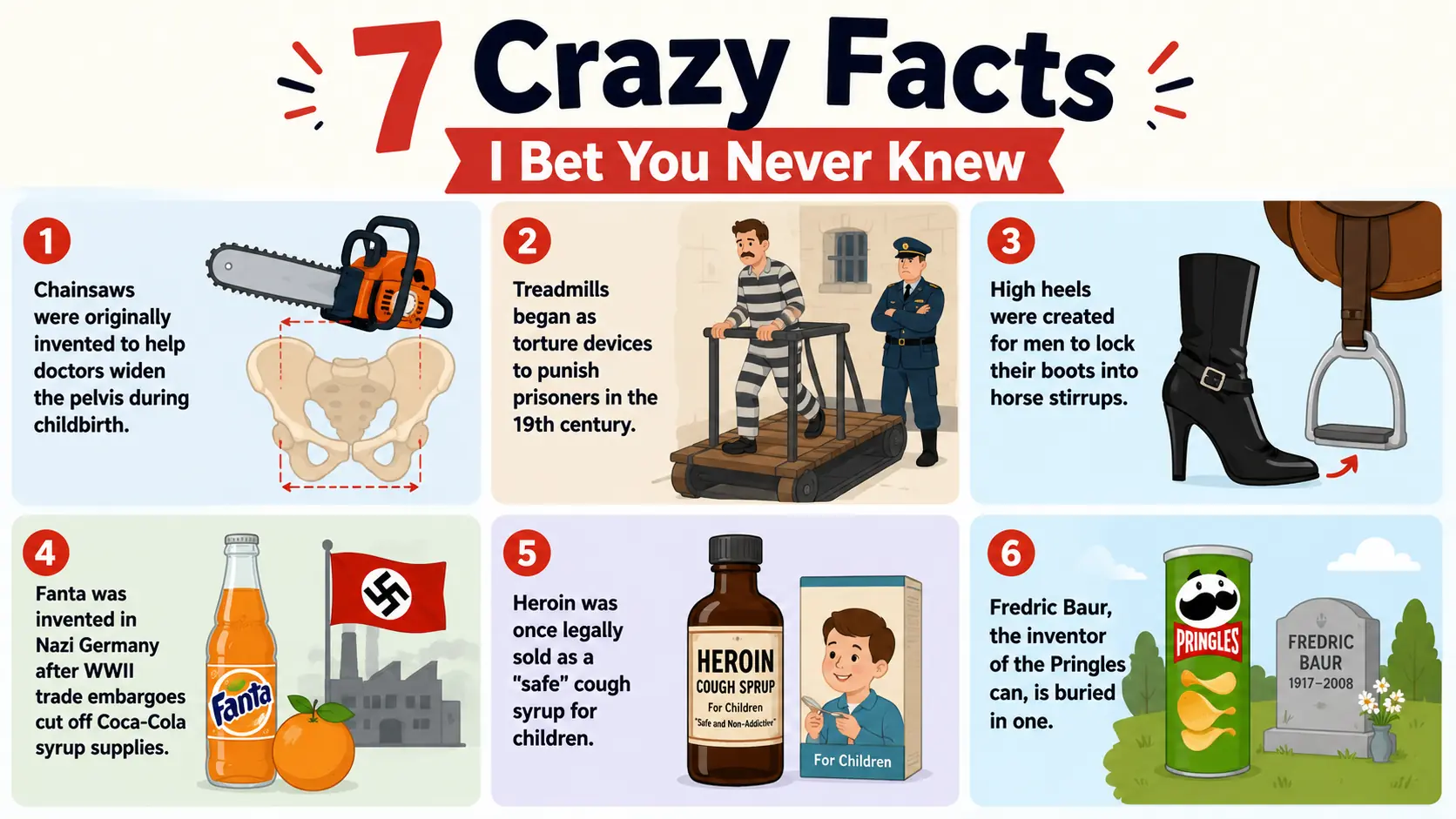
1. Chainsaws were originally invented to help doctors widen the pelvis during childbirth.
Verdict: Mostly true, but the earliest medical device looked very different from a modern chainsaw.
Before safe cesarean sections became widely available, difficult or obstructed labor could be deadly for both mother and baby. One procedure used at the time was called a symphysiotomy, in which a doctor divided cartilage and ligaments at the pubic joint to widen the pelvis.
In the late 18th century, Scottish physicians John Aitken and James Jeffray developed a small, hand-operated cutting instrument consisting of a fine chain with serrated links. It was designed to make procedures involving bone and cartilage faster than using an ordinary knife or saw.
The device was compact and manually operated. It did not resemble the large gasoline-powered chainsaws used today for cutting trees. Its chain-and-teeth mechanism, however, was an early step in the technological development that eventually led to modern chainsaws.
These obstetric procedures were dangerous and could cause hemorrhage, infection, incontinence, pelvic instability, fistulas, chronic pain, and difficulty walking. Their use declined as anesthesia, antiseptic techniques, and safer cesarean surgery developed during the 19th century.
So the viral claim captures a real and disturbing piece of medical history, but saying that the modern chainsaw was invented specifically for childbirth oversimplifies the story.
2. Treadmills began as torture devices to punish prisoners in the 19th century.
Verdict: Largely true, although they were officially designed as prison labor machines rather than solely as instruments of torture.
The penal treadmill was introduced in Britain in the early 19th century. Prisoners stood side by side on steps attached to a large rotating wheel and repeatedly climbed as the wheel turned beneath them.
Some machines used the prisoners’ effort to grind grain, pump water, or operate prison equipment. Others produced no useful work at all and existed mainly to impose exhausting, monotonous labor.
Prisoners could be forced to spend hours stepping without meaningful progress. The labor was physically punishing, mentally draining, and sometimes dangerous. People fell, suffered injuries, or collapsed from exhaustion.
Although reformers initially promoted the treadmill as a way to encourage discipline and productive labor, its painful and repetitive nature eventually made it a symbol of cruel punishment. During the second half of the 19th century, critics increasingly regarded it as an instrument of torture.
The modern exercise treadmill shares the continuous-moving concept, but today’s machines are descendants of later fitness and medical-testing equipment—not simply prison treadmills placed inside gyms.
3. High heels were created for men to lock their boots into horse stirrups.
Verdict: Broadly accurate, but “created for men” needs historical context.
Heeled footwear has existed in different forms across several cultures, so there may not be one single inventor. However, one of the most influential early uses of raised heels came from Persian cavalry.
By around the 10th century, Persian horsemen wore footwear with heels that helped secure their feet in stirrups. This offered greater stability while riding, particularly when standing in the stirrups to use weapons such as bows.
The heel was therefore practical military equipment before it became a fashion statement. When Persian diplomatic and cultural influence reached Europe around the turn of the 17th century, European aristocratic men adopted heeled shoes. Heels became symbols of military prestige, wealth, power, and elite status.
Women later adopted the fashion as well. Over time, men’s clothing became more restrained and practical, while women’s heels became taller, narrower, and more decorative.
Therefore, high heels were not originally designed exclusively as feminine footwear. Their best-known early function was connected to male cavalry and horseback riding.
4. Fanta was invented in Nazi Germany after WWII trade embargoes cut off Coca-Cola syrup supplies.
Verdict: True, with one important correction—the original German Fanta was not the same orange soda sold today.
Fanta was created in Germany in 1940 during World War II. Coca-Cola’s German operation could no longer reliably obtain the syrup and other ingredients required to make Coca-Cola because wartime trade restrictions and supply disruptions had cut the company off from its American headquarters.
Max Keith, who managed Coca-Cola’s German business, instructed employees to develop a drink using ingredients that remained available locally. The resulting beverage reportedly relied on materials such as whey and apple pomace, which were byproducts of other food-production processes.
The name came from the German word Fantasie, meaning imagination. According to the commonly repeated account, employees were encouraged to use their imagination when naming the product, leading to “Fanta.”
The original wartime drink was not the bright orange, fruit-flavored soda familiar to modern consumers. The orange version was developed in Italy during the 1950s and later became the basis for the global brand.
It is accurate to say Fanta originated in Nazi-era Germany because Coca-Cola’s local branch lacked its usual imported ingredients. However, it was primarily a commercial response to wartime shortages, not a drink developed as an official Nazi product.
5. Heroin was once legally sold as a “safe” cough syrup for children.
Verdict: Substantially true, though the wording needs nuance.
Heroin was first synthesized in the 19th century and introduced commercially by the German pharmaceutical company Bayer in 1898. It was sold legally as a pain reliever and cough suppressant.
At the time, tuberculosis, pneumonia, and other respiratory illnesses caused widespread coughing, and doctors had limited treatment options. Heroin appeared to suppress coughing effectively and was initially promoted as a powerful medication.
It was also marketed as a supposedly safer and less habit-forming alternative to morphine. That belief proved dangerously wrong. Heroin is converted in the body into morphine and can produce intense euphoria, physical dependence, respiratory depression, overdose, and addiction.
Historical advertisements and medical preparations were directed toward both adults and children, although saying it was universally sold as a bottled “children’s cough syrup” can create a misleading modern image. It was a pharmaceutical cough treatment that physicians and pharmacists could give to patients, including children, during a period when drug regulation and addiction science were far less developed.
As evidence of its addictive potential accumulated, medical enthusiasm declined and governments introduced increasingly strict controls. Today, heroin has no accepted medical use in the United States, although a pharmaceutical form called diamorphine is used under tightly controlled conditions in a small number of countries.
6. Fredric Baur, the inventor of the Pringles can, is buried in one.
Verdict: Partly true—some of his cremated remains were buried inside a Pringles can.
Fredric J. Baur was an organic chemist and food-storage technician who worked for Procter & Gamble. He helped develop the distinctive cylindrical Pringles container and received a patent connected to the package and the method used to store the uniformly shaped crisps.
Baur was reportedly so proud of the design that he told his family he wanted part of his ashes placed inside a Pringles can after his death.
When he died in 2008 at the age of 89, his family honored the request. According to accounts from his children, they stopped on the way to the funeral home to buy a can of Original Pringles. Some of his ashes were placed inside it and buried in his grave.
Not all of his remains were stored in the can. Other ashes were placed in a traditional urn, and a portion was reportedly given to one of his grandchildren.
Therefore, saying Baur “is buried in a Pringles can” is memorable but incomplete. More precisely, part of his cremated remains was buried in the package he helped create.
The Bigger Lesson Behind These Facts
These stories are fascinating because they show how dramatically an object’s meaning can change over time.
A cutting tool used in dangerous surgery evolved into machinery associated with forestry. A prison punishment became exercise equipment. Military footwear became fashion. A wartime substitute became an international soda brand. A medicine once promoted as safe became one of the world’s most feared addictive substances. A snack container became part of its designer’s unusual final request.
Viral facts often contain a core of truth, but the most interesting history usually appears when the missing context is restored. Some claims are accurate, while others become misleading when condensed into a single shocking sentence.