The first motorcycle rolled into the gravel lot of Mason's Corner Diner at 4:17 on a Thursday afternoon, followed by six more in a slow, disciplined line. Inside, forks paused halfway to mouths as the engines settled into a low thunder before dying one by one.
The riders climbed off without swagger or laughter, men and women in worn leather vests marked with small veterans' pins rather than bright club colors. At the back window, eighty-three-year-old Silas Walker kept staring at the same untouched slice of apple pie, his thin fingers resting beside a pair of faded military dog tags.
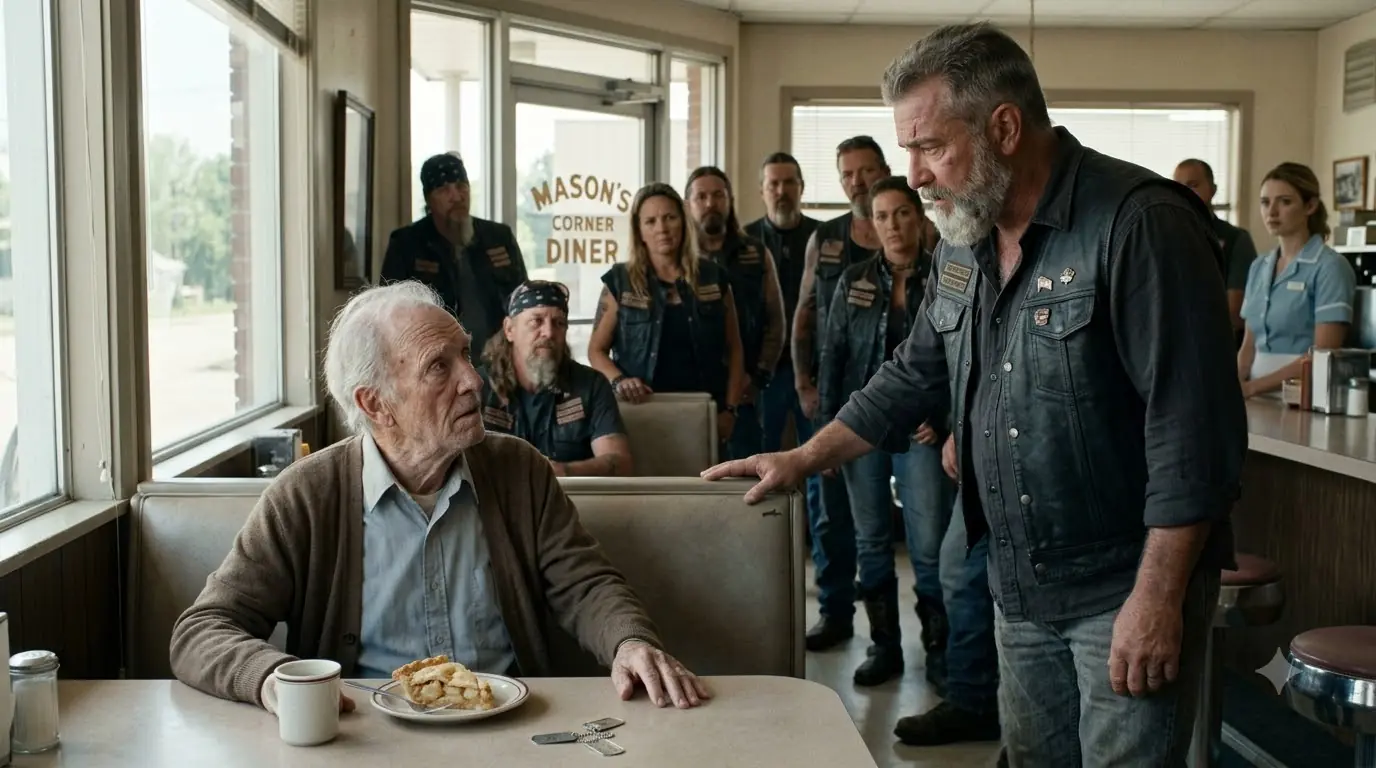
Silas came to the diner every Thursday because Thursday had once meant letters from overseas. The habit had outlived the war, his wife Margaret, most of his friends, and nearly every clear memory he had of the men whose faces still visited him in dreams. He lived three streets away in a small rented duplex filled with old newspapers, pill bottles, and cardboard boxes he had never unpacked after moving there eight years earlier. The waitress, twenty-six-year-old June Parker, knew he liked his coffee weak, his eggs overdone, and his chair facing the door even though he could no longer explain why.
When the riders entered, June noticed that the largest one was not looking around for a booth. He was a broad-shouldered man in his late fifties with a gray beard, a scar cutting through his left eyebrow, and rain-darkened denim beneath an old black vest. He carried himself like someone used to loud engines and long roads, but his hands trembled when he spotted Silas by the window. For one suspended second, the biker simply stood there while the other riders spread out behind him, quiet as a funeral procession.
His name was Elias Miller, and he had spent eleven months searching for the old man.
It had begun beside his father's hospice bed in western Pennsylvania. Jonah Miller had been eighty years old, thin from cancer and furious about dying before he could finish one last task. For most of Elias's life, Jonah had spoken sparingly about Vietnam, but one name appeared again and again in the margins of old notebooks, on the backs of photographs, and in stories told only after midnight when the house was quiet. Silas Walker was the man who had carried Jonah out of a jungle ravine while his own leg was broken and gunfire cut through the trees behind them.
Jonah had never forgotten the weight of that debt. He told Elias that Silas had dragged and carried him for nearly three miles after an ambush scattered their patrol, refusing to leave him even when the rest of the unit believed both men had been lost. Jonah survived infections, surgery, nightmares, a failing marriage, and decades of factory work because another exhausted soldier had kept saying, "One more ridge." By the time Elias was old enough to understand the story, Silas had become almost mythic in the Miller family, a name spoken with the gravity other families reserved for saints.
Yet Jonah had lost him after the war. Letters were returned, addresses changed, records vanished into bureaucratic gaps, and both men built lives while carrying memories they could not neatly explain to anyone else. Jonah tried again in the 1990s, then after the internet became common, then after retirement, but he never found the right Silas Walker among dozens of men with the same name. The one clue he protected was a heavy silver ring bearing the crest of their old reconnaissance unit, a ring Silas had once traded him for a canteen during a feverish night because Jonah had lost everything else he owned. Jonah had kept it for fifty-seven years.
Three days before he died, he pressed that ring into Elias's palm. His fingers were weak, but his voice sharpened with urgency as he told his son not to treat the search like a favor. "That man spent the rest of his strength getting me home," Jonah whispered. "If he's alive, he deserves to know I had a life because he refused to leave me." Elias promised, though at the time he had no idea how he would keep the promise.
After the funeral, Elias found a dented ammunition box under Jonah's workbench. Inside were photographs, discharge papers, yellowed envelopes, and a list of possible addresses written across thirty years. One photograph showed Jonah at twenty-two beside a taller, leaner soldier with dark hair and a crooked smile, both men standing next to a muddy transport truck. On the back, in Jonah's handwriting, were five words: SILAS WALKER, ST. LOUIS, '69.
Elias began with military records, veterans' groups, obituary databases, and old union rosters. He called strangers, drove to closed addresses, and learned more about privacy laws than he ever wanted to know. A veterans' service officer in Ohio finally found a pension record connected to a Silas E. Walker who had once lived near St. Louis before moving to a small Missouri town called Hawthorne. The trail might still have gone cold if not for a photograph posted by a local diner during a Veterans Day breakfast the previous year.
In the corner of that photograph sat a narrow old man wearing a brown cardigan and staring down at dog tags on the table. Elias enlarged the image until the pixels blurred and placed it beside Jonah's photograph from 1969. Time had folded the young soldier inward, hollowing his cheeks and whitening his hair, but the line of the nose and the slight bend in the right ear were unmistakable. Elias did not sleep that night.
He called three friends the next morning. They were all veterans or sons of veterans, men and women who rode with an informal group called the Steel Lanterns, named for the lights they carried during memorial rides. Elias told them he needed witnesses, not because he expected trouble, but because his father had spent decades searching and deserved something more solemn than a lonely knock on a stranger's door. By sunset, six riders had volunteered to cross three states with him.
The trip to Hawthorne took two days because Elias refused to rush it. They stopped at a cemetery in Indiana where Jonah's younger brother was buried, then at a roadside overlook where Elias finally admitted he was terrified Silas would not remember anything. "Then you tell him anyway," said Mae Collins, a former Army medic riding a blue Indian Scout. "Memory isn't the only place a debt can live."
By the time they reached Hawthorne, Elias had rehearsed a hundred openings. None survived the moment he saw Silas through the diner's window.
Inside Mason's Corner, the mood changed the instant the riders entered. Hawthorne was not hostile to motorcycles, but seven leather-clad strangers arriving together in a sleepy diner created its own weather. A salesman at the counter turned on his stool, two high school boys stopped sharing fries, and a mother drew her toddler closer without realizing she had done it. June Parker watched Elias cross the room toward Silas and felt the instinctive tension of a waitress who had broken up enough parking-lot arguments to recognize when strangers brought history through the door.
Silas did not look up. He was staring at his dog tags, rubbing the stamped edge of one plate with his thumb as if trying to read it through touch. Elias stopped beside the table and said his name softly. The old man blinked once but gave no sign he had heard.
"Mr. Walker?" Elias tried again. "Silas Walker?"
Silas slowly raised his eyes. Cataracts had clouded them, but there was still caution beneath the gray. "Do I know you?" he asked.
Every sentence Elias had practiced vanished. He glanced back once at the six riders and then did the only thing that felt right: he lowered himself to one knee so his face was level with Silas's. The movement startled the room more than if he had slammed a fist on the table. Several customers interpreted the closeness as intimidation, especially when Elias reached toward Silas's hand.