Six months after my mother died, my father married her best friend.
I was fourteen.
At fourteen, you don’t understand grief in a balanced way. You don’t process it gently or rationally. You feel it like a fire with nowhere to go, so it burns everything around you instead.
My mother wasn’t simply gone. She was everywhere.
Her clothes still hung in the closet. Her favorite mug remained in the kitchen cabinet. A half-used bottle of her perfume sat on the bathroom counter because no one had the courage to move it. Sometimes I opened the cap just to smell her again, then cried because the scent faded faster each time.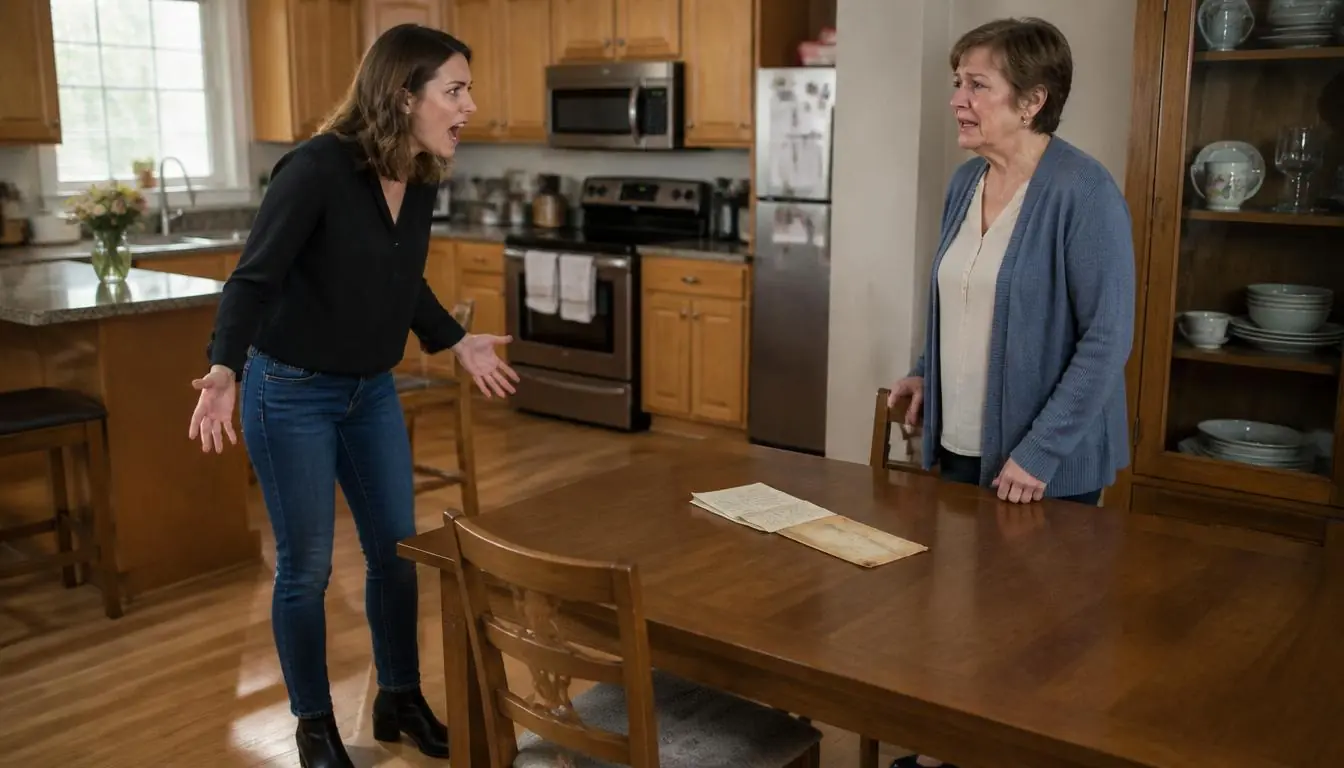
Her voice still echoed in the places where she used to stand.
“Shoes off the couch.”
“Don’t forget your lunch.”
“Come here and tell me what’s wrong.”
The morning she died, I believed nothing in our house would ever change because changing anything would feel like admitting she wasn’t coming back.
Then, six months later, another woman was sitting at the head of our table.
Her best friend, Diane.
I remembered standing in the hallway the day she moved in. Boxes covered the living room floor. Her books sat beside my mother’s books. Her winter coat hung in the closet next to one of Mom’s old raincoats.
Her things were mixed with ours as though someone had poured water into ink and decided to call the result a family.
My father looked exhausted. He had lost weight, and deep shadows had settled beneath his eyes. He had never learned how to sleep alone. Most nights, I heard him walking through the house long after midnight.
That afternoon, he tried to smile at me.
“Diane is going to help us, okay?”
I didn’t answer.
What I wanted to say was too cruel for a fourteen-year-old to say aloud, so I walked away instead.
That was the beginning of the silence.
At first, it was made of small things.
I stopped eating dinner with them. I stopped answering when Diane called my name. I stopped looking at her when she entered a room.
If she cooked spaghetti, I said I wasn’t hungry. If she washed my clothes, I pulled them from the dryer and washed them again. If she offered to drive me to school, I walked in the rain.
Then the small things became bigger.
I stopped speaking to my father too.
Not because I didn’t love him, but because every time I looked at him, I saw betrayal layered over grief. I couldn’t separate the two.
He had promised my mother forever. Then, before the first anniversary of her death, he stood in a courthouse and promised forever to someone else.
In my mind, my mother hadn’t just died.
She had been replaced.
And I decided someone had to pay for that.
Diane became the easiest person to punish.
One night, about a month after the wedding, she knocked on my bedroom door.
“Can we talk?” she asked.
I opened it only halfway.
Her eyes were red—not freshly crying, but tired from the kind of crying that never completely stopped.
“I’m not trying to replace your mother,” she said.
I laughed bitterly.
“You already did.”
The words hung between us like broken glass.
She flinched, but she didn’t leave.
“I loved her,” she said softly. “She was my best friend long before your father and she got married. Do you really think I would ever want to take her place?”
“You’re sleeping in her room.”
Her face lost its color.
“You’re wearing the robe she kept on the back of the bathroom door.”
“It was cold, and your father handed it to me. I shouldn’t have—”
“You sit in her chair. You cook in her kitchen. You act like this is your house.”
“I know what it looks like.”
“You don’t know anything.”
She lowered her eyes.
“You’re right,” she said. “I don’t know what it feels like to lose your mother.”
“I don’t care what you think.”
Then I slammed the door.
The next morning, my mother’s robe was folded neatly outside my room. Diane never touched it again.
But I didn’t notice that part then.
Grief is selective. It collects every detail that proves the world is cruel and ignores anything that might soften the story.
After that, the house became divided into invisible territories.
My side. Their side.
I spent most evenings in my bedroom. My father left food outside my door and asked through the wood if I needed help with homework. I usually waited until his footsteps disappeared before retrieving the plate.
He tried to fix things in small ways. He bought the cereal I liked. He offered to take me to the movies. He left notes on the kitchen counter reminding me that he loved me.
I threw the notes away.
Once, he sat outside my bedroom door and said, “I know you think I forgot her.”
I pressed my face into my pillow and stayed silent.
“I didn’t,” he continued. “I don’t know how to explain this in a way that won’t hurt you.”
“Then don’t,” I said.
He didn’t.
Years passed that way.
Not loud years. Not dramatic years.
Just quiet distance growing between people who once belonged to one another.
Diane attended every school event but sat in the back. When I graduated, she stood beside my father for photographs only after he asked her three times. When I left for college, she packed snacks for the drive and placed them in the trunk without mentioning them.
I found a note inside the bag.
In case you get hungry. I’m proud of you.
I crumpled it and shoved it into the glove compartment.
I didn’t throw it away.
That should have told me something.
During college, I came home only when necessary. At Christmas, I stayed two nights. During the summers, I found jobs near campus. I called my father on his birthday and avoided speaking to Diane whenever she answered.
Still, she sent cards.
She never signed them “Mom.” She never wrote “love” unless it was followed by her own name.
Thinking of you, Diane.
Proud of you, Diane.
Here if you need anything, Diane.
She seemed to understand that even affection could feel like trespassing.
I grew older, but my anger didn’t grow up with me. It remained the same age it had been when it was born.
Fourteen.
Frozen.
Sharp.
Safe.
Anger became the final thing I shared with my mother. Letting it go felt like betraying her all over again.
Then I got engaged.
Ethan proposed in our apartment on an ordinary Tuesday night. He had planned candles and music, but the fire alarm went off because he burned the dinner. We ended up laughing on the sidewalk while firefighters inspected the building.
When he asked me to marry him again, holding the ring beneath flashing red lights, I said yes.
I called my father the next morning.
He cried.
Diane sent flowers with a card that read, Your mother would be so happy for you.
I stared at that sentence for a long time.
Part of me resented her for invoking Mom. Another part recognized that Diane had known my mother as a young woman, before illness and hospitals, before I was old enough to remember her as anyone except my mother.
Wedding planning should have been happy, but it opened every wound I had carefully covered.
Choosing a dress reminded me that Mom wasn’t there to see it. Discussing the father-daughter dance made me think about the years Dad and I had barely spoken. Every mention of family brought back the question I had spent half my life avoiding:
What was Diane to me?
She never asked to participate. She didn’t offer opinions about flowers or food. She came to the bridal shower, brought a gift, and sat near the edge of the room.
When someone mistakenly called her my mother, she corrected them immediately.
“I’m her stepmother,” she said. “Her mother passed away when she was young.”
There was no claim in her voice. No attempt to take a title that wasn’t hers.
For the first time, I wondered how many times she had made that correction over the years.
A week before the wedding, she called me.
“Could we meet alone?” she asked.
My first instinct was to refuse, but something in her voice made me agree.
We met at my father’s house in the same kitchen where I had once slammed cupboards and refused meals. The cabinets had been repainted, but my mother’s mug still sat in its old place.
Diane stood near the table for a long time without speaking.
Then she said, “There’s something I should have given you years ago.”
My stomach tightened.
“What is it?”
She opened her bag and pulled out an old envelope. The paper was worn and creased, as though it had been held and reopened countless times.
My name was written across the front.
I recognized the handwriting immediately.
My mother’s.
My breath stopped.
I didn’t take the envelope at first. My hands began trembling before I even touched it.
“She wrote this before she died,” Diane said.
I looked up sharply.
“You’ve had a letter from my mother all this time?”
“Yes.”
“Why didn’t you give it to me?”
Her eyes filled with tears, but her voice remained steady.
“Because she asked me to wait until you were ready.”
“How were you supposed to know when I was ready?”
“I didn’t. That was the problem.”
Anger rose in me with shocking speed. For one moment, I was fourteen again.
“You had no right to keep this from me.”
“I know.”
“That belonged to me.”
“I know.”
“You watched me suffer, and you kept her words hidden in a bag?”
Diane absorbed every accusation without defending herself.
Finally, she said, “If I had given it to you then, you would have believed I was using your mother’s words to justify marrying your father. And you would have been right to wonder.”
I stared at her.
She pushed the envelope toward me.
“I needed you to hate me a little less before I could give it to you without making it about me.”
I opened it carefully.
The letter was several pages long, written in the uneven handwriting Mom had developed near the end of her illness.
My love,
If you are reading this, I am gone.
I know you will hurt. I know you will be angry. I know you will try to make sense of things that will never feel fair. I wish I could take that pain with me, but I cannot.
Please listen carefully.
Your father will not know how to survive without support. Neither will you, though you may insist otherwise.
There is someone I trust more than anyone else in this world. Diane has known me through every version of myself—the foolish girl, the frightened new mother, the woman who became sick before she was ready.
She is not your replacement. She is not my replacement. She is simply someone who will try to hold what is left together when I cannot.
Please don’t punish her for staying.
Please don’t punish your father for needing another human being beside him.
And please don’t let your pain become something that destroys the family I loved more than my own life.
If Diane is still there years from now, understand that she stayed knowing you might never love her for it. That kind of staying is its own kind of love.
My vision blurred.
I read the pages again.
Then a third time.
Each reading felt heavier—not because it changed the past, but because it changed how I understood it.
When I looked up, Diane was crying silently.
“I didn’t want to use her letter against you,” she said. “I didn’t want to force you to accept me because your mother asked you to.”
“So all this time, I was wrong?”
She shook her head immediately.
“No. You were grieving. Grief doesn’t think clearly. It protects itself.”
I looked down at the envelope.
“There’s something else inside,” she said.
I reached into it and found a small brass key taped beneath the final page.
“What is this?”
“The key to the safe-deposit box your mother opened before she died.”
I stared at her.
“Your father doesn’t know about it,” Diane continued. “Your mother asked me to keep the key until your wedding.”
The next morning, Diane and I went to the bank together.
Inside the box was my mother’s wedding veil, a small collection of photographs, and the pearl necklace she had worn when she married my father. Beneath them sat a bundle of letters—one for my graduation, one for the day I became a parent, and one marked For the day you forgive yourself.
But the final document was the real twist.
It was a notarized statement written by my mother.
In it, she explained that Diane had not started a relationship with my father before her death. Mom had asked Diane to help him after she was gone, but she had never asked them to marry. That had happened later, after months of shared grief, practical emergencies, and two lonely adults trying to keep a household from collapsing.
Mom had anticipated exactly what I would believe.
If your father and Diane someday find comfort in each other, please do not assume it began while I was alive. I know them both. Guilt may make them hide their feelings, and their silence may look like proof of something ugly. But silence is not always deception. Sometimes it is simply shame mixed with grief.
I lowered the paper.
“Why didn’t Dad tell me any of this?”
Diane looked toward the locked door of the viewing room.
“Because he believed it would sound like an excuse. And because your mother’s last months were private. She didn’t want you remembering her as someone arranging everyone’s future from a hospital bed.”
Then Diane told me something I had never known.
After Mom died, my father stopped eating. He missed work, forgot bills, and once left the stove burning. I had been so consumed by my own grief that I hadn’t understood how badly he was unraveling.
Diane came by to bring groceries and help with paperwork. She drove me to appointments I assumed my father had arranged. She contacted my teachers when my grades collapsed. She paid our overdue electric bill from her own savings because Dad couldn’t find the checkbook.
And three weeks before the courthouse wedding, Diane had tried to leave.
“She thought marrying me would cost her any chance of having a relationship with you,” my father told me later. “I begged her to stay.”
He hadn’t replaced my mother in six months.
He had been drowning, and Diane was the person who jumped into the water—even though I spent years blaming her for the storm.
That night, I didn’t sleep.
For the first time in years, I wasn’t angry. I felt empty in a different way, as if something heavy had been lifted but left an ache where it had rested.
I thought about the meals outside my door, the cards signed carefully with her name, the graduation ceremony where she sat in the back.
Diane had spent years loving me in ways small enough not to frighten me.
She had never asked to be called Mom.
She had only refused to disappear.
On my wedding day, I wore my mother’s pearl necklace.
Everything felt unreal—the music, the flowers, the laughter—but my attention kept returning to the people who had shaped my life in ways I had never fully understood.
My father sat in the front row, older now, his hands trembling as he tried not to cry.
Beside him, Diane sat perfectly still. She wasn’t trying to be noticed. She wasn’t trying to perform a role.
When Dad’s hands began shaking, she gently adjusted his sleeve and placed her hand over his.
She looked less like a woman who had taken someone else’s place and more like a person who had made a promise to remain beside a grieving family, even after that family had given her every reason to leave.
After the ceremony, I found her standing alone outside.
For a moment, neither of us spoke.
Then I said, “I was wrong about you.”
She looked at me carefully.
“No,” she said. “You were a child who lost her mother and didn’t know where to put the pain.”
“I put it on you.”
“I was an adult. I could carry it for a while.”
“For a while? I made you carry it for years.”
Her face crumpled slightly.
“I loved your mother,” she whispered. “And I grew to love you. I just didn’t know if I would ever be allowed to say that.”
I stepped forward and hugged her.
She froze.
Then her arms closed around me carefully, as though something fragile had finally been given permission to exist between us.
She didn’t smell like my mother.
She didn’t feel like my mother.
And for the first time, I understood that she had never needed to.
Later, during the reception, I changed the order of the dances. After dancing with my father, I asked Diane to join us.
She shook her head at first, overwhelmed.
I held out my hand.
“You stayed,” I said. “Please let me thank you for staying.”
She took it.
The three of us stood together beneath the lights—not as the family we had once been and not as a replacement for what we had lost, but as the family grief had reshaped.
That day taught me something I wish I had understood sooner:
Not every painful story has a villain.
Sometimes people arrive in the middle of someone else’s grief and choose to stay anyway. They stay when they are misunderstood. They stay when their kindness is rejected. They stay even when no one thanks them.
I could never recover the years anger had taken from us. Forgiveness didn’t rewrite the past, and understanding Diane did not make me miss my mother any less.
But healing wasn’t about choosing one woman over the other.
Loving Diane did not betray my mother.
It honored the person my mother had trusted to remain when she could not.
And sometimes healing doesn’t feel like a dramatic apology or a perfect reunion.
Sometimes it feels like wearing your mother’s pearls while holding the hand of the woman who protected them for you.
Sometimes it feels like finally being able to breathe in a house where you once held your breath for far too long.