They say you don't disappear all at once. It happens slowly, car by car, person by person, until one day you're standing in plain sight and no one can see you. This is the story of Evelyn Ruth Hawthorne, 60 years old, a widow, a mother, a woman who spent 3 months learning what it feels like to become invisible. And one February afternoon when the temperature dropped to 8° below zero, and she found herself standing at a bus stop counting cars. 47 of them. 47 people who looked at her and kept driving. 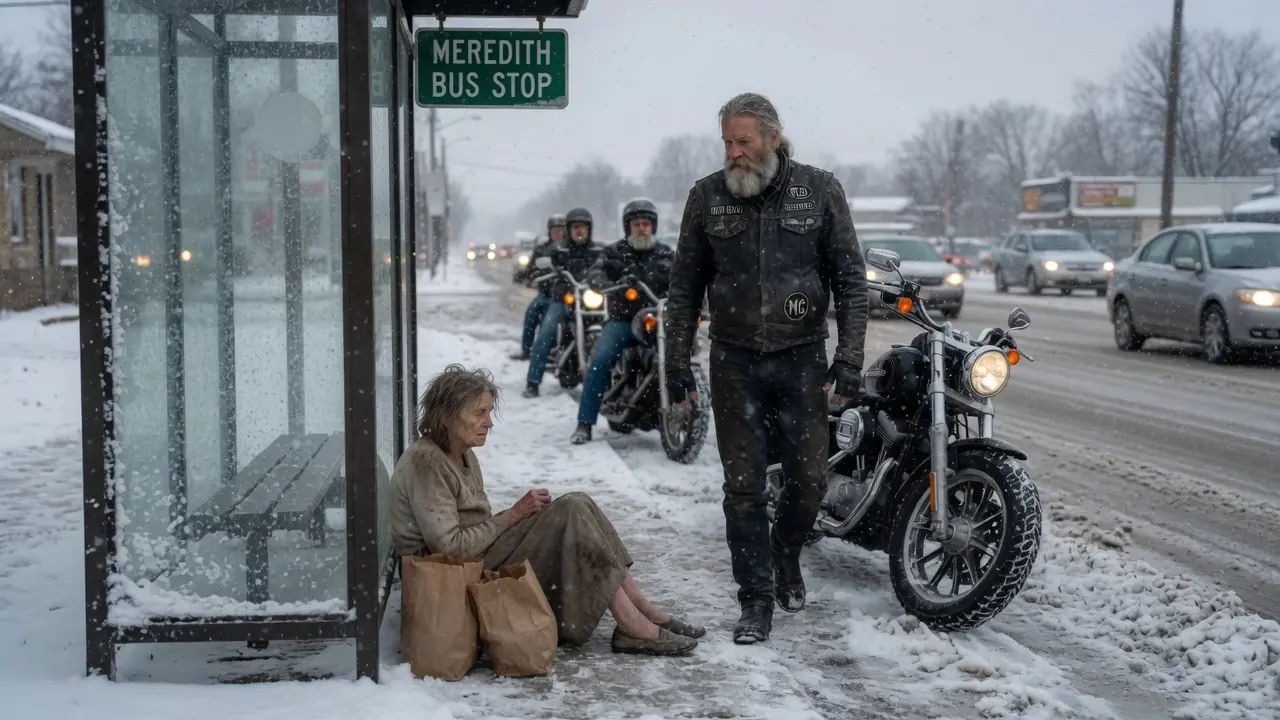
Before we get to that bus stop, before we watch the world make its decision about Evelyn, you need to understand what she had already survived, because that changes everything. This story happens in the dead of winter. February 13th, 2024. When the trees are bare and the sidewalks are gray and the cold comes in off the open land with nothing to stop it. The streets of Meredith were built for people who knew each other.
Wide enough to wave from across the road. Lined with houses that once had front porches where neighbors sat in the evenings and watched the neighborhood breathe. There was a time not so long ago when you couldn't walk two blocks without someone calling your name. When a new family moving in meant casseroles at the door and introductions at the fence line. When the hardware store owner knew your father and the woman at the post office knew your children's grades.
That time didn't disappear overnight. It faded the way most things fade. Slowly. Quietly. In such small increments that nobody could point to the moment it changed. People got busier. Porches became garages. Evenings moved indoors and then moved on to screens. The neighborhood didn't become unfriendly. It became something quieter and in some way sadder than unfriendly. It became indifferent. Not out of cruelty. Never out of cruelty. Just out of the weight of everyone having somewhere else to be and something else to look at and not quite enough left over at the end of the day to look up and check on the person standing next to them.
She stayed because this town was hers in the way that only a place you've truly lived in can be yours, not owned. Lived in. There's a difference. She's the kind of woman who still writes birthday cards by hand in cursive and mails them three days early so they arrive on time. She keeps a small dish of hard candy near her front door, the old-fashioned kind wrapped in cellophane, because she likes to have something to offer when people stop by. And she believes people should always feel welcome when they come to your door.
She knows the names of her neighbor's grandchildren. She remembers the anniversary of her pastor's marriage. She sends flowers, actual flowers from an actual florist, when someone in her circle loses someone they love. And she is proud. That's perhaps the most important thing to understand about Evelyn. Not in a small way, in a way that runs through her like a spine. She was raised to handle her own difficulties quietly and without complaint. To ask for help only when there was truly no other option.
To never under any circumstances be a burden on the people around her. This pride has served her well for 60 years. It has made her strong and self-sufficient and deeply capable. It has also, on one particular morning 3 months before our story begins, led her directly into danger. November 15th, 2023, 2:15 in the afternoon, a Sunday. Evelyn was walking back to her car in the Target parking lot. She'd been inside for 20 minutes.
Dish soap, paper towels, the ordinary supplies of an ordinary life. She was carrying one bag, not heavy, nothing she couldn't manage. There was a slight rise in the pavement where the concrete met the asphalt, a lip maybe half an inch high, the kind of thing you'd step over a thousand times without noticing. This time her foot caught it. She went down hard, not a stumble, a fall, the kind where your center of gravity shifts so suddenly that there's no time to catch yourself.
Her right wrist took the impact first, then her hip, then her shoulder. She lay there on the cold asphalt, stunned, winded, pain shooting up her arm. And she could not get up. She tried, pushed with her left hand, but her right wrist wouldn't bear weight, and her hip felt like someone had driven a spike through it. And she was 60 years old lying in a Target parking lot at 2:15 on a Sunday afternoon. And she started counting.
Not because she planned to, but because her mind needed something to do while she lay there trying to understand why nobody was stopping. Person number one, a teenager, maybe 17, walking past with his phone in his hand. He glanced down at her, made eye contact, then looked away and kept walking. Person number two, a woman in her 30s, yoga pants, coffee cup. She saw Evelyn. Evelyn saw her see.
The woman's pace quickened slightly. She walked past. Person number three, four, and five, a family, mother, father, two children. The little boy maybe 6 years old pointed. "Mommy that lady fell." Evelyn heard it clearly. The mother took the boy's hand and pulled him along. "Stay away from strangers honey." They kept walking.
Person number six, seven, eight, nine. Don't. 10. Evelyn stopped trying to make eye contact. She just counted. 11, 12, 13. An elderly man maybe 70. He stopped, looked down at her and for a moment for just one moment Evelyn thought he was going to help. Their eyes met. She could see him thinking, making some calculation in his head. Then he shook his head slowly and walked away.
14, 15, 16, 17, 18, 19, 20, 21, 22, 23. 11 minutes and 43 seconds. That's how long she lay there. She counted the seconds too. Because her mind needed the occupation. Needed something to focus on besides the growing certainty that she had become the kind of person that people step around. At 11 minutes and 43 seconds a man in a security uniform approached. George Patterson. 67 years old. 20 years working security at this Target.
He knelt down beside her. "Ma'am you all right? Let me help you up." His voice was kind, concerned. The first human voice directed at her in nearly 12 minutes. He helped her to her feet slowly, carefully. Asked if she needed an ambulance. She said no. Pride kicking in even through the pain.
He walked her to her car, made sure she could drive, offered to call someone. She thanked him, told him she was fine, got in her car and drove home. And she told no one. Not her daughter Nora who lived 90 miles away in Columbus and called twice a week. Not her son Benjamin who lived in Portland, Oregon and called once a month when he remembered. Not her pastor. Not her friends from church. Not a single soul because telling someone would mean admitting what had happened.
And admitting what had happened would mean confronting what those 11 minutes and 43 seconds actually meant. That 23 people had looked at her and decided she wasn't worth the trouble. That she had become in some fundamental way dismissible. That the world had looked at Evelyn Ruth Hawthorne, 60 years old, lying on the ground, unable to get up. And the world had said, "Not my problem."
And if she told someone, they might agree with that assessment. They might decide she couldn't take care of herself anymore. That she needed supervision. Management. That it was time to start having conversations about assisted living and someone checking in on her daily and all the other things that happen when the world decides you're no longer capable of managing your own life. So, she said nothing.
She went home that November afternoon and she iced her wrist and she took some aspirin and she sat in her living room in the house she'd shared with Robert for 24 years before cancer took him in October of 2016. And she made a decision. Not consciously. Not all at once. But a decision nonetheless. She would ask for less. Need less. Take up less space in the world.
Because the world had made it clear that was what it wanted from her. Over the next 3 months, November through early February, Evelyn Ruth Hawthorne began to disappear. She stopped accepting invitations. Beverly Thompson from church called in late November. The ladies auxiliary was having a potluck. They'd love to see her there. Evelyn made an excuse. Too much to do. Maybe next time.
There was a Christmas party at the community center. She'd gone every year there for a decade. This year she stayed home. Margaret Richardson, her closest friend from the neighborhood, invited her over for coffee three times in December. Three times Evelyn said she was busy. The fourth time Margaret stopped asking. She called Nora less. Used to be twice a week. By January it was once every two weeks.
And the conversations got shorter. More surface. How are you? Fine. How are the grandchildren? Fine. Everything fine. Nothing worth mentioning. Nothing worth burdening anyone with. She stopped going to the weekly book club she'd attended for 8 years. Just quietly stopped showing up. Nobody called to ask why. Or maybe they did and she didn't answer.
The line between the two possibilities blurred. She was making herself smaller. Quieter. Less present. And the terrifying thing was how easy it was. How little resistance the world offered. How quickly people accepted her absence as the new normal. By early February Evelyn had developed a belief. Not a thought. A belief. The kind that sits deeper than conscious awareness.
The kind that shapes every decision you make without you realizing it's there. The belief was this. I don't matter enough to inconvenience anyone. And on February 13th, 2024 that belief nearly killed her. She woke at 6:30 that morning, Tuesday. The sky outside still dark. She made coffee. One cup. She used to make a full pot when Robert was alive. Now she measured out exactly enough for one cup because wasting seemed wrong and drinking more than she needed seemed indulgent.
She sat at her kitchen table and looked out the window at the driveway. At her 1998 Honda Civic. Blue. 212,000 miles. It had been making a clicking sound for 3 weeks. She'd been meaning to take it in. Kept putting it off. There was always something else more pressing. At 7:45 she put on her coat. The navy one that had been Robert's. She'd kept it after he died. It was too big on her, but she liked the weight of it. The way it felt like being held.
She grabbed her purse, checked her phone, Nokia flip phone from 2010, battery at 43%. Good enough. She picked up her keys and walked out to the driveway. Turned the key in the ignition. Nothing. Tried again. Click. Click. Click. Nothing. The battery was dead, completely dead.
She sat there for a moment, hand still on the key, trying to decide what to do. She could call Nora, ask her to drive up from Columbus, 90 miles, 3 hours round trip, take Evelyn to the grocery store and back, or she could call a tow truck, get the car jumped or towed to a mechanic. But that meant calling someone, asking for help, becoming someone's problem for the day.
Or she could walk. The Kroger was a mile and a half away. She walked it before, years ago, 2014 when her car had been in the shop for a week. She remembered it being manageable. A nice walk, actually. Good exercise. She needed groceries anyway. The refrigerator was down to one egg and some milk that was starting to turn. She'd been putting off this trip for 2 days already. Walking seemed reasonable. Walking seemed like something she could do without bothering anyone.
She went back inside, put on a second layer, found her purse again, checked the cash in her wallet. $63, plenty. She looked around for her gloves, couldn't find them. They were on the kitchen counter, but she was already focused on getting out the door, and she missed them completely. She looked at the photo of Robert on the mantel, taken in 2008, a camping trip in Michigan. He was smiling, sunburned, happy.
"You'd tell me this is a bad idea, wouldn't you?" She said it out loud, to the empty house, to the photo, to the ghost of a man who used to worry about her walking alone. Then she opened the door and stepped out into a Tuesday morning that looked from inside her warm kitchen like something she could handle. It was 8:00 in the morning when she started walking. The air was cold, but still. No wind yet. The sidewalks were mostly clear. Some patches of ice in the shaded spots, but nothing she couldn't navigate carefully.
She walked at a steady pace. Not fast, not slow. The pace of a woman who's walked a thousand miles in her life and knows how to measure her energy. The streets were quiet, a few cars passing, people heading to work. Nobody she recognized. Or if she did, they didn't recognize her. Or they recognized her and didn't wave. Hard to say which.
She reached Kroger at 9:15. 75 minutes. Longer than she'd expected, but fine. Manageable. She was a little out of breath, but that was just age. Just the cold. Nothing to worry about. Inside the store was warm. She took her time. Filled her basket slowly. Bread, milk, eggs, a small chicken, vegetables that would keep. She paid in cash. Thanked the cashier by name.
The walk home started fine. The temperature had risen a few degrees. The wind was still light. She felt accomplished. Independent. Then the wind picked up. It came across the open fields on the edge of town like something with teeth. It cut through her coat, through the second layer, straight to skin. Her hands went numb first. Then her face. Then her feet. She kept walking.
The grocery bags grew heavier with every block. The cold settled deeper. By the time she reached the halfway point her steps had slowed. Her breathing was shallow. She told herself it was just the wind. Just the distance. She would be home soon. She would make tea. She would warm up. Everything would be fine.
The first car that passed didn't slow. The second didn't either. By the time she reached the bus stop on Maple Street she had been walking for nearly two hours. The temperature had dropped again. Her body was shaking. She set the bags down and stood under the shelter, counting cars. Forty-seven. Forty-seven cars passed. Forty-seven people who saw a 60-year-old woman standing in the cold with grocery bags and kept driving.
She wasn't waving. She wasn't asking. She was simply there. Visible. And invisible at the same time. The 48th vehicle was a motorcycle. Then another. Then three more. Five motorcycles in total pulled over. Men in their 40s and 50s, leathers worn from real miles, faces weathered by real winters. They didn't ask many questions. They saw what needed doing and did it.
One took her bags. Another offered his jacket. They got her onto the back of one of the bikes and rode her the last half mile home. They carried her groceries inside. They made sure she was warm. They stayed until the color came back to her face and her hands stopped shaking. They left their numbers. They said call if she needed anything. Anything at all.
Evelyn sat in her kitchen that night with a cup of tea and the quiet knowledge that five strangers on motorcycles had seen her when 47 cars had not. The next morning she called Nora. Really called her. Told her the truth about the fall. About the winter. About the disappearing. Nora cried. Benjamin flew home that weekend. The church ladies showed up with casseroles. Margaret Richardson came for coffee and stayed for hours.
The world hadn't stopped caring. It had simply been waiting for her to stop disappearing. Evelyn Ruth Hawthorne never became invisible again. She learned that sometimes the kindest thing you can do is let yourself be seen. And sometimes the people who see you are the ones you least expect. Five men on motorcycles changed everything. Not because they were heroes in some grand story. But because they stopped.
Because they looked. Because they decided one cold afternoon that a woman standing at a bus stop was worth their time. And in doing so they reminded an entire town, and one woman in particular, what it means to pay attention. The kind of attention that saves lives. The kind that brings people back from the edge of disappearing. The kind that proves good people are still everywhere.
Even in towns nobody writes songs about. Even in February when the cold tries to take everything. Even when the world has almost convinced you that you don't matter. You do. And sometimes all it takes is five people on motorcycles to remind you.